The kinetic-energy bottleneck in Fast Radio Burst models
Pith reviewed 2026-06-25 22:26 UTC · model grok-4.3
The pith
A kinetic-energy bottleneck rules out external and reconnection models for fast radio bursts.
A machine-rendered reading of the paper's core claim, the machinery that carries it, and where it could break.
Core claim
Most Fast Radio Burst models invoke a two-step process in which energy released by the central engine is converted into particle kinetic energy and only subsequently radiated as coherent GHz emission. Model-independent constraints are derived on the density, size, and particle Lorentz factor of the emitting region. Inner-magnetospheric models operating near the neutron-star surface and incorporating continuous particle acceleration remain the most promising FRB emission scenario, subject to successful wave escape from the magnetosphere.
What carries the argument
The two-step kinetic-energy conversion process that imposes model-independent brightness-temperature and kinetic-luminosity constraints on the emitting plasma parameters.
If this is right
- Inner-magnetospheric models can be powered by magnetar-strength fields that supply parallel electric fields out to radii of about 10^10 cm when continuous acceleration is present.
- Monster-shock scenarios demand particle densities exceeding the Goldreich-Julian value by at least 10^12, shifting the maser peak to frequencies above 1000 GHz.
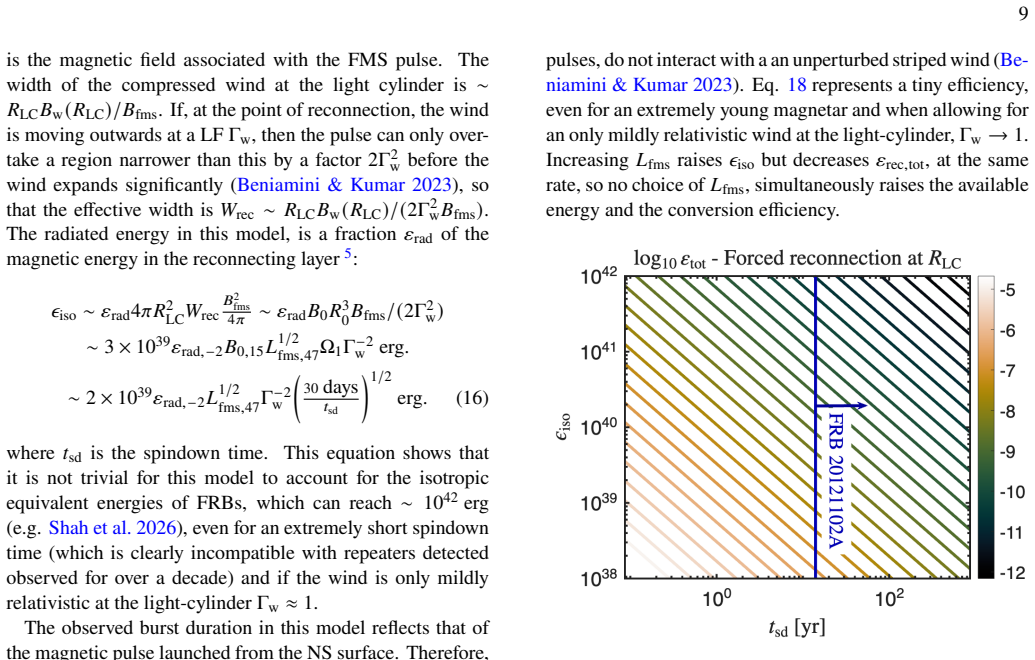
- Forced reconnection at the light cylinder radiates at most 10^-6 of the injected energy in radio waves from the compressed layer.
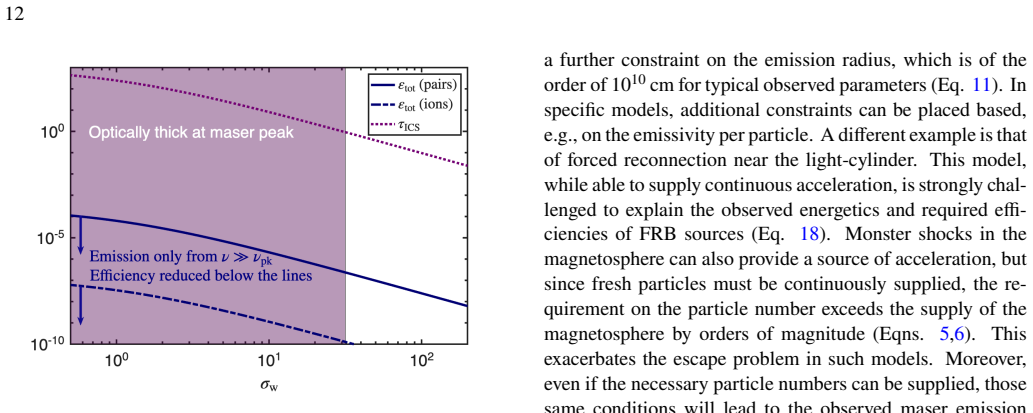
- External-shock maser models remain optically thick to induced Compton scattering independent of the model's main parameters.
Where Pith is reading between the lines
- If wave escape from the magnetosphere turns out to be inefficient, mechanisms that bypass the kinetic-energy step entirely would become necessary.
- Polarization and spectral measurements could directly test whether continuous acceleration occurs close to the neutron-star surface.
- Searches for associated high-energy or gravitational-wave signals could distinguish surface emission from more distant sites.
Load-bearing premise
That every viable FRB emission mechanism must first convert central-engine energy into particle kinetic energy before radiating it as coherent radio waves.
What would settle it
Detection of an FRB whose inferred emitting-region parameters violate the derived kinetic-luminosity or brightness-temperature limits in the absence of continuous in-situ acceleration.
Figures
read the original abstract
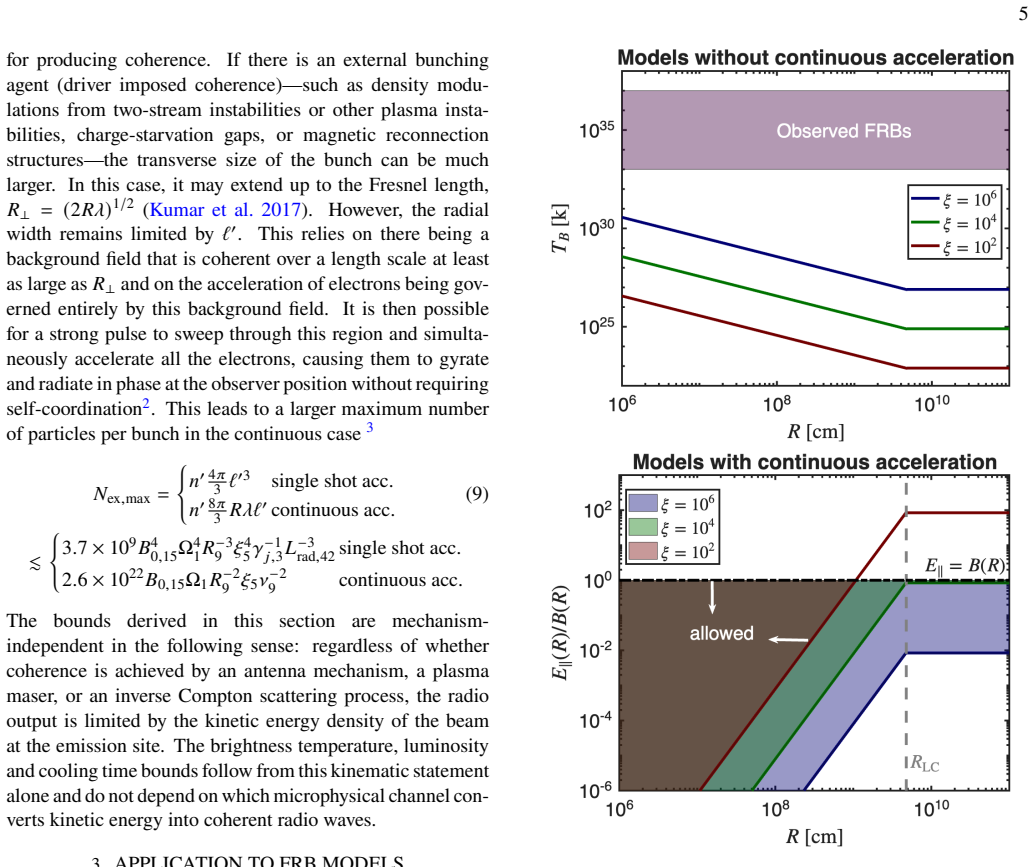
Most Fast Radio Burst (FRB) models invoke a two-step process in which energy released by the central engine is converted into particle kinetic energy and only subsequently radiated as coherent GHz emission. We derive model-independent constraints on FRB emission mechanisms and use them to infer the density, size, and particle Lorentz factor of the emitting region. We assess the implications for the three main classes of FRB models. (i) Inner-magnetospheric models violate brightness-temperature and kinetic-luminosity constraints unless particles are continuously re-accelerated in situ. Magnetar-strength magnetic fields can supply the required parallel electric field out to $R\lesssim10^{10} \mathrm{cm}$ with additional, model-dependent constraints. The monster-shock scenario provides such continuous acceleration, but requires particle densities exceeding the Goldreich-Julian value by $\gtrsim 10^{12}$, shifting the maser peak to $\gtrsim10^3$ GHz for typical FRB luminosities. (ii) Light-cylinder-scale forced-reconnection provides continuous particle acceleration but the radio energy emitted from the compressed reconnection layer is typically only $\lesssim10^{-6}$ of the injected energy. (iii) External-shock maser models satisfy kinetic-luminosity and brightness-temperature constraints. However, we show that the upstream wind is unavoidably optically thick to induced Compton scattering, independent of the model's principal parameters. Proposed escape routes - emission above the maser peak or upstream magnetization $\sigma_{\rm w}\gtrsim30$ - lead to tiny efficiencies, while the former also conflicts with narrow FRB spectra. We conclude that magnetospheric models operating near the neutron-star surface and incorporating continuous particle acceleration remain the most promising FRB emission scenario, subject to successful wave escape from the magnetosphere (discussed in the Introduction).
Editorial analysis
A structured set of objections, weighed in public.
Referee Report
Summary. The manuscript argues that most FRB models follow a two-step process in which central-engine energy is first converted to particle kinetic energy before coherent GHz radiation. It derives constraints on emitting-region density, size, and Lorentz factor from brightness temperature and kinetic luminosity, then applies them to three model classes: (i) inner-magnetospheric scenarios require continuous in-situ re-acceleration (possible with magnetar B-fields out to ~10^10 cm); (ii) light-cylinder forced reconnection yields radio efficiency ≲10^{-6}; (iii) external-shock masers satisfy kinetic-luminosity and brightness-temperature limits but the upstream wind is optically thick to induced Compton scattering independent of principal parameters. Escape routes (emission above the maser peak or σ_w ≳30) produce low efficiencies or conflict with narrow spectra. The paper concludes that magnetospheric models near the neutron-star surface with continuous acceleration are the most promising, subject to wave escape.
Significance. If the two-step premise and the claimed parameter-independent optical-depth result hold, the work supplies a compact set of fundamental limits that can be used to rank FRB emission scenarios and to identify the minimal additional physics (continuous acceleration, wave escape) required in the favored class. The explicit efficiency penalties attached to proposed loopholes for external shocks add concrete, testable implications for future modeling.
major comments (2)
- [Abstract] Abstract: The derivation of 'model-independent constraints' rests on the premise that viable models convert central-engine energy into an intermediate particle kinetic reservoir before radiation. The abstract itself qualifies this as applying to 'most' models. If mechanisms exist that radiate directly from magnetic energy without populating such a reservoir, the constraints and the subsequent ranking (favoring inner-magnetospheric models) do not apply. This assumption is load-bearing for the central comparative claim.
- [Abstract] Abstract (external-shock paragraph): The assertion that the upstream wind is 'unavoidably optically thick to induced Compton scattering, independent of the model's principal parameters' is presented without an explicit inequality or derivation showing that τ_IC > 1 for every combination of luminosity, frequency, Lorentz factor, and density consistent with observed FRB properties. The independence claim is central to ruling out this class and therefore requires the supporting algebra to be shown.
Simulated Author's Rebuttal
We thank the referee for their careful reading and insightful comments on our manuscript. We address each of the major comments below, providing clarifications and indicating where revisions will be made to improve the presentation.
read point-by-point responses
-
Referee: [Abstract] Abstract: The derivation of 'model-independent constraints' rests on the premise that viable models convert central-engine energy into an intermediate particle kinetic reservoir before radiation. The abstract itself qualifies this as applying to 'most' models. If mechanisms exist that radiate directly from magnetic energy without populating such a reservoir, the constraints and the subsequent ranking (favoring inner-magnetospheric models) do not apply. This assumption is load-bearing for the central comparative claim.
Authors: The manuscript focuses on the predominant class of FRB models that do invoke a two-step process involving particle kinetic energy. The abstract qualifies the constraints as applying to 'most' models to reflect this. Mechanisms that radiate directly from magnetic energy without an intermediate kinetic reservoir would indeed not be subject to these constraints. However, such direct-conversion scenarios are not the primary focus of the current FRB modeling efforts we address. We will revise the abstract to more explicitly state the scope of applicability to two-step models and note that direct magnetic radiation pathways are outside the present analysis. revision: partial
-
Referee: [Abstract] Abstract (external-shock paragraph): The assertion that the upstream wind is 'unavoidably optically thick to induced Compton scattering, independent of the model's principal parameters' is presented without an explicit inequality or derivation showing that τ_IC > 1 for every combination of luminosity, frequency, Lorentz factor, and density consistent with observed FRB properties. The independence claim is central to ruling out this class and therefore requires the supporting algebra to be shown.
Authors: The full text of the manuscript provides the derivation of the induced Compton optical depth, demonstrating its independence from the principal parameters within the range consistent with FRB observations. To make this more prominent and directly responsive to the comment, we will add the key inequality τ_IC > 1 and a brief outline of the derivation to the abstract in the revised manuscript. revision: yes
Circularity Check
No circularity: constraints derived from standard observables under explicit premise
full rationale
The paper states its central premise upfront as an assumption applying to most (but not necessarily all) FRB models and then applies standard brightness-temperature and kinetic-luminosity limits to obtain conditional constraints on density, size, and Lorentz factor. No equations reduce a derived quantity to a fitted parameter by construction, no load-bearing step rests on a self-citation chain, and no ansatz or uniqueness result is smuggled in from prior work by the same authors. The model ranking follows directly from applying these external physical bounds to each scenario class, rendering the derivation self-contained.
Axiom & Free-Parameter Ledger
axioms (2)
- domain assumption FRB models follow a two-step energy conversion from central engine to particle kinetic energy then to coherent radiation
- standard math Standard expressions for brightness temperature, kinetic luminosity, and induced Compton optical depth apply to the FRB emitting plasma
Reference graph
Works this paper leans on
-
[1]
2020, MNRAS, 499, 2884, doi: 10.1093/mnras/staa2612
Babul, A.-N., & Sironi, L. 2020, MNRAS, 499, 2884, doi: 10.1093/mnras/staa2612
-
[2]
Baring, M. G., & Harding, A. K. 2001, ApJ, 547, 929, doi: 10.1086/318390
-
[3]
Beloborodov, A. M. 2013, ApJ, 777, 114, doi: 10.1088/0004-637X/777/2/114 —. 2017, ApJL, 843, L26, doi: 10.3847/2041-8213/aa78f3 —. 2019, arXiv e-prints, arXiv:1908.07743. https://arxiv.org/abs/1908.07743 —. 2021, ApJL, 922, L7, doi: 10.3847/2041-8213/ac2fa0 —. 2023, ApJ, 959, 34, doi: 10.3847/1538-4357/acf659 —. 2026, arXiv e-prints, arXiv:2606.10189. htt...
-
[4]
Beloborodov, A. M., & Thompson, C. 2007, ApJ, 657, 967, doi: 10.1086/508917
-
[5]
2020, MNRAS, 498, 651, doi: 10.1093/mnras/staa2489 —
Beniamini, P., & Kumar, P. 2020, MNRAS, 498, 651, doi: 10.1093/mnras/staa2489 —. 2023, MNRAS, 519, 5345, doi: 10.1093/mnras/stad028 —. 2025, ApJ, 982, 45, doi: 10.3847/1538-4357/adb8e6
-
[6]
Bernardi, D., Yuan, Y., & Chen, A. Y. 2025, arXiv e-prints, arXiv:2506.04175, doi: 10.48550/arXiv.2506.04175
-
[7]
1989, ApJ, 343, 839, doi: 10.1086/167754
Blaes, O., Blandford, R., Goldreich, P., & Madau, P. 1989, ApJ, 343, 839, doi: 10.1086/167754
-
[8]
Burnaz, L., Most, E. R., & Bransgrove, A. 2025, ApJL, 995, L57, doi: 10.3847/2041-8213/ae2466
-
[9]
1976, MNRAS, 177, 109, doi: 10.1093/mnras/177.1.109
Buschauer, R., & Benford, G. 1976, MNRAS, 177, 109, doi: 10.1093/mnras/177.1.109
-
[10]
Y., Yuan, Y., Li, X., & Mahlmann, J
Chen, A. Y., Yuan, Y., Li, X., & Mahlmann, J. F. 2022, arXiv e-prints, arXiv:2210.13506, doi: 10.48550/arXiv.2210.13506
-
[11]
Cooper, A. J., & Wadiasingh, Z. 2024, MNRAS, 533, 2133, doi: 10.1093/mnras/stae1813
-
[12]
Cooper, A. J., & Wijers, R. A. M. J. 2021, MNRAS, 508, L32, doi: 10.1093/mnrasl/slab099
-
[13]
Cordes, J. M. 1979, SSRv, 24, 567, doi: 10.1007/BF00172214
-
[14]
2021, Science, 372, 187, doi: 10.1126/science.abd4659
Enoto, T., Terasawa, T., Kisaka, S., et al. 2021, Science, 372, 187, doi: 10.1126/science.abd4659
-
[15]
Goldreich, P., & Julian, W. H. 1969, ApJ, 157, 869, doi: 10.1086/150119
-
[16]
P., Ripperda, B., Beloborodov, A
Grehan, M. P., Ripperda, B., Beloborodov, A. M., Thompson, C., & Most, E. R. 2026, arXiv e-prints, arXiv:2602.21290, doi: 10.48550/arXiv.2602.21290
-
[17]
Hankins, T. H., & Eilek, J. A. 2007, ApJ, 670, 693, doi: 10.1086/522362 15
-
[18]
Hankins, T. H., Kern, J. S., Weatherall, J. C., & Eilek, J. A. 2003, Nature, 422, 141, doi: 10.1038/nature01477
-
[19]
Harding, A. K., & Muslimov, A. G. 2011, ApJ, 743, 181, doi: 10.1088/0004-637X/743/2/181
-
[20]
K., Wadiasingh, Z., & Baring, M
Harding, A. K., Wadiasingh, Z., & Baring, M. G. 2025, ApJ, 991, 178, doi: 10.3847/1538-4357/adfa06
-
[21]
Hessels, J. W. T., Spitler, L. G., Seymour, A. D., et al. 2019, ApJL, 876, L23, doi: 10.3847/2041-8213/ab13ae
-
[22]
Hewitt, D. M., Hessels, J. W. T., Ould-Boukattine, O. S., et al. 2023, MNRAS, 526, 2039, doi: 10.1093/mnras/stad2847
-
[23]
2006, ApJ, 652, 1475, doi: 10.1086/508317
Hirotani, K. 2006, ApJ, 652, 1475, doi: 10.1086/508317
-
[24]
2024, PhRvL, 132, 035201, doi: 10.1103/PhysRevLett.132.035201
Hoshino, M. 2024, PhRvL, 132, 035201, doi: 10.1103/PhysRevLett.132.035201
-
[25]
Jessner, A., Popov, M. V., Kondratiev, V. I., et al. 2010, A&A, 524, A60, doi: 10.1051/0004-6361/201014806
-
[26]
Kennel, C. F., & Coroniti, F. V. 1984, ApJ, 283, 694, doi: 10.1086/162356
-
[27]
Kirk, J. G., Lyubarsky, Y., & Petri, J. 2009, in Astrophysics and Space Science Library, Vol. 357, Astrophysics and Space Science Library, ed. W. Becker, 421, doi: 10.1007/978-3-540-76965-1_16
-
[28]
Kumar, P., Beniamini, P., Gupta, O., & Cordes, J. M. 2024a, MNRAS, 527, 457, doi: 10.1093/mnras/stad3010
-
[29]
2020, MNRAS, 494, 2385, doi: 10.1093/mnras/staa774
Kumar, P., & Bošnjak, Ž. 2020, MNRAS, 494, 2385, doi: 10.1093/mnras/staa774
-
[30]
2020, MNRAS, 494, 1217, doi: 10.1093/mnras/staa801
Kumar, P., & Lu, W. 2020, MNRAS, 494, 1217, doi: 10.1093/mnras/staa801
-
[31]
2017, MNRAS, 468, 2726, doi: 10.1093/mnras/stx665
Kumar, P., Lu, W., & Bhattacharya, M. 2017, MNRAS, 468, 2726, doi: 10.1093/mnras/stx665
-
[32]
2024b, ApJ, 974, 160, doi: 10.3847/1538-4357/ad6cda
Kumar, P., Qu, Y., & Zhang, B. 2024b, ApJ, 974, 160, doi: 10.3847/1538-4357/ad6cda
-
[33]
2018, MNRAS, 477, 2470, doi: 10.1093/mnras/sty716
Lu, W., & Kumar, P. 2018, MNRAS, 477, 2470, doi: 10.1093/mnras/sty716
-
[34]
2008, in American Institute of Physics Conference
Lyubarsky, Y. 2008, in American Institute of Physics Conference
2008
-
[35]
983, 40 Years of Pulsars: Millisecond Pulsars, Magnetars and More, ed
Series, Vol. 983, 40 Years of Pulsars: Millisecond Pulsars, Magnetars and More, ed. C. Bassa, Z. Wang, A. Cumming, & V. M. Kaspi (AIP), 29–37, doi: 10.1063/1.2900170 Lyubarsky,Y.2014,MNRAS,442,L9,doi:10.1093/mnrasl/slu046 —. 2020, ApJ, 897, 1, doi: 10.3847/1538-4357/ab97b5
-
[36]
2021, ApJ, 922, 166, doi: 10.3847/1538-4357/ac1b32 —
Lyutikov, M. 2021, ApJ, 922, 166, doi: 10.3847/1538-4357/ac1b32 —. 2024, MNRAS, 529, 2180, doi: 10.1093/mnras/stae591
-
[37]
2022, ApJL, 932, L20, doi: 10.3847/2041-8213/ac7156
Hakobyan, H. 2022, ApJL, 932, L20, doi: 10.3847/2041-8213/ac7156
-
[38]
Majid, W. A., Pearlman, A. B., Prince, T. A., et al. 2021, ApJL, 919, L6, doi: 10.3847/2041-8213/ac1921
-
[39]
On the polarization position angle jumps in FRB 20240114A
Manaswini, N., Hewitt, D. M., Spitler, L. G., et al. 2026, arXiv e-prints, arXiv:2604.28012, doi: 10.48550/arXiv.2604.28012
work page internal anchor Pith review Pith/arXiv arXiv doi:10.48550/arxiv.2604.28012 2026
-
[40]
Manchester, R. N., Hobbs, G. B., Teoh, A., & Hobbs, M. 2005, AJ, 129, 1993, doi: 10.1086/428488
work page internal anchor Pith review doi:10.1086/428488 2005
-
[41]
Margalit, B., Beniamini, P., Sridhar, N., & Metzger, B. D. 2020a, ApJL, 899, L27, doi: 10.3847/2041-8213/abac57
-
[42]
Margalit, B., Metzger, B. D., & Sironi, L. 2020b, MNRAS, 494, 4627, doi: 10.1093/mnras/staa1036
-
[43]
2025, Nature, 637, 43, doi: 10.1038/s41586-024-08184-4
Mckinven, R., Bhardwaj, M., Eftekhari, T., et al. 2025, Nature, 637, 43, doi: 10.1038/s41586-024-08184-4
-
[44]
Melrose, D. B. 1978, ApJ, 225, 557, doi: 10.1086/156516
-
[45]
Metzger, B. D., Margalit, B., & Sironi, L. 2019, MNRAS, 485, 4091, doi: 10.1093/mnras/stz700
-
[46]
title An XMM-Newton spectral survey of 12 m selected galaxies - I
Narayan, R., Kumar, P., & Tchekhovskoy, A. 2011, MNRAS, 416, 2193, doi: 10.1111/j.1365-2966.2011.19197.x
-
[47]
Nimmo, K., Hessels, J. W. T., Keimpema, A., et al. 2021, Nature Astronomy, 5, 594, doi: 10.1038/s41550-021-01321-3
-
[48]
2025, Nature, 637, 48, doi: 10.1038/s41586-024-08297-w
Nimmo, K., Pleunis, Z., Beniamini, P., et al. 2025, Nature, 637, 48, doi: 10.1038/s41586-024-08297-w
-
[49]
Niu, J. R., Wang, W. Y., Jiang, J. C., et al. 2024, arXiv e-prints, arXiv:2407.10540, doi: 10.48550/arXiv.2407.10540
-
[50]
2020, PhRvL, 124, 245101, doi: 10.1103/PhysRevLett.124.245101
Philippov, A., Timokhin, A., & Spitkovsky, A. 2020, PhRvL, 124, 245101, doi: 10.1103/PhysRevLett.124.245101
-
[51]
A., Spitkovsky, A., & Cerutti, B
Philippov, A., Uzdensky, D. A., Spitkovsky, A., & Cerutti, B. 2019, ApJL, 876, L6, doi: 10.3847/2041-8213/ab1590
-
[52]
2019, MNRAS, 485, 3816, doi: 10.1093/mnras/stz640
Plotnikov, I., & Sironi, L. 2019, MNRAS, 485, 3816, doi: 10.1093/mnras/stz640
-
[53]
2026, ApJ, 998, 190, doi: 10.3847/1538-4357/ae3a9d
Qu, Y., & Bransgrove, A. 2026, ApJ, 998, 190, doi: 10.3847/1538-4357/ae3a9d
-
[54]
2022, MNRAS, 515, 2020, doi: 10.1093/mnras/stac1910
Qu, Y., Kumar, P., & Zhang, B. 2022, MNRAS, 515, 2020, doi: 10.1093/mnras/stac1910
-
[55]
2024, ApJ, 972, 124, doi: 10.3847/1538-4357/ad5d5b
Qu, Y., & Zhang, B. 2024, ApJ, 972, 124, doi: 10.3847/1538-4357/ad5d5b
-
[56]
2026, ApJ, 997, 37, doi: 10.3847/1538-4357/ae285e
Qu, Y., Zhang, B., & Kumar, P. 2026, ApJ, 997, 37, doi: 10.3847/1538-4357/ae285e
-
[57]
Ruderman, M. A., & Sutherland, P. G. 1975, ApJ, 196, 51, doi: 10.1086/153393
-
[58]
Sand, K. R., Curtin, A. P., Michilli, D., et al. 2025, ApJ, 979, 160, doi: 10.3847/1538-4357/ad9b11
-
[59]
1995, ApJL, 455, L143, doi: 10.1086/309835
Sari, R., & Piran, T. 1995, ApJL, 455, L143, doi: 10.1086/309835
-
[60]
Shah, V., Hessels, J. W. T., Kaspi, V. M., et al. 2026, arXiv e-prints, arXiv:2602.19335, doi: 10.48550/arXiv.2602.19335
-
[61]
Shannon, R. M., Macquart, J. P., Bannister, K. W., et al. 2018, Nature, 562, 386, doi: 10.1038/s41586-018-0588-y
-
[62]
Snelders, M. P., Nimmo, K., Hessels, J. W. T., et al. 2023, Nature Astronomy, 7, 1486, doi: 10.1038/s41550-023-02101-x
-
[63]
Sturrock, P. A. 1971, ApJ, 164, 529, doi: 10.1086/150865
-
[64]
Thompson, C., & Duncan, R. C. 1995, MNRAS, 275, 255, doi: 10.1093/mnras/275.2.255
-
[65]
Timokhin, A. N. 2010, MNRAS, 408, 2092, doi: 10.1111/j.1365-2966.2010.17286.x 16
-
[66]
N., Eichler, D., & Lyubarsky, Y
Timokhin, A. N., Eichler, D., & Lyubarsky, Y. 2008, ApJ, 680, 1398, doi: 10.1086/587925
-
[67]
Timokhin, A. N., & Harding, A. K. 2019, ApJ, 871, 12, doi: 10.3847/1538-4357/aaf050 van Hoven, M., & Levin, Y. 2011, MNRAS, 410, 1036, doi: 10.1111/j.1365-2966.2010.17499.x
-
[68]
2025, PhRvL, 134, 035201, doi: 10.1103/PhysRevLett.134.035201
Vanthieghem, A., & Levinson, A. 2025, PhRvL, 134, 035201, doi: 10.1103/PhysRevLett.134.035201
-
[69]
2019, ApJ, 879, 4, doi: 10.3847/1538-4357/ab2240
Wadiasingh, Z., & Timokhin, A. 2019, ApJ, 879, 4, doi: 10.3847/1538-4357/ab2240
-
[70]
2024, ApJL, 974, L21, doi: 10.3847/2041-8213/ad8154
Wu, H.-C. 2024, ApJL, 974, L21, doi: 10.3847/2041-8213/ad8154
-
[71]
2018, ApJ, 868, 31, doi: 10.3847/1538-4357/aae685
Yang, Y.-P., & Zhang, B. 2018, ApJ, 868, 31, doi: 10.3847/1538-4357/aae685
-
[72]
2022, ApJ, 925, 53, doi: 10.3847/1538-4357/ac3979
Zhang, B. 2022, ApJ, 925, 53, doi: 10.3847/1538-4357/ac3979
-
[73]
2023, ApJ, 955, 142, doi: 10.3847/1538-4357/aced0b
Zhang, Y.-K., Li, D., Zhang, B., et al. 2023, ApJ, 955, 142, doi: 10.3847/1538-4357/aced0b
-
[74]
Zhou, D. J., Han, J. L., Zhang, B., et al. 2022, Research in Astronomy and Astrophysics, 22, 124001, doi: 10.1088/1674-4527/ac98f8
-
[75]
2025, arXiv e-prints, arXiv:2507.17696
Zhu, Y., Niu, C., Dai, S., et al. 2025, arXiv e-prints, arXiv:2507.17696. https://arxiv.org/abs/2507.17696
arXiv 2025
discussion (0)
Sign in with ORCID, Apple, or X to comment. Anyone can read and Pith papers without signing in.