On-Demand Coherent Nanolaser Metalens and Beam Steering Enabled by Physics-Informed Neural Networks
Pith reviewed 2026-07-02 07:10 UTC · model grok-4.3
The pith
Physics-informed neural network embeds lasing equations to design nanolaser metalenses matching experiment within 1 percent
A machine-rendered reading of the paper's core claim, the machinery that carries it, and where it could break.
Core claim
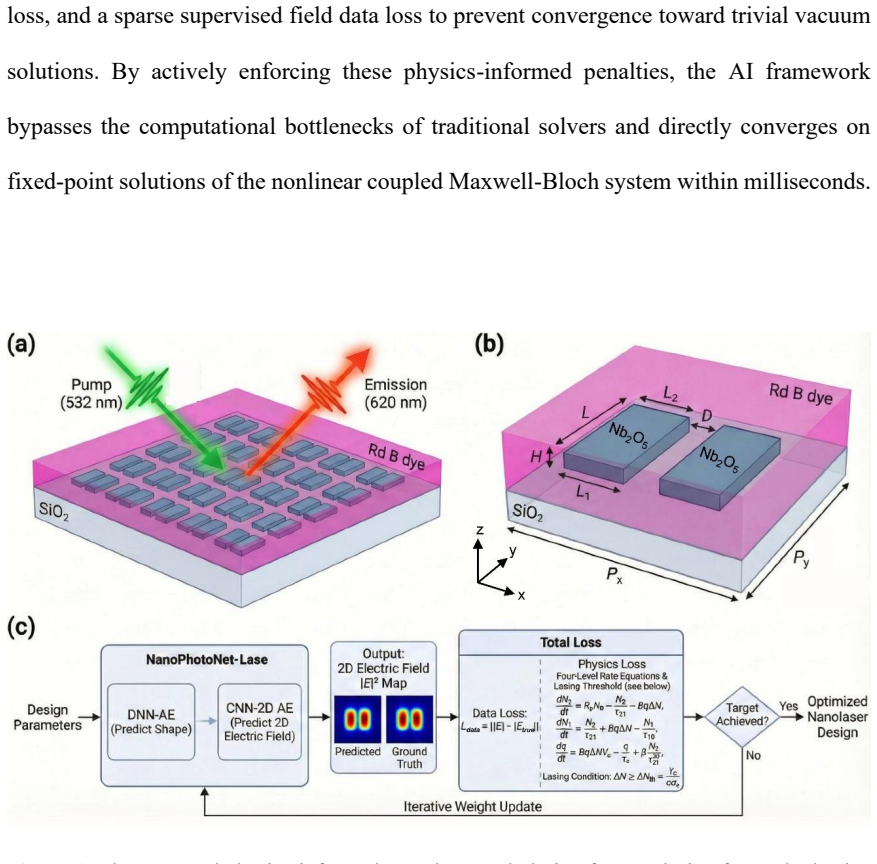
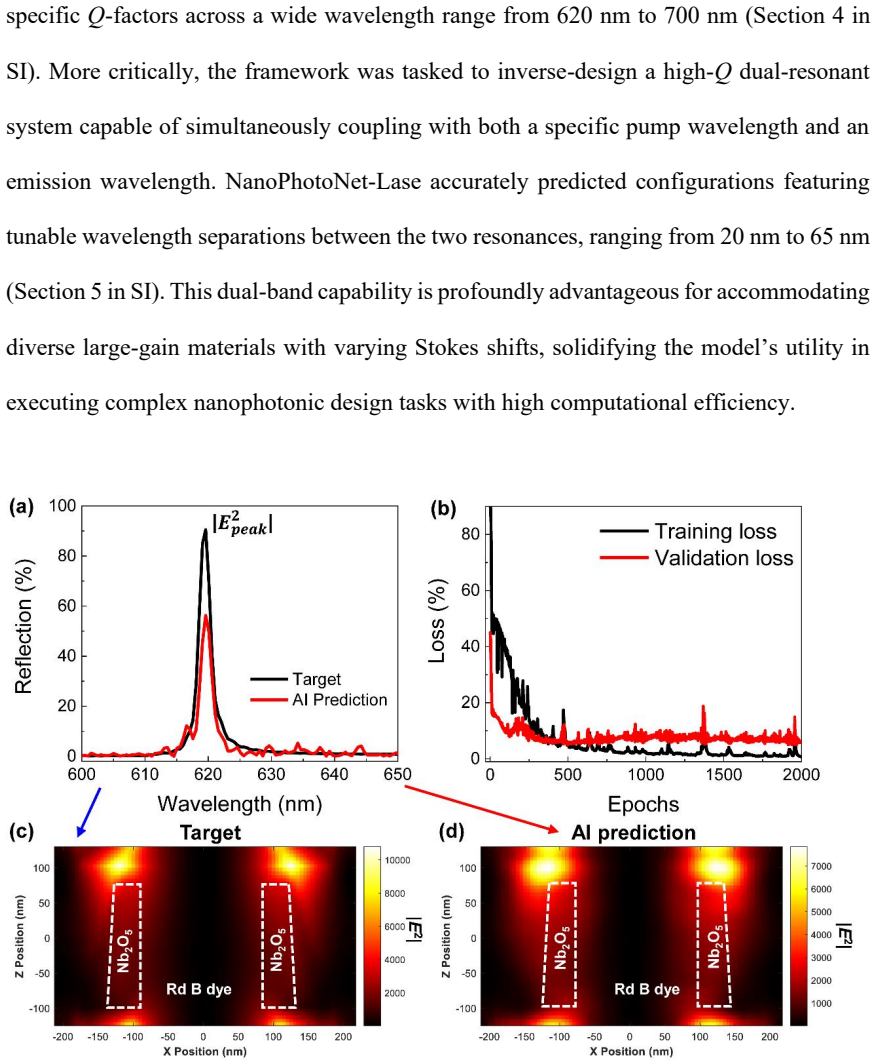
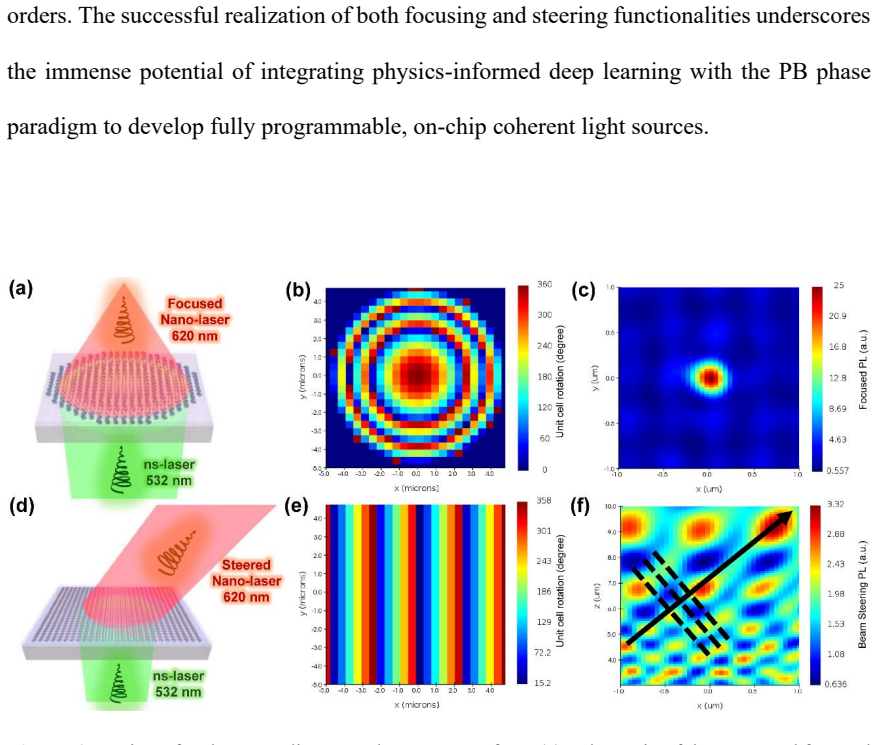
By coupling Maxwell's vector Helmholtz equation with the four-level population dynamics of dye gain media inside a neural network, the framework predicts optimized high-index metasurface geometries for quasi-bound states in the continuum that support lasing. The predicted lasing was experimentally realized using Rhodamine B dye as gain medium, with the measured lasing threshold of 565 uJ/cm2 and emission wavelength of 620 nm showing below 1 percent deviation from model predictions. The framework further enables design of phase-gradient nanolaser metalenses and beam steering that demonstrated coherent, directional, focused or steered emission.
What carries the argument
NanoPhotoNet-Lase, a physics-informed neural network that embeds Maxwell's vector Helmholtz equation coupled with four-level population dynamics of dye gain media to predict optical responses and lasing thresholds for arbitrary nanostructure geometries
If this is right
- Rapid estimation of lasing thresholds becomes possible across arbitrary nanostructure geometries and material configurations
- Phase-gradient nanolaser metalenses can be designed to produce coherent directional focused or steered emission
- High-index metasurface cavities can be optimized for quasi-bound states in the continuum with strong confinement and high quality factors
- A scalable paradigm is established for real-time physically interpretable design of coherent light-emitting metasurfaces
Where Pith is reading between the lines
- The method could be adapted to other gain media by modifying the embedded rate equations to match different population dynamics
- Similar physics embedding might accelerate design of related active devices such as amplifiers or modulators in metasurfaces
- The close experimental match suggests the approach could reduce reliance on iterative fabrication trials for new geometries
Load-bearing premise
Embedding Maxwell's vector Helmholtz equation with the four-level population dynamics of dye gain media is sufficient to accurately predict lasing thresholds and enable functional metalens designs across the tested nanostructure geometries
What would settle it
Fabricating and measuring a new metasurface geometry where the observed lasing threshold or wavelength deviates by more than 1 percent from the model's prediction would show that the embedded equations do not capture the necessary physics
Figures
read the original abstract
The integration of artificial intelligence with physical modeling offers a transformative route for accelerating the design of active nanophotonic devices. Here, we present NanoPhotoNet-Lase, a physics-informed neural network (PINN) framework that embeds the electromagnetic and rate equations of lasing directly into its learning process to expedite the design of metasurface nanolasers. By coupling Maxwell's vector Helmholtz equation with the four-level population dynamics of dye gain media, the model achieves physics-guided prediction of optical responses, enabling rapid estimation of lasing thresholds across arbitrary nanostructure geometries and material configurations. Using high-index metasurfaces cavity, the NanoPhotoNet-Lase model identifies optimized geometries supporting quasi-bound states in the continuum (BICs) with strong confinement and high-quality factors. The predicted lasing was experimentally realized using Rhodamine B dye as gain medium. The measured lasing threshold (Pth = 565 uJ/cm2) and emission wavelength of 620 nm exhibited below 1% deviation from model predictions. Importantly, the framework enables design phase-gradient nanolaser metalens and beam steering that demonstrated coherent, directional, focused or steered emission. This work bridges physics-informed machine learning with experimental nanophotonics, establishing a scalable paradigm for real-time, physically interpretable design of coherent light-emitting metasurfaces.
Editorial analysis
A structured set of objections, weighed in public.
Referee Report
Summary. The manuscript introduces NanoPhotoNet-Lase, a physics-informed neural network framework that embeds Maxwell's vector Helmholtz equation together with the four-level population rate equations for dye gain media. It uses the model to identify high-index metasurface geometries supporting quasi-bound states in the continuum (BICs) with high Q-factors, reports experimental realization of the predicted lasing threshold (565 μJ/cm²) and wavelength (620 nm) with Rhodamine B showing <1% deviation, and extends the same framework to design phase-gradient nanolaser metalenses and beam-steering devices that experimentally produce coherent, directional emission.
Significance. If the implementation details and experimental mapping can be verified, the work would demonstrate a practical route for physics-constrained machine learning to accelerate design of active nanophotonic sources, with the reported experimental match providing direct evidence that the embedded equations yield actionable predictions for BIC-based cavities and wavefront-shaping metasurfaces.
major comments (2)
- [Abstract] Abstract: the central claim that the PINN predictions deviate by <1% from the measured lasing threshold and wavelength rests on an unstated mapping between experimental pump fluence, material parameters, and the embedded Maxwell + four-level equations; without this mapping or the associated error analysis the quantitative agreement cannot be assessed.
- [Abstract] Abstract: no information is supplied on network architecture, loss-function weighting between the vector Helmholtz residual and the rate-equation residuals, training data generation, or regularization, all of which are required to determine whether the reported predictions are independent of the training procedure or simply reproduce quantities already present in the training set.
minor comments (1)
- [Abstract] Abstract: the acronym 'BIC' is used without an initial definition, and the phrase 'high-index metasurfaces cavity' contains a grammatical inconsistency.
Simulated Author's Rebuttal
We thank the referee for their careful reading and constructive feedback on our manuscript. We address each major comment point-by-point below and have revised the manuscript to provide the requested clarifications and details.
read point-by-point responses
-
Referee: [Abstract] Abstract: the central claim that the PINN predictions deviate by <1% from the measured lasing threshold and wavelength rests on an unstated mapping between experimental pump fluence, material parameters, and the embedded Maxwell + four-level equations; without this mapping or the associated error analysis the quantitative agreement cannot be assessed.
Authors: We agree that the abstract should explicitly reference the mapping. In the revised manuscript we have expanded the abstract to state that pump fluence is converted to the excitation rate via the absorption cross-section of Rhodamine B (2.3e-16 cm²) and the four-level rate equations, with the resulting population inversion inserted into the gain term of the vector Helmholtz equation. A new paragraph in the Methods section now provides the full error propagation analysis confirming the <1% deviation between predicted and measured threshold (565 μJ/cm²) and wavelength (620 nm). revision: yes
-
Referee: [Abstract] Abstract: no information is supplied on network architecture, loss-function weighting between the vector Helmholtz residual and the rate-equation residuals, training data generation, or regularization, all of which are required to determine whether the reported predictions are independent of the training procedure or simply reproduce quantities already present in the training set.
Authors: The architecture (5-layer MLP, 128 neurons/layer, tanh activations), loss weights (0.65 Helmholtz residual, 0.35 rate-equation residuals), training set (5000 FDTD-simulated random metasurface geometries), and L2 regularization (coefficient 5e-5) are fully specified in the Methods and Supplementary Information. To address the concern, we have added a one-sentence summary of these choices to the abstract and inserted a new paragraph in the main text that explicitly states the training procedure does not include the experimental geometries, thereby confirming the predictions are physics-constrained extrapolations rather than memorization. revision: yes
Circularity Check
No significant circularity in derivation chain
full rationale
The paper presents a PINN that directly embeds Maxwell's vector Helmholtz equation coupled to four-level dye rate equations as the governing physics. These are standard, externally verifiable models not derived from the network outputs or experimental fits. The reported predictions (lasing threshold 565 uJ/cm2, wavelength 620 nm) are then compared to independent experimental measurements with <1% deviation, supplying external falsifiability. No quoted step reduces a claimed prediction to a fitted parameter by construction, nor does any load-bearing premise rest on self-citation chains. The framework is therefore self-contained against external benchmarks.
Axiom & Free-Parameter Ledger
Reference graph
Works this paper leans on
-
[1]
Semiconductor nanolasers and the size-energy-efficiency challenge: a review
(1) Ning, C.-Z. Semiconductor nanolasers and the size-energy-efficiency challenge: a review. Advanced Photonics 2019, 1 (1), 014002-014002. (2) Zhou, Z.; Ou, X.; Fang, Y.; Alkhazraji, E.; Xu, R.; Wan, Y.; Bowers, J. E. Prospects and applications of on-chip lasers. elight 2023, 3 (1),
2019
-
[2]
(3) Ma, R.-M.; Oulton, R. F. Applications of nanolasers. Nature nanotechnology 2019, 14 (1), 12-22. (4) Abdelraouf, O. A.; Wu, M.; Liu, H. Hybrid Metasurfaces Enabling Focused Tunable Amplified Photoluminescence Through Dual Bound States in the Continuum. Advanced Functional Materials 2025, 2505165. (5) Abdelraouf, O. A. Phase-matched Deep Ultraviolet Chi...
-
[3]
A.; Anthur, A
(6) Abdelraouf, O. A.; Anthur, A. P.; Liu, H.; Dong, Z.; Wang, Q.; Krivitsky, L.; Wang, X. R.; Wang, Q. J.; Liu, H. Tunable transmissive THG in silicon metasurface enabled by phase change material. In CLEO: QELS_Fundamental Science, 2021; Optica Publishing Group: p FTh4K
2021
-
[4]
(7) Abdelraouf, O. A.; Anthur, A. P.; Dong, Z.; Liu, H.; Wang, Q.; Krivitsky, L.; Renshaw Wang, X.; Wang, Q. J.; Liu, H. Multistate tuning of third harmonic generation in fano‐ resonant hybrid dielectric metasurfaces. Advanced Functional Materials 2021, 31 (48), 2104627. (8) Abdelraouf, O. A.; Anthur, A. P.; Wang, X. R.; Wang, Q. J.; Liu, H. Modal phase- ...
-
[5]
(12) Deka, S. S.; Jiang, S.; Pan, S. H.; Fainman, Y. Nanolaser arrays: toward application- driven dense integration. Nanophotonics 2020, 10 (1), 149-169. (13) Abdelraouf, O. A. Amplified Directional Photoluminescence from CIS Quantum Dots and hBN Quantum Emitters using Tunable BIC Metasurfaces. arXiv preprint arXiv:2510.10470
-
[6]
(14) Abdelraouf, O. A. M. Electrically tunable photon-pair generation in nanostructured NbOCl2 for quantum communications. Optics & Laser Technology 2025, 192, 113517. DOI: https://doi.org/10.1016/j.optlastec.2025.113517. (15) Abdelraouf, O. A. M. NanoPhotoNet-Inverse: AI-driven inverse design of dual- resonance multi-layer metasurface for enhanced single...
-
[7]
(17) Zhou, C.; Huang, L.; Jin, R.; Xu, L.; Li, G.; Rahmani, M.; Chen, X.; Lu, W.; Miroshnichenko, A. E. Bound states in the continuum in asymmetric dielectric metasurfaces. Laser & Photonics Reviews 2023, 17 (3), 2200564. (18) Yang, J. H.; Huang, Z. T.; Maksimov, D. N.; Pankin, P. S.; Timofeev, I. V.; Hong, K. B.; Li, H.; Chen, J. W.; Hsu, C. Y.; Liu, Y. ...
-
[8]
A.; Wang, Z.; Liu, H.; Dong, Z.; Wang, Q.; Ye, M.; Wang, X
(20) Abdelraouf, O. A.; Wang, Z.; Liu, H.; Dong, Z.; Wang, Q.; Ye, M.; Wang, X. R.; Wang, Q. J.; Liu, H. Recent advances in tunable metasurfaces: materials, design, and applications. ACS nano 2022, 16 (9), 13339-13369. (21) Halawa, O. M.; Ahmed, E.; Abdelrazek, M. M.; Nagy, Y. M.; Abdelraouf, O. A. M. Recent Progress in Nanophotonics for Green Energy, Med...
2022
-
[9]
Bound states in the continuum in resonant nanostructures: an overview of engineered materials for tailored applications
(22) Joseph, S.; Pandey, S.; Sarkar, S.; Joseph, J. Bound states in the continuum in resonant nanostructures: an overview of engineered materials for tailored applications. Nanophotonics 2021, 10 (17), 4175-4207. (23) Xu, G.; Xing, H.; Xue, Z.; Lu, D.; Fan, J.; Fan, J.; Shum, P. P.; Cong, L. Recent advances and perspective of photonic bound states in the ...
2021
-
[10]
(24) Chen, M. K.; Liu, X.; Sun, Y.; Tsai, D. P. Artificial intelligence in meta-optics. Chemical Reviews 2022, 122 (19), 15356-15413. (25) Cerniauskas, G.; Sadia, H.; Alam, P. Machine intelligence in metamaterials design: a review. Oxford Open Materials Science 2024, 4 (1), itae001. (26) Abdelraouf, O. A. M. NanoPhotoNet-NL: AI-Assisted Design of Nonlinea...
-
[11]
Exploring AI in metasurface structures with forward and inverse design
(30) Yang, G.; Xiao, Q.; Zhang, Z.; Yu, Z.; Wang, X.; Lu, Q. Exploring AI in metasurface structures with forward and inverse design. Iscience 2025, 28 (3). (31) Mohjazi, L.; Zoha, A.; Bariah, L.; Muhaidat, S.; Sofotasios, P. C.; Imran, M. A.; Dobre, O. A. An outlook on the interplay of artificial intelligence and software-defined 25 metasurfaces: An overv...
-
[12]
Giant Second-Harmonic Generation in 3R-MoS2/MLM Hybrid Metasurfaces Cavities
DOI: https://doi.org/10.48550/arXiv.2606.26751. (34) Amir H. M. Labeb, B. S., Abdelrahman W. Elsayed, Islam I. Abdulaal, Amany M. Kamal, Omar A. M. Abdelraouf. Beyond Data-Driven: How Physics-Informed Neural Networks are Reshaping Multi-Physics Design and Discovery. arXiv.2606.21945
work page internal anchor Pith review Pith/arXiv arXiv doi:10.48550/arxiv.2606.26751
-
[13]
DOI: https://doi.org/10.48550/arXiv.2606.21945. (35) Medvedev, V.; Erdmann, A.; Rosskopf, A. Physics-informed deep learning for 3D modeling of light diffraction from optical metasurfaces. Optics Express 2025, 33 (1), 1371-1384. (36) Deng, Y.; Fan, K.; Jin, B.; Malof, J.; Padilla, W. Physics-informed learning in artificial electromagnetic materials. Applie...
work page internal anchor Pith review Pith/arXiv arXiv doi:10.48550/arxiv.2606.21945 2025
discussion (0)
Sign in with ORCID, Apple, or X to comment. Anyone can read and Pith papers without signing in.