Secure AltDA Integration for Ethereum L2s: An End-to-End Validation Framework
Pith reviewed 2026-06-28 10:08 UTC · model grok-4.3
The pith
Secure AltDA integration requires enforcing a complete deterministic and total translation from L1 inbox to L2 payload at the integration layer.
A machine-rendered reading of the paper's core claim, the machinery that carries it, and where it could break.
Core claim
We model the boundary as a typed, deterministic, and total translation from L1 inbox bytes to an AltDA commitment, then to externally available data, and finally to the rollup payload consumed by the rest of core L2s logic. The central principle is that every adversarial input must lead to a defined unique outcome. We show how missing obligations lead to concrete failure modes, including underconstrained settlement, derivation halts, inconsistent honest node behavior, invalid state assertions, and bridge safety failures.
What carries the argument
The typed, deterministic, and total translation function at the L1-to-L2 boundary that connects inbox bytes to the accepted rollup payload.
If this is right
- Missing parts of the validation chain produce underconstrained settlement.
- Non-total translations allow derivation to halt on certain adversarial inputs.
- Nondeterministic mappings cause inconsistent states across honest nodes.
- Gaps permit invalid state assertions to be accepted.
- Incomplete relations between commitment and payload enable bridge attacks.
Where Pith is reading between the lines
- L2 designers should document the entire translation relation explicitly rather than depending only on the DA provider or bridge.
- Audits of deployed AltDA setups can check for totality and determinism at each step of the chain.
- The same boundary-modeling approach could apply to other L1-L2 data handoffs such as messaging or state roots.
- Enforcing the full relation may require new interface specifications in L2 client code.
Load-bearing premise
That enforcing a total deterministic translation at the L1-to-L2 boundary is both necessary and sufficient to eliminate the listed failure modes in deployed systems.
What would settle it
An observation of two honest L2 nodes deriving different payloads from the same L1 inbox data under an AltDA setup, or a successful bridge attack traceable to an incomplete validation relation.
Figures
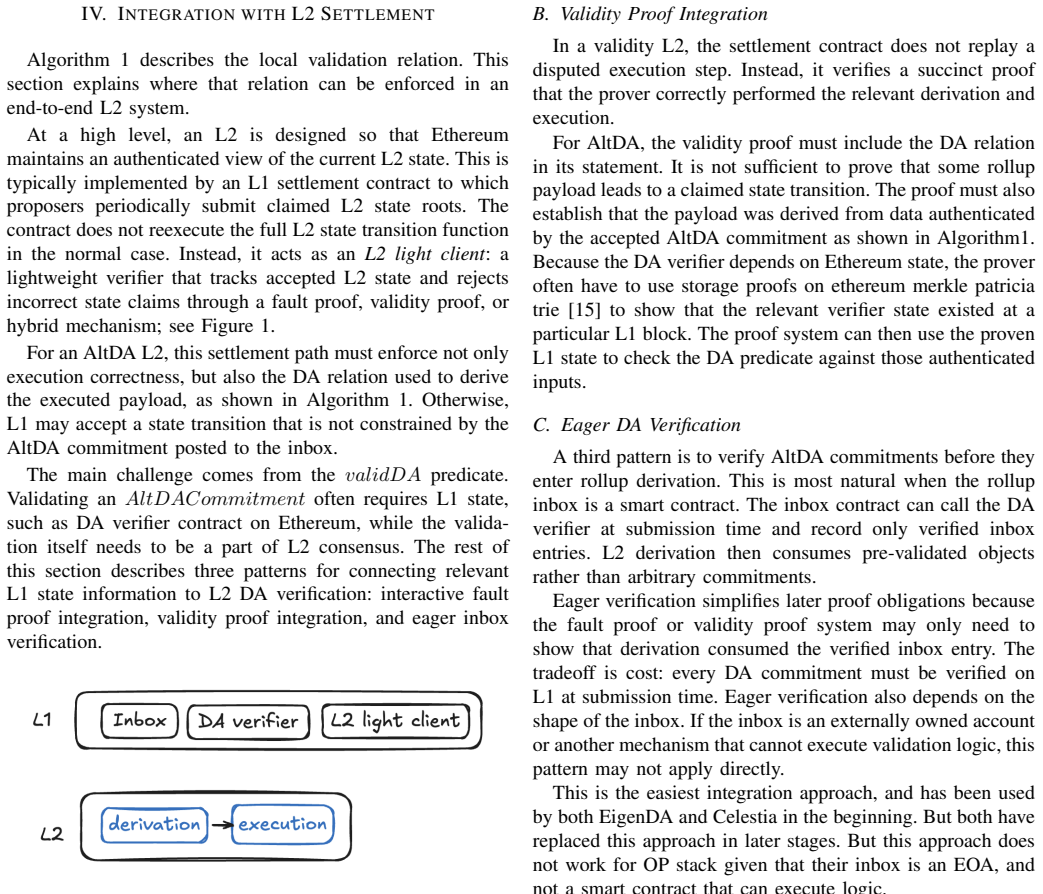
read the original abstract
Alternative data availability (AltDA) systems provide Ethereum L2s with an external data publication layer for high throughput rollup designs. By moving bulk data publication outside of Ethereum, AltDA allows L2s to process more data than native DA. However, this replacement introduces a new consensus critical integration layer. Existing ecosystem frameworks identify high level risks, such as external DA trust assumptions and the presence or absence of a DA verifier, but do not provide a complete specification for how an L2 should integrate with AltDA. This gap can lead to L2 halts, inconsistent derivation across honest L2 nodes, invalid state assertions, or bridge attacks. This paper presents a canonical validation framework for secure AltDA integration. We model the boundary as a typed, deterministic, and total translation from L1 inbox bytes to an AltDA commitment, then to externally available data, and finally to the rollup payload consumed by the rest of core L2s logic. The central principle is that every adversarial input must lead to a defined unique outcome. We show how missing obligations lead to concrete failure modes, including underconstrained settlement, derivation halts, inconsistent honest node behavior, invalid state assertions, and bridge safety failures. We then apply the framework to representative AltDA integration architectures, including Celestia-Blobstream, EigenDA based designs, and Avail-ZKsync. Our evaluation shows that secure AltDA integration is not determined solely by the DA provider or bridge. The surrounding L2 integration must also enforce the full validation relation connecting L1 inbox inputs to accepted L2 state.
Editorial analysis
A structured set of objections, weighed in public.
Referee Report
Summary. The paper presents a canonical validation framework for secure AltDA integration with Ethereum L2s. It models the L1-to-L2 boundary as a typed, deterministic, and total translation from L1 inbox bytes to an AltDA commitment, then to externally available data, and finally to the rollup payload consumed by core L2 logic. The central principle is that every adversarial input must lead to a defined unique outcome. The work shows how missing obligations produce concrete failure modes (underconstrained settlement, derivation halts, inconsistent honest nodes, invalid assertions, bridge attacks) and applies the framework to Celestia-Blobstream, EigenDA-based designs, and Avail-ZKsync, concluding that secure integration requires the full L2-enforced validation relation rather than depending solely on the DA provider or bridge.
Significance. If the central modeling principle is established, the framework supplies a structured end-to-end lens for identifying integration obligations that existing high-level risk taxonomies omit. The explicit linkage of L1 inbox inputs through AltDA to accepted L2 state is a useful organizing principle for preventing the enumerated failure modes in deployed systems. The evaluation across three distinct architectures illustrates that the surrounding L2 logic is decisive, which is a concrete contribution to the design of high-throughput rollups.
major comments (2)
- [§3 (Validation Framework)] §3 (Validation Framework): The claim that a total deterministic translation from L1 inbox bytes through AltDA commitment and external data to rollup payload is necessary and sufficient to eliminate the five listed failure modes rests on an informal enumeration of obligations. No formal definition of the translation function, inductive argument establishing totality over all inputs, or exhaustive case analysis is supplied, so the sufficiency argument remains unsubstantiated.
- [§5 (Evaluation on Architectures)] §5 (Evaluation on Architectures): The analyses of Celestia-Blobstream, EigenDA, and Avail-ZKsync correctly identify missing obligations in each design, yet they do not enumerate the full input space or verify that the proposed total function covers every adversarial case. Without this, it is possible that unmodeled interactions still produce undefined behavior at the L1-L2 boundary.
minor comments (2)
- [Abstract and §3] The abstract and framework description refer to a 'typed' translation, but the type system and its enforcement mechanism are not specified; adding a short formal signature or pseudocode definition would improve clarity.
- [Figures in §5] Figure captions and architecture diagrams would benefit from explicit mapping to the translation steps (inbox bytes → commitment → external data → payload) to make the end-to-end relation visually traceable.
Simulated Author's Rebuttal
We thank the referee for the constructive feedback on the validation framework and its application. The comments correctly note that the sufficiency arguments rely on conceptual modeling and case enumeration rather than formal definitions or exhaustive proofs. We address each point below, proposing targeted clarifications and additions to strengthen the presentation without altering the paper's scope as a practical design framework.
read point-by-point responses
-
Referee: [§3 (Validation Framework)] The claim that a total deterministic translation from L1 inbox bytes through AltDA commitment and external data to rollup payload is necessary and sufficient to eliminate the five listed failure modes rests on an informal enumeration of obligations. No formal definition of the translation function, inductive argument establishing totality over all inputs, or exhaustive case analysis is supplied, so the sufficiency argument remains unsubstantiated.
Authors: We agree that §3 presents the framework through an informal but structured enumeration of obligations and failure modes rather than a machine-checked formalization. The translation is modeled as the composition of three typed functions (inbox-to-commitment, commitment-to-external-data, external-data-to-payload) with the explicit requirement that the overall relation be total and deterministic; sufficiency is argued by showing that any deviation produces one of the five concrete failure modes via the L1-L2 boundary. We will revise §3 to include an explicit pseudocode definition of the translation relation and a short discussion clarifying that the argument is a modeling principle for obligation identification, not a formal theorem. This addresses the request for greater precision while preserving the paper's focus. revision: partial
-
Referee: [§5 (Evaluation on Architectures)] The analyses of Celestia-Blobstream, EigenDA, and Avail-ZKsync correctly identify missing obligations in each design, yet they do not enumerate the full input space or verify that the proposed total function covers every adversarial case. Without this, it is possible that unmodeled interactions still produce undefined behavior at the L1-L2 boundary.
Authors: The §5 case studies apply the framework to surface concrete missing obligations that map directly to the enumerated failure modes; they are not intended as exhaustive verification of the input space. The central claim is that any input outside the total relation must produce a defined outcome (rejection or error), which the identified gaps violate. We will add a clarifying paragraph in §5 noting the illustrative nature of the architectures and that the framework's totality requirement is the mechanism for handling unenumerated cases. This makes the scope explicit without requiring a separate exhaustive analysis. revision: partial
Circularity Check
No circularity: independent modeling framework with no fitted predictions or self-citation chains
full rationale
The paper introduces a conceptual validation framework requiring a typed, deterministic, total translation from L1 inbox bytes through AltDA commitment to rollup payload. This is defined directly as the central principle without reference to prior fitted results, equations, or self-citations that bear the load. No self-definitional loops, no renaming of known results, and no ansatz smuggled via citation appear. The argument that missing obligations produce listed failure modes is informal but self-contained as a modeling lens rather than a derivation that reduces to its inputs by construction. External benchmarks or formal proofs are absent, but that is a correctness issue, not circularity.
Axiom & Free-Parameter Ledger
Reference graph
Works this paper leans on
-
[1]
[Online]
fusaka upgrade. [Online]. Available: https://ethereum.org/roadmap/fus aka/
-
[2]
[Online]
Megaeth endgame how we break performance limits with eigenda. [Online]. Available: https://www.megaeth.com/blog-news/endgame-h ow-we-break-performance-limits-with-eigenda
-
[3]
[Online]
Rise gigagas era. [Online]. Available: https://medium.com/@rise chain /the-gigagas-era-f5693ad336cb
-
[4]
[Online]
Conduit g3. [Online]. Available: https://www.conduit.xyz/blog/the-infra structure-behind-the-money-upgrade-introducing-g3/
-
[5]
[Online]
Celestia. [Online]. Available: https://celestia.org/
-
[6]
[Online]
Eigenda. [Online]. Available: https://www.eigencloud.xyz/da
-
[7]
[Online]
Avail da. [Online]. Available: https://availproject.org/da
-
[8]
[Online]
Eth altda framework. [Online]. Available: https://l2beat.com/data-avail ability/summary
-
[9]
[Online]
L2beat. [Online]. Available: https://forum.l2beat.com/t/secure-integrati on-of-alt-da-l2s-with-data-availability-verifiers/408
-
[10]
[Online]
Eth altda framework. [Online]. Available: https://ethresear.ch/t/framewo rk-for-altda-secure-integration-on-ethereum/23591
-
[11]
[Online]
Optimism spec. [Online]. Available: https://specs.optimism.io/
-
[12]
[Online]
Arbitrum doc. [Online]. Available: https://docs.arbitrum.io/how-arbitru m-works/deep-dives/sequencer
-
[13]
[Online]
Ethereum 4844 spec. [Online]. Available: https://eips.ethereum.org/EI PS/eip-4844
-
[14]
Constant-size commitments to polynomials and their applications,
A. Kate, G. M. Zaverucha, and I. Goldberg, “Constant-size commitments to polynomials and their applications,” inAdvances in Cryptology - ASIACRYPT 2010, M. Abe, Ed. Berlin, Heidelberg: Springer Berlin Heidelberg, 2010, pp. 177–194
2010
-
[15]
[Online]
Merkle patricia trie. [Online]. Available: https://ethereum.org/developer s/docs/data-structures-and-encoding/patricia-merkle-trie/
-
[16]
[Online]
Hana repo. [Online]. Available: https://github.com/celestiaorg/hana/tree /3ac60784fd0246263d1e57497c3087b6f233f66c
-
[17]
[Online]
Celestia arbitrum integration. [Online]. Available: https://github.com/c elestiaorg/nitro-das-celestia/blob/main/daserver/types/reader.go
-
[18]
[Online]
hokulea repo. [Online]. Available: https://github.com/Layr-Labs/hokule a/tree/22c48b995b05486fa300510316c78173e6ecc3f3
-
[19]
[Online]
Eigenda arbitrum integration. [Online]. Available: https://github.com/L ayr-Labs/nitro
-
[20]
[Online]
Hana op integration. [Online]. Available: https://github.com/celestiao rg/hana/blob/main/docs/audits/Celestia%20Q2%202025%20 %20Hana %20Library%20Audit%20Report Final.pdf
-
[21]
[Online]
sp1 contract call. [Online]. Available: https://succinctlabs.github.io/sp1 -contract-call/
-
[22]
[Online]
steel. [Online]. Available: https://docs.boundless.network/developers/st eel/what-is-steel
-
[23]
[Online]
Eigenda canoe. [Online]. Available: https://github.com/Layr-Labs/hoku lea/blob/master/docs/canoe.md
-
[24]
[Online]
Sp1 vector. [Online]. Available: https://succinctlabs.github.io/sp1-vector/
discussion (0)
Sign in with ORCID, Apple, or X to comment. Anyone can read and Pith papers without signing in.