Virtual Nodes Guided Dynamic Graph Neural Network for Brain Tumor Segmentation with Missing Modalities
Pith reviewed 2026-05-19 20:48 UTC · model grok-4.3
The pith
A graph neural network with virtual nodes and dynamic connections segments brain tumors effectively even with missing MRI modalities.
A machine-rendered reading of the paper's core claim, the machinery that carries it, and where it could break.
Core claim
The authors claim that introducing modality-specific virtual nodes as supplementary sources, combined with a dynamic adjacency matrix adjustment based on modality availability and heterogeneous weight matrices, enables robust one-stage segmentation that surpasses existing methods on most incomplete modality combinations in the BRATS-2018 and BRATS-2020 datasets.
What carries the argument
Modality-specific virtual nodes serving as information compensators, paired with a dynamic connection strategy that modifies the graph's adjacency matrix according to which modalities are present.
If this is right
- The method supports single-stage training for both complete and incomplete modality cases, lowering computational costs compared to multi-stage strategies.
- Dynamic adjustment of the adjacency matrix preserves useful information flow from available modalities while reducing interference from missing ones.
- Use of heterogeneous weight matrices improves the graph network's adaptability to varying multimodal inputs.
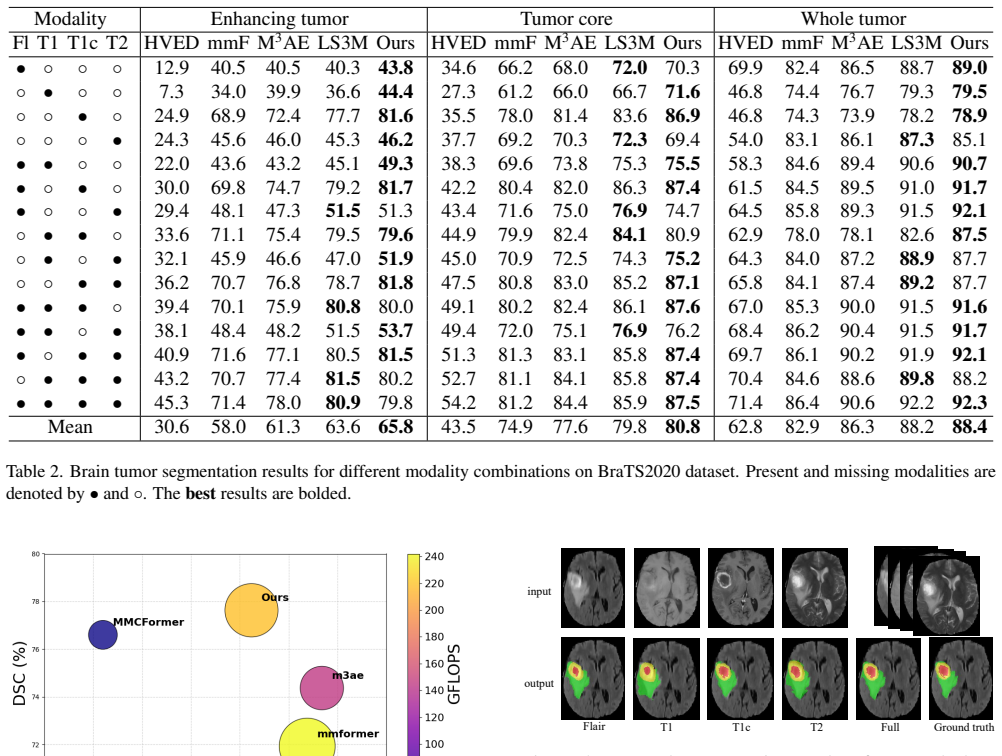
- Experimental results show outperformance over state-of-the-art approaches on nearly all subsets of incomplete modalities in standard brain tumor datasets.
Where Pith is reading between the lines
- This dynamic graph approach might apply to other medical imaging tasks involving incomplete multimodal data, such as in cardiac or abdominal scans.
- If the virtual nodes effectively compensate without artifacts, similar mechanisms could be integrated into non-graph neural network architectures for missing data handling.
- Further validation could involve testing the framework on datasets with more variable missing rates or additional imaging types to check generalizability.
Load-bearing premise
Dynamically adjusting the adjacency matrix based on modality availability will preserve beneficial information flow while mitigating interference effects caused by missing modalities without introducing new biases or artifacts.
What would settle it
Running the model on a held-out portion of the BRATS dataset with specific patterns of missing modalities, such as only T1 and T2 available, and checking if segmentation accuracy drops significantly below reported levels or fails to beat baselines.
Figures



read the original abstract
Multimodal magnetic resonance imaging (MRI) is crucial for brain tumor segmentation, with many methods leveraging its four key modalities to capture complementary information for effective sub-region analysis. However, the absence of several modalities is very common in practice, leading to severe performance degradation in existing full-modality segmentation methods. Limited by the structured data model, recent works often adopt a multi-stage training strategy for full-modality and missing-modality scenarios, which increases training costs and inadequately addresses the interference of miss. In this work, we propose a graph-based one-stage framework for robust brain tumor segmentation with missing modalities. Specifically, we introduce modality-specific virtual nodes that serve as supplementary information sources to compensate for missing modalities. To enhance model robustness against arbitrary modality combinations, we leverage the inherent flexibility of graph networks to devise a dynamic connection strategy. This mechanism dynamically adjusts the adjacency matrix based on modality availability, preserving beneficial information flow while mitigating interference effects caused by missing modalities. Furthermore, we enhance the graph network through heterogeneous weight matrices, enhancing its adaptability to multimodal scenarios. Extensive experiments on the BRATS-2018 and BRATS-2020 datasets demonstrate that our method outperforms the state-of-the-art methods on almost all subsets of incomplete modalities.
Editorial analysis
A structured set of objections, weighed in public.
Referee Report
Summary. The paper proposes a one-stage graph neural network framework for brain tumor segmentation from multimodal MRI data that is robust to arbitrary missing modalities. It introduces modality-specific virtual nodes as supplementary information sources and a dynamic connection strategy that adjusts the graph adjacency matrix according to modality availability, combined with heterogeneous weight matrices to improve adaptability. The central empirical claim is that this approach outperforms state-of-the-art methods on nearly all incomplete-modality subsets of the BRATS-2018 and BRATS-2020 datasets while avoiding the training overhead of multi-stage baselines.
Significance. If the empirical results and mechanism hold under rigorous verification, the work could meaningfully advance robust multimodal medical image segmentation. The one-stage design directly tackles the practical training-cost problem of prior multi-stage methods, and the virtual-node plus dynamic-adjacency idea offers a graph-native way to manage cross-modal information flow under missing data. This could influence downstream clinical tools where modality dropout is common.
major comments (2)
- [Abstract] Abstract: the central claim that the method 'outperforms the state-of-the-art methods on almost all subsets of incomplete modalities' is stated without any quantitative metrics, baseline names, statistical tests, or ablation summaries. Because the outperformance result is the primary evidence for the framework's value, the absence of these details in the abstract (and the need to locate them in the full experimental section) makes independent assessment of the claim impossible from the summary alone.
- [§3.2] §3.2 (Dynamic Connection Strategy): the description of how the adjacency matrix is adjusted based on modality availability remains high-level and does not supply an explicit construction (e.g., whether edges are zeroed, re-weighted by learned scalars, or routed exclusively through virtual nodes). This detail is load-bearing for the paper's claim that the strategy 'preserves beneficial information flow while mitigating interference effects'; without it, it is impossible to evaluate the skeptic's concern that the adjustment may simply mask inputs rather than actively compensate, potentially introducing new biases when missingness correlates with tumor features.
minor comments (2)
- [Abstract] Abstract: the phrase 'inadequately addresses the interference of miss' is grammatically incomplete and should be revised to 'missing modalities' for clarity.
- [Figures/Tables] Figure and table captions: ensure each caption is self-contained and explicitly states which modality subsets are shown and which metrics are reported, so readers can interpret results without cross-referencing the main text.
Simulated Author's Rebuttal
We thank the referee for these constructive comments on improving the clarity of our central claims and technical details. We will revise the manuscript to address both points directly.
read point-by-point responses
-
Referee: [Abstract] Abstract: the central claim that the method 'outperforms the state-of-the-art methods on almost all subsets of incomplete modalities' is stated without any quantitative metrics, baseline names, statistical tests, or ablation summaries. Because the outperformance result is the primary evidence for the framework's value, the absence of these details in the abstract (and the need to locate them in the full experimental section) makes independent assessment of the claim impossible from the summary alone.
Authors: We agree that the abstract would benefit from including key quantitative support for the main claim. In the revised manuscript we will add specific Dice scores (e.g., average improvements on BRATS-2018/2020 incomplete subsets), name the primary baselines (such as the leading multi-stage and graph-based methods), and note that paired t-tests confirmed statistical significance. This keeps the abstract concise while making the empirical contribution immediately verifiable. revision: yes
-
Referee: [§3.2] §3.2 (Dynamic Connection Strategy): the description of how the adjacency matrix is adjusted based on modality availability remains high-level and does not supply an explicit construction (e.g., whether edges are zeroed, re-weighted by learned scalars, or routed exclusively through virtual nodes). This detail is load-bearing for the paper's claim that the strategy 'preserves beneficial information flow while mitigating interference effects'; without it, it is impossible to evaluate the skeptic's concern that the adjustment may simply mask inputs rather than actively compensate, potentially introducing new biases when missingness correlates with tumor features.
Authors: We accept that the current wording in §3.2 is insufficiently precise. We will expand this section with an explicit formulation: the dynamic adjacency matrix A' is obtained by element-wise masking unavailable modality nodes, followed by learned scalar re-weighting on edges incident to the modality-specific virtual nodes. Information from available modalities is routed through these virtual nodes rather than simply zeroed; we will also add a short discussion of potential bias when missingness correlates with tumor characteristics and how the heterogeneous weight matrices help mitigate it. revision: yes
Circularity Check
No circularity detected in proposed architecture or claims
full rationale
The paper describes a graph-based one-stage framework that introduces modality-specific virtual nodes and a dynamic connection strategy to adjust the adjacency matrix according to modality availability. No equations, derivations, or first-principles results are presented in the provided text that reduce by construction to fitted inputs, self-definitions, or self-citation chains. The central mechanism is presented as an architectural design choice leveraging graph network flexibility, with performance claims supported by external experimental validation on BRATS-2018 and BRATS-2020 datasets rather than any internal reduction or renaming of known results. This constitutes a self-contained proposal without load-bearing circular steps.
Axiom & Free-Parameter Ledger
axioms (1)
- domain assumption Graph networks can model complementary information across MRI modalities and compensate for absences via virtual nodes.
invented entities (1)
-
modality-specific virtual nodes
no independent evidence
Reference graph
Works this paper leans on
-
[1]
Radhakrishna Achanta, Appu Shaji, Kevin Smith, Aurelien Lucchi, Pascal Fua, and Sabine S ¨usstrunk. Slic superpix- els compared to state-of-the-art superpixel methods.IEEE transactions on pattern analysis and machine intelligence, 34(11):2274–2282, 2012. 3
work page 2012
-
[2]
Smu-net: Style matching u-net for brain tumor segmentation with missing modalities
Reza Azad, Nika Khosravi, and Dorit Merhof. Smu-net: Style matching u-net for brain tumor segmentation with missing modalities. InInternational conference on medical imaging with deep learning, pages 48–62. PMLR, 2022. 2
work page 2022
-
[3]
Robust multimodal brain tumor seg- mentation via feature disentanglement and gated fusion
Cheng Chen, Qi Dou, Yueming Jin, Hao Chen, Jing Qin, and Pheng-Ann Heng. Robust multimodal brain tumor seg- mentation via feature disentanglement and gated fusion. In International conference on medical image computing and computer-assisted intervention, pages 447–456. Springer,
-
[4]
Cheng Chen, Qi Dou, Yueming Jin, Quande Liu, and Pheng Ann Heng. Learning with privileged multimodal knowledge for unimodal segmentation.IEEE transactions on medical imaging, 41(3):621–632, 2021. 2
work page 2021
-
[5]
Rfnet: Region-aware fusion network for incomplete multi-modal brain tumor seg- mentation
Yuhang Ding, Xin Yu, and Yi Yang. Rfnet: Region-aware fusion network for incomplete multi-modal brain tumor seg- mentation. InProceedings of the IEEE/CVF international conference on computer vision, pages 3975–3984, 2021. 5
work page 2021
-
[6]
Hetero-modal variational encoder-decoder for joint modality completion and segmen- tation
Reuben Dorent, Samuel Joutard, Marc Modat, S ´ebastien Ourselin, and Tom Vercauteren. Hetero-modal variational encoder-decoder for joint modality completion and segmen- tation. InInternational Conference on Medical Image Com- puting and Computer-Assisted Intervention, pages 74–82. Springer, 2019. 2, 5, 6
work page 2019
-
[7]
A joint 3d unet-graph neural network-based method for airway seg- mentation from chest cts
Antonio Garcia-Uceda Juarez, Raghavendra Selvan, Zaigham Saghir, and Marleen de Bruijne. A joint 3d unet-graph neural network-based method for airway seg- mentation from chest cts. InInternational workshop on machine learning in medical imaging, pages 583–591. Springer, 2019. 3
work page 2019
-
[8]
Generative adversarial nets.Advances in neural information processing systems, 27, 2014
Ian J Goodfellow, Jean Pouget-Abadie, Mehdi Mirza, Bing Xu, David Warde-Farley, Sherjil Ozair, Aaron Courville, and Yoshua Bengio. Generative adversarial nets.Advances in neural information processing systems, 27, 2014. 2
work page 2014
-
[9]
A new model for learning in graph domains
Marco Gori, Gabriele Monfardini, and Franco Scarselli. A new model for learning in graph domains. InProceed- ings. 2005 IEEE international joint conference on neural networks, 2005., pages 729–734. IEEE, 2005. 3
work page 2005
-
[10]
Hemis: Hetero-modal image segmen- tation
Mohammad Havaei, Nicolas Guizard, Nicolas Chapados, and Yoshua Bengio. Hemis: Hetero-modal image segmen- tation. InInternational conference on medical image com- puting and computer-assisted intervention, pages 469–477. Springer, 2016. 1
work page 2016
-
[11]
Distilling the Knowledge in a Neural Network
Geoffrey Hinton, Oriol Vinyals, and Jeff Dean. Distill- ing the knowledge in a neural network.arXiv preprint arXiv:1503.02531, 2015. 2
work page internal anchor Pith review Pith/arXiv arXiv 2015
-
[12]
Knowledge distillation from multi-modal to mono- modal segmentation networks
Minhao Hu, Matthis Maillard, Ya Zhang, Tommaso Ci- ceri, Giammarco La Barbera, Isabelle Bloch, and Pietro Gori. Knowledge distillation from multi-modal to mono- modal segmentation networks. InInternational Conference on Medical Image Computing and Computer-Assisted Inter- vention, pages 772–781. Springer, 2020. 2
work page 2020
-
[13]
Michael Iv, Byung C Yoon, Jeremy J Heit, Nancy Fischbein, and Max Wintermark. Current clinical state of advanced magnetic resonance imaging for brain tumor diagnosis and follow up. InSeminars in roentgenology, pages 45–61. Else- vier, 2018. 1
work page 2018
-
[14]
Haozhe Jia, Weidong Cai, Heng Huang, and Yong Xia. H 2 nf-net for brain tumor segmentation using multimodal mr imaging: 2nd place solution to brats challenge 2020 segmen- tation task. InInternational MICCAI Brainlesion Workshop, pages 58–68. Springer, 2020. 1
work page 2020
-
[15]
Two-stage cascaded u-net: 1st place solution to brats challenge 2019 segmentation task
Zeyu Jiang, Changxing Ding, Minfeng Liu, and Dacheng Tao. Two-stage cascaded u-net: 1st place solution to brats challenge 2019 segmentation task. InInternational MICCAI brainlesion workshop, pages 231–241. Springer, 2019. 1
work page 2019
-
[16]
Mmcformer: Missing modality compensation transformer for brain tumor segmentation
Sanaz Karimijafarbigloo, Reza Azad, Amirhossein Kazer- ouni, Saeed Ebadollahi, and Dorit Merhof. Mmcformer: Missing modality compensation transformer for brain tumor segmentation. InMedical imaging with deep learning, pages 1144–1162. PMLR, 2024. 6
work page 2024
-
[17]
Adam: A Method for Stochastic Optimization
Diederik P Kingma and Jimmy Ba. Adam: A method for stochastic optimization.arXiv preprint arXiv:1412.6980,
work page internal anchor Pith review Pith/arXiv arXiv
-
[18]
Dongwook Lee, Won-Jin Moon, and Jong Chul Ye. Assess- ing the importance of magnetic resonance contrasts using collaborative generative adversarial networks.Nature Ma- chine Intelligence, 2(1):34–42, 2020. 2
work page 2020
-
[19]
M3ae: multimodal representation learning for brain tumor segmentation with missing modal- ities
Hong Liu, Dong Wei, Donghuan Lu, Jinghan Sun, Liansheng Wang, and Yefeng Zheng. M3ae: multimodal representation learning for brain tumor segmentation with missing modal- ities. InProceedings of the AAAI conference on artificial intelligence, pages 1657–1665, 2023. 2, 6, 7
work page 2023
-
[20]
SGDR: Stochastic Gradient Descent with Warm Restarts
Ilya Loshchilov and Frank Hutter. Sgdr: Stochas- tic gradient descent with warm restarts.arXiv preprint arXiv:1608.03983, 2016. 6
work page internal anchor Pith review Pith/arXiv arXiv 2016
-
[21]
Qihang Ma, Siyuan Zhou, Chengye Li, Feng Liu, Yan Liu, Mingzheng Hou, and Yi Zhang. Dgrunit: Dual graph reason- ing unit for brain tumor segmentation.Computers in biology and medicine, 149:106079, 2022. 3
work page 2022
-
[22]
Bjoern H Menze, Andras Jakab, Stefan Bauer, Jayashree Kalpathy-Cramer, Keyvan Farahani, Justin Kirby, Yuliya Burren, Nicole Porz, Johannes Slotboom, Roland Wiest, et al. The multimodal brain tumor image segmentation benchmark (brats).IEEE transactions on medical imaging, 34(10):1993–2024, 2014. 5
work page 1993
-
[23]
V-net: Fully convolutional neural networks for volumetric medical image segmentation
Fausto Milletari, Nassir Navab, and Seyed-Ahmad Ahmadi. V-net: Fully convolutional neural networks for volumetric medical image segmentation. In2016 fourth international conference on 3D vision (3DV), pages 565–571. Ieee, 2016. 5
work page 2016
-
[24]
Yansheng Qiu, Delin Chen, Hongdou Yao, Yongchao Xu, and Zheng Wang. Scratch each other’s back: Incomplete multi-modal brain tumor segmentation via category aware group self-support learning. InProceedings of the IEEE/CVF International Conference on Computer Vision, pages 21317– 21326, 2023. 2
work page 2023
-
[25]
Exploring graph-based neural networks for automatic brain tumor segmentation
Camillo Saueressig, Adam Berkley, Elliot Kang, Reshma Munbodh, and Ritambhara Singh. Exploring graph-based neural networks for automatic brain tumor segmentation. In International Symposium: From Data to Models and Back, pages 18–37. Springer, 2020. 3
work page 2020
-
[26]
Brain tumor segmentation on mri with missing modalities
Yan Shen and Mingchen Gao. Brain tumor segmentation on mri with missing modalities. InInternational conference on information processing in medical imaging, pages 417–428. Springer, 2019. 2
work page 2019
-
[27]
Petar Veli ˇckovi´c, Guillem Cucurull, Arantxa Casanova, Adriana Romero, Pietro Lio, and Yoshua Bengio. Graph at- tention networks.arXiv preprint arXiv:1710.10903, 2017. 2, 4
work page internal anchor Pith review Pith/arXiv arXiv 2017
-
[28]
Multi-modal learning with missing modality via shared-specific feature modelling
Hu Wang, Yuanhong Chen, Congbo Ma, Jodie Avery, Louise Hull, and Gustavo Carneiro. Multi-modal learning with missing modality via shared-specific feature modelling. In Proceedings of the IEEE/CVF conference on computer vi- sion and pattern recognition, pages 15878–15887, 2023. 2, 5
work page 2023
-
[29]
Junze Wang, Lei Fan, Weipeng Jing, Donglin Di, Yang Song, Sidong Liu, and Cong Cong. Hypergraph tversky-aware do- main incremental learning for brain tumor segmentation with missing modalities. InInternational Conference on Medi- cal Image Computing and Computer-Assisted Intervention, pages 283–293. Springer, 2025. 1
work page 2025
-
[30]
Acn: adversarial co-training network for brain tumor segmentation with missing modalities
Yixin Wang, Yang Zhang, Yang Liu, Zihao Lin, Jiang Tian, Cheng Zhong, Zhongchao Shi, Jianping Fan, and Zhiqiang He. Acn: adversarial co-training network for brain tumor segmentation with missing modalities. InInternational con- ference on medical image computing and computer-assisted intervention, pages 410–420. Springer, 2021. 1
work page 2021
-
[31]
Brain tissue segmentation based on graph convolutional networks
Zhang Yan, Kong Youyong, Wu Jiasong, Gouenou Coa- trieux, and Shu Huazhong. Brain tissue segmentation based on graph convolutional networks. In2019 IEEE Interna- tional Conference on Image Processing (ICIP), pages 1470–
-
[32]
Heran Yang, Jian Sun, and Zongben Xu. Learning unified hyper-network for multi-modal mr image synthesis and tu- mor segmentation with missing modalities.IEEE Transac- tions on Medical Imaging, 42(12):3678–3689, 2023. 2, 3
work page 2023
-
[33]
Biting Yu, Luping Zhou, Lei Wang, Yinghuan Shi, Jurgen Fripp, and Pierrick Bourgeat. Ea-gans: edge-aware genera- tive adversarial networks for cross-modality mr image syn- thesis.IEEE transactions on medical imaging, 38(7):1750– 1762, 2019
work page 2019
-
[34]
Ziqi Yu, Xiaoyang Han, Shengjie Zhang, Jianfeng Feng, Tingying Peng, and Xiao-Yong Zhang. Mousegan++: unsu- pervised disentanglement and contrastive representation for multiple mri modalities synthesis and structural segmenta- tion of mouse brain.IEEE Transactions on Medical Imaging, 42(4):1197–1209, 2022. 2
work page 2022
-
[35]
Modality-aware mutual learning for multi-modal medical image segmenta- tion
Yao Zhang, Jiawei Yang, Jiang Tian, Zhongchao Shi, Cheng Zhong, Yang Zhang, and Zhiqiang He. Modality-aware mutual learning for multi-modal medical image segmenta- tion. InInternational conference on medical image com- puting and computer-assisted intervention, pages 589–599. Springer, 2021. 1
work page 2021
-
[36]
Yao Zhang, Nanjun He, Jiawei Yang, Yuexiang Li, Dong Wei, Yawen Huang, Yang Zhang, Zhiqiang He, and Yefeng Zheng. mmformer: Multimodal medical transformer for incomplete multimodal learning of brain tumor segmenta- tion. InInternational conference on medical image com- puting and computer-assisted intervention, pages 107–117. Springer, 2022. 1, 6, 7
work page 2022
-
[37]
Tm- former: Token merging transformer for brain tumor seg- mentation with missing modalities
Zheyu Zhang, Gang Yang, Yueyi Zhang, Huanjing Yue, Aip- ing Liu, Yunwei Ou, Jian Gong, and Xiaoyan Sun. Tm- former: Token merging transformer for brain tumor seg- mentation with missing modalities. InProceedings of the AAAI Conference on Artificial Intelligence, pages 7414– 7422, 2024. 5
work page 2024
-
[38]
Incomplete multi-modal brain tumor segmentation via learnable sorting state space model
Zheyu Zhang, Yayuan Lu, Feipeng Ma, Yueyi Zhang, Huan- jing Yue, and Xiaoyan Sun. Incomplete multi-modal brain tumor segmentation via learnable sorting state space model. InProceedings of the IEEE/CVF Conference on Computer Vision and Pattern Recognition, pages 25982–25992, 2025. 2, 7
work page 2025
-
[39]
Modality-adaptive feature interaction for brain tumor segmentation with miss- ing modalities
Zechen Zhao, Heran Yang, and Jian Sun. Modality-adaptive feature interaction for brain tumor segmentation with miss- ing modalities. InInternational conference on medical image computing and computer-assisted intervention, pages 183–
discussion (0)
Sign in with ORCID, Apple, or X to comment. Anyone can read and Pith papers without signing in.