Distributional Learning of Graph Languages Generated by Fixed-Interface Clause Systems
Pith reviewed 2026-05-07 12:51 UTC · model grok-4.3
The pith
Fixed-parameter graph languages generated by clause systems are learnable in the limit from positive data and membership queries.
A machine-rendered reading of the paper's core claim, the machinery that carries it, and where it could break.
Core claim
For every fixed parameter tuple (Δ,m,s,t,w,d), the target language in the bounded class FICSL^FCP_Δ(m,s,t,w,d) is identifiable in the limit from positive data and membership queries. The oracle-guided learner constructs hypotheses from boundary representations induced by observed positive examples; target contexts appear eventually, target clauses are reconstructed over the corresponding predicate representatives, and spurious clauses are excluded by membership queries. The learner also has polynomial-time update on the class.
What carries the argument
The oracle-guided learning algorithm that constructs hypotheses from boundary representations induced by observed positive examples, relying on the finite context property to guarantee eventual appearance of target contexts.
If this is right
- Target contexts eventually appear in the positive sample.
- Target clauses are reconstructed over corresponding predicate representatives.
- Spurious clauses are excluded by membership queries.
- The learner updates its hypothesis in polynomial time per new example.
Where Pith is reading between the lines
- Similar distributional techniques could be tried on other bounded graph grammar families once a finite-context property is established for them.
- The polynomial update bound suggests the method could be implemented for moderate-sized graph datasets in practice.
- Relaxing the fixed-parameter restriction while keeping polynomial update would require a different argument.
Load-bearing premise
The target language must belong to the bounded class satisfying the finite context property under the bounded-degree assumption for some fixed parameters.
What would settle it
An infinite positive presentation of a language inside one of the fixed-parameter classes on which the algorithm keeps changing its hypothesis after any finite point, even when membership queries are answered correctly.
Figures


read the original abstract
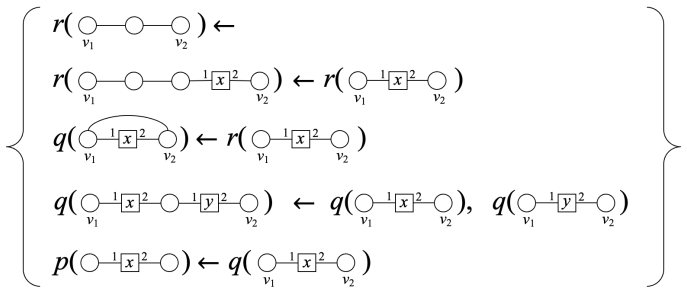
Distributional learning provides a useful framework for studying the learnability of structured languages from positive data. In this paper, we extend this framework to graph languages generated by fixed-interface clause systems (FICSs). We formulate FICSs explicitly and study the corresponding learning problem under positive presentations and membership queries. We consider a bounded class of graph languages satisfying the finite context property (FCP) under a bounded-degree assumption. The bounds are expressed by the degree bound $\Delta$ together with five structural parameters $m,s,t,w$, and $d$, which control the clause-system structure, interface ranks, and local head-frame complexity. The learning algorithm constructs hypotheses from ordered boundary representations induced by the observed positive examples. These representations make explicit the interface information needed to compare contexts and to test candidate clauses by membership queries. We prove that target contexts eventually appear in the observed sample, target clauses are reconstructed over the corresponding predicate representatives, and spurious non-fact clauses are eventually excluded. Consequently, for every fixed parameter tuple, the target language is identifiable in the limit from positive data and membership queries. We also prove that the learner has polynomial-time update on $\FICSLFCP_{\Delta}(m,s,t,w,d)$: at each stage, only polynomially many ordered boundary representations, predicate symbols, clause candidates, and membership queries are needed. Overall, the paper gives a parameterized reformulation of distributional learning for interface-based graph languages in a fixed-interface setting.
Editorial analysis
A structured set of objections, weighed in public.
Referee Report
Summary. The paper extends distributional learning to graph languages generated by fixed-interface clause systems (FICSL). It defines fixed-interface graph pattern clause systems and focuses on the bounded class FICSL^FCP_Δ(m,s,t,w,d) that satisfies the finite context property under a bounded-degree assumption, with bounds controlled by the parameter tuple (Δ,m,s,t,w,d). An oracle-guided algorithm constructs hypotheses from boundary representations induced by positive examples. The central claim is that for any fixed parameter tuple, languages in this class are identifiable in the limit from positive data plus membership queries, with the learner having polynomial-time updates. The abstract sketches the proof via context appearance, clause reconstruction over predicate representatives, and elimination of spurious clauses via membership queries.
Significance. If the result holds, this provides a parameterized extension of distributional learning to regular FGS-style graph languages, offering an algorithmic approach with polynomial updates that could be useful for learning structured graph data. The boundary-representation technique and the combination of positive data with membership queries represent a concrete advance in identifiability proofs for graph grammars under finite-context assumptions.
major comments (2)
- [Abstract] Abstract (proof outline): the sketch states that 'target contexts eventually appear in the sample, target clauses are reconstructed over the corresponding predicate representatives, and spurious clauses are excluded by membership queries', but the explicit construction of boundary representations from positive examples, the precise reconstruction procedure, and the handling of all edge cases in clause elimination are not derived in the provided text. This is load-bearing for the identifiability claim.
- [Class definition and assumptions] The finite-context property and bounded-degree assumption: the identifiability result relies on the target belonging to FICSL^FCP_Δ(m,s,t,w,d), yet the manuscript does not detail how the parameters ensure that all relevant contexts appear and that the polynomial update bound holds uniformly; a concrete bound derivation or example would strengthen this.
minor comments (2)
- The notation FICSL^FCP_Δ(m,s,t,w,d) and related symbols appear without an early inline gloss of each parameter's role; adding this would improve readability.
- The abstract claims a 'polynomial-time update' but does not indicate the degree of the polynomial in terms of the parameters; a brief complexity statement would clarify the result.
Simulated Author's Rebuttal
We thank the referee for the careful reading and constructive comments on our manuscript. The two major comments identify opportunities to improve the clarity of the proof sketch and the role of the parameter bounds. We address each point below and will incorporate revisions to strengthen the presentation.
read point-by-point responses
-
Referee: [Abstract] Abstract (proof outline): the sketch states that 'target contexts eventually appear in the sample, target clauses are reconstructed over the corresponding predicate representatives, and spurious clauses are excluded by membership queries', but the explicit construction of boundary representations from positive examples, the precise reconstruction procedure, and the handling of all edge cases in clause elimination are not derived in the provided text. This is load-bearing for the identifiability claim.
Authors: The abstract supplies a high-level outline of the argument. The explicit construction of boundary representations from positive examples appears in Definition 4.2 together with Algorithm 1 (Section 4). The reconstruction of target clauses over predicate representatives is formalized in Theorem 5.1, while the elimination of spurious clauses, including edge cases such as overlapping contexts, multiple predicate occurrences, and non-minimal representations, is treated in the proof of Lemma 5.3 (Section 5). To make these load-bearing steps more immediately visible, we will expand the abstract with a slightly longer outline that references the relevant definitions and theorems, and we will insert a short illustrative walk-through of the boundary-representation construction in the introduction. revision: yes
-
Referee: [Class definition and assumptions] The finite-context property and bounded-degree assumption: the identifiability result relies on the target belonging to FICSL^FCP_Δ(m,s,t,w,d), yet the manuscript does not detail how the parameters ensure that all relevant contexts appear and that the polynomial update bound holds uniformly; a concrete bound derivation or example would strengthen this.
Authors: The parameter tuple (Δ,m,s,t,w,d) is introduced in Section 3 precisely to enforce a uniform bound on degree, context size, clause width, and related quantities, guaranteeing that the finite-context property holds and that only finitely many distinct contexts and clauses need be considered. The polynomial update bound is stated in Theorem 6.2 as a function of sample size and the fixed parameters. We agree that an explicit derivation and a concrete example would improve accessibility. In the revision we will add a short paragraph in Section 3 deriving the number of candidate contexts as O(Δ^m · s^t) and the update time as O(n^k) for a fixed k depending only on the tuple; we will also include a small worked example with concrete values (e.g., Δ=3, m=2) showing that all relevant contexts appear after a bounded number of positive examples. revision: yes
Circularity Check
No significant circularity in derivation chain
full rationale
The paper defines the parameterized class FICSL^FCP_Δ(m,s,t,w,d) of graph languages satisfying the finite context property under bounded-degree assumptions, then constructs an explicit oracle-guided learner that builds hypotheses from boundary representations of positive examples and uses membership queries to filter spurious clauses. Identifiability in the limit and polynomial-time updates are proved directly from these definitions and the algorithm's behavior (target contexts appear in samples, clauses reconstruct over predicate representatives). No step reduces a claimed prediction to a fitted input by construction, invokes a self-citation as the sole justification for a uniqueness or ansatz claim, or renames a known result; the argument is self-contained within the stated assumptions and algorithm.
Axiom & Free-Parameter Ledger
free parameters (1)
- parameter tuple (Δ,m,s,t,w,d)
axioms (2)
- domain assumption Target language satisfies the finite context property
- domain assumption Graphs obey a bounded-degree assumption
invented entities (2)
-
fixed-interface graph pattern clause systems
no independent evidence
-
boundary representations
no independent evidence
discussion (0)
Sign in with ORCID, Apple, or X to comment. Anyone can read and Pith papers without signing in.