A Friendly Phantom: Late-time AdS-to-dS transition and cosmological tensions
Pith reviewed 2026-06-27 12:14 UTC · model grok-4.3
The pith
A phantom scalar on a bounded tanh potential induces a smooth late-time AdS-to-dS transition in dark energy density.
A machine-rendered reading of the paper's core claim, the machinery that carries it, and where it could break.
Core claim
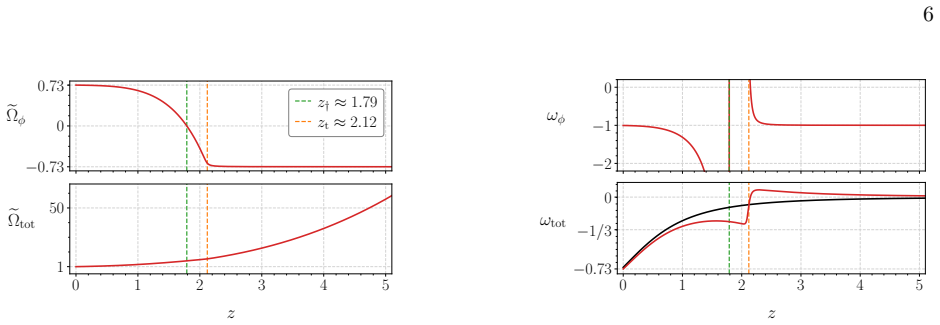
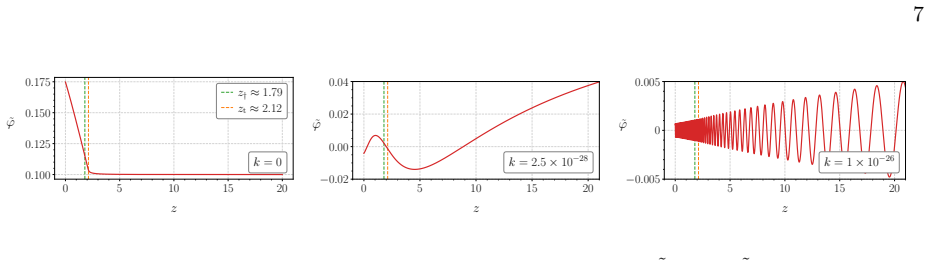
Ph-Λ_s CDM is realized by a phantom scalar field evolving on a bounded hyperbolic-tangent potential that induces a smooth mirror AdS-to-dS transition in the late-time dark-energy density. The wrong-sign kinetic term lifts the field from a negative- to a positive-energy vacuum-like regime. The cosmology remains controlled: total energy stays positive, the late-time attractor is de Sitter rather than a Big Rip, and the dynamics remain safely infrared.
What carries the argument
The phantom scalar with wrong-sign kinetic term evolving on the bounded hyperbolic-tangent potential, which supplies the mechanism for lifting the field across the zero-energy threshold.
If this is right
- Total energy density remains positive at every stage of the transition.
- The universe reaches a de Sitter attractor instead of a Big Rip.
- The phantom field can exert repulsive gravitational effects while its energy density is negative.
- The background dynamics stay free of infrared instabilities.
Where Pith is reading between the lines
- The same scalar dynamics could be confronted with supernova or BAO data to check whether the predicted transition redshift aligns with existing tension resolutions.
- Embedding the potential in a multi-field setup might allow simultaneous addressing of early- and late-time discrepancies without additional fine-tuning.
- Analytic continuation of the tanh potential to other bounded shapes could generate families of models with different transition speeds.
Load-bearing premise
The phantom scalar with the wrong-sign kinetic term on the chosen tanh potential yields stable infrared-safe dynamics with positive total energy throughout the transition.
What would settle it
A measurement of the dark-energy equation-of-state parameter that shows a sign change in its density contribution at low redshift while the Hubble parameter remains positive and the expansion history avoids a future singularity.
Figures

read the original abstract
We present Ph-$\Lambda_{\rm s}$CDM, a phantom-scalar realization within General Relativity of the sign-switching cosmological-constant idea, $\Lambda_{\rm s}$CDM, in which a phantom scalar evolving on a bounded hyperbolic-tangent potential induces a smooth mirror AdS-to-dS transition in the late-time dark-energy density. The wrong-sign kinetic term, usually viewed as pathological, becomes the mechanism lifting the field from a negative- to a positive-energy vacuum-like regime. The construction also shows that the field can become repulsive while its energy density is still negative. The cosmology nevertheless remains controlled: total energy stays positive, the late-time attractor is de Sitter rather than a Big Rip, and the dynamics remain safely infrared. Ph-$\Lambda_{\rm s}$CDM thus offers a concrete late-time mechanism with the potential to address multiple cosmological tensions.
Editorial analysis
A structured set of objections, weighed in public.
Referee Report
Summary. The manuscript proposes Ph-Λ_sCDM, a phantom-scalar realization of the sign-switching cosmological-constant idea (Λ_sCDM) within general relativity. A phantom field with negative kinetic term evolves on a bounded hyperbolic-tangent potential and induces a smooth late-time transition of the dark-energy density from an AdS-like (negative) to a dS-like (positive) regime. The authors claim that this construction keeps the total energy density strictly positive at all times, renders the late-time attractor exactly de Sitter (no Big Rip), and maintains infrared-safe dynamics, thereby offering a controlled mechanism that may address multiple cosmological tensions.
Significance. If the positivity and stability assertions are verified by explicit solution of the Friedmann and Klein-Gordon equations, the work would supply a concrete, late-time realization of sign-switching dark energy that repurposes the phantom kinetic term as a lifting mechanism rather than a pathology. This could be of interest for tension-resolution scenarios that require a controlled AdS-to-dS transition without additional fields or modifications to gravity. The significance is reduced, however, by the observation that the desired behavior appears to be built into the choice of bounded tanh potential and wrong-sign kinetic term.
major comments (2)
- [Abstract] Abstract: The central claim that 'total energy stays positive' and 'the dynamics remain safely infrared' throughout the transition is stated without any explicit Friedmann or Klein-Gordon equation, stability analysis, or numerical check. Because this positivity condition is load-bearing for the assertion of a 'controlled cosmology,' its absence prevents verification of the model's viability.
- [Abstract] Abstract: The statement that the late-time attractor is de Sitter rather than a Big Rip is presented as following from the bounded tanh potential, yet no derivation is supplied showing that ρ_total > 0 holds for generic initial conditions or across the parameter ranges of the potential. This leaves open whether the 'no Big Rip' outcome is independent or follows tautologically from the model definition.
minor comments (1)
- The abstract would be strengthened by the inclusion of at least the explicit form of the potential V(φ) and the Friedmann equation used, even if only in schematic form, to allow immediate assessment of the energy-density sign.
Simulated Author's Rebuttal
We thank the referee for their detailed reading and comments on the abstract. We respond point-by-point below, clarifying that the full manuscript contains the requested derivations and checks while agreeing to improve the abstract for clarity.
read point-by-point responses
-
Referee: [Abstract] Abstract: The central claim that 'total energy stays positive' and 'the dynamics remain safely infrared' throughout the transition is stated without any explicit Friedmann or Klein-Gordon equation, stability analysis, or numerical check. Because this positivity condition is load-bearing for the assertion of a 'controlled cosmology,' its absence prevents verification of the model's viability.
Authors: The abstract summarizes results whose derivations appear in the body of the paper. Explicit Friedmann and Klein-Gordon equations are given in Section II, the stability analysis is performed in Section III, and numerical solutions confirming ρ_total > 0 together with infrared safety for representative initial conditions are shown in Section IV. We will revise the abstract to add a parenthetical reference to these sections. revision: yes
-
Referee: [Abstract] Abstract: The statement that the late-time attractor is de Sitter rather than a Big Rip is presented as following from the bounded tanh potential, yet no derivation is supplied showing that ρ_total > 0 holds for generic initial conditions or across the parameter ranges of the potential. This leaves open whether the 'no Big Rip' outcome is independent or follows tautologically from the model definition.
Authors: Section III.B contains the analytic demonstration that the bounded tanh potential yields a de Sitter fixed point with ρ_total remaining positive; this is cross-checked numerically over a range of initial conditions and potential parameters in Section IV. The verification requires solving the coupled system and is therefore not tautological, although the potential form is of course chosen to realize the desired transition. We will revise the abstract to indicate that these derivations are supplied in the main text. revision: yes
Circularity Check
No significant circularity; model dynamics derived from standard equations
full rationale
The paper defines Ph-Λ_sCDM as a phantom scalar on a bounded tanh potential within GR and derives the AdS-to-dS transition, positive total energy, and de Sitter attractor directly from the Friedmann and Klein-Gordon equations applied to that ansatz. No quoted steps reduce the claimed outcomes to inputs by construction, no fitted parameters are relabeled as predictions, and no load-bearing self-citations or uniqueness theorems are invoked in the provided text. The control over instabilities and absence of Big Rip follow as consequences of solving the model equations rather than tautological redefinitions. This is a standard self-contained model construction.
Axiom & Free-Parameter Ledger
free parameters (1)
- tanh potential parameters
axioms (2)
- standard math General relativity governs the background cosmology
- domain assumption Phantom scalar with wrong-sign kinetic term is physically allowable in this context
invented entities (1)
-
Ph-Λ_sCDM model
no independent evidence
Reference graph
Works this paper leans on
-
[1]
R. R. Caldwell, A Phantom Menace? Cosmological consequences of a dark energy component with super-negative EoS.Phys. Lett. B545, 23 (2002), arXiv:astro-ph/9908168
Pith/arXiv arXiv 2002
-
[2]
S. M. Carroll, M. Hoffman, and M. Trodden, Can the dark energy equation-of-state parameterωbe less than−1?Phys. Rev. D68, 023509 (2003), arXiv:astro-ph/0301273
Pith/arXiv arXiv 2003
-
[3]
R. R. Caldwell, M. Kamionkowski, and N. N. Weinberg, Phantom Energy: Dark Energy withw <−1 Causes a Cosmic Doomsday.Phys. Rev. Lett.91, 071301 (2003), arXiv:astro-ph/0302506
Pith/arXiv arXiv 2003
-
[4]
J. M. Cline, S. Jeon, and G. D. Moore, The Phantom Menace: Constraints on low-energy effective ghosts.Phys. Rev. D70, 043543 (2004), arXiv:hep-ph/0311312
Pith/arXiv arXiv 2004
-
[5]
N. Arkani-Hamed, H.-C. Cheng, M. A. Luty, and S. Mukohyama, Ghost Condensation and a Consistent Infrared Modification of Gravity.JHEP0405, 074 (2004), arXiv:hep-th/0312099
Pith/arXiv arXiv 2004
-
[6]
F. Piazza and S. Tsujikawa, Dilatonic ghost condensate as dark energy.JCAP0407, 004 (2004), arXiv:hep-th/0405054 [hep-th]
Pith/arXiv arXiv 2004
-
[7]
L. Perivolaropoulos and F. Skara, Challenges for ΛCDM: An update.New Astron. Rev.95, 101659 (2022), arXiv:2105.05208 [astro-ph.CO]. 10
Pith/arXiv arXiv 2022
-
[8]
E. Abdalla, G. Franco Abell´ an, A. Aboubrahim, A. Agnello,¨O. Akarsu Y. Akrami, G. Alestas, D. Aloni, L. Amendola, and L. A. Anchordoquiet al., Cosmology intertwined: A review of the particle physics, astrophysics, and cosmology associated with the cosmological tensions and anomalies.JHEAp34, 49 (2022), doi:10.1016/j.jheap.2022.04.002, arXiv:2203.06142 [...
work page internal anchor Pith review Pith/arXiv arXiv doi:10.1016/j.jheap.2022.04.002 2022
- [9]
-
[10]
E. Di Valentinoet al.(CosmoVerse Network), The CosmoVerse White Paper: Addressing observational tensions in cosmology with systematics and fundamental physics.Phys. Dark Univ.49, 101965 (2025), arXiv:2504.01669 [astro-ph.CO]
Pith/arXiv arXiv 2025
- [11]
- [12]
- [13]
- [14]
-
[15]
E. A. Paraskevas, A. Cam, L. Perivolaropoulos, and ¨O. Akarsu Transition dynamics in the ΛsCDM model: Implications for bound cosmic structures.Phys. Rev. D109, 103522 (2024), arXiv:2402.05908 [astro-ph.CO]
arXiv 2024
- [16]
-
[17]
L. A. Escamilla, ¨O. Akarsu, E. Di Valentino, E.¨Oz¨ ulker, and J. A. Vazquez, Exploring the Growth-Index (γ) Tension with Λ sCDM. arXiv:2503.12945 [astro-ph.CO]
-
[18]
¨O. Akarsu, E. Di Valentino, J. Vyskoˇ cil, E. Yılmaz, A. E. Y¨ ukselci, and A. Zhuk, Nonlinear Matter Power Spectrum from relativisticN-body Simulations: Λ sCDM versus ΛCDM. arXiv:2510.18741 [astro- ph.CO]
- [19]
-
[20]
W. Elbers, C. S. Frenk, A. Jenkins, B. Li, and S. Pascoli, Negative neutrino masses as a mirage of dark energy.Phys. Rev. D111, 063534 (2025), doi:10.1103/PhysRevD.111.063534, arXiv:2407.10965 [astro-ph.CO]. 11
-
[21]
W. Elbers, A. Aviles, H. E. Noriega, D. Chebat, A. Menegas, C. S. Frenk, C. Garcia-Quintero, D. Gon- zalez, M. Ishak, and O. Lahavet al., Constraints on neutrino physics from DESI DR2 BAO and DR1 full shape.Phys. Rev. D112, 083513 (2025), arXiv:2503.14744 [astro-ph.CO]
Pith/arXiv arXiv 2025
-
[22]
L. A. Anchordoqui, I. Antoniadis, and D. Lust, Anti-de Sitter→de Sitter transition driven by Casimir forces and mitigating tensions in cosmological parameters.Phys. Lett. B855, 138775 (2024), arXiv:2312.12352 [hep-th]
arXiv 2024
-
[23]
L. A. Anchordoqui, I. Antoniadis, D. Lust, N. T. Noble, and J. F. Soriano, From infinite to infinitesimal: Using the universe as a dataset to probe Casimir corrections to the vacuum energy from fields inhabiting the dark dimension.Phys. Dark Univ.46, 101715 (2024), arXiv:2404.17334 [astro-ph.CO]
arXiv 2024
-
[24]
L. A. Anchordoqui, I. Antoniadis, D. Bielli, A. Chatrabhuti, and H. Isono, Thin-wall vacuum de- cay in the presence of a compact dimension meets the H 0 and S 8 tensions.JHEP07, 021 (2025), arXiv:2410.18649 [hep-th]
arXiv 2025
-
[25]
J. F. Soriano, S. Wohlberg, and L. A. Anchordoqui, New insights on a sign-switching Λ.Phys. Dark Univ.48, 101911 (2025), arXiv:2502.19239 [astro-ph.CO]
arXiv 2025
-
[26]
¨O. Akarsu, A. De Felice, E. Di Valentino, S. Kumar, R. C. Nunes, E. ¨Oz¨ ulker, J. A. Vazquez, and A. Yadav, ΛsCDM cosmology from a type-II minimally modified gravity.Mon. Not. Roy. Astron. Soc. 546, staf2276 (2026), arXiv:2402.07716 [astro-ph.CO]
Pith/arXiv arXiv 2026
- [27]
-
[28]
A. De Felice, A. Doll, and S. Mukohyama, A theory of type-II minimally modified gravity.JCAP09, 034 (2020), doi:10.1088/1475-7516/2020/09/034, arXiv:2004.12549 [gr-qc]
- [29]
-
[30]
M. S. Souza, A. M. Barcelos, R. C. Nunes, ¨O. Akarsu, and S. Kumar, Mapping the Λ sCDM Scenario to f(T) Modified Gravity: Effects on Structure Growth Rate.Universe11, 2 (2025), arXiv:2501.18031 [astro-ph.CO]
arXiv 2025
-
[31]
B. Alexandre, S. Gielen, and J. Magueijo, Overall signature of the metric and the cosmological constant. JCAP02, 036 (2024), arXiv:2306.11502 [hep-th]
arXiv 2024
- [32]
-
[33]
¨O. Akarsu, M. Eingorn, L. Perivolaropoulos, A. E. Y¨ ukselci, and A. Zhuk, Dynamical dark energy with AdS-dS transitions vs. Baryon Acoustic Oscillations atz≈2.3–2.4. Contribution to the bookOpen Issues in Gravitation and Cosmology: Original Contributions, Essays and Recollections in Honor of Alexei Starobinsky, arXiv:2504.07299 [astro-ph.CO]. 12
-
[34]
S. A. Adil, M. A. Zapata, ¨O. Akarsu, and J. A. Vazquez, Background-level reconstruction of scalar-field potentials from dark-energy histories and comparison with analytic potential families. arXiv:2603.14693 [astro-ph.CO]
- [35]
-
[36]
M. G¨ ok¸ cen,¨O. Akarsu, and E. Di Valentino, Revisiting CPL with sign-switching density: To cross or not to cross the NECB.Phys. Dark Univ.52, 102273 (2026), arXiv:2602.21169 [astro-ph.CO]
arXiv 2026
-
[37]
Aghanimet al.[Planck], Planck 2018 results
N. Aghanimet al.[Planck], Planck 2018 results. VI. Cosmological parameters.Astron. Astrophys.641, A6 (2020), [erratum:Astron. Astrophys.652, C4 (2021)], arXiv:1807.06209 [astro-ph.CO]
Pith/arXiv arXiv 2018
-
[38]
A. G. Riess, W. Yuan, L. M. Macri, D. Scolnic, D. Brout, S. Casertano, D. O. Jones, Y. Murakami, L. Breuval, and T. G. Brinket al., A Comprehensive Measurement of the Local Value of the Hubble Constant with 1 km s −1 Mpc−1 Uncertainty from the Hubble Space Telescope and the SH0ES Team. Astrophys. J. Lett.934, L7 (2022), arXiv:2112.04510 [astro-ph.CO]
Pith/arXiv arXiv 2022
-
[39]
R. R. Caldwell and E. V. Linder, Null Impact of the Null Energy Condition in Current Cosmology. arXiv:2511.07526 [astro-ph.CO]
-
[40]
C. L. Steinhardt, P. Capak, D. Masters, and J. Speagle, The impossibly early galaxy problem.Astrophys. J.824, 21 (2016), arXiv:1506.01377 [astro-ph.GA]
Pith/arXiv arXiv 2016
-
[41]
M. Boylan-Kolchin, Stress testing ΛCDM with high-redshift galaxy candidates.Nature Astronomy7, 731 (2023), arXiv:2208.01611 [astro-ph.CO]
arXiv 2023
-
[42]
J. Matthee, R. P. Naidu, G. Brammer, J. Chisholm, A. C. Eilers, A. Goulding, J. Greene, D. Kashino, I. Labbe, and S. J. Lillyet al., Little Red Dots: An Abundant Population of Faint Active Galactic Nuclei at z∼5 Revealed by the EIGER and FRESCO JWST Surveys.Astrophys. J.963, 129 (2024), arXiv:2306.05448 [astro-ph.GA]
arXiv 2024
-
[43]
V. Rusakov, D. Watson, G. P. Nikopoulos, G. Brammer, R. Gottumukkala, T. Harvey, K. E. Heintz, et al., Little red dots as young supermassive black holes in dense ionized cocoons.Nature649(2026), arXiv:2503.16595 [astro-ph.GA]
arXiv 2026
discussion (0)
Sign in with ORCID, Apple, or X to comment. Anyone can read and Pith papers without signing in.