REVIEW 4 major objections 4 minor 34 references
From Fog to Failure: The Unintended Consequences of Dehazing on Object Detection in Clear Images
T0 review · 4 major / 4 minor · reviewed 2026-08-09 · deepseek-v4-flash
Pith's one-line read Selective dehazing of detected regions helps object detection in fog but degrades it on clear images.
desk verdict An internally contradictory workshop paper: the headline inverse-trend result is undercut by its own appendix, so the paper needs major revision and targeted ablations before the claim can be trusted. read the letter →
The pith
A machine-rendered reading of the paper's core claim, the machinery that carries it, and where it could break.
The reading
What carries the argument
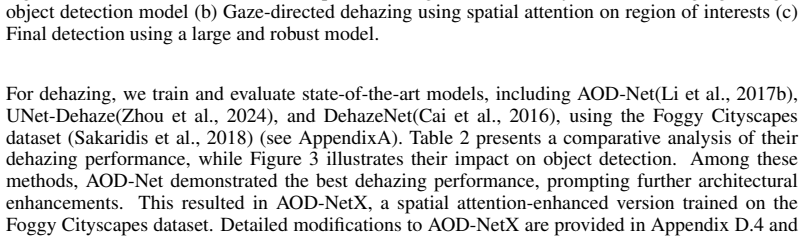
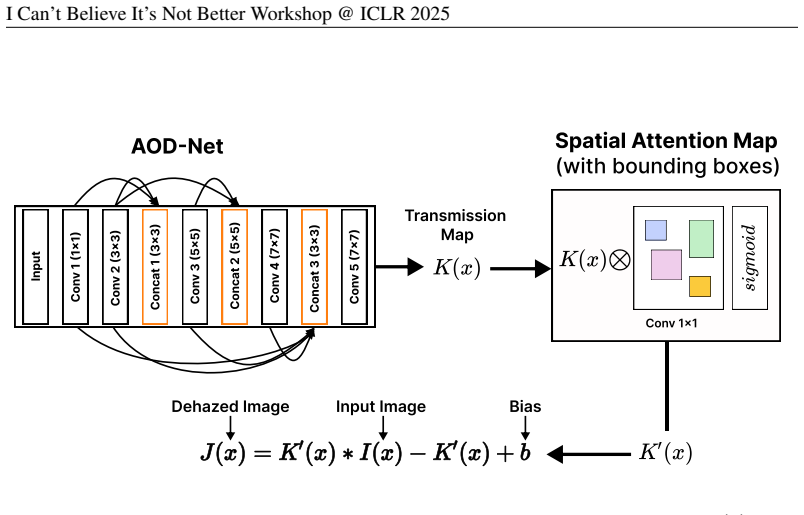
The load-bearing object is AOD-NetX, a modification of the AOD-Net dehazing network. Standard AOD-Net takes a hazy input and directly estimates a transmission map $K(x)$ under the atmospheric scattering model; AOD-NetX adds a spatial attention layer built from the bounding boxes that the lightweight detector (YOLOv5s or YOLOv8n) outputs. A sigmoid maps each box's attention weight to $[0,1]$, each region is treated independently, and the attention-weighted transmission map $K'(x)$ is used to dehaze the image. The final heavy detector then runs on the selectively dehazed image. This mechanism is what isolates the paper's claim: the global AOD-Net baseline actually improves clear mAP, so the clear-image penalty appears only when dehazing is attention-gated and trained only on fog.
What would settle it
Run AOD-NetX on a clear-image set under three conditions: the original selective attention, an all-ones attention map (global dehazing), and no dehazing. If all-ones keeps clear mAP near baseline while selective attention drops it, the paper's selectivity explanation is supported; if both drop, the penalty is a domain-mismatch artifact. As a second check, retrain AOD-NetX on a mix of clear and foggy images and re-measure Table 1; the inverse trend should disappear if fog overfitting is the cause.
Extended reading notes
Core claim
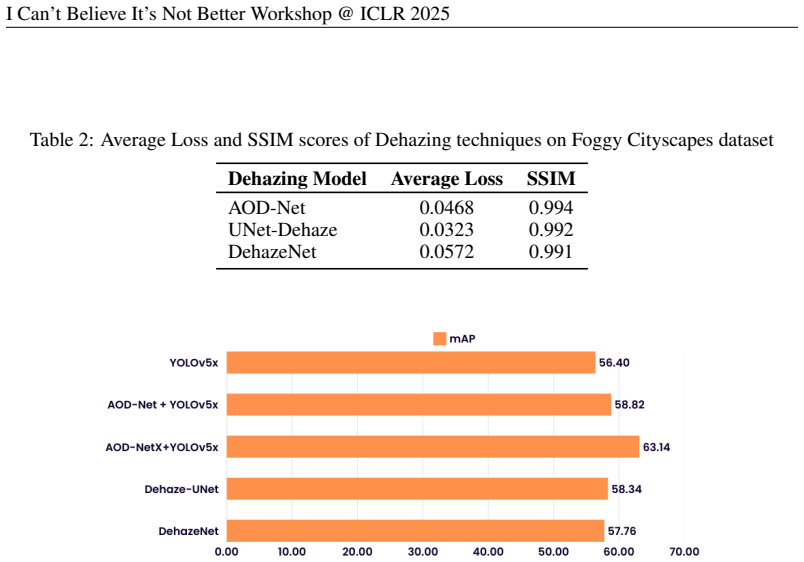
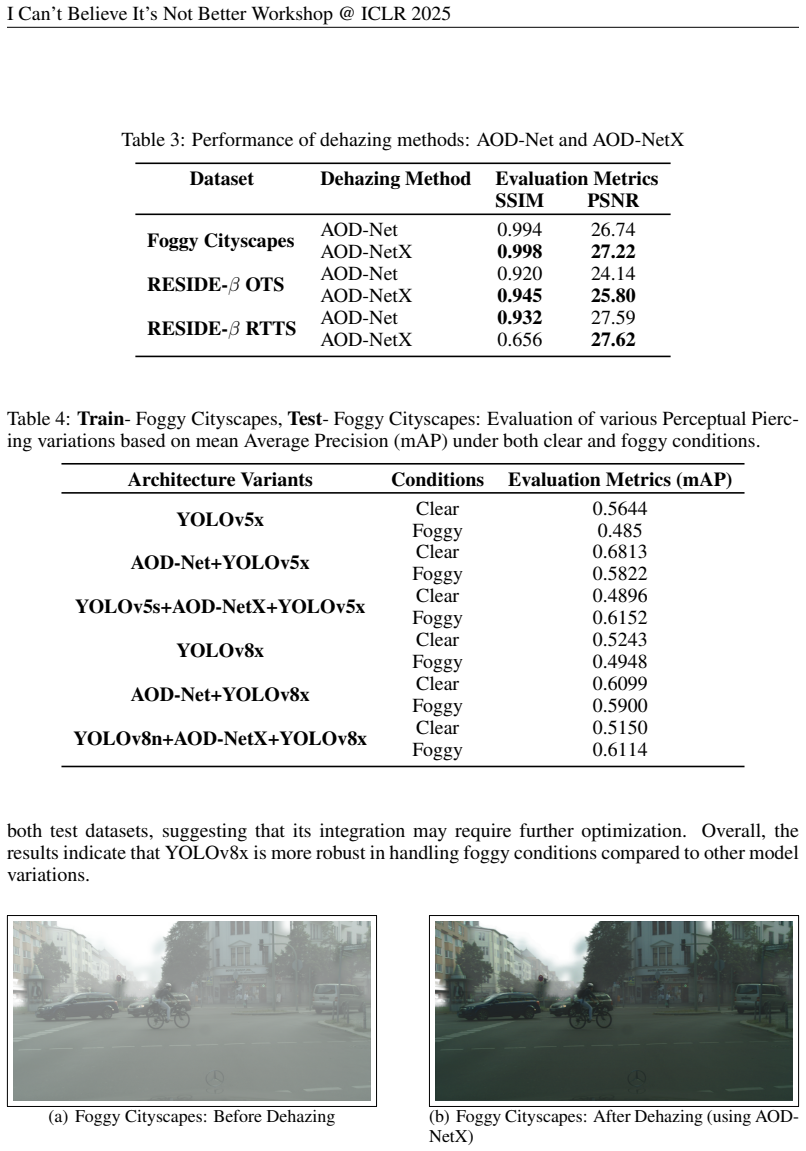
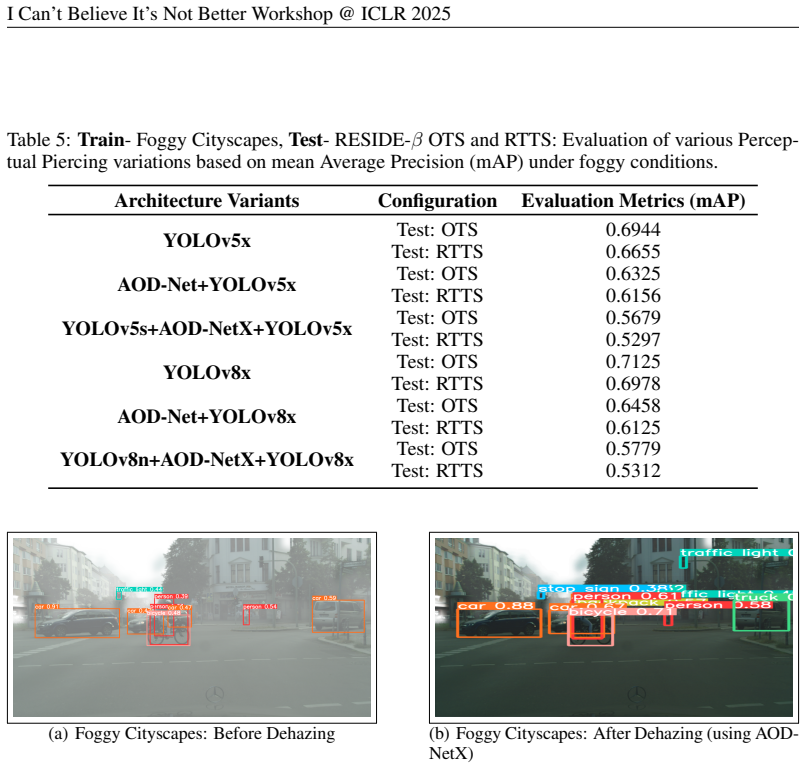
The paper's central finding is that AOD-NetX integration reverses the normal clear-to-foggy performance direction. Where baseline YOLOv5x drops from 0.5644 clear mAP to 0.4850 foggy mAP, and global AOD-Net + YOLOv5x drops from 0.6813 to 0.5822, the selective pipeline YOLOv5s + AOD-NetX + YOLOv5x scores 0.4896 clear and 0.6152 foggy. The same shape appears with YOLOv8n + AOD-NetX + YOLOv8x: 0.5150 clear versus 0.6114 foggy. The paper reads these numbers as an implicit domain-adaptation effect: AOD-NetX's features are optimized for haze removal and therefore distort clear images, while helping foggy ones. It also confirms that the benefit is dataset-specific, because on the RESIDE-$\beta$ OTS and RTTS out-of-distribution sets the AOD-NetX variants fall below their baselines.
Load-bearing premise
The load-bearing assumption is that the spatial attention map built from the lightweight detector's bounding boxes is a faithful implementation of selective region enhancement, so the clear-image penalty is caused by that selectivity combined with fog-only training, not by applying a fog-trained network to clear inputs.
Editorial extensions
If this is right
- Deploying a fog-optimized selective dehazer in an always-on system would trade clear-weather accuracy for foggy-weather accuracy, so a domain or haze-level gate is needed before enhancement is applied.
- AOD-NetX's foggy gains do not transfer across fog distributions: on RESIDE-$\beta$ OTS and RTTS, the AOD-NetX variants score below the YOLOv5x and YOLOv8x baselines, so the phenomenon is not a general fog benefit.
- The contrast with global AOD-Net indicates that the clear-image degradation is tied to the selective attention mechanism and its fog-only training, not to dehazing as such.
- Training or fine-tuning the whole enhancement-plus-detection pipeline jointly, or adding clear images to the dehazer's training set, becomes a necessary design step rather than an optional refinement.
Reading between the lines
- The paper does not fully isolate the attention mask from the training-domain mismatch; if a fog-only-trained dehazer distorts clear pixels regardless of where it is applied, the clear-image penalty would not be evidence against selective enhancement specifically.
- A natural experiment the paper leaves implicit is to set AOD-NetX's attention map to all ones on clear images and compare with the selective map: equal degradation would point to domain mismatch, while unequal degradation would point to the mask.
- The inverse trend could be partly a paired-data artifact, because the clear images in Foggy Cityscapes are the same scenes used to make the foggy images; testing on an independent clear benchmark would settle how much of the clear penalty is real.
Editorial analysis
A structured set of objections, weighed in public.
Referee Report
Summary. The paper proposes a multi-stage detection pipeline ("Perceptual Piercing") in which a lightweight detector identifies RoIs, AOD-NetX (a spatial-attention-enhanced dehazer) processes only those regions, and a heavy detector performs final recognition. The headline empirical claim, in Section 4 and Table 1, is that this selective pipeline exhibits an inverse trend: it improves mAP on foggy images relative to clear images (e.g., +25.68% for YOLOv5s+AOD-NetX+YOLOv5x), whereas conventional detectors and global AOD-Net integration show the expected clear-to-foggy drop. The paper interprets this as an implicit domain adaptation effect and discusses trade-offs of cascaded enhancement. However, the evidence for the causal role of selective region enhancement is incomplete, and the manuscript contains a direct internal contradiction between Table 1/Table 4 and the textual claim in Appendix F.1. The out-of-distribution results in Table 5 also weaken the "effective in foggy conditions" framing.
Significance. If the inverse trend is robust, the paper points to a genuinely surprising interaction between selective dehazing and object detection, with implications for autonomous driving and other vision pipelines that chain image restoration with high-level tasks. The paper ships an open implementation and evaluates across two YOLO families, three dehazing backbones, and multiple datasets, which is a useful empirical contribution. Yet the central causal interpretation is currently underdetermined: the AOD-NetX pipeline differs from the AOD-Net baselines in both architecture and RoI masking, and no ablation isolates the selective attention mechanism. The internal contradiction in Appendix F.1 and the OOD results in Table 5 are serious enough that the paper's main conclusion cannot be accepted as stated.
major comments (4)
- [Section 4, Table 1; Section 5; Appendix D.4] The central claim that selective region enhancement degrades clear-image detection is not supported by the presented comparisons. The AOD-Net+YOLOv5x row (clear mAP 0.6813) and the YOLOv5s+AOD-NetX+YOLOv5x row (clear mAP 0.4896) differ in two confounded ways: the dehazing architecture (AOD-NetX adds a spatial attention module) and the RoI-masked application of dehazing, in addition to the lightweight detector stage. No ablation keeps AOD-NetX fixed and removes only the RoI-derived attention mask. Without such a control, the clear-image penalty cannot be attributed to selective region enhancement rather than to applying a fog-trained dehazer (with its modified architecture) to clear inputs. Please add this ablation or explicitly reframe the conclusion as a property of the full pipeline, not of selectivity.
- [Appendix F.1, Table 4] There is a direct internal contradiction: Appendix F.1 states that "the integration of dehazing modules, such as AOD-Net and AOD-NetX, consistently enhances object detection in both clear and foggy conditions," but Table 4 shows that AOD-NetX integration reduces clear mAP from 0.5644 to 0.4896 for YOLOv5x and from 0.5243 to 0.5150 for YOLOv8x. This is not a minor wording issue; it undermines the paper's explanation of the inverse trend. Please correct the text and clarify whether AOD-NetX has a net positive or negative effect on clear images.
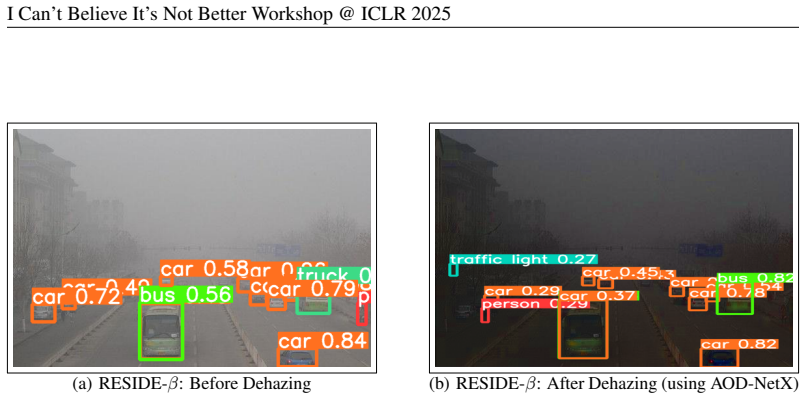
- [Appendix F.2, Table 5] The out-of-distribution evaluation contradicts the unqualified claim that the proposed pipeline is "effective in foggy conditions." On RESIDE-β RTTS, YOLOv5s+AOD-NetX+YOLOv5x achieves mAP 0.5297 versus 0.6655 for the baseline YOLOv5x, and the AOD-NetX variants are consistently below their baselines on both OTS and RTTS. If the claim of foggy-domain effectiveness is meant only for the in-distribution Foggy Cityscapes benchmark, that scope limitation must be stated prominently in the abstract and Section 4; otherwise the paper overclaims robustness.
- [Section 4, Table 1; Appendix F] No error bars, repeated-seed runs, or statistical significance measures are reported for any mAP value. The central observation is a relative change in mAP (e.g., 0.4896 vs. 0.6152 for YOLOv5s+AOD-NetX+YOLOv5x), and without variance information it is impossible to assess whether the "inverse trend" is a stable effect or within run-to-run noise. Please report at least three independent runs or provide error estimates for the key configurations in Table 1.
minor comments (4)
- [Abstract and Section 4] The phrase "effective in foggy conditions" should be qualified as "effective on in-distribution Foggy Cityscapes," given the RTTS results in Table 5.
- [Appendix D.3] The text says DehazeNet's architecture is "illustrated in Figure 5," but Figure 5 shows dehazing performance on Foggy Cityscapes, not the DehazeNet architecture; the figure reference appears to be incorrect.
- [References] The AOD-Net reference appears twice (Li et al., 2017a and 2017b), with the same title and venue; please consolidate.
- [Title and front matter] The title contains an odd hyphenation and spacing artifact ("CONSE - QUENCES"); the camera-ready version should fix this and other spacing issues.
Circularity Check
No significant circularity; the inverse trend is an empirical measurement and the proposed explanation is post-hoc, not a derivation from fitted inputs.
full rationale
This paper does not derive a prediction from fitted parameters; it reports measured mAP, SSIM, and PSNR values across fixed, pre-trained modules (AOD-Net, YOLO variants) plus a modified AOD-NetX whose spatial-attention mask is computed from a lightweight detector's boxes. No equation in the paper equates an output metric to a fitted input, and no load-bearing claim is justified solely by a self-citation (the authors do not cite themselves). The 'implicit domain adaptation' explanation in Section 5 is post-hoc speculation about feature space, not a deduction from the experiment. The paper contains genuine experimental-design weaknesses—Table 1 lacks an ablation that removes only the RoI mask, and Appendix F.1 ('The integration of dehazing modules, such as AOD-Net and AOD-NetX, consistently enhances object detection in both clear and foggy conditions') contradicts Table 1's clear-image drop—but an inconsistent comparison is a correctness concern, not circularity. Appendix F.2 and Tables 3 and 5 provide external OOD benchmarks that are independent of the main claim. Therefore no circular step can be exhibited, and the appropriate score is 0.
Assumptions & free parameters
free parameters (2)
- AOD-NetX learned weights =
trained on Foggy Cityscapes
- Lightweight detector confidence threshold =
unspecified
assumptions (4)
- domain assumption Foggy Cityscapes synthetic fog images, generated from Cityscapes via depth-based transmission maps, are representative of real fog for evaluating dehazing.
- domain assumption Bounding boxes from the lightweight detector are a sufficient proxy for regions where dehazing is beneficial.
- domain assumption Pre-trained MS-COCO YOLO detectors can be applied directly to Cityscapes-derived images without fine-tuning.
- domain assumption The atmospheric scattering model underlying AOD-Net is valid for the synthetic fog in Foggy Cityscapes.
Cite this review
Pith. "Pith review of From Fog to Failure: The Unintended Consequences of Dehazing on Object Detection in Clear Images." pith.science (2026). https://pith.science/paper/XJW4D4VF
@misc{pith2026250202027,
  author       = {Pith},
  title        = {Pith review of: From Fog to Failure: The Unintended Consequences of Dehazing on Object Detection in Clear Images},
  year         = {2026},
  howpublished = {\url{https://pith.science/paper/XJW4D4VF}},
  note         = {Machine review of arXiv:2502.02027}
}
read the original abstract
This study explores the challenges of integrating human visual cue-based dehazing into object detection, given the selective nature of human perception. While human vision adapts dynamically to environmental conditions, computational dehazing does not always enhance detection uniformly. We propose a multi-stage framework where a lightweight detector identifies regions of interest (RoIs), which are then improved via spatial attention-based dehazing before final detection by a heavier model. Though effective in foggy conditions, this approach unexpectedly degrades the performance on clear images. We analyze this phenomenon, investigate possible causes, and offer insights for designing hybrid pipelines that balance enhancement and detection. Our findings highlight the need for selective preprocessing and challenge assumptions about universal benefits from cascading transformations.
Figures

Figures from the paper (4 more)
Reference graph
Works this paper leans on
-
[1]
Y . Atom, M. Ye, L. Ren, Y . Tai, and X. Liu. Color-wise attention network for low-light image en- hancement. In 2020 IEEE/CVF Conference on Computer Vision and Pattern Recognition Work- shops (CVPRW), pp. 2130–2139, Seattle, W A, USA,
work page 2020
-
[4]
doi: 10.1016/j.neuron.2012.01.010. S. Dodge and L. Karam. A study and comparison of human and deep learning recognition perfor- mance under visual distortions. In 2017 26th International Conference on Computer Communi- cation and Networks (ICCCN),
-
[10]
Boyi Li, Xiulian Peng, Zhangyang Wang, Jizheng Xu, and Dan Feng
doi: 10.1109/TIP.2018.2867951. Boyi Li, Xiulian Peng, Zhangyang Wang, Jizheng Xu, and Dan Feng. Aod-net: All-in-one dehazing network. In Proceedings of the IEEE international conference on computer vision , pp. 4770– 4778, 2017b. Zhiying Li, Shuyuan Lin, Zhongming Liang, Yongjia Lei, Zefan Wang, and Hao Chen. Pde: A real- time object detection and enhanci...
-
[13]
doi: 10.1109/JSEN. 2014.2306911. H. Lukanov, P. K¨onig, and G. Pipa. Biologically inspired deep learning model for efficient foveal- peripheral vision. Frontiers in Computational Neuroscience, 15,
-
[14]
doi: 10.3389/fncom.2021. 746204. D. Malowany and H. Guterman. Biologically inspired visual system architecture for object recogni- tion in autonomous systems. Algorithms, 13(7):167,
-
[15]
doi: 10.3390/a13070167. Jun Mao and Uthai Phommasak. Detecting foggy images and estimating the haze degree factor. Journal of Computer Science & Systems Biology, 7(06),
-
[18]
doi: 10.1175/ JTECH-D-21-0170.1. S. Krishna B V , B. Rajalakshmi, U. Dhammini, M. K. Monika, C. Nethra, and K. Ashok. Image de- hazing techniques for vision based applications - a survey. In 2023 International Conference for Advancement in Technology (ICONAT), pp. 1–5, Goa, India,
work page 2023
-
[19]
doi: 10.1109/ICONAT57137. 2023.10080156. L. E. van Dyck, R. Kwitt, S. J. Denzler, and W. R. Gruber. Comparing object recognition in humans and deep convolutional neural networks: An eye-tracking study. Frontiers in Neuroscience, 15,
Show all 34 references
-
[20]
doi: 10.3389/fnins.2021.750639. L. E. van Dyck, S. J. Denzler, and W. R. Gruber. Guiding visual attention in deep convolutional neural networks based on human eye movements. Frontiers in Neuroscience, 16,
2021
-
[21]
doi: 10.3389/fnins.2022.975639. X. Wu and Z. Gao. Based on the improved yolov8 pedestrian and vehicle detection under low- visibility conditions. In 2023 2nd International Conference on Artificial Intelligence and In- telligent Information Processing (AIIIP) , pp. 297–300, Han...
2022
-
[22]
doi: 10.1109/ AIIIP61647.2023.00063. J. Yang, J. Yang, L. Luo, Y . Wang, S. Wang, and J. Liu. Robust visual recognition in poor visibility conditions: A prior knowledge-guided adversarial learning approach. Electronics, 12(17):3711, 2023a. doi: 10.3390/electronics12173711. J. ...
2023
-
[23]
Yun Zhai and Mubarak Shah
doi: 10.1109/TIP.2020.2981922. Yun Zhai and Mubarak Shah. Visual attention detection in video sequences using spatiotemporal cues. In Proceedings of the 14th ACM international conference on Multimedia (MM ’06) , pp. 815–824, New York, NY , USA,
2020
-
[25]
arXiv:2311.16475. H. Zhang and V .M. Patel. Densely connected pyramid dehazing network. In Proceedings of the IEEE conference on computer vision and pattern recognition, pp. 3194–3203,
-
[26]
Zhang, Z
L. Zhang, Z. Zhai, L. Bai, Y . Li, W. Niu, and L. Yuan. Visual-inertial state estimation for the civil aircraft landing in low visibility conditions. In 2018 International Conference on Networking and Network Applications (NaNA), pp. 292–297, Xi’an, China,
2018
-
[27]
doi: 10.1109/NANA.2018. 8648726. X.-S. Zhang, S.-B. Gao, C.-Y . Li, and Y .-J. Li. A retina inspired model for enhancing visibility of hazy images. Frontiers in Computational Neuroscience, 9,
2018 doi
-
[29]
2023.3297218
doi: 10.1109/ACCESS. 2023.3297218. Hao Zhou, Zekai Chen, Qiao Li, and Tao Tao. Dehaze-unet: A lightweight network based on unet for single-image dehazing. Electronics, 13(11):2082,
2023
-
[31]
While significant research has been conducted on im- age dehazing and semantic scene understanding for clear-weather images, SFSU remains relatively underexplored
was developed to tackle the challenge of semantic foggy scene understanding (SFSU). While significant research has been conducted on im- age dehazing and semantic scene understanding for clear-weather images, SFSU remains relatively underexplored. Due to the challenges associa...
2019
-
[32]
Unlike softmax, which normalizes outputs across multiple regions, sigmoid is preferred in this context since each bounding box holds independent significance. D D EHAZING MODELS D.1 AOD-N ET AOD-Net (All-in-One Dehazing Network) is a convolutional neural network (CNN) designed...
2025
-
[33]
E O BJECT DETECTION MODELS The detection pipeline incorporates various YOLO models, each optimized for specific applications
Unlike softmax, which normalizes outputs across multiple regions, sigmoid is preferred as each bounding box holds independent significance. E O BJECT DETECTION MODELS The detection pipeline incorporates various YOLO models, each optimized for specific applications. YOLOv5s is ...
2025
-
[34]
Among the tested variants, the AOD-Net + YOLOv5x configuration achieved the highest mAP under clear conditions (0.6813)
The integration of dehazing modules, such as AOD-Net and AOD-NetX (detailed in Appendix C), consistently enhances object detection in both clear and foggy conditions. Among the tested variants, the AOD-Net + YOLOv5x configuration achieved the highest mAP under clear conditions...
2025
-
[2006]
doi: 10.1145/ 1180639.1180824
Association for Computing Machinery. doi: 10.1145/ 1180639.1180824. 6 I Can’t Believe It’s Not Better Workshop @ ICLR 2025 Yu-Wei Zhan, Fan Liu, Xin Luo, Liqiang Nie, Xin-Shun Xu, and Mohan Kankanhalli. Generat- ing human-centric visual cues for human-object interaction detect...
2025
-
[2011]
2011.6091977
doi: 10.1109/IEMBS. 2011.6091977. C. Liu, Q. Zhao, Y . Zhang, and K. Tan. Runway extraction in low visibility conditions based on sensor fusion method. IEEE Sensors Journal, 14(6):1980–1987, June
2011
-
[2012]
Bolun Cai, Xiangmin Xu, Kui Jia, Chunmei Qing, and Dacheng Tao
doi: 10.1109/LCOMM.2011.122211.112093. Bolun Cai, Xiangmin Xu, Kui Jia, Chunmei Qing, and Dacheng Tao. Dehazenet: An end-to-end system for single image haze removal. IEEE transactions on image processing , 25(11):5187– 5198,
2011 arXiv
-
[2014]
doi: 10.1109/ DASC.2014.6979422. B. Li, X. Peng, Z. Wang, J. Xu, and D. Feng. Aod-net: All-in-one dehazing network. InProceedings of the IEEE international conference on computer vision, pp. 4770–4778, 2017a. B. Li et al. Benchmarking single-image dehazing and beyond. IEEE Tra...
2014
-
[2015]
doi: 10.3389/fncom.2015. 00151. Y . Zheng, Y . Zhan, X. Huang, and G. Ji. Yolov5s fmg: An improved small target detection algorithm based on yolov5 in low visibility. IEEE Access, 11:75782–75793,
2015 doi
-
[2016]
doi: 10.1016/j.visres.2015.11.007. C. Sakaridis, D. Dai, and L. Van Gool. Semantic foggy scene understanding with synthetic data. International Journal of Computer Vision, 126:973–992,
2015 doi
-
[2017]
Yihua Fan, Yongzhen Wang, Mingqiang Wei, Fu Lee Wang, and Haoran Xie
doi: 10.1109/icccn.2017.8038465. Yihua Fan, Yongzhen Wang, Mingqiang Wei, Fu Lee Wang, and Haoran Xie. Friendnet: Detection- friendly dehazing network. arXiv preprint arXiv:2403.04443,
2017
-
[2018]
Rong Tang, Qian Li, and Shaoen Tang
doi: 10.1007/s11263-018-1072-8. Rong Tang, Qian Li, and Shaoen Tang. Comparison of visual features for image-based visi- bility detection. Journal of Atmospheric and Oceanic Technology , 39,
-
[2019]
doi: 10.1109/AERO.2019.8741787. L. J. Kramer et al. Using vision system technologies to enable operational improvements for low visibility approach and landing operations. In 2014 IEEE/AIAA 33rd Digital Avionics Systems Conference (DASC), pp. 2B2–1–2B2–17, Colorado Springs, CO, USA,
2019
-
[2020]
doi: 10.1109/CVPRW50498.2020. 00261. M. Boban, T. T. V . Vinhoza, O. K. Tonguz, and J. Barros. Seeing is believing—enhancing message dissemination in vehicular networks through visual cues. IEEE Communications Letters, 16(2): 238–241, February
2020
-
[2021]
doi: 10.1016/j.eswa.2020.114219. S. Khattak, C. Papachristos, and K. Alexis. Visual-thermal landmarks and inertial fusion for navi- gation in degraded visual environments. In 2019 IEEE Aerospace Conference, pp. 1–9, Big Sky, MT, USA,
2020
-
[2022]
2022.0131299
doi: 10.14569/IJACSA. 2022.0131299. 5 I Can’t Believe It’s Not Better Workshop @ ICLR 2025 P. Lieby et al. Substituting depth for intensity and real-time phosphene rendering: Visual navigation under low vision conditions. In 2011 Annual International Conference of the IEEE Eng...
2022
-
[2023]
Xiaochen Huang, Xiaofeng Wang, Qizhi Teng, Xiaohai He, and Honggang Chen
doi: 10.1109/TIM.2023.3304668. Xiaochen Huang, Xiaofeng Wang, Qizhi Teng, Xiaohai He, and Honggang Chen. Degradation type- aware image restoration for effective object detection in adverse weather. Sensors, 24(19):6330,
2023
-
[2024]
7 I Can’t Believe It’s Not Better Workshop @ ICLR 2025 A D ATASETS A.1 F OGGY CITY SCAPES The Foggy Cityscapes dataset (Sakaridis et al.,
2025
Reviewed August 9, 2026 · model on record in the stance chip above.
Discussion (0). Continue with ORCID to comment.