Absorption of Gravitons and Photon Luminosities of Interstellar/Intergalactic Hydrogen Atoms
Reviewed by Pith T0 review T1 audit T2 compute T3 formal T4 kernel 2026-07-02 23:29 UTCgrok-4.3pith:XK4O7MODrecord.jsonopen to challenge →
The pith
The ratio of photon luminosities from interstellar hydrogen atoms can reveal graviton luminosity and sources of gravitational radiation.
A machine-rendered reading of the paper's core claim, the machinery that carries it, and where it could break.
Core claim
Hydrogen atoms absorb gravitons at a rate proportional to both the atom count and the graviton luminosity; the resulting ratio of photon luminosities from these atoms therefore carries information about graviton luminosity in different regions of space and is sensitive to gravitational radiation sources.
What carries the argument
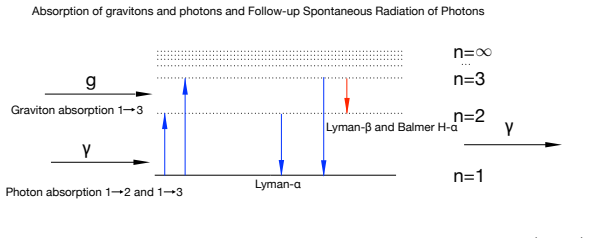
Resonant absorption of gravitons by hydrogen atoms whose transition energies overlap the eV-keV graviton luminosity range, combined with the helicity-dependent photon luminosity ratio.
If this is right
- Absorption rate grows linearly with hydrogen atom density and graviton luminosity.
- Photon luminosity ratios expose the helicity difference between photons and gravitons.
- The ratio provides a method to measure graviton luminosity treated as an unknown quantity.
- Any source of gravitational radiation produces a detectable change in the observed ratio.
Where Pith is reading between the lines
- Optical or UV observations of hydrogen lines in space could map graviton source distributions without dedicated graviton detectors.
- The approach connects atomic transition data directly to gravitational-wave astronomy through shared energy ranges.
- Similar ratios might be tested for other atoms whose resonances fall in comparable energy bands.
Load-bearing premise
Graviton luminosity from the Sun or typical stars lies in the eV to keV range that overlaps the resonance frequencies of hydrogen atoms.
What would settle it
Observation that photon luminosity ratios from interstellar hydrogen show no deviation in regions containing strong gravitational radiation sources.
Figures
read the original abstract
We compute the emission and absorption rates of gravitons by hydrogen atoms. The absorption rate of gravitons is proportional to the number of hydrogen atoms and to the graviton luminosity. The number of hydrogen atoms in interstellar/intergalactic media can be large while the graviton luminosity of Sun, or a typical star, is in the eV to keV range that well overlaps with the resonance frequencies of the hydrogen atoms. Currently, the observational knowledge of the graviton luminosity in different regions of the Universe is limited, and here we will consider its value as unknown quantity that should be determined by independent astrophysical observations. We suggest measuring the ratio of the photon luminosities from interstellar/intergalactic hydrogen atoms that can provide information concerning the luminosity of gravitons in different regions of space. This ratio maximally exposes the fundamental physical nature of photons and gravitons - their helicity, which is one for the photons and two for the gravitons. The ratio is sensitive to any sources of gravitational radiation and provide a possible method for measuring their radiation intensities.
Editorial analysis
A structured set of objections, weighed in public.
Referee Report
Summary. The manuscript claims to compute the emission and absorption rates of gravitons by hydrogen atoms. It states that the absorption rate is proportional to the number of hydrogen atoms and to the graviton luminosity. The authors propose that the ratio of photon luminosities from interstellar/intergalactic hydrogen atoms can provide information on the graviton luminosity in different regions of space; this ratio is asserted to be sensitive to sources of gravitational radiation and to maximally expose the helicity difference between photons (helicity 1) and gravitons (helicity 2). The graviton luminosity is treated as an unknown quantity to be constrained by independent observations.
Significance. If the central claims hold after the required calculations are supplied, the work would offer a novel astrophysical probe for graviton luminosities via hydrogen emission-line ratios, with potential sensitivity to helicity. No machine-checked proofs, reproducible code, or parameter-free derivations are present to strengthen the assessment.
major comments (3)
- [Abstract] Abstract: the assertion that 'the graviton luminosity of Sun, or a typical star, is in the eV to keV range that well overlaps with the resonance frequencies of the hydrogen atoms' is presented without derivation, spectrum calculation, production mechanism, or reference; this assumption is load-bearing for resonant absorption to occur at observable levels.
- [Abstract] Abstract: the statement that the photon-luminosity ratio 'maximally exposes' the helicity difference is made without explicit matrix-element derivation, rate formulas, or numerical verification showing how helicity 1 versus 2 enters the ratio.
- [Abstract] Abstract: the absorption rate is defined directly in terms of graviton luminosity, which the paper treats as an unknown to be determined by the very observations it proposes; this renders the 'prediction' of the photon-luminosity ratio circular and dependent on fitted input rather than an independent test.
minor comments (1)
- The explicit formulas for the claimed emission and absorption rates, including any matrix elements or error analysis, are not shown in the provided text and should be added with numbered equations.
Simulated Author's Rebuttal
We thank the referee for the careful reading of our manuscript and the constructive comments. We address each major comment point by point below, indicating where we agree that revisions are needed and where we maintain a different view on the substance.
read point-by-point responses
-
Referee: [Abstract] Abstract: the assertion that 'the graviton luminosity of Sun, or a typical star, is in the eV to keV range that well overlaps with the resonance frequencies of the hydrogen atoms' is presented without derivation, spectrum calculation, production mechanism, or reference; this assumption is load-bearing for resonant absorption to occur at observable levels.
Authors: We agree that the statement in the abstract requires additional justification. The full manuscript treats this as an order-of-magnitude estimate based on the energy scales of known gravitational processes, but no explicit spectrum or reference is supplied in the abstract. In the revised version we will add a short derivation or citation to relevant astrophysical mechanisms (e.g., high-frequency components from compact-object dynamics) to support the claimed overlap with hydrogen resonances. revision: yes
-
Referee: [Abstract] Abstract: the statement that the photon-luminosity ratio 'maximally exposes' the helicity difference is made without explicit matrix-element derivation, rate formulas, or numerical verification showing how helicity 1 versus 2 enters the ratio.
Authors: The claim follows from the distinct spin and helicity selection rules for vector versus tensor interactions with atomic states. To make this explicit, the revised manuscript will include the relevant matrix-element derivations and resulting rate formulas in a dedicated section, together with any numerical checks that illustrate the helicity dependence of the luminosity ratio. revision: yes
-
Referee: [Abstract] Abstract: the absorption rate is defined directly in terms of graviton luminosity, which the paper treats as an unknown to be determined by the very observations it proposes; this renders the 'prediction' of the photon-luminosity ratio circular and dependent on fitted input rather than an independent test.
Authors: We disagree that the approach is circular. The graviton luminosity is an independent quantity set by the distribution of gravitational-wave sources; the proposed ratio of photon luminosities is an observable that can be used to constrain that independent quantity. This is analogous to using line ratios to infer unseen radiation fields. We will revise the abstract and discussion to clarify the logical separation between the unknown luminosity and the proposed measurement method. revision: no
Circularity Check
No circularity; measurement proposal with luminosity treated as independent unknown
full rationale
The paper states it computes emission/absorption rates, notes absorption rate is proportional to graviton luminosity (explicitly called an unknown to be determined by observations), and proposes the photon-luminosity ratio as a probe sensitive to that luminosity and to helicity. This is a standard observational method, not a derivation that reduces by construction to its own inputs. No fitted parameters are renamed as predictions, no self-citations are load-bearing for a uniqueness claim, and the central suggestion does not equate the ratio to the luminosity input by definition. The eV-keV luminosity assumption is an external premise (potentially weak) but does not create circularity in the rate equations or ratio proposal.
Axiom & Free-Parameter Ledger
free parameters (1)
- graviton luminosity
axioms (2)
- standard math Gravitons carry helicity 2 and photons carry helicity 1
- domain assumption Stellar graviton luminosities fall in the eV-keV band overlapping hydrogen resonances
Reference graph
Works this paper leans on
-
[1]
Weinberg, S.: Derivation of gauge invariance and the equivalence principle from Lorentz invariance of the S- matrix. Phys. Lett.9(4), 357–359 (1964) https://doi. org/10.1016/0031-9163(64)90396-8
-
[2]
Weinberg, S.: Photons and Gravitons inS-Matrix Theory: Derivation of Charge Conservation and Equality of Gravitational and Inertial Mass. Phys. Rev.135, 1049–1056 (1964) https://doi.org/10.1103/PhysRev.135.B1049
-
[3]
Weinberg, S.: Infrared photons and gravitons. Phys. Rev.140, 516–524 (1965) https://doi.org/10.1103/PhysRev.140.B516
-
[4]
Weinberg, S.: Photons and gravitons in perturbation theory: Derivation of Maxwell’s and Einstein’s equations. Phys. Rev.138, 988–1002 (1965) https: //doi.org/10.1103/PhysRev.138.B988
-
[5]
The Astrophys- ical Journal288, 789–794 (1985) https://doi.org/10.1086/162848
Gould, R.J.: The graviton luminosity of the sun and other stars. The Astrophys- ical Journal288, 789–794 (1985) https://doi.org/10.1086/162848
-
[6]
Dyson, F.: Is a graviton detectable? Int. J. Mod. Phys. A28, 1330041 (2013) https://doi.org/10.1142/S0217751X1330041X 25
-
[7]
Nature Commun.15(1), 7229 (2024) https://doi.org/10
Tobar, G., Manikandan, S.K., Beitel, T., Pikovski, I.: Detecting single gravitons with quantum sensing. Nature Commun.15(1), 7229 (2024) https://doi.org/10. 1038/s41467-024-51420-8 arXiv:2308.15440 [quant-ph]
-
[8]
Rothman, T., Boughn, S.: Can gravitons be detected? Found. Phys.36, 1801–1825 (2006) https://doi.org/10.1007/s10701-006-9081-9 arXiv:gr-qc/0601043
work page internal anchor Pith review Pith/arXiv arXiv doi:10.1007/s10701-006-9081-9 2006
-
[9]
Boughn, S., Rothman, T.: Aspects of graviton detection: Graviton emission and absorption by atomic hydrogen. Class. Quant. Grav.23, 5839–5852 (2006) https: //doi.org/10.1088/0264-9381/23/20/006 arXiv:gr-qc/0605052
work page internal anchor Pith review Pith/arXiv arXiv doi:10.1088/0264-9381/23/20/006 2006
-
[10]
Marletto, C., Vedral, V.: Gravitationally-induced entanglement between two mas- sive particles is sufficient evidence of quantum effects in gravity. Phys. Rev. Lett.119(24), 240402 (2017) https://doi.org/10.1103/PhysRevLett.119.240402 arXiv:1707.06036 [quant-ph]
work page internal anchor Pith review Pith/arXiv arXiv doi:10.1103/physrevlett.119.240402 2017
-
[11]
In: Gravity, Strings and Fields: A Conference in Honour of Gordon Semenoff (2024)
Carney, D.: Comments on Graviton Detection. In: Gravity, Strings and Fields: A Conference in Honour of Gordon Semenoff (2024). https://doi.org/10.1007/ 978-3-031-91266-5 2
work page 2024
-
[12]
Manikandan, S.K., Wilczek, F.: Complementary probes of gravitational radiation states. Phys. Rev. A112(4), 043716 (2025) https://doi.org/10.1103/83tt-tt57 arXiv:2505.11422 [gr-qc]
-
[13]
Sitzungsberichte der K¨ oniglich Preussischen Akademie der Wissenschaften.1, 688–696 (1916)
Einstein, A.: N¨ aherungsweise Integration der Feldgleichungen der Gravitation. Sitzungsberichte der K¨ oniglich Preussischen Akademie der Wissenschaften.1, 688–696 (1916)
work page 1916
-
[14]
Sitzungsberichte der K¨ oniglich Preussis- chen Akademie der Wissenschaften., –154167 (1918)
Einstein, A.: ¨Uber gravitationswellen. Sitzungsberichte der K¨ oniglich Preussis- chen Akademie der Wissenschaften., –154167 (1918)
work page 1918
-
[15]
Einstein, A.: Zur Quantentheorie der Strahlung. Phys. Z.18, 121–128 (1917)
work page 1917
-
[16]
Dirac, P.A.M.: Quantum theory of emission and absorption of radiation. Proc. Roy. Soc. Lond. A114, 243 (1927) https://doi.org/10.1098/rspa.1927.0039
-
[17]
Fermi, E.: Quantum Theory of Radiation. Rev. Mod. Phys.4(1), 87–132 (1932) https://doi.org/10.1103/RevModPhys.4.87
-
[18]
The University of Chicago Press, Chicago (1960)
Fermi, E.: Notes on Quantum Mechanics. The University of Chicago Press, Chicago (1960)
work page 1960
-
[19]
Heisenberg, W., Euler, H.: Consequences of Dirac’s theory of positrons. Z. Phys.98(11-12), 714–732 (1936) https://doi.org/10.1007/BF01343663 arXiv:physics/0605038
work page internal anchor Pith review Pith/arXiv arXiv doi:10.1007/bf01343663 1936
-
[20]
Schwinger, J.S.: On gauge invariance and vacuum polarization. Phys. Rev.82, 664–679 (1951) https://doi.org/10.1103/PhysRev.82.664 26
-
[21]
DeWitt, B.S.: Quantum Theory of Gravity. 3. Applications of the Covariant The- ory. Phys. Rev.162, 1239–1256 (1967) https://doi.org/10.1103/PhysRev.162. 1239
-
[22]
Hooft, G., Veltman, M.J.G.: One-loop divergencies in the theory of gravitation. Ann. Inst. H. Poincare Phys. Theor. A20(1), 69–94 (1974) https://doi.org/10. 1142/9789814539395 0001
work page 1974
-
[23]
Goroff, M.H., Sagnotti, A.: The Ultraviolet Behavior of Einstein Gravity. Nucl. Phys. B266, 709–736 (1986) https://doi.org/10.1016/0550-3213(86)90193-8
-
[24]
Bunch, T.S., Davies, P.C.W.: Quantum Field Theory in de Sitter Space: Renor- malization by Point Splitting. Proc. Roy. Soc. Lond. A360, 117–134 (1978) https://doi.org/10.1098/rspa.1978.0060
-
[25]
Savvidy, G.K.: Infrared Instability of the Vacuum State of Gauge Theories and Asymptotic Freedom. Phys. Lett. B71, 133–134 (1977) https://doi.org/10.1016/ 0370-2693(77)90759-6
work page 1977
-
[26]
Matinyan, S.G., Savvidy, G.K.: Vacuum Polarization Induced by the Intense Gauge Field. Nucl. Phys. B134, 539–545 (1978) https://doi.org/10.1016/ 0550-3213(78)90463-7
work page 1978
-
[27]
Batalin, I.A., Matinyan, S.G., Savvidy, G.K.: Vacuum Polarization by a Source- Free Gauge Field. Sov. J. Nucl. Phys.26, 214 (1977)
work page 1977
- [28]
-
[29]
Green, M.B., Schwarz, J.H., Witten, E.: Superstring Theory. Vol. 1: Introduction. Cambridge Monographs on Mathematical Physics, (1988)
work page 1988
-
[30]
Green, M.B., Schwarz, J.H., Witten, E.: Superstring Theory. Vol. 2: Loop Ampli- tudes, Anomalies and Phenomenology. Cambridge Monographs on Mathematical Physics, (1988)
work page 1988
-
[31]
In: A.S.Blum, A., R.Dean (eds.) Berlin: Max-Planck-Gesellschaft zur F¨ orderung der Wissenschaften
Quantum gravity in the first half of the twentieth century: A sourcebook. In: A.S.Blum, A., R.Dean (eds.) Berlin: Max-Planck-Gesellschaft zur F¨ orderung der Wissenschaften. (2018)
work page 2018
-
[32]
Duality between helicity and Dirac quantization conditions
Savvidy, G.: Schwinger’s non-commutative coordinates for photons and gravitons. Duality between helicity and Dirac quantization conditions. J. Math. Phys.66(8), 082302 (2025) https://doi.org/10.1063/5.0279941 arXiv:2504.21529 [hep-th]
-
[33]
Course of Theoretical Physics, Publisher Pergamon, (1975) 27
Landau, L.D., Lifschitz, E.M.: vol.2: The Classical Theory of Fields (Fourth Edition) . Course of Theoretical Physics, Publisher Pergamon, (1975) 27
work page 1975
-
[34]
John Wiley and Sons, New York (1972)
Weinberg, S.: Gravitation and Cosmology: Principles and Applications of the General Theory of Relativity. John Wiley and Sons, New York (1972)
work page 1972
-
[35]
Classical and Quantum Gravity11, 463 (1994) https://doi.org/10
Fischer, U.: Transition probabilities for a rydberg atom in the field of a gravita- tional wave. Classical and Quantum Gravity11, 463 (1994) https://doi.org/10. 1088/0264-9381/11/2/018
work page 1994
-
[36]
Dyson, J.E., Williams, D.A.: The Physics of the Interstellar Medium . CRC Press, New York (2020). https://doi.org/10.1201/9781003025030
-
[37]
2024, NIST Atomic Spectra Database (version 5.12), Online, doi: 10.18434/T4W30F
Kramida, A., Ralchenko, Y., Reader, J., al.: NIST Atomic Spectra Database (version 5.12). National Institute of Standards and Technology, Gaithersburg, MD. (2026) https://doi.org/10.18434/T4W30F
-
[38]
Arvanitaki, A., Geraci, A.A.: Detecting high-frequency gravitational waves with optically levitated sensors. Phys. Rev. Lett.110, 071105 (2013) https://doi.org/ 10.1103/PhysRevLett.110.071105
-
[39]
Classical and Quantum Gravity6, 161 (1989) https://doi.org/10.1088/0264-9381/6/9/002
Grishchuk, L.P., Sidorov, Y.V.: On the quantum state of relic gravitons. Classical and Quantum Gravity6, 161 (1989) https://doi.org/10.1088/0264-9381/6/9/002
-
[40]
Bunker, e.a. Andrew J.: JADES NIRSpec Spectroscopy of GN-z11: Lyman-α emission and possible enhanced nitrogen abundance in a z = 10.60 luminous galaxy. Astronomy and Astrophysics677, 88 (2023) https://doi.org/10.1051/ 0004-6361/202346159 arXiv:2302.07256 [astro-ph.GA]
-
[41]
Heintz, e.a. K. E.: The JWST-PRIMAL archival survey: A JWST/NIRSpec ref- erence sample for the physical properties and Lyman-αabsorption and emission of∼600 galaxies at z = 5.0−13.4. Astronomy and Astrophysics693, 60 (2025) https://doi.org/10.1051/0004-6361/202450243 arXiv:2404.02211 [astro-ph.GA]
-
[42]
The Astrophysical Journal 950(1), 66 (2023) https://doi.org/10.3847/1538-4357/acc588
Kashino, D., Lilly, S.J., Matthee, J., Eilers, A.-C., Mackenzie, R., Bordoloi, R., Simcoe, R.A.: Eiger: A large sample of [o iii]-emitting galaxies at 5.3−6.9 and direct evidence for local reionization by galaxies. The Astrophysical Journal 950(1), 66 (2023) https://doi.org/10.3847/1538-4357/acc588
-
[43]
https://arxiv.org/abs/2306.00647
Heintz, K.E., Watson, D., Brammer, G., Vejlgaard, S., Hutter, A., Strait, V.B., Matthee, J., Oesch, P.A., Jakobsson, P., Tanvir, N.R., Laursen, P., Naidu, R.P., Mason, C.A., Killi, M., Jung, I., Hsiao, T.Y.-Y., Abdurro’uf, Coe, D., Haro, P.A., Finkelstein, S.L., Toft, S.: Extreme damped Lyman-αabsorption in young star- forming galaxies atz= 9−11 (2023). h...
-
[44]
Sanders, R.L., Shapley, A.E., Topping, M.W., Reddy, N.A., Brammer, G.B.: Direct te-based metallicities of z = 2−9 galaxies with jwst/nirspec: Empirical metallicity calibrations applicable from reionisation to cosmic noon. Astro- physical Journal962(1), 24 (2024) https://doi.org/10.3847/1538-4357/ad15fc arXiv:2303.08149 [astro-ph.GA] 28
work page internal anchor Pith review Pith/arXiv arXiv doi:10.3847/1538-4357/ad15fc 2024
-
[45]
Solar Energy76(4), 423–453 (2004) https: //doi.org/10.1016/j.solener.2003.08.039
Gueymard, C.A.: The sun’s total and spectral irradiance for solar energy appli- cations and solar radiation models. Solar Energy76(4), 423–453 (2004) https: //doi.org/10.1016/j.solener.2003.08.039
-
[46]
Delbouille, L., Roland, G., Brault, J., Testerman, L.: Photometric Atlas of the Solar Spectrum, (1981).http://bass2000.obspm.fr/solar spect.php
work page 1981
-
[47]
Applied Optics35(16), 2747–2751 (1996) https://doi.org/10.1364/AO.35.002747
Abrams, M.C., Goldman, A., Gunson, M.R., Rinsland, C.P., Zander, R.: Obser- vations of the infrared solar spectrum from space by the ATMOS experiment. Applied Optics35(16), 2747–2751 (1996) https://doi.org/10.1364/AO.35.002747
-
[48]
Asplund, M., Grevesse, N., Sauval, A.J., Scott, P.: The chemical composition of the sun. Annual Review of Astronomy and Astrophysics47(1), 481–522 (2009) https://doi.org/10.1146/annurev.astro.46.060407.145222
-
[49]
N.: The solar hydro- gen lyman-alpha lyman-beta ratio
Lemaire, P., Vial, J.-C., Curdt, W., Sch¨ uhle, U., Woods, T. N.: The solar hydro- gen lyman-alpha lyman-beta ratio. A&A542, 25 (2012) https://doi.org/10.1051/ 0004-6361/201219026
work page 2012
-
[50]
An Updated Characterization of Luminous Ly{\alpha} emitters at the End of Reionization
Ning, Y., Cai, Z., Jiang, L., Guo, Y., Li, Q., Yu, S.-Y., Yu, X., Zheng, Z.-Y.: An Updated Characterization of Luminous Lyman-alpha emitters at the End of Reionization (2026). https://arxiv.org/abs/2605.14313 29
work page internal anchor Pith review Pith/arXiv arXiv 2026
discussion (0)
Sign in with ORCID, Apple, or X to comment. Anyone can read and Pith papers without signing in.