LFQ: Logit-aware Final-block Quantization for Boosting the Generation Quality of Low-Bit Quantized LLMs
Pith reviewed 2026-06-29 07:36 UTC · model grok-4.3
The pith
Aligning token probabilities at the logit level in the final block boosts generation quality of low-bit quantized LLMs
A machine-rendered reading of the paper's core claim, the machinery that carries it, and where it could break.
Core claim
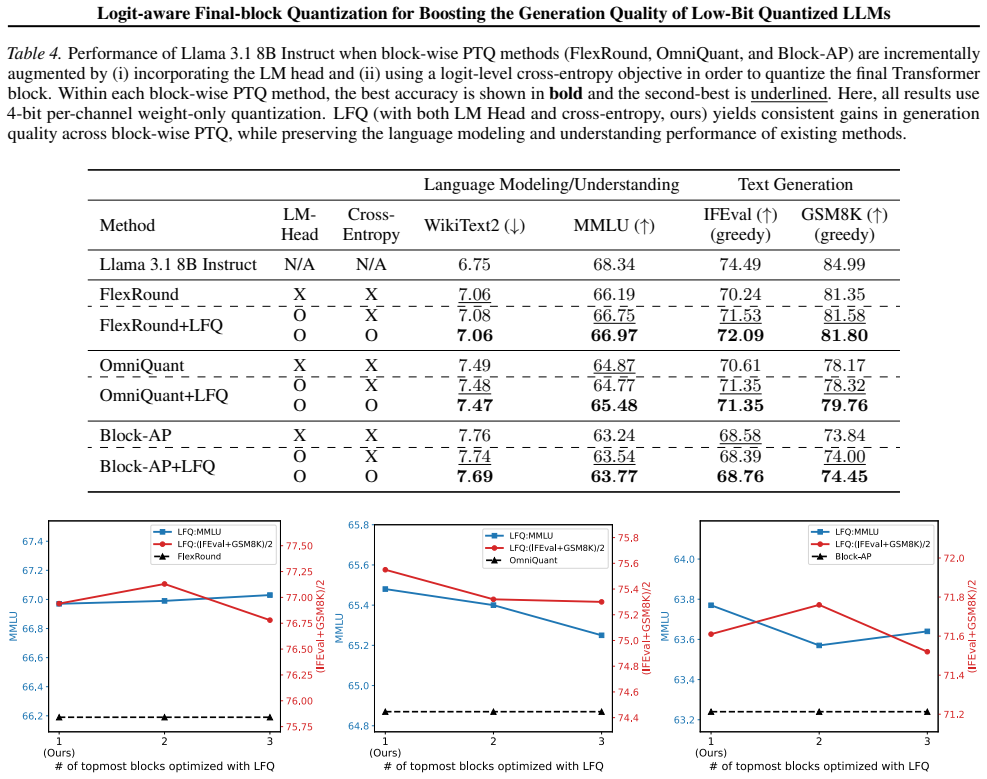
LFQ quantizes the final Transformer block by minimizing the cross-entropy between the logits of the full-precision model and its quantized counterpart. This aligns the token probability distributions, addressing the shortfall in standard block-wise PTQ caused by omitting the LM head and relying on MSE. As a result, the method improves accuracy on generation benchmarks across model families without sacrificing performance on language modeling and understanding tasks.
What carries the argument
Logit-aware Final-block Quantization (LFQ), a method that applies cross-entropy loss to the final block's output logits instead of MSE during quantization.
If this is right
- Consistently improves accuracy of complex generation tasks over state-of-the-art block-wise PTQ.
- Maintains parity with FP baselines on language modeling and understanding.
- Works across diverse model families.
- Addresses misalignment in token probability distribution for better long-response generation.
Where Pith is reading between the lines
- Extending LFQ to multiple final blocks could further close the gap to FP models on very long generations.
- Similar logit-alignment techniques might benefit other compression methods like pruning or distillation.
- The approach suggests that final-layer calibration is critical for preserving output distribution in quantized networks.
Load-bearing premise
The quality degradation in block-wise PTQ stems mainly from omitting the unembedding layer and using MSE, and that correcting only the final block is enough to fix misalignment throughout the model.
What would settle it
An experiment showing no improvement in generation task accuracy when applying LFQ compared to standard PTQ on the same models and bit-widths would falsify the claim.
Figures

read the original abstract
As large language models continue to scale, low-bit weight-only post-training quantization (PTQ) offers a practical solution to their memory-efficient deployment. Although block-wise PTQ is capable of matching the full-precision (FP) baseline on basic language modeling and understanding, its quality is degraded for generative tasks -- especially at longer responses and extended chains of thought, which is critical in boosting task accuracy. We attribute this shortfall to two factors: (i) the omission of the unembedding layer (the LM head) in block-wise optimization and (ii) the reliance on the mean squared error (MSE) objective. Both factors cause the token probability distribution of the quantized model to misalign with that of the FP model, yielding notable accuracy drops on text generation benchmarks. To rectify the discrepancy, we introduce Logit-aware Final-block Quantization (LFQ), a simple yet effective enhancement to block-wise PTQ that quantizes the final Transformer block by minimizing the cross-entropy between the logits of the FP model and those of its quantized counterpart. By aligning token probabilities at the logit level in the final block, LFQ consistently improves the accuracy of complex generation tasks over state-of-the-art block-wise PTQ across diverse model families, while maintaining parity with FP baselines on language modeling and understanding.
Editorial analysis
A structured set of objections, weighed in public.
Referee Report
Summary. The manuscript claims that standard block-wise post-training quantization (PTQ) of LLMs degrades generation quality on complex tasks because it omits the unembedding layer and optimizes blocks with MSE, causing token-probability misalignment with the FP model. It proposes LFQ as a simple fix: quantize all blocks with standard block-wise PTQ except the final Transformer block, which is instead optimized by minimizing cross-entropy between the FP model's logits and the quantized model's logits. This logit-level alignment is asserted to restore generation accuracy across model families while preserving parity with FP baselines on language modeling and understanding benchmarks.
Significance. If the experimental claims hold, LFQ provides a low-overhead, targeted intervention that improves the practical utility of low-bit weight-only quantized LLMs specifically for generative workloads. The approach is notable for requiring no new parameters and for being a direct change to the loss on one block rather than a global retraining or architectural modification.
major comments (1)
- [Abstract and method description] Abstract and method description: The central claim that optimizing only the final block with cross-entropy is sufficient to correct token-probability misalignment rests on the untested assumption that upstream quantization errors (under MSE) do not produce input hidden-state distributions to the final block that cannot be adequately compensated by last-block logit alignment. No analysis of distribution shift, ablation on upstream vs. final-block effects, or comparison of hidden-state statistics is referenced, leaving the sufficiency of the final-block correction as a load-bearing but unsupported point.
Simulated Author's Rebuttal
We thank the referee for highlighting the need for stronger empirical support of the final-block correction's sufficiency. We address the comment below and will revise the manuscript accordingly.
read point-by-point responses
-
Referee: [Abstract and method description] Abstract and method description: The central claim that optimizing only the final block with cross-entropy is sufficient to correct token-probability misalignment rests on the untested assumption that upstream quantization errors (under MSE) do not produce input hidden-state distributions to the final block that cannot be adequately compensated by last-block logit alignment. No analysis of distribution shift, ablation on upstream vs. final-block effects, or comparison of hidden-state statistics is referenced, leaving the sufficiency of the final-block correction as a load-bearing but unsupported point.
Authors: We agree that the current manuscript lacks explicit analysis of distribution shift or ablations isolating upstream MSE quantization effects from the final-block correction. While the empirical gains on generative tasks across model families provide indirect support that the final block can compensate, this does not directly test the assumption. In revision we will add: (i) an ablation comparing standard block-wise PTQ (all blocks MSE) against variants where only upstream blocks use MSE and the final block uses cross-entropy, (ii) statistics (mean, variance, cosine similarity) of hidden-state distributions at the input to the final block for FP, standard PTQ, and LFQ models, and (iii) a short discussion of how logit-level optimization enables the final block to adapt to shifted inputs. These additions will directly address the load-bearing assumption. revision: yes
Circularity Check
No circularity; method is an empirical loss change with no self-referential reduction
full rationale
The paper defines LFQ directly as quantizing only the final Transformer block via cross-entropy minimization between FP and quantized logits, then reports empirical gains on generation tasks. No equations, derivations, or self-citations are presented that reduce the claimed improvement to a quantity fitted or defined by the method itself. The attribution of prior PTQ shortfalls to omitted unembedding and MSE is an explanatory hypothesis, not a load-bearing derivation that collapses into the new procedure. The approach remains self-contained against external benchmarks.
Axiom & Free-Parameter Ledger
axioms (1)
- domain assumption The shortfall in generative quality for block-wise PTQ stems from omission of the unembedding layer and reliance on MSE, causing token probability misalignment.
Reference graph
Works this paper leans on
-
[1]
URL https: //aclanthology.org/2025.acl-long.498/
doi: 10.18653/v1/2025.acl-long.498. URL https: //aclanthology.org/2025.acl-long.498/. Cheng, W., Zhang, W., Shen, H., Cai, Y ., He, X., Kaokao, L., and Liu, Y . Optimize weight rounding via signed gradient descent for the quantization of LLMs. In Al-Onaizan, Y ., Bansal, M., and Chen, Y .-N. (eds.), Findings of the Association for Computational Linguis- t...
-
[2]
Training Verifiers to Solve Math Word Problems
URL https://aclanthology.org/2024. findings-emnlp.662/. Cobbe, K., Kosaraju, V ., Bavarian, M., Chen, M., Jun, H., Kaiser, L., Plappert, M., Tworek, J., Hilton, J., Nakano, R., Hesse, C., and Schulman, J. Training verifiers to solve math word problems, 2021. URL https://arxiv. org/abs/2110.14168. DeepSeek-AI, Guo, D., Yang, D., Zhang, H., Song, J., Zhang,...
work page internal anchor Pith review Pith/arXiv arXiv 2024
-
[3]
URL https://proceedings.mlr.press/ v202/lee23h.html. Lee, J. H., Kim, J., Yang, J. Y ., Kwon, S. J., Yang, E., Yoo, K. M., and Lee, D. LRQ: Optimizing post- training quantization for large language models by learn- ing low-rank weight-scaling matrices. In Chiruzzo, L., Ritter, A., and Wang, L. (eds.),Proceedings of the 2025 Conference of the Nations of th...
-
[4]
URL https://aclanthology.org/2025. naacl-long.393/. Li, Z., Su, Y ., Yang, R., Xie, C., Wang, Z., Xie, Z., Wong, N., and Yang, H. Quantization meets reasoning: Exploring llm low-bit quantization degradation for mathematical reasoning, 2025. URL https://arxiv.org/abs/ 2501.03035. Lightman, H., Kosaraju, V ., Burda, Y ., Edwards, H., Baker, B., Lee, T., Lei...
discussion (0)
Sign in with ORCID, Apple, or X to comment. Anyone can read and Pith papers without signing in.