Transition-Based Digital Twin Modelling for Alzheimer's Disease under Sparse Longitudinal Data
Pith reviewed 2026-06-27 16:59 UTC · model grok-4.3
The pith
Transition-based modeling of adjacent visits outperforms sequence models for Alzheimer's progression prediction under sparse data.
A machine-rendered reading of the paper's core claim, the machinery that carries it, and where it could break.
Core claim
The central claim is that a transition-based digital twin framework, integrating cognitive assessments, clinical variables, and MRI-derived phenotypes from ADNI, predicts cognitive status and diagnostic categories with greater accuracy via local transition modeling of adjacent visits than via sequence-based modeling in sparse longitudinal settings, while also quantifying predictive uncertainty and supporting patient-specific what-if analysis.
What carries the argument
The transition-based digital twin that models clinical state changes between adjacent visits as the primary predictive engine, supplemented by sequence modeling for longer-term dependencies.
If this is right
- Local transition modeling supplies a more data-efficient predictive strategy than full sequences for irregular clinical visits.
- Sequence models retain value specifically for uncertainty-aware long-range trajectory forecasting.
- The dual-branch framework supports interpretable patient-specific scenario analysis for disease monitoring.
- Aligning the choice of temporal modeling with the sparse structure of clinical data improves overall robustness.
Where Pith is reading between the lines
- The same transition-focused design could be tested on other neurodegenerative conditions that produce similarly irregular visit patterns.
- Varying the degree of data sparsity in controlled simulations would directly test the claimed efficiency edge.
- Adding genetic or fluid biomarker streams might further strengthen the digital twin's subject-specific forecasts.
- Clinical trial simulators could use the transition layer to generate realistic patient cohorts under different intervention scenarios.
Load-bearing premise
The leak-free subject-level splits on ADNI data represent typical real-world sparse longitudinal observations without hidden selection biases or preprocessing artifacts that would change the performance comparison.
What would settle it
Re-evaluating the same models on an independent longitudinal Alzheimer's dataset with documented different sparsity patterns or preprocessing choices that yields equal or higher accuracy for the sequence branch would falsify the data-efficiency advantage.
Figures



read the original abstract
Alzheimer's disease (AD) progression is highly heterogeneous and is typically observed through sparse and irregular longitudinal data, posing challenges for prediction and personalised monitoring. Existing machine learning approaches have improved AD prediction using multimodal data, yet often focus on static classification or cohort-level risk estimation, providing limited support for subject-specific modelling and uncertainty-aware reasoning. To address these limitations, we present a personalised digital twin framework for AD prediction and scenario-based analysis using multimodal longitudinal data. The proposed approach integrates complementary modelling strategies to capture clinical transitions and temporal dependencies across visits. Using data from the Alzheimer's Disease Neuroimaging Initiative (ADNI), including cognitive assessments, clinical variables, and MRI-derived phenotypes, the framework predicts cognitive status and diagnostic categories while quantifying predictive uncertainty and enabling patient-specific what-if trajectory analysis. Evaluation on leak-free subject-level splits demonstrates strong performance in score forecasting and diagnosis classification. In this sparse and irregular ADNI setting, transition-based modelling of adjacent visits achieved higher predictive accuracy than the sequence-based branch, suggesting that local transition modelling may be more data-efficient. While sequence models remain valuable for uncertainty-aware trajectory forecasting, local transition modelling offers a more data-efficient and robust predictive strategy. These findings highlight the importance of aligning temporal modelling strategies with clinical data structure and suggest that transition-based digital twin formulations may provide a practical and interpretable approach for personalised disease forecasting in neurodegenerative disorders.
Editorial analysis
A structured set of objections, weighed in public.
Referee Report
Summary. The manuscript proposes a personalised digital twin framework for Alzheimer's disease that combines transition-based modelling of adjacent visits with sequence-based temporal modelling on multimodal sparse longitudinal ADNI data (cognitive scores, clinical variables, MRI phenotypes). It reports that the transition-based branch achieved higher predictive accuracy than the sequence-based branch on leak-free subject-level splits, interprets this as evidence that local transitions are more data-efficient under sparsity, and claims the framework supports uncertainty quantification and patient-specific what-if trajectory analysis.
Significance. If the reported performance advantage is quantified with baselines and holds under external validation, the empirical observation that transition-based modelling can be more data-efficient than sequence modelling for sparse AD longitudinal data would be useful for guiding temporal modelling choices in digital-twin applications for neurodegenerative disease. The manuscript's use of subject-level splits is a positive practice that avoids obvious leakage.
major comments (3)
- [Abstract] Abstract: the central claim that 'transition-based modelling of adjacent visits achieved higher predictive accuracy than the sequence-based branch' is presented without any numeric metrics (e.g., MAE, accuracy, AUC), baseline comparisons, confidence intervals, or statistical significance tests, rendering the data-efficiency conclusion impossible to assess from the provided text.
- [Evaluation] Evaluation description: all reported results derive from models trained and tested on the same ADNI cohort (subject-level splits only); no external validation cohort or hold-out dataset from a different source is mentioned, so the claimed superiority remains a within-distribution fitted outcome rather than a generalisable finding.
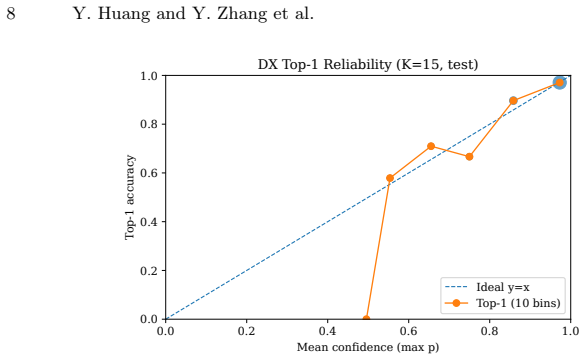
- [Framework] Framework description: the abstract highlights 'quantifying predictive uncertainty' as a core capability, yet supplies no details on the uncertainty method (e.g., Bayesian, ensemble, conformal), calibration procedure, or any reliability diagrams/metrics, which is load-bearing for the uncertainty-aware claim.
minor comments (1)
- [Abstract] The abstract refers to 'personalised digital twin framework' and 'invented_entities' without a concise one-sentence definition of what constitutes the 'digital twin' versus a standard predictive model.
Simulated Author's Rebuttal
We thank the referee for the constructive feedback on the abstract, evaluation setup, and uncertainty quantification. We address each major comment point-by-point below, indicating where revisions will be made to strengthen the manuscript.
read point-by-point responses
-
Referee: [Abstract] Abstract: the central claim that 'transition-based modelling of adjacent visits achieved higher predictive accuracy than the sequence-based branch' is presented without any numeric metrics (e.g., MAE, accuracy, AUC), baseline comparisons, confidence intervals, or statistical significance tests, rendering the data-efficiency conclusion impossible to assess from the provided text.
Authors: We agree the abstract should be self-contained with quantitative support. The full manuscript reports these metrics (including MAE, accuracy, AUC with confidence intervals and significance tests) in the results section on subject-level splits. We will revise the abstract to include the key numeric values, baseline comparisons, and a brief note on statistical testing to make the data-efficiency claim directly assessable. revision: yes
-
Referee: [Evaluation] Evaluation description: all reported results derive from models trained and tested on the same ADNI cohort (subject-level splits only); no external validation cohort or hold-out dataset from a different source is mentioned, so the claimed superiority remains a within-distribution fitted outcome rather than a generalisable finding.
Authors: The evaluation uses only the ADNI cohort with subject-level splits, as described. No external cohort from a different source is available or used in the current study. We will add an explicit limitations paragraph acknowledging that the superiority is demonstrated within the ADNI distribution and discuss the value of future multi-cohort validation while noting that subject-level splits already mitigate leakage. revision: partial
-
Referee: [Framework] Framework description: the abstract highlights 'quantifying predictive uncertainty' as a core capability, yet supplies no details on the uncertainty method (e.g., Bayesian, ensemble, conformal), calibration procedure, or any reliability diagrams/metrics, which is load-bearing for the uncertainty-aware claim.
Authors: Details on the uncertainty method (ensemble-based with calibration) and associated metrics appear in the methods and results sections. We will revise the abstract to briefly specify the uncertainty quantification approach and reference the calibration evaluation to support the claim. revision: yes
Circularity Check
No significant circularity identified
full rationale
The paper reports an empirical result from training and evaluating two modeling branches (transition-based vs. sequence-based) on leak-free subject-level splits of the ADNI cohort. The central claim—that transition modeling showed higher accuracy under sparsity—is a direct outcome of this standard ML experiment rather than any derivation that reduces to its inputs by construction. No self-definitional equations, fitted parameters renamed as predictions, load-bearing self-citations, or ansatz smuggling appear in the abstract or described methodology. The result is presented as an observation on this specific dataset and is therefore self-contained.
Axiom & Free-Parameter Ledger
free parameters (1)
- model hyperparameters and transition probabilities
axioms (1)
- domain assumption ADNI multimodal longitudinal records are representative of real-world sparse AD progression without systematic selection bias
invented entities (1)
-
personalised digital twin framework
no independent evidence
Reference graph
Works this paper leans on
-
[1]
Alzheimer’s Research & Therapy17(1), 125 (2025)
Amato, L.G., Lassi, M., Vergani, A.A., Carpaneto, J., Mazzeo, S., Moschini, V., Burali, R., Salvestrini, G., Fabbiani, C., Giacomucci, G., et al.: Digital twins and non-invasive recordings enable early diagnosis of alzheimer’s disease. Alzheimer’s Research & Therapy17(1), 125 (2025)
2025
-
[2]
In: Metaverse Technologies in Healthcare, pp
Balasubramaniam, S., Sumina, S., Kumar, K.S., Prasanth, A.: Machine learning based models for implementing digital twins in healthcare industry. In: Metaverse Technologies in Healthcare, pp. 135–162. Elsevier (2024)
2024
-
[3]
Journal of Big Data 12(1), 1–28 (2025)
Elgammal, Z., Albrijawi, M.T., Alhajj, R.: Digital twins in healthcare: a review of AI-powered practical applications across health domains. Journal of Big Data 12(1), 1–28 (2025)
2025
-
[4]
Frontiers in Neuroscience18, 1454856 (2024)
Fekonja, L.S., Schenk, R., Schr"oder, E., Tomasello, R., Tomsic, S., Picht, T.: The digital twin in neuroscience: from theory to tailored therapy. Frontiers in Neuroscience18, 1454856 (2024)
2024
-
[5]
Scientific Reports9(1), 13622 (2019)
Fisher, C.K., Smith, A.M., Walsh, J.R.: Machine learning for comprehensive fore- casting of alzheimer’s disease progression. Scientific Reports9(1), 13622 (2019)
2019
-
[6]
Applied Sciences14(22), 10121 (2024) A Transition-Based Digital Twin Framework for AD Prediction 13
Hasan Saif, F., Al-Andoli, M.N., Bejuri, W.M.Y.W.: Explainable AI for alzheimer detection: A review of current methods and applications. Applied Sciences14(22), 10121 (2024) A Transition-Based Digital Twin Framework for AD Prediction 13
2024
-
[7]
In: International Conference on AI in Healthcare
Karaman, B.K., Sabuncu, M.R.: Assessing the significance of longitudinal data in alzheimer’s disease forecasting. In: International Conference on AI in Healthcare. pp. 3–16. Springer (2024)
2024
-
[8]
JAMIA Open7(3), ooae087 (2024)
Kumar, S., Yu, S.C., Michelson, A., Kannampallil, T., Payne, P.R.: HiMAL: Multimodal hierarchical multi-task auxiliary learning framework for predicting alzheimer’s disease progression. JAMIA Open7(3), ooae087 (2024)
2024
-
[9]
arXiv preprint arXiv:2002.03419 (2020)
Marinescu, R.V., Oxtoby, N.P., Young, A.L., Bron, E.E., Toga, A.W., Weiner, M.W., Barkhof, F., Fox, N.C., Eshaghi, A., Toni, T., et al.: The alzheimer’s disease prediction of longitudinal evolution (TADPOLE) challenge: results after 1 year follow-up. arXiv preprint arXiv:2002.03419 (2020)
-
[10]
The Lancet Neurology13(8), 788–794 (2014)
Norton, S., Matthews, F.E., Barnes, D.E., Yaffe, K., Brayne, C.: Potential for primary prevention of alzheimer’s disease: an analysis of population-based data. The Lancet Neurology13(8), 788–794 (2014)
2014
-
[11]
Cognitive Neurodynamics18(3), 775–794 (2024)
Odusami, M., Maskeliunas, R., Damasevicius, R., Misra, S.: Machine learning with multimodal neuroimaging data to classify stages of alzheimer’s disease: a system- atic review and meta-analysis. Cognitive Neurodynamics18(3), 775–794 (2024)
2024
-
[12]
Artificial Intelligence in Medicine145, 102678 (2023)
Qiang, Y.R., Zhang, S.W., Li, J.N., Li, Y., Zhou, Q.Y.: Diagnosis of alzheimer’s disease by joining dual attention CNN and MLP based on structural MRIs, clinical and genetic data. Artificial Intelligence in Medicine145, 102678 (2023)
2023
-
[13]
Neurotherapeutics p
Ren, Y., Pieper, A.A., Cheng, F.: Utilization of precision medicine digital twins for drug discovery in alzheimer’s disease. Neurotherapeutics p. e00553 (2025)
2025
discussion (0)
Sign in with ORCID, Apple, or X to comment. Anyone can read and Pith papers without signing in.