REVIEW 3 major objections 4 minor 3 cited by
DiffMS: Diffusion Generation of Molecules Conditioned on Mass Spectra
T0 review · 3 major / 4 minor · reviewed 2026-08-07 · deepseek-v4-flash
Pith's one-line read DiffMS, a formula-restricted graph diffusion model, outperforms all tested baselines at generating molecular structures from mass spectra.
desk verdict A credible SOTA result in MS-to-structure generation, with a leakage-control gap in the pretraining pipeline that is testable and fixable. read the letter →
The pith
A machine-rendered reading of the paper's core claim, the machinery that carries it, and where it could break.
The reading
What carries the argument
The load-bearing mechanism is formula-restricted discrete graph diffusion on the one-hot bond-type adjacency matrix, adapted from the DiGress discrete denoising diffusion framework for graphs. Given the heavy-atom count and types from the chemical formula, the decoder fixes node features and learns to denoise edge types through a Markov transition process with a marginal bond-type prior and cosine noise schedule; training minimizes cross-entropy between predicted and true upper-triangular adjacency entries. The condition is a spectrum embedding from a formula transformer that models each peak's predicted chemical formula and pairwise neutral losses, and decoder pretraining replaces that embedding with the molecule's Morgan fingerprint, exposing the decoder to 2.8M fingerprint-structure pairs before end-to-end finetuning. This design makes generation permutation-invariant, enforces the formula constraint exactly, and guarantees valid graphs by construction.
What would settle it
Compute, for every MassSpecGym test molecule, the maximum Tanimoto similarity (or minimum MCES) to any molecule in the 2.8M pretraining set; if a substantial fraction of test molecules have a near neighbour there, say Tanimoto above 0.85 or MCES below 10, the claim that evaluation represents truly novel structures collapses and the comparison to baselines trained without that library would need to be redone.
Extended reading notes
Core claim
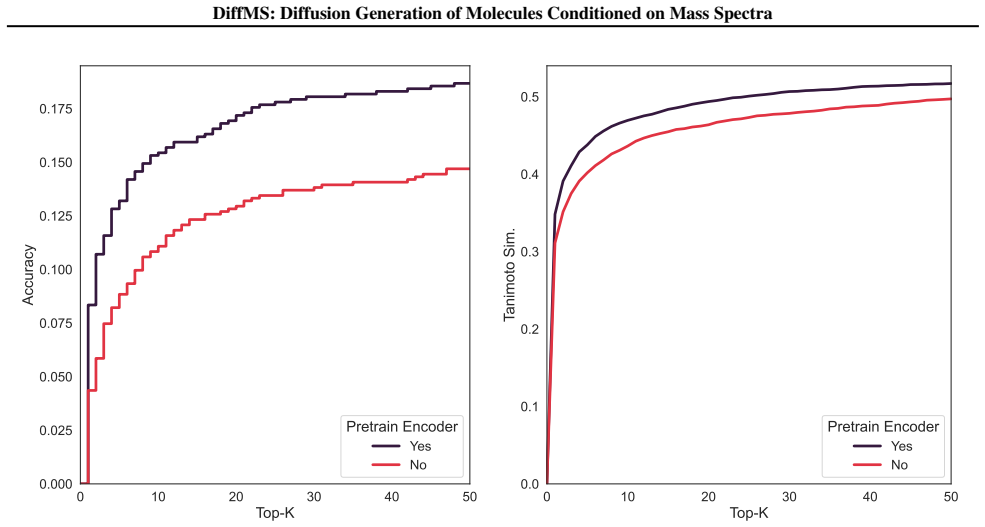
The central claim is that conditional molecular generation from mass spectra is better formulated as formula-restricted discrete graph diffusion than as autoregressive text generation. DiffMS's decoder noise-processes the adjacency matrix of a molecule whose heavy-atom composition is fixed by the inferred formula, then denoises it under a spectrum embedding extracted by a transformer that encodes peak formulae and neutral losses. On NPLIB1, DiffMS reaches 8.34% top-1 accuracy versus 5.40% for the best re-implemented baseline; on MassSpecGym it reaches 2.30% versus 1.31% for the next best method, and it also attains the best MCES and Tanimoto similarity at top-1 and top-10. The paper further claims that pretraining the diffusion decoder on 2.8M fingerprint-structure pairs improves performance monotonically with dataset size, and that removing exact benchmark test and validation molecules from that pretraining set makes the evaluation a genuinely novel-structure setting.
Load-bearing premise
The load-bearing premise is that removing the exact benchmark test and validation molecules from the 2.8M fingerprint-structure pretraining set is enough to keep test information out of the decoder; if near-identical analogues of test molecules remain in libraries such as DSSTox, HMDB, COCONUT, or MOSES, the reported out-of-distribution gains are inflated.
Editorial extensions
If this is right
- If DiffMS is right, de novo MS/MS structure elucidation should be built on formula-constrained graph diffusion rather than SMILES or scaffold autoregression; the graph representation yields 100% valid candidates and respects the known heavy-atom composition.
- The observed scaling with pretraining set size implies that adding more fingerprint-structure pairs, which are cheap relative to spectrum-structure pairs, should continue to raise exact-match and similarity metrics.
- Because predicted formulae from MIST-CF lose only about one point of top-1 accuracy on both benchmarks, a practical pipeline can run DiffMS on the top few formula hypotheses without manual formula assignment and still generate near-target candidates.
- On MassSpecGym, where test structures are far from training structures, DiffMS still produces meaningfully similar candidates in the top-1 list while almost all baselines stay near zero, suggesting the method is usable for candidate ranking in discovery workflows, not only for benchmark exact matches.
Reading between the lines
- My inference: the paper's pretraining holdout removes only exact test and validation molecules; a stricter holdout that also excludes near-identical analogues of MassSpecGym test structures would reveal how much of the 2.30% top-1 gain is true generalization versus memorized substructure patterns.
- My inference: because every DiffMS sample is a valid graph, candidate lists could be reranked by orthogonal evidence such as retention time, collision cross-section, or forward spectral prediction; the paper stops at generation and does not explore reranking.
- My inference: given the one-to-many spectrum-to-structure ambiguity, exact top-1 accuracy has a ceiling; reporting diversity and coverage of the top-k list, which the paper does not formalize, would better capture the value for expert curation.
- My inference: the scaling trend suggests the next bottleneck is the spectrum encoder's fingerprint pretraining, which uses only the small benchmark training sets, not the decoder; pretraining the encoder on larger synthetic or retrieved spectra could be a direct follow-up.
Editorial analysis
A structured set of objections, weighed in public.
Referee Report
Summary. The paper presents DiffMS, a two-module generative model for predicting molecular structures from tandem mass spectra. A spectrum encoder based on the MIST formula transformer embeds MS/MS peaks and predicted peak formulae, and a discrete graph diffusion decoder (built on DiGress) generates an adjacency matrix under a fixed heavy-atom composition; the decoder is pretrained on 2.8M fingerprint-structure pairs and the encoder on spectrum-to-fingerprint prediction, after which the system is finetuned end-to-end. On NPLIB1 and MassSpecGym, DiffMS is reported to achieve the best top-1/top-10 accuracy, MCES, and Tanimoto metrics among the compared baselines. The paper also reports ablations for encoder pretraining, decoder pretraining scale, diffusion prior, and inferred formulas.
Significance. If the reported results are robust, DiffMS is a meaningful advance for de novo structure elucidation: it is the first formula-constrained diffusion generator for MS/MS, it demonstrates a practical pretraining strategy for the decoder using abundant fingerprint-structure pairs, and it reports consistent scaling with pretraining set size. The empirical evaluation is transparent and includes several ablations, and the code is publicly released. The main caveats are that the out-of-distribution claim on MassSpecGym depends on a leakage-control assumption that is not fully verified, and the headline margins over the strongest baselines are small and reported without variance estimates.
major comments (3)
- [Section 3.3] The statement that the authors 'remove all NPLIB1 and MassSpecGym test and validation molecules from our decoder pretraining dataset' only excludes exact matches; it does not exclude near-identical analogues. The paper itself notes in Section 4.3 that NPLIB1 contains train/test pairs with Tanimoto similarity above 0.85, and the pretraining libraries (DSSTox, HMDB, COCONUT, MOSES) are large enough that similar analogues of MassSpecGym test molecules are likely present. Because the decoder is conditioned on Morgan fingerprints, a near-identical analogue seen during pretraining can teach essentially the same fingerprint-to-structure mapping as the test molecule, which would inflate the MassSpecGym 'out-of-distribution' results and make the comparison against MADGEN and Spec2Mol potentially unfair. I ask for a quantitative nearest-neighbor analysis between the pretraining corpus and the benchmark test sets (e.g., maximum and percentile Tanimoto and MCES values), and an ablation in which all pretraining molecules within a threshold (for example Tanimoto > 0.85 or MCES < 10) are removed before retraining the decoder.
- [Section 3.3] The description 'We pretrain our encoder on the same datasets used for fine-tuning (i.e., NPLIB1 (CANOPUS) or MassSpecGym)' is ambiguous: if the encoder pretraining includes test-set spectra, the reported end-to-end accuracies would be circular. Please state explicitly that only the training splits of NPLIB1 and MassSpecGym are used for encoder pretraining, and confirm that the finetuning and evaluation splits coincide with the benchmark-defined train/test splits.
- [Table 1] The headline comparisons in Table 1 are reported as point estimates without standard deviations or confidence intervals. This matters because sampling 100 molecules per spectrum is stochastic and the adopted ranking step is based on frequency, so the top-1 accuracy itself has sampling variance; on MassSpecGym the gap over MADGEN is only 2.30% versus 1.31%, which is small relative to plausible sampling noise. Please report mean plus/minus standard deviation over multiple sampling seeds, and ideally over multiple finetuning seeds, for the main metrics.
minor comments (4)
- [Section 4.1] The ranking procedure (sampling 100 molecules, removing invalid molecules, and taking the most frequent structures) should be described precisely, including how ties are broken and whether invalid or duplicate samples are counted when computing frequencies; the statement that the post-processing is also applied to baseline methods should clarify how each baseline's native ranking is overridden.
- [Section 3.1] The paper states that DiffMS models only heavy atoms and that generated molecules may differ from the true molecule in hydrogen count; please clarify how hydrogen atoms are inferred (or ignored) during training and evaluation, since this affects the definition of exact top-1 matches.
- [Table 1] Minor formatting: the entry '11.04 %' contains an unusual space, and the table would benefit from a note stating the number of sampling seeds used for all stochastic methods.
- [Section 4.5] For the MIST-CF formula inference ablation, the paper should state what happens when the true formula is not among the top-5 predicted formulae, since the 100 samples are then necessarily generated under incorrect heavy-atom compositions.
Circularity Check
No significant circularity; DiffMS is an empirical benchmark paper whose central claims are evaluated on held-out test splits, and its self-citations to MIST are component reuse rather than load-bearing justification.
full rationale
DiffMS makes no analytical claim that reduces to a fitted quantity. Its central claim is that a formula-constrained discrete graph diffusion decoder pretrained on fingerprint-structure pairs and finetuned end-to-end on spectrum-structure pairs outperforms baselines on NPLIB1 and MassSpecGym. The reported numbers (8.34% vs 5.40% top-1 on NPLIB1; 2.30% vs 1.31% on MassSpecGym) are computed on held-out test splits of public benchmarks, so the predictions are not equivalent to the training objective by construction. The self-citations to MIST (Goldman et al., 2023b,c) are reused as the spectrum encoder and formula annotation tools; these are prior components with independent external validation, not invoked as the justification for the SOTA claim. The encoder pretraining on the same training splits is a standard training procedure, and the ablations measure its contribution rather than rename it as a prediction. The only substantive concern is a potential data-leakage risk from near-identical analogues in the 2.8M decoder pretraining libraries, which the paper partially addresses by exact removal of NPLIB1 and MassSpecGym test and validation molecules; that is an empirical validity issue, not circular reasoning. Therefore no circular step is identified.
Assumptions & free parameters
free parameters (4)
- Decoder pretraining dataset size =
2.8M molecules
- Morgan fingerprint radius and length =
radius 2, 2048 bits
- Number of sampled molecules per spectrum for ranking =
100
- Number of formula candidates from MIST-CF =
top 5
assumptions (5)
- standard math The Markov chain forward noising process with transition matrices Q_t (Eqs. 1-4) is a valid generative prior for molecular adjacency matrices.
- domain assumption The chemical formula, specifically the heavy-atom composition, is known or can be inferred with sufficient accuracy from MS1 and isotope data using SIRIUS, BUDDY, or MIST-CF.
- domain assumption Morgan fingerprints are a sufficient structural condition for pretraining the decoder, and the learned decoder generalizes to spectrum-embedding conditions during finetuning.
- domain assumption Hydrogen atoms can be inferred implicitly, so modeling only heavy atoms is sufficient.
- ad hoc to paper Ranking 100 samples by frequency produces a valid top-k list.
Cite this review
Pith. "Pith review of DiffMS: Diffusion Generation of Molecules Conditioned on Mass Spectra." pith.science (2026). https://pith.science/paper/XS5F5J54
@misc{pith2026250209571,
  author       = {Pith},
  title        = {Pith review of: DiffMS: Diffusion Generation of Molecules Conditioned on Mass Spectra},
  year         = {2026},
  howpublished = {\url{https://pith.science/paper/XS5F5J54}},
  note         = {Machine review of arXiv:2502.09571}
}
read the original abstract
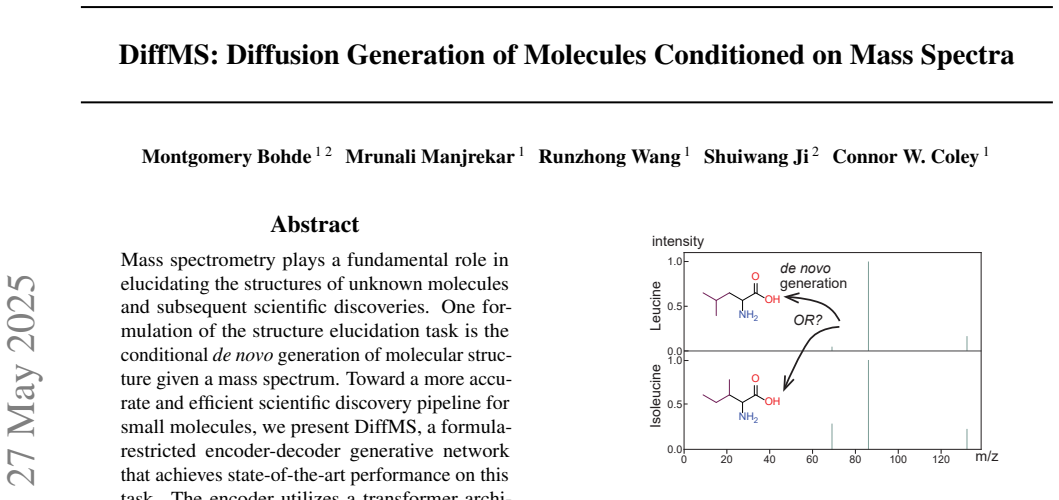
Mass spectrometry plays a fundamental role in elucidating the structures of unknown molecules and subsequent scientific discoveries. One formulation of the structure elucidation task is the conditional de novo generation of molecular structure given a mass spectrum. Toward a more accurate and efficient scientific discovery pipeline for small molecules, we present DiffMS, a formula-restricted encoder-decoder generative network that achieves state-of-the-art performance on this task. The encoder utilizes a transformer architecture and models mass spectra domain knowledge such as peak formulae and neutral losses, and the decoder is a discrete graph diffusion model restricted by the heavy-atom composition of a known chemical formula. To develop a robust decoder that bridges latent embeddings and molecular structures, we pretrain the diffusion decoder with fingerprint-structure pairs, which are available in virtually infinite quantities, compared to structure-spectrum pairs that number in the tens of thousands. Extensive experiments on established benchmarks show that DiffMS outperforms existing models on de novo molecule generation. We provide several ablations to demonstrate the effectiveness of our diffusion and pretraining approaches and show consistent performance scaling with increasing pretraining dataset size. DiffMS code is publicly available at https://github.com/coleygroup/DiffMS.
Figures


Figures from the paper (8 more)




Forward citations
Cited by 3 Pith papers
-
FRIGID: Scaling Diffusion-Based Molecular Generation from Mass Spectra at Training and Inference Time
FRIGID scales a diffusion-based model for de novo molecular structure generation from mass spectra, reaching over 18% top-1 accuracy on MassSpecGym and tripling prior bests on NPLIB1 via large unlabeled training and i...
-
A collaborative constrained graph diffusion model for the generation of realistic synthetic molecules
A valence-preserving double edge-swap diffusion model with a learned time estimator generates chemically valid molecules with property distributions closer to real molecules than JTVAE and DiGress on the GuacaMol benchmark.
-
MS-GPT: Rethinking MS/MS De Novo Structure Elucidation as Spectrum-Induced Posterior Querying of a Molecule-Language Model
Querying a fingerprint-conditioned molecule-language model with a calibrated band of spectrum-induced posteriors beats point-threshold fingerprint decoding on NPLIB1 and MassSpecGym.
Reference graph
Works this paper leans on
-
[1]
Equivariant Shape-Conditioned Generation of 3D Molecules for Ligand-Based Drug Design
Adams, K. and Coley, C. W. Equivariant shape-conditioned generation of 3d molecules for ligand-based drug design. arXiv preprint arXiv:2210.04893, 2022
work page Pith review arXiv 2022
-
[2]
Alberts, M., Zipoli, F., and Vaucher, A. C. Learning the language of nmr: Structure elucidation from nmr spectra using transformer models. In NeurIPS 2023 Workshop, 2023
work page 2023
-
[3]
Competitive fragmentation modeling of esi-ms/ms spectra for putative metabolite identification
Allen, F., Greiner, R., and Wishart, D. Competitive fragmentation modeling of esi-ms/ms spectra for putative metabolite identification. Metabolomics, 11: 0 98--110, 2015
work page 2015
-
[4]
D., Ho, J., Tarlow, D., and van den Berg, R
Austin, J., Johnson, D. D., Ho, J., Tarlow, D., and van den Berg, R. Structured denoising diffusion models in discrete state-spaces, 2023. URL https://arxiv.org/abs/2107.03006
arXiv 2023
-
[5]
Bittremieux, W., Wang, M., and Dorrestein, P. C. The critical role that spectral libraries play in capturing the metabolomics community knowledge. Metabolomics, 18 0 (12): 0 94, 2022
work page 2022
-
[6]
B \"o cker, S. and D \"u hrkop, K. Fragmentation trees reloaded. Journal of cheminformatics, 8: 0 1--26, 2016
work page 2016
-
[7]
Bushuiev, R., Bushuiev, A., de Jonge, N. F., Young, A., Kretschmer, F., Samusevich, R., Heirman, J., Wang, F., Zhang, L., Dührkop, K., Ludwig, M., Haupt, N. A., Kalia, A., Brungs, C., Schmid, R., Greiner, R., Wang, B., Wishart, D. S., Liu, L.-P., Rousu, J., Bittremieux, W., Rost, H., Mak, T. D., Hassoun, S., Huber, F., van der Hooft, J. J. J., Stravs, M. ...
arXiv 2024
-
[8]
Ms2mol: A transformer model for illuminating dark chemical space from mass spectra
Butler, T., Frandsen, A., Lightheart, R., Bargh, B., Taylor, J., Bollerman, T., Kerby, T., West, K., Voronov, G., Moon, K., et al. Ms2mol: A transformer model for illuminating dark chemical space from mass spectra. ChemRxiv, 2023
work page 2023
Show all 71 references
-
[9]
Distributed Structure-Searchable Toxicity (DSSTox) Database
CCTE, E. Distributed Structure-Searchable Toxicity (DSSTox) Database . 4 2019. doi:10.23645/epacomptox.5588566.v7. URL https://epa.figshare.com/articles/dataset/Chemistry_Dashboard_Data_DSSTox_Identifiers_Mapped_to_CAS_Numbers_and_Names/5588566
2019
-
[10]
Efficient and degree-guided graph generation via discrete diffusion modeling, 2023
Chen, X., He, J., Han, X., and Liu, L.-P. Efficient and degree-guided graph generation via discrete diffusion modeling, 2023. URL https://arxiv.org/abs/2305.04111
2023 arXiv
-
[11]
Diffdock: Diffusion steps, twists, and turns for molecular docking
Corso, G., Stärk, H., Jing, B., Barzilay, R., and Jaakkola, T. Diffdock: Diffusion steps, twists, and turns for molecular docking. In International Conference on Learning Representations (ICLR), 2023
2023
-
[12]
and Nichol, A
Dhariwal, P. and Nichol, A. Diffusion models beat gans on image synthesis. Advances in neural information processing systems, 34: 0 8780--8794, 2021
2021
-
[13]
u hrkop, K., Shen, H., Meusel, M., Rousu, J., and B \
D \"u hrkop, K., Shen, H., Meusel, M., Rousu, J., and B \"o cker, S. Searching molecular structure databases with tandem mass spectra using csi: Fingerid. Proceedings of the National Academy of Sciences, 112 0 (41): 0 12580--12585, 2015
2015
-
[14]
u hrkop, K., Nothias, L.-F., Fleischauer, M., Reher, R., Ludwig, M., Hoffmann, M. A., Petras, D., Gerwick, W. H., Rousu, J., Dorrestein, P. C., and B \
D \"u hrkop, K., Nothias, L.-F., Fleischauer, M., Reher, R., Ludwig, M., Hoffmann, M. A., Petras, D., Gerwick, W. H., Rousu, J., Dorrestein, P. C., and B \"o cker, S. Systematic classification of unknown metabolites using high-resolution fragmentation mass spectra. Nature Biot...
2021 doi
-
[15]
A., Petras, D., Gerwick, W
D \"u hrkop, K., Nothias, L.-F., Fleischauer, M., Reher, R., Ludwig, M., Hoffmann, M. A., Petras, D., Gerwick, W. H., Rousu, J., Dorrestein, P. C., et al. Systematic classification of unknown metabolites using high-resolution fragmentation mass spectra. Nature biotechnology, 3...
2021
-
[16]
Dwivedi, V. P. and Bresson, X. A generalization of transformer networks to graphs. AAAI Workshop on Deep Learning on Graphs: Methods and Applications, 2021
2021
-
[17]
Scalable fragment-based 3d molecular design with reinforcement learning
Flam-Shepherd, D., Zhigalin, A., and Aspuru-Guzik, A. Scalable fragment-based 3d molecular design with reinforcement learning. arXiv preprint arXiv:2202.00658, 2022
2022 arXiv
-
[18]
C., Collins, S
Gentry, E. C., Collins, S. L., Panitchpakdi, M., Belda-Ferre, P., Stewart, A. K., Carrillo Terrazas, M., Lu, H.-h., Zuffa, S., Yan, T., Avila-Pacheco, J., et al. Reverse metabolomics for the discovery of chemical structures from humans. Nature, 626 0 (7998): 0 419--426, 2024
2024
-
[19]
Prefix-tree decoding for predicting mass spectra from molecules
Goldman, S., Bradshaw, J., Xin, J., and Coley, C. Prefix-tree decoding for predicting mass spectra from molecules. Advances in Neural Information Processing Systems, 36: 0 48548--48572, 2023 a
2023
-
[20]
J., and Coley, C
Goldman, S., Wohlwend, J., Stra z ar, M., Haroush, G., Xavier, R. J., and Coley, C. W. Annotating metabolite mass spectra with domain-inspired chemical formula transformers. Nature Machine Intelligence, 5 0 (9): 0 965--979, 2023 b
2023
-
[21]
Goldman, S., Xin, J., Provenzano, J., and Coley, C. W. Mist-cf: Chemical formula inference from tandem mass spectra. Journal of Chemical Information and Modeling, 64 0 (7): 0 2421--2431, 2023 c
2023
-
[22]
Goldman, S., Li, J., and Coley, C. W. Generating molecular fragmentation graphs with autoregressive neural networks. Analytical Chemistry, 96 0 (8): 0 3419--3428, 2024
2024
-
[23]
N., Duvenaud, D., Hern \'a ndez-Lobato, J
G \'o mez-Bombarelli, R., Wei, J. N., Duvenaud, D., Hern \'a ndez-Lobato, J. M., S \'a nchez-Lengeling, B., Sheberla, D., Aguilera-Iparraguirre, J., Hirzel, T. D., Adams, R. P., and Aspuru-Guzik, A. Automatic chemical design using a data-driven continuous representation of mol...
2018
-
[24]
and Salimans, T
Ho, J. and Salimans, T. Classifier-free diffusion guidance. arXiv preprint arXiv:2207.12598, 2022
2022 arXiv
-
[25]
Denoising diffusion probabilistic models
Ho, J., Jain, A., and Abbeel, P. Denoising diffusion probabilistic models. In Proceedings of the 34th International Conference on Neural Information Processing Systems, NIPS '20, Red Hook, NY, USA, 2020. Curran Associates Inc. ISBN 9781713829546
2020
-
[26]
I., Torres-Hernandez, A
Hu, M., Yang, L., Twarog, N., Ochoada, J., Li, Y., Vrettos, E. I., Torres-Hernandez, A. X., Martinez, J. B., Bhatia, J., Young, B. M., et al. Continuous collective analysis of chemical reactions. Nature, 636 0 (8042): 0 374--379, 2024
2024
-
[27]
Elucidating the design space of diffusion-based generative models
Karras, T., Aittala, M., Aila, T., and Laine, S. Elucidating the design space of diffusion-based generative models. Advances in neural information processing systems, 35: 0 26565--26577, 2022
2022
-
[28]
W., and B \"o cker, S
Kretschmer, F., Seipp, J., Ludwig, M., Klau, G. W., and B \"o cker, S. Small molecule machine learning: All models are wrong, some may not even be useful. bioRxiv, 2023. doi:10.1101/2023.03.27.534311. URL https://www.biorxiv.org/content/early/2023/03/27/2023.03.27.534311
2023 doi
-
[29]
Neuraldecipher--reverse-engineering extended-connectivity fingerprints (ecfps) to their molecular structures
Le, T., Winter, R., No \'e , F., and Clevert, D.-A. Neuraldecipher--reverse-engineering extended-connectivity fingerprints (ecfps) to their molecular structures. Chemical science, 11 0 (38): 0 10378--10389, 2020
2020
-
[30]
S., and Hashimoto, T
Li, X., Thickstun, J., Gulrajani, I., Liang, P. S., and Hashimoto, T. B. Diffusion-lm improves controllable text generation. Advances in Neural Information Processing Systems, 35: 0 4328--4343, 2022
2022
-
[31]
Learning deep generative models of graphs
Li, Y., Vinyals, O., Dyer, C., Pascanu, R., and Battaglia, P. Learning deep generative models of graphs. arXiv preprint arXiv:1803.03324, 2018
2018 arXiv
-
[32]
K., Buchanan, B., Feigenbaum, E., and Lederberg, J
Lindsay, R. K., Buchanan, B., Feigenbaum, E., and Lederberg, J. Applications of artificial intelligence for organic chemistry: the DENDRAL project. McGraw-Hill Companies, 1980
1980
-
[33]
E., Chenthamarakshan, V., Das, P., and Kavraki, L
Litsa, E. E., Chenthamarakshan, V., Das, P., and Kavraki, L. E. An end-to-end deep learning framework for translating mass spectra to de-novo molecules. Communications Chemistry, 6 0 (1): 0 132, 2023
2023
-
[34]
On the variance of the adaptive learning rate and beyond
Liu, L., Jiang, H., He, P., Chen, W., Liu, X., Gao, J., and Han, J. On the variance of the adaptive learning rate and beyond. In Proceedings of the Eighth International Conference on Learning Representations (ICLR 2020), April 2020
2020
-
[35]
Generating 3d molecules for target protein binding
Liu, M., Luo, Y., Uchino, K., Maruhashi, K., and Ji, S. Generating 3d molecules for target protein binding. In International Conference on Machine Learning, 2022
2022
-
[36]
Constrained graph variational autoencoders for molecule design
Liu, Q., Allamanis, M., Brockschmidt, M., and Gaunt, A. Constrained graph variational autoencoders for molecule design. Advances in neural information processing systems, 31, 2018
2018
-
[37]
and Hutter, F
Loshchilov, I. and Hutter, F. Sgdr: Stochastic gradient descent with warm restarts, 2017
2017
-
[38]
and Hutter, F
Loshchilov, I. and Hutter, F. Decoupled weight decay regularization. In Proceedings of the Seventh International Conference on Learning Representations (ICLR 2019), 2019
2019
-
[39]
Discrete diffusion modeling by estimating the ratios of the data distribution, 2024
Lou, A., Meng, C., and Ermon, S. Discrete diffusion modeling by estimating the ratios of the data distribution, 2024. URL https://arxiv.org/abs/2310.16834
2024 arXiv
-
[40]
A 3d generative model for structure-based drug design
Luo, S., Guan, J., Ma, J., and Peng, J. A 3d generative model for structure-based drug design. Advances in Neural Information Processing Systems, 34: 0 6229--6239, 2021
2021
-
[41]
and Ji, S
Luo, Y. and Ji, S. An autoregressive flow model for 3d molecular geometry generation from scratch. In International conference on learning representations (ICLR), 2022
2022
-
[42]
Morgan, H. L. The generation of a unique machine description for chemical structures-a technique developed at chemical abstracts service. Journal of chemical documentation, 5 0 (2): 0 107--113, 1965
1965
-
[43]
Efficiently predicting high resolution mass spectra with graph neural networks
Murphy, M., Jegelka, S., Fraenkel, E., Kind, T., Healey, D., and Butler, T. Efficiently predicting high resolution mass spectra with graph neural networks. In International Conference on Machine Learning, pp.\ 25549--25562. PMLR, 2023
2023
-
[44]
Nichol, A. Q. and Dhariwal, P. Improved denoising diffusion probabilistic models. In International conference on machine learning, pp.\ 8162--8171. PMLR, 2021
2021
-
[45]
NIST standard reference database
NIST. NIST standard reference database. National Institute of Standards and Technology, 2023. URL https://www.nist.gov/srd
2023
-
[46]
Fiora: Local neighborhood-based prediction of compound mass spectra from single fragmentation events
Nowatzky, Y., Russo, F., Lisec, J., Kister, A., Reinert, K., Muth, T., and Benner, P. Fiora: Local neighborhood-based prediction of compound mass spectra from single fragmentation events. bioRxiv, pp.\ 2024--04, 2024
2024
-
[47]
Molecular sets (moses): A benchmarking platform for molecular generation models, 2020
Polykovskiy, D., Zhebrak, A., Sanchez-Lengeling, B., Golovanov, S., Tatanov, O., Belyaev, S., Kurbanov, R., Artamonov, A., Aladinskiy, V., Veselov, M., Kadurin, A., Johansson, S., Chen, H., Nikolenko, S., Aspuru-Guzik, A., and Zhavoronkov, A. Molecular sets (moses): A benchmar...
2020 arXiv
-
[48]
A., Melnik, A
Quinn, R. A., Melnik, A. V., Vrbanac, A., Fu, T., Patras, K. A., Christy, M. P., Bodai, Z., Belda-Ferre, P., Tripathi, A., Chung, L. K., et al. Global chemical effects of the microbiome include new bile-acid conjugations. Nature, 579 0 (7797): 0 123--129, 2020
2020
-
[49]
P., Maragakis, P., Skopp, P., and Shaw, D
Roney, J. P., Maragakis, P., Skopp, P., and Shaw, D. E. Generating realistic 3d molecules with an equivariant conditional likelihood model. 2022
2022
-
[50]
L., Ghasemipour, K., Gontijo Lopes, R., Karagol Ayan, B., Salimans, T., et al
Saharia, C., Chan, W., Saxena, S., Li, L., Whang, J., Denton, E. L., Ghasemipour, K., Gontijo Lopes, R., Karagol Ayan, B., Salimans, T., et al. Photorealistic text-to-image diffusion models with deep language understanding. Advances in neural information processing systems, 35...
2022
-
[51]
H., Kogej, T., Tyrchan, C., and Waller, M
Segler, M. H., Kogej, T., Tyrchan, C., and Waller, M. P. Generating focused molecule libraries for drug discovery with recurrent neural networks. ACS central science, 4 0 (1): 0 120--131, 2018
2018
-
[52]
D., Swainston, N., Samanta, S., Roberts, I., Wright Muelas, M., and Kell, D
Shrivastava, A. D., Swainston, N., Samanta, S., Roberts, I., Wright Muelas, M., and Kell, D. B. Massgenie: A transformer-based deep learning method for identifying small molecules from their mass spectra. Biomolecules, 11 0 (12): 0 1793, 2021
2021
-
[53]
and Komodakis, N
Simonovsky, M. and Komodakis, N. Graphvae: Towards generation of small graphs using variational autoencoders. In Artificial Neural Networks and Machine Learning--ICANN 2018: 27th International Conference on Artificial Neural Networks, Rhodes, Greece, October 4-7, 2018, Proceed...
2018
-
[54]
Deep unsupervised learning using nonequilibrium thermodynamics
Sohl-Dickstein, J., Weiss, E., Maheswaranathan, N., and Ganguli, S. Deep unsupervised learning using nonequilibrium thermodynamics. In Bach, F. and Blei, D. (eds.), Proceedings of the 32nd International Conference on Machine Learning, volume 37 of Proceedings of Machine Learni...
2015
-
[55]
P., Kumar, A., Ermon, S., and Poole, B
Song, Y., Sohl-Dickstein, J., Kingma, D. P., Kumar, A., Ermon, S., and Poole, B. Score-based generative modeling through stochastic differential equations. In International Conference on Learning Representations, 2021. URL https://openreview.net/forum?id=PxTIG12RRHS
2021
-
[56]
A., and Steinbeck, C
Sorokina, M., Merseburger, P., Rajan, K., Yirik, M. A., and Steinbeck, C. Coconut online: Collection of open natural products database. Journal of Cheminformatics, 13 0 (1), Jan 2021. doi:10.1186/s13321-020-00478-9
2021 doi
-
[57]
u hrkop, K., B \
Stravs, M. A., D \"u hrkop, K., B \"o cker, S., and Zamboni, N. Msnovelist: de novo structure generation from mass spectra. Nature Methods, 19 0 (7): 0 865--870, 2022
2022
-
[58]
T., Gonzalez, M., Wetzel, J., Wu, C., Hu, X., Prat, J., Mudrock, E., Hettinger, R., et al
Tian, Z., Zhao, H., Peter, K. T., Gonzalez, M., Wetzel, J., Wu, C., Hu, X., Prat, J., Mudrock, E., Hettinger, R., et al. A ubiquitous tire rubber--derived chemical induces acute mortality in coho salmon. Science, 371 0 (6525): 0 185--189, 2021
2021
-
[59]
N., Kaiser, ., and Polosukhin, I
Vaswani, A., Shazeer, N., Parmar, N., Uszkoreit, J., Jones, L., Gomez, A. N., Kaiser, ., and Polosukhin, I. Attention is all you need. In Neural Info. Process. Systems, volume 30, 2017
2017
-
[60]
Digress: Discrete denoising diffusion for graph generation
Vignac, C., Krawczuk, I., Siraudin, A., Wang, B., Cevher, V., and Frossard, P. Digress: Discrete denoising diffusion for graph generation. In International Conference on Learning Representations (ICLR), 2023
2023
-
[61]
MADGEN : Mass-spec attends to de novo molecular generation
Wang, Y., Chen, X., Liu, L., and Hassoun, S. MADGEN : Mass-spec attends to de novo molecular generation. In The Thirteenth International Conference on Learning Representations, 2025. URL https://openreview.net/forum?id=78tc3EiUrN
2025
-
[62]
L., Juergens, D., Bennett, N
Watson, J. L., Juergens, D., Bennett, N. R., Trippe, B. L., Yim, J., Eisenach, H. E., Ahern, W., Borst, A. J., Ragotte, R. J., Milles, L. F., Wicky, B. I. M., Hanikel, N., Pellock, S. J., Courbet, A., Sheffler, W., Wang, J., Venkatesh, P., Sappington, I., Torres, S. V., Lauko,...
2023
-
[63]
Learning continuous and data-driven molecular descriptors by translating equivalent chemical representations
Winter, R., Montanari, F., Noé, F., and Clevert, D.-A. Learning continuous and data-driven molecular descriptors by translating equivalent chemical representations. Chem. Sci., 10: 0 1692--1701, 2019. doi:10.1039/C8SC04175J. URL http://dx.doi.org/10.1039/C8SC04175J
2019 doi
-
[64]
Wishart, D. S., Guo, A., Oler, E., Wang, F., Anjum, A., Peters, H., Dizon, R., Sayeeda, Z., Tian, S., Lee, B., Berjanskii, M., Mah, R., Yamamoto, M., Jovel, J., Torres-Calzada, C., Hiebert-Giesbrecht, M., Lui, V., Varshavi, D., Varshavi, D., Allen, D., Arndt, D., Khetarpal, N....
2022
-
[65]
BUDDY : molecular formula discovery via bottom-up MS/MS interrogation
Xing, S., Shen, S., Xu, B., Li, X., and Huan, T. BUDDY : molecular formula discovery via bottom-up MS/MS interrogation. Nat. Methods, 20 0 (6): 0 881--890, June 2023
2023
-
[66]
Tandem mass spectrum prediction for small molecules using graph transformers
Young, A., R \"o st, H., and Wang, B. Tandem mass spectrum prediction for small molecules using graph transformers. Nature Machine Intelligence, 6 0 (4): 0 404--416, 2024 a
2024
-
[67]
Fragnnet: A deep probabilistic model for mass spectrum prediction
Young, A., Wang, F., Wishart, D., Wang, B., R \"o st, H., and Greiner, R. Fragnnet: A deep probabilistic model for mass spectrum prediction. arXiv preprint arXiv:2404.02360, 2024 b
2024 arXiv
-
[68]
Mattergen: a generative model for inorganic materials design, 2024
Zeni, C., Pinsler, R., Zügner, D., Fowler, A., Horton, M., Fu, X., Shysheya, S., Crabbé, J., Sun, L., Smith, J., Nguyen, B., Schulz, H., Lewis, S., Huang, C.-W., Lu, Z., Zhou, Y., Yang, H., Hao, H., Li, J., Tomioka, R., and Xie, T. Mattergen: a generative model for inorganic m...
2024 arXiv
-
[69]
, and Ji, S
Zhang, X., Wang, L., Helwig, J., Luo, Y., Fu, C., Xie, Y., ... , and Ji, S. Artificial intelligence for science in quantum, atomistic, and continuum systems. arXiv preprint arXiv:2307.08423, 2023
2023 arXiv
-
[70]
How to train your neural network for molecular structure generation from mass spectra? In 2024 IEEE International Conference on Bioinformatics and Biomedicine (BIBM), pp.\ 817--822
Zhao, K., Liu, Y., Dian, L., Sun, S., and Cui, X. How to train your neural network for molecular structure generation from mass spectra? In 2024 IEEE International Conference on Bioinformatics and Biomedicine (BIBM), pp.\ 817--822. IEEE, December 2024
2024
-
[71]
write newline
" write newline "" before.all 'output.state := FUNCTION n.dashify 't := "" t empty not t #1 #1 substring "-" = t #1 #2 substring "--" = not "--" * t #2 global.max substring 't := t #1 #1 substring "-" = "-" * t #2 global.max substring 't := while if t #1 #1 substring * t #2 gl...
Reviewed August 7, 2026 · model on record in the stance chip above.
Discussion (0). Continue with ORCID to comment.