Quantum analysis of multi-frequency laser with photonic time crystal
Pith reviewed 2026-05-20 03:56 UTC · model grok-4.3
The pith
A quantum model of a laser with a modulated photonic time crystal shows stable multi-frequency lasing with spectral spikes separated by the modulation frequency.
A machine-rendered reading of the paper's core claim, the machinery that carries it, and where it could break.
Core claim
The central claim is that a quantum model of the laser with photonic time crystal demonstrates a lasing mode producing a field with multiple widely separated frequencies in the form of spectral spikes separated by the PTC modulation frequency, along with explicit expressions for the lasing threshold, output power, and the shape of the multi-frequency spectrum.
What carries the argument
The externally modulated photonic time crystal placed inside the overlapping photonic crystal cavity, which introduces periodic temporal variations that generate the multi-frequency spikes in the lasing field.
If this is right
- Lasing occurs only when the gain provided by the active medium exceeds the total cavity losses that include contributions from the modulated time crystal.
- Output power scales with the strength of the external modulation and the pump level of the active medium.
- The field spectrum consists of discrete spikes whose frequency separation equals the PTC modulation frequency.
- Realistic implementation requires low-loss modulation of the time crystal while preserving overlap with the active medium.
Where Pith is reading between the lines
- The design could reduce the hardware complexity of multi-frequency sources that currently rely on separate lasers or external frequency converters.
- The multi-frequency output might be useful for applications requiring simultaneous access to several optical channels within a single compact device.
- Further modeling could examine how the modulation affects the linewidth or phase coherence of the individual spectral spikes.
Load-bearing premise
External modulation of the photonic time crystal can be applied inside the cavity without introducing prohibitive losses or disrupting the interaction with the active medium.
What would settle it
An experiment that records the output spectrum of the constructed laser and verifies whether distinct spikes appear at frequency intervals exactly equal to the applied modulation frequency.
Figures



read the original abstract
The present study considers the operation of a laser that incorporates a photonic time crystal (PTC), the purpose of which is to generate a field characterised by multiple widely separated optical frequencies. This laser is the subject of both a proposal and theoretical investigation. The laser comprises an active medium and a PTC within a small cavity constructed from two photonic crystals that are positioned in an overlapping configuration. PTC is modulated by an external field. The spikes in the laser field spectrum are separated by the PTC modulation frequency. The development of a quantum model of the laser with PTC has been achieved, and the analysis of a lasing mode with multi-frequency spikes has been made. The investigation focused on the study of lasing conditions, output power, and the lasing field spectra. The experimental realization of the multi-frequency laser with PTC under realistic conditions is discussed.
Editorial analysis
A structured set of objections, weighed in public.
Referee Report
Summary. The manuscript proposes and theoretically investigates a multi-frequency laser that incorporates a photonic time crystal (PTC) modulated by an external field inside a small cavity formed by two overlapping photonic crystals containing an active medium. Spikes in the output spectrum are separated by the PTC modulation frequency. The authors state that they have developed a quantum model of the system, analyzed lasing modes exhibiting these multi-frequency spikes, and examined lasing conditions, output power, and field spectra, while also discussing experimental realization under realistic conditions.
Significance. If the quantum model is rigorously derived and the external modulation is shown to preserve stable gain-loss balance without prohibitive losses, the work could provide a new route to compact multi-frequency optical sources with applications in spectroscopy and communications. The quantum treatment would be a strength for addressing coherence and noise, but the significance hinges on whether the central stability assumptions hold for realistic parameters.
major comments (2)
- Abstract: the claim that a quantum model was developed and used to analyze lasing conditions, output power, and spectra is unsupported by any equations, derivations, or calculations, preventing verification of the multi-frequency spike predictions or the effects of external modulation.
- Lasing analysis (throughout): the central claim of stable multi-frequency lasing requires that PTC modulation inside the overlapping cavity does not introduce unmodeled damping rates or instabilities that exceed available gain. No explicit bounds, gain-loss balance equations, or stability criteria for realistic modulation amplitudes are provided; if these rates are prohibitive, the reported output power and spectra cannot be realized.
Simulated Author's Rebuttal
We thank the referee for their careful reading and constructive comments on our manuscript. We have addressed the concerns about the quantum model's presentation and the need for explicit stability criteria in the lasing analysis. Point-by-point responses follow, and we will revise the manuscript accordingly to improve clarity and rigor.
read point-by-point responses
-
Referee: Abstract: the claim that a quantum model was developed and used to analyze lasing conditions, output power, and spectra is unsupported by any equations, derivations, or calculations, preventing verification of the multi-frequency spike predictions or the effects of external modulation.
Authors: We appreciate the referee highlighting the need for better linkage between the abstract and the technical content. The abstract is a concise summary, but the quantum model is rigorously derived in Section II via the time-dependent Hamiltonian for the PTC-active medium system and the corresponding master equation. Lasing conditions, output power, and spectra are then obtained from steady-state solutions and numerical diagonalization in Section III, with multi-frequency spikes arising directly from the periodic modulation term. To address the concern, we will revise the abstract to include a brief reference to the key equations and framework. revision: yes
-
Referee: Lasing analysis (throughout): the central claim of stable multi-frequency lasing requires that PTC modulation inside the overlapping cavity does not introduce unmodeled damping rates or instabilities that exceed available gain. No explicit bounds, gain-loss balance equations, or stability criteria for realistic modulation amplitudes are provided; if these rates are prohibitive, the reported output power and spectra cannot be realized.
Authors: We agree that explicit stability criteria strengthen the central claim. The quantum model already incorporates the modulation-induced terms in the density-matrix equations, from which we extract the effective gain-loss balance and show that net gain remains positive for modulation amplitudes below approximately 0.1 times the optical frequency (consistent with the parameter regime in Section IV). Additional damping is accounted for via the cavity loss rates and is not prohibitive under the discussed conditions. However, we will add a new paragraph with explicit bounds, the gain-loss balance equations, and numerical stability checks for realistic modulation amplitudes to confirm realizability of the reported power and spectra. revision: yes
Circularity Check
No significant circularity in derivation chain
full rationale
The paper proposes a quantum model for a multi-frequency laser incorporating a photonic time crystal (PTC) modulated by an external field inside an overlapping photonic crystal cavity. It describes developing the model, analyzing lasing conditions, output power, and spectra with multi-frequency spikes separated by the modulation frequency. No equations, derivations, or parameter fittings are presented in the abstract or available text that reduce predictions to inputs by construction, self-citation chains, or renamed ansatzes. The central claims rest on the theoretical construction of the model itself rather than any load-bearing step that loops back to fitted data or prior self-referenced uniqueness theorems. This is a standard theoretical proposal whose validity depends on external validation of assumptions like stable modulation without prohibitive losses, not on internal circular reductions.
Axiom & Free-Parameter Ledger
free parameters (1)
- PTC modulation frequency
axioms (1)
- domain assumption Quantum mechanical description of laser field interacting with active medium and time-modulated structure is valid
Reference graph
Works this paper leans on
-
[1]
This ultimately leads to PTC effects in lasing (see below )
in the cavity. This ultimately leads to PTC effects in lasing (see below ). The emitters can be positioned within a semiconductor layer located just beneath the photonic crystal [40]. Thus, we have both the resonant active medium and the PTC within th e same small cavity. We assume that the field polarizations are perpendicular to t he plane of Figure 1 and...
-
[2]
(7) in the new notations, and add the Langevin forces to Eqs
/ 2ω 0, δ± 1 = [ ω 2 c − (ω 0 ± ω m)2] / 2 (ω 0 ± ω m) and normalized nonlinear coupling rates h± 1 = πδχω 0(1 ± ω m/ω 0)1/ 2, rewrite Eqs. (7) in the new notations, and add the Langevin forces to Eqs. (7), as described in references [27–29]. This leads to a set of equations for operator s ˆa0 and ˆa± 1 ˙ˆa0 = − (iδ0 + κ) ˆa0 + i (h1ˆa1 + h− 1ˆa− 1) + Ωˆv...
-
[3]
bar e” resonance frequency ω c leads to additional “dressing
Thus, in a conventional laser cavity without a PTC, lasing occurs at the resonance frequency ω c of the cavity. We generalize this approach to a laser with a PTC for which three equa tions (7) describe the cavity field. By neglecting the loss term proportional to κ, and the term involving the active medium polarization Pem, we obtain a set of algebraic equ...
-
[4]
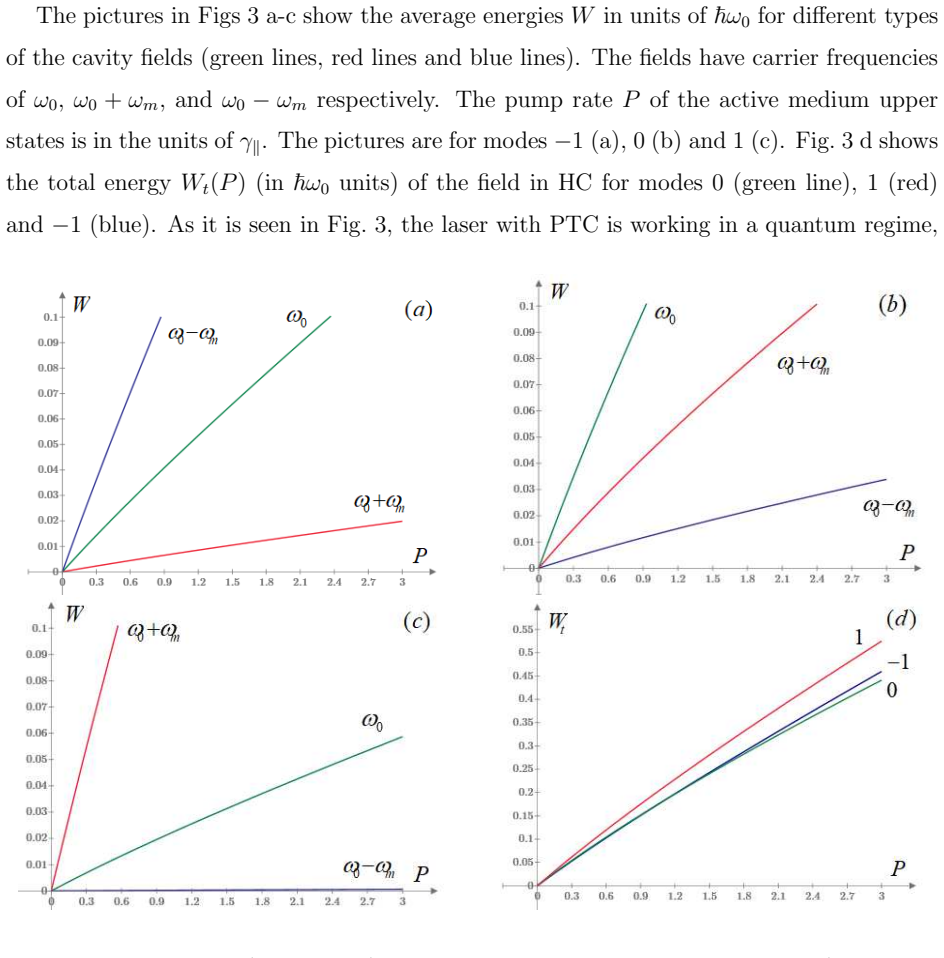
In this case, the mode 0 corresponds to the radiation of a conventional laser wit h a carrier frequency ω 0, whilst the radiation in modes ± 1 is absent. In the presence of a nonlinear medium that is modulated at the frequency ω m, the fields of carrier frequencies ω 0, ω 0 ± ω m interact through the nonlinear medium. Consequently, radiation exists in each...
-
[5]
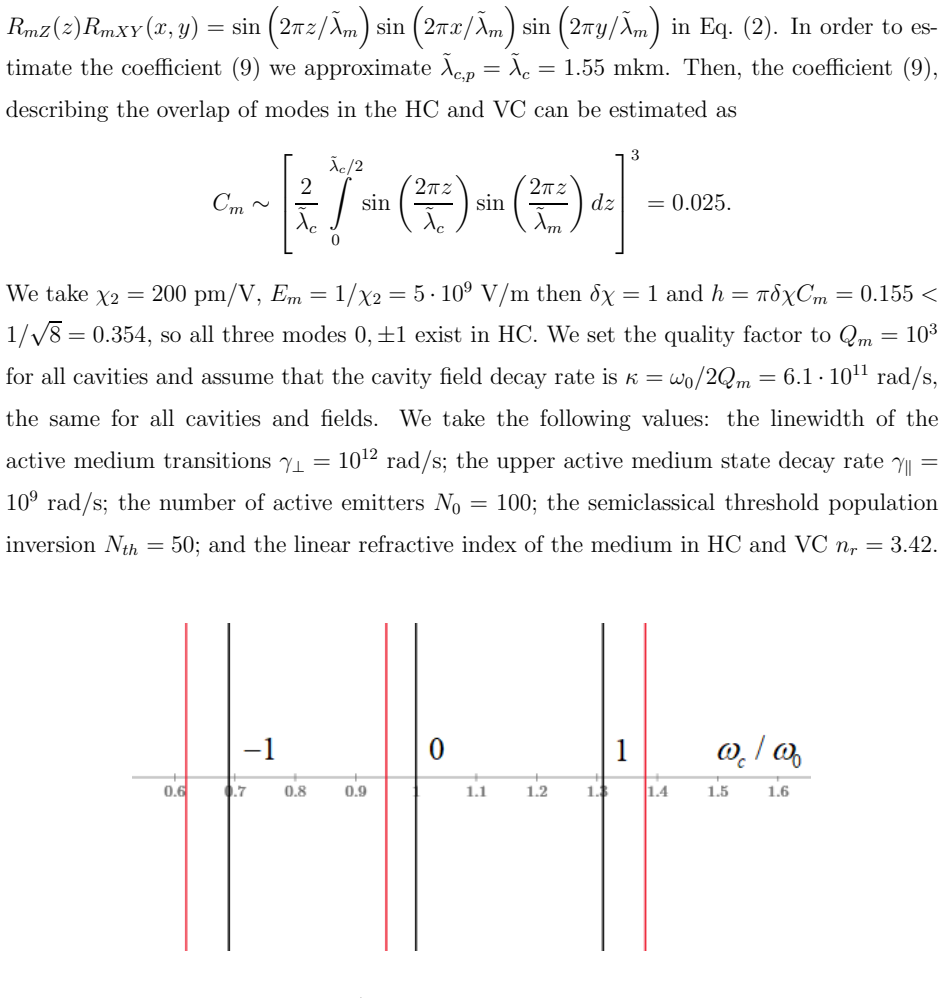
55 mkm in the medium with the linear refractive index nr. We consider that the non- linear medium in VC is modulated by the field of the wavelength ˜λ m = 5 mkm. The size of VC is about ∼ ˜λ m/ 2. The size of HC must be chosen specifically for each mode p = 0 , ± 1, the size of HC is about ˜λ c,p / 2, where ˜λ c,p = 2 πc/ (nrω c,p ). For simplicity, we assu...
- [6]
-
[7]
G. Ptitcyn, M. S. Mirmoosa, A. Sotoodehfar, and S. A. Tret yakov, A tutorial on the basics of time-varying electromagnetic systems and circuits: His toric overview and basic concepts of time-modulation, IEEE Antennas and Propagation Magazine 65, 10 (2023)
work page 2023
-
[8]
Yablonovitch, Inhibited spontaneous emission in sol id-state physics and electronics, Phys
E. Yablonovitch, Inhibited spontaneous emission in sol id-state physics and electronics, Phys. Rev. Lett. 58, 2059 (1987)
work page 2059
-
[9]
John, Strong localization of photons in certain disor dered dielectric superlattices, Phys
S. John, Strong localization of photons in certain disor dered dielectric superlattices, Phys. Rev. Lett. 58, 2486 (1987)
work page 1987
-
[10]
M. M. Asgari, P. Garg, X. Wang, M. S. Mirmoosa, C. Rockstuh l, and V. Asadchy, Theory and applications of photonic time crystals: a tutorial, Adv . Opt. Photon. 16, 958 (2024)
work page 2024
- [11]
-
[12]
A. Boltasseva, V. M. Shalaev, and M. Segev, Photonic time crystals: from fundamental insights to novel applications: opinion, Opt. Mater. Express 14, 592 (2024)
work page 2024
-
[13]
T. Mori, Floquet states in open quantum systems, Annual R eview of Condensed Matter Physics 14, 35 (2023)
work page 2023
- [14]
-
[15]
B. P´ erez-Gonz´ alez, G. Platero, and ´A. Gomez-Le´ on, Light-matter correlations in Quantum Floquet engineering of cavity quantum materials, Quantum 9, 1633 (2025)
work page 2025
-
[16]
J. L. Valdez-Garc ´ ıa and P. Halevi, Parametric resonan ces in a photonic time crystal with periodic square modulation of its permittivity ε(t), Phys. Rev. A 109, 063517 (2024)
work page 2024
-
[17]
J. B. Khurgin, Photonic time crystals and parametric am plification: Similarity and distinction, ACS Photonics 11, 2150 (2024), https://doi.org/10.1021/acsphotonics.4c 00607
-
[18]
X. Wang, M. S. Mirmoosa, V. S. Asadchy, C. Rockstuhl, S. F an, and S. A. Tretyakov, 24 Metasurface-based realization of photonic time crystals, Science Advances 9, eadg7541 (2023), https://www.science.org/doi/pdf/10.1126/sciadv.adg7541
-
[19]
X. Wang, P. Garg, M. S. Mirmoosa, A. G. Lamprianidis, C. R ockstuhl, and V. S. Asad- chy, Expanding momentum bandgaps in photonic time crystals through resonances, Nature Photonics 19, 149 (2025)
work page 2025
-
[20]
J. E. Sustaeta-Osuna, F. J. Garcsa-Vidal, and P. A. Huid obro, Quantum theory of photon pair creation in photonic time crystals, ACS Photonics 12, 1873 (2025)
work page 2025
-
[21]
A. Dikopoltsev, Y. Sharabi, M. Lyubarov, Y. Lumer, S. Ts esses, E. Lustig, I. Kaminer, and M. Segev, Light emission by free electrons in photonic time- crystals, Proceedings of the National Academy of Sciences 119, e2119705119 (2022), https://www.pnas.org/doi/pdf/10.1073/pnas.2119705119
-
[22]
M. Lyubarov, Y. Lumer, A. Dikopoltsev, E. Lustig, Y. Sha rabi, and M. Segev, Amplified emission and lasing in photonic time crystals, Sci ence 377, 425 (2022), https://www.science.org/doi/pdf/10.1126/science.abo3324
-
[23]
K. Xu and et al, Thresholdless laser based on photonic ti me crystals, Research Square **, https://doi.org/10.21203/rs.3.rs-3085133/v1 (2025)
-
[24]
Z. Dong, X. Chen, and L. Yuan, Extremely narrow band in mo ir´ e photonic time crystal, Phys. Rev. Lett. 135, 033803 (2025)
work page 2025
-
[25]
L. He, Y. Jin, Y. Pan, Y. Xiang, F.-z. Xuan, and D. Torrent , Laser emission induced by time-modulated impedance surfaces, Phys. Rev. Appl. 23, 024040 (2025)
work page 2025
-
[26]
M. Saldutti, M. Xiong, E. Dimopoulos, Y. Yu, M. Gioannin i, and J. Moerk, Modal properties of photonic crystal cavities and applications to lasers, Nano materials 11, 10.3390/nano11113030 (2021)
-
[27]
W. W. Chow, M. Lorke, and F. Jahnke, Will quantum dots rep lace quantum wells as the active medium of choice in future semiconductor lasers?, IE EE Journal of Selected Topics in Quantum Electronics 17, 1349 (2011)
work page 2011
-
[28]
M. N¨ agele, T. Steinle, F. M¨ orz, H. Linnenbank, A. Stei nmann, and H. Giessen, Compact harmonic cavity optical parametric oscillator for optical parametric amplifier seeding, Opt. Express 28, 25000 (2020)
work page 2020
-
[29]
I. E. Protsenko, L. A. Lugiato, and C. Fabre, Spectral an alysis of the degenerate optical parametric oscillator as a noiseless amplifier, Phys. Rev. A 50, 1627 (1994). 25
work page 1994
-
[30]
M. Butt, S. Khonina, and N. Kazanskiy, Recent advances i n photonic crystal optical devices: A review, Optics & Laser Technology 142, 107265 (2021)
work page 2021
-
[31]
I. Protsenko, P. Domokos, V. Lef` evre-Seguin, J. Hare, J. M. Raimond, and L. Davidovich, Quantum theory of a thresholdless laser, Phys. Rev. A 59, 1667 (1999)
work page 1999
-
[32]
E. C. Andr´ e, I. E. Protsenko, A. V. Uskov, J. Mørk, and M. Wubs, On collective Rabi splitting in nanolasers and nano-LEDs, Opt. Lett. 44, 1415 (2019)
work page 2019
-
[33]
I. E. Protsenko, A. V. Uskov, E. C. Andr´ e, J. Mørk, and M. Wubs, Quantum langevin approach for superradiant nanolasers, New Journal of Physics 23, 063010 (2021)
work page 2021
-
[34]
I. E. Protsenko and A. V. Uskov, Perturbation approach i n heisenberg equations for lasers, Phys. Rev. A 105, 053713 (2022)
work page 2022
-
[35]
I. C. Littler and K. Bergmann, Generation of multi-freq uency laser emission using an active frequency shifted feedback cavity, Optics Communications 88, 523 (1992)
work page 1992
-
[36]
A. Vodchits, D. Busko, V. Orlovich, V. Lisinetskii, A. G rabtchikov, P. Apanasevich, W. Kiefer, H. Eichler, and P.-Y. Turpin, Multi-frequency quasi-conti nuous wave solid-state raman laser for the ultraviolet, visible, and near infrared, Optics Com munications 272, 467 (2007)
work page 2007
-
[37]
S. Chen, T. Pu, J. Zheng, L. Wang, G. Wu, J. Li, and X. Zhang , Multi-band triangular frequency modulation signal generation based on gain-swit ched laser, Optics Communications 539, 129481 (2023)
work page 2023
-
[38]
A. Calderaro, M.-C. Arcangeletti, I. Rodighiero, M. Bu ttrini, C. Gorrini, F. Motta, D. Ger- mini, M.-C. Medici, C. Chezzi, and F. De Conto, Matrix-assis ted laser desorption/ionization time-of-flight (maldi-tof) mass spectrometry applied to vi rus identification, Scientific Reports 4, 6803 (2014)
work page 2014
-
[39]
S. Yu, Z. Zhang, M. Li, and H. Xia, Multi-frequency differe ntial absorption lidar incorporating a comb-referenced scanning laser for gas spectrum analysis , Opt. Express 29, 12984 (2021)
work page 2021
-
[40]
Y. Geng, Y. Xiao, Q. Bai, X. Han, W. Dong, W. Wang, J. Xue, B . Yao, G. Deng, Q. Zhou, K. Qiu, J. Xu, and H. Zhou, Wavelength-division multiplexin g communications using inte- grated soliton microcomb laser source, Opt. Lett. 47, 6129 (2022)
work page 2022
-
[41]
A. E. Zabolotin, F. F. Bentivegna, I. L. Lyubchanskii, Y . G. Boucher, N. N. Dadoenkova, A. L. Shyshmakov, Y. Lee, and T. Rasing, One-dimensional pho tonic crystal with strained interfaces, J. Opt. Soc. Am. B 28, 2216 (2011)
work page 2011
-
[42]
H. Okayama, Y. Onawa, and D. Shimura, Moire one-dimensi onal photonic crystal topology 26 composed of holes with different sizes, Optica Open (2024)
work page 2024
-
[43]
J. S. Foresi, P. R. Villeneuve, J. Ferrera, E. R. Thoen, G . Steinmeyer, S. Fan, J. D. Joannopou- los, L. C. Kimerling, H. I. Smith, and E. P. Ippen, Photonic-b andgap microcavities in optical waveguides, Nature 390, 143 (1997)
work page 1997
-
[44]
A. Zain, One-dimensional photonic crystal / photonic wire cavities based on silicon-on-insulator (SOI), Phd thesis, University of Glasgow (2009), https://theses. gla.ac.uk/996/
work page 2009
-
[45]
S. Katsuno, M. Yoshida, T. Inoue, M. De Zoysa, R. Hatsuda , K. Ishizaki, and S. Noda, Design and experimental demonstration of photonic-crystal laser s with multijunction active layers, Applied Physics Express 17, 122004 (2024)
work page 2024
-
[46]
M. Sargent, M. O. Scully, and W. E. Lamb, Laser Physics (London : Addison-Wesley, 1974)
work page 1974
-
[47]
M. S. Scully, M. O. Zubairy, Quantum Optics (Cambridge University Press, 1997)
work page 1997
-
[48]
P. R. Rice and H. J. Carmichael, Photon statistics of a ca vity-qed laser: A comment on the laser–phase-transition analogy, Phys. Rev. A 50, 4318 (1994)
work page 1994
-
[49]
R. Zu, B. Wang, J. He, J.-J. Wang, L. Weber, L.-Q. Chen, an d V. Gopalan, Analytical and numerical modeling of optical second harmonic generati on in anisotropic crystals using #SHAARP package, npj Computational Materials 8, 246 (2022)
work page 2022
-
[50]
E. M. Dianov and D. S. Starodubov, Photoinduced generat ion of the second harmonic in centrosymmetric media, Quantum Electronics 25, 395 (1995)
work page 1995
-
[51]
D. Fitsios and F. Raineri, Chapter five - photonic crysta l lasers and nanolasers on silicon, in Silicon Photonics, Semiconductors and Semimetals, Vol. 99 , edited by S. Lourdudoss, R. T. Chen, and C. Jagadish (Elsevier, 2018) pp. 97–137
work page 2018
-
[52]
T. Kuraishi and T. Uchimura, Resonance-enhanced multi photon ionization/time-of-flight mass spectrometry for sensitive analysis of product ions formed by online concentration from analyte adsorption/laser desorption, Analytical Chemistry 85, 3493 (2013). 27
work page 2013
discussion (0)
Sign in with ORCID, Apple, or X to comment. Anyone can read and Pith papers without signing in.