Reweighted Time-Evolving Block Decimation for Improved Quantum Dynamics Simulations
Pith reviewed 2026-05-23 06:56 UTC · model grok-4.3
The pith
Reweighted TEBD improves MPDO time-evolution accuracy by deprioritizing high-weight expectation values during truncation.
A machine-rendered reading of the paper's core claim, the machinery that carries it, and where it could break.
Core claim
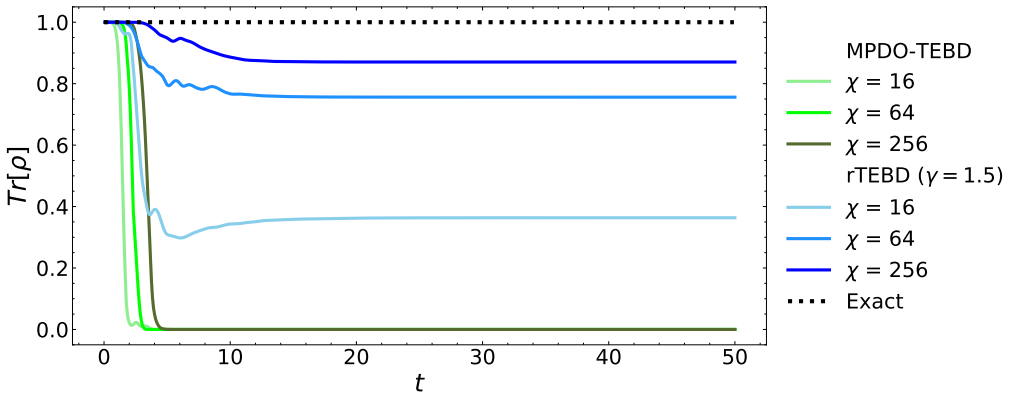
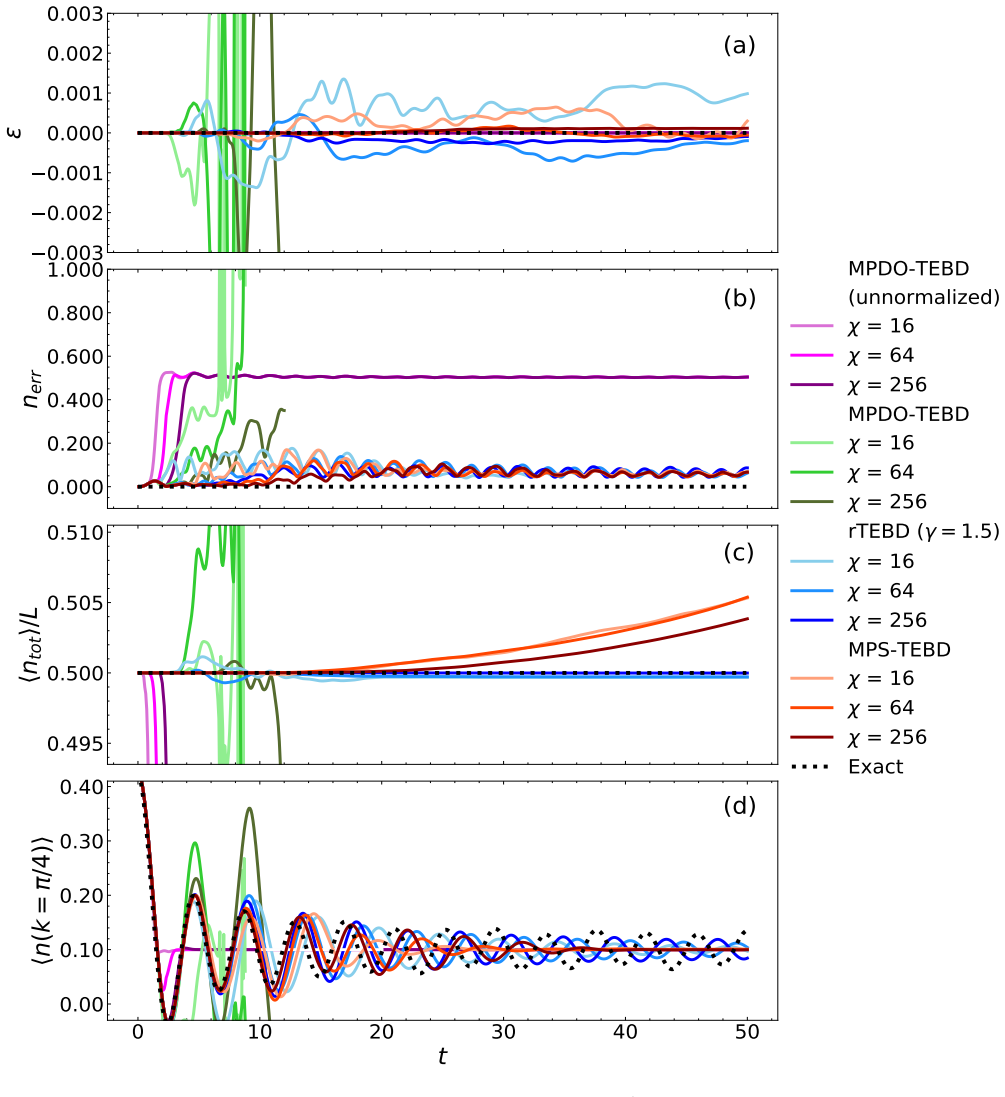
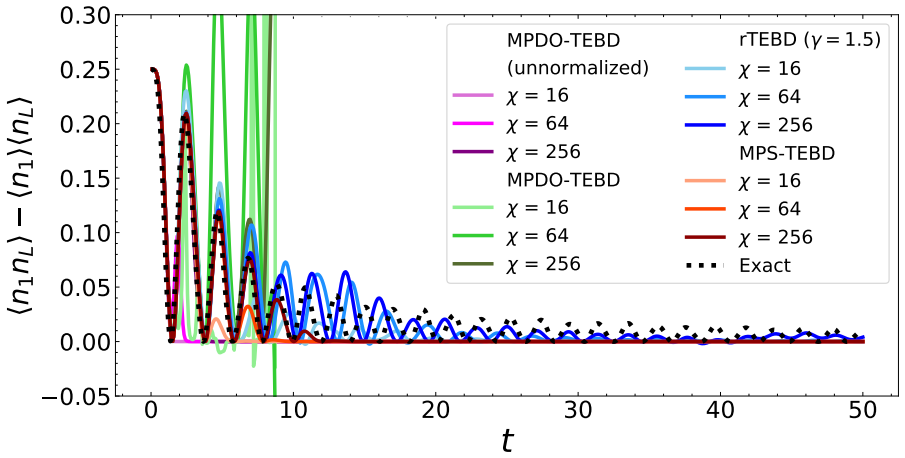
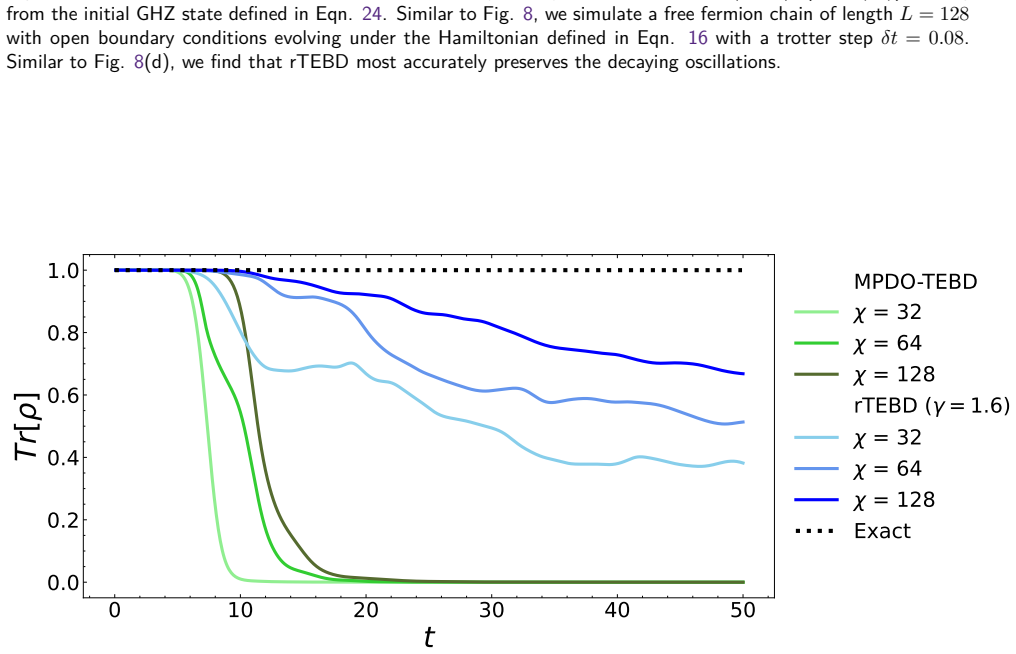
The central claim is that applying a reweighting factor γ^{-n} to high-weight expectation values inside the singular-value truncation of an MPDO makes the resulting time-dependent simulation significantly more accurate than standard TEBD on the same MPDO representation, competitive with or better than TEBD on an MPS representation, and able to preserve conserved quantities to high numerical precision.
What carries the argument
The reweighting factor γ^{-n} applied to expectation values of weight n inside every truncation step of the MPDO time-evolution algorithm.
If this is right
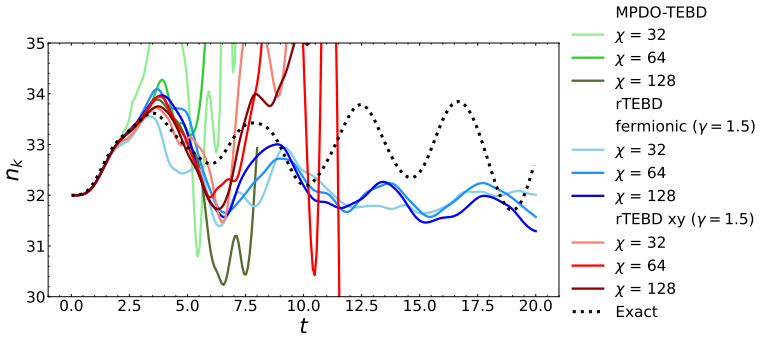
- rTEBD time-dependent MPDO simulations are significantly more accurate than standard TEBD MPDO simulations.
- rTEBD accuracy is competitive with or sometimes exceeds TEBD accuracy on MPS representations.
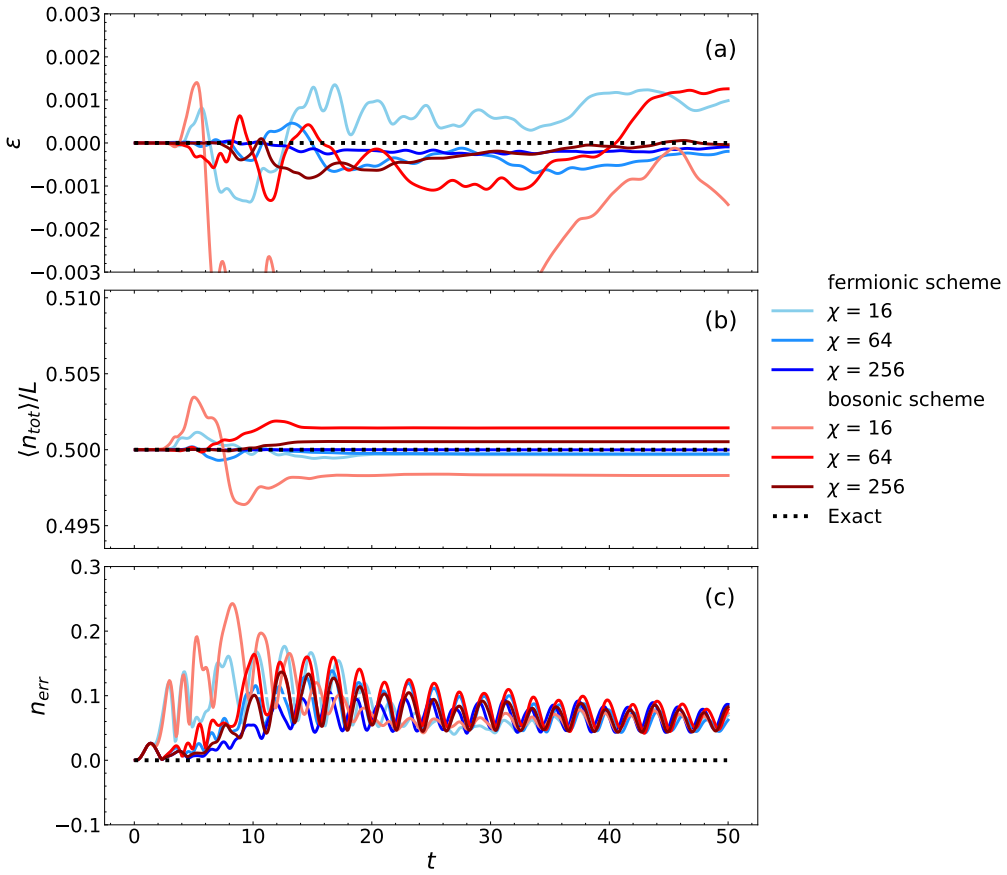
- Conserved quantities remain close to their exact values over long simulation times when low-weight terms are prioritized.
- The improvement requires no extra computational cost beyond the standard TEBD truncation step.
Where Pith is reading between the lines
- The same reweighting idea could be tested inside other MPDO algorithms such as time-dependent variational principle or purification-based methods.
- Choosing γ adaptively rather than as a fixed hyper-parameter might further reduce truncation error on specific models.
- Because the method only changes the truncation weights, it can be combined with existing bond-dimension adaptation schemes without altering the underlying Trotter decomposition.
- Long-time simulations of open quantum systems may benefit most, since conservation of quantities such as particle number is often the dominant accuracy requirement.
Load-bearing premise
Low-weight expectation values are sufficiently more important than high-weight ones that systematically reducing the latter by a fixed factor γ^{-n} at every truncation improves overall accuracy without creating new systematic errors.
What would settle it
Run both rTEBD and standard TEBD on the same MPDO for a model whose dynamics are known to be dominated by high-weight correlators; if the rTEBD error grows faster or conserved quantities drift more, the central claim is falsified.
Figures





read the original abstract
We introduce a simple yet significant improvement to the time-evolving block decimation (TEBD) tensor network algorithm for simulating the time dynamics of strongly correlated one-dimensional (1D) mixed quantum states. The efficiency of 1D tensor network methods stems from using a product of matrices to express either: the coefficients of a wavefunction, yielding a matrix product state (MPS); or the expectation values of a density matrix, yielding a matrix product density operator (MPDO). To avoid exponential computational costs, TEBD truncates the matrix dimension while simulating the time evolution. However, when truncating an MPDO, TEBD does not favor the likely more important low-weight expectation values, such as $\langle c_i^\dagger c_j \rangle$, over the exponentially many high-weight expectation values, such as $\langle c_{i_1}^\dagger c^\dagger_{i_2} \cdots c_{i_n} \rangle$ of weight $n$, despite the critical importance of the low-weight expectation values. Motivated by this shortcoming, we propose a reweighted TEBD (rTEBD) algorithm that deprioritizes high-weight expectation values by a factor of $\gamma^{-n}$ during the truncation. This modification makes rTEBD significantly more accurate than the TEBD time-dependent simulation of an MPDO, and competitive with and sometimes better than TEBD using MPS. Furthermore, by prioritizing low-weight expectation values, rTEBD preserves conserved quantities to high precision.
Editorial analysis
A structured set of objections, weighed in public.
Referee Report
Summary. The manuscript introduces reweighted time-evolving block decimation (rTEBD) for simulating time dynamics of 1D mixed quantum states represented as matrix product density operators (MPDOs). Standard TEBD truncation on MPDOs treats all expectation values equally, but rTEBD deprioritizes high-weight operators (weight n) by a tunable factor γ^{-n} during each truncation step. The central claims are that this yields significantly higher accuracy than TEBD on MPDOs, is competitive with or superior to MPS-based TEBD, and preserves conserved quantities to high precision by favoring low-weight observables such as ⟨c†_i c_j⟩.
Significance. If the numerical improvements hold under controlled tests, the method offers a lightweight, practical enhancement to existing tensor-network toolkits for open-system or mixed-state dynamics. The explicit separation of low- versus high-weight contributions during truncation is a simple idea that could be adopted quickly; however, the lack of any error bound or convergence analysis limits its immediate theoretical impact.
major comments (3)
- [Methods / truncation procedure] The central claim that rTEBD remains a controlled approximation to the original Liouvillian step rests on the assertion that reweighting only affects truncation without introducing new systematic bias. No derivation or perturbative bound is supplied showing that the modified singular-value spectrum still converges to the unweighted case as γ → 1 or as bond dimension → ∞ (see the truncation step in the Methods section).
- [Numerical results / figures] The paper reports that rTEBD is “significantly more accurate” and “competitive with and sometimes better than” MPS-TEBD, yet the only quantitative support appears to be selected fidelity or observable plots without tabulated error bars, system sizes, or direct comparison of Trotter and truncation errors across multiple γ values. This makes it impossible to judge whether the observed gains exceed the usual statistical fluctuations of the underlying TEBD implementation.
- [Algorithm description / parameter γ] The reweighting parameter γ is introduced as a free tunable factor. The manuscript does not demonstrate that the final observables become insensitive to γ within a stated window, nor does it provide an a-priori prescription for choosing γ from the Hamiltonian or initial state; this leaves open the possibility that the reported improvements are the result of post-hoc optimization rather than a robust algorithmic advance.
minor comments (2)
- [Introduction] Notation for the weight-n operators is introduced only in the abstract; a clear definition (e.g., the number of creation/annihilation operators) should appear in the main text before the first use of γ^{-n}.
- [Abstract / Results] The abstract states that rTEBD “preserves conserved quantities to high precision,” but the manuscript does not specify which quantities are conserved by the underlying model or how the deviation is quantified (absolute error, relative drift per unit time, etc.).
Simulated Author's Rebuttal
We thank the referee for the careful review and constructive comments. We address each major comment below and indicate the revisions that will be incorporated.
read point-by-point responses
-
Referee: [Methods / truncation procedure] The central claim that rTEBD remains a controlled approximation to the original Liouvillian step rests on the assertion that reweighting only affects truncation without introducing new systematic bias. No derivation or perturbative bound is supplied showing that the modified singular-value spectrum still converges to the unweighted case as γ → 1 or as bond dimension → ∞ (see the truncation step in the Methods section).
Authors: We agree that no derivation or perturbative bound is supplied. By construction the procedure reduces exactly to standard TEBD when γ = 1. We will add an explicit statement in the Methods section noting this limit. A rigorous bound on any additional bias is not derived in the present work. revision: partial
-
Referee: [Numerical results / figures] The paper reports that rTEBD is “significantly more accurate” and “competitive with and sometimes better than” MPS-TEBD, yet the only quantitative support appears to be selected fidelity or observable plots without tabulated error bars, system sizes, or direct comparison of Trotter and truncation errors across multiple γ values. This makes it impossible to judge whether the observed gains exceed the usual statistical fluctuations of the underlying TEBD implementation.
Authors: The manuscript currently presents results through figures. In the revision we will add a table reporting quantitative maximum errors in fidelity and selected observables for multiple system sizes, several γ values, and with Trotter and truncation contributions separated where possible. revision: yes
-
Referee: [Algorithm description / parameter γ] The reweighting parameter γ is introduced as a free tunable factor. The manuscript does not demonstrate that the final observables become insensitive to γ within a stated window, nor does it provide an a-priori prescription for choosing γ from the Hamiltonian or initial state; this leaves open the possibility that the reported improvements are the result of post-hoc optimization rather than a robust algorithmic advance.
Authors: We will add a sensitivity analysis in the revision showing that key observables remain stable for γ within a window around the reported value. A general a-priori rule for selecting γ directly from the Hamiltonian is not supplied; we will include a brief heuristic discussion based on the expected weight distribution of observables. revision: partial
- A formal perturbative bound or convergence analysis for the reweighted truncation as γ → 1 or bond dimension → ∞.
Circularity Check
No significant circularity detected in rTEBD proposal
full rationale
The paper proposes rTEBD as an explicit heuristic modification to standard TEBD truncation for MPDOs, introducing the tunable reweighting factor γ^{-n} by direct ansatz to deprioritize high-weight operators. This choice is stated as motivated by the relative importance of low-weight expectation values, with no equations or derivations that reduce the claimed accuracy gains or conservation preservation back to the inputs by construction. No fitted parameters are relabeled as predictions, no self-citations form load-bearing uniqueness arguments, and the central improvement is presented as an empirical outcome of the modification rather than a tautological result. The derivation chain remains self-contained as a proposed algorithm change whose performance is to be validated externally.
Axiom & Free-Parameter Ledger
free parameters (1)
- γ
axioms (1)
- domain assumption Low-weight expectation values are more important for accurate dynamics than high-weight expectation values of the same MPDO.
Reference graph
Works this paper leans on
-
[1]
Efficient simulation of one- dimensional quantum many-body systems
Guifré Vidal. “Efficient simulation of one- dimensional quantum many-body systems”. Phys. Rev. Lett.93, 040502 (2004). 10 0 20 40 60 80 100 t 0.20 0.21 0.22 0.23 0.24 0.25 0.26 MPDO-TEBD (unnormalized) = 32 = 64 = 128 MPDO-TEBD = 32 = 64 = 128 rTEBD ( = 1.6) = 32 = 64 = 128 MPS-TEBD = 32 = 64 = 128 Exact Figure 12: Same as Fig. 8(a), except for the intera...
work page 2004
-
[2]
Time-evolution methods for matrix- product states
Sebastian Paeckel, Thomas Köhler, An- dreas Swoboda, Salvatore R. Manmana, Ulrich Schollwöck, and Claudius Hubig. “Time-evolution methods for matrix- product states”. Annals of Physics411, 167998 (2019)
work page 2019
-
[3]
Time-evolution of lo- cal information: thermalization dynamics of local observables
Thomas Klein Kvorning, Loïc Herviou, and Jens H. Bardarson. “Time-evolution of lo- cal information: thermalization dynamics of local observables”. SciPost Phys.13, 080 (2022)
work page 2022
-
[4]
Efficient large-scale many-body quantum dynamics via local-information time evolution
Claudia Artiaco, Christoph Fleckenstein, David Aceituno Chávez, Thomas Klein Kvorning, and Jens H. Bardarson. “Efficient large-scale many-body quantum dynamics via local-information time evolution”. PRX Quantum5, 020352 (2024)
work page 2024
-
[5]
Quantum dynamics of thermalizing sys- tems
Christopher David White, Michael Zale- tel, Roger S. K. Mong, and Gil Refael. “Quantum dynamics of thermalizing sys- tems”. Physical Review B97(2018)
work page 2018
-
[6]
Emergent hydrodynamics 11 in nonequilibrium quantum systems
Bingtian Ye, Francisco Machado, Christo- pher David White, Roger S. K. Mong, and Norman Y. Yao. “Emergent hydrodynamics 11 in nonequilibrium quantum systems”. Phys. Rev. Lett.125, 030601 (2020)
work page 2020
-
[7]
Dissipation- assisted operator evolution method for capturing hydrodynamic transport
Tibor Rakovszky, C. W. von Keyser- lingk, and Frank Pollmann. “Dissipation- assisted operator evolution method for capturing hydrodynamic transport” (2020). arXiv:2004.05177
-
[8]
Probing hydrodynamic crossovers with dissipation-assisted operator evolution
N. S. Srivatsa, Oliver Lunt, Tibor Rakovszky, and Curt von Keyserlingk. “Probing hydrodynamic crossovers with dissipation-assisted operator evolu- tion” (2024). arXiv:2408.08249
work page internal anchor Pith review Pith/arXiv arXiv 2024
- [9]
-
[10]
En-Jui Kuo, Brayden Ware, Peter Lunts, Mohammad Hafezi, and Christopher David White. “Energy diffusion in weakly interact- ing chains with fermionic dissipation- assisted operator evolution” (2023). arXiv:2311.17148
-
[11]
Real-time operator evolution in two and three dimensions via sparse pauli dynam- ics
Tomislav Begušić and Garnet Kin-Lic Chan. “Real-time operator evolution in two and three dimensions via sparse pauli dynam- ics” (2024). arXiv:2409.03097
-
[12]
Com- paring numerical methods for hydrodynam- ics in a one-dimensional lattice spin model
Stuart Yi-Thomas, Brayden Ware, Jay D. Sau, and Christopher David White. “Com- paring numerical methods for hydrodynam- ics in a one-dimensional lattice spin model”. Phys. Rev. B110, 134308 (2024)
work page 2024
-
[13]
A universal operator growth hypoth- esis
Daniel E. Parker, Xiangyu Cao, Alexander Avdoshkin, Thomas Scaffidi, and Ehud Alt- man. “A universal operator growth hypoth- esis”. Phys. Rev. X9, 041017 (2019)
work page 2019
-
[14]
Operator backflow and the classical simulation of quantum trans- port
Curt von Keyserlingk, Frank Pollmann, and Tibor Rakovszky. “Operator backflow and the classical simulation of quantum trans- port”. Phys. Rev. B105, 245101 (2022)
work page 2022
-
[15]
Christopher David White. “Effective dissi- pation rate in a liouvillian-graph picture of high-temperature quantum hydrodynamics”. Phys. Rev. B107, 094311 (2023)
work page 2023
-
[16]
Finding purifica- tions with minimal entanglement
Johannes Hauschild, Eyal Leviatan, Jens H. Bardarson, Ehud Altman, Michael P. Zale- tel, and Frank Pollmann. “Finding purifica- tions with minimal entanglement”. Physical Review B98, 235163 (2018)
work page 2018
-
[17]
Variational adiabatic trans- port of tensor networks
Hyeongjin Kim, Matthew Fishman, and Dries Sels. “Variational adiabatic trans- port of tensor networks”. PRX Quantum5, 020361 (2024)
work page 2024
-
[18]
Time dependent variational principle for tree tensor networks
Daniel Bauernfeind and Markus Aichhorn. “Time dependent variational principle for tree tensor networks” (2019). url:http: //arxiv.org/abs/1908.03090
-
[19]
Shimpei Goto and Ippei Danshita. “Per- formance of the time-dependent variational principle for matrix product states in long- time evolution of a pure state”. Physical Re- view B99, 054307 (2019)
work page 2019
-
[20]
Time-dependentvari- ationalprincipleforquantumlattices
Jutho Haegeman, J. Ignacio Cirac, Tobias J. Osborne, Iztok Pižorn, Henri Verschelde, andFrankVerstraete. “Time-dependentvari- ationalprincipleforquantumlattices”. Phys- ical Review Letters107, 070601 (2011)
work page 2011
-
[21]
Density matrix formu- lation for quantum renormalization groups
Steven R. White. “Density matrix formu- lation for quantum renormalization groups”. Phys. Rev. Lett.69, 2863–2866 (1992)
work page 1992
-
[22]
Time-dependent density-matrix renormalization-group using adaptive effec- tive hilbert spaces
A J Daley, C Kollath, U Schollwöck, and G Vidal. “Time-dependent density-matrix renormalization-group using adaptive effec- tive hilbert spaces”. Journal of Statistical Mechanics: Theory and Experiment2004, P04005 (2004)
work page 2004
-
[23]
From density-matrix renormalization group to matrix prod- uct states
Ian P McCulloch. “From density-matrix renormalization group to matrix prod- uct states”. Journal of Statistical Me- chanics: Theory and Experiment2007, P10014 (2007)
work page 2007
-
[24]
Matrix product states and projected entangled pair states: Concepts, symmetries, theorems
J. Ignacio Cirac, David Pérez-García, Nor- bert Schuch, and Frank Verstraete. “Matrix product states and projected entangled pair states: Concepts, symmetries, theorems”. Reviews of Modern Physics93(2021)
work page 2021
-
[25]
Real-time evolution using the density ma- trix renormalization group
Steven R. White and Adrian E. Feiguin. “Real-time evolution using the density ma- trix renormalization group”. Physical Re- view Letters93(2004)
work page 2004
-
[26]
The density-matrix renormalization group in the age of matrix product states
Ulrich Schollwöck. “The density-matrix renormalization group in the age of matrix product states”. Annals of Physics326, 96–192 (2011)
work page 2011
-
[27]
A simple ten- sor network algorithm for two-dimensional 12 steady states
Augustine Kshetrimayum, Hendrik Weimer, and Roman Orus. “A simple ten- sor network algorithm for two-dimensional 12 steady states”. Nature Communications8, 1291 (2017)
work page 2017
-
[28]
Matrix product states for dynamical simulation of infinite chains
M. C. Bañuls, M. B. Hastings, F. Verstraete, and J. I. Cirac. “Matrix product states for dynamical simulation of infinite chains”. Physical Review Letters102, 240603 (2009)
work page 2009
-
[29]
Time evolution of an infinite projected entangled pair state: an efficient algorithm
Piotr Czarnik, Jacek Dziarmaga, and Philippe Corboz. “Time evolution of an infinite projected entangled pair state: an efficient algorithm”. Physical Review B99(2019)
work page 2019
-
[30]
Repulsively Bound Hadrons in aZ 2 Lattice Gauge The- ory
Sayak Guha Roy, Vaibhav Sharma, Kaidi Xu, Umberto Borla, Jad C. Halimeh, and Kaden R. A. Hazzard. “Repulsively Bound Hadrons in aZ 2 Lattice Gauge The- ory” (2025). arXiv:2510.23618
-
[31]
Escap- ing fronts in local quenches of a confining spin chain
Anna Krasznai and Gábor Takács. “Escap- ing fronts in local quenches of a confining spin chain”. SciPost Phys.16, 138 (2024)
work page 2024
-
[32]
Matrix prod- uct study of spin fractionalization in the one- dimensional kondo insulator
Jing Chen, E. Miles Stoudenmire, Yashar Komijani, and Piers Coleman. “Matrix prod- uct study of spin fractionalization in the one- dimensional kondo insulator”. Phys. Rev. Res.6, 023227 (2024)
work page 2024
-
[33]
Time-dependent variational princi- ple with controlled bond expansion for ma- trix product states
Jheng-Wei Li, Andreas Gleis, and Jan von Delft. “Time-dependent variational princi- ple with controlled bond expansion for ma- trix product states”. Phys. Rev. Lett.133, 026401 (2024)
work page 2024
-
[34]
Parallel implementation of the time- evolving block decimation algorithm for the bose–hubbard model
Miroslav Urbanek and Pavel Soldán. “Parallel implementation of the time- evolving block decimation algorithm for the bose–hubbard model”. Computer Physics Communications199, 170–177 (2016)
work page 2016
-
[35]
Unifying time evolution and opti- mization with matrix product states
JuthoHaegeman, ChristianLubich, IvanOs- eledets, Bart Vandereycken, and Frank Ver- straete. “Unifying time evolution and opti- mization with matrix product states”. Phys- ical Review B94, 165116 (2016)
work page 2016
-
[36]
Post-matrix product state methods: To tangent space and be- yond
Jutho Haegeman, Tobias J. Osborne, and Frank Verstraete. “Post-matrix product state methods: To tangent space and be- yond”. Physical Review B88, 075133 (2013)
work page 2013
-
[37]
Matrix product states ap- proaches to operator spreading in ergodic quantum systems
Kévin Hémery, Frank Pollmann, and David J. Luitz. “Matrix product states ap- proaches to operator spreading in ergodic quantum systems”. Phys. Rev. B100, 104303 (2019)
work page 2019
-
[38]
Infinite boundary conditions for matrix product state calculations
Ho N. Phien, Guifré Vidal, and Ian P. Mc- Culloch. “Infinite boundary conditions for matrix product state calculations”. Phys. Rev. B86, 245107 (2012)
work page 2012
-
[39]
V Zauner, M Ganahl, H G Evertz, and T Nishino. “Time evolution within a comov- ingwindow: scalingofsignalfrontsandmag- netization plateaus after a local quench in quantum spin chains”. Journal of Physics: Condensed Matter27, 425602 (2015)
work page 2015
-
[40]
Stable quantum-correlated many-body states through engineered dissi- pation
X. Mi et al. “Stable quantum-correlated many-body states through engineered dissi- pation”. Science383, 1332–1337 (2024)
work page 2024
-
[41]
Avalanche terahertz photon detection in a rydberg tweezer array
Chris Nill, Albert Cabot, Arno Traut- mann, Christian Groß, and Igor Lesanovsky. “Avalanche terahertz photon detection in a rydberg tweezer array”. Phys. Rev. Lett. 133, 073603 (2024)
work page 2024
-
[42]
Eduardo Mascarenhas, Hugo Flayac, and Vincenzo Savona. “Matrix-product-operator approach to the nonequilibrium steady state of driven-dissipative quantum arrays”. Phys. Rev. A92, 022116 (2015)
work page 2015
-
[43]
Efficient higher-order matrix productoperatorsfortimeevolution
Maarten Van Damme, Jutho Haegeman, Ian McCulloch, and Laurens Vander- straeten. “Efficient higher-order matrix productoperatorsfortimeevolution” (2023). arXiv:2302.14181
-
[44]
Matrix product density operators: Simulation of finite-temperature and dis- sipative systems
F. Verstraete, J. J. García-Ripoll, and J. I. Cirac. “Matrix product density operators: Simulation of finite-temperature and dis- sipative systems”. Phys. Rev. Lett.93, 207204 (2004)
work page 2004
-
[45]
Variational matrix product opera- tors for the steady state of dissipative quan- tum systems
Jian Cui, J. Ignacio Cirac, and Mari Carmen Bañuls. “Variational matrix product opera- tors for the steady state of dissipative quan- tum systems”. Physical Review Letters114, 220601 (2015)
work page 2015
-
[46]
Simulation methods for open quantum many-body systems
Hendrik Weimer, Augustine Kshetrimayum, and Román Orús. “Simulation methods for open quantum many-body systems”. Rev. Mod. Phys.93, 015008 (2021)
work page 2021
-
[47]
Michael Zwolak and Guifré Vidal. “Mixed- state dynamics in one-dimensional quantum lattice systems: A time-dependent super- operator renormalization algorithm”. Phys. Rev. Lett.93, 207205 (2004). 13
work page 2004
-
[48]
Theory of trotter error with commutator scaling
Andrew M. Childs, Yuan Su, Minh C. Tran, Nathan Wiebe, and Shuchen Zhu. “Theory of trotter error with commutator scaling”. Physical Review X11(2021)
work page 2021
-
[49]
Shimpei Goto, Ryui Kaneko, and Ippei Dan- shita. “Matrix product state approach for a quantum system at finite temperatures us- ing random phases and trotter gates”. Phys. Rev. B104, 045133 (2021)
work page 2021
-
[50]
Qubit-reuse compilation with mid-circuit measurement and reset
Matthew DeCross, Eli Chertkov, Megan Ko- hagen, and Michael Foss-Feig. “Qubit-reuse compilation with mid-circuit measurement and reset”. Phys. Rev. X13, 041057 (2023)
work page 2023
-
[51]
Über das paulis- che äquivalenzverbot
P. Jordan and E. Wigner. “Über das paulis- che äquivalenzverbot”. Zeitschrift für Physik 47, 631–651 (1928)
work page 1928
-
[52]
Reweighted TEBD code repository
Sayak Guha Roy. “Reweighted TEBD code repository” (2025).https://doi.org/10. 5281/zenodo.17479680. A Derivation of the MPDOs and unitaries in the reweighted basis In this section, we will derive Eqn. 9 and the time evolving two-qubit unitaries (Eqn. 8) in the reweighted Pauli basis. To see Eqn. 9, we can consider a 1-qubit system whose density operator is...
work page 2025
discussion (0)
Sign in with ORCID, Apple, or X to comment. Anyone can read and Pith papers without signing in.