Semileptonic sum rules in heavy-to-light charm decays
Pith reviewed 2026-05-22 06:09 UTC · model grok-4.3
The pith
A sum rule relates lepton-flavor universality ratios in charm semileptonic decays to within the percent level under existing new physics bounds.
A machine-rendered reading of the paper's core claim, the machinery that carries it, and where it could break.
Core claim
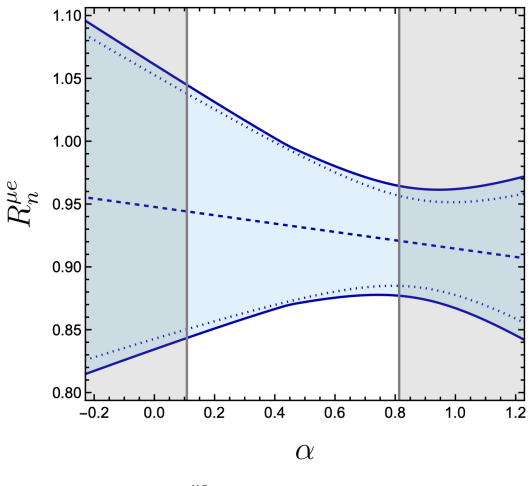
In the c to d semileptonic transitions the three lepton-flavor universality ratios obey a linear sum rule whose maximum violation is restricted to the sub-percent level once all new-physics operators allowed by low-energy and high-p_T data are taken into account; the relation therefore supplies a consistency test for charm measurements and yields a numerical prediction for the unmeasured R_n^{mu e} in Lambda_c to n l nu.
What carries the argument
The linear sum rule among the three R_H^{mu e} ratios obtained by direct analogy with the b to c and b to u relations and applied to the c to d sector.
If this is right
- The relation functions as an internal consistency check for charm semileptonic data.
- Any observed violation exceeding the percent level would require either experimental inconsistency or new physics outside present bounds.
- The sum rule supplies a definite numerical prediction for the ratio R_n^{mu e} in the Lambda_c to neutron channel.
Where Pith is reading between the lines
- Future higher-precision measurements of the D and Lambda_c modes could convert the sum rule into a sharper test of lepton-flavor universality.
- If the relation is confirmed experimentally it would support the assumption that no large additional breaking mechanisms operate in these decays.
- The same analogy-based construction might be examined in other heavy-to-light transitions where similar data exist.
Load-bearing premise
The algebraic structure that produces the sum rule in bottom decays survives in charm decays once the only sizable corrections are those from new-physics operators already bounded by other data.
What would settle it
Precise measurements of the three ratios that, after standard-model corrections, produce a combined deviation from the sum-rule prediction larger than one percent would show that the claimed bound does not hold.
Figures




read the original abstract
We investigate semileptonic sum rules in heavy-to-light charm decays, motivated by analogous relations in $b \to c$ and $b \to u$ transitions. Focusing on the $c \to d\overline{\ell}\nu$ decays, $D \to \pi\overline{\ell}\nu$, $D \to \rho\overline{\ell}\nu$, and $\Lambda_c \to n\overline{\ell}\nu$, we examine a relation among their lepton-flavor universality ratios $R_H^{\mu e}$. Although the charm sum rule is less precise than the relations in bottom-hadron decays, current low-energy and high-$p_T$ constraints on new physics restrict the actual deviation from the relation to below the percent level. The relation can therefore provide a useful consistency check of charm semileptonic measurements. As an application, we derive a prediction for the yet-unmeasured ratio $R_n^{\mu e}$ in $\Lambda_c \to n\overline{\ell}\nu$.
Editorial analysis
A structured set of objections, weighed in public.
Referee Report
Summary. The manuscript derives a sum rule relating the lepton-flavor universality ratios R_H^{μe} among the charm semileptonic decays D → π ℓ ν, D → ρ ℓ ν, and Λ_c → n ℓ ν. Motivated by analogous relations in b → c and b → u transitions, it argues that new-physics-induced deviations from the sum rule are bounded below the percent level by existing low-energy and high-p_T constraints, allowing the relation to serve as a consistency check; as an application, a numerical prediction is given for the unmeasured ratio R_n^{μe} in Λ_c → n ℓ ν.
Significance. If the central claim holds, the work supplies a modest but useful phenomenological consistency test for emerging charm semileptonic data. The explicit use of external NP bounds to limit deviations, together with the falsifiable prediction for an unmeasured observable, constitutes a clear strength; the relation is acknowledged to be less precise than its bottom-sector counterparts.
major comments (2)
- [§3] §3 (sum-rule derivation): the claim that the c → d sum rule inherits a structure comparable to the b → c/u relations requires an explicit operator matching or form-factor argument showing that SU(3)-breaking and 1/m_c corrections do not spoil the relation at the claimed level; without this step the percent-level NP bound cannot be directly transferred.
- [§4] §4 (NP constraints): the statement that low-energy and high-p_T data restrict deviations below one percent is load-bearing for the consistency-check claim, yet the manuscript provides neither the explicit list of operators considered nor the numerical inputs and error propagation that produce the <1 % figure; this must be supplied with a table or equation.
minor comments (2)
- [Introduction] Define R_H^{μe} explicitly at first appearance and state the kinematic range over which the sum rule is asserted to hold.
- [§2] Add a brief comparison table of the precision achieved in the b-sector sum rules versus the charm case to quantify the statement that the charm relation is 'less precise'.
Simulated Author's Rebuttal
We thank the referee for the careful reading of the manuscript and the positive recommendation for minor revision. The comments are constructive and will improve the clarity of the presentation. We respond to each major comment below.
read point-by-point responses
-
Referee: [§3] §3 (sum-rule derivation): the claim that the c → d sum rule inherits a structure comparable to the b → c/u relations requires an explicit operator matching or form-factor argument showing that SU(3)-breaking and 1/m_c corrections do not spoil the relation at the claimed level; without this step the percent-level NP bound cannot be directly transferred.
Authors: We agree that an explicit discussion strengthens the argument. Although the manuscript already notes that the charm sum rule is less precise than its bottom-sector counterparts, we will revise §3 to include a concise operator-matching argument in the effective theory together with order-of-magnitude estimates of SU(3)-breaking and 1/m_c corrections. These corrections remain at the few-percent level and do not prevent transferring the existing NP bounds at the percent level for the purpose of a consistency check. revision: yes
-
Referee: [§4] §4 (NP constraints): the statement that low-energy and high-p_T data restrict deviations below one percent is load-bearing for the consistency-check claim, yet the manuscript provides neither the explicit list of operators considered nor the numerical inputs and error propagation that produce the <1 % figure; this must be supplied with a table or equation.
Authors: We acknowledge that the supporting details for the <1% bound should be presented more transparently. In the revised version we will add a table in §4 that enumerates the relevant operators, cites the low-energy and high-p_T experimental inputs, and shows the error propagation leading to the quoted bound. This will make the numerical claim fully reproducible while preserving the overall conclusion. revision: yes
Circularity Check
No significant circularity; derivation uses external NP bounds and analogous relations
full rationale
The paper motivates a sum rule relating R_H^{μe} ratios in D→π, D→ρ, and Λ_c→n decays from b→c/u analogs, then invokes external low-energy and high-p_T constraints to bound NP-induced deviations below the percent level. The prediction for the unmeasured R_n^{μe} follows directly from applying this externally bounded relation as a consistency check. No self-definitional equations, fitted parameters renamed as predictions, or load-bearing self-citations appear in the abstract or summary; the central claim remains independent and falsifiable against external data.
Axiom & Free-Parameter Ledger
axioms (2)
- domain assumption Sum rules derived for b to c and b to u transitions retain analogous structure when applied to c to d transitions.
- domain assumption Deviations from the sum rule arise only from new-physics operators already constrained by low-energy and high-p_T data.
Reference graph
Works this paper leans on
-
[1]
Partial Symmetries of Weak Interactions,
S. L. Glashow, “Partial Symmetries of Weak Interactions,” Nucl. Phys.22 (1961) 579–588
work page 1961
-
[2]
S. Weinberg, “A Model of Leptons,” Phys. Rev. Lett.19(1967) 1264–1266. 21
work page 1967
-
[3]
Weak and Electromagnetic Interactions,
A. Salam, “Weak and Electromagnetic Interactions,” Conf. Proc. C680519 (1968) 367–377. [4]Particle Data GroupCollaboration, “Review of particle physics,” Phys. Rev. D110(2024) 030001
work page 1968
-
[4]
Opportunities in Flavour Physics at the HL-LHC and HE-LHC
A. Dainese,et al., eds., “Report from Working Group 4: Opportunities in Flavour Physics at the HL-LHC and HE-LHC,” CERN Yellow Rep. Monogr.7 (2019) 867–1158[arXiv:1812.07638]
work page internal anchor Pith review Pith/arXiv arXiv 2019
-
[5]
E. Kou and P. Urquijo, eds., “The Belle II Physics Book,” PTEP2019(2019) 123C01[arXiv:1808.10567]. [Erratum: PTEP 2020, 029201 (2020)]. [7]BESIIICollaboration, “Future Physics Programme of BESIII,” Chin. Phys. C 44(2020) 040001[arXiv:1912.05983]. [8]FCCCollaboration, “Future Circular Collider Feasibility Study Report: Volume 1, Physics, Experiments, Detec...
-
[6]
STCF conceptual design report (Volume 1): Physics & detector,
M. Achasovet al., “STCF conceptual design report (Volume 1): Physics & detector,” Front. Phys. (Beijing)19(2024) 14701[arXiv:2303.15790]
-
[7]
M. Blanke,et al., “Impact of polarization observables andB c →τ νon new physics explanations of theb→cτ νanomaly,” Phys. Rev. D99(2019) 075006 [arXiv:1811.09603]
work page internal anchor Pith review Pith/arXiv arXiv 2019
-
[8]
M. Blanke,et al., “Addendum to “Impact of polarization observables and Bc →τ νon new physics explanations of theb→cτ νanomaly”.” arXiv:1905.08253. [Addendum: Phys.Rev.D 100, 035035 (2019)]
-
[9]
Impact of Λ b →Λ cτ νmeasurement on new physics in b→clνtransitions,
M. Fedele,et al., “Impact of Λ b →Λ cτ νmeasurement on new physics in b→clνtransitions,” Phys. Rev. D107(2023) 055005[arXiv:2211.14172]
-
[10]
On sum rules for semi-leptonicb→candb→udecays,
W.-F. Duan, S. Iguro, X.-Q. Li, R. Watanabe, and Y.-D. Yang, “On sum rules for semi-leptonicb→candb→udecays,” JHEP07(2025) 166 [arXiv:2410.21384]
-
[11]
Heavy quark symmetry behindb→csemileptonic sum rule,
M. Endo, S. Iguro, S. Mishima, and R. Watanabe, “Heavy quark symmetry behindb→csemileptonic sum rule,” JHEP05(2025) 112 [arXiv:2501.09382]
-
[12]
b→c semileptonic sum rule: extension to angular observables,
M. Endo, S. Iguro, T. Kretz, S. Mishima, and R. Watanabe, “b→c semileptonic sum rule: extension to angular observables,” Eur. Phys. J. C85 (2025) 961[arXiv:2506.16027]. [Erratum: Eur.Phys.J.C 85, 1050 (2025)]. 22
-
[13]
b→csemileptonic sum rule: current status and prospects,
M. Endo, S. Iguro, S. Mishima, and R. Watanabe, “b→csemileptonic sum rule: current status and prospects,” JHEP01(2026) 143[arXiv:2508.06322]
-
[14]
Constructing heavy-quark sum rule forb→cmeson and baryon decays,
M. Endo, S. Iguro, S. Mishima, and R. Watanabe, “Constructing heavy-quark sum rule forb→cmeson and baryon decays,” Phys. Rev. D113(2026) 014021 [arXiv:2509.02006]
-
[15]
b→csemileptonic sum rule: exploring a sterile neutrino loophole
M. Endo, S. Iguro, T. Kretz, and S. Mishima, “b→csemileptonic sum rule: exploring a sterile neutrino loophole.”arXiv:2603.15029
-
[16]
$b \to c$ semileptonic sum rule: orbitally excited hadrons
M. Endo, S. Iguro, and S. Mishima, “b→csemileptonic sum rule: orbitally excited hadrons.”arXiv:2604.27970
work page internal anchor Pith review Pith/arXiv arXiv
-
[17]
$b \to c$ semileptonic sum rule: SU(3)$_{\rm{F}}$ symmetry violation
S. Iguro in60th Rencontres de Moriond on QCD and High Energy Interactions: Moriond QCD 2026. 2026.arXiv:2604.05186. [21]BelleCollaboration, “Search forB 0 →π −τ +ντ with hadronic tagging at Belle,” Phys. Rev. D93(2016) 032007[arXiv:1509.06521]
work page internal anchor Pith review Pith/arXiv arXiv 2026
-
[18]
Discriminating tauphilic leptoquark explanations of the B anomalies viaK→πν¯νandB→Kν¯ν,
A. Crivellin, S. Iguro, and T. Kitahara, “Discriminating tauphilic leptoquark explanations of the B anomalies viaK→πν¯νandB→Kν¯ν,” Phys. Rev. D 112(2025) 095016[arXiv:2505.05552]. [23]Belle-IICollaboration, “Measurement ofB + →τ +ντ branching fraction with a hadronic tagging method at Belle II,” Phys. Rev. D112(2025) 072002 [arXiv:2502.04885]. [24]Belle I...
-
[19]
$\Lambda_b\to\Lambda^{(*)}\nu{\bar\nu}$ and $b\to s$ $B$ decays
J.-P. Lee, “Λ b →Λ (∗)ν¯νandb→sBdecays.”arXiv:2509.26370
work page internal anchor Pith review Pith/arXiv arXiv
-
[20]
Baryon-Meson Sum Rule for $b \to s \nu\bar\nu$
T. Kitahara, M. K. Mohapatra, and K. Sasaki, “Baryon-Meson Sum Rule for b→sν¯ν.”arXiv:2604.20340. [27]BelleCollaboration, “Measurement ofD 0 →πlν(Klν) Form Factors and Absolute Branching Fractions,” Phys. Rev. Lett.97(2006) 061804 [hep-ex/0604049]. [28]BESIIICollaboration, “Study of Dynamics ofD 0 →K −e+νe and D0 →π −e+νe Decays,” Phys. Rev. D92(2015) 072...
work page internal anchor Pith review Pith/arXiv arXiv 2006
-
[21]
L. Riggio, G. Salerno, and S. Simula, “Extraction of|V cd|and|V cs|from experimental decay rates using lattice QCDD→π(K)ℓνform factors,” Eur. Phys. J. C78(2018) 501[arXiv:1706.03657]. [38]ETMCollaboration, “Scalar and vector form factors ofD→π(K)ℓνdecays withN f = 2 + 1 + 1 twisted fermions,” Phys. Rev. D96(2017) 054514 [arXiv:1706.03017]. [Erratum: Phys....
work page internal anchor Pith review Pith/arXiv arXiv 2018
-
[22]
Λ c →Nform factors from lattice QCD and phenomenology of Λc →nℓ +νℓ and Λc →pµ +µ− decays,
S. Meinel, “Λ c →Nform factors from lattice QCD and phenomenology of Λc →nℓ +νℓ and Λc →pµ +µ− decays,” Phys. Rev. D97(2018) 034511 [arXiv:1712.05783]. [41]UKQCDCollaboration, “An ’improved’ lattice study of semileptonic decays of D mesons,” Phys. Rev. D51(1995) 4905–4923[hep-lat/9410012]. 24
-
[23]
Y.-L. Wu, M. Zhong, and Y.-B. Zuo, “B s,D s →π,K,η,ρ,K ∗,ω,ϕTransition Form Factors and Decay Rates with Extraction of the CKM parameters|V ub|, |Vcs|,|V cd|,” Int. J. Mod. Phys. A21(2006) 6125–6172[hep-ph/0604007]
work page internal anchor Pith review Pith/arXiv arXiv 2006
-
[24]
Testing leptoquark models in $\bar B \to D^{(*)} \tau \bar\nu$
Y. Sakaki, M. Tanaka, A. Tayduganov, and R. Watanabe, “Testing leptoquark models in ¯B→D (∗)τ¯ν,” Phys. Rev. D88(2013) 094012[arXiv:1309.0301]
work page internal anchor Pith review Pith/arXiv arXiv 2013
-
[25]
Phenomenology of $\Lambda_b \to \Lambda_c \tau \bar{\nu}_{\tau}$ using lattice QCD calculations
A. Datta, S. Kamali, S. Meinel, and A. Rashed, “Phenomenology of Λ b →Λ cτ ντ using lattice QCD calculations,” JHEP08(2017) 131[arXiv:1702.02243]
work page internal anchor Pith review Pith/arXiv arXiv 2017
-
[26]
Precise predictions for $\Lambda_b \to \Lambda_c$ semileptonic decays
F. U. Bernlochner, Z. Ligeti, D. J. Robinson, and W. L. Sutcliffe, “Precise predictions for Λ b →Λ c semileptonic decays,” Phys. Rev. D99(2019) 055008 [arXiv:1812.07593]. [46]Heavy Flavor Averaging Group (HFLA V)Collaboration, “Averages of b-hadron,c-hadron, andτ-lepton properties as of 2023.”arXiv:2411.18639
work page internal anchor Pith review Pith/arXiv arXiv 2019
-
[27]
Leptonic decay constants fK, fD and fDs with Nf = 2+1+1 twisted-mass lattice QCD
N. Carrascoet al., “Leptonic decay constantsf K, fD,andf Ds with Nf = 2 + 1 + 1 twisted-mass lattice QCD,” Phys. Rev. D91(2015) 054507 [arXiv:1411.7908]
work page internal anchor Pith review Pith/arXiv arXiv 2015
-
[28]
B- andD-meson leptonic decay constants from four-flavor lattice QCD,
A. Bazavovet al., “B- andD-meson leptonic decay constants from four-flavor lattice QCD,” Phys. Rev. D98(2018) 074512[arXiv:1712.09262]. [49]Flavour Lattice Averaging Group (FLAG)Collaboration, “FLAG review 2024,” Phys. Rev. D113(2026) 014508[arXiv:2411.04268]
-
[29]
Charm physics confronts high-p T lepton tails,
J. Fuentes-Martin, A. Greljo, J. Martin Camalich, and J. D. Ruiz-Alvarez, “Charm physics confronts high-p T lepton tails,” JHEP11(2020) 080 [arXiv:2003.12421]. [51]ATLASCollaboration, “Search for a heavy charged boson in events with a charged lepton and missing transverse momentum fromppcollisions at √s= 13 TeV with the ATLAS detector,” Phys. Rev. D100(20...
-
[30]
TheD→ρsemileptonic and radiative decays within the light-cone sum rules,
H.-B. Fu, L. Zeng, R. L¨ u, W. Cheng, and X.-G. Wu, “TheD→ρsemileptonic and radiative decays within the light-cone sum rules,” Eur. Phys. J. C80 (2020) 194[arXiv:1808.06412]. 25
-
[31]
Semileptonic decays of D→ρl +νandD (s) →K ∗l+νfrom light-cone sum rules,
W. Lin, X.-E. Huang, S. Cheng, and D.-L. Yao, “Semileptonic decays of D→ρl +νandD (s) →K ∗l+νfrom light-cone sum rules,” Phys. Rev. D111 (2025) 113005[arXiv:2505.01329]
-
[32]
B→ρℓ¯νResonance Form Factors fromB→ππℓ¯νin Lattice QCD,
L. Leskovec,et al., “B→ρℓ¯νResonance Form Factors fromB→ππℓ¯νin Lattice QCD,” Phys. Rev. Lett.134(2025) 161901[arXiv:2501.00903]
-
[33]
Testing leptoquark/EFT in ¯B→D (∗)l¯νat the LHC,
S. Iguro, M. Takeuchi, and R. Watanabe, “Testing leptoquark/EFT in ¯B→D (∗)l¯νat the LHC,” Eur. Phys. J. C81(2021) 406[arXiv:2011.02486]
-
[34]
S. Iguro and R. Watanabe, “Bayesian fit analysis to full distribution data of ¯B→D (∗)ℓ¯ν:|Vcb|determination and New Physics constraints,” JHEP08 (2020) 006[arXiv:2004.10208]
-
[35]
Toward a complete description ofb→uℓ −νdecays within the Weak Effective Theory,
D. Leljak, B. Meli´ c, F. Novak, M. Reboud, and D. van Dyk, “Toward a complete description ofb→uℓ −νdecays within the Weak Effective Theory,” JHEP08(2023) 063[arXiv:2302.05268]. 26
discussion (0)
Sign in with ORCID, Apple, or X to comment. Anyone can read and Pith papers without signing in.