Topological Neural Dynamics: A Neuron-wise Framework for Sequence Modeling
Pith reviewed 2026-07-01 07:18 UTC · model grok-4.3
The pith
Shifting sequence models to neuron-wise dynamics on a directed graph yields superior performance on sequential tasks.
A machine-rendered reading of the paper's core claim, the machinery that carries it, and where it could break.
Core claim
Topological Neural Dynamics (TND) models a neural system as a directed neuron graph, an interaction operator, and local dynamics functions so that each neuron evolves independently while collective computation arises from interactions along the graph. When instantiated as a discrete-time graph-coupled system and tested on single-player Pong, TND records the highest catch rate with an average of 17.47 consecutive catches per round.
What carries the argument
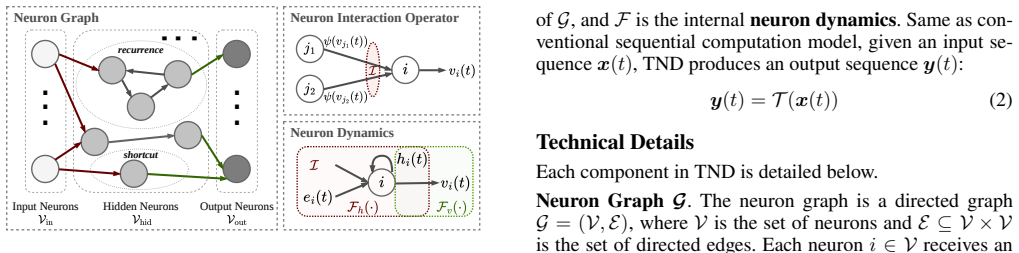
A directed neuron graph that couples independent local dynamics functions through an interaction operator, enabling neuron-wise rather than layer-wise evolution.
If this is right
- Sequence modeling tasks may benefit from explicit topology that allows neurons to maintain distinct evolution trajectories.
- Models could capture complex dynamics more efficiently by separating local rules from global interactions.
- Behavior cloning and similar control tasks might see improved long-horizon performance with this inductive bias.
- Future sequence architectures could incorporate graph structures as a core design principle instead of implicit layer sharing.
Where Pith is reading between the lines
- This structure might make it easier to analyze or interpret how information flows in the model compared to fully connected layers.
- The approach could extend to continuous-time settings or hybrid models combining graph topology with attention mechanisms.
- Performance gains observed in Pong suggest potential advantages in other domains involving temporal dependencies and decision making.
Load-bearing premise
The gains in performance result from the neuron-wise dynamics and graph topology rather than from differences in model size, training procedure, or other unaccounted factors.
What would settle it
Re-running the Pong experiments with an otherwise identical model that uses layer-wise dynamics and measuring whether the consecutive catch count drops to baseline levels.
Figures


read the original abstract
Existing sequence models, including RNNs, LSTMs, continuous-time networks, and Transformers, share a common structural principle: layer-wise dynamics, where all neurons in the same layer co-evolve through a shared parameterized operator, leaving individual neurons no freedom to evolve independently. Yet in many complex dynamical systems, rich global behavior emerges precisely from locally evolving units interacting through structured connectivity. Inspired by this principle, we introduce Topological Neural Dynamics (TND), a sequence modeling framework that shifts computation from layer-wise to neuron-wise dynamics. TND represents a neural system as a directed neuron graph, an interaction operator, and a local dynamics function, where each neuron evolves independently and collective computation emerges from interactions through the explicit graph topology. We instantiate TND as a discrete-time graph-coupled dynamical system and evaluate it as a case study on a behavior cloning task in single-player Pong. Compared with Vanilla RNN, Sparse RNN, LSTM, Closed-form continuous-time neural network (CfC), and Transformer baselines, TND achieves the best catch rate and a mean of 17.47 consecutive catches per round, more than three times that of the strongest baseline. These results suggest that shifting from layer-wise to neuron-wise dynamics provides an effective inductive bias for sequence modeling.
Editorial analysis
A structured set of objections, weighed in public.
Referee Report
Summary. The manuscript introduces Topological Neural Dynamics (TND), a sequence modeling framework that replaces layer-wise dynamics (shared operator across neurons in a layer) with neuron-wise dynamics on an explicit directed neuron graph. Each neuron evolves via its own local dynamics function, with collective behavior arising from an interaction operator over the graph topology. An instantiation is evaluated on a single-player Pong behavior-cloning task, where TND reports the highest catch rate and a mean of 17.47 consecutive catches per round—more than three times the strongest baseline (RNN, Sparse RNN, LSTM, CfC, Transformer).
Significance. If the performance attribution to neuron-wise dynamics can be isolated from capacity, initialization, or optimization confounds, the framework would supply a new structural inductive bias for sequence models grounded in explicit topology and independent local evolution. The abstract alone supplies no evidence that this isolation has been performed.
major comments (3)
- [Abstract] Abstract: the headline result (17.47 consecutive catches, >3× strongest baseline) is reported without error bars, statistical significance tests, ablation of the directed graph topology, or any comparison of total parameter count or training protocol against the listed baselines, preventing attribution of gains to the claimed neuron-wise principle rather than model capacity or task-specific engineering.
- [Abstract] Abstract: no description is supplied of (i) how the directed neuron graph is constructed or initialized, (ii) the functional form or parameterization of the local dynamics function, or (iii) the interaction operator, rendering the central architectural claim non-reproducible and unverifiable from the manuscript.
- [Abstract] Abstract: the evaluation is confined to a single task (Pong behavior cloning) with no additional sequence-modeling benchmarks, leaving the generality of the neuron-wise inductive bias untested.
Simulated Author's Rebuttal
We thank the referee for the comments on our manuscript. We address each major comment below. Only the abstract is available in the provided manuscript, which constrains responses to information contained therein.
read point-by-point responses
-
Referee: [Abstract] Abstract: the headline result (17.47 consecutive catches, >3× strongest baseline) is reported without error bars, statistical significance tests, ablation of the directed graph topology, or any comparison of total parameter count or training protocol against the listed baselines, preventing attribution of gains to the claimed neuron-wise principle rather than model capacity or task-specific engineering.
Authors: The abstract presents the headline result as a concise summary of the case study evaluation on Pong behavior cloning. It does not include error bars, statistical tests, ablations, or explicit parameter/training comparisons. The text reports the mean consecutive catches and comparison to baselines (RNN, Sparse RNN, LSTM, CfC, Transformer) but provides no further experimental details. revision: no
-
Referee: [Abstract] Abstract: no description is supplied of (i) how the directed neuron graph is constructed or initialized, (ii) the functional form or parameterization of the local dynamics function, or (iii) the interaction operator, rendering the central architectural claim non-reproducible and unverifiable from the manuscript.
Authors: The abstract states that TND represents a neural system as a directed neuron graph, an interaction operator, and a local dynamics function, where each neuron evolves independently and collective computation emerges from interactions through the explicit graph topology. It further notes instantiation as a discrete-time graph-coupled dynamical system. No specifics on construction, initialization, functional form, parameterization, or the interaction operator are supplied. revision: no
-
Referee: [Abstract] Abstract: the evaluation is confined to a single task (Pong behavior cloning) with no additional sequence-modeling benchmarks, leaving the generality of the neuron-wise inductive bias untested.
Authors: The abstract explicitly frames the evaluation as a case study on a behavior cloning task in single-player Pong and states that the results suggest the neuron-wise dynamics provide an effective inductive bias. No additional benchmarks are mentioned or reported. revision: no
- Detailed experimental results including error bars, statistical significance tests, ablations of the directed graph topology, and comparisons of total parameter count or training protocol
- Specifics on how the directed neuron graph is constructed or initialized, the functional form or parameterization of the local dynamics function, and the interaction operator
- Results or evaluations on any sequence-modeling benchmarks beyond the single-player Pong behavior cloning task
Circularity Check
No circularity in claimed derivation or results
full rationale
The abstract presents TND as a new framework (directed neuron graph + interaction operator + local dynamics) inspired by biological principles, instantiated as a discrete-time system, and evaluated empirically on Pong behavior cloning against listed baselines. No equations, no predictions derived from fitted parameters, and no self-citations appear in the provided text. The performance numbers (17.47 consecutive catches) are external empirical measurements rather than quantities forced by the model definition itself. The central claim therefore does not reduce to its inputs by construction.
Axiom & Free-Parameter Ledger
axioms (1)
- domain assumption Rich global behavior emerges from locally evolving units interacting through structured connectivity.
invented entities (3)
-
Directed neuron graph
no independent evidence
-
Interaction operator
no independent evidence
-
Local dynamics function
no independent evidence
discussion (0)
Sign in with ORCID, Apple, or X to comment. Anyone can read and Pith papers without signing in.