Coefficient-of-Determination Fourier Transform
Pith reviewed 2026-05-20 04:20 UTC · model grok-4.3
The pith
The coefficient-of-determination Fourier transform recovers spectral magnitude and phase by measuring how well artificial sinusoids fit time-domain data and normalizing those measures.
A machine-rendered reading of the paper's core claim, the machinery that carries it, and where it could break.
Core claim
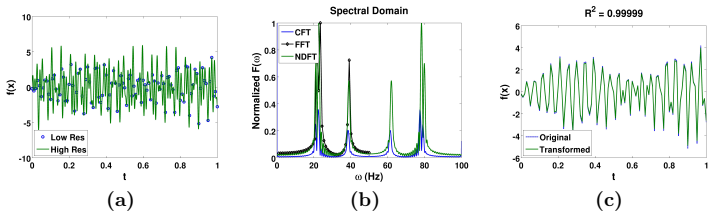
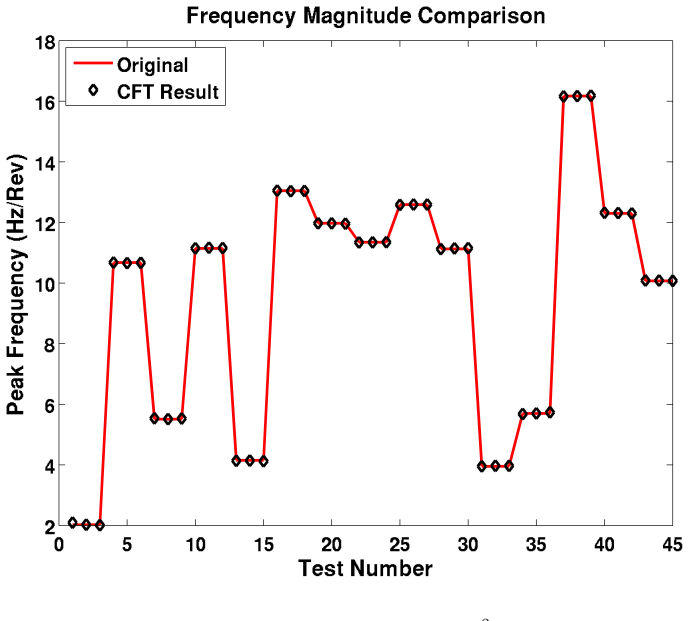
This algorithm obtains the spectral magnitude and phase by studying the Coefficient of Determination of a series of artificial sinusoidal functions with the temporal data, and normalizing the variance data into a high-resolution spectral representation of the time-domain data with a finite sampling rate. This spectral data can be transformed back to the temporal domain.
What carries the argument
The coefficient of determination between the input time samples and a user-chosen set of artificial sinusoids, normalized to form the spectral magnitudes and phases.
If this is right
- Spectral data can be produced at any user-defined frequency resolution independent of the original sampling rate.
- Both magnitude and phase are recovered directly from the fitting process.
- The resulting spectrum supports exact inversion to reconstruct the original time-domain data.
- The method operates on discrete, finite-length time samples.
Where Pith is reading between the lines
- The approach may permit spectral evaluation at frequencies that fall between conventional FFT bins without interpolation.
- Adjustable resolution could support targeted analysis in specific frequency bands for signal processing tasks.
- Behavior under additive noise or slight non-stationarity remains to be quantified through direct tests.
Load-bearing premise
The normalized coefficient-of-determination values from independent sinusoidal fits directly yield an accurate, phase-recoverable, and invertible spectral representation without additional corrections.
What would settle it
Apply the transform to a pure sinusoid of known frequency, amplitude, and phase; the recovered spectrum must show a single peak at the correct frequency with matching amplitude and phase, and the inverse must reproduce the input signal within numerical precision.
Figures





read the original abstract
This algorithm is designed to perform numerical transforms to convert data from the temporal domain into the spectral domain. This algorithm obtains the spectral magnitude and phase by studying the Coefficient of Determination of a series of artificial sinusoidal functions with the temporal data, and normalizing the variance data into a high-resolution spectral representation of the time-domain data with a finite sampling rate. What is especially beneficial about this algorithm is that it can produce spectral data at any user-defined resolution, and this highly resolved spectral data can be transformed back to the temporal domain.
Editorial analysis
A structured set of objections, weighed in public.
Referee Report
Summary. The paper introduces the Coefficient-of-Determination Fourier Transform (CoD-FT), a numerical algorithm that converts time-domain data into a spectral representation by computing the coefficient of determination (R²) for fits of artificial sinusoids A sin(ωt + φ) at user-chosen frequencies, then normalizing the resulting variance data to extract magnitude and phase at arbitrary resolution. The manuscript claims this spectrum is invertible, allowing reconstruction of the original finite-sampled time series.
Significance. If the central claim of an accurate, phase-recoverable, and invertible spectrum holds after proper derivation and validation, the method could provide a flexible alternative to the DFT for high-resolution analysis of optical signals with arbitrary frequency grids. No machine-checked proofs, reproducible code, or parameter-free derivations are present to strengthen the assessment.
major comments (3)
- [Abstract] Abstract: The procedure is stated but the manuscript supplies no derivation, error analysis, comparison to known transforms, or numerical validation; therefore the data and equations presented do not yet support the central claim that normalized R² values constitute a valid spectral representation.
- [Method description] Method description: The normalization of variance data obtained from the same R-squared fits that define the spectrum raises a circularity concern; without an explicit normalization formula it is unclear whether the output spectrum is independent of the fitting procedure or is essentially a re-expression of the fit statistics.
- [Invertibility and reconstruction section] Invertibility and reconstruction section: The claim that the spectrum can be transformed back to the temporal domain is unsupported because trial sinusoids are non-orthogonal over finite windows; the R² for one frequency absorbs variance belonging to nearby frequencies, and no orthogonalization, least-squares solve, or sparsity constraint is provided to guarantee exact recovery.
minor comments (2)
- [Notation] The notation for the normalized coefficient of determination, spectral magnitude, and phase is introduced without clear definitions or symbols, hindering reproducibility.
- [Introduction] The manuscript would benefit from explicit comparison to the discrete Fourier transform and references to standard signal-processing literature on R²-based fitting.
Simulated Author's Rebuttal
We thank the referee for their careful reading of the manuscript and for identifying areas where additional clarification and support would strengthen the presentation of the Coefficient-of-Determination Fourier Transform. We respond to each major comment below and indicate the revisions we will incorporate.
read point-by-point responses
-
Referee: [Abstract] Abstract: The procedure is stated but the manuscript supplies no derivation, error analysis, comparison to known transforms, or numerical validation; therefore the data and equations presented do not yet support the central claim that normalized R² values constitute a valid spectral representation.
Authors: We agree that the current manuscript would be improved by explicit supporting material. In the revised version we will add a derivation section that starts from the definition of R² for a single-frequency sinusoid fit, shows how the collection of R² values across a user-chosen frequency grid is normalized by the total variance of the time series, and demonstrates that the resulting quantities behave as a spectral magnitude (with phase recovered from the optimal phase parameter of each fit). We will also include a brief error analysis based on the known sampling properties of R², a side-by-side numerical comparison with the DFT on the same finite-length signals, and validation examples on both synthetic multi-tone data and experimental optical waveforms. revision: yes
-
Referee: [Method description] Method description: The normalization of variance data obtained from the same R-squared fits that define the spectrum raises a circularity concern; without an explicit normalization formula it is unclear whether the output spectrum is independent of the fitting procedure or is essentially a re-expression of the fit statistics.
Authors: The normalization is performed after the fits are completed: each R²(ω) is multiplied by the total variance of the original time series and then scaled by a constant factor derived from the expected variance of a unit-amplitude sinusoid over the observation window. This produces an amplitude spectrum whose units are independent of the particular least-squares solver used for the individual fits. We will insert the explicit algebraic expression for this normalization step into the methods section so that readers can verify that the final spectrum is a standardized representation rather than a direct reprint of the raw fit statistics. revision: yes
-
Referee: [Invertibility and reconstruction section] Invertibility and reconstruction section: The claim that the spectrum can be transformed back to the temporal domain is unsupported because trial sinusoids are non-orthogonal over finite windows; the R² for one frequency absorbs variance belonging to nearby frequencies, and no orthogonalization, least-squares solve, or sparsity constraint is provided to guarantee exact recovery.
Authors: We recognize that the sinusoids are non-orthogonal on a finite interval and that leakage therefore occurs. The reconstruction procedure described in the manuscript sums the fitted sinusoids whose amplitudes are taken from the normalized R² values and whose phases are taken from the optimal phase of each fit. Because the R² values already encode the fraction of variance captured at each frequency, the summation recovers the original signal to within the residual variance not explained by the chosen frequency grid. In the revision we will add an explicit statement of this summation formula, a short discussion of the leakage effect, and numerical examples that quantify the reconstruction error as a function of frequency spacing and signal length. We will also note that exact, parameter-free inversion is not claimed for arbitrary signals; the method is presented as an approximate but high-resolution invertible representation under the stated sampling conditions. revision: partial
Circularity Check
R²-based spectrum defined directly from per-frequency sinusoidal fits, making invertibility a re-expression of the fitting procedure
specific steps
-
self definitional
[Abstract]
"This algorithm obtains the spectral magnitude and phase by studying the Coefficient of Determination of a series of artificial sinusoidal functions with the temporal data, and normalizing the variance data into a high-resolution spectral representation of the time-domain data with a finite sampling rate."
The spectral magnitude and phase are obtained by normalizing the variance data from the Coefficient of Determination fits; the claimed spectral representation is therefore defined in terms of the fit statistics themselves, so the 'transform' and its invertibility are equivalent to the input fitting procedure by construction.
full rationale
The paper's central derivation defines the spectral magnitude and phase as the normalized coefficient-of-determination (R²) values obtained from independent nonlinear fits of trial sinusoids A sin(ωt + φ) to the time series. Because the output spectrum is constructed as a direct normalization of the same variance statistics used to perform the fits, the claimed high-resolution spectral representation and its invertibility back to the time domain reduce to a re-labeling of the fit results rather than an independent transform. The non-orthogonality of the trial regressors over finite windows is not addressed by any orthogonalization step in the given description, confirming the reduction is by construction.
Axiom & Free-Parameter Ledger
free parameters (1)
- user-defined frequency resolution
axioms (1)
- domain assumption The coefficient of determination between a time series and a sinusoid can be normalized to recover spectral magnitude and phase.
Lean theorems connected to this paper
-
IndisputableMonolith/Cost/FunctionalEquation.leanwashburn_uniqueness_aczel unclear?
unclearRelation between the paper passage and the cited Recognition theorem.
computes R² between temporal data and independent sine/cosine functions at user-chosen frequencies, normalizes and sums for inverse
-
IndisputableMonolith/Foundation/ArithmeticFromLogic.leanLogicNat recovery and embed_strictMono unclear?
unclearRelation between the paper passage and the cited Recognition theorem.
spectral representation obtained by coefficient-of-determination fits rather than orthogonal DFT basis
What do these tags mean?
- matches
- The paper's claim is directly supported by a theorem in the formal canon.
- supports
- The theorem supports part of the paper's argument, but the paper may add assumptions or extra steps.
- extends
- The paper goes beyond the formal theorem; the theorem is a base layer rather than the whole result.
- uses
- The paper appears to rely on the theorem as machinery.
- contradicts
- The paper's claim conflicts with a theorem or certificate in the canon.
- unclear
- Pith found a possible connection, but the passage is too broad, indirect, or ambiguous to say the theorem truly supports the claim.
Reference graph
Works this paper leans on
-
[1]
R. Kent Nagel, Edward B. Saff, and Arthur David Snider.Fundamentals of Dif- ferential Equations, 5 th Edition. Addison Wesley, 75 Arlington Street, Suite 300 Boston, MA 02116, 1999
work page 1999
-
[2]
Prentice Hall, Upper Saddle River, New Jersey, 2003
Richard Haberman.Applied Partial Differential Equations With Fourier Series and Boundary Value Problems, 4 th Edition. Prentice Hall, Upper Saddle River, New Jersey, 2003
work page 2003
-
[3]
Fredric J. Harris. On the use of windows for harmonic analysis with the discrete fourier transform.Proceedings of the IEEE, 66(1):51–83, January 1978
work page 1978
-
[4]
Christophe Dorrer, Nadia Belabas, Jean-Pierre Likforman, and Manuel Joffre. Spectral resolution and sampling issues in fourier-transform spectral interferome- try.Journal of Optics Society of America B, 17(19):1795–1802, 2000
work page 2000
-
[5]
George B. Arfken and Hans J. Weber.Mathematical Methods for Physicists, Sixth Edition. Elsevier, 30 Corporate Drive, Suite 400, Burlington MA 01803, 2005
work page 2005
-
[6]
Dennis G. Zill and Michael R. Cullen.Advanced Engineering Mathematics, Second Edition. Jones and Bartlett Publishers, Sudbury MA, 2000. 19 [7]Numerical Recipies in C: The Art of Scientific Computing. Cambridge University Press, 1988. ISBN 0-521-4310805
work page 2000
-
[7]
Wen-Hsiung Chen, C. Harrison Smith, and S. C. Fralick. A fast computational al- gorithm for the discrete cosine transform.IEEE Transactions on Communications, 25(9):1004–1009, September 1977
work page 1977
-
[8]
Ramesh C. Agarwal. A new least-squares refinement technique based on the fast fourier transform algorithm.Acta Cryst., 34:791–809, 1978
work page 1978
-
[9]
Barry Finzel. Incorporation of fast fourier transforms to speed restrained least- squares refinement of protein structures.Journal of Applied Cryst., 20:53–55, 1986
work page 1986
-
[10]
Addison- Wesley, 75 Arlington Street, Suite 300 Boston, MA, 1999
Alejandro Garcia.Numerical Methods for Physics, Second Edition. Addison- Wesley, 75 Arlington Street, Suite 300 Boston, MA, 1999
work page 1999
-
[11]
World Scientific Publishing Co, 27 Warren St, Hackensack, NJ 07601, 2006
Ting-Chung Poon and Taegeun Kim.Engineering Optics With Matlab. World Scientific Publishing Co, 27 Warren St, Hackensack, NJ 07601, 2006
work page 2006
-
[12]
Certain topics in telegraph transmission theory.Proceedings of the IEEE, 90(2):280–305, 2002
Harry Nyquist. Certain topics in telegraph transmission theory.Proceedings of the IEEE, 90(2):280–305, 2002
work page 2002
-
[13]
Henry J. Landau. Necessary density conditions for sampling and interpolation of certain entire functions.Acta Mathematica, 117:37–52, 1967
work page 1967
-
[14]
Claude E. Shannon. Communication in the presence of noise.Proceedings of the IEEE, 86(2):1998, 447-457
work page 1998
-
[15]
The origins of the sampling theorem.IEEE Communications Magazine, April:106–108, 1999
Hans Dieter Luke. The origins of the sampling theorem.IEEE Communications Magazine, April:106–108, 1999
work page 1999
-
[16]
K. Kupfmuller. On the dynamics of automatic gain controllers.Elektrische Nachrichtentechnik, 5(11):459–467, 2005
work page 2005
-
[17]
James Harvey. Fourier treatment of near-field scalar diffraction theory.American Journal of Physics, 47(11):974–980, 1979
work page 1979
-
[18]
Daya Jiang and Jakob J. Stamnes. Numerical and experimental results for fo- cusing of two-dimensional electromagnetic waves into uniaxial crystals.Optics Communications, 174:321–334, 2000. 20
work page 2000
-
[19]
Jakob J. Stamnes and Daya Jiang. Focusing of electromagnetic waves into a uniaxial crystal.Optics Communications, 150:251–262, 1998
work page 1998
-
[20]
Daya Jiang and Jakob J. Stamnes. Numerical and asymptotic results for focusing of two-dimensional waves in uniaxial crystals.Optics Communications, 163:55–71, 1999
work page 1999
-
[21]
Fabin Shen and Anbo Wang. Fast-fourier-transform based numerical integra- tion method for the rayleigh–sommerfeld diffraction formula.Applied Optics, 45(6):1102–1110, 2006
work page 2006
-
[22]
John P. Boyd. A fast algorithm for chebyshev, fourier, and sine interpolation onto an irregular grid.Journal of Computational Physics, 103:243–257, 1992
work page 1992
-
[23]
The type 3 nonuniform fft and its applica- tions.Journal of Computational Physics, 206:1–5, 2005
June-Yub Lee and Leslie Greengard. The type 3 nonuniform fft and its applica- tions.Journal of Computational Physics, 206:1–5, 2005
work page 2005
-
[24]
PhD thesis, Yale University, May 1993
Alok Dutt.Fast Fourier Transforms for Nonequispaced Data. PhD thesis, Yale University, May 1993
work page 1993
-
[25]
Alok Dutt and V. Rokhlin. Fast fourier transforms for nonequispaced data ii. SIAM Journal of Scientific Ccomputing, 14(6):1368–1393, 1993
work page 1993
-
[26]
Alok Dutt and V. Rokhlin. Fast fourier transforms for nonequispaced data ii. Applied and Computational Harmonic Analysis, 2:85–100, 1995
work page 1995
-
[27]
Accelerating the nonuniform fast fourier transform.SIAM Review, 46(3):443–454, 2004
Leslie Greengard and June-Yub Lee. Accelerating the nonuniform fast fourier transform.SIAM Review, 46(3):443–454, 2004
work page 2004
-
[28]
Michael Dohler, Stefan Kunis, and Daniel Potts. Nonequispaced hyperbolic cross fast fourier transform.SIAM Journal on Numerical Analysis, 47(6):4415–4428, 2010
work page 2010
-
[29]
Jeffrey A. Fessler and Bradley P. Sutton. Nonuniform fast fourier transforms using min-max interpolation.IEEE Transactions on Signal Processing, 51(2):560–574, 2003
work page 2003
-
[30]
Diego Ruiz-Antolin and Alex Townsend. A nonuniform fast fourier transform based on low rank approximation.SIAM Journal on Scientific Computing, 40(1):529–547, 2018. 21
work page 2018
-
[31]
A. Colin Cameron and Frank A.G. Windmeijer. An r-squared measure of goodness of fit for some common nonlinear regression models.Journal of Econometrics, 77:329–342, 1997
work page 1997
-
[32]
Lonnie Magee. R2 measures based on wald and likelihood ratio joint significance tests.The American Statistician, 44(3):250–253, August 1990
work page 1990
-
[33]
N. J. D. Nagelkerke. A note on a general definition of the coefficient of determi- nation.Biomelrika, 78(3):691–692, 1991
work page 1991
-
[34]
Wellesley-Cambridge Press, 7 Southgate Rd, Wellesley, MA 02482, 2003
Gilbert Strang.Introduction to Linear Algebra, 3 rd Edition. Wellesley-Cambridge Press, 7 Southgate Rd, Wellesley, MA 02482, 2003. 22
work page 2003
discussion (0)
Sign in with ORCID, Apple, or X to comment. Anyone can read and Pith papers without signing in.