REVIEW 3 major objections 5 minor 4 cited by
Large Language Models for Next-Generation Wireless Network Management: A Survey and Tutorial
T0 review · 3 major / 5 minor · reviewed 2026-08-05 · deepseek-v4-flash
Pith's one-line read This first survey and tutorial argues LLMs, not heuristics or DRL, are the right engine for 6G's combinatorial wireless optimization problems, organized as a formulate-solve-verify pipeline.
desk verdict Useful survey with a sensible pipeline taxonomy; the quantitative case studies are self-cited and poorly controlled, so the 'transformative' framing overstates the evidence. read the letter →
The pith
A machine-rendered reading of the paper's core claim, the machinery that carries it, and where it could break.
The reading
What carries the argument
The central organizing object is the formulation–solution–verification pipeline for LLM-enabled wireless optimization. The load-bearing mechanisms inside it: natural-language-to-mathematical translation, where LLMs convert user intents into solver-compatible MILP/constraint-programming models; chain-of-thought prompting and retrieval-augmented generation, which decompose problems and pull domain knowledge from curated corpora; solver feedback loops and LLM-guided heuristics (population initialization, heuristic generation, local-search repair, automated parameter tuning); and verification layers — constraint/syntax checking, prompt-based self-verification, ensemble voting, and simulation-gui
What would settle it
Rerun the LAURA UAV routing pipeline on the same sensor configurations (N=30 and N=40) across many random seeds and compare the distribution of average maximum AoI against Greedy; rerun the LEO RSMA intent-networking loop against PPO the same way. If the reported 16.6–24.7% and 11.45% advantages disappear once seed-to-seed variance is counted, or if LLM-generated formulations on a standard benchmark (e.g., the ACCORD-90K or CO-Bench instances) yield worse optimality gaps than expert formulations, the survey's central quantitative narrative loses its support.
Extended reading notes
Core claim
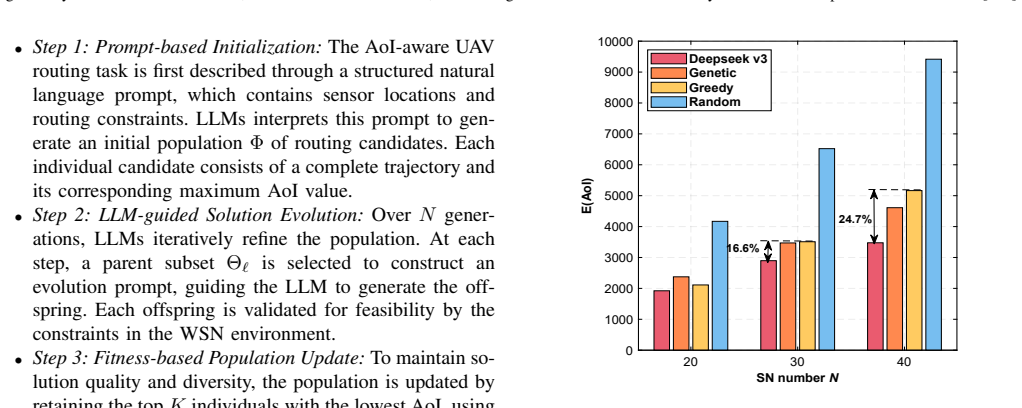
The paper claims LLM-enabled optimization is a distinct, viable paradigm for wireless networks, distinguished from ILP, heuristics, and DRL by interpreting natural-language intents, decomposing non-convex combinatorial problems, and refining solutions without retraining. Its organizational claim is a three-stage pipeline — formulation, solution, verification — proposed as the field's roadmap. The evidence backbone is three case studies: a satellite RSMA formulation system completing symbolic modeling within six interaction rounds; LLM-guided UAV routing (LAURA) cutting average maximum AoI by 16.6% and 24.7% versus Greedy for 30 and 40 sensors; and an LEO RSMA intent-networking loop convergin
Load-bearing premise
The survey's positive conclusions depend on a handful of experimental results, most of them the authors' own prior work, reported without error bars or statistical tests; if those results do not reproduce, the case that LLM-enabled optimization beats traditional methods loses its quantitative support.
Editorial extensions
If this is right
- Optimization formulation stops being an expert-only activity: operators could state goals in natural language and receive solver-ready models reconfigurable by prompt edits.
- Hybrid LLM-plus-solver architectures become the default design pattern for wireless optimization, with LLMs owning semantics and solvers owning numeric rigor.
- Verification becomes a standard third stage, with simulation-in-the-loop repair safety-checking LLM solutions against physical-layer constraints before deployment.
- Multi-agent systems with token-efficient communication make large-scale, decentralized scheduling and slicing feasible in latency-sensitive environments.
- The open-source frameworks and benchmarks the paper catalogs give the community ready-made infrastructure to test and compare LLM optimization methods on wireless problems.
Reading between the lines
- If the formulation-stage results hold across domains, the bottleneck shifts from modeling expertise to knowledge retrieval and prompt design; a testable prediction, left implicit in the paper, is that richer RAG corpora (standards-style documents) should reduce verification-stage repairs.
- The headline numerical claims should be the first target for replication: LAURA's AoI advantage and the RSMA loop's PPO gain are reported without variance or significance tests, so a seeded rerun with distributional reporting would settle the strength of the survey's evidence — a concern the paper itself registers under trustworthy verification.
- The pipeline structure implies a natural scaling path: as small language models and edge deployment mature, the formulate-solve-verify loop could move on-device, turning the case-study prototypes into closed-loop network controllers — listed among future directions but not developed.
- The same pipeline may transfer to adjacent discrete-decision domains where humans express intent (edge offloading, slicing, vehicular scheduling), though the survey's evidence is limited to the three presented scenarios.
Editorial analysis
A structured set of objections, weighed in public.
Referee Report
Summary. The paper is a survey and tutorial on using large language models (LLMs) for optimization problems in wireless networks. It proposes a formulation–solution–verification pipeline taxonomy, contrasts LLM-driven optimization with classical heuristics and DRL, reviews techniques such as prompting, RAG, solver collaboration, verification, and multi-agent frameworks, and tabulates open-source frameworks and datasets. Three case studies are developed in depth: LLM-assisted optimization formulation for satellite communications, LLM-guided UAV routing for AoI minimization (LAURA), and LLM-enabled RSMA sum-rate maximization in LEO satellite networks. The paper closes with challenges and future research directions.
Significance. If its central claims hold, the paper fills a genuine gap: it is one of the first surveys devoted specifically to LLM-enabled optimization in wireless networks, and its pipeline taxonomy is a useful organizing device for a fast-growing literature. The paper is strong on breadth: it covers a wide range of recent work, includes clear figures and comparative tables, and provides pointers to open-source tools and benchmarks. The main weakness is that the survey's positive quantitative narrative relies on a small number of self-cited, unreplicated case studies that are presented without statistical or computational-budget controls. The survey is therefore valuable as a structured entry point to the field, but its strongest empirical claims are not yet supported.
major comments (3)
- [§V.B.4 and §V.C.4, Figs. 11 and 13] The central quantitative evidence for LLM superiority is not reproducible or statistically grounded. The AoI reductions (16.6–24.7% vs Greedy) and the 11.45% rate improvement vs PPO are presented without error bars, number of seeds, hyperparameters, or compute budgets. Both LLM pipelines are evolutionary/prompt-refinement loops (Steps 1–3 in V.B.3; Steps 1–4 in V.C.3), so the reported gains may reflect additional search effort rather than LLM semantic reasoning. The baselines are not matched in number of fitness evaluations, generations, or wall-clock time, and no ablation isolates the LLM contribution (e.g., a genetic algorithm with the same initialization or a random mutator with the same evaluation budget). These results underpin the 'super improvement' claim in §I.A and the comparative entries in Table II, so the overstatements should be tempered and the experimental details/ablation
- [§V.A–V.C, Refs. [122], [156], [195], [210]] The three featured case studies are drawn almost entirely from the authors' own prior work: LAURA (B. Wei et al., [122]), satellite modeling (R. Zhang et al., [156], [195]), and RSMA intent networking (R. Zhang et al., [210]). No independent replication or third-party comparison is reported. For a survey whose contribution is to synthesize evidence for LLM-enabled wireless optimization, this self-cited evidence base is a circular support for the central narrative. The manuscript should either incorporate independent results from other groups, or clearly and repeatedly state that these demonstrations are author-provided proofs of concept rather than an empirical survey of the literature. The current wording, e.g., 'markedly outperforming traditional manual modeling techniques' and 'fundamentally transforms', oversells the strength of the evidence.
- [§II.C, Table II] Table II and the surrounding discussion overstate LLM capabilities. The entry '✓ Real-time learning capabilities; adapts to dynamic network states [85]' is not accurate: LLMs do not update their parameters in real time; they perform inference with prompts, retrieval, and iterative refinement. The cited reference [85] is a survey of digital twins and does not establish real-time learning for LLMs. Similarly, 'Designed for complexity and scale' is a design aspiration rather than a demonstrated property. These claims are load-bearing because they define the central distinction between LLM-driven and traditional optimization paradigms. They should be reworded to describe what is currently evidenced: flexible inference-time adaptation, prompt-based reconfiguration, and retrieval-augmented context handling.
minor comments (5)
- [§V.A.1, §V.B.1, §V.C.1] Cross-references to open-source toolkits say 'detailed in Section V', but the open-source frameworks are presented in Section IV. For example, V.B.1 refers to 'ReEvo [123] and HeuriGym [184]' as being in Section V. These should be corrected to Section IV.
- [Throughout (title, abstract, Section I)] The phrase 'optimization problem' is repeatedly used where 'optimization problems' or 'optimization' is intended (e.g., the abstract: 'dedicated explicitly to LLM-enabled optimization problem in wireless networks'). This is a recurring grammar/language issue that should be cleaned up.
- [Fig. 4] The figure label 'Refinement over RHLF' appears to be a typo for 'RLHF'. Please correct.
- [§V.A.4, Fig. 9] The 'interaction rounds' metric is not formally defined, and the claim that chunk size 2000/3000 'achieve great interaction quality' is based on a single illustrative experiment. Consider defining the metric and clearly labeling this as a qualitative/illustrative result.
- [§V.B.4] The text says the LLM framework 'consistently achieves superior performance' but Fig. 11 shows only three values of N and no statistical comparison across multiple runs. Please add error bars or weaken the wording.
Circularity Check
No significant circularity: the paper is a survey/tutorial, and its self-cited case studies are reported experimental evidence rather than predictions derived from the survey's framework.
full rationale
This manuscript is a survey and tutorial, not a derivation. Its central contribution is a taxonomy of LLM-enabled optimization pipelines (formulation, solution, verification) and a synthesis of existing results. The case studies in Section V (LAURA for UAV routing, RSMA for LEO satellite networks, and LLM-based optimization formulation) are explicitly drawn from prior cited papers, several of which are by the same authors. Citing one's own prior work in a survey is normal; it becomes circular only if the survey's central claim is justified exclusively by those citations or if the cited results are secretly assumed by the framework. Here the survey's quantitative statements (e.g., 16.6–24.7% AoI reductions in Fig. 11 and 11.45% rate gain in Fig. 13) are empirical findings reported in the cited papers, not consequences of the survey's own equations. The paper does not fit any parameter and then rename it a prediction, and it invokes no uniqueness theorem or ansatz from self-citation. The broader narrative is also supported by independent external work, including OptiMUS [47], LLM-OptiRA [48], ReEvo [123], and Habib et al. [86] (17.25% throughput improvement over DRL). Furthermore, the paper itself flags the central limitations in Section VI—LLMs' lack of causal grounding in wireless physics, feasibility risks, and the need for verification—so it does not present LLM-enabled optimization as a forced or definitionally guaranteed result. Concerns about unmatched compute budgets or missing error bars in the self-cited case studies are legitimate reproducibility/correctness concerns, but they are not circularity: no specific reduction of a prediction to its input is exhibited. Under the required standard, no circular step can be identified.
Assumptions & free parameters
assumptions (3)
- domain assumption LLMs possess the capabilities the survey attributes to them in wireless optimization (e.g., translating natural language intents into correct mathematical models).
- domain assumption The cited experimental results, especially those from the authors' own prior papers, are accurate and representative.
- domain assumption The taxonomy of formulation, solution, and verification is a complete and useful decomposition of LLM-enabled wireless optimization.
Cite this review
Pith. "Pith review of Large Language Models for Next-Generation Wireless Network Management: A Survey and Tutorial." pith.science (2026). https://pith.science/paper/XVC6BSNP
@misc{pith2026250905946,
  author       = {Pith},
  title        = {Pith review of: Large Language Models for Next-Generation Wireless Network Management: A Survey and Tutorial},
  year         = {2026},
  howpublished = {\url{https://pith.science/paper/XVC6BSNP}},
  note         = {Machine review of arXiv:2509.05946}
}
read the original abstract
The rapid advancement toward sixth-generation (6G) wireless networks has significantly intensified the complexity and scale of optimization problems, including resource allocation and trajectory design, often formulated as combinatorial problems in large discrete decision spaces. However, traditional optimization methods, such as heuristics and deep reinforcement learning (DRL), struggle to meet the demanding requirements of real-time adaptability, scalability, and dynamic handling of user intents in increasingly heterogeneous and resource-constrained network environments. Large language models (LLMs) present a transformative paradigm by enabling natural language-driven problem formulation, context-aware reasoning, and adaptive solution refinement through advanced semantic understanding and structured reasoning capabilities. This paper provides a systematic and comprehensive survey of LLM-enabled optimization frameworks tailored for wireless networks. We first introduce foundational design concepts and distinguish LLM-enabled methods from conventional optimization paradigms. Subsequently, we critically analyze key enabling methodologies, including natural language modeling, solver collaboration, and solution verification processes. Moreover, we explore representative case studies to demonstrate LLMs' transformative potential in practical scenarios such as optimization formulation, low-altitude economy networking, and intent networking. Finally, we discuss current research challenges, examine prominent open-source frameworks and datasets, and identify promising future directions to facilitate robust, scalable, and trustworthy LLM-enabled optimization solutions for next-generation wireless networks.
Figures


Figures from the paper (10 more)




Forward citations
Cited by 4 Pith papers
-
6G Needs Agents: Toward Agentic AI-Native Networks for Autonomous Intelligence
6G networks need LLM-based agents in a layered semantic control plane to achieve autonomous intelligence, with empirical results showing that heterogeneous deployment across device-edge-core is required due to inheren...
-
Smart-TCP: An Agentic AI-based Autonomous and Adaptive TCP Protocol
An LLM with a deterministic arithmetic tool can drive TCP state/flag decisions and complete simulated sessions, where pure LLMs cannot.
-
When Large Language Models Meet UAV Projects: An Empirical Study from Developers' Perspective
The first empirical taxonomy of LLM tasks in UAVs, with an academia-industry comparison and survey, shows LLMs are used mainly for planning and interaction, not direct control.
-
Agents Should Replace Narrow Predictive AI as the Orchestrator in 6G AI-RAN
Position paper proposes replacing fragmented narrow AI models with LLMs as the cognitive orchestrator in the RAN Intelligent Controller for Level 5 autonomous 6G networks.
Reference graph
Works this paper leans on
-
[122]
LAURA: LLM-Assisted UAV Routing for AoI Minimization
B. Wei, R. Zhang, R. Jiang,et al., “LAURA: LLM-Assisted UA V Routing for AoI Minimization,”arXiv preprint arXiv:2503.23132, 2025
work page Pith review arXiv 2025
-
[156]
Generative ai agents with large language model for satellite networks via a mixture of experts trans- mission,
R. Zhang, H. Du, Y . Liu,et al., “Generative ai agents with large language model for satellite networks via a mixture of experts trans- mission,”IEEE Journal on Selected Areas in Communications, vol. 42, no. 12, pp. 3581–3596, 2024
2024
-
[195]
Satellite communications in the new space era: A survey and future challenges,
O. Kodheli, E. Lagunas, N. Maturo,et al., “Satellite communications in the new space era: A survey and future challenges,”IEEE Commu- nications Surveys & Tutorials, vol. 23, no. 1, pp. 70–109, 2020
2020
-
[210]
Toward democratized generative ai in next-generation mobile edge networks,
R. Zhang, J. He, X. Luo,et al., “Toward democratized generative ai in next-generation mobile edge networks,”IEEE Network, pp. 1–1, 2025
2025
-
[85]
A survey on applications of large lan- guage model-driven digital twins for intelligent network optimization,
Z. Guo, F. Tang, L. Luo,et al., “A survey on applications of large lan- guage model-driven digital twins for intelligent network optimization,” IEEE Communications Surveys & Tutorials, pp. 1–1, 2025
2025
-
[1]
5g-advanced toward 6g: Past, present, and future,
W. Chen, X. Lin, J. Lee,et al., “5g-advanced toward 6g: Past, present, and future,”IEEE Journal on Selected Areas in Communications, vol. 41, no. 6, pp. 1592–1619, 2023
2023
-
[2]
6g wireless systems: Vision, requirements, challenges, insights, and opportunities,
H. Tataria, M. Shafi, A. F. Molisch,et al., “6g wireless systems: Vision, requirements, challenges, insights, and opportunities,”Proceedings of the IEEE, vol. 109, no. 7, pp. 1166–1199, 2021
2021
-
[3]
6g internet of things: A comprehensive survey,
D. C. Nguyen, M. Ding, P. N. Pathirana,et al., “6g internet of things: A comprehensive survey,”IEEE Internet of Things Journal, vol. 9, no. 1, pp. 359–383, 2022
2022
Show all 273 references
-
[4]
A survey on integrated sensing, communication, and computation,
D. Wen, Y . Zhou, X. Li,et al., “A survey on integrated sensing, communication, and computation,”IEEE Communications Surveys & Tutorials, pp. 1–1, 2024
2024
-
[5]
Urllc in beyond 5g and 6g networks: An interference management perspective,
M. U. A. Siddiqui, H. Abumarshoud, L. Bariah,et al., “Urllc in beyond 5g and 6g networks: An interference management perspective,”IEEE Access, vol. 11, pp. 54 639–54 663, 2023
2023
-
[6]
Decision-theoretic distributed channel selection for opportunistic spectrum access: Strategies, chal- lenges and solutions,
Y . Xu, A. Anpalagan, Q. Wu,et al., “Decision-theoretic distributed channel selection for opportunistic spectrum access: Strategies, chal- lenges and solutions,”IEEE Communications Surveys & Tutorials, vol. 15, no. 4, pp. 1689–1713, 2013
2013
-
[7]
Resource allocation for ultra- dense networks: A survey, some research issues and challenges,
Y . Teng, M. Liu, F. R. Yu,et al., “Resource allocation for ultra- dense networks: A survey, some research issues and challenges,”IEEE Communications Surveys & Tutorials, vol. 21, no. 3, pp. 2134–2168, 2019
2019
-
[8]
Joint task offloading and resource allocation for multi-server mobile-edge computing networks,
T. X. Tran and D. Pompili, “Joint task offloading and resource allocation for multi-server mobile-edge computing networks,”IEEE Transactions on Vehicular Technology, vol. 68, no. 1, pp. 856–868, 2018
2018
-
[9]
Ultra-high rate-reliability fairness in grant-free massive urllc noma system: Joint power and channel allocation using meta-heuristic search,
M. Katwe, K. Singh, C.-P. Li,et al., “Ultra-high rate-reliability fairness in grant-free massive urllc noma system: Joint power and channel allocation using meta-heuristic search,”IEEE Transactions on Vehicular Technology, vol. 72, no. 12, pp. 15 899–15 915, 2023
2023
-
[10]
A survey on mobile anchor node as- sisted localization in wireless sensor networks,
G. Han, J. Jiang, C. Zhang,et al., “A survey on mobile anchor node as- sisted localization in wireless sensor networks,”IEEE Communications Surveys & Tutorials, vol. 18, no. 3, pp. 2220–2243, 2016
2016
-
[11]
On the complexity of joint subcarrier and power allocation for multi-user ofdma systems,
Y .-F. Liu and Y .-H. Dai, “On the complexity of joint subcarrier and power allocation for multi-user ofdma systems,”IEEE Transactions on Signal Processing, vol. 62, no. 3, pp. 583–596, 2014
2014
-
[12]
Optimal resource allocation for multicarrier noma in short packet communications,
J. Chen, L. Zhang, Y .-C. Liang,et al., “Optimal resource allocation for multicarrier noma in short packet communications,”IEEE Transactions on Vehicular Technology, vol. 69, no. 2, pp. 2141–2156, 2020
2020
-
[13]
A survey on modeling and optimizing multi-objective systems,
J.-H. Cho, Y . Wang, R. Chen,et al., “A survey on modeling and optimizing multi-objective systems,”IEEE Communications Surveys & Tutorials, vol. 19, no. 3, pp. 1867–1901, 2017
1901
-
[14]
Embracing complexity: Agent-based modeling for hetnets design and optimization via concur- rent reinforcement learning algorithms,
M. Ibrahim, U. S. Hashmi, M. Nabeel,et al., “Embracing complexity: Agent-based modeling for hetnets design and optimization via concur- rent reinforcement learning algorithms,”IEEE Transactions on Network and Service Management, vol. 18, no. 4, pp. 4042–4062, 2021
2021
-
[15]
Adaptive antenna array assisted dynamic channel allocation techniques,
J. S. Blogh, P. J. Cherriman, and L. Hanzo, “Adaptive antenna array assisted dynamic channel allocation techniques,”IEEE Journal on Selected Areas in Communications, vol. 19, no. 2, pp. 305–311, 2002
2002
-
[16]
Energy-efficient deep reinforcement learning assisted resource allocation for 5g-ran slicing,
Y . Azimi, S. Yousefi, H. Kalbkhani,et al., “Energy-efficient deep reinforcement learning assisted resource allocation for 5g-ran slicing,” IEEE Transactions on Vehicular Technology, vol. 71, no. 1, pp. 856– 871, 2021
2021
-
[17]
Network slicing for embb, urllc, and mmtc: An uplink rate-splitting multiple access approach,
Y . Liu, B. Clerckx, and P. Popovski, “Network slicing for embb, urllc, and mmtc: An uplink rate-splitting multiple access approach,”IEEE Transactions on Wireless Communications, vol. 23, no. 3, pp. 2140– 2152, 2023
2023
-
[18]
Joint optimization strategy of computa- tion offloading and resource allocation in multi-access edge computing environment,
H. Li, H. Xu, C. Zhou,et al., “Joint optimization strategy of computa- tion offloading and resource allocation in multi-access edge computing environment,”IEEE Transactions on Vehicular Technology, vol. 69, no. 9, pp. 10 214–10 226, 2020
2020
-
[19]
Intelligent reflecting surface enhanced wireless network via joint active and passive beamforming,
Q. Wu and R. Zhang, “Intelligent reflecting surface enhanced wireless network via joint active and passive beamforming,”IEEE transactions on wireless communications, vol. 18, no. 11, pp. 5394–5409, 2019
2019
-
[20]
Federated edge learning for 6g: Foundations, methodologies, and applications,
M. Tao, Y . Zhou, Y . Shi,et al., “Federated edge learning for 6g: Foundations, methodologies, and applications,”Proceedings of the IEEE, 2024
2024
-
[21]
Space-air-ground integrated wireless networks for 6g: Basics, key technologies and future trends,
Y . Xiao, Z. Ye, M. Wu,et al., “Space-air-ground integrated wireless networks for 6g: Basics, key technologies and future trends,”IEEE Journal on Selected Areas in Communications, 2024
2024
-
[22]
Toward 6g optical fronthaul: A survey on enabling technologies and research perspectives,
A. Fayad, T. Cinkler, and J. Rak, “Toward 6g optical fronthaul: A survey on enabling technologies and research perspectives,”IEEE Communications Surveys & Tutorials, vol. 27, no. 1, pp. 629–666, 2024
2024
-
[23]
A comprehensive survey of large ai models for future communications: Foundations, applications and challenges,
F. Jiang, C. Pan, L. Dong,et al., “A comprehensive survey of large ai models for future communications: Foundations, applications and challenges,”arXiv preprint arXiv:2505.03556, 2025
2025 arXiv
-
[24]
Large language model (llm) for telecommunications: A comprehensive survey on principles, key tech- niques, and opportunities,
H. Zhou, C. Hu, Y . Yuan,et al., “Large language model (llm) for telecommunications: A comprehensive survey on principles, key tech- niques, and opportunities,”IEEE Communications Surveys & Tutorials, 2024
2024
-
[25]
Deepseek-inspired exploration of rl-based llms and synergy with wireless networks: A survey,
Y . Qiao, P.-N. Tran, J. S. Yoon,et al., “Deepseek-inspired exploration of rl-based llms and synergy with wireless networks: A survey,”arXiv preprint arXiv:2503.09956, 2025
2025
-
[26]
Large language models- empowered wireless networks: Fundamentals, architecture, and chal- lenges,
L. U. Khan, M. Guizani, S. Muhaidat,et al., “Large language models- empowered wireless networks: Fundamentals, architecture, and chal- lenges,”arXiv preprint arXiv:2506.10651, 2025
2025 arXiv
-
[27]
Wirelessllm: Empowering large language models towards wireless intelligence,
J. Shao, J. Tong, Q. Wu,et al., “Wirelessllm: Empowering large language models towards wireless intelligence,”arXiv preprint arXiv:2405.17053, 2024
2024 arXiv
-
[28]
Nextg-gpt: Leveraging genai for advancing wireless networks and communication research,
A. M. Nazar, M. Y . Selim, D. Qiao,et al., “Nextg-gpt: Leveraging genai for advancing wireless networks and communication research,” arXiv preprint arXiv:2505.19322, 2025
2025 arXiv
-
[29]
Large language models for wireless networks: an overview from the prompt engineering perspective,
H. Zhou, C. Hu, D. Yuan,et al., “Large language models for wireless networks: an overview from the prompt engineering perspective,”IEEE Wireless Communications, 2025
2025
-
[30]
A survey on large language models for communication, network, and service manage- ment: Application insights, challenges, and future directions,
G. O. Boateng, H. Sami, A. Alagha,et al., “A survey on large language models for communication, network, and service manage- ment: Application insights, challenges, and future directions,”IEEE Communications Surveys & Tutorials, 2025
2025
-
[31]
A survey on intelligent network operations and performance optimization based on large language models,
S. Long, J. Tan, B. Mao,et al., “A survey on intelligent network operations and performance optimization based on large language models,”IEEE Communications Surveys & Tutorials, pp. 1–1, 2025
2025
-
[32]
Mobile edge intelligence for large language models: A contemporary survey,
G. Qu, Q. Chen, W. Wei,et al., “Mobile edge intelligence for large language models: A contemporary survey,”IEEE Communications Surveys & Tutorials, 2025
2025
-
[33]
Generative ai for space-air-ground integrated networks,
R. Zhang, H. Du, D. Niyato,et al., “Generative ai for space-air-ground integrated networks,”IEEE Wireless Communications, vol. 31, no. 6, pp. 10–20, 2024
2024
-
[34]
Empowering near-field communications in low-altitude economy with llm: Fundamentals, potentials, solutions, and future directions,
Z. Xu, T. Zheng, and L. Dai, “Empowering near-field communications in low-altitude economy with llm: Fundamentals, potentials, solutions, and future directions,”arXiv preprint arXiv:2506.17067, 2025
2025 arXiv
-
[35]
Machine learning for large-scale optimization in 6g wireless networks,
Y . Shi, L. Lian, Y . Shi,et al., “Machine learning for large-scale optimization in 6g wireless networks,”IEEE Communications Surveys & Tutorials, vol. 25, no. 4, pp. 2088–2132, 2023
-
[36]
Large language models for combinatorial optimization: A systematic review,
F. D. Ros, M. Soprano, L. D. Gaspero,et al., “Large language models for combinatorial optimization: A systematic review,” 2025. [Online]. Available: https://arxiv.org/abs/2507.03637 26
2025
-
[37]
An overview of machine learning-based techniques for solving optimization problems in communications and signal processing,
H. Dahrouj, R. Alghamdi, H. Alwazani,et al., “An overview of machine learning-based techniques for solving optimization problems in communications and signal processing,”IEEE Access, vol. 9, pp. 74 908–74 938, 2021
2021
-
[38]
A comprehensive survey of linear, integer, and mixed-integer programming approaches for optimizing resource allocation in 5g and beyond networks,
N. Ejaz and S. Choudhury, “A comprehensive survey of linear, integer, and mixed-integer programming approaches for optimizing resource allocation in 5g and beyond networks,” 2025. [Online]. Available: https://arxiv.org/abs/2502.15585
2025 arXiv
-
[39]
A lagrangian-relaxation-based approach for service function chain dynamic orchestration for the internet of things,
Y . Liu, Y . Lu, X. Li,et al., “A lagrangian-relaxation-based approach for service function chain dynamic orchestration for the internet of things,”IEEE Internet of Things Journal, vol. 8, no. 23, pp. 17 071– 17 089, 2021
2021
-
[40]
Time-varying convex optimization: Time-structured algorithms and applications,
A. Simonetto, E. Dall’Anese, S. Paternain,et al., “Time-varying convex optimization: Time-structured algorithms and applications,”Proceed- ings of the IEEE, vol. 108, no. 11, pp. 2032–2048, 2020
-
[41]
Spatio-temporal mixing for compu- tational offloading in satellite edge networks with channel uncertainty,
S. Zhang, H. Yang, F. Wang,et al., “Spatio-temporal mixing for compu- tational offloading in satellite edge networks with channel uncertainty,” IEEE Transactions on Wireless Communications, vol. 24, no. 7, pp. 6151–6165, 2025
2025
-
[42]
Deep reinforcement learning for internet of things: A comprehensive survey,
W. Chen, X. Qiu, T. Cai,et al., “Deep reinforcement learning for internet of things: A comprehensive survey,”IEEE Communications Surveys & Tutorials, vol. 23, no. 3, pp. 1659–1692, 2021
2021
-
[43]
Reinforcement learning for intelligent healthcare systems: A review of challenges, applications, and open research issues,
A. A. Abdellatif, N. Mhaisen, A. Mohamed,et al., “Reinforcement learning for intelligent healthcare systems: A review of challenges, applications, and open research issues,”IEEE Internet of Things Journal, vol. 10, no. 24, pp. 21 982–22 007, 2023
2023
-
[44]
Foundational challenges in assuring alignment and safety of large language models,
U. Anwar, A. Saparov, J. Rando,et al., “Foundational challenges in assuring alignment and safety of large language models,” 2024. [Online]. Available: https://arxiv.org/abs/2404.09932
2024 arXiv
-
[45]
A survey of integrating generative artificial intelligence and 6g mobile services: Architectures, solutions, technologies and outlooks,
Y .-J. Liu, H. Du, X. Xu,et al., “A survey of integrating generative artificial intelligence and 6g mobile services: Architectures, solutions, technologies and outlooks,”IEEE Transactions on Cognitive Commu- nications and Networking, 2025
2025
-
[46]
Ai-generated network design: A diffusion model-based learning approach,
Y . Huang, M. Xu, X. Zhang,et al., “Ai-generated network design: A diffusion model-based learning approach,”IEEE Network, vol. 38, no. 3, pp. 202–209, 2024
2024
-
[47]
Optimus: Scalable op- timization modeling with (mi)lp solvers and large language models,
A. AhmadiTeshnizi, W. Gao, and M. Udell, “Optimus: Scalable op- timization modeling with (mi)lp solvers and large language models,” arXiv preprint arXiv:2402.10172, 2024
2024 arXiv
-
[48]
Llm-optira: Llm-driven optimization of resource allocation for non-convex problems in wireless communi- cations,
X. Peng, Y . Liu, Y . Cang,et al., “Llm-optira: Llm-driven optimization of resource allocation for non-convex problems in wireless communi- cations,”arXiv preprint arXiv:2505.02091, 2025
2025
-
[49]
Towards better chain-of-thought prompting strategies: A survey,
Z. Yu, L. He, Z. Wu,et al., “Towards better chain-of-thought prompting strategies: A survey,”arXiv preprint arXiv:2310.04959, 2023
2023 arXiv
-
[50]
Automatic chain of thought prompting in large language models,
Z. Zhang, A. Zhang, M. Li,et al., “Automatic chain of thought prompting in large language models,”arXiv preprint arXiv:2210.03493, 2022
2022 arXiv
-
[51]
Chain-of-thought for large language model-empowered wireless communications,
X. Wang, J. Zhu, R. Zhang,et al., “Chain-of-thought for large language model-empowered wireless communications,” 2025. [Online]. Available: https://arxiv.org/abs/2505.22320
2025 arXiv
-
[52]
World models for cognitive agents: Transforming edge intelligence in future networks,
C. Zhao, R. Zhang, J. Wang,et al., “World models for cognitive agents: Transforming edge intelligence in future networks,”arXiv preprint arXiv:2506.00417, 2025
2025 arXiv
-
[53]
A survey on large language models with some insights on their capabilities and limitations,
A. Matarazzo and R. Torlone, “A survey on large language models with some insights on their capabilities and limitations,”arXiv preprint arXiv:2501.04040, 2025
2025 arXiv
-
[54]
Artificial intelligence for safety-critical systems in industrial and transportation domains: A survey,
J. Perez-Cerrolaza, J. Abella, M. Borg,et al., “Artificial intelligence for safety-critical systems in industrial and transportation domains: A survey,”ACM Computing Surveys, vol. 56, no. 7, pp. 1–40, 2024
2024
-
[55]
Real-time prediction of non-stationary wireless channels,
M. A. A. Careem and A. Dutta, “Real-time prediction of non-stationary wireless channels,”IEEE Transactions on Wireless Communications, vol. 19, no. 12, pp. 7836–7850, 2020
2020
-
[56]
An overview for designing 6g networks: Technologies, spectrum management, enhanced air interface and ai/ml optimization,
D. Sharma, V . Tilwari, and S. Pack, “An overview for designing 6g networks: Technologies, spectrum management, enhanced air interface and ai/ml optimization,”IEEE Internet of Things Journal, 2024
2024
-
[57]
Graph reinforcement learning for combinatorial optimization: A survey and unifying per- spective,
V .-A. Darvariu, S. Hailes, and M. Musolesi, “Graph reinforcement learning for combinatorial optimization: A survey and unifying per- spective,”arXiv preprint arXiv:2404.06492, 2024
2024 arXiv
-
[58]
Deep reinforcement learning-based intelligent reflecting surface for secure wireless communications,
H. Yang, Z. Xiong, J. Zhao,et al., “Deep reinforcement learning-based intelligent reflecting surface for secure wireless communications,” IEEE Transactions on Wireless Communications, vol. 20, no. 1, pp. 375–388, 2021
2021
-
[59]
Deep reinforcement learning for user association and resource allocation in heterogeneous cellular networks,
N. Zhao, Y .-C. Liang, D. Niyato,et al., “Deep reinforcement learning for user association and resource allocation in heterogeneous cellular networks,”IEEE Transactions on Wireless Communications, vol. 18, no. 11, pp. 5141–5152, 2019
2019
-
[60]
Balancing qos and security in the edge: Existing practices, challenges, and 6g opportunities with machine learning,
Z. M. Fadlullah, B. Mao, and N. Kato, “Balancing qos and security in the edge: Existing practices, challenges, and 6g opportunities with machine learning,”IEEE Communications Surveys & Tutorials, vol. 24, no. 4, pp. 2419–2448, 2022
2022
-
[61]
Joint resource allocation and trajectory optimization with qos in uav-based noma wireless networks,
Y . Li, H. Zhang, K. Long,et al., “Joint resource allocation and trajectory optimization with qos in uav-based noma wireless networks,” IEEE Transactions on Wireless Communications, vol. 20, no. 10, pp. 6343–6355, 2021
2021
-
[62]
Toward safe and accelerated deep reinforcement learning for next-generation wireless networks,
A. M. Nagib, H. Abou-zeid, and H. S. Hassanein, “Toward safe and accelerated deep reinforcement learning for next-generation wireless networks,”IEEE Network, vol. 37, no. 2, pp. 182–189, 2022
2022
-
[63]
Joint resource alloca- tion and transceiver design for sum-rate maximization under latency constraints in multicell mu-mimo systems,
I. M. Braga, R. P. Antonioli, G. Fodor,et al., “Joint resource alloca- tion and transceiver design for sum-rate maximization under latency constraints in multicell mu-mimo systems,”IEEE Transactions on Communications, vol. 69, no. 7, pp. 4569–4584, 2021
2021
-
[64]
Quantum optimiza- tion: Potential, challenges, and the path forward,
A. Abbas, A. Ambainis, B. Augustino,et al., “Quantum optimiza- tion: Potential, challenges, and the path forward,”arXiv preprint arXiv:2312.02279, 2023
2023 arXiv
-
[65]
Joint optimization of resource allocation and trajectory control for mobile group users in fixed- wing uav-enabled wireless network,
X. Yan, X. Fang, C. Deng,et al., “Joint optimization of resource allocation and trajectory control for mobile group users in fixed- wing uav-enabled wireless network,”IEEE Transactions on Wireless Communications, vol. 23, no. 2, pp. 1608–1621, 2023
2023
-
[66]
Resource allocation and task scheduling in fog computing and internet of everything environments: A taxonomy, review, and future directions,
B. Jamil, H. Ijaz, M. Shojafar,et al., “Resource allocation and task scheduling in fog computing and internet of everything environments: A taxonomy, review, and future directions,”ACM Computing Surveys (CSUR), vol. 54, no. 11s, pp. 1–38, 2022
2022
-
[67]
Semantic-aware vision-assisted inte- grated sensing and communication: Architecture and resource alloca- tion,
Y . Lu, W. Mao, H. Du,et al., “Semantic-aware vision-assisted inte- grated sensing and communication: Architecture and resource alloca- tion,”IEEE Wireless Communications, vol. 31, no. 3, pp. 302–308, 2024
2024
-
[68]
Energy-quality-time optimized task mapping on dvfs-enabled multicores,
L. Mo, A. Kritikakou, and O. Sentieys, “Energy-quality-time optimized task mapping on dvfs-enabled multicores,”IEEE Transactions on Computer-Aided Design of Integrated Circuits and Systems, vol. 37, no. 11, pp. 2428–2439, 2018
2018
-
[69]
Joint optimization of trajectory and user association via reinforcement learning for uav-aided data collection in wireless networks,
G. Chen, X. B. Zhai, and C. Li, “Joint optimization of trajectory and user association via reinforcement learning for uav-aided data collection in wireless networks,”IEEE Transactions on Wireless Com- munications, vol. 22, no. 5, pp. 3128–3143, 2022
2022
-
[70]
Large vision model-enhanced digital twin with deep reinforcement learning for user association and load balancing in dynamic wireless networks,
Z. Tao, W. Xu, and X. You, “Large vision model-enhanced digital twin with deep reinforcement learning for user association and load balancing in dynamic wireless networks,” 2025. [Online]. Available: https://arxiv.org/abs/2410.07611
2025 arXiv
-
[71]
Wireless large ai model: Shaping the ai-native future of 6g and beyond,
F. Zhu, X. Wang, X. Li,et al., “Wireless large ai model: Shaping the ai-native future of 6g and beyond,”arXiv preprint arXiv:2504.14653, 2025
2025 arXiv
-
[72]
Next-generation wi-fi net- works with generative ai: Design and insights,
J. Wang, X. Fang, D. Niyato,et al., “Next-generation wi-fi net- works with generative ai: Design and insights,”arXiv preprint arXiv:2408.04835, 2024
2024 arXiv
-
[73]
Advancing transformer architecture in long-context large language models: A comprehensive survey,
Y . Huang, J. Xu, J. Lai,et al., “Advancing transformer architecture in long-context large language models: A comprehensive survey,”arXiv preprint arXiv:2311.12351, 2023
2023 arXiv
-
[74]
A practical survey on zero-shot prompt design for in-context learning,
Y . Li, “A practical survey on zero-shot prompt design for in-context learning,”arXiv preprint arXiv:2309.13205, 2023
2023 arXiv
-
[75]
Language models are few-shot learners,
B. Mann, N. Ryder, M. Subbiah,et al., “Language models are few-shot learners,”arXiv preprint arXiv:2005.14165, vol. 1, p. 3, 2020
2005 arXiv
-
[76]
Lora: Low-rank adaptation of large language models
E. J. Hu, Y . Shen, P. Wallis,et al., “Lora: Low-rank adaptation of large language models.”ICLR, vol. 1, no. 2, p. 3, 2022
2022
-
[77]
Empowering large language models in wireless communication: A novel dataset and fine-tuning framework,
Y . Lin, R. Zhang, W. Huang,et al., “Empowering large language models in wireless communication: A novel dataset and fine-tuning framework,”IEEE Transactions on Communications, pp. 1–1, 2025
2025
-
[78]
Large language models (llms) assisted wireless network deployment in urban settings,
N. Sevim, M. Ibrahim, and S. Ekin, “Large language models (llms) assisted wireless network deployment in urban settings,” 2024. [Online]. Available: https://arxiv.org/abs/2405.13356
2024 arXiv
-
[79]
Chain-of-thought prompt- ing elicits reasoning in large language models,
J. Wei, X. Wang, D. Schuurmans,et al., “Chain-of-thought prompt- ing elicits reasoning in large language models,”Advances in neural information processing systems, vol. 35, pp. 24 824–24 837, 2022
2022
-
[80]
Retrieval-augmented generation for large language models: A survey,
Y . Gao, Y . Xiong, X. Gao,et al., “Retrieval-augmented generation for large language models: A survey,”arXiv preprint arXiv:2312.10997, vol. 2, no. 1, 2023
2023 arXiv
-
[81]
Toward agentic ai: Generative infor- mation retrieval inspired intelligent communications and networking,
R. Zhang, S. Tang, Y . Liu,et al., “Toward agentic ai: Generative infor- mation retrieval inspired intelligent communications and networking,”
-
[82]
Next-gen service function chain deployment: Combining multi-objective optimization with ai large language models,
Y . Li, Q. Zhang, H. Yao,et al., “Next-gen service function chain deployment: Combining multi-objective optimization with ai large language models,”IEEE Network, vol. 39, no. 3, pp. 20–28, 2025. 27
2025
-
[83]
Advanced deep learning models for 6g: Overview, opportunities, and challenges,
L. Jiao, Y . Shao, L. Sun,et al., “Advanced deep learning models for 6g: Overview, opportunities, and challenges,”IEEE Access, vol. 12, pp. 133 245–133 314, 2024
2024
-
[84]
Adaptive drl-based task scheduling for energy-efficient cloud computing,
K. Kang, D. Ding, H. Xie,et al., “Adaptive drl-based task scheduling for energy-efficient cloud computing,”IEEE Transactions on Network and Service Management, vol. 19, no. 4, pp. 4948–4961, 2022
2022
-
[86]
Llm-based intent processing and network optimization using attention-based hierarchical reinforcement learning,
M. A. Habib, P. E. Iturria Rivera, Y . Ozcan,et al., “Llm-based intent processing and network optimization using attention-based hierarchical reinforcement learning,” in2025 IEEE Wireless Communications and Networking Conference (WCNC), 2025, pp. 1–6
2025
-
[87]
On softwarization of intelligence in 6g networks for ultra-fast optimal policy selection: Challenges and opportunities,
S. Hashima, Z. M. Fadlullah, M. M. Fouda,et al., “On softwarization of intelligence in 6g networks for ultra-fast optimal policy selection: Challenges and opportunities,”IEEE Network, vol. 37, no. 2, pp. 190– 197, 2023
2023
-
[88]
Joint resource allocation and computation offloading with time-varying fading channel in vehicular edge comput- ing,
S. Li, S. Lin, L. Cai,et al., “Joint resource allocation and computation offloading with time-varying fading channel in vehicular edge comput- ing,”IEEE Transactions on Vehicular Technology, vol. 69, no. 3, pp. 3384–3398, 2020
2020
-
[89]
Agentic graph neural networks for wireless communications and networking towards edge general intelligence: A survey,
Y . Lu, S. Zhang, C. Liu,et al., “Agentic graph neural networks for wireless communications and networking towards edge general intelligence: A survey,”arXiv preprint arXiv:2508.08620, 2025
2025 arXiv
-
[90]
Diffsg: A generative solver for network optimization with diffusion model,
R. Liang, B. Yang, Z. Yu,et al., “Diffsg: A generative solver for network optimization with diffusion model,”IEEE Communications Magazine, vol. 63, no. 6, pp. 16–24, 2025
2025
-
[91]
A deep learning framework for physical-layer secure beamforming,
Z. Song, Y . Lu, X. Chen,et al., “A deep learning framework for physical-layer secure beamforming,”IEEE Transactions on Vehicular Technology, 2024
2024
-
[92]
Diffusion models as network op- timizers: Explorations and analysis,
R. Liang, B. Yang, P. Chen,et al., “Diffusion models as network op- timizers: Explorations and analysis,”IEEE Internet of Things Journal, 2025
2025
-
[93]
Federated learning in mobile edge networks: A comprehensive survey,
W. Y . B. Lim, N. C. Luong, D. T. Hoang,et al., “Federated learning in mobile edge networks: A comprehensive survey,”IEEE Communi- cations Surveys & Tutorials, vol. 22, no. 3, pp. 2031–2063, 2020
-
[94]
Convergence of edge computing and deep learning: A comprehensive survey,
X. Wang, Y . Han, V . C. M. Leung,et al., “Convergence of edge computing and deep learning: A comprehensive survey,”IEEE Com- munications Surveys & Tutorials, vol. 22, no. 2, pp. 869–904, 2020
2020
-
[95]
Swiptnet: a unified deep learning framework for swipt based on gnn and transfer learning,
H. Han, Y . Lu, Z. Song,et al., “Swiptnet: a unified deep learning framework for swipt based on gnn and transfer learning,”IEEE Transactions on Mobile Computing, 2025
2025
-
[96]
Graph neural networks for wireless networks: Graph representation, architecture and evaluation,
Y . Lu, Y . Li, R. Zhang,et al., “Graph neural networks for wireless networks: Graph representation, architecture and evaluation,”IEEE Wireless Communications, 2024
2024
-
[97]
Zero-trust foundation models: A new paradigm for secure and collaborative artificial intelligence for internet of things,
K. Li, C. Li, X. Yuan,et al., “Zero-trust foundation models: A new paradigm for secure and collaborative artificial intelligence for internet of things,”arXiv preprint arXiv:2505.23792, 2025
2025 arXiv
-
[98]
Hallucination-aware optimization for large language model-empowered communications,
Y . Liu, G. Liu, R. Zhang,et al., “Hallucination-aware optimization for large language model-empowered communications,”arXiv preprint arXiv:2412.06007, 2024
2024 arXiv
-
[99]
Unleashing the power of edge-cloud generative ai in mobile networks: A survey of aigc services,
M. Xu, H. Du, D. Niyato,et al., “Unleashing the power of edge-cloud generative ai in mobile networks: A survey of aigc services,”IEEE Communications Surveys & Tutorials, vol. 26, no. 2, pp. 1127–1170, 2024
2024
-
[100]
Large language models and artifi- cial intelligence generated content technologies meet communication networks,
J. Guo, M. Wang, H. Yin,et al., “Large language models and artifi- cial intelligence generated content technologies meet communication networks,”IEEE Internet of Things Journal, 2024
2024
-
[101]
When knowledge graph meets retrieval augmented generation for wireless networks: a tutorial and case study,
Y . Xiong, R. Zhang, Y . Liu,et al., “When knowledge graph meets retrieval augmented generation for wireless networks: a tutorial and case study,”IEEE Wireless Communications, 2025
2025
-
[102]
Uav-assisted integrated communica- tion and over-the-air computation with interference awareness,
X. Lan, X. Tang, R. Zhang,et al., “Uav-assisted integrated communica- tion and over-the-air computation with interference awareness,”IEEE Transactions on Communications, 2025
2025
-
[103]
A survey on human-centric llms,
J. Y . Wang, N. Sukiennik, T. Li,et al., “A survey on human-centric llms,”arXiv preprint arXiv:2411.14491, 2024
2024 arXiv
-
[104]
Markov decision processes with applications in wireless sensor networks: A survey,
M. A. Alsheikh, D. T. Hoang, D. Niyato,et al., “Markov decision processes with applications in wireless sensor networks: A survey,” IEEE Communications Surveys & Tutorials, vol. 17, no. 3, pp. 1239– 1267, 2015
2015
-
[105]
Deep insights into automated optimization with large language models and evolutionary algorithms,
H. Yu and J. Liu, “Deep insights into automated optimization with large language models and evolutionary algorithms,”arXiv preprint arXiv:2410.20848, 2024
2024 arXiv
-
[106]
Advancing reasoning in large language models: Promising methods and approaches,
A. Patil and A. Jadon, “Advancing reasoning in large language models: Promising methods and approaches,”arXiv preprint arXiv:2502.03671, 2025
2025 arXiv
-
[107]
A survey of large language models for financial applications: Progress, prospects and challenges,
Y . Nie, Y . Kong, X. Dong,et al., “A survey of large language models for financial applications: Progress, prospects and challenges,” 2024. [Online]. Available: https://arxiv.org/abs/2406.11903
2024 arXiv
-
[108]
Cross-asset risk management: Integrating llms for real-time monitoring of equity, fixed income, and currency markets,
J. Yang, Y . Tang, Y . Li,et al., “Cross-asset risk management: Integrating llms for real-time monitoring of equity, fixed income, and currency markets,” 2025. [Online]. Available: https://arxiv.org/abs/ 2504.04292
2025 arXiv
-
[109]
Large foundation models for power systems,
C. Huang, S. Li, R. Liu,et al., “Large foundation models for power systems,” 2023. [Online]. Available: https://arxiv.org/abs/2312.07044
2023 arXiv
-
[110]
Designing and deploying ai models for sustainable logistics optimization: A case study on eco-efficient supply chains in the usa,
R. E. R. Shawon, M. R. Hasan, M. A. Rahman,et al., “Designing and deploying ai models for sustainable logistics optimization: A case study on eco-efficient supply chains in the usa,”Journal of Ecohumanism, vol. 4, no. 2, Mar. 2025. [Online]. Available: http://dx.doi.org/10.627...
2025 doi
-
[111]
Accord: Autoregressive constraint-satisfying generation for combinatorial optimization with routing and dynamic attention,
H. Abgaryan, T. Cazenave, and A. Harutyunyan, “Accord: Autoregressive constraint-satisfying generation for combinatorial optimization with routing and dynamic attention,” 2025. [Online]. Available: https://arxiv.org/abs/2506.11052
2025 arXiv
-
[112]
Joint access point placement and power-channel-resource-unit assignment for ieee 802.11ax-based dense wifi network with qos requirements,
S. Qiu, X. Chu, Y .-W. Leung,et al., “Joint access point placement and power-channel-resource-unit assignment for ieee 802.11ax-based dense wifi network with qos requirements,”IEEE Transactions on Mobile Computing, vol. 22, no. 5, pp. 2771–2788, 2023
2023
-
[113]
Lm4opt: Unveiling the potential of large language models in formulating mathematical optimization problems,
T. Ahmed and S. Choudhury, “Lm4opt: Unveiling the potential of large language models in formulating mathematical optimization problems,” 2024. [Online]. Available: https://arxiv.org/abs/2403.01342
2024 arXiv
-
[114]
Resource allocation in an open ran system using network slicing,
M. Karbalaee Motalleb, V . Shah-Mansouri, S. Parsaeefard,et al., “Resource allocation in an open ran system using network slicing,” IEEE Transactions on Network and Service Management, vol. 20, no. 1, pp. 471–485, 2023
2023
-
[115]
Large language models for constructing and optimizing machine learning workflows: A survey,
Y . Gu, H. You, J. Cao,et al., “Large language models for constructing and optimizing machine learning workflows: A survey,”arXiv preprint arXiv:2411.10478, 2024
2024 arXiv
-
[116]
Optimai: Optimization from natural language using llm-powered ai agents,
R. Thind, Y . Sun, L. Liang,et al., “Optimai: Optimization from natural language using llm-powered ai agents,”arXiv preprint arXiv:2504.16918, 2025
2025
-
[117]
Llms for cold-start cutting plane separator configuration,
C. Lawless, Y . Li, A. Wikum,et al., “Llms for cold-start cutting plane separator configuration,” inInternational Conference on the Integration of Constraint Programming, Artificial Intelligence, and Operations Research. Springer, 2025, pp. 51–69
2025
-
[118]
Towards foundation models for mixed integer linear programming,
S. Li, J. Kulkarni, I. Menache,et al., “Towards foundation models for mixed integer linear programming,” 2025. [Online]. Available: https://arxiv.org/abs/2410.08288
2025 arXiv
-
[119]
A review on genetic algo- rithm: past, present, and future,
S. Katoch, S. S. Chauhan, and V . Kumar, “A review on genetic algo- rithm: past, present, and future,”Multimedia tools and applications, vol. 80, pp. 8091–8126, 2021
2021
-
[120]
Bio-inspired computation: Where we stand and what’s next,
J. Del Ser, E. Osaba, D. Molina,et al., “Bio-inspired computation: Where we stand and what’s next,”Swarm and Evolutionary Computa- tion, vol. 48, pp. 220–250, 2019
2019
-
[121]
Synergistic integration of meta- heuristics and machine learning: latest advances and emerging trends,
R. Zhang, J. Wang, C. Liu,et al., “Synergistic integration of meta- heuristics and machine learning: latest advances and emerging trends,” Artificial Intelligence Review, vol. 58, no. 9, p. 268, 2025
2025
-
[123]
Reevo: Large language models as hyper- heuristics with reflective evolution,
H. Ye, J. Wang, Z. Cao,et al., “Reevo: Large language models as hyper- heuristics with reflective evolution,”Advances in neural information processing systems, vol. 37, pp. 43 571–43 608, 2024
2024
-
[124]
Ars: Automatic routing solver with large language models,
K. Li, F. Liu, Z. Wang,et al., “Ars: Automatic routing solver with large language models,”arXiv preprint arXiv:2502.15359, 2025
2025 arXiv
-
[125]
In-the-loop hyper-parameter optimization for llm-based automated design of heuristics,
N. van Stein, D. Vermetten, and T. B ¨ack, “In-the-loop hyper-parameter optimization for llm-based automated design of heuristics,”ACM Transactions on Evolutionary Learning, 2024
2024
-
[126]
Efficient link scheduling in wireless networks under rayleigh-fading and multiuser interference,
J. Yu, K. Yu, D. Yu,et al., “Efficient link scheduling in wireless networks under rayleigh-fading and multiuser interference,”IEEE Transactions on Wireless Communications, vol. 19, no. 8, pp. 5621– 5634, 2020
2020
-
[127]
Learning to schedule in non- stationary wireless networks with unknown statistics,
Q. M. Nguyen and E. Modiano, “Learning to schedule in non- stationary wireless networks with unknown statistics,” 2023. [Online]. Available: https://arxiv.org/abs/2308.02734
2023 arXiv
-
[128]
Resource management for multiplexing embb and urllc services over ris-aided thz commu- nication,
H. Zarini, N. Gholipoor, M. R. Mili,et al., “Resource management for multiplexing embb and urllc services over ris-aided thz commu- nication,”IEEE Transactions on Communications, vol. 71, no. 2, pp. 1207–1225, 2023
2023
-
[129]
Dynamic adapter meets prompt tuning: Parameter-efficient transfer learning for point cloud analysis,
X. Zhou, D. Liang, W. Xu,et al., “Dynamic adapter meets prompt tuning: Parameter-efficient transfer learning for point cloud analysis,” inProceedings of the IEEE/CVF Conference on Computer Vision and Pattern Recognition, 2024, pp. 14 707–14 717. 28
2024
-
[130]
Unleashing chatgpt’s power: A case study on optimizing information retrieval in flipped classrooms via prompt engineering,
M. Wang, M. Wang, X. Xu,et al., “Unleashing chatgpt’s power: A case study on optimizing information retrieval in flipped classrooms via prompt engineering,”IEEE Transactions on Learning Technologies, vol. 17, pp. 629–641, 2023
2023
-
[131]
Intelligent mobile ai-generated con- tent services via interactive prompt engineering and dynamic service provisioning,
Y . Liu, R. Zhang, J. Wang,et al., “Intelligent mobile ai-generated con- tent services via interactive prompt engineering and dynamic service provisioning,”arXiv preprint arXiv:2502.11386, 2025
2025 arXiv
-
[132]
Meta prompting for ai systems,
Y . Zhang, Y . Yuan, and A. C.-C. Yao, “Meta prompting for ai systems,” 2025. [Online]. Available: https://arxiv.org/abs/2311.11482
2025 arXiv
-
[133]
User scheduling and resource alloca- tion in hetnets with hybrid energy supply: An actor-critic reinforcement learning approach,
Y . Wei, F. R. Yu, M. Song,et al., “User scheduling and resource alloca- tion in hetnets with hybrid energy supply: An actor-critic reinforcement learning approach,”IEEE Transactions on Wireless Communications, vol. 17, no. 1, pp. 680–692, 2018
2018
-
[134]
A survey on human preference learning for large language models,
R. Jiang, K. Chen, X. Bai,et al., “A survey on human preference learning for large language models,”arXiv preprint arXiv:2406.11191, 2024
2024 arXiv
-
[135]
Rlthf: Targeted human feedback for llm alignment,
Y . Xu, T. Chakraborty, E. Kıcıman,et al., “Rlthf: Targeted human feedback for llm alignment,” 2025
2025
-
[136]
A survey on the optimization of large language model-based agents,
S. Du, J. Zhao, J. Shi,et al., “A survey on the optimization of large language model-based agents,”arXiv preprint arXiv:2503.12434, 2025
2025
-
[137]
Rlsf: Fine-tuning llms via symbolic feedback,
P. Jha, P. Jana, P. Suresh,et al., “Rlsf: Fine-tuning llms via symbolic feedback,”arXiv preprint arXiv:2405.16661, 2024
2024
-
[138]
Intelligent resource slicing for embb and urllc coexistence in 5g and beyond: A deep reinforcement learning based approach,
M. Alsenwi, N. H. Tran, M. Bennis,et al., “Intelligent resource slicing for embb and urllc coexistence in 5g and beyond: A deep reinforcement learning based approach,”IEEE Transactions on Wireless Communica- tions, vol. 20, no. 7, pp. 4585–4600, 2021
2021
-
[139]
Zero-shot verification-guided chain of thoughts,
J. R. Chowdhury and C. Caragea, “Zero-shot verification-guided chain of thoughts,”arXiv preprint arXiv:2501.13122, 2025
2025 arXiv
-
[140]
Not all votes count! programs as verifiers improve self-consistency of language models for math reasoning,
V . Y . H. Toh, D. Ghosal, and S. Poria, “Not all votes count! programs as verifiers improve self-consistency of language models for math reasoning,” 2024. [Online]. Available: https://arxiv.org/abs/2410.12608
2024 arXiv
-
[141]
Wireless multi-agent generative ai: From connected intelligence to collective intelligence,
H. Zou, Q. Zhao, L. Bariah,et al., “Wireless multi-agent generative ai: From connected intelligence to collective intelligence,” 2023. [Online]. Available: https://arxiv.org/abs/2307.02757
2023 arXiv
-
[142]
Omac: A broad optimization framework for llm-based multi-agent collaboration,
S. Li, H. Hasson, and J. Ghosh, “Omac: A broad optimization framework for llm-based multi-agent collaboration,” 2025. [Online]. Available: https://arxiv.org/abs/2505.11765
2025 arXiv
-
[143]
Heterogeneous group-based reinforcement learning for llm-based multi-agent systems,
G. Chen, S. Yang, C. Li,et al., “Heterogeneous group-based reinforcement learning for llm-based multi-agent systems,” 2025. [Online]. Available: https://arxiv.org/abs/2506.02718
2025 arXiv
-
[144]
Optima: Optimizing effectiveness and efficiency for llm-based multi-agent system,
W. Chen, J. Yuan, C. Qian,et al., “Optima: Optimizing effectiveness and efficiency for llm-based multi-agent system,” 2025. [Online]. Available: https://arxiv.org/abs/2410.08115
2025 arXiv
-
[145]
Agentic satellite-augmented low- altitude economy and terrestrial networks: A survey on generative approaches,
X. Gao, Y . Wang, B. Liu,et al., “Agentic satellite-augmented low- altitude economy and terrestrial networks: A survey on generative approaches,”arXiv preprint arXiv:2507.14633, 2025
2025 arXiv
-
[146]
Providing guaranteed protection in multi-hop wireless networks with interference constraints,
G. Kuperman and E. Modiano, “Providing guaranteed protection in multi-hop wireless networks with interference constraints,”IEEE Transactions on Mobile Computing, vol. 16, no. 12, pp. 3502–3512, 2017
2017
-
[147]
Joint optimisation of real-time deployment and resource allocation for uav-aided disaster emergency communications,
T. Do-Duy, L. D. Nguyen, T. Q. Duong,et al., “Joint optimisation of real-time deployment and resource allocation for uav-aided disaster emergency communications,”IEEE Journal on Selected Areas in Communications, vol. 39, no. 11, pp. 3411–3424, 2021
2021
-
[148]
Self-edit: Fault-aware code editor for code generation,
K. Zhang, Z. Li, J. Li,et al., “Self-edit: Fault-aware code editor for code generation,” 2023. [Online]. Available: https: //arxiv.org/abs/2305.04087
2023 arXiv
-
[149]
Large language models are better reasoners with self-verification,
Y . Weng, M. Zhu, F. Xia,et al., “Large language models are better reasoners with self-verification,” 2023. [Online]. Available: https://arxiv.org/abs/2212.09561
2023 arXiv
-
[150]
Dynamic channel selection and transmission scheduling for cognitive radio networks,
X. Zhu, Y . Huang, Q. Wu,et al., “Dynamic channel selection and transmission scheduling for cognitive radio networks,”IEEE Internet of Things Journal, vol. 9, no. 23, pp. 24 429–24 443, 2022
2022
-
[151]
Pyepo: A pytorch-based end-to-end predict- then-optimize library for linear and integer programming,
B. Tang and E. B. Khalil, “Pyepo: A pytorch-based end-to-end predict- then-optimize library for linear and integer programming,”arXiv preprint arXiv:2206.14234, 2022
2022 arXiv
-
[152]
The relay selection and transmis- sion trade-off in cooperative communication systems,
V . Shah, N. B. Mehta, and R. Yim, “The relay selection and transmis- sion trade-off in cooperative communication systems,”IEEE Transac- tions on Wireless Communications, vol. 9, no. 8, pp. 2505–2515, 2010
2010
-
[153]
Joint access point placement and power-channel-resource-unit assignment for 802.11ax-based dense wifi with qos requirements,
S. Qiu, X. Chu, Y .-W. Leung,et al., “Joint access point placement and power-channel-resource-unit assignment for 802.11ax-based dense wifi with qos requirements,” inIEEE INFOCOM 2020 - IEEE Conference on Computer Communications, 2020, pp. 2569–2578
2020
-
[154]
Distributed link scheduling for throughput maximization under physical interference model,
Y . Zhou, X.-Y . Li, M. Liu,et al., “Distributed link scheduling for throughput maximization under physical interference model,” in2012 Proceedings IEEE INFOCOM, 2012, pp. 2691–2695
2012
-
[155]
An iteratively weighted mmse approach to distributed sum-utility maximization for a mimo in- terfering broadcast channel,
Q. Shi, M. Razaviyayn, Z.-Q. Luo,et al., “An iteratively weighted mmse approach to distributed sum-utility maximization for a mimo in- terfering broadcast channel,”IEEE Transactions on Signal Processing, vol. 59, no. 9, pp. 4331–4340, 2011
2011
-
[157]
Lameta: Intent-aware agentic network optimization via a large ai model-empowered two-stage approach,
Y . Liu, G. Liu, J. Wang,et al., “Lameta: Intent-aware agentic network optimization via a large ai model-empowered two-stage approach,” arXiv preprint arXiv:2505.12247, 2025
2025 arXiv
-
[158]
Asktoact: Enhancing llms tool use via self-correcting clarification,
X. Zhang, Y . Shen, Z. Zheng,et al., “Asktoact: Enhancing llms tool use via self-correcting clarification,”arXiv preprint arXiv:2503.01940, 2025
2025 arXiv
-
[159]
Tptu: large language model- based ai agents for task planning and tool usage,
J. Ruan, Y . Chen, B. Zhang,et al., “Tptu: large language model- based ai agents for task planning and tool usage,”arXiv preprint arXiv:2308.03427, 2023
2023
-
[160]
Optimizing aoi in ris-aided wireless powered backscatter-active communication networks,
H. Hu, R. Zhang, Z. Ding,et al., “Optimizing aoi in ris-aided wireless powered backscatter-active communication networks,”IEEE Transactions on Vehicular Technology, pp. 1–6, 2025
2025
-
[161]
Aerial active star-ris-assisted satellite-terrestrial covert communications,
C. Zhang, G. Sun, J. Li,et al., “Aerial active star-ris-assisted satellite-terrestrial covert communications,” 2025. [Online]. Available: https://arxiv.org/abs/2504.16146
2025 arXiv
-
[162]
Swipt-enabled cell-free massive mimo-noma networks: A machine learning-based approach,
R. Zhang, K. Xiong, Y . Lu,et al., “Swipt-enabled cell-free massive mimo-noma networks: A machine learning-based approach,”IEEE Transactions on Wireless Communications, vol. 23, no. 7, pp. 6701– 6718, 2024
2024
-
[163]
Joint downlink base station association and power control for max-min fairness: Computation and complexity,
R. Sun, M. Hong, and Z.-Q. Luo, “Joint downlink base station association and power control for max-min fairness: Computation and complexity,”IEEE Journal on Selected Areas in Communications, vol. 33, no. 6, pp. 1040–1054, 2015
2015
-
[164]
End-to-end slicing with optimized communication and computing resource allocation in multi- tenant 5g systems,
H.-T. Chien, Y .-D. Lin, C.-L. Lai,et al., “End-to-end slicing with optimized communication and computing resource allocation in multi- tenant 5g systems,”IEEE Transactions on Vehicular Technology, vol. 69, no. 2, pp. 2079–2091, 2020
-
[165]
Call blocking probability and effective throughput for call admission control of comp joint transmission,
S.-Y . Kim and C.-H. Cho, “Call blocking probability and effective throughput for call admission control of comp joint transmission,”IEEE Transactions on Vehicular Technology, vol. 66, no. 1, pp. 622–634, 2017
2017
-
[166]
Social-community-aware resource allocation for d2d communications underlaying cellular networks,
F. Wang, Y . Li, Z. Wang,et al., “Social-community-aware resource allocation for d2d communications underlaying cellular networks,” IEEE Transactions on Vehicular Technology, vol. 65, no. 5, pp. 3628– 3640, 2016
2016
-
[167]
Toward edge general intelligence with multiple-large language model (multi-llm): Architecture, trust, and orchestration,
H. Luo, Y . Liu, R. Zhang,et al., “Toward edge general intelligence with multiple-large language model (multi-llm): Architecture, trust, and orchestration,”arXiv preprint arXiv:2507.00672, 2025
2025 arXiv
-
[168]
Reinforced reasoning for embodied planning,
D. Wu, J. Fan, J. Zang,et al., “Reinforced reasoning for embodied planning,”arXiv preprint arXiv:2505.22050, 2025
2025 arXiv
-
[169]
Explor- ing synaptic resonance in large language models: A novel approach to contextual memory integration,
G. Applegarth, C. Weatherstone, M. Hollingsworth,et al., “Explor- ing synaptic resonance in large language models: A novel approach to contextual memory integration,”arXiv preprint arXiv:2502.10699, 2025
2025 arXiv
-
[170]
Integrating llms with its: Recent advances, potentials, challenges, and future directions,
D. Mahmud, H. Hajmohamed, S. Almentheri,et al., “Integrating llms with its: Recent advances, potentials, challenges, and future directions,” IEEE Transactions on Intelligent Transportation Systems, 2025
2025
-
[171]
Unleashing the potential of prompt engineering in large language models: a comprehensive review,
B. Chen, Z. Zhang, N. Langren ´e,et al., “Unleashing the potential of prompt engineering in large language models: a comprehensive review,” arXiv preprint arXiv:2310.14735, 2023
2023 arXiv
-
[172]
A systematic survey of prompt engineering in large language models: Techniques and applications,
P. Sahoo, A. K. Singh, S. Saha,et al., “A systematic survey of prompt engineering in large language models: Techniques and applications,” arXiv preprint arXiv:2402.07927, 2024
2024 arXiv
-
[173]
Deep research agents: A sys- tematic examination and roadmap,
Y . Huang, Y . Chen, H. Zhang,et al., “Deep research agents: A sys- tematic examination and roadmap,”arXiv preprint arXiv:2506.18096, 2025
2025 arXiv
-
[174]
Synergizing rag and reasoning: A systematic review,
Y . Gao, Y . Xiong, Y . Zhong,et al., “Synergizing rag and reasoning: A systematic review,”arXiv preprint arXiv:2504.15909, 2025
2025 arXiv
-
[175]
A comprehensive survey in llm (- agent) full stack safety: Data, training and deployment,
K. Wang, G. Zhang, Z. Zhou,et al., “A comprehensive survey in llm (- agent) full stack safety: Data, training and deployment,”arXiv preprint arXiv:2504.15585, 2025
2025 arXiv
-
[176]
Llm-based retrieval- augmented generation: A novel framework for resource optimization in 6g and beyond wireless networks,
H. M. A. Zeeshan, M. Umer, M. Akbar,et al., “Llm-based retrieval- augmented generation: A novel framework for resource optimization in 6g and beyond wireless networks,”IEEE Communications Magazine, vol. 5, 2025
2025
-
[177]
Llmopt: Learning to define and solve general optimization problems from scratch,
C. Jiang, X. Shu, H. Qian,et al., “Llmopt: Learning to define and solve general optimization problems from scratch,” 2025. [Online]. Available: https://arxiv.org/abs/2410.13213 29
2025 arXiv
-
[178]
Efficient heuristics generation for solving combinatorial optimization problems using large language models,
X. Wu, D. Wang, Z. Cao,et al., “Efficient heuristics generation for solving combinatorial optimization problems using large language models,” 2025. [Online]. Available: https://openreview.net/forum?id= 0fwJMANq9P
2025
-
[179]
Trajevo: Designing trajectory prediction heuristics via llm-driven evolution,
Z. Zhao, C. Hua, F. Berto,et al., “Trajevo: Designing trajectory prediction heuristics via llm-driven evolution,” 2025. [Online]. Available: https://arxiv.org/abs/2505.04480
2025 arXiv
-
[180]
Parallel autoregressive models for multi-agent combinatorial optimization,
F. Berto, C. Hua, L. Luttmann,et al., “Parallel autoregressive models for multi-agent combinatorial optimization,” 2025. [Online]. Available: https://arxiv.org/abs/2409.03811
2025
-
[181]
Ensembling prioritized hybrid policies for multi-agent pathfinding,
H. Tang, F. Berto, and J. Park, “Ensembling prioritized hybrid policies for multi-agent pathfinding,” 2024. [Online]. Available: https://arxiv.org/abs/2403.07559
2024 arXiv
-
[182]
Neural combinatorial optimization for real-world routing,
J. Son, Z. Zhao, F. Berto,et al., “Neural combinatorial optimization for real-world routing,” 2025. [Online]. Available: https://arxiv.org/ abs/2503.16159
2025
-
[183]
Co-bench: Benchmarking language model agents in algorithm search for combinatorial optimization,
W. Sun, S. Feng, S. Li,et al., “Co-bench: Benchmarking language model agents in algorithm search for combinatorial optimization,”
-
[184]
Heurigym: An agentic benchmark for llm-crafted heuristics in combinatorial optimization,
H. Chen, Y . Wang, Y . Cai,et al., “Heurigym: An agentic benchmark for llm-crafted heuristics in combinatorial optimization,” 2025. [Online]. Available: https://arxiv.org/abs/2506.07972
2025
-
[185]
Available: https://arxiv.org/abs/2504.04310
[Online]. Available: https://arxiv.org/abs/2504.04310
-
[186]
Multi-dimensional polarized modulation for land mobile satellite communications,
L. Qian, P. Yang, Y . L. Guan,et al., “Multi-dimensional polarized modulation for land mobile satellite communications,”IEEE Transac- tions on Cognitive Communications and Networking, vol. 7, no. 2, pp. 383–397, 2021
2021
-
[187]
Rl4co: an extensive reinforcement learning for combinatorial optimization benchmark,
F. Berto, C. Hua, J. Park,et al., “Rl4co: an extensive reinforcement learning for combinatorial optimization benchmark,” 2025. [Online]. Available: https://arxiv.org/abs/2306.17100
2025 arXiv
-
[188]
Low earth orbit satellite security and re- liability: Issues, solutions, and the road ahead,
P. Yue, J. An, J. Zhang,et al., “Low earth orbit satellite security and re- liability: Issues, solutions, and the road ahead,”IEEE Communications Surveys & Tutorials, vol. 25, no. 3, pp. 1604–1652, 2023
2023
-
[189]
Adaptive coding optimiza- tion in wireless networks: Design and implementation aspects,
Y . Shi, Y . E. Sagduyu, J. Zhang,et al., “Adaptive coding optimiza- tion in wireless networks: Design and implementation aspects,”IEEE Transactions on Wireless Communications, vol. 14, no. 10, pp. 5672– 5680, 2015
2015
-
[190]
Wireless agentic ai with retrieval-augmented multimodal semantic perception,
G. Liu, Y . Liu, R. Zhang,et al., “Wireless agentic ai with retrieval-augmented multimodal semantic perception,”arXiv preprint arXiv:2505.23275, 2025
2025 arXiv
-
[191]
A novel frequency reuse model for co-existing leo and geo satellites,
B. Li, J. Park, A. Al-Hourani,et al., “A novel frequency reuse model for co-existing leo and geo satellites,”IEEE Wireless Communications Letters, vol. 13, no. 4, pp. 1024–1028, 2024
2024
-
[192]
Software-defined next-generation satellite networks: Architecture, challenges, and solutions,
S. Xu, X.-W. Wang, and M. Huang, “Software-defined next-generation satellite networks: Architecture, challenges, and solutions,”IEEE Ac- cess, vol. 6, pp. 4027–4041, 2018
2018
-
[193]
A fuzzy logic frame- work for text-based incident prioritization: Mathematical modeling and case study evaluation,
A. Peralta, J. A. Olivas, and P. Navarro-Illana, “A fuzzy logic frame- work for text-based incident prioritization: Mathematical modeling and case study evaluation,”Mathematics, vol. 13, no. 12, p. 2014, 2025
2014
-
[194]
Generative agents: Interactive simulacra of human behavior,
J. S. Park, J. C. O’Brien, C. J. Cai,et al., “Generative agents: Interactive simulacra of human behavior,” 2023. [Online]. Available: https://arxiv.org/abs/2304.03442
2023 arXiv
-
[196]
Reinforcement learning with llms interaction for distributed diffusion model services,
H. Du, R. Zhang, D. Niyato,et al., “Reinforcement learning with llms interaction for distributed diffusion model services,” 2025. [Online]. Available: https://arxiv.org/abs/2311.11094
2025 arXiv
-
[197]
Interactive ai with retrieval-augmented generation for next generation networking,
R. Zhang, H. Du, Y . Liu,et al., “Interactive ai with retrieval-augmented generation for next generation networking,”IEEE Network, vol. 38, no. 6, pp. 414–424, 2024
2024
-
[198]
Retrieval-augmented generation for knowledge-intensive nlp tasks,
P. Lewis, E. Perez, A. Piktus,et al., “Retrieval-augmented generation for knowledge-intensive nlp tasks,”Advances in neural information processing systems, vol. 33, pp. 9459–9474, 2020
2020
-
[199]
Satellite-based computing networks with federated learning,
H. Chen, M. Xiao, and Z. Pang, “Satellite-based computing networks with federated learning,”IEEE Wireless Communications, vol. 29, no. 1, pp. 78–84, 2022
2022
-
[200]
Leo satellite access network (leo-san) toward 6g: Challenges and approaches,
Z. Xiao, J. Yang, T. Mao,et al., “Leo satellite access network (leo-san) toward 6g: Challenges and approaches,”IEEE Wireless Communica- tions, vol. 31, no. 2, pp. 89–96, 2024
2024
-
[201]
Generative ai-enabled vehicular networks: Fundamentals, framework, and case study,
R. Zhang, K. Xiong, H. Du,et al., “Generative ai-enabled vehicular networks: Fundamentals, framework, and case study,”IEEE Network, vol. 38, no. 4, pp. 259–267, 2024
2024
-
[202]
Embodied ai-enhanced vehicular networks: An integrated vision language models and reinforcement learning method,
R. Zhang, C. Zhao, H. Du,et al., “Embodied ai-enhanced vehicular networks: An integrated vision language models and reinforcement learning method,”IEEE Transactions on Mobile Computing, 2025
2025
-
[203]
Crosssense: Towards cross-site and large-scale wifi sensing,
J. Zhang, Z. Tang, M. Li,et al., “Crosssense: Towards cross-site and large-scale wifi sensing,” inProceedings of the 24th annual international conference on mobile computing and networking, 2018, pp. 305–320
2018
-
[204]
Energy-efficient and throughput fair resource allocation for ts-noma uav-assisted com- munications,
A. Masaracchia, L. D. Nguyen, T. Q. Duong,et al., “Energy-efficient and throughput fair resource allocation for ts-noma uav-assisted com- munications,”IEEE Transactions on Communications, vol. 68, no. 11, pp. 7156–7169, 2020
2020
-
[205]
Uav-enabled communi- cation using noma,
A. A. Nasir, H. D. Tuan, T. Q. Duong,et al., “Uav-enabled communi- cation using noma,”IEEE Transactions on Communications, vol. 67, no. 7, pp. 5126–5138, 2019
2019
-
[206]
Real-time status: How often should one update?
S. Kaul, R. Yates, and M. Gruteser, “Real-time status: How often should one update?”Proc. IEEE INFOCOM, pp. 2731–2735, 2012
2012
-
[207]
Integrated sensing and communica- tion for low altitude economy: Opportunities and challenges,
Y . Jiang, X. Li, G. Zhu,et al., “Integrated sensing and communica- tion for low altitude economy: Opportunities and challenges,”IEEE Communications Magazine, 2025
2025
-
[208]
Improved q-learning-based multi-hop routing for uav-assisted communication,
N. P. Sharvari, D. Das, J. Bapat,et al., “Improved q-learning-based multi-hop routing for uav-assisted communication,”IEEE Transactions on Network and Service Management, vol. 22, no. 2, pp. 1330–1344, 2025
2025
-
[209]
Aoi-minimal trajectory planning and data collection in uav-assisted wireless powered iot networks,
H. Hu, K. Xiong, G. Qu,et al., “Aoi-minimal trajectory planning and data collection in uav-assisted wireless powered iot networks,”IEEE Internet of Things Journal, vol. 8, no. 2, pp. 1211–1223, 2021
2021
-
[211]
Autonomous on-demand deployment for uav assisted wireless networks,
Y . Wang, M. Yan, G. Feng,et al., “Autonomous on-demand deployment for uav assisted wireless networks,”IEEE Transactions on Wireless Communications, vol. 22, no. 12, pp. 9488–9501, 2023
2023
-
[212]
Llm-land: Large language models for context-aware drone landing,
S. Cai, Y . Wu, and L. Zhou, “Llm-land: Large language models for context-aware drone landing,” 2025. [Online]. Available: https: //arxiv.org/abs/2505.06399
2025 arXiv
-
[213]
Trajectory-prediction techniques for unmanned aerial vehicles (uavs): A comprehensive survey,
P. Shukla, S. Shukla, and A. Kumar Singh, “Trajectory-prediction techniques for unmanned aerial vehicles (uavs): A comprehensive survey,”IEEE Communications Surveys & Tutorials, vol. 27, no. 3, pp. 1867–1910, 2025
1910
-
[214]
Large language model-enhanced reinforcement learning for low-altitude economy networking,
L. Cai, R. Zhang, C. Zhao,et al., “Large language model-enhanced reinforcement learning for low-altitude economy networking,”arXiv preprint arXiv:2505.21045, 2025
2025 arXiv
-
[215]
Temporal spectrum cartography in low-altitude economy networks: A generative ai framework with multi-agent learning,
C. Zhao, R. Zhang, J. Wang,et al., “Temporal spectrum cartography in low-altitude economy networks: A generative ai framework with multi-agent learning,”arXiv preprint arXiv:2505.15571, 2025
2025 arXiv
-
[216]
Hierarchical and collaborative llm- based control for multi-uav motion and communication in integrated terrestrial and non-terrestrial networks,
Z. Yan, H. Zhou, J. Pei,et al., “Hierarchical and collaborative llm- based control for multi-uav motion and communication in integrated terrestrial and non-terrestrial networks,” 2025. [Online]. Available: https://arxiv.org/abs/2506.06532
2025 arXiv
-
[217]
Energy-efficient uav communication with tra- jectory optimization,
Y . Zeng and R. Zhang, “Energy-efficient uav communication with tra- jectory optimization,”IEEE Transactions on Wireless Communications, vol. 16, no. 6, pp. 3747–3760, 2017
2017
-
[218]
Uav-aided data collection for infor- mation freshness in wireless sensor networks,
J. Liu, P. Tong, and X. Wang, “Uav-aided data collection for infor- mation freshness in wireless sensor networks,”IEEE Transactions on Wireless Communications, vol. 20, no. 4, pp. 2368–2382, 2021
2021
-
[219]
Instance-adaptive zero-shot chain- of-thought prompting,
X. Yuan, C. Shen, S. Yan,et al., “Instance-adaptive zero-shot chain- of-thought prompting,”Advances in Neural Information Processing Systems, vol. 37, pp. 125 469–125 486, 2024
2024
-
[220]
Uav trajectory planning for aoi-minimal data collection in uav-aided iot networks by transformer,
B. Zhu, E. Bedeer, H. H. Nguyen,et al., “Uav trajectory planning for aoi-minimal data collection in uav-aided iot networks by transformer,” IEEE Transactions on Wireless Communications, vol. 22, no. 2, pp. 1343–1358, 2023
2023
-
[221]
Large language model based multi- objective optimization for integrated sensing and communications in uav networks,
H. Li, M. Xiao, K. Wang,et al., “Large language model based multi- objective optimization for integrated sensing and communications in uav networks,”IEEE Wireless Communications Letters, vol. 14, no. 4, pp. 979–983, 2025
2025
-
[222]
Urllc edge networks with joint optimal user association, task offloading and resource allocation: A digital twin approach,
D. Van Huynh, V .-D. Nguyen, S. R. Khosravirad,et al., “Urllc edge networks with joint optimal user association, task offloading and resource allocation: A digital twin approach,”IEEE Transactions on Communications, vol. 70, no. 11, pp. 7669–7682, 2022
2022
-
[223]
Rate-splitting multiple access: Fundamentals, survey, and future research trends,
Y . Mao, O. Dizdar, B. Clerckx,et al., “Rate-splitting multiple access: Fundamentals, survey, and future research trends,”IEEE Communica- tions Surveys & Tutorials, vol. 24, no. 4, pp. 2073–2126, 2022
-
[224]
Enhanced learning-based hybrid optimization framework for rsma-aided underlay leo communication with non-collaborative terrestrial primary network,
Z. Ali, W. Ullah Khan, M. Asif,et al., “Enhanced learning-based hybrid optimization framework for rsma-aided underlay leo communication with non-collaborative terrestrial primary network,”IEEE Transactions on Communications, vol. 73, no. 4, pp. 2176–2190, 2025. 30
2025
-
[225]
Deep reinforcement learning-based resource allocation for rsma in leo satellite-terrestrial networks,
J. Huang, Y . Yang, J. Lee,et al., “Deep reinforcement learning-based resource allocation for rsma in leo satellite-terrestrial networks,”IEEE Transactions on Communications, vol. 72, no. 3, pp. 1341–1354, 2024
2024
-
[226]
Distributed rate-splitting multiple access for multilayer satellite communications,
Y . Xu, L. Yin, Y . Mao,et al., “Distributed rate-splitting multiple access for multilayer satellite communications,”IEEE Transactions on Communications, vol. 72, no. 10, pp. 6131–6144, 2024
2024
-
[227]
Llm-guided drl for multi-tier leo satellite networks with hybrid fso/rf links,
J. Li, G. Sun, Z. Sun,et al., “Llm-guided drl for multi-tier leo satellite networks with hybrid fso/rf links,”arXiv preprint arXiv:2505.11978, 2025
2025 arXiv
-
[228]
Secrecy energy efficiency maximiza- tion in irs-assisted vlc miso networks with rsma: A ds-ppo approach,
Y . Guo, J. Fan, R. Zhang,et al., “Secrecy energy efficiency maximiza- tion in irs-assisted vlc miso networks with rsma: A ds-ppo approach,” IEEE Transactions on Wireless Communications, 2025
2025
-
[229]
Integrated sensing and com- munications enabled low earth orbit satellite systems,
L. Yin, Z. Liu, M. R. B. Shankar,et al., “Integrated sensing and com- munications enabled low earth orbit satellite systems,”IEEE Network, vol. 38, no. 6, pp. 252–258, 2024
2024
-
[230]
Inverse reinforcement learning meets power allocation in multi-user cellular networks,
R. Zhang, K. Xiong, X. Tian,et al., “Inverse reinforcement learning meets power allocation in multi-user cellular networks,” inIEEE INFOCOM 2022-IEEE Conference on Computer Communications Workshops (INFOCOM WKSHPS). IEEE, 2022, pp. 1–2
2022
-
[231]
Deep reinforcement learning-based power allocation for rate-splitting multiple access in 6g leo satel- lite communication system,
J. Huang, Y . Yang, L. Yin,et al., “Deep reinforcement learning-based power allocation for rate-splitting multiple access in 6g leo satel- lite communication system,”IEEE Wireless Communications Letters, vol. 11, no. 10, pp. 2185–2189, 2022
2022
-
[232]
Optimizing generative ai net- working: A dual perspective with multi-agent systems and mixture of experts,
R. Zhang, H. Du, D. Niyato,et al., “Optimizing generative ai net- working: A dual perspective with multi-agent systems and mixture of experts,”arXiv preprint arXiv:2405.12472, 2024
2024 arXiv
-
[233]
Uplink rsma in leo satellite communications: A perspective from generative artificial intelligence,
K. Wang, X. Wang, N. Zhao,et al., “Uplink rsma in leo satellite communications: A perspective from generative artificial intelligence,” IEEE Transactions on Vehicular Technology, pp. 1–6, 2025
2025
-
[234]
Utilizing large language models for advanced optimization and intelligent management in space-air-ground integrated networks,
J. Tang, F. Tang, S. Long,et al., “Utilizing large language models for advanced optimization and intelligent management in space-air-ground integrated networks,”IEEE Network, pp. 1–1, 2024
2024
-
[235]
Adaptive resource allocation optimization using large language models in dynamic wireless environ- ments,
H. Noh, B. Shim, and H. J. Yang, “Adaptive resource allocation optimization using large language models in dynamic wireless environ- ments,”IEEE Transactions on Vehicular Technology, pp. 1–6, 2025
2025
-
[236]
Joint coordinated beamforming and power splitting ratio optimization in mu-miso swipt-enabled hetnets: A multi-agent ddqn-based approach,
R. Zhang, K. Xiong, Y . Lu,et al., “Joint coordinated beamforming and power splitting ratio optimization in mu-miso swipt-enabled hetnets: A multi-agent ddqn-based approach,”IEEE Journal on Selected Areas in Communications, vol. 40, no. 2, pp. 677–693, 2022
2022
-
[237]
A survey on intent-driven end-to-end 6g mobile communication system,
Y . Wang, C. Yang, T. Li,et al., “A survey on intent-driven end-to-end 6g mobile communication system,”IEEE Communications Surveys & Tutorials, pp. 1–1, 2025
2025
-
[238]
Dynamic transmission and computation resource optimization for dense leo satellite assisted mobile-edge computing,
C. Ding, J.-B. Wang, M. Cheng,et al., “Dynamic transmission and computation resource optimization for dense leo satellite assisted mobile-edge computing,”IEEE Transactions on Communications, vol. 71, no. 5, pp. 3087–3102, 2023
2023
-
[239]
Adapting to dynamic leo-b5g systems: Meta-critic learning based efficient resource scheduling,
Y . Yuan, L. Lei, T. X. Vu,et al., “Adapting to dynamic leo-b5g systems: Meta-critic learning based efficient resource scheduling,” IEEE Transactions on Wireless Communications, vol. 21, no. 11, pp. 9582–9595, 2022
2022
-
[240]
A survey on trustworthy edge intelli- gence: From security and reliability to transparency and sustainability,
X. Wang, B. Wang, Y . Wu,et al., “A survey on trustworthy edge intelli- gence: From security and reliability to transparency and sustainability,” IEEE Communications Surveys & Tutorials, vol. 27, no. 3, pp. 1729– 1757, 2025
2025
-
[241]
A survey on network management for xanet: Evolution, challenges, future directions,
T. Li, C. Yang, Y . Wang,et al., “A survey on network management for xanet: Evolution, challenges, future directions,”IEEE Communications Surveys & Tutorials, pp. 1–1, 2025
2025
-
[242]
Large-scale ai in telecom: Charting the roadmap for innovation, scalability, and enhanced digital experiences,
A. Shahid, A. Kliks, A. Al-Tahmeesschi,et al., “Large-scale ai in telecom: Charting the roadmap for innovation, scalability, and enhanced digital experiences,” 2025. [Online]. Available: https://arxiv.org/abs/2503.04184
2025 arXiv
-
[243]
A comprehensive survey of small language models in the era of large language models: Techniques, en- hancements, applications, collaboration with llms, and trustworthiness,
F. Wang, Z. Zhang, X. Zhang,et al., “A comprehensive survey of small language models in the era of large language models: Techniques, en- hancements, applications, collaboration with llms, and trustworthiness,” arXiv preprint arXiv:2411.03350, 2024
2024 arXiv
-
[244]
A comprehensive survey of hallucination mitigation techniques in large language models,
S. Tonmoy, S. Zaman, V . Jain,et al., “A comprehensive survey of hallucination mitigation techniques in large language models,”arXiv preprint arXiv:2401.01313, vol. 6, 2024
2024 arXiv
-
[245]
Sla management in intent- driven service management systems: A taxonomy and future direc- tions,
Y . Sharma, D. Bhamare, N. Sastry,et al., “Sla management in intent- driven service management systems: A taxonomy and future direc- tions,”ACM Computing Surveys, vol. 55, no. 13s, pp. 1–38, 2023
2023
-
[246]
Tspec-llm: An open- source dataset for llm understanding of 3gpp specifications,
R. Nikbakht, M. Benzaghta, and G. Geraci, “Tspec-llm: An open- source dataset for llm understanding of 3gpp specifications,”arXiv preprint arXiv:2406.01768, 2024
2024 arXiv
-
[247]
Spec5g: A dataset for 5g cellular network protocol analysis,
I. Karim, K. S. Mubasshir, M. M. Rahman,et al., “Spec5g: A dataset for 5g cellular network protocol analysis,”arXiv preprint arXiv:2301.09201, 2023
2023 arXiv
-
[248]
Large language model enabled multi- task physical layer network,
T. Zheng and L. Dai, “Large language model enabled multi- task physical layer network,” 2025. [Online]. Available: https: //arxiv.org/abs/2412.20772
2025 arXiv
-
[249]
Large language model agent: A survey on methodology, applications and challenges,
J. Luo, W. Zhang, Y . Yuan,et al., “Large language model agent: A survey on methodology, applications and challenges,”arXiv preprint arXiv:2503.21460, 2025
2025 arXiv
-
[250]
A top-down survey on optical wireless communications for the internet of things,
A. Celik, I. Romdhane, G. Kaddoum,et al., “A top-down survey on optical wireless communications for the internet of things,”IEEE Communications Surveys & Tutorials, vol. 25, no. 1, pp. 1–45, 2023
2023
-
[251]
From standalone llms to integrated intelligence: A survey of compound al systems,
J. Chen, J. Ye, and G. Wang, “From standalone llms to integrated intelligence: A survey of compound al systems,” 2025. [Online]. Available: https://arxiv.org/abs/2506.04565
2025 arXiv
-
[252]
Exploiting llm quantization,
K. Egashira, M. Vero, R. Staab,et al., “Exploiting llm quantization,” Advances in Neural Information Processing Systems, vol. 37, pp. 41 709–41 732, 2024
2024
-
[253]
Towards general industrial intelligence: A survey of large models as a service in industrial iot,
J. Tang, J. Chen, J. He,et al., “Towards general industrial intelligence: A survey of large models as a service in industrial iot,”IEEE Commu- nications Surveys & Tutorials, pp. 1–1, 2025
2025
-
[254]
Llm pruning and distillation in practice: The minitron approach,
S. T. Sreenivas, S. Muralidharan, R. Joshi,et al., “Llm pruning and distillation in practice: The minitron approach,”arXiv preprint arXiv:2408.11796, 2024
2024 arXiv
-
[255]
Llm-pruner: On the structural pruning of large language models,
X. Ma, G. Fang, and X. Wang, “Llm-pruner: On the structural pruning of large language models,”Advances in neural information processing systems, vol. 36, pp. 21 702–21 720, 2023
2023
-
[256]
Adascale: Dynamic context-aware dnn scaling via automated adaptation loop on mobile devices,
Y . Wang, S. Liu, B. Guo,et al., “Adascale: Dynamic context-aware dnn scaling via automated adaptation loop on mobile devices,”IEEE Internet of Things Journal, vol. 12, no. 12, pp. 19 745–19 766, 2025
2025
-
[257]
Efficient reasoning models: A survey,
S. Feng, G. Fang, X. Ma,et al., “Efficient reasoning models: A survey,” arXiv preprint arXiv:2504.10903, 2025
2025
-
[258]
Large language models and their applications in roadway safety and mobility enhancement: A comprehensive review,
M. M. Karim, Y . Shi, S. Zhang,et al., “Large language models and their applications in roadway safety and mobility enhancement: A comprehensive review,”arXiv preprint arXiv:2506.06301, 2025
2025
-
[259]
Intelligent resource scheduling for 5g radio access network slicing,
M. Yan, G. Feng, J. Zhou,et al., “Intelligent resource scheduling for 5g radio access network slicing,”IEEE Transactions on Vehicular Technology, vol. 68, no. 8, pp. 7691–7703, 2019
2019
-
[260]
Covert prompt transmission for se- cure large language model services,
R. Zhang, Y . Liu, S. Tang,et al., “Covert prompt transmission for se- cure large language model services,”arXiv preprint arXiv:2504.21311, 2025
2025 arXiv
-
[261]
Rule based rewards for language model safety,
T. Mu, A. Helyar, J. Heidecke,et al., “Rule based rewards for language model safety,”Advances in Neural Information Processing Systems, vol. 37, pp. 108 877–108 901, 2024
2024
-
[262]
Personalized model partition- ing and aggregation for federated human activity recognition,
W. Zhang, X. Wu, T. Zhang,et al., “Personalized model partition- ing and aggregation for federated human activity recognition,”IEEE Transactions on Cognitive Communications and Networking, 2025
2025
-
[263]
The evolving role of large language models in scientific innovation: Evaluator, collaborator, and scientist,
H. Zhang, R. Li, Y . Zhang,et al., “The evolving role of large language models in scientific innovation: Evaluator, collaborator, and scientist,” arXiv preprint arXiv:2507.11810, 2025
2025 arXiv
-
[264]
Co-cot: A prompt-based framework for collaborative chain- of-thought reasoning,
S. Yoo, “Co-cot: A prompt-based framework for collaborative chain- of-thought reasoning,” 2025. [Online]. Available: https://arxiv.org/abs/ 2504.17091
2025 arXiv
-
[265]
A comprehensive survey of llm alignment techniques: Rlhf, rlaif, ppo, dpo and more,
Z. Wang, B. Bi, S. K. Pentyala,et al., “A comprehensive survey of llm alignment techniques: Rlhf, rlaif, ppo, dpo and more,” 2024. [Online]. Available: https://arxiv.org/abs/2407.16216
2024 arXiv
-
[266]
Rlhf-v: Towards trustworthy mllms via behavior alignment from fine-grained correctional human feedback,
T. Yu, Y . Yao, H. Zhang,et al., “Rlhf-v: Towards trustworthy mllms via behavior alignment from fine-grained correctional human feedback,” inProceedings of the IEEE/CVF Conference on Computer Vision and Pattern Recognition, 2024, pp. 13 807–13 816
2024
-
[267]
Deductive verification of chain- of-thought reasoning,
Z. Ling, Y . Fang, X. Li,et al., “Deductive verification of chain- of-thought reasoning,”Advances in Neural Information Processing Systems, vol. 36, pp. 36 407–36 433, 2023
2023
-
[268]
Artificial intelligence for satellite communication: A survey,
G. Fontanesi, F. Ort ´ız, E. Lagunas,et al., “Artificial intelligence for satellite communication: A survey,”IEEE Communications Surveys & Tutorials, pp. 1–1, 2025
2025
-
[269]
Retrieval augmented generation (rag) and beyond: A comprehensive survey on how to make your llms use external data more wisely,
S. Zhao, Y . Yang, Z. Wang,et al., “Retrieval augmented generation (rag) and beyond: A comprehensive survey on how to make your llms use external data more wisely,” 2024. [Online]. Available: https://arxiv.org/abs/2409.14924
2024 arXiv
-
[270]
Learning flow-based disentanglement,
J.-T. Chien and S.-J. Huang, “Learning flow-based disentanglement,” IEEE Transactions on Neural Networks and Learning Systems, vol. 35, no. 2, pp. 2390–2402, 2022
2022
-
[271]
Generative ai in transportation planning: A survey,
L. Da, T. Chen, Z. Li,et al., “Generative ai in transportation planning: A survey,”arXiv preprint arXiv:2503.07158, 2025
2025 arXiv
-
[273]
Dependency-aware microservice deploy- ment for edge computing: A deep reinforcement learning approach with network representation,
C. Wang, H. Yu, X. Li,et al., “Dependency-aware microservice deploy- ment for edge computing: A deep reinforcement learning approach with network representation,”IEEE Transactions on Mobile Computing, vol. 23, no. 12, pp. 14 737–14 753, 2024
2024
-
[2025]
Available: https://arxiv.org/abs/2502.16866
[Online]. Available: https://arxiv.org/abs/2502.16866
Reviewed August 5, 2026 · model on record in the stance chip above.
Discussion (0). Sign in to comment.