Recognition: unknown
6G Needs Agents: Toward Agentic AI-Native Networks for Autonomous Intelligence
Pith reviewed 2026-05-09 17:48 UTC · model grok-4.3
The pith
6G networks require LLM-based agents in a semantic control plane above deterministic infrastructure to achieve autonomous intelligence.
A machine-rendered reading of the paper's core claim, the machinery that carries it, and where it could break.
Core claim
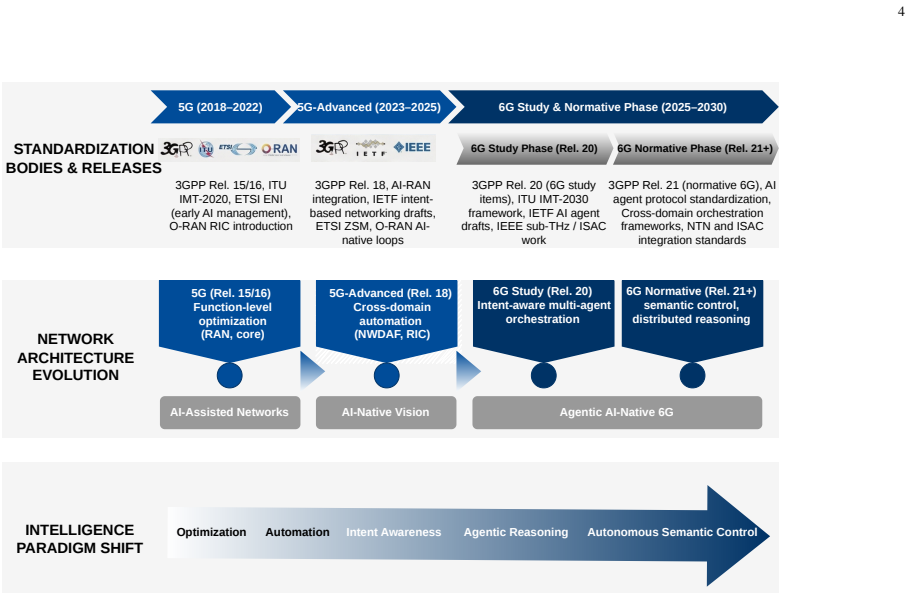
The paper claims that Agentic AI-Native 6G, built around LLM-based agents operating as bounded reasoning entities in a semantic control plane layered above deterministic 3GPP infrastructure, provides the necessary reasoning capability missing from optimization-centric designs. A four-layer architecture integrates deterministic network infrastructure, semantic abstraction of intent and context, hierarchical reasoning, and a distributed multi-agent fabric spanning device, edge, and core domains. Empirical results from a domain-specific benchmark show a tradeoff between reasoning depth and system efficiency that requires heterogeneous agent placement rather than uniform deployment, along with a
What carries the argument
Four-layer Agentic AI-Native 6G architecture that places policy-governed LLM agents in a semantic control plane above 3GPP infrastructure to handle intent, context, and orchestration.
If this is right
- No single LLM satisfies latency, throughput, and accuracy constraints simultaneously.
- Heterogeneous deployment of agents across device-edge-core is required to balance performance goals.
- Quantization produces non-uniform effects across models, so system-level optimization is needed beyond model compression.
- Agentic intelligence is a viable direction for 6G but demands solutions for scalability and trustworthiness.
Where Pith is reading between the lines
- Natural-language intents could drive network operations with far less manual configuration than current interfaces allow.
- The same layered-agent pattern might transfer to other dynamic systems such as industrial IoT or vehicular networks.
- Public release of the benchmark and scripts allows independent checks of the reported tradeoffs in live environments.
- Policy-governance mechanisms would require explicit adversarial testing to confirm they prevent unsafe agent actions.
Load-bearing premise
LLM-based agents can be made sufficiently bounded and policy-governed to operate safely and efficiently inside the strict latency and reliability constraints of real 6G infrastructure without introducing unacceptable overhead or failure modes.
What would settle it
A single uniformly deployed LLM agent that simultaneously satisfies all latency, throughput, accuracy, and reliability targets across a realistic 6G testbed would falsify the need for heterogeneous agentic deployment.
Figures


read the original abstract
Sixth-generation (6G) networks are increasingly envisioned as AI-native infrastructures integrating communication, sensing, and computing into a unified fabric. However, existing approaches remain largely optimization-centric, relying on closed-loop control with limited reasoning capability. In this paper, we argue for a paradigm shift toward Agentic AI-Native 6G, in which Large Language Model (LLM)-based agents operate as bounded, policy-governed reasoning entities within a semantic control plane layered above deterministic 3GPP infrastructure. We propose a four-layer architecture that integrates deterministic network infrastructure, semantic abstraction of intent and context, hierarchical reasoning, and a distributed multi-agent fabric spanning device, edge, and core domains. To assess feasibility, we develop a proof-of-concept agentic reasoning and orchestration framework and conduct an extensive empirical study using a domain-specific 6G benchmark under realistic deployment constraints. Our results reveal a fundamental tradeoff between reasoning capability and system efficiency, showing that no single model simultaneously satisfies latency, throughput, and accuracy requirements. Instead, heterogeneous deployment of LLM agents across the device--edge--core continuum is necessary to balance these constraints. We further demonstrate that quantization introduces non-uniform effects across models, reinforcing the need for system-level optimization rather than model-level compression alone. These findings establish agentic intelligence as a viable architectural direction for 6G and highlight key challenges in achieving scalable, trustworthy, and self-reasoning networks. All experimental results and evaluation scripts are publicly available to support reproducibility.
Editorial analysis
A structured set of objections, weighed in public.
Referee Report
Summary. The paper argues for a paradigm shift in 6G toward Agentic AI-Native networks, in which LLM-based agents function as bounded, policy-governed reasoning entities within a semantic control plane layered over deterministic 3GPP infrastructure. It proposes a four-layer architecture (deterministic infrastructure, semantic abstraction, hierarchical reasoning, and distributed multi-agent fabric) and supports the proposal with a proof-of-concept agentic framework and an empirical benchmark study on a domain-specific 6G workload. The study reports a fundamental tradeoff between reasoning capability and efficiency, finds that no single model satisfies latency/throughput/accuracy simultaneously, shows non-uniform quantization effects, and concludes that heterogeneous deployment across device-edge-core is required. The authors state that these results establish agentic intelligence as a viable architectural direction for 6G; all experimental results and scripts are released publicly.
Significance. If the benchmark observations generalize beyond the reported PoC to operational 6G constraints, the work supplies a concrete architectural proposal and empirical motivation for moving beyond closed-loop optimization to reasoning agents. The public release of results and evaluation scripts is a clear strength that enables direct reproducibility and community follow-up.
major comments (2)
- [Abstract] Abstract: the claim that the findings 'establish agentic intelligence as a viable architectural direction for 6G' is not load-bearingly supported by the reported evidence. The study documents that no single model meets all three constraints simultaneously and that quantization effects are non-uniform, yet it does not report concrete measurements of agent-induced jitter, policy-violation rates, or end-to-end reliability under sub-millisecond 3GPP latency budgets; the viability conclusion therefore rests on an extrapolation that the manuscript does not test.
- [Empirical study / benchmark section] Empirical study / benchmark section: the tradeoff conclusions and heterogeneous-deployment recommendation lack visible experimental controls, statistical significance tests, error bars, or ablation depth. Without these, it is difficult to assess whether the observed efficiency gaps are robust or sensitive to prompt engineering, agent orchestration overhead, or specific 6G traffic patterns.
minor comments (2)
- [Architecture description] The four-layer architecture diagram and accompanying text would benefit from an explicit mapping table that shows which functions are placed at device, edge, and core and which 3GPP interfaces they interact with.
- [Abstract and Introduction] Several sentences in the abstract and introduction repeat the same tradeoff observation; tightening the prose would improve readability without altering technical content.
Simulated Author's Rebuttal
We thank the referee for the constructive and detailed feedback, which highlights important aspects of evidence strength and experimental rigor. We address each major comment below and outline the revisions we will implement.
read point-by-point responses
-
Referee: [Abstract] Abstract: the claim that the findings 'establish agentic intelligence as a viable architectural direction for 6G' is not load-bearingly supported by the reported evidence. The study documents that no single model meets all three constraints simultaneously and that quantization effects are non-uniform, yet it does not report concrete measurements of agent-induced jitter, policy-violation rates, or end-to-end reliability under sub-millisecond 3GPP latency budgets; the viability conclusion therefore rests on an extrapolation that the manuscript does not test.
Authors: We agree that the abstract phrasing overstates the direct support provided by the PoC. The benchmark quantifies the reasoning-efficiency tradeoff and demonstrates the necessity of heterogeneous deployment, but does not measure agent-induced jitter, policy-violation rates, or end-to-end reliability under sub-millisecond 3GPP budgets. These metrics would require integration with a full-scale 6G simulator outside the current scope. We will revise the abstract to state that the results 'provide empirical motivation for' agentic intelligence as a viable direction rather than 'establish' it, and we will add an explicit limitations paragraph in the discussion section to delineate the PoC boundaries and the extrapolations involved. revision: yes
-
Referee: [Empirical study / benchmark section] Empirical study / benchmark section: the tradeoff conclusions and heterogeneous-deployment recommendation lack visible experimental controls, statistical significance tests, error bars, or ablation depth. Without these, it is difficult to assess whether the observed efficiency gaps are robust or sensitive to prompt engineering, agent orchestration overhead, or specific 6G traffic patterns.
Authors: The study was performed with repeated executions across models and configurations under fixed conditions, with all scripts and data released publicly. To strengthen presentation, we will incorporate error bars (standard deviation over repeated runs), report results of statistical significance tests on the primary metrics, explicitly document experimental controls (fixed prompt templates, measured orchestration overhead, and evaluated 6G traffic patterns), and expand ablation analysis to include sensitivity to prompt variations and orchestration parameters. These additions will be included in the revised manuscript to better substantiate the robustness of the tradeoff and heterogeneous-deployment conclusions. revision: yes
Circularity Check
No circularity detected in derivation chain
full rationale
The paper advances an architectural proposal for agentic AI-native 6G networks, defines a four-layer structure, implements a PoC framework, and reports benchmark observations on LLM agent tradeoffs under latency/accuracy constraints. These observations directly inform the conclusion that heterogeneous deployment is required and that agentic intelligence is a viable direction. No equations, fitted parameters, self-referential definitions, or load-bearing self-citations appear in the derivation; the empirical results function as independent external measurements rather than outputs forced by the inputs or prior author work.
Axiom & Free-Parameter Ledger
axioms (2)
- domain assumption LLM-based agents can be bounded and policy-governed to operate safely within network latency and reliability constraints
- domain assumption A semantic abstraction layer can be added without compromising the deterministic behavior of the underlying network
invented entities (1)
-
Agentic AI-Native 6G semantic control plane
no independent evidence
Reference graph
Works this paper leans on
-
[1]
Toward 6g edge intelligence: Lightweight llms for intent-driven network automa- tion,
B. Wu, S. Zou, M. Liwang, W. Ni, X. Wang, and Y . Tian, “Toward 6g edge intelligence: Lightweight llms for intent-driven network automa- tion,”IEEE Transactions on Mobile Computing, 2026
2026
-
[2]
Agen- tic ai empowered intent-based networking for 6g.arXiv preprint arXiv:2601.06640, 2026
G. Jiang, K. Wang, X. Chen, and Y . Huang, “Agentic ai empowered intent-based networking for 6g,”arXiv preprint arXiv:2601.06640, 2026
-
[3]
A trustworthy agentic multi-llm network: Challenges, solutions, and a use case,
H. Luo, G. Sun, Y . Liu, D. Niyato, H. Yu, M. Atiquzzaman, and S. Dustdar, “A trustworthy agentic multi-llm network: Challenges, solutions, and a use case,”IEEE Wireless Communications, 2026
2026
-
[4]
Intent- Based Networking – Concepts and Definitions,
A. Clemm, L. Ciavaglia, L. Z. Granville, and A. Folkmanis, “Intent- Based Networking – Concepts and Definitions,” https://www.ietf.org/ rfc/rfc9315.pdf, IETF, Tech. Rep. RFC 9315, 2022
2022
-
[5]
Experiential Networked Intelligence (ENI); Use Cases and Requirements for AI Agents Based Core Network,
ETSI, “Experiential Networked Intelligence (ENI); Use Cases and Requirements for AI Agents Based Core Network,” https://www.etsi.org/deliver/etsi gr/ENI/001 099/055/04.01.01 60/ gr ENI055v040101p.pdf, ETSI, Tech. Rep. ETSI GR ENI 055 V4.1.1, 2025
2025
-
[6]
Experiential Networked Intelligence (ENI); Study on Multi-Agent Frameworks for Next-Generation Core Networks,
ETSI, “Experiential Networked Intelligence (ENI); Study on Multi-Agent Frameworks for Next-Generation Core Networks,” https://www.etsi.org/deliver/etsi gr/ENI/001 099/056/04.01.01 60/gr ENI056v040101p.pdf, ETSI, Tech. Rep. ETSI GR ENI 056 V4.1.1, 2025. 20
2025
-
[7]
Zero-touch Network and Service Management (ZSM); Refer- ence Architecture,
ETSI, “Zero-touch Network and Service Management (ZSM); Refer- ence Architecture,” https://www.etsi.org/deliver/etsi gs/ZSM/001 099/ 002/01.01.01 60/gs zsm002v010101p.pdf, ETSI, Tech. Rep. ETSI GS ZSM 002 V1.1.1, 2019
2019
-
[8]
Multi-access Edge Computing (MEC); Framework and Refer- ence Architecture,
ETSI, “Multi-access Edge Computing (MEC); Framework and Refer- ence Architecture,” https://www.etsi.org/deliver/etsi gs/MEC/001 099/ 003/03.02.01 60/gs mec003v030201p.pdf, ETSI, Tech. Rep. ETSI GS MEC 003 V3.2.1, 2024
2024
-
[9]
O-RAN Native AI Architec- ture Description,
O-RAN ALLIANCE, “O-RAN Native AI Architec- ture Description,” https://www.o-ran.org/research-reports/ o-ran-native-ai-architecture-description, 2025, alliance research report, accessed 2026-04-28
2025
-
[10]
Integrated Sensing And Communications (ISAC); System and RAN Architectures,
ETSI, “Integrated Sensing And Communications (ISAC); System and RAN Architectures,” https://www.etsi.org/deliver/etsi gr/ISC/001 099/ 003/01.01.01 60/gr ISC003v010101p.pdf, ETSI, Tech. Rep. ETSI GR ISC 003 V1.1.1, 2026
2026
-
[11]
Generative ai for intent-driven network man- agement in 6g ran: A case study on the mamba model,
M. A. Habib, M. Elsayed, Y . Ozcan, P. E. Iturria-Rivera, M. Bavand, and M. Erol-Kantarci, “Generative ai for intent-driven network man- agement in 6g ran: A case study on the mamba model,”IEEE Wireless Communications, 2026
2026
-
[12]
Reasoning- enhanced graphrag-based large and small ai model collaboration: A unified 6g network management approach,
J. Yu, L. Feng, S. Gu, Y . Zhou, C. Wu, and S. Guo, “Reasoning- enhanced graphrag-based large and small ai model collaboration: A unified 6g network management approach,”IEEE Communications Magazine, 2026
2026
-
[13]
Imt-2030: Techni- cal requirements for the 6g future,
International Telecommunication Union (ITU), “Imt-2030: Techni- cal requirements for the 6g future,” https://www.itu.int/hub/2026/03/ imt-2030-technical-requirements-for-the-6g-future/, 2026, accessed: 17 Mar 2026
2030
-
[14]
Framework and Overall Objectives of the Future De- velopment of IMT for 2030 and Beyond,
International Telecommunication Union, Radiocommunication Sector (ITU-R), “Framework and Overall Objectives of the Future De- velopment of IMT for 2030 and Beyond,” https://www.itu.int/rec/ R-REC-M.2160-0-202311-I/en, ITU-R, Tech. Rep. Recommendation ITU-R M.2160-0, 2023, approved November 2023
2030
-
[15]
Study on 6G Scenarios and Requirements,
3rd Generation Partnership Project (3GPP), “Study on 6G Scenarios and Requirements,” 3GPP, Tech. Rep. TR 38.914, 2026, release 20, draft study item
2026
-
[16]
Study on 6G Use Cases and Service Requirements,
3rd Generation Partnership Project (3GPP), “Study on 6G Use Cases and Service Requirements,” 3GPP, Tech. Rep. TR 22.870, 2025, release 20, under change control
2025
-
[17]
Network AI Agent Use Cases and Requirements in 6G,
Y . Tong, A. Sun, A. Wang, Y . Liu, and Y . Xie, “Network AI Agent Use Cases and Requirements in 6G,” IETF Internet-Draft draft- tong-network-agent-use-cases-in-6g-00, https://www.ietf.org/archive/ id/draft-tong-network-agent-use-cases-in-6g-00.html, 2025, work in progress
2025
-
[18]
Framework, Use Cases and Requirements for AI Agent Protocols,
J. Rosenberg and C. Jennings, “Framework, Use Cases and Requirements for AI Agent Protocols,” IETF Internet-Draft draft-rosenberg-ai-protocols-00, https://www.ietf.org/archive/id/ draft-rosenberg-ai-protocols-00.html, 2025, work in progress
2025
-
[19]
AI based Network Management Agent (NMA): Concepts and Architecture,
Z. Zhaoet al., “AI based Network Management Agent (NMA): Concepts and Architecture,” IETF Internet-Draft draft-zhao- nmop-network-management-agent-04, https://datatracker.ietf.org/ doc/draft-zhao-nmop-network-management-agent/, 2026, work in progress
2026
-
[20]
Zte autonomous networks white paper 2026: Re- flections and practice of l4 high-level autonomous networks,
ZTE Corporation, “Zte autonomous networks white paper 2026: Re- flections and practice of l4 high-level autonomous networks,” ZTE Corporation, White Paper, 2026, accessed: 17 Mar 2026
2026
-
[21]
Study on Architecture for 6G System; Stage 2,
3rd Generation Partnership Project (3GPP), “Study on Architecture for 6G System; Stage 2,” 3GPP, Tech. Rep. TR 23.801-01, 2026, release 20, draft study item
2026
-
[22]
Release 20,
3rd Generation Partnership Project (3GPP), “Release 20,” https://www. 3gpp.org/specifications-technologies/releases/release-20, 2025, 3GPP Release 20 work plan and release overview, accessed 2026-04-28
2025
-
[23]
Towards native intelligence: 6g-llm trained with reinforcement learning from ndt feedback,
Z. Xiao, T. Tao, C. Ye, Y . Hu, Y . Feng, T. Jiao, and L. Cai, “Towards native intelligence: 6g-llm trained with reinforcement learning from ndt feedback,”arXiv preprint arXiv:2601.09992, 2026
-
[24]
Mul- timodal llm integrated semantic communications for 6g immersive experiences,
Y . Zhang, Y . Sun, L. Guo, W. Chen, B. Ai, and D. Gunduz, “Mul- timodal llm integrated semantic communications for 6g immersive experiences,”IEEE Communications Magazine, 2026
2026
-
[25]
Agentic ai as a network control- plane intelligence layer for federated learning over 6g,
L. X. Nguyen, J. S. Yoon, H. Q. Le, Y . Qiao, A. D. Raha, E.-N. Huh, N. H. Tran, Z. Han, and C. S. Hong, “Agentic ai as a network control- plane intelligence layer for federated learning over 6g,”arXiv preprint arXiv:2603.09141, 2026
-
[26]
S. A. Khowaja, K. Dev, M. S. Pathan, E. Zeydan, and M. Debbah, “Integration of agentic ai with 6g networks for mission-critical appli- cations: Use-case and challenges,”arXiv preprint arXiv:2502.13476, 2025
-
[27]
Agile-6g: Agentic ai for autonomous management of 6g network/ap- plication services,
A. Antonopoulos, E. Kartsakli, N. Bartzoudis, D. Brodimas, D. Vuko- bratovic, D. Tsolkas, F. Diego, G. Roumelas, and L. Tomaszewski, “Agile-6g: Agentic ai for autonomous management of 6g network/ap- plication services,”IEEE Network, 2025
2025
-
[28]
Future factories with 6g: Agentic ai and cyber-physical digital twins,
H. Li, H. Madhukumar, N. Methley, X. Chen, Y . Wu, J. Parra-Ullauri, V . Sharma, J. Lee, A. R. Koblitz, M. Andrewset al., “Future factories with 6g: Agentic ai and cyber-physical digital twins,”IEEE Internet of Things Journal, 2025
2025
-
[29]
Toward agentic ai networking in 6g: A generative foundation model-as-agent approach,
Y . Xiao, G. Shi, and P. Zhang, “Toward agentic ai networking in 6g: A generative foundation model-as-agent approach,”IEEE Communica- tions Magazine, vol. 63, no. 9, pp. 68–74, 2025
2025
-
[30]
Towards 6g native-ai edge networks: A semantic-aware and agentic intelligence paradigm,
C. Feng, A. Zhang, G. Min, Y . Huang, T. Q. Quek, and X. You, “Towards 6g native-ai edge networks: A semantic-aware and agentic intelligence paradigm,”arXiv preprint arXiv:2512.04405, 2025
-
[31]
Toward edge general intelligence with agentic ai and agentification: Concepts, technologies, and future directions,
R. Zhang, G. Liu, Y . Liu, C. Zhao, J. Wang, Y . Xu, D. Niyato, J. Kang, Y . Li, S. Maoet al., “Toward edge general intelligence with agentic ai and agentification: Concepts, technologies, and future directions,” IEEE Communications Surveys & Tutorials, vol. 28, pp. 4285–4318, 2026
2026
-
[32]
Agentic ai for 6g: A new paradigm for autonomous ran security compliance,
S. Chatzimiltis, M. B. Mashhadi, M. Shojafar, M. Debbah, and R. Tafa- zolli, “Agentic ai for 6g: A new paradigm for autonomous ran security compliance,”IEEE Communications Standards Magazine, 2026
2026
-
[33]
Z. Li, X. Jin, J. Pan, Q. Yang, and Z. Shi, “Agentic wireless commu- nication for 6g: Intent-aware and continuously evolving physical-layer intelligence,”arXiv preprint arXiv:2602.17096, 2026
-
[34]
Bridging 6g iot and ai: Llm-based efficient approach for physical layer’s optimization tasks,
A. Mehmood, N. U. Hassan, and G. M. Kraidy, “Bridging 6g iot and ai: Llm-based efficient approach for physical layer’s optimization tasks,” arXiv preprint arXiv:2602.06819, 2026
-
[35]
Machine learning-based resource allocation in 6g integrated space and terrestrial networks-aided intel- ligent autonomous transportation,
S. C. Prabhashana, D. Van Huynh, K. Singh, H.-J. Zepernick, O. A. Dobre, H. Shin, and T. Q. Duong, “Machine learning-based resource allocation in 6g integrated space and terrestrial networks-aided intel- ligent autonomous transportation,”IEEE Transactions on Intelligent Transportation Systems, 2025
2025
-
[36]
Transfer learning applied to deep reinforcement learning for 6g resource man- agement in intra-and inter-slice ran-edge domains,
S. Mhatre, F. Adelantado, K. Ramantas, and C. Verikoukis, “Transfer learning applied to deep reinforcement learning for 6g resource man- agement in intra-and inter-slice ran-edge domains,”IEEE Transactions on Consumer Electronics, 2025
2025
-
[37]
Reinforcement learning based edge-end collaboration for multi-task scheduling in 6g enabled intelligent autonomous transport systems,
P. Li, Z. Xiao, H. Gao, X. Wang, and Y . Wang, “Reinforcement learning based edge-end collaboration for multi-task scheduling in 6g enabled intelligent autonomous transport systems,”IEEE Transactions on Intelligent Transportation Systems, vol. 26, no. 10, pp. 17 624– 17 637, 2025
2025
-
[38]
Toward energy-efficient ai: Learning generic assignment skills with unsuper- vised reinforcement learning for network slicing in distributed 6g networks,
N. Ghafouri, J. S. Vardakas, K. Ramantas, and C. Verikoukis, “Toward energy-efficient ai: Learning generic assignment skills with unsuper- vised reinforcement learning for network slicing in distributed 6g networks,”IEEE Communications Magazine, 2026
2026
-
[39]
Joint ai service placement, task scheduling, and resource allocation for iot in 6g networks,
Z. Zhang, L. Lu, Q. Li, Y . Chai, D. Wu, and Y . Zhang, “Joint ai service placement, task scheduling, and resource allocation for iot in 6g networks,”IEEE Internet of Things Journal, 2025
2025
-
[40]
A review of 6g and ai convergence: Enhancing communica- tion networks with artificial intelligence,
Y . Sanjalawe, S. Fraihat, M. Abualhaj, S. Makhadmeh, E. Alzubi et al., “A review of 6g and ai convergence: Enhancing communica- tion networks with artificial intelligence,”IEEE Open Journal of the Communications Society, 2025
2025
-
[41]
Accelerated and distributed upf for the era of agentic ai and 6g,
Y . Zhang, R. Gadiyar, S. Chowdhury, and E. Blatt, “Accelerated and distributed upf for the era of agentic ai and 6g,” https://developer.nvidia.com/blog/ accelerated-and-distributed-upf-for-the-era-of-agentic-ai-and-6g, 2025, nVIDIA Technical Blog (Oct. 15, 2025)
2025
-
[42]
AI Agent protocols for 6G systems,
E. Stephan, R. Schott, D. Lopez, X. Duan, and L. Morand, “AI Agent protocols for 6G systems,” Internet Engineering Task Force, Internet- Draft draft-stephan-ai-agent-6g-02, Oct. 2025. [Online]. Available: https://datatracker.ietf.org/doc/draft-stephan-ai-agent-6g/02/
2025
-
[43]
AI Agent Use Cases and Require- ments in 6G Network,
M. Yu, A. Wang, J. Li, and Z. Li, “AI Agent Use Cases and Require- ments in 6G Network,” Internet Engineering Task Force, Internet-Draft draft-yu-ai-agent-use-cases-in-6g-02, Jan. 2026. [Online]. Available: https://datatracker.ietf.org/doc/draft-yu-ai-agent-use-cases-in-6g/02/
2026
-
[44]
Ai- ran: Transforming ran with ai-driven computing infrastructure,
L. Kundu, X. Lin, R. Gadiyar, J.-F. Lacasse, and S. Chowdhury, “Ai- ran: Transforming ran with ai-driven computing infrastructure,”IEEE Communications Magazine, 2025
2025
-
[45]
Ai-ran in 6g networks: State-of-the-art and challenges,
N. A. Khan and S. Schmid, “Ai-ran in 6g networks: State-of-the-art and challenges,”IEEE Open Journal of the Communications Society, vol. 5, pp. 294–311, 2023
2023
-
[46]
Cost-aware neural adaptive scaling for vran resource allocation,
T. Kim, D. Jung, Y . Kim, and S. Pack, “Cost-aware neural adaptive scaling for vran resource allocation,”IEEE Transactions on Mobile Computing, 2025
2025
-
[47]
Ad-vran: Drl-based adaptive deployment of virtualized ran in an open telco edge 21 cloud,
Y .-Y . Lou, C. Chen, Y .-H. Huang, M. Chiang, and K. T. Kim, “Ad-vran: Drl-based adaptive deployment of virtualized ran in an open telco edge 21 cloud,”IEEE Journal on Selected Areas in Communications, vol. 44, pp. 4535–4551, 2026
2026
-
[48]
(2026, Mar.) Evolution of the cu– du split architecture for ai-native 6g ran
Samsung Research. (2026, Mar.) Evolution of the cu– du split architecture for ai-native 6g ran. Accessed: 2026- 04-28. [Online]. Available: https://research.samsung.com/blog/ Evolution-of-the-CU-DU-Split-Architecture-for-AI-Native-6G-RAN
2026
-
[49]
Local partial rzf in cell-free massive mimo: A deterministic equivalent analysis,
J. Fu, P. Jiang, P. Zhu, H. Q. Ngo, M. Matthaiou, and X. You, “Local partial rzf in cell-free massive mimo: A deterministic equivalent analysis,”IEEE Transactions on Wireless Communications, vol. 25, pp. 12 548–12 564, 2026
2026
-
[50]
5g; nr; user equipment (ue) radio transmission and reception; part 2: Range 2 standalone (3gpp ts 38.101-2 version 15.4.0 release 15),
ETSI and 3GPP, “5g; nr; user equipment (ue) radio transmission and reception; part 2: Range 2 standalone (3gpp ts 38.101-2 version 15.4.0 release 15),” European Telecommunications Standards Institute (ETSI), Tech. Rep. ETSI TS 138 101-2 V15.4.0, Aug. 2021, accessed: 2026-04-28. [Online]. Available: https://www.etsi.org/deliver/etsi ts/ 138100 138199/13810...
2021
-
[51]
A. T. Abebe, F. Sun, H. Ji, and E. Onggosanusi. (2025, Jul.) 6g ai/ml for physical-layer: Part i – general views. Accessed: 2026-04-28. [Online]. Available: https://research.samsung.com/blog/ 6G-AI-ML-for-Physical-layer-Part-I-General-Views
2025
-
[52]
Large multimodal model-aided scheduling for 6g autonomous communications,
S. Kim and B. Shim, “Large multimodal model-aided scheduling for 6g autonomous communications,”IEEE Transactions on Cognitive Communications and Networking, vol. 12, pp. 3732–3747, 2025
2025
-
[53]
Advancing 6g: Survey for explainable ai on communications and network slicing,
H. Sun, Y . Liu, A. Al-Tahmeesschi, A. Nag, M. Soleimanpour, B. Can- berk, H. Arslan, and H. Ahmadi, “Advancing 6g: Survey for explainable ai on communications and network slicing,”IEEE Open Journal of the Communications Society, vol. 6, pp. 1372–1412, 2025
2025
-
[54]
Intent-based network slicing in 6g: Optimization approach for conflict resolution,
B. Ojaghi, R. Mu ˜noz, and R. Vilalta, “Intent-based network slicing in 6g: Optimization approach for conflict resolution,”IEEE Transactions on Mobile Computing, 2026
2026
-
[55]
Explainable and trust-aware ai-driven network slicing framework for 6g iot using deep learning,
K. Zhang, B. Zheng, J. Xue, and Y . Zhou, “Explainable and trust-aware ai-driven network slicing framework for 6g iot using deep learning,” IEEE Internet of Things Journal, 2025
2025
-
[56]
Ai-driven digital twins: Optimizing 5g/6g network slicing with ntns,
A. Ali and H. Arslan, “Ai-driven digital twins: Optimizing 5g/6g network slicing with ntns,”IEEE Wireless Communications Letters, 2025
2025
-
[57]
Flat up: A converged ran-core architecture for the 6g user plane,
H. Harkous, A. Kak, A. Urie, H. Straulino, H. Wu, H.-T. Thieu, and N. Choi, “Flat up: A converged ran-core architecture for the 6g user plane,”IEEE Transactions on Network and Service Management, vol. 23, pp. 3934–3947, 2026
2026
-
[58]
Multimodal and agentic intelligence–driven ml fusion for sustainable 6g network slicing,
S. Vashisht, S. Rani, and H. Feng, “Multimodal and agentic intelligence–driven ml fusion for sustainable 6g network slicing,”IEEE Open Journal of the Communications Society, 2026
2026
-
[59]
Move-llm: Multimodal llm- assisted drl framework for on-demand service deployment in 6g vehic- ular networks,
G. O. Boateng, A. K. Ghebreziabiher, R. Mizouni, A. Mourad, H. Otrok, J. Bentahar, and S. Muhaidat, “Move-llm: Multimodal llm- assisted drl framework for on-demand service deployment in 6g vehic- ular networks,”IEEE Transactions on Vehicular Technology, 2026
2026
-
[60]
Integrated sensing and communications over the years: An evolution perspective,
D. Zhang, Y . Cui, X. Cao, N. Su, Y . Gong, F. Liu, W. Yuan, X. Jing, J. A. Zhang, J. Xuet al., “Integrated sensing and communications over the years: An evolution perspective,”IEEE Communications Surveys & Tutorials, 2026
2026
-
[61]
Implementing neural networks over-the-air via reconfigurable intelligent surfaces,
M. Hua, C. Bian, H. Wu, and D. G ¨und¨uz, “Implementing neural networks over-the-air via reconfigurable intelligent surfaces,”IEEE Transactions on Wireless Communications, vol. 25, pp. 11 562–11 576, 2026
2026
-
[62]
An ecosystemic approach for the seamless integration of terrestrial and non-terrestrial network connections,
C. Sacchi, C. D’Andrea, E. Conti, T. Foggi, A. Piemontese, A. Ugolini, A. Vannucci, C. Rojas, N. Badini, F. Patroneet al., “An ecosystemic approach for the seamless integration of terrestrial and non-terrestrial network connections,”IEEE Open Journal of the Communications Society, 2026
2026
-
[63]
From large ai models to agentic ai: A tutorial on future intelligent communications,
F. Jiang, C. Pan, K. Wang, P. Michiardi, O. A. Dobre, and M. Debbah, “From large ai models to agentic ai: A tutorial on future intelligent communications,”IEEE Journal on Selected Areas in Communications, 2026
2026
-
[64]
A survey on intent-driven end-to-end 6g mobile communication system,
Y . Wang, C. Yang, T. Li, Y . Ouyang, X. Mi, and Y . Song, “A survey on intent-driven end-to-end 6g mobile communication system,”IEEE Communications Surveys & Tutorials, 2025
2025
-
[65]
Defining intent-based service management automation for 6g multi- stakeholders scenarios,
P. Alemany, R. Mu ˜noz, J. C. Cisneros, M. Karaca, P. Porambage, H. Q. Tran, P. G. Giardina, I. Tzanettis, X. R. Sousa, J. M. J. Valeroet al., “Defining intent-based service management automation for 6g multi- stakeholders scenarios,”IEEE Open Journal of the Communications Society, 2025
2025
-
[66]
6gagentgym: Tool use, data synthesis, and agentic learning for network management,
J. Chen, J. Tang, X. Yang, and Z. Lv, “6gagentgym: Tool use, data synthesis, and agentic learning for network management,”arXiv preprint arXiv:2603.29656, 2026
-
[67]
Wirelessbench: A tolerance-aware llm agent benchmark for wireless network intelligence,
J. Tong, F. Liu, L. Xv, S. Lu, K. Li, Y . Zhang, Y . Song, Z. Xue, and J. Zhang, “Wirelessbench: A tolerance-aware llm agent benchmark for wireless network intelligence,”arXiv preprint arXiv:2603.21251, 2026
-
[68]
Llm-driven multicast network slicing for 6g non-terrestrial networks,
Z. Jing, J. Mu, Y . Zhu, L. Xu, and F. Qi, “Llm-driven multicast network slicing for 6g non-terrestrial networks,”IEEE Transactions on Broadcasting, 2025
2025
-
[69]
Stacked intelligent metasurfaces for 6g wireless networks: Principles, applications, and research directions,
E. Shi, J. Zhang, Z. Liu, Z. Liu, A. Nallanathan, M. Debbah, S. Jin, and B. Ai, “Stacked intelligent metasurfaces for 6g wireless networks: Principles, applications, and research directions,”IEEE Wireless Com- munications, 2026
2026
-
[70]
Ai-native 6g physical layer with cross-module optimization and cooperative control agents,
X. Zheng, H. Xiao, S. Jin, Z. Wang, W. Tian, W. Liu, J. Cao, J. Shen, Z. Shi, Z. Zhanget al., “Ai-native 6g physical layer with cross-module optimization and cooperative control agents,”IEEE Journal on Selected Areas in Communications, 2026
2026
-
[71]
Network digital twin for 6g and beyond: An end-to-end view across multi-domain network ecosystems,
D.-H. Tran, N. Waheed, Y . M. Saputra, X. Lin, C. T. Nguyen, T. S. Abdu, V . N. V o, V .-Q. Pham, M. Alsenwi, A. B. M. Adam et al., “Network digital twin for 6g and beyond: An end-to-end view across multi-domain network ecosystems,”IEEE Open Journal of the Communications Society, 2025
2025
-
[72]
Explainable rein- forcement and causal learning for improving trust to 6g stakeholders,
M. Arana-Catania, A. Sonee, A.-M. Khan, K. Fatehi, Y . Tang, B. Jin, A. Soligo, D. Boyle, R. Calinescu, P. Yadavet al., “Explainable rein- forcement and causal learning for improving trust to 6g stakeholders,” IEEE Open Journal of the Communications Society, 2025
2025
-
[73]
Securing edge devices in iot and 6g: A trust-based approach for resource-constrained environments,
S. Mahmood, M. Gohar, O. A. Khashan, N. Alzahrani, A. Ghani, and F. Al-Turjman, “Securing edge devices in iot and 6g: A trust-based approach for resource-constrained environments,”IEEE Open Journal of the Communications Society, 2025
2025
-
[74]
Ibn@ metaverse: Integrating intent-based networking with the metaverse–approaches, challenges, and future directions,
M. Afaq, J. J. D. Rivera, K. Abbas, Z. Kaleem, A. Abbas, D. Niyato, and W.-C. Song, “Ibn@ metaverse: Integrating intent-based networking with the metaverse–approaches, challenges, and future directions,” IEEE Wireless Communications, 2026
2026
-
[75]
6g-bench: An open bench- mark for semantic communication and network-level reasoning with foundation models in ai-native 6g networks,
M. A. Ferrag, A. Lakas, and M. Debbah, “6g-bench: An open bench- mark for semantic communication and network-level reasoning with foundation models in ai-native 6g networks,”IEEE Open Journal of the Communications Society, vol. 7, pp. 3305–3330, 2026
2026
-
[76]
Agentic reasoning: A streamlined framework for enhancing llm reasoning with agentic tools,
J. Wu, J. Zhu, Y . Liu, M. Xu, and Y . Jin, “Agentic reasoning: A streamlined framework for enhancing llm reasoning with agentic tools,” inProceedings of the 63rd Annual Meeting of the Association for Computational Linguistics (Volume 1: Long Papers), 2025, pp. 28 489– 28 503
2025
-
[77]
Rslaq-a robust sla-driven 6g o-ran qos xapp using deep reinforcement learning,
N. M. Yungaicela-Naula, V . Sharma, and S. Scott-Hayward, “Rslaq-a robust sla-driven 6g o-ran qos xapp using deep reinforcement learning,” IEEE Transactions on Mobile Computing, 2026
2026
-
[78]
Beyond connectivity: An open architecture for ai-ran convergence in 6g,
M. Polese, N. Mohamadi, S. D’Oro, L. Bonati, and T. Melodia, “Beyond connectivity: An open architecture for ai-ran convergence in 6g,”IEEE Communications Magazine, 2026
2026
-
[79]
Why user- centric cell-free distributed mimo systems will be the disruptive 6g technology,
S. Buzzi, F. Linsalata, E. Moro, and G. Interdonato, “Why user- centric cell-free distributed mimo systems will be the disruptive 6g technology,”IEEE Communications Magazine, 2026
2026
-
[80]
Multi-agentic ai for conflict- aware rapp policy orchestration in open ran,
H. Li, Y . Wu, and D. Simeonidou, “Multi-agentic ai for conflict- aware rapp policy orchestration in open ran,”arXiv preprint arXiv:2603.07375, 2026
discussion (0)
Sign in with ORCID, Apple, or X to comment. Anyone can read and Pith papers without signing in.