Mitigation of spatial economic impact propagation of highway disruptions by redundant networks
Pith reviewed 2026-06-28 18:15 UTC · model grok-4.3
The pith
Redundant highway networks limit the spread of economic damage from disruptions more widely than they cut travel times.
A machine-rendered reading of the paper's core claim, the machinery that carries it, and where it could break.
Core claim
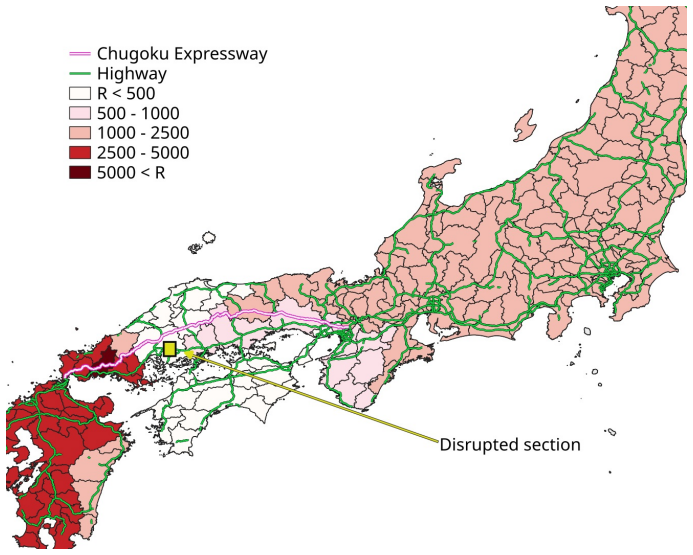
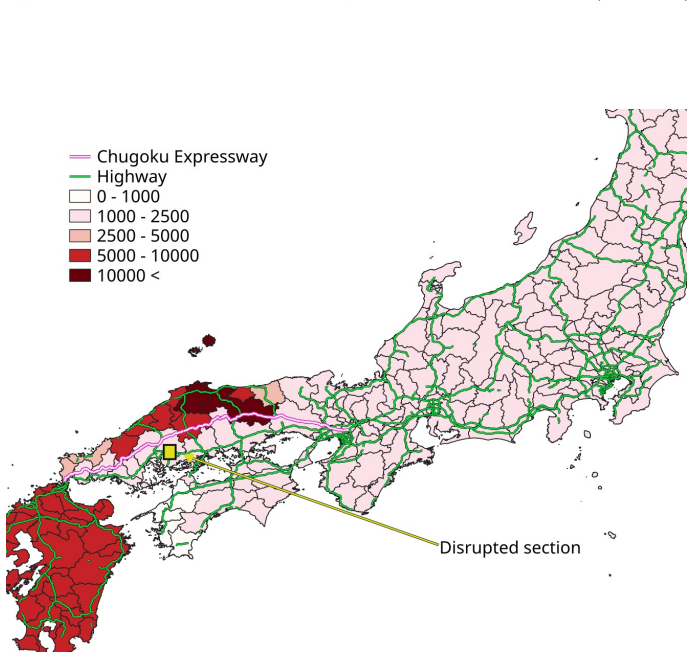
The methodology combines inter-regional road network connectivity with a spatial computable general equilibrium model to evaluate redundant transportation networks. Applied to road disruption scenarios in the Chugoku region, several counterfactual simulations show that the economic vulnerability reduction effect is more far-reaching than the transportation impacts measured by travel time changes.
What carries the argument
The integration of inter-regional road network connectivity analysis with a spatial computable general equilibrium model that simulates economic responses to travel time changes under disruption scenarios with and without alternative routes.
If this is right
- Rural areas with low-density networks experience smaller economic losses when parallel highways exist.
- Economic impacts propagate to nearby zones through interdependencies even when those zones avoid direct travel time increases.
- The method separates transportation effects from broader economic effects for clearer evaluation of network redundancy.
- Counterfactual removal of alternative roads produces larger negative benefits than the baseline disruption case.
Where Pith is reading between the lines
- Infrastructure planners could apply the same combined network and equilibrium approach to rank proposed new routes by their expected reduction in regional economic vulnerability.
- The framework might extend to other linear networks such as rail lines or pipelines to test redundancy benefits under comparable disruption assumptions.
- Regions outside Japan with similar parallel corridor structures could test the method on local data to check whether economic effects consistently outpace transport effects.
Load-bearing premise
The spatial computable general equilibrium model accurately captures the economic interdependencies and responses to travel time changes from road disruptions in the studied region.
What would settle it
Comparison of the model's predicted negative benefits in the region after an actual highway disruption against observed economic data in the presence versus absence of the parallel routes.
Figures
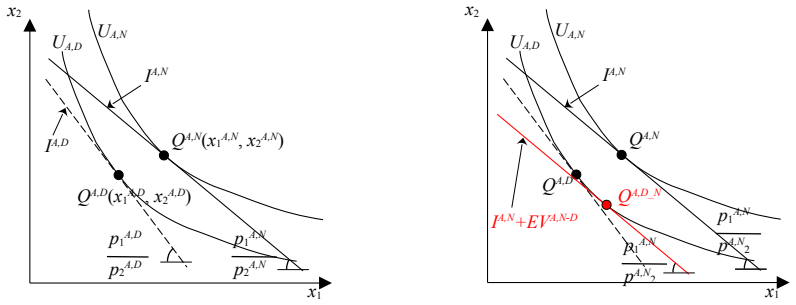
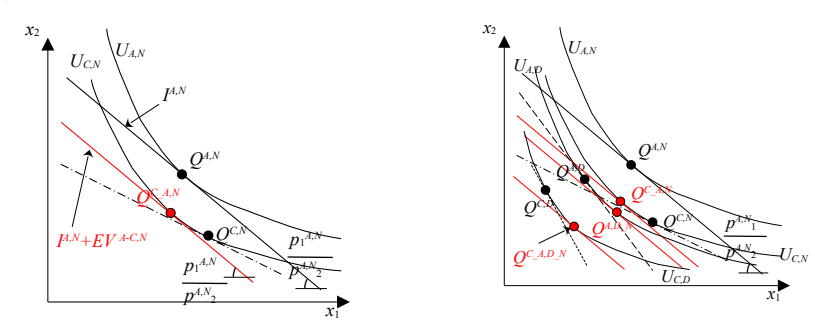
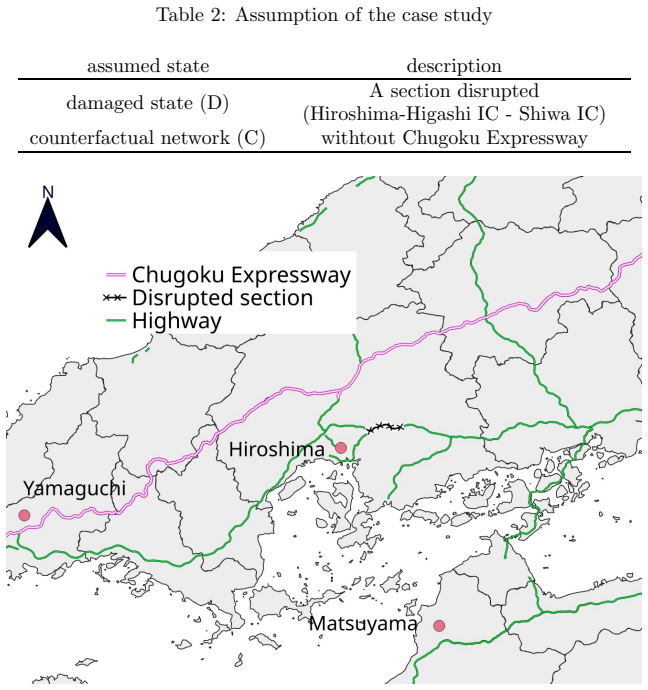
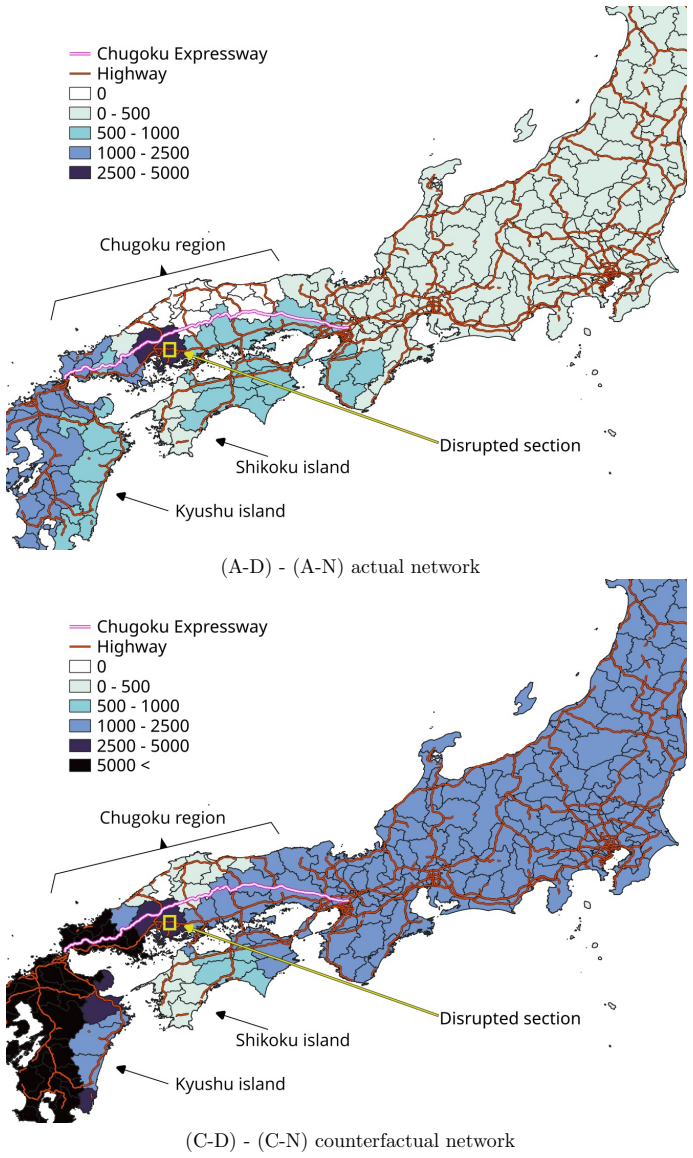


read the original abstract
The damage to transportation infrastructure caused by disasters can indirectly lead to economic damage through economic interdependence, even in areas that are not directly affected. However, even when transportation routes are interrupted by a disaster, the damage can be mitigated if alternative routes are secured. Rural areas with low-density transportation networks are more vulnerable to traffic disruptions in a disaster. This study develops a method for evaluating the effectiveness of redundant transportation networks in mitigating economic vulnerability in the event of a disaster. Our methodology combines inter-regional road network connectivity with a spatial computable general equilibrium (SCGE) model. We apply the method to road disruption scenarios in the Chugoku region of Japan, which has a system of parallel highways. The affected areas are in close geographical proximity to many rural areas and have strong economic interdependencies with them. Several counterfactual simulations depicted the situation without the alternative road and the disaster. We evaluate the transportation impacts, measured by changes in travel time, and the economic impacts, measured by negative benefits, respectively. The results suggest that the economic vulnerability reduction effect is more far-reaching than the transportation impacts.
Editorial analysis
A structured set of objections, weighed in public.
Referee Report
Summary. The paper develops a method integrating road-network connectivity analysis with a spatial computable general equilibrium (SCGE) model to quantify how redundant parallel highways mitigate both direct travel-time increases and indirect economic losses from highway disruptions. Applied via counterfactual simulations to the Chugoku region of Japan, the results indicate that the spatial footprint of economic-vulnerability reduction from the redundant network exceeds that of the transportation-time savings alone.
Significance. If the SCGE linkages are shown to be robustly calibrated, the finding that economic propagation is spatially broader than transport effects would strengthen the case for valuing network redundancy in disaster-resilient infrastructure planning, particularly in low-density regions with inter-regional trade dependencies. The combined network-plus-SCGE approach itself represents a potentially reusable framework for ex-ante resilience assessment.
major comments (2)
- The abstract (and available description) supplies no functional forms, Armington elasticities, migration or capital-adjustment parameters, or calibration targets for the SCGE model; without these, it is impossible to verify that the reported wider spatial reach of economic impacts is not an artifact of overstated inter-regional linkages.
- No data sources, out-of-sample validation against observed disaster impacts, or sensitivity analysis on key parameters are described, leaving the central claim that economic vulnerability reduction is “more far-reaching” without an identifiable empirical anchor.
minor comments (1)
- The abstract refers to “negative benefits” without defining the welfare metric or numeraire used in the SCGE simulations.
Simulated Author's Rebuttal
We thank the referee for these comments, which highlight the need for greater transparency on model specification and empirical grounding. We address each point below and will revise the manuscript to incorporate additional details and analyses where feasible.
read point-by-point responses
-
Referee: The abstract (and available description) supplies no functional forms, Armington elasticities, migration or capital-adjustment parameters, or calibration targets for the SCGE model; without these, it is impossible to verify that the reported wider spatial reach of economic impacts is not an artifact of overstated inter-regional linkages.
Authors: We agree that the abstract omits these specifics. The full manuscript describes the SCGE structure in the methods section, but we will revise both the abstract and main text to explicitly list the functional forms (CES production and Armington demand), the Armington elasticity values used, migration and capital adjustment assumptions, and the calibration targets (e.g., regional input-output tables and observed trade flows). This will allow readers to assess the strength of inter-regional linkages. revision: yes
-
Referee: No data sources, out-of-sample validation against observed disaster impacts, or sensitivity analysis on key parameters are described, leaving the central claim that economic vulnerability reduction is “more far-reaching” without an identifiable empirical anchor.
Authors: We will add an explicit data-sources subsection detailing the road-network, input-output, and population datasets employed. Sensitivity analysis on key parameters (including elasticities and disruption durations) will be included in a new appendix. Out-of-sample validation against specific past disasters is not feasible within the current counterfactual framework without additional observed post-disaster data, but we will discuss this limitation and strengthen the calibration description to better anchor the results. revision: partial
Circularity Check
No circularity: SCGE application uses standard external linkages without self-referential reduction in provided text
full rationale
The abstract and available text describe combining road-network connectivity with an SCGE model to run counterfactual simulations of disruptions, measuring travel-time changes versus negative benefits. No equations, parameter-fitting steps, self-citations, or uniqueness theorems are quoted that would make any prediction equivalent to its inputs by construction. The economic-propagation claim rests on the model's inter-regional linkages, which are presented as independent of the target result rather than fitted or renamed from it. Absent any load-bearing self-citation chain or definitional loop in the visible derivation, the analysis is self-contained against external benchmarks.
Axiom & Free-Parameter Ledger
Reference graph
Works this paper leans on
-
[1]
doi: 10.1080/03081060.2015.1039230
ISSN 0308-1060. doi: 10.1080/03081060.2015.1039230. Reza Faturechi and Elise Miller-Hooks. Measuring the Performance of Transportation Infrastructure Systems in Disasters: A Comprehensive Review. Journal of Infrastructure Systems , 21(1):04014025, March
-
[2]
doi: 10.1061/(ASCE)IS.1943-555X .0000212
ISSN 1943-555X. doi: 10.1061/(ASCE)IS.1943-555X .0000212. Tomoki Ishikura and Shogo Iso. Estimation of impacts of volcanic as h fall from Mt. Fuji eruption on freight transport and effects of partial restoration of highways . The Annals of Regional Science , 73: 111–134,
-
[3]
doi: 10.1007/s00168-023-012 51-0
ISSN 1432-0592. doi: 10.1007/s00168-023-012 51-0. Tomoki Ishikura and Fuga Yokoyama. Regional economic effects of the Ring Road project in the Greater Tokyo Area: A spatial CGE approach. Papers in Regional Science , 101(4):811–837, April
-
[4]
ISSN 1056-8190. doi: 10.1111/pirs.12677. Erik Jenelius and Oded Cats. The value of new public transport links fo r network robustness and redundancy. Transportmetrica A: Transport Science , 11(9):819–835, October
-
[5]
doi: 10.1080/23249935.2015.1087232
ISSN 2324-9935. doi: 10.1080/23249935.2015.1087232. 14 Yoshio Kajitani and Hirokazu Tatano. Applicability of a spatial compu table general equilibrium model to assess the short-term economic impact of natural disasters. Economic Systems Research , 30(3): 289–312, July
-
[6]
doi: 10.1080/09535314.201 7.1369010
ISSN 0953-5314. doi: 10.1080/09535314.201 7.1369010. Tschangho John Kim, Heejoo Ham, and David E. Boyce. Economic impa cts of transportation network changes: Implementation of a combined transportation network a nd input-output model. Papers in Regional Science, 81(2):223–246,
-
[7]
ISSN 1056-8190. doi: 10.1007/s1011001 00101. Ministry of Land, Infrastructure, Transport and Tourism. White paper on land, infrastructure, transport and tourism in Japan, 2012,
-
[8]
doi: 10.1007/978-3-030-16 237-5
ISBN 978-3- 030-16236-8 978-3-030-16237-5. doi: 10.1007/978-3-030-16 237-5. Adam Rose and Shu-Yi Liao. Modeling Regional Economic Resilience to D isasters: A Computable General Equilibrium Analysis of Water Service Disruptions. Journal of Regional Science , 45(1):75– 112,
-
[9]
doi: 10.1111/j.0022-4146.2005.0036 5.x
ISSN 1467-9787. doi: 10.1111/j.0022-4146.2005.0036 5.x. Xiangdong Xu, Anthony Chen, Guangming Xu, Chao Yang, and William H. K. Lam. Enhancing network resilience by adding redundancy to road networks. Transportation Research Part E: Logistics and Transportation Review, 154:102448, October
-
[10]
doi: 10.1016/j.tre .2021.102448
ISSN 1366-5545. doi: 10.1016/j.tre .2021.102448. Lijiao Yang, Xinge Wang, Xinyu Jiang, and Hirokazu Tatano. Assessin g the Regional Economic Ripple Effect of Flood Disasters Based on a Spatial Computable General Eq uilibrium Model Considering Traffic Disruptions. International Journal of Disaster Risk Science , 14(3):488–505, June
-
[11]
doi: 10.1007/s13753-023-00500-2
ISSN 2192-6395. doi: 10.1007/s13753-023-00500-2. Jingjing Zhu, Xiangdong Xu, and Zijian Wang. Economic evaluation of r edundancy design for transporta- tion networks under disruptions: Framework and case study. Transport Policy, 142:70–83, October
-
[12]
doi: 10.1016/j.tranpol.2023.08.004
ISSN 0967-070X. doi: 10.1016/j.tranpol.2023.08.004. 15
discussion (0)
Sign in with ORCID, Apple, or X to comment. Anyone can read and Pith papers without signing in.