REVIEW 3 major objections 5 minor 45 references
Temporal Continual Learning with Prior Compensation for Human Motion Prediction
T0 review · 3 major / 5 minor · reviewed 2026-08-06 · deepseek-v4-flash
Pith's one-line read The paper claims that a staged training schedule plus a learned compensation factor for forgotten prior knowledge makes the same human motion prediction backbone beat its one-stage training on four datasets and seven backbones.
desk verdict Broad empirical training recipe with an overclaimed theoretical justification; the experiments are worth taking seriously, the derivation needs fixing. read the letter →
The pith
A machine-rendered reading of the paper's core claim, the machinery that carries it, and where it could break.
The reading
What carries the argument
The central object is the Prior Compensation Factor, $\alpha_{\mathcal{Z}_{1:k-1}\to\mathcal{Z}_k}$, a scalar defined as the gap between the probability of predicting segment $k$ with the ideal prior and with the corrupted prior carried over from earlier stages. In practice the backbone outputs an extra dimension passed through an MLP, and the learned output is treated as $\alpha$. Its job is to down-weight a newly added segment when prior knowledge is judged to be lost and to weight the retained earlier segments accordingly, turning the intractable stage-$k$ objective into the weighted loss in Eq. (7). The load-bearing identity is Lemma 3.1's bound, $-\log(a+b)\le (1-a)(-\log b)+(1-a)\log(1-a)+\log(1+a)$ for $0\le a\le 1-b$, which converts products inside the logarithm into additive per-task terms; Lemma 3.2 then certifies that the surrogate stays within $\log(3/2)(k-1)$ of the true objective under a mild probability condition.
What would settle it
On a held-out validation split, compute the true forgetting gap for each stage by comparing the probability the current model assigns to an early segment against the probability the previous stage's model assigns to the same segment, and correlate that gap with the compensation value the trained model outputs; if the correlation is not positive, the compensation mechanism is refuted even if final benchmark errors improve.
Extended reading notes
Core claim
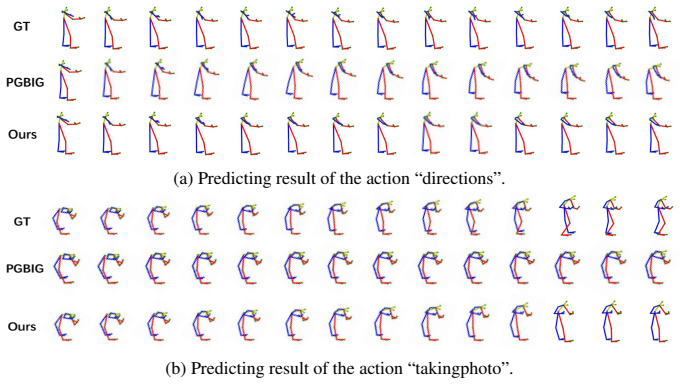
The paper's central claim is that a large part of human motion prediction error comes from how the model is trained, not from which backbone is used, and that a staged schedule can recover it. The future interval is split into K segments; the first stage trains the model on the earliest segment only, and each later stage trains on all segments seen so far, starting from the previous stage's parameters. Because switching objectives makes the model forget the prior knowledge stored in those parameters, the model is also asked to output an extra scalar, the Prior Compensation Factor $\alpha$, which reweights the current segment's loss against earlier segments; at the end of each stage the average $\alpha$ over training samples is frozen and carried into the next stage. A lemma upper-bounds the underlying negative log-likelihood and produces the weighted loss actually minimized. The paper reports that this recipe lowers average error relative to one-stage training of the same backbone on all four datasets and all seven backbones tried; for example, PGBIG's average error drops from 66.52 to 64.97 on Human3.6M and from 72.49 to 63.59 on 3DPW.
Load-bearing premise
The scheme rests on the assumption that the extra number the model learns to output really measures how much earlier-stage knowledge is being forgotten; if it is merely a free weight, the stated mechanism is unverified even if benchmarks improve.
Editorial extensions
If this is right
- Applying TCL to a backbone should keep short-term prediction accuracy from degrading when long-term frames enter the objective; the paper's stage-by-stage table shows the early-segment error rising only 0.27 with the compensation factor versus 0.83 without it.
- The schedule transfers across architecture families: the paper reports gains on RNN, GCN, transformer, and MLP backbones, so a new HMP model can adopt the recipe without changing its architecture.
- The number of training stages saturates at three segments in the default split (3, 9, and 13 future frames): the paper reports average error 66.95 with one task, 66.02 with two, 65.00 with three, and roughly flat values for five or eight tasks.
- Deployment cost is unaffected: inference uses the same backbone with one extra output dimension, so the accuracy gain is obtained at training time only.
Reading between the lines
- The paper does not test the same stage-then-grow schedule on other temporal forecasting problems, but the logic is generic; trajectory forecasting, video frame prediction, and speech prosody are natural places to try the identical backbone-plus-schedule protocol.
- The reported $\alpha$ values increase steadily across stages, which suggests the learned factor may partly be acting as a curriculum schedule; replacing it with a fixed ramp matched to the observed trajectory would separate the compensation mechanism from a simpler weighting effect.
- A direct measurement of the Eq. (3) gap on validation data, correlated with the MLP output, would turn the paper's assumed mechanism into a tested one; the paper does not perform that measurement.
Editorial analysis
A structured set of objections, weighed in public.
Referee Report
Summary. The paper proposes Temporal Continual Learning (TCL), a multi-stage training framework for human motion prediction. Instead of training a backbone on all future frames at once, TCL divides the future sequence into segments, trains on an increasing number of segments stage by stage, and introduces a Prior Compensation Factor (PCF) to mitigate forgetting of previously learned knowledge. The authors claim that a theoretical derivation yields a more reasonable optimization objective, and they report consistent improvements over several backbone models on Human3.6M, CMU-MoCap, 3DPW, and AMASS. The paper also includes ablations on the number of stages, the PCF, and the forgetting behavior.
Significance. If the claims hold, the contribution is a general and useful training recipe rather than a new architecture: it can be plugged into existing HMP backbones and yields consistent gains, especially on long-term prediction and on the challenging 3DPW dataset. The empirical protocol is broad, with same-backbone comparisons across four datasets and seven backbones, and the ablation study shows that multi-stage training alone helps and that PCF provides additional gains. The main weakness is that the theoretical derivation is currently not established: the learned PCF is treated as a free variable although Eq. (3) defines it as a function of the model parameters, and the proofs of the lemmas are deferred to an appendix that is absent from the manuscript. The empirical results may stand independently, but the theoretical framing needs repair or explicit reframing as a heuristic.
major comments (3)
- [§3.3–3.4, Eqs. (3)–(5), (7)] The derivation of the optimization objective is not valid for the implemented loss. Equation (3) defines αZ1:k−1→Zk as a deterministic function of θ, namely P(Zk|Z1:k−1;θ) − P(Zk|Ẑ1:k−1;θ). Lemma 3.1 upper-bounds Eq. (4) only when α equals that true probability gap. In Section 3.4, however, α is produced by an MLP head and Eq. (7) is minimized jointly over θ and this unconstrained α. The paper never shows that the learned α equals the gap, satisfies the condition 0 ≤ α ≤ 1 − P(Zk|Ẑ1:k−1;θ), or that minimizing Eq. (7) minimizes Eq. (4) or its upper bound. Consequently, the central claim that TCL 'derives a more reasonable optimization objective through theoretical derivation' is not established; the PCF is at present an ad hoc learned loss weight whose connection to prior compensation is asserted rather than derived. This is load-bearing because the PCF design is the paper's main novelty.
- [§3.3, Lemmas 3.1–3.2] The proofs of Lemmas 3.1 and 3.2 are deferred to an appendix that is not present in the submitted arXiv manuscript. Since Lemma 3.1 is the sole basis for the upper bound in Eq. (5), the central derivation cannot be checked. Please include the appendix or provide the proofs in the main text.
- [§4.4, Eq. (8), Fig. 5] The learned α is never validated against the quantity it is supposed to estimate. Equation (8) averages the MLP outputs over the training set, and Fig. 5 shows that the value increases across stages, but there is no comparison with the actual probability gap in Eq. (3) and no analysis of whether the learned values fall in the range required by Lemma 3.1. Without such evidence, the interpretation of α as compensating for forgotten prior knowledge remains an assumption rather than a demonstrated mechanism.
minor comments (5)
- [§3.4, Eq. (6)] 'Mean Suqared Error' should be 'Mean Squared Error'.
- [§4.1] 'millimeters (ms)' should be 'millimeters (mm)'.
- [§4.1] The sentence 'For the 3DPW dataset, we predict 30 frames conditioned on the observation of the preceding 10 frames' should state explicitly that the input length is 10 frames, to match the description given for the other datasets.
- [Algorithm 1] The set A accumulates the estimated α values, but the loss Lk in Eq. (7) uses them as fixed coefficients; please clarify the indexing and ordering of A when it is passed to Lk.
- [§3.4, Eq. (7)] The transition from Eq. (5) to Eq. (7) is not spelled out; please state explicitly how the negative log-likelihood terms are replaced by MSE terms and how the constant terms are handled.
Circularity Check
No significant circularity: the empirical gains are measured against external baselines, and the PCF derivation, while under-validated, does not reduce a fitted quantity to a prediction.
full rationale
I find no circular step. The central empirical claim—TCL improves HMP accuracy over seven backbone models on four standard benchmarks—is tested against released backbones and external protocols, so it is not equivalent to the paper's own inputs. The derivation chain Eq. (3) to Eq. (4) is a substitution/identity, and Eq. (4) to Eq. (5) is an inequality upper bound; Eq. (7) then treats the PCF as a learned loss weight. The manuscript does not show that the MLP-learned alpha equals the Eq. (3) probability gap or satisfies Lemma 3.1's conditions, which is a validity/completeness defect rather than circularity: no equation forces the learned alpha to be the quantity it names, and no fitted value is later reported as a prediction. The proof omission is explicit ('Due to the space limitation, we present the proofs of Lemma 3.1 and 3.2 in the appendix.') but the appendix is absent; this weakens the derivation but is not a circular reduction. The self-citations ([40], [42]) appear only in related work and are not load-bearing. Accordingly, the appropriate finding is no significant circularity.
Assumptions & free parameters
free parameters (2)
- Prior Compensation Factor alpha (per stage) =
roughly 0.25 to 0.375 per stage, learned by an MLP head
- Segment boundaries and number of stages =
three segments of lengths 3, 9, and 13 frames; K=3
assumptions (5)
- standard math The chain-rule factorization P(Z1:k) = P(Z1) * product P(Zi | Z1:i-1) holds for the HMP objective.
- domain assumption Short-term prediction knowledge serves as a useful prior for long-term prediction.
- ad hoc to paper The prior compensation factor alpha can be represented by an MLP head and learned jointly with the model.
- ad hoc to paper Lemma 3.1 and Lemma 3.2 are correct and their proofs in the appendix are valid.
- domain assumption Mean squared error is proportional to negative log probability for the pose segments.
invented entities (1)
-
Prior Compensation Factor alpha_{Z1:k-1 to Zk}
Cite this review
Pith. "Pith review of Temporal Continual Learning with Prior Compensation for Human Motion Prediction." pith.science (2026). https://pith.science/paper/XW24AE6J
@misc{pith2026250704060,
  author       = {Pith},
  title        = {Pith review of: Temporal Continual Learning with Prior Compensation for Human Motion Prediction},
  year         = {2026},
  howpublished = {\url{https://pith.science/paper/XW24AE6J}},
  note         = {Machine review of arXiv:2507.04060}
}
read the original abstract
Human Motion Prediction (HMP) aims to predict future poses at different moments according to past motion sequences. Previous approaches have treated the prediction of various moments equally, resulting in two main limitations: the learning of short-term predictions is hindered by the focus on long-term predictions, and the incorporation of prior information from past predictions into subsequent predictions is limited. In this paper, we introduce a novel multi-stage training framework called Temporal Continual Learning (TCL) to address the above challenges. To better preserve prior information, we introduce the Prior Compensation Factor (PCF). We incorporate it into the model training to compensate for the lost prior information. Furthermore, we derive a more reasonable optimization objective through theoretical derivation. It is important to note that our TCL framework can be easily integrated with different HMP backbone models and adapted to various datasets and applications. Extensive experiments on four HMP benchmark datasets demonstrate the effectiveness and flexibility of TCL. The code is available at https://github.com/hyqlat/TCL.
Figures


Figures from the paper (3 more)


Reference graph
Works this paper leans on
- [1]
- [2]
-
[3]
A. Bouazizi, A. Holzbock, U. Kressel, K. Dietmayer, and V . Belagiannis. Motionmixer: Mlp-based 3d human body pose forecasting.arXiv preprint arXiv:2207.00499, 2022
arXiv 2022
-
[4]
H.-k. Chiu, E. Adeli, B. Wang, D.-A. Huang, and J. C. Niebles. Action-agnostic human pose forecasting. In2019 IEEE Winter Conference on Applications of Computer Vision (WACV), pages 1423–1432. IEEE, 2019
work page 2019
- [5]
- [6]
-
[7]
Q. Cui, H. Sun, and F. Yang. Learning dynamic relationships for 3d human motion prediction. InProceedings of the IEEE/CVF conference on computer vision and pattern recognition, pages 6519–6527, 2020
work page 2020
-
[8]
K. Fragkiadaki, S. Levine, P. Felsen, and J. Malik. Recurrent network models for human dynamics. InProceedings of the IEEE international conference on computer vision, pages 4346–4354, 2015
work page 2015
Show all 45 references
-
[9]
Ghosh, J
P. Ghosh, J. Song, E. Aksan, and O. Hilliges. Learning human motion models for long-term predictions. In2017 International Conference on 3D Vision (3DV), pages 458–466. IEEE, 2017
2017
-
[10]
Gopalakrishnan, A
A. Gopalakrishnan, A. Mali, D. Kifer, L. Giles, and A. G. Ororbia. A neural temporal model for human motion prediction. InProceedings of the IEEE/CVF Conference on Computer Vision and Pattern Recognition, pages 12116–12125, 2019
2019
-
[11]
Gui, Y .-X
L.-Y . Gui, Y .-X. Wang, X. Liang, and J. M. Moura. Adversarial geometry-aware human motion prediction. InProceedings of the european conference on computer vision (ECCV), pages 786–803, 2018
2018
-
[12]
Gui, Y .-X
L.-Y . Gui, Y .-X. Wang, D. Ramanan, and J. M. Moura. Few-shot human motion prediction via meta-learning. InProceedings of the European Conference on Computer Vision (ECCV), pages 432–450, 2018
2018
-
[13]
W. Guo, Y . Du, X. Shen, V . Lepetit, X. Alameda-Pineda, and F. Moreno-Noguer. Back to mlp: A simple baseline for human motion prediction. InProceedings of the IEEE/CVF Winter Conference on Applications of Computer Vision, pages 4809–4819, 2023
2023
-
[14]
Guo and J
X. Guo and J. Choi. Human motion prediction via learning local structure representations and temporal dependencies. InProceedings of the AAAI Conference on Artificial Intelligence, volume 33, pages 2580–2587, 2019. 11
2019
-
[15]
Hochreiter and J
S. Hochreiter and J. Schmidhuber. Long short-term memory.Neural computation, 9(8):1735– 1780, 1997
1997
-
[16]
J.-F. Hu, J. Sun, Z. Lin, J.-H. Lai, W. Zeng, and W.-S. Zheng. Apanet: Auto-path aggregation for future instance segmentation prediction.IEEE Transactions on Pattern Analysis and Machine Intelligence, 44(7):3386–3403, 2021
2021
-
[17]
Ionescu, D
C. Ionescu, D. Papava, V . Olaru, and C. Sminchisescu. Human3. 6m: Large scale datasets and predictive methods for 3d human sensing in natural environments.IEEE transactions on pattern analysis and machine intelligence, 36(7):1325–1339, 2013
2013
-
[18]
A. Jain, A. R. Zamir, S. Savarese, and A. Saxena. Structural-rnn: Deep learning on spatio- temporal graphs. InProceedings of the ieee conference on computer vision and pattern recognition, pages 5308–5317, 2016
2016
-
[19]
Kendall, Y
A. Kendall, Y . Gal, and R. Cipolla. Multi-task learning using uncertainty to weigh losses for scene geometry and semantics. InProceedings of the IEEE conference on computer vision and pattern recognition, pages 7482–7491, 2018
2018
-
[20]
Kirkpatrick, R
J. Kirkpatrick, R. Pascanu, N. Rabinowitz, J. Veness, G. Desjardins, A. A. Rusu, K. Milan, J. Quan, T. Ramalho, A. Grabska-Barwinska, et al. Overcoming catastrophic forgetting in neural networks.Proceedings of the national academy of sciences, 114(13):3521–3526, 2017
2017
-
[21]
Lebailly, S
T. Lebailly, S. Kiciroglu, M. Salzmann, P. Fua, and W. Wang. Motion prediction using temporal inception module. InProceedings of the Asian Conference on Computer Vision, 2020
2020
-
[22]
M. Li, S. Chen, X. Chen, Y . Zhang, Y . Wang, and Q. Tian. Symbiotic graph neural networks for 3d skeleton-based human action recognition and motion prediction.IEEE Transactions on Pattern Analysis and Machine Intelligence, 44(6):3316–3333, 2021
2021
-
[23]
M. Li, S. Chen, Y . Zhao, Y . Zhang, Y . Wang, and Q. Tian. Dynamic multiscale graph neural networks for 3d skeleton based human motion prediction. InProceedings of the IEEE/CVF Conference on Computer Vision and Pattern Recognition, pages 214–223, 2020
2020
-
[24]
Z. Lin, J. Sun, J.-F. Hu, Q. Yu, J.-H. Lai, and W.-S. Zheng. Predictive feature learning for future segmentation prediction. InProceedings of the IEEE/CVF International Conference on Computer Vision, pages 7365–7374, 2021
2021
-
[25]
Liu and J
J. Liu and J. Yin. Multi-grained trajectory graph convolutional networks for habit-unrelated human motion prediction.arXiv preprint arXiv:2012.12558, 2020
2012 arXiv
-
[26]
Z. Liu, S. Wu, S. Jin, Q. Liu, S. Lu, R. Zimmermann, and L. Cheng. Towards natural and accurate future motion prediction of humans and animals. InProceedings of the IEEE/CVF Conference on Computer Vision and Pattern Recognition, pages 10004–10012, 2019
2019
-
[27]
Lucas, F
T. Lucas, F. Baradel, P. Weinzaepfel, and G. Rogez. Posegpt: Quantization-based 3d human motion generation and forecasting. InEuropean Conference on Computer Vision, pages 417–435. Springer, 2022
2022
-
[28]
T. Ma, Y . Nie, C. Long, Q. Zhang, and G. Li. Progressively generating better initial guesses towards next stages for high-quality human motion prediction. InProceedings of the IEEE/CVF Conference on Computer Vision and Pattern Recognition, pages 6437–6446, 2022
2022
-
[29]
Mahmood, N
N. Mahmood, N. Ghorbani, N. F. Troje, G. Pons-Moll, and M. J. Black. Amass: Archive of motion capture as surface shapes. InProceedings of the IEEE/CVF international conference on computer vision, pages 5442–5451, 2019
2019
-
[30]
W. Mao, M. Liu, and M. Salzmann. History repeats itself: Human motion prediction via motion attention. InEuropean Conference on Computer Vision, pages 474–489. Springer, 2020
2020
-
[31]
W. Mao, M. Liu, M. Salzmann, and H. Li. Learning trajectory dependencies for human motion prediction. InProceedings of the IEEE/CVF International Conference on Computer Vision, pages 9489–9497, 2019. 12
2019
-
[32]
Martinez, M
J. Martinez, M. J. Black, and J. Romero. On human motion prediction using recurrent neural networks. InProceedings of the IEEE conference on computer vision and pattern recognition, pages 2891–2900, 2017
2017
-
[33]
Martínez-González, M
A. Martínez-González, M. Villamizar, and J.-M. Odobez. Pose transformers (potr): Human motion prediction with non-autoregressive transformers. InProceedings of the IEEE/CVF International Conference on Computer Vision, pages 2276–2284, 2021
2021
-
[34]
Mohamed, K
A. Mohamed, K. Qian, M. Elhoseiny, and C. Claudel. Social-stgcnn: A social spatio-temporal graph convolutional neural network for human trajectory prediction. InProceedings of the IEEE/CVF conference on computer vision and pattern recognition, pages 14424–14432, 2020
2020
-
[35]
Radford, K
A. Radford, K. Narasimhan, T. Salimans, I. Sutskever, et al. Improving language understanding by generative pre-training. 2018
2018
-
[36]
M. B. Ring. Child: A first step towards continual learning.Machine Learning, 28(1):77–104, 1997
1997
-
[37]
Sang, Z.-Z
H.-F. Sang, Z.-Z. Chen, and D.-K. He. Human motion prediction based on attention mechanism. Multimedia Tools and Applications, 79(9):5529–5544, 2020
2020
-
[38]
H. Shin, J. K. Lee, J. Kim, and J. Kim. Continual learning with deep generative replay.Advances in neural information processing systems, 30, 2017
2017
-
[39]
Sofianos, A
T. Sofianos, A. Sampieri, L. Franco, and F. Galasso. Space-time-separable graph convolutional network for pose forecasting. InProceedings of the IEEE/CVF International Conference on Computer Vision, pages 11209–11218, 2021
2021
-
[40]
J. Sun, Z. Lin, X. Han, J.-F. Hu, J. Xu, and W.-S. Zheng. Action-guided 3d human motion prediction.Advances in Neural Information Processing Systems, 34:30169–30180, 2021
2021
-
[41]
J. Sun, J. Xie, J.-F. Hu, Z. Lin, J. Lai, W. Zeng, and W.-s. Zheng. Predicting future instance segmentation with contextual pyramid convlstms. InProceedings of the 27th acm international conference on multimedia, pages 2043–2051, 2019
2019
-
[42]
J. Tang, J. Wang, and J.-F. Hu. Predicting human poses via recurrent attention network.Visual Intelligence, 1(1):18, Aug 2023
2023
-
[43]
Vaswani, N
A. Vaswani, N. Shazeer, N. Parmar, J. Uszkoreit, L. Jones, A. N. Gomez, Ł. Kaiser, and I. Polosukhin. Attention is all you need.Advances in neural information processing systems, 30, 2017
2017
-
[44]
V on Marcard, R
T. V on Marcard, R. Henschel, M. J. Black, B. Rosenhahn, and G. Pons-Moll. Recovering accurate 3d human pose in the wild using imus and a moving camera. InProceedings of the European conference on computer vision (ECCV), pages 601–617, 2018
2018
-
[45]
Xu, Y .-X
S. Xu, Y .-X. Wang, and L.-Y . Gui. Diverse human motion prediction guided by multi-level spatial-temporal anchors. InEuropean Conference on Computer Vision, pages 251–269. Springer, 2022. 13
2022
Reviewed August 6, 2026 · model on record in the stance chip above.
Discussion (0). Continue with ORCID to comment.