Statistical Properties of Molecular Clouds in the Milky Way: Insights from Three-Isotopologue CO Observations of the MWISP Project
Pith reviewed 2026-06-25 23:42 UTC · model grok-4.3
The pith
Molecular clouds have turbulent 12CO outer layers not tied to star formation, while C18O cores are gravity-dominated.
A machine-rendered reading of the paper's core claim, the machinery that carries it, and where it could break.
Core claim
A comparison across tracers reveals that typical MCs have a turbulent, diffuse, 12CO-bright gas structure in their outer layers that does not contribute directly to star formation. In contrast, 13CO-bright gas represents a turning point where gravity becomes significant; C18O-bright gas is about gravity-dominated.
What carries the argument
The three-isotopologue comparison that separates turbulent outer gas, transitional gas, and gravity-dominated inner gas within the same molecular clouds.
If this is right
- Star formation is concentrated in the gravity-dominated C18O-bright gas rather than the full cloud volume.
- 12CO-only structures are small, young clouds that inherit turbulence from the surrounding diffuse medium.
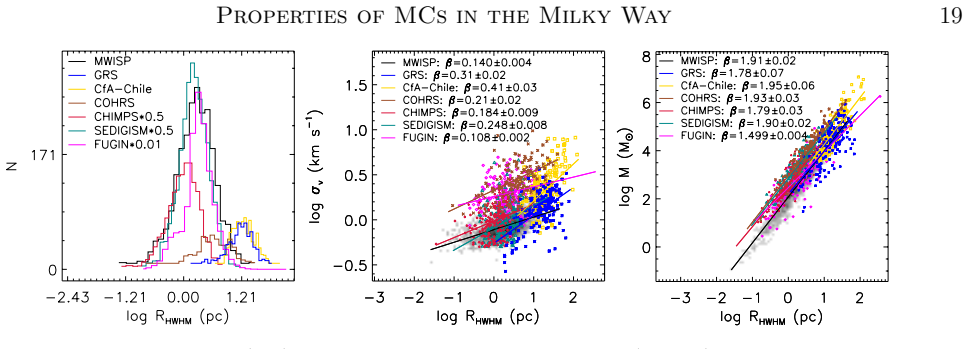
- The velocity-size relation is flatter than the classic Larson relation, and mass-size relations are strong.
- Most observed cloud parameters can be estimated from a minimal set of eigenparameters linked by underlying scaling relations.
- MCs are typically oblate and aligned with the Galactic plane, with distinct properties in spiral arms versus interarm regions.
Where Pith is reading between the lines
- Star-formation prescriptions in simulations could be refined by weighting gas according to which isotopologue it emits in rather than using whole-cloud averages.
- The 13CO transition point offers a potential observational marker for identifying clouds that are about to collapse.
- If the layering pattern holds in other galaxies, multi-tracer maps could separate feedback-dominated envelopes from collapsing cores at extragalactic distances.
- The finding that supra-Larson dispersion clouds are mostly small and young suggests an evolutionary pathway from diffuse turbulent gas to more bound structures.
Load-bearing premise
The sample of 3161 well-resolved clouds accurately represents typical cloud properties without major unaccounted biases from distance selection or standard conversion methods.
What would settle it
Detection of widespread star formation in clouds visible only in 12CO but absent in 13CO and C18O, or absence of gravitational signatures such as bound motions in C18O-bright regions.
Figures





read the original abstract
We present a comprehensive statistical analysis of molecular cloud (MC) properties using the MWISP survey's 12CO, 13CO, and C18O (J = 1--0) data toward the inner (l = 45$^\circ$--60$^\circ$) and outer (l = 120$^\circ$--130$^\circ$) Galaxy. From a strict selection of 24,724 identified MCs, a final sample of 3,161 well-resolved MCs is established. We investigate the distributions of observational, morphological, and derived physical parameters, as well as their environmental dependencies and intercorrelations. Our analysis reveals that MCs are typically oblate and tend to align with the Galactic disk. A critical evaluation using a nearby subsample confirms significant distance-dependent selection effects for some parameters, nevertheless, the direction of changes in these parameters can indicate distance influence. We also examine several specific subsamples, revealing the distinct characteristics of MCs in the G120 spiral shock region, MCs in the G50 interarm spurs, C18O-bright MCs, and MCs with supra-Larson velocity dispersion. For instance, MCs with supra-Larson velocity dispersion are predominantly small and likely young clouds inheriting turbulence from the diffuse ISM. Notably, a comparison across tracers reveals that typical MCs have a turbulent, diffuse, 12CO-bright gas structure in their outer layers that does not contribute directly to star formation. In contrast, 13CO-bright gas represents a turning point where gravity becomes significant; C18O-bright gas is about gravity-dominated. Comprehensive correlation analysis confirms a flatter $\sigma_v$-size relation than classic Larson's law and a strong mass-size relation. Incorporating dimensional analysis, we derive minimal sets of eigenparameters from which most other observational and physical parameters can be estimated. This highlights the underlying scaling relations that governing cloud properties.
Editorial analysis
A structured set of objections, weighed in public.
Referee Report
Summary. The paper analyzes statistical properties of 3,161 well-resolved molecular clouds identified from MWISP 12CO, 13CO, and C18O (J=1-0) data in two Galactic longitude ranges. It reports distributions of observational and physical parameters, environmental dependencies, subsample differences (e.g., G120, G50, C18O-bright, supra-Larson), a tracer-dependent structural interpretation (12CO tracing turbulent non-star-forming envelopes, 13CO as gravity turning point, C18O as gravity-dominated), a flatter σ_v-size relation than Larson's law, a strong mass-size relation, and derivation of eigenparameters via dimensional analysis from which other quantities can be estimated.
Significance. If the central claims hold after addressing selection biases, the work offers a large-sample, multi-isotopologue observational framework for layered MC structure and the transition to gravity dominance, with direct relevance to star-formation models. Strengths include the scale of the sample, explicit subsample checks, and the eigenparameter approach that reduces the parameter space via scaling relations.
major comments (2)
- [Sample selection and distance-effects evaluation] The description of the final 3,161-MC sample (selected from 24,724 via a strict resolution cut) and the nearby-subsample check for distance-dependent selection effects: these effects are load-bearing for the tracer-comparison claim, because the cut may preferentially retain clouds bright in multiple lines or alter apparent sizes/masses differently per isotopologue, risking an artifactual 'turning point' at 13CO rather than an intrinsic structural transition.
- [Tracer comparison and physical-parameter derivation] The interpretation that 13CO marks the onset of gravity significance and C18O is gravity-dominated (abstract and results sections): this rests on derived sizes, masses, and velocity dispersions whose accuracy depends on standard conversion factors and cloud-identification methods that are not shown to be unbiased across tracers or distances.
minor comments (2)
- [Abstract] The abstract states MCs are 'typically oblate and tend to align with the Galactic disk' without specifying the quantitative criteria or measurement method used for axis ratios and orientation.
- [Eigenparameter section] The eigenparameter derivation via dimensional analysis is presented as yielding 'minimal sets' from which most parameters can be estimated, but the exact procedure, the number of retained eigenparameters, and the fraction of variance explained are not quantified in the provided summary.
Simulated Author's Rebuttal
We thank the referee for the constructive and detailed report. The two major comments raise valid points about potential selection effects and the robustness of physical parameter derivations. We address each below and outline revisions that will strengthen the manuscript without altering its core conclusions.
read point-by-point responses
-
Referee: [Sample selection and distance-effects evaluation] The description of the final 3,161-MC sample (selected from 24,724 via a strict resolution cut) and the nearby-subsample check for distance-dependent selection effects: these effects are load-bearing for the tracer-comparison claim, because the cut may preferentially retain clouds bright in multiple lines or alter apparent sizes/masses differently per isotopologue, risking an artifactual 'turning point' at 13CO rather than an intrinsic structural transition.
Authors: We agree that the resolution cut and multi-tracer selection require careful scrutiny, as they are central to the tracer-comparison results. The manuscript already presents a nearby-subsample analysis that quantifies distance-dependent effects on several parameters. In revision we will expand this section with explicit statistics on the fraction of clouds detected in one, two, or three isotopologues in both the full and nearby samples, and we will tabulate how the resolution cut changes the apparent size and mass distributions per tracer. These additions will directly test whether the observed transition at 13CO could arise from selection rather than intrinsic structure. revision: yes
-
Referee: [Tracer comparison and physical-parameter derivation] The interpretation that 13CO marks the onset of gravity significance and C18O is gravity-dominated (abstract and results sections): this rests on derived sizes, masses, and velocity dispersions whose accuracy depends on standard conversion factors and cloud-identification methods that are not shown to be unbiased across tracers or distances.
Authors: The referee is correct that the structural interpretation rests on standard X-factor conversions and the cloud-finding algorithm, neither of which has been exhaustively validated for isotopologue-to-isotopologue consistency in this work. The paper discusses the adopted factors and notes their uncertainties, but does not present dedicated bias tests across tracers. In revision we will add a short subsection that (i) summarizes the sensitivity of the reported size, mass, and σ_v values to plausible variations in the conversion factors and (ii) compares the eigenparameter results obtained with the fiducial versus alternative factor choices. We will also tone down the language in the abstract and conclusions to present the gravity-dominance sequence as an interpretation consistent with the data rather than a definitively proven transition. revision: partial
Circularity Check
Eigenparameters section uses data-derived quantities to 'estimate' the same inputs by construction
specific steps
-
fitted input called prediction
[Abstract]
"Incorporating dimensional analysis, we derive minimal sets of eigenparameters from which most other observational and physical parameters can be estimated. This highlights the underlying scaling relations that governing cloud properties."
Eigenparameters are extracted from the correlations among the measured parameters (sizes, masses, velocity dispersions, etc.) of the same 3,161 clouds. Using those eigenparameters to estimate the original parameters is therefore tautological; the estimation step is the fit itself rather than an independent prediction.
full rationale
The paper's core results consist of direct statistical distributions, morphological properties, and tracer comparisons from the 3,161-MC sample. These are observational and not derived from prior fits. The sole load-bearing step that reduces to its inputs is the eigenparameters derivation via dimensional analysis on the observed intercorrelations; by construction such components reconstruct the input parameters. This is a minor, localized instance of fitted-input-called-prediction and does not propagate to the main claims. No self-citation chains, uniqueness theorems, or ansatz smuggling appear in the provided text. Distance-dependent selection is a potential bias concern but is not a circularity issue.
Axiom & Free-Parameter Ledger
free parameters (1)
- various scaling factors in mass and size derivations
axioms (2)
- domain assumption Assumptions underlying the identification of molecular clouds from CO emission maps
- domain assumption Standard CO-to-H2 conversion factors and excitation assumptions
Reference graph
Works this paper leans on
-
[1]
2026a, PASJ, doi: 10.1093/pasj/psag021 —
Baba, J. 2026a, PASJ, doi: 10.1093/pasj/psag021 —. 2026b, PASJ, doi: 10.1093/pasj/psag045
-
[2]
Ballesteros-Paredes, J., Hartmann, L. W., Vázquez-Semadeni, E., Heitsch, F., & Zamora-A vilés, M. A. 2011, MNRAS, 411, 65, doi: 10.1111/j.1365-2966.2010.17657.x Properties of MCs in the Milky W ay 25
-
[3]
Beaumont, C. N., Goodman, A. A., Alves, J. F., et al. 2012, MNRAS, 423, 2579, doi: 10.1111/j.1365-2966.2012.21061.x
-
[4]
and Wolfire, Mark and Leroy, Adam K
Bolatto, A. D., Wolfire, M., & Leroy, A. K. 2013, ARA&A, 51, 207, doi: 10.1146/annurev-astro-082812-140944
work page internal anchor Pith review doi:10.1146/annurev-astro-082812-140944 2013
-
[5]
Braiding, C., Burton, M. G., Blackwell, R., et al. 2015, PASA, 32, e020, doi: 10.1017/pasa.2015.20
-
[6]
Braiding, C., Wong, G. F., Maxted, N. I., et al. 2018, PASA, 35, e029, doi: 10.1017/pasa.2018.18
-
[7]
1993, A&A, 275, 67
Brand, J., & Blitz, L. 1993, A&A, 275, 67
1993
-
[8]
1914, Physical Review, 4, 345, doi: 10.1103/PhysRev.4.345
Buckingham, E. 1914, Physical Review, 4, 345, doi: 10.1103/PhysRev.4.345
-
[9]
G., Braiding, C., Glueck, C., et al
Burton, M. G., Braiding, C., Glueck, C., et al. 2013, PASA, 30, e044, doi: 10.1017/pasa.2013.22
-
[10]
2024, ApJ, 961, 153, doi: 10.3847/1538-4357/ad0cf8
Alves, J. 2024, ApJ, 961, 153, doi: 10.3847/1538-4357/ad0cf8
-
[11]
Caselli, P., & Myers, P. C. 1995, ApJ, 446, 665, doi: 10.1086/175825
-
[12]
Clarke, S. D., Jaffa, S. E., & Whitworth, A. P. 2022, MNRAS, 516, 2782, doi: 10.1093/mnras/stac2318
-
[13]
2019, MNRAS, 483, 4291, doi: 10.1093/mnras/sty3283
Colombo, D., Rosolowsky, E., Duarte-Cabral, A., et al. 2019, MNRAS, 483, 4291, doi: 10.1093/mnras/sty3283
-
[14]
Crutcher, R. M. 2012, ARA&A, 50, 29, doi: 10.1146/annurev-astro-081811-125514
-
[15]
Cubuk, K. O., Burton, M. G., Braiding, C., et al. 2023, PASA, 40, e047, doi: 10.1017/pasa.2023.44
-
[16]
Dame, T. M. 2011, arXiv e-prints, arXiv:1101.1499. https://arxiv.org/abs/1101.1499
Pith/arXiv arXiv 2011
-
[17]
M., Hartmann, D., & Thaddeus, P
Dame, T. M., Hartmann, D., & Thaddeus, P. 2001, ApJ, 547, 792, doi: 10.1086/318388
work page internal anchor Pith review doi:10.1086/318388 2001
-
[18]
Dame, T. M., & Thaddeus, P. 2022, ApJS, 262, 5, doi: 10.3847/1538-4365/ac7e53
-
[19]
Deharveng, L., Schuller, F., Anderson, L. D., et al. 2010, A&A, 523, A6, doi: 10.1051/0004-6361/201014422
-
[20]
doi:10.1093/mnras/staa2480 , archivePrefix =
Duarte-Cabral, A., Colombo, D., Urquhart, J. S., et al. 2021, The SEDIGISM survey: molecular clouds in the inner Galaxy, OUP, doi: 10.1093/mnras/staa2480
-
[21]
Beattie, J. R. 2021, Nature Astronomy, 5, 365, doi: 10.1038/s41550-020-01282-z
-
[22]
Fleck, Jr., R. C. 1996, ApJ, 458, 739, doi: 10.1086/176853
-
[23]
Fujita, S., Ito, A. M., Miyamoto, Y., et al. 2023, PASJ, 75, 279, doi: 10.1093/pasj/psac104
-
[24]
2021, ApJ, 915, 84, doi: 10.3847/1538-4357/abff4a
Fukui, Y., Sano, H., Yamane, Y., et al. 2021, ApJ, 915, 84, doi: 10.3847/1538-4357/abff4a
-
[25]
Gao, Y., & Solomon, P. M. 2004, ApJ, 606, 271, doi: 10.1086/382999
-
[26]
Heyer, M., Krawczyk, C., Duval, J., & Jackson, J. M. 2009, ApJ, 699, 1092, doi: 10.1088/0004-637X/699/2/1092
-
[27]
Heyer, M. H., Carpenter, J. M., & Snell, R. L. 2001, ApJ, 551, 852, doi: 10.1086/320218
-
[28]
Huang, B., Wang, K., Girart, J. M., et al. 2023, ApJ, 949, 46, doi: 10.3847/1538-4357/acc532
-
[29]
2015, A&A, 580, A49, doi: 10.1051/0004-6361/201425584
Hosokawa, T. 2015, A&A, 580, A49, doi: 10.1051/0004-6361/201425584
-
[30]
Jackson, J. M., Rathborne, J. M., Shah, R. Y., et al. 2006, ApJS, 163, 145, doi: 10.1086/500091
-
[31]
Howard, A. D. P. 2018, MNRAS, 477, 1940, doi: 10.1093/mnras/sty696
-
[32]
2025, A&A, 701, A152, doi: 10.1051/0004-6361/202453608
Jiao, S., Wu, J., Zhang, Z.-Y., et al. 2025, A&A, 701, A152, doi: 10.1051/0004-6361/202453608
-
[33]
Kauffmann, J., Bertoldi, F., Bourke, T. L., Evans, N. J., I., & Lee, C. W. 2008, A&A, 487, 993, doi: 10.1051/0004-6361:200809481
-
[34]
Kohno, M., & Sofue, Y. 2024, MNRAS, 527, 9290, doi: 10.1093/mnras/stad3648
-
[35]
ApJ , archivePrefix = "arXiv", eprint =
Lada, C. J., Lombardi, M., & Alves, J. F. 2010, ApJ, 724, 687, doi: 10.1088/0004-637X/724/1/687
-
[36]
Larson, R. B. 1981, MNRAS, 194, 809, doi: 10.1093/mnras/194.4.809
-
[37]
Li, S., Zhang, Q., Liu, H. B., et al. 2020, ApJ, 896, 110, doi: 10.3847/1538-4357/ab84f1
-
[38]
MacLaren, I., Richardson, K. M., & Wolfendale, A. W. 1988, ApJ, 333, 821, doi: 10.1086/166791
-
[39]
2004, in Astronomical Society of the Pacific Conference Series, Vol
Mizuno, A., & Fukui, Y. 2004, in Astronomical Society of the Pacific Conference Series, Vol. 317, Milky Way Surveys: The Structure and Evolution of our Galaxy, ed. D. Clemens, R. Shah, & T. Brainerd, 59
2004
-
[40]
R., Colombo, D., Duarte-Cabral, A., et al
Neralwar, K. R., Colombo, D., Duarte-Cabral, A., et al. 2022, A&A, 663, A56, doi: 10.1051/0004-6361/202142428
-
[41]
Neumann, L., Jimenez-Donaire, M. J., Leroy, A. K., et al. 2024, arXiv e-prints, arXiv:2412.10506, doi: 10.48550/arXiv.2412.10506 26 Zhou et al
-
[42]
Shah, R. Y., & Simon, R. 2009, ApJS, 182, 131, doi: 10.1088/0067-0049/182/1/131
-
[43]
2016, ApJ, 823, 77, doi: 10.3847/0004-637X/823/2/77
Brunthaler, A. 2016, ApJ, 823, 77, doi: 10.3847/0004-637X/823/2/77
-
[44]
Reid, M. J., Menten, K. M., Brunthaler, A., et al. 2019, ApJ, 885, 131, doi: 10.3847/1538-4357/ab4a11
-
[45]
Beaumont, C., & Dame, T. M. 2016, ApJ, 822, 52, doi: 10.3847/0004-637X/822/1/52
-
[46]
Rigby, A. J., Moore, T. J. T., Eden, D. J., et al. 2019, A&A, 632, A58, doi: 10.1051/0004-6361/201935236
-
[47]
H., Gutermuth, R., Snell, R
Ripple, F., Heyer, M. H., Gutermuth, R., Snell, R. L., & Brunt, C. M. 2013, MNRAS, 431, 1296
2013
-
[48]
and Heyer, Mark and Johnson, Alexis and Rathborne, Jill and Shah, Ronak and Simon, Robert , number =
Roman-Duval, J., Jackson, J. M., Heyer, M., et al. 2009, ApJ, 699, 1153, doi: 10.1088/0004-637X/699/2/1153
-
[49]
2010, ApJ, 723, 492, doi: 10.1088/0004-637X/723/1/492
Rathborne, J., & Simon, R. 2010, ApJ, 723, 492, doi: 10.1088/0004-637X/723/1/492
-
[50]
Kelly, B. C., & Klessen, R. S. 2012, MNRAS, 425, 720, doi: 10.1111/j.1365-2966.2012.21588.x
-
[51]
Simon, R., Jackson, J. M., Clemens, D. P., Bania, T. M., & Heyer, M. H. 2001, ApJ, 551, 747, doi: 10.1086/320230
-
[52]
2023, Ap&SS, 368, 74, doi: 10.1007/s10509-023-04231-0
Sofue, Y. 2023, Ap&SS, 368, 74, doi: 10.1007/s10509-023-04231-0
-
[53]
2020, MNRAS, 497, 1851, doi: 10.1093/mnras/staa2056
Sofue, Y., & Kohno, M. 2020, MNRAS, 497, 1851, doi: 10.1093/mnras/staa2056
-
[54]
Sokolov, V., Wang, K., Pineda, J. E., et al. 2018, A&A, 611, L3, doi: 10.1051/0004-6361/201832746
- [55]
-
[56]
A generator approach to stochastic monotonicity and propagation of order
Solomon, P. M., & Vanden Bout, P. A. 2005, ARA&A, 43, 677, doi: 10.1146/annurev.astro.43.051804.102221
work page internal anchor Pith review Pith/arXiv arXiv doi:10.1146/annurev.astro.43.051804.102221 2005
-
[57]
2021, ApJ, 910, 131, doi: 10.3847/1538-4357/abe5ab
Su, Y., Yang, J., Yan, Q.-Z., et al. 2021, ApJ, 910, 131, doi: 10.3847/1538-4357/abe5ab
-
[58]
2020, ApJS, 246, 7, doi: 10.3847/1538-4365/ab5b97
Sun, Y., Yang, J., Xu, Y., et al. 2020, ApJS, 246, 7, doi: 10.3847/1538-4365/ab5b97
-
[59]
2024a, ApJS, 275, 35, doi: 10.3847/1538-4365/ad8237
Sun, Y., Yang, J., Yan, Q.-Z., et al. 2024a, ApJS, 275, 35, doi: 10.3847/1538-4365/ad8237
-
[60]
2024b, MNRAS, 527, 8151, doi: 10.1093/mnras/stad3643
Sun, Y., Zhang, Z.-Y., Wang, J., et al. 2024b, MNRAS, 527, 8151, doi: 10.1093/mnras/stad3643
-
[61]
2019, PASJ, 71, S2, doi: 10.1093/pasj/psz033
Torii, K., Fujita, S., Nishimura, A., et al. 2019, PASJ, 71, S2, doi: 10.1093/pasj/psz033
-
[62]
Umemoto, T., Minamidani, T., Kuno, N., et al. 2017, PASJ, 69, 78, doi: 10.1093/pasj/psx061 Vázquez-Semadeni, E., Ballesteros-Paredes, J., & Rodríguez, L. F. 1997, ApJ, 474, 292, doi: 10.1086/303432
-
[63]
2020, ApJ, 898, 80, doi: 10.3847/1538-4357/ab9f9c
Yan, Q.-Z., Yang, J., Su, Y., Sun, Y., & Wang, C. 2020, ApJ, 898, 80, doi: 10.3847/1538-4357/ab9f9c
-
[64]
2026, ApJS, 282, 65, doi: 10.3847/1538-4365/ae29e7
Yang, J., Yan, Q.-Z., Su, Y., et al. 2026, ApJS, 282, 65, doi: 10.3847/1538-4365/ae29e7
-
[65]
2025, ApJ, 989, 25, doi: 10.3847/1538-4357/ade98f
Yuan, L., & Yang, J. 2025, ApJ, 989, 25, doi: 10.3847/1538-4357/ade98f
-
[66]
2021, ApJS, 257, 51, doi: 10.3847/1538-4365/ac242a
Yuan, L., Yang, J., Du, F., et al. 2021, ApJS, 257, 51, doi: 10.3847/1538-4365/ac242a
-
[67]
2024, AJ, 167, 207, doi: 10.3847/1538-3881/ad323a
Yuan, L., Yang, J., Chen, X., et al. 2024, AJ, 167, 207, doi: 10.3847/1538-3881/ad323a
-
[68]
2021, Research in Astronomy and Astrophysics, 21, 024, doi: 10.1088/1674-4527/21/1/24
Yue, N.-N., Li, D., Zhang, Q.-Z., et al. 2021, Research in Astronomy and Astrophysics, 21, 024, doi: 10.1088/1674-4527/21/1/24
-
[69]
2016, ApJ, 833, 4, doi: 10.3847/0004-637X/833/1/4
Zhou, X., Yang, J., Fang, M., et al. 2016, ApJ, 833, 4, doi: 10.3847/0004-637X/833/1/4
-
[70]
2025, AJ, 170, 239, doi: 10.3847/1538-3881/adfe68
Zhou, X., Yang, J., Sun, Y., et al. 2025, AJ, 170, 239, doi: 10.3847/1538-3881/adfe68
-
[71]
2026, Molecular Cloud Properties in the Galactic Longitude 45 ◦–60◦and 120 ◦–130◦revealed by
Zhou, X., Yang, J., Yan, Q.-Z., et al. 2026, Molecular Cloud Properties in the Galactic Longitude 45 ◦–60◦and 120 ◦–130◦revealed by
2026
-
[72]
MWISP, V1, Science Data Bank, doi: 10.57760/sciencedb.32354
-
[73]
Zucker, C., Goodman, A. A., Alves, J., et al. 2022, Nature, 601, 334, doi: 10.1038/s41586-021-04286-5
discussion (0)
Sign in with ORCID, Apple, or X to comment. Anyone can read and Pith papers without signing in.