Production of Magic States via Z Bosons and Dark Photons
Pith reviewed 2026-07-02 18:19 UTC · model grok-4.3
The pith
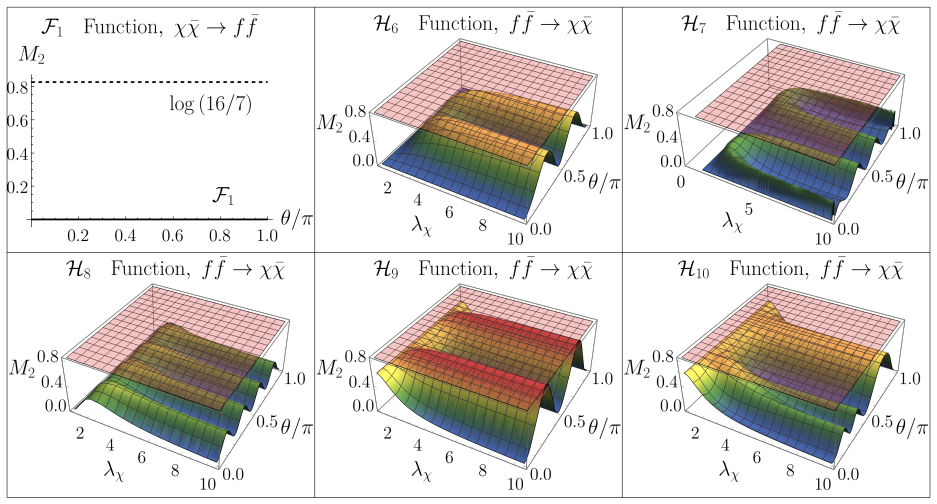
Magic distributions for scattering in a dark U(1) extension reach maximal value at SM-to-dark fermion mass ratios approaching 0 and 1.83929.
A machine-rendered reading of the paper's core claim, the machinery that carries it, and where it could break.
Core claim
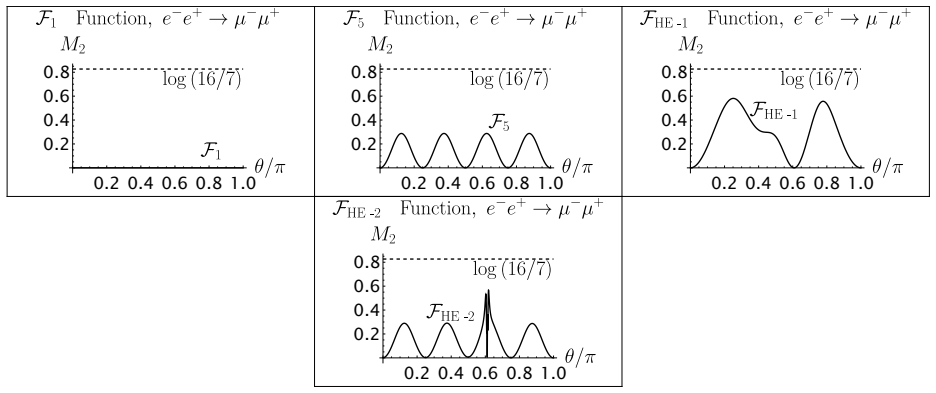
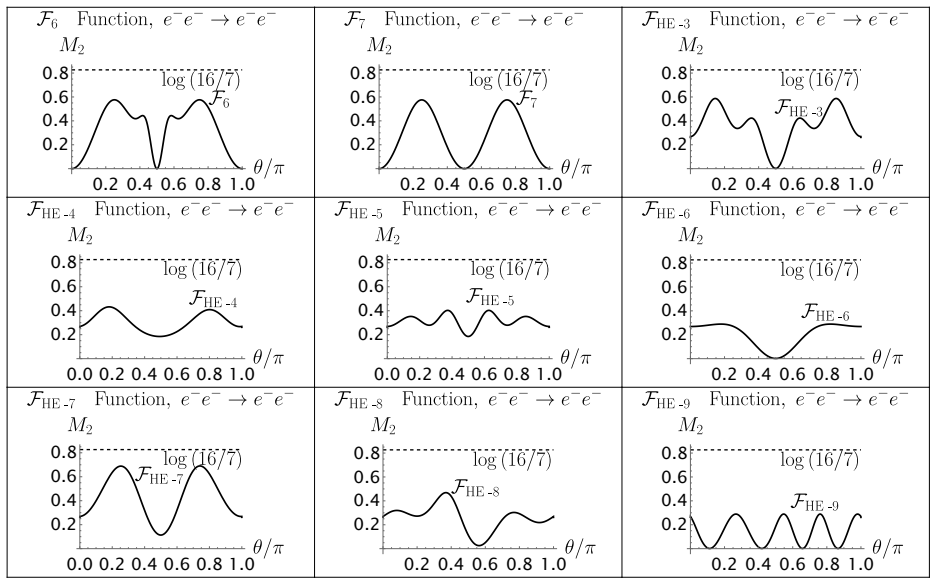
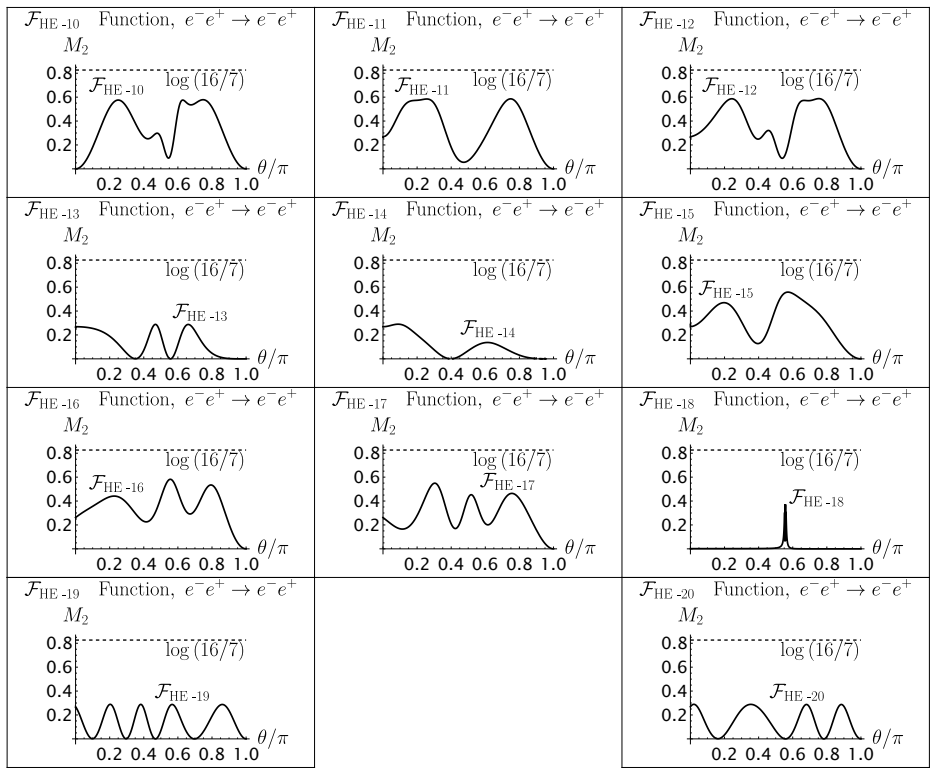
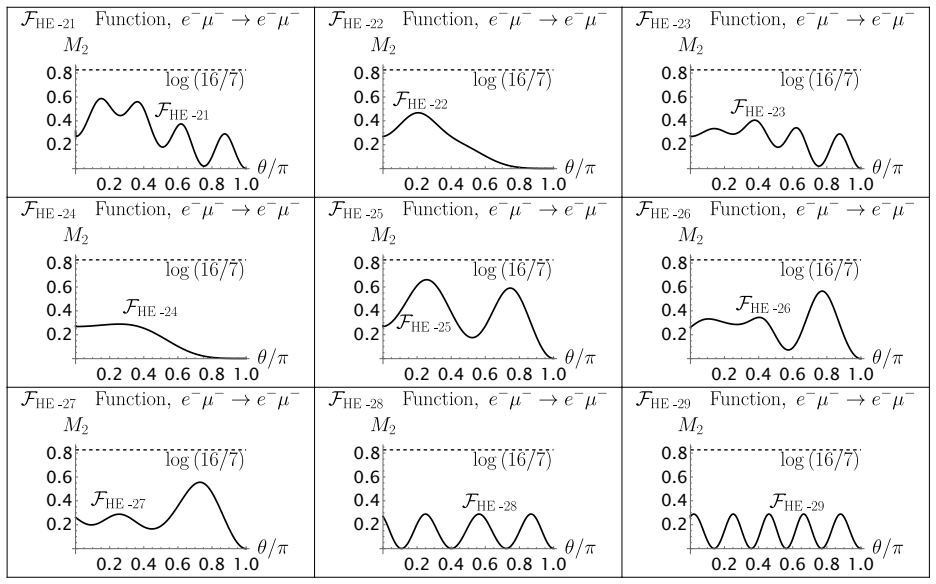
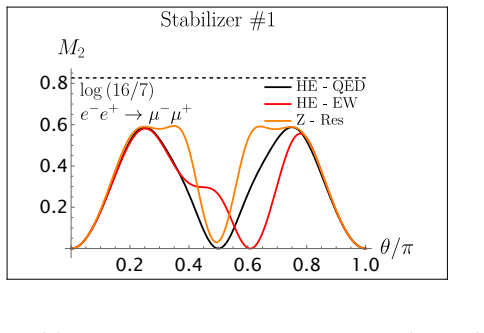
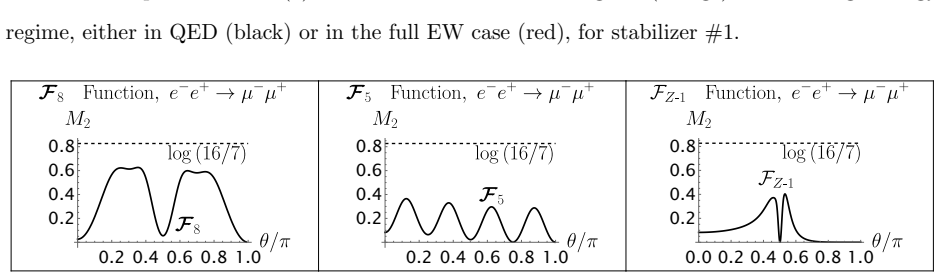
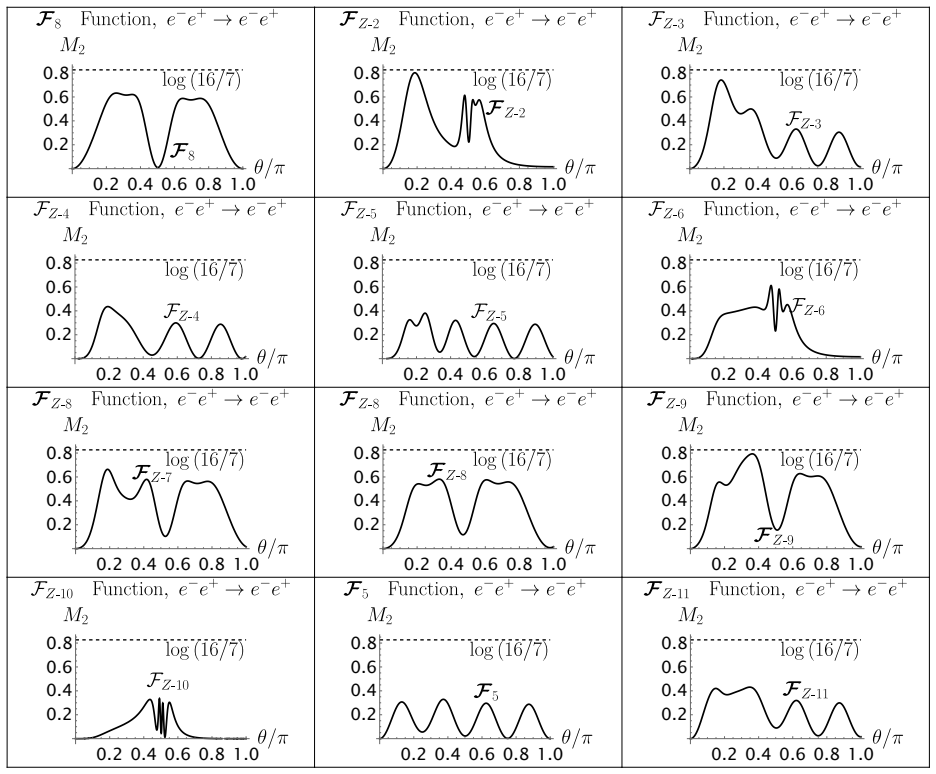
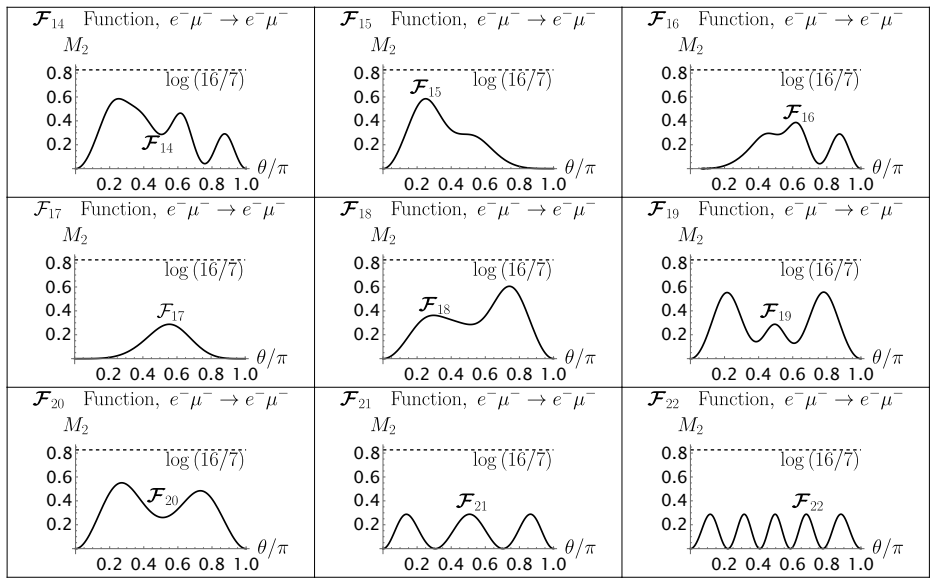
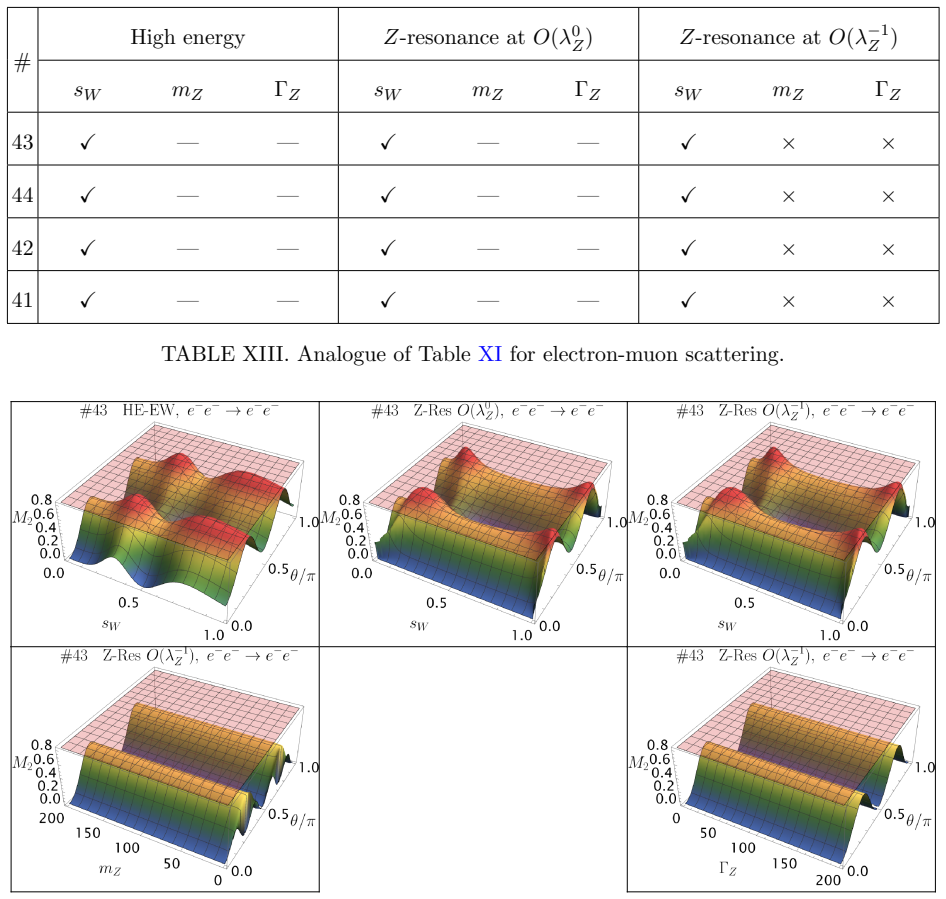
In the dark sector the low-energy effective theory produces new magic distribution functions for Moller-like, Bhabha-like, and inverse pair-annihilation processes that reach the maximal magic value at the SM-to-dark fermion mass ratios m_f/m_χ → 0 and m_f/m_χ → 1.83929; in the electroweak sector the Z boson introduces additional magic distributions at high energy and resonance while a subset of stabilizer states retain unchanged magic distributions across regimes.
What carries the argument
Magic distribution functions extracted from the scattering amplitudes of the chosen processes in the presence of the Z boson or the new dark gauge boson.
If this is right
- Bhabha scattering shows the strongest sensitivity to electroweak effects among the processes considered.
- A subset of fixed stabilizer states keep identical magic distributions in every energy regime examined.
- The massive mediator in the dark sector produces entirely new magic distribution functions for the three listed processes at low energy.
- Maximal magic is attained exactly at the two limiting mass ratios m_f/m_χ → 0 and m_f/m_χ → 1.83929.
Where Pith is reading between the lines
- The specific numerical value 1.83929 could serve as a benchmark ratio in other dark-sector models that incorporate quantum-resource measures.
- If the magic distributions can be connected to measurable asymmetries, collider data on Bhabha or Moller scattering might indirectly constrain the dark-fermion mass.
- The inverse pair-annihilation channel links the magic measure to the dark-matter annihilation rate, suggesting possible cross-checks between quantum-information quantities and relic-density calculations.
- The reorganization of stabilizer classes at the Z resonance may indicate energy-dependent transitions in the quantum-resource content of scattering final states.
Load-bearing premise
The low-energy effective description together with the selected scattering channels is enough to determine the magic distributions without higher-order corrections or extra channels altering the reported maxima.
What would settle it
An explicit computation of any of the reported magic distribution functions at a mass ratio near 1.83929 that returns a value strictly below the claimed maximum.
Figures




read the original abstract
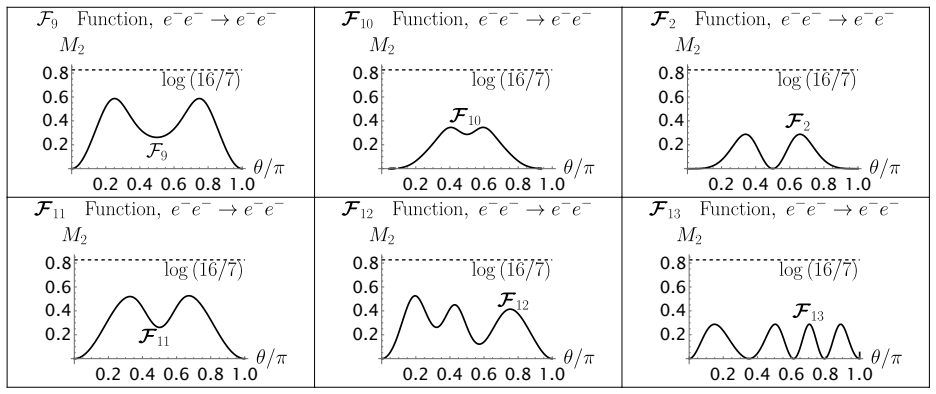
The production of magic states is studied in two settings. The first is the electroweak (EW) sector of the Standard Model (SM). The second is an extension featuring a new broken $U(1)$ gauge symmetry and a Dirac fermion charged under it. This setup resembles a dark $U(1)$ scenario, with the additional fermion playing the role of a dark matter candidate that annihilates into SM particles through its coupling to the new gauge boson. In the EW sector, the low-energy regime reproduces earlier magic production results obtained for Quantum Electrodynamics, whereas the high-energy and $Z$-resonance regimes generate new magic distribution functions and non-trivially reorganize the stabilizer state classes, with Bhabha scattering exhibiting the strongest sensitivity to electroweak effects. Also, a subset of fixed stabilizer states is identified, for which the magic distributions remain unchanged across the different energy regimes. In the dark sector, the main effect of the new massive mediator is the appearance of new magic distributions functions for Moller-like, Bhabha-like, and inverse pair-annihilation processes in the low-energy limit. These reach the maximal magic value at the SM-to-dark fermion mass ratios $m_f/m_\chi \to 0$ and $m_f/m_\chi\to 1.83929$.
Editorial analysis
A structured set of objections, weighed in public.
Referee Report
Summary. The manuscript examines magic-state production in electroweak scattering processes within the Standard Model and in a dark U(1) extension containing a Dirac fermion dark-matter candidate that annihilates via a new gauge boson. It asserts that the low-energy electroweak regime recovers prior QED results, that high-energy and Z-resonance regimes produce new magic distributions with Bhabha scattering most sensitive to electroweak corrections, that certain stabilizer states remain fixed across regimes, and that in the dark sector the new magic distributions for Moller-like, Bhabha-like, and inverse pair-annihilation channels attain their global maxima precisely at the mass ratios m_f/m_χ → 0 and m_f/m_χ → 1.83929.
Significance. If the reported extrema are shown to be robust, the work supplies concrete, falsifiable links between quantum-information measures of magic and calculable particle-physics amplitudes, including the first explicit dark-sector magic distributions and the identification of regime-independent stabilizer states. These results could motivate new observables in high-energy collisions or dark-matter searches.
major comments (2)
- [Abstract] Abstract: the central claim that the dark-sector magic distributions reach their maxima at m_f/m_χ → 1.83929 is stated without any derivation, analytic condition, or numerical procedure, rendering it impossible to verify whether the value is an extremum of the computed amplitudes or an artifact of the chosen low-energy effective theory.
- [Abstract] Abstract (dark-sector paragraph): the assertion that the listed channels suffice to extract the global maxima assumes that no additional diagrams, higher-order terms in the dark gauge coupling, or other annihilation channels alter the location or height of the reported extrema; no explicit stability check against such extensions is provided, yet this assumption is load-bearing for the quoted mass ratios.
minor comments (1)
- [Abstract] The abstract refers to “new magic distribution functions” without defining the precise functional form or the measure of magic employed; a brief statement of the definition used would improve readability.
Simulated Author's Rebuttal
We thank the referee for the careful reading and constructive comments. We respond point-by-point to the major comments on the abstract and indicate the revisions that will be incorporated.
read point-by-point responses
-
Referee: [Abstract] Abstract: the central claim that the dark-sector magic distributions reach their maxima at m_f/m_χ → 1.83929 is stated without any derivation, analytic condition, or numerical procedure, rendering it impossible to verify whether the value is an extremum of the computed amplitudes or an artifact of the chosen low-energy effective theory.
Authors: The value 1.83929 is the result of a numerical maximization of the magic distribution over the mass ratio m_f/m_χ performed on the low-energy amplitudes for the dark-sector channels; the procedure and the underlying expressions are given in the main text. We will revise the abstract to state that the reported maxima are obtained by numerical maximization of the computed distributions. revision: yes
-
Referee: [Abstract] Abstract (dark-sector paragraph): the assertion that the listed channels suffice to extract the global maxima assumes that no additional diagrams, higher-order terms in the dark gauge coupling, or other annihilation channels alter the location or height of the reported extrema; no explicit stability check against such extensions is provided, yet this assumption is load-bearing for the quoted mass ratios.
Authors: The quoted results are obtained at tree level within the low-energy effective theory of the stated dark U(1) model, using only the diagrams for the three listed channels. We will add an explicit statement clarifying the perturbative order and model assumptions under which the extrema are reported, together with a note that extensions lie outside the present scope. revision: yes
Circularity Check
No significant circularity detected
full rationale
The paper derives magic distribution functions from scattering amplitudes in the SM electroweak sector and a dark U(1) extension, then reports the mass ratios at which these functions attain their maxima (including the numerical value 1.83929). This is a direct computational outcome of the effective-theory matrix elements and the chosen magic measure, not a redefinition or fit renamed as a prediction. Prior QED results are reproduced as a consistency check rather than used as a load-bearing premise. No self-citation chains, ansatze smuggled via citation, or uniqueness theorems reduce the central claims to tautologies. The derivation chain is self-contained against the paper's own definitions and assumptions.
Axiom & Free-Parameter Ledger
axioms (2)
- domain assumption Magic state measures and stabilizer formalism can be directly applied to S-matrix elements of QFT scattering processes.
- domain assumption The dark U(1) extension with Dirac fermion is a valid effective theory below the new gauge boson mass.
invented entities (1)
-
Dark U(1) gauge boson (dark photon)
no independent evidence
Reference graph
Works this paper leans on
-
[1]
These shifts in θare listed in Table XXII
Once again, hatted functions areθ-shifts of their counterparts without a hat. These shifts in θare listed in Table XXII. VIII. DISCUSSION This work studied the production of magic states via 2→2 fermion tree-level scatter- ing processes mediated by neutral electroweak bosons (γ, Z) and a massive gauge boson (A′) under aU(1) dark symmetry, taking the fermi...
-
[2]
P. Benioff, The computer as a physical system: A microscopic quantum mechanical Hamilto- nian model of computers as represented by Turing machines, Journal of Statistical Physics22 (1980)
1980
-
[3]
R. P. Feynman, Quantum mechanical computers, Optics News11(1985)
1985
-
[4]
H.-L. Huang, D. Wu, D. Fan, and X. Zhu, Superconducting quantum computing: a review, Sci. China Inf. Sci.63, 10.1007/s11432-020-2881-9 (2020), arXiv:2006.10433 [quant-ph]
-
[5]
G. J. Milburn, Quantum optical Fredkin gate, Phys. Rev. Lett.62(1989)
1989
-
[6]
C. Monroe and J. Kim, Scaling the ion trap quantum processor, Science339, 10.1126/sci- ence.1231298 (2013)
-
[7]
Quantum Computing in the NISQ era and beyond
J. Preskill, Quantum computing in the NISQ era and beyond, Quantum2, 10.22331/q-2018- 08-06-79 (2018), arXiv:1801.00862 [quant-ph]
work page internal anchor Pith review Pith/arXiv arXiv doi:10.22331/q-2018- 2018
-
[8]
R. Acharyaet al., Quantum error correction below the surface code threshold, Nature638, 10.1038/s41586-024-08449-y (2025), arXiv:2503.16602 [hep-ph]
-
[9]
L. K. Grover, A fast quantum mechanical algorithm for database search, Proceedings of the Twenty-Eighth Annual ACM Symposium on Theory of Computing 10.1145/237814.237866 (1996), arXiv:quant-ph/9605043
-
[10]
P. W. Shor, Polynomial-time algorithms for prime factorization and discrete logarithms on a quantum computer, SIAM Journal on Computing26(1997), arXiv:quant-ph/9508027
work page internal anchor Pith review Pith/arXiv arXiv 1997
- [11]
- [12]
-
[13]
I. Fr´ erot, F. Baccari, and A. Ac´ ın, Unveiling quantum entanglement in many-body systems from partial information, PRX Quantum3, 10.1103/PRXQuantum.3.010342 (2022)
-
[14]
J. Kudler-Flam and G. Penington, It costs nothing to teleport information into a black hole, Int. J. Mod. Phys. D34, 10.1142/S0218271825430023 (2025), arXiv:2504.01058 [hep-th]
-
[15]
D. P. DiVincenzo, Two-bit gates are universal for quantum computation, Phys. Rev. A51 (1995), arXiv:cond-mat/9407022. 58
work page internal anchor Pith review Pith/arXiv arXiv 1995
-
[16]
D. Gottesman and I. L. Chuang, Demonstrating the viability of universal quantum com- putation using teleportation and single-qubit operations, Nature402(1999), arXiv:quant- ph/9908010
-
[17]
The Heisenberg Representation of Quantum Computers
D. Gottesman, The Heisenberg representation of quantum computers (1998), arXiv:quant- ph/9807006
-
[18]
Improved Simulation of Stabilizer Circuits
S. Aaronson and D. Gottesman, Improved simulation of stabilizer circuits, Phys. Rev. A70 (2004), arXiv:quant-ph/0406196
work page internal anchor Pith review Pith/arXiv arXiv 2004
-
[19]
Universal quantum computation with ideal Clifford gates and noisy ancillas,
S. Bravyi and A. Kitaev, Universal quantum computation with ideal Clifford gates and noisy ancillas, Phys. Rev. A71(2005), arXiv:quant-ph/0403025
-
[20]
P. Sales Rodriguez, J. M. Robinson, and P. N. e. a. Jepsen, Experimental demonstration of logi- cal magic state distillation, Nature645, 10.1038/s41586-025-09367-3 (2025), arXiv:2412.15165 [quant-ph]
- [21]
-
[22]
Y. Afiket al., Quantum information meets high-energy physics: input to the update of the european strategy for particle physics, The European Physical Journal Plus140, 10.1140/epjp/s13360-025-06752-9 (2025), arXiv:2504.00086 [hep-ph]
- [23]
-
[24]
Y.-J. Fang, A. Bhoonah, K. Cheng, T. Han, Y. Liu, and H. Zhang, Spin correlation and quantum entanglement of fermion pairs in transversely polarizede −e+ collisions (2026), arXiv:2604.11887 [hep-ph]
work page internal anchor Pith review Pith/arXiv arXiv 2026
-
[25]
Entanglement of a Pair of Quantum Bits
S. Hill and W. K. Wootters, Entanglement of a pair of quantum bits, Phys. Rev. Lett.78, 10.1103/PhysRevLett.78.5022 (1997), arXiv:quant-ph/9703041
work page internal anchor Pith review Pith/arXiv arXiv doi:10.1103/physrevlett.78.5022 1997
- [26]
-
[27]
J. Gargalionis, N. Moynihan, S. Trifinopoulos, E. N. V. Wallace, C. D. White, and M. J. White, Spin versus nonstabilizerness in gluon and graviton scattering, Phys. Rev. D113 (2026), arXiv:2603.04148 [hep-th]. 59
- [28]
-
[29]
C. E. P. Robin and M. J. Savage, Quantum complexity fluctuations from nuclear and hyper- nuclear forces, Phys. Rev. C112, 10.1103/r8rq-y9tb (2025), arXiv:2405.10268
-
[30]
Q. Liu, I. Low, and Z. Yin, Quantum magic in quantum electrodynamics, Phys. Rev. D113, 10.1103/l8vw-kwhz (2025), arXiv:2503.03098 [quant-ph]
- [31]
- [32]
-
[33]
Navaset al.(Particle Data Group), Review of particle physics, Phys
S. Navaset al.(Particle Data Group), Review of particle physics, Phys. Rev. D110, 10.1103/PhysRevD.110.030001 (2024)
-
[34]
R. Aaijet al.(LHCb), Measurement of the forward-backward asymmetry inz/γ ∗ →µ +µ− decays and determination of the effective weak mixing angle, JHEP11, arXiv:1509.07645 [hep-ex]
work page internal anchor Pith review Pith/arXiv arXiv
-
[35]
Precision Measurement of the Weak Mixing Angle in Moller Scattering
P. Anthonyet al., Precision measurement of the weak mixing angle in Moller scattering, Phys. Rev. Lett.95, 10.1103/PhysRevLett.95.081601 (2005), arXiv:hep-ex/0504049
work page internal anchor Pith review Pith/arXiv arXiv doi:10.1103/physrevlett.95.081601 2005
- [36]
-
[37]
T. Coudarchet, A. Hebecker, J. Jaeckel, and J. Steiner, The string theory photoverse, JHEP 04, arXiv:2510.12874 [hep-th]
work page internal anchor Pith review Pith/arXiv arXiv
-
[38]
T. Gherghetta, J. Kersten, K. Olive, and M. Pospelov, Evaluating the price of tiny kinetic mixing, Physical Review D100(2019), arXiv:1909.00696 [hep-ph]
-
[39]
swap test and hong-ou-mandel effect are equiv- alent,
T. Hambye, M. H. G. Tytgat, J. Vandecasteele, and L. Vanderheyden, Dark matter from dark photons: a taxonomy of dark matter production, Phys. Rev. D100, 10.1103/Phys- RevD.100.095018 (2019), arXiv:1908.09864 [hep-ph]
-
[40]
P. Braat and M. Postma, SIMPly add a dark photon, JHEP03, 216, arXiv:2301.04513 [hep- ph]
-
[41]
Phenomenology of ELDER Dark Matter
E. Kuflik, M. Perelstein, N. R.-L. Lorier, and Y.-D. Tsai, Phenomenology of ELDER dark matter, JHEP08, arXiv:1706.05381 [hep-ph]. 60
work page internal anchor Pith review Pith/arXiv arXiv
- [42]
-
[43]
M. Fabbrichesi, E. Gabrielli, and G. Lanfranchi,The Physics of the Dark Photon: A Primer (Springer International Publishing, 2021) arXiv:2005.01515 [hep-ph]. 61
work page internal anchor Pith review Pith/arXiv arXiv 2021
discussion (0)
Sign in with ORCID, Apple, or X to comment. Anyone can read and Pith papers without signing in.