Neutrino helicity oscillations in astrophysical environments: a many-body approach
Pith reviewed 2026-06-28 21:57 UTC · model grok-4.3
The pith
Full many-body calculations of neutrino helicity oscillations in dense environments produce spin-flip rates orders of magnitude above mean-field predictions.
A machine-rendered reading of the paper's core claim, the machinery that carries it, and where it could break.
Core claim
In neutrino-dense environments, a full many-body calculation of helicity conversion leads to spin-flip probabilities that exceed by orders of magnitude those from mean-field treatments, with the enhancement tied to many-body momentum exchange in configurations with few neutrinos in well-defined momentum states.
What carries the argument
Many-body momentum exchange enabling helicity conversion beyond forward-scattering processes.
If this is right
- Spin-flip probabilities in neutrino-dense environments exceed mean-field results by orders of magnitude.
- The helicity conversion enhancement arises from many-body momentum exchange not included in forward-only calculations.
- Such effects would be missed in standard mean-field treatments of neutrino evolution.
- The calculation applies to simple few-neutrino configurations with defined momenta, with speculated astrophysical implications.
Where Pith is reading between the lines
- If the enhancement scales to continuous spectra, it could alter neutrino flavor and helicity evolution in core-collapse supernovae.
- Extensions to include continuous momentum distributions would test the robustness of the observed effect.
- The result suggests that collective neutrino interactions in dense media require treatments beyond standard approximations for accurate rate estimates.
Load-bearing premise
The spin-flip enhancement found in small systems with discrete momenta will persist or scale when applied to continuous momentum distributions and higher densities in real astrophysical settings.
What would settle it
A many-body calculation or simulation for a system with continuous neutrino momentum distribution at astrophysical densities that shows whether the spin-flip probability matches the enhanced many-body result or reverts to mean-field levels.
Figures






read the original abstract
Neutrino rest mass enables left-handed states to "flip" to right-handed states and vice versa. In-medium effects can enhance the probability for such spin-flip. We demonstrate that a full many-body calculation of this process in neutrino-dense environments can lead to spin-flip probabilities that exceed by orders of magnitude those calculated with mean-field treatments. We study simple configurations with a few neutrinos in well-defined momentum states, for which we show that the helicity conversion enhancement is connected to many-body momentum exchange. Such an effect would therefore be missed in a calculation that considers only forward processes. We speculate on the potential astrophysical implications of these results and the range of applicability of our calculation and its limitations.
Editorial analysis
A structured set of objections, weighed in public.
Referee Report
Summary. The paper claims that neutrino rest mass enables helicity flips whose probability in dense environments is strongly enhanced by many-body effects relative to mean-field treatments. Using explicit calculations on small-N systems with discrete, fixed momenta, the authors attribute the enhancement to non-forward momentum-exchange processes that are absent from forward-only approximations. They speculate that the effect may have important consequences for astrophysical neutrino evolution but note limitations in applicability.
Significance. If the reported many-body enhancement survives integration over continuous momentum spectra, realistic number densities, and backgrounds, the result would imply that mean-field treatments systematically underestimate spin-flip rates in supernovae and the early universe, potentially affecting neutrino spectra, nucleosynthesis yields, and flavor evolution. The manuscript supplies no scaling argument or numerical test that establishes this survival, so the astrophysical significance remains conditional on an unverified extrapolation.
major comments (1)
- [Abstract and discussion of applicability] The central astrophysical claim (orders-of-magnitude enhancement in neutrino-dense environments) rests on calculations performed only for few-neutrino systems with sharply defined individual momenta. No derivation, scaling relation, or numerical demonstration is given showing that the non-forward momentum-exchange contribution survives (i) integration over a continuous momentum distribution, (ii) the much higher densities of supernovae or the early universe, or (iii) the presence of a dense electron/positron background that modifies the forward scattering kernel.
Simulated Author's Rebuttal
We thank the referee for the careful and constructive review. The referee correctly notes that our explicit calculations are restricted to small-N systems with discrete, fixed momenta. We agree that this limits direct applicability to realistic astrophysical conditions and that the manuscript does not contain a scaling relation or numerical demonstration of survival under continuous spectra, supernova densities, or electron backgrounds. Our response below addresses this point, and we propose a partial revision to the discussion section.
read point-by-point responses
-
Referee: The central astrophysical claim (orders-of-magnitude enhancement in neutrino-dense environments) rests on calculations performed only for few-neutrino systems with sharply defined individual momenta. No derivation, scaling relation, or numerical demonstration is given showing that the non-forward momentum-exchange contribution survives (i) integration over a continuous momentum distribution, (ii) the much higher densities of supernovae or the early universe, or (iii) the presence of a dense electron/positron background that modifies the forward scattering kernel.
Authors: We agree that the calculations are performed only for few-neutrino systems with discrete momenta, as stated in the abstract and throughout the text. The reported enhancement is explicitly tied to non-forward momentum-exchange processes that are absent from forward-only mean-field treatments. No derivation, scaling relation, or numerical test for survival under continuous momentum distributions, realistic supernova or early-universe densities, or electron/positron backgrounds is provided, because such an analysis would require a substantially different computational framework (e.g., continuum limits or effective large-N descriptions) that lies outside the scope of the present work. The manuscript already qualifies the astrophysical implications as speculative and notes the limitations of the model. We will revise the discussion section to state more explicitly that whether the many-body enhancement persists under the three conditions listed remains an open question for future study. revision: partial
Circularity Check
No circularity; numerical results for discrete few-body cases with explicit speculation on continuum applicability
full rationale
The manuscript reports explicit many-body calculations only for small-N systems with fixed discrete momenta, where non-forward scattering produces the reported helicity conversion enhancement. No derivation chain, fitted parameters, or self-citation is invoked to extend this to continuous spectra or supernova densities; the astrophysical claim is labeled as speculation. Because no load-bearing step reduces by construction to an input or prior self-citation, and the central numerical result is independent of the speculative extrapolation, the paper is self-contained against external benchmarks.
Axiom & Free-Parameter Ledger
Forward citations
Cited by 1 Pith paper
-
Collective neutrino oscillations: Many-body non-forward effects and non-classicality
In a neutrino-gas model, the many-body Hamiltonian yields different evolution timescales and asymptotics than the quantum kinetic approach with collisions, while quantum resources for the full case sit at the low end ...
Reference graph
Works this paper leans on
-
[1]
The fields are written ν(x) = X p X h=± 1p 2V Ep ah(p)uh(p)eip·x +b † h(p)vh(p)e−ip·x ,(4) with the expressions of the helicity spinors defined in Ap- pendix A, Sec. A 2. The above creation and annihilation operators for left- and right-handed occupation obey the nonzero anticommutation rules n ah(p), a† h′(p′) o = n bh(p), b† h′(p′) o =δ hh′δp,p′ .(5) Ex...
-
[2]
forward” and “exchange
Occupation numbers In the following, we will be particularly interested in the one-body observables describing the amount of right- handed neutrinos. The generalized occupation num- bers are the combinations⟨a † h′(p ′)ah(p)⟩. The initial states we will consider will be product states|Ψ(0)⟩= a† ... · · ·a † ... |0⟩, which are eigenvectors of N = L andP. T...
-
[3]
As a conse- quence of these expressions, if a momentum binpis not initially occupied, its density matrix remainsρ(p, t) = 0 for all times
Simplifications of the mean-field potential The solution to the mean-field equation is formally ρ(p, t) =U(p, t)ρ(p,0)U †(p, t),(29) with U(p, t) =Texp −i Z t 0 dτΓ(p, τ) ,(30) whereTdenotes a time ordering operator. As a conse- quence of these expressions, if a momentum binpis not initially occupied, its density matrix remainsρ(p, t) = 0 for all times. S...
-
[4]
trun- cated Hamiltonian
Two-dimensional systems In Sec. III, we will focus on two-dimensional systems withp z = 0, such thatθ p =π/2 for allp. It is then 2 To make the connection explicit, we recall that in our expressions µ=G F /( √ 2V); for one flavor the trace terms in Ref. [61] simply double the result; and the complex vectorϵ ∗ q appearing in their Eq. (114) reads ˆqθ +iˆqϕ...
-
[5]
quantization volume
Momentum configuration For computational purposes, we introduce some di- mensionless quantities: time will be measured in units oft 0 ≡µ −1; and the unit of energy isp 0 = 2π/L. We define ˜t≡ t t0 ,(39) and recall thatn=p/p 0 is a vector of integers; see Eq. (3). In order to use realistic values, we takep 0 ≈ 1 MeV. The “quantization volume” is then V=L 3...
-
[6]
unper- turbed Hamiltonian
Kinetic energy conservation In the interaction Hamiltonian (8), the only conserva- tion law that explicitly appears is that of spatial momen- tump 1 +p 2 =p 3 +p 4. There is no a priori pairwise kinetic energy conservation,|p 1|+|p 2|=|p 3|+|p 4|. Such an additional conservation law appears in the for- ward limit, where it is a simple consequence of the e...
-
[7]
beam-like
Resolution strategy In the next section, we will compare the results ob- tained for the mean-field [Eq. (26)], as well as the trun- cated and the full many-body calculations [Eq. (41)]. We always consider pure Hartree-Fock states as initial conditions: |Ψ(0)⟩=|Ψ 0⟩= Y i∈S0 a† hi (pi)|0⟩,(46) withS 0 the set of initially occupied one-body states. This corr...
-
[8]
background
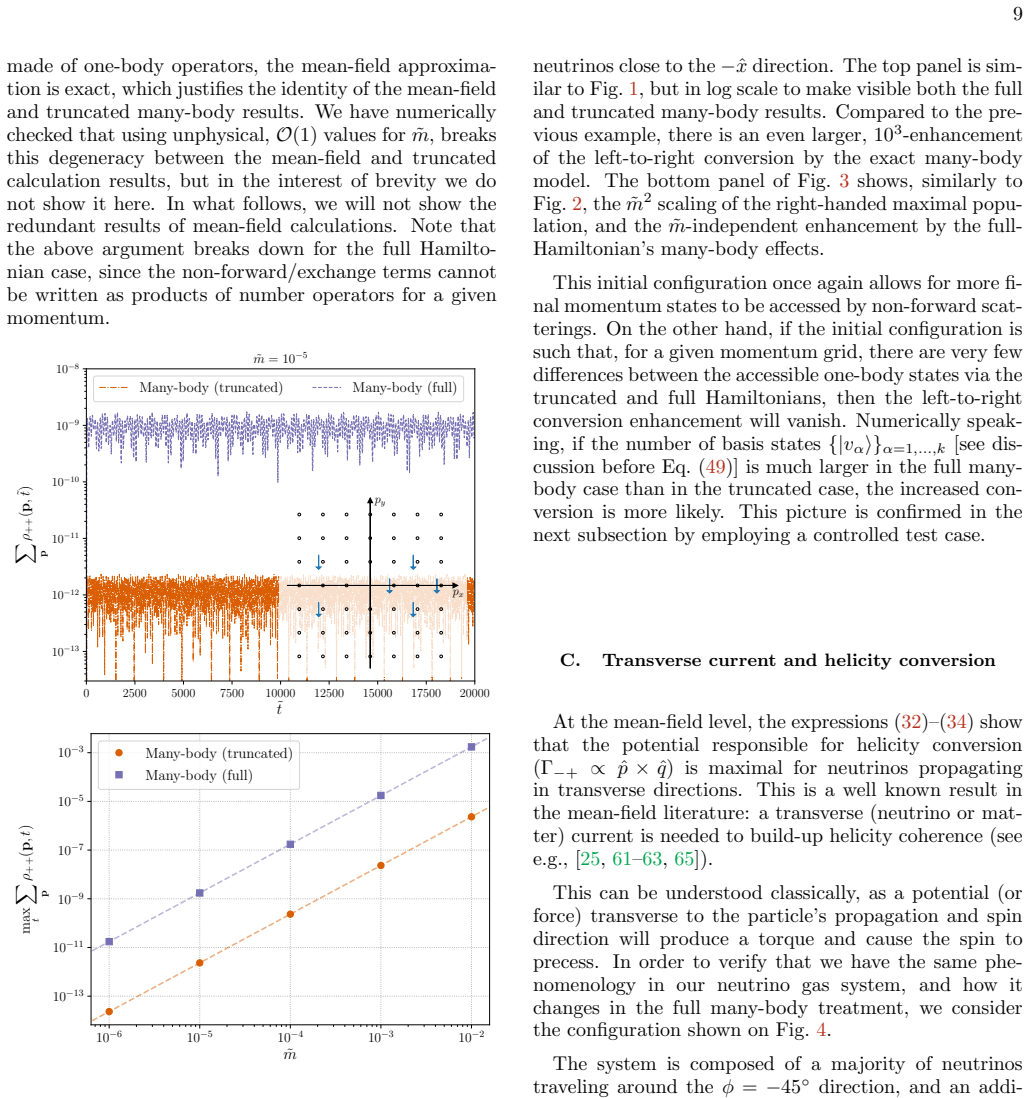
Mean-field behavior Let us focus on the density matrix describing thep ′ momentum bin, first in the mean-field scenario. We can make several simplifying assumptions: given the very small amount of helicity transformation (sup- pressed by ˜m2), we can takeρ −− to be constant in time, equal to 1 for initially occupied momentum states, and 0 otherwise. As a ...
-
[9]
Accessible momentum states and helicity conversion This example sheds light on the mechanisms behind the increased spin flip observed when using the full Hamiltonian. We have argued previously that, since the general Hamiltonian allows for the population of new mo- mentum states, these extra possibilities create new con- version channels and hence, more r...
2000
-
[10]
(66) is of order ˜m 0
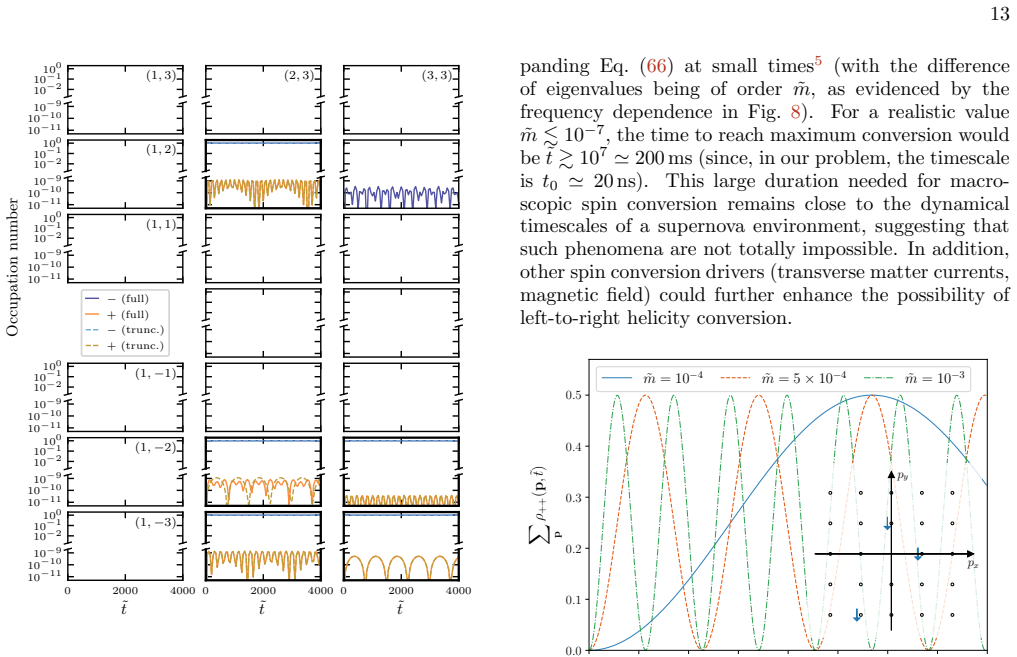
Full equipartition case We first identify an “extreme” case where the ampli- tude|R µν|appearing in Eq. (66) is of order ˜m 0. The total occupation number of right-handed states for the full many-body calculations is shown in Fig. 8, where we compare this quantity for different values of the mass parameter. The amplitude of the large oscillations is in- d...
-
[11]
Mass-independent frequency case In Fig. 11, we show two cases, with respectively 4 and 6 neutrinos, where it is now the frequency of oscillations that is mass-independent, but the amplitude of conver- sion scales as ˜m2. To highlight these two points, we use a logarithmic scale. 0 2000 4000 6000 8000 10000 12000 14000 16000 ˜t 10−15 10−13 10−11 10−9 10−7 ...
-
[12]
Neutrino Hamiltonian We start by rigorously deriving the expression of the neutrino Hamiltonian. The goal is to provide a self- contained bridge between the four-fermion Lagrangian, the interaction-picture field expansion in a finite vol- ume, and the operator structures that appear in the spin/helicity-resolved Hamiltonians used in our numer- ical many-b...
-
[13]
accessible
Spinor conventions a. Gamma matrices and two-component helicity spinors We use the chiral/Weyl representation of the Dirac ma- trices, γ0 = 0I 2 I2 0 ,γ= 0σ −σ0 , γ5 ≡iγ 0γ1γ2γ3 = −I2 0 0I 2 , (A13) whereσ= (σ 1, σ2, σ3) is the vector of Pauli matrices, andI 2 is the 2×2 identity. For any momentum direction ˆp≡p/p, the two- component helicity eigenspinors...
-
[14]
Explosion Mechanisms of Core- Collapse Supernovae,
Hans-Thomas Janka, “Explosion Mechanisms of Core- Collapse Supernovae,” Ann. Rev. Nucl. Part. Sci.62, 407–451 (2012), arXiv:1206.2503 [astro-ph.SR]
Pith/arXiv arXiv 2012
-
[15]
Anthony Mezzacappa, Eirik Endeve, O. E. Bron- son Messer, and Stephen W. Bruenn, “Physical, nu- merical, and computational challenges of modeling neu- trino transport in core-collapse supernovae,” Liv. Rev. Comput. Astrophys.6, 4 (2020), arXiv:2010.09013 [astro- ph.HE]
arXiv 2020
-
[16]
Core-Collapse Supernova Explosion Theory,
Adam Burrows and David Vartanyan, “Core-Collapse Supernova Explosion Theory,” Nature589, 29–39 (2021), arXiv:2009.14157 [astro-ph.SR]
arXiv 2021
-
[17]
The Dynamics of Binary Neutron Star Mergers and GW170817,
David Radice, Sebastiano Bernuzzi, and Albino Perego, “The Dynamics of Binary Neutron Star Mergers and GW170817,” Ann. Rev. Nucl. Part. Sci.70, 95–119 (2020), arXiv:2002.03863 [astro-ph.HE]
arXiv 2020
-
[18]
Neutrino transport in general rela- tivistic neutron star merger simulations,
Francois Foucart, “Neutrino transport in general rela- tivistic neutron star merger simulations,” Liv. Rev. Com- put. Astrophys.9, 1 (2023), arXiv:2209.02538 [astro- ph.HE]
arXiv 2023
-
[19]
Synthesis of the elements in stars,
Margaret E. Burbidge, G. R. Burbidge, William A. Fowler, and F. Hoyle, “Synthesis of the elements in stars,” Rev. Mod. Phys.29, 547–650 (1957)
1957
-
[20]
Nuclear Reactions in Stars and Nu- cleogenesis,
A. G. W. Cameron, “Nuclear Reactions in Stars and Nu- cleogenesis,” Publications of the ASP69, 201 (1957)
1957
-
[21]
Theα-process and ther-process,
S. E. Woosley and Robert D. Hoffman, “Theα-process and ther-process,” Astrophys. J.395, 202–239 (1992)
1992
-
[22]
Ther-,s-, andp-processes in nucleosynthe- sis,
B. S. Meyer, “Ther-,s-, andp-processes in nucleosynthe- sis,” Ann. Rev. Astron. Astrophys.32, 153–190 (1994)
1994
-
[23]
Production of the Lightp-Process Nuclei in Neutrino-driven Winds,
R. D. Hoffman, S. E. Woosley, G. M. Fuller, and B. S. Meyer, “Production of the Lightp-Process Nuclei in Neutrino-driven Winds,” Astrophys. J.460, 478 (1996)
1996
-
[24]
Neutrino-induced nucleosynthesis of A> 64 nuclei: theνp-process,
C. Fr¨ ohlich, G. Mart´ ınez-Pinedo, M. Liebend¨ orfer, F.-K. Thielemann, E. Bravo, W. R. Hix, K. Langanke, and 20 N. T. Zinner, “Neutrino-induced nucleosynthesis of A> 64 nuclei: theνp-process,” Phys. Rev. Lett.96, 142502 (2006), arXiv:astro-ph/0511376
Pith/arXiv arXiv 2006
-
[25]
Nucleosynthesis in Early Super- nova Winds. II. The Role of Neutrinos,
Jason Pruet, R. D. Hoffman, S. E. Woosley, H. T. Janka, and R. Buras, “Nucleosynthesis in Early Super- nova Winds. II. The Role of Neutrinos,” Astrophys. J. 644, 1028–1039 (2006), arXiv:astro-ph/0511194
Pith/arXiv arXiv 2006
-
[26]
Therp-process in neutrino-driven winds,
Shinya Wanajo, “Therp-process in neutrino-driven winds,” Astrophys. J.647, 1323–1340 (2006), arXiv:astro-ph/0602488
Pith/arXiv arXiv 2006
-
[27]
Neutrinos and nucleosynthesis of elements,
Tobias Fischer, Gang Guo, Karlheinz Langanke, Gabriel Mart´ ınez-Pinedo, Yong-Zhong Qian, and Meng-Ru Wu, “Neutrinos and nucleosynthesis of elements,” Prog. Part. Nucl. Phys.137, 104107 (2024), arXiv:2308.03962 [astro- ph.HE]
arXiv 2024
-
[28]
Neutrinos and Heavy Element Nucleosynthesis,
Xilu Wang and Rebecca Surman, “Neutrinos and Heavy Element Nucleosynthesis,” inHandbook of Nu- clear Physics, edited by Isao Tanihata, Hiroshi Toki, and Toshitaka Kajino (Springer Nature Singapore, Singapore,
- [29]
-
[30]
Collective Neutrino Oscillations,
Huaiyu Duan, George M. Fuller, and Yong-Zhong Qian, “Collective Neutrino Oscillations,” Ann. Rev. Nucl. Part. Sci.60, 569–594 (2010), arXiv:1001.2799 [hep-ph]
Pith/arXiv arXiv 2010
-
[31]
Collective neutrino flavor conver- sion: Recent developments,
Sovan Chakraborty, Rasmus Hansen, Ignacio Izaguirre, and Georg Raffelt, “Collective neutrino flavor conver- sion: Recent developments,” Nucl. Phys. B908, 366–381 (2016), arXiv:1602.02766 [hep-ph]
Pith/arXiv arXiv 2016
-
[32]
New Devel- opments in Flavor Evolution of a Dense Neutrino Gas,
Irene Tamborra and Shashank Shalgar, “New Devel- opments in Flavor Evolution of a Dense Neutrino Gas,” Ann. Rev. Nucl. Part. Sci.71, 165–188 (2021), arXiv:2011.01948 [astro-ph.HE]
arXiv 2021
-
[33]
Sherwood Richers and Manibrata Sen, “Fast Flavor Transformations,” inHandbook of Nuclear Physics, edited by Isao Tanihata, Hiroshi Toki, and Toshitaka Kajino (2022) pp. 1–17, arXiv:2207.03561 [astro-ph.HE]
arXiv 2022
-
[34]
M. Cristina Volpe, “Neutrinos from dense environments: Flavor mechanisms, theoretical approaches, observations, and new directions,” Rev. Mod. Phys.96, 025004 (2024), arXiv:2301.11814 [hep-ph]
arXiv 2024
-
[35]
Neutrino Oscillations in Core-Collapse Supernovae and Neutron Star Mergers,
Lucas Johns, Sherwood Richers, and Meng-Ru Wu, “Neutrino Oscillations in Core-Collapse Supernovae and Neutron Star Mergers,” Ann. Rev. Nucl. Part. Sci.75, 399–423 (2025), arXiv:2503.05959 [astro-ph.HE]
arXiv 2025
-
[36]
Neutrino oscillations at high densi- ties,
James Pantaleone, “Neutrino oscillations at high densi- ties,” Phys. Lett. B287, 128–132 (1992)
1992
-
[37]
General kinetic description of relativistic mixed neutrinos,
G. Sigl and G. Raffelt, “General kinetic description of relativistic mixed neutrinos,” Nucl. Phys. B406, 423– 451 (1993)
1993
-
[38]
Cristina Volpe, Daavid V¨ a¨ an¨ anen, and Catalina Es- pinoza, “Extended evolution equations for neutrino prop- agation in astrophysical and cosmological environments,” Phys. Rev. D87, 113010 (2013), arXiv:1302.2374 [hep- ph]
Pith/arXiv arXiv 2013
-
[39]
Alexey Vlasenko, George M. Fuller, and Vincenzo Cirigliano, “Neutrino Quantum Kinetics,” Phys. Rev. D 89, 105004 (2014), arXiv:1309.2628 [hep-ph]
Pith/arXiv arXiv 2014
-
[40]
Neutrino Quantum Kinetic Equations: The Collision Term,
Daniel N. Blaschke and Vincenzo Cirigliano, “Neutrino Quantum Kinetic Equations: The Collision Term,” Phys. Rev. D94, 033009 (2016), arXiv:1605.09383 [hep-ph]
Pith/arXiv arXiv 2016
-
[41]
Neutrino Quantum Ki- netics in Compact Objects,
Sherwood A. Richers, Gail C. McLaughlin, James P. Kneller, and Alexey Vlasenko, “Neutrino Quantum Ki- netics in Compact Objects,” Phys. Rev. D99, 123014 (2019), [Erratum: Phys.Rev.D 109, 129902 (2024)], arXiv:1903.00022 [astro-ph.HE]
arXiv 2019
-
[42]
Neutrino decoupling including flavour oscilla- tions and primordial nucleosynthesis,
Julien Froustey, Cyril Pitrou, and Maria Cristina Volpe, “Neutrino decoupling including flavour oscilla- tions and primordial nucleosynthesis,” JCAP12, 015 (2020), arXiv:2008.01074 [hep-ph]
arXiv 2020
-
[43]
Speedup through Entanglement: Many Body Effects in Neutrino Processes,
Nicole F. Bell, Andrew A. Rawlinson, and R. F. Sawyer, “Speedup through Entanglement: Many Body Effects in Neutrino Processes,” Phys. Lett. B573, 86–93 (2003), arXiv:hep-ph/0304082
Pith/arXiv arXiv 2003
-
[45]
Exact solution of multiangle quantum many-body collective neutrino-flavor oscillations,
Ermal Rrapaj, “Exact solution of multiangle quantum many-body collective neutrino-flavor oscillations,” Phys. Rev. C101, 065805 (2020), arXiv:1905.13335 [hep-ph]
arXiv 2020
-
[46]
Entanglement and collective flavor oscillations in a dense neutrino gas,
Michael J. Cervia, Amol V. Patwardhan, A. B. Bal- antekin, S. N. Coppersmith, and Calvin W. John- son, “Entanglement and collective flavor oscillations in a dense neutrino gas,” Phys. Rev. D100, 083001 (2019), arXiv:1908.03511 [hep-ph]
arXiv 2019
-
[47]
Entanglement and many-body ef- fects in collective neutrino oscillations,
Alessandro Roggero, “Entanglement and many-body ef- fects in collective neutrino oscillations,” Phys. Rev. D 104, 103016 (2021), arXiv:2102.10188 [hep-ph]
arXiv 2021
-
[48]
Spectral splits and entanglement entropy in col- lective neutrino oscillations,
Amol V. Patwardhan, Michael J. Cervia, and A. B. Bal- antekin, “Spectral splits and entanglement entropy in col- lective neutrino oscillations,” Phys. Rev. D104, 123035 (2021), arXiv:2109.08995 [hep-ph]
arXiv 2021
-
[49]
Many-body effects of collective neu- trino oscillations,
Zewei Xiong, “Many-body effects of collective neu- trino oscillations,” Phys. Rev. D105, 103002 (2022), arXiv:2111.00437 [astro-ph.HE]
arXiv 2022
-
[50]
Classical and quantum evolution in a simple coherent neutrino problem,
Joshua D. Martin, A. Roggero, Huaiyu Duan, J. Carlson, and V. Cirigliano, “Classical and quantum evolution in a simple coherent neutrino problem,” Phys. Rev. D105, 083020 (2022), arXiv:2112.12686 [hep-ph]
arXiv 2022
-
[51]
Collective neutrino oscillations with tensor networks using a time-dependent variational principle,
Michael J. Cervia, Pooja Siwach, Amol V. Patwardhan, A. B. Balantekin, S. N. Coppersmith, and Calvin W. Johnson, “Collective neutrino oscillations with tensor networks using a time-dependent variational principle,” Phys. Rev. D105, 123025 (2022), arXiv:2202.01865 [hep- ph]
arXiv 2022
-
[52]
Role of non-Gaussian quantum fluctuations in neutrino entanglement,
Denis Lacroix, A. B. Balantekin, Michael J. Cervia, Amol V. Patwardhan, and Pooja Siwach, “Role of non-Gaussian quantum fluctuations in neutrino entanglement,” Phys. Rev. D106, 123006 (2022), arXiv:2205.09384 [nucl-th]
arXiv 2022
-
[53]
Trapped-ion quantum simulation of collective neutrino oscillations,
Valentina Amitrano, Alessandro Roggero, Piero Luchi, Francesco Turro, Luca Vespucci, and Francesco Ped- eriva, “Trapped-ion quantum simulation of collective neutrino oscillations,” Phys. Rev. D107, 023007 (2023), arXiv:2207.03189 [quant-ph]
arXiv 2023
-
[54]
Multi-Neutrino Entan- glement and Correlations in Dense Neutrino Systems,
Marc Illa and Martin J. Savage, “Multi-Neutrino Entan- glement and Correlations in Dense Neutrino Systems,” Phys. Rev. Lett.130, 221003 (2023), arXiv:2210.08656 [nucl-th]
arXiv 2023
-
[55]
Equilibration of quantum many-body fast neutrino flavor oscillations,
Joshua D. Martin, Duff Neill, A. Roggero, Huaiyu Duan, and J. Carlson, “Equilibration of quantum many-body fast neutrino flavor oscillations,” Phys. Rev. D108, 123010 (2023), arXiv:2307.16793 [hep-ph]
arXiv 2023
-
[56]
Qutrit and qubit circuits for three- flavor collective neutrino oscillations,
Francesco Turro, Ivan A. Chernyshev, Ramya Bhaskar, and Marc Illa, “Qutrit and qubit circuits for three- flavor collective neutrino oscillations,” Phys. Rev. D111, 043038 (2025), arXiv:2407.13914 [quant-ph]
arXiv 2025
-
[57]
Quantum magic and computational complexity 21 in the neutrino sector,
Ivan Chernyshev, Caroline E. P. Robin, and Martin J. Savage, “Quantum magic and computational complexity 21 in the neutrino sector,” Phys. Rev. Res.7, 023228 (2025), arXiv:2411.04203 [quant-ph]
arXiv 2025
-
[58]
Pooja Siwach, A. Baha Balantekin, Amol V. Patward- han, and Anna M. Suliga, “Exploring entanglement and spectral split correlations in three-flavor collective neu- trino oscillations,” Phys. Rev. D111, 063038 (2025), arXiv:2411.05169 [hep-th]
arXiv 2025
-
[59]
Collective neutrino oscillations in three flavors on qubit and qutrit processors,
Luca Spagnoliet al., “Collective neutrino oscillations in three flavors on qubit and qutrit processors,” Phys. Rev. D111, 103054 (2025), arXiv:2503.00607 [quant-ph]
arXiv 2025
-
[60]
Quantum Simulation of Col- lective Neutrino Oscillations using Dicke States,
Katarina Bleau, Nikolina Ilic, Joachim Kopp, Ushak Ra- haman, and Xin Yue Yu, “Quantum Simulation of Col- lective Neutrino Oscillations using Dicke States,” (2026), arXiv:2604.07452 [quant-ph]
Pith/arXiv arXiv 2026
-
[61]
Many-Body Col- lective Neutrino Oscillations: Recent Developments,
Amol V. Patwardhan, Michael J. Cervia, Ermal Rrapaj, Pooja Siwach, and A. B. Balantekin, “Many-Body Col- lective Neutrino Oscillations: Recent Developments,” in Handbook of Nuclear Physics, edited by Isao Tanihata, Hiroshi Toki, and Toshitaka Kajino (2023) pp. 1–16, arXiv:2301.00342 [hep-ph]
arXiv 2023
-
[62]
Quantum in- formation and quantum simulation of neutrino physics,
A. B. Balantekin, Michael J. Cervia, Amol V. Patward- han, Ermal Rrapaj, and Pooja Siwach, “Quantum in- formation and quantum simulation of neutrino physics,” Eur. Phys. J. A59, 186 (2023), arXiv:2305.01150 [nucl- th]
arXiv 2023
-
[63]
Alexander Friedland and Cecilia Lunardini, “Neutrino flavor conversion in a neutrino background: Single par- ticle versus multiparticle description,” Phys. Rev. D68, 013007 (2003), arXiv:hep-ph/0304055
Pith/arXiv arXiv 2003
-
[64]
Do many particle neutrino interactions cause a novel coherent ef- fect?
Alexander Friedland and Cecilia Lunardini, “Do many particle neutrino interactions cause a novel coherent ef- fect?” JHEP10, 043 (2003), arXiv:hep-ph/0307140
Pith/arXiv arXiv 2003
-
[65]
Construction and analysis of a simplified many-body neutrino model,
Alexander Friedland, Bruce H. J. McKellar, and Ivona Okuniewicz, “Construction and analysis of a simplified many-body neutrino model,” Phys. Rev. D73, 093002 (2006), arXiv:hep-ph/0602016
Pith/arXiv arXiv 2006
-
[66]
Non-Boltzmann behaviour in models of inter- acting neutrinos,
Bruce H. J. McKellar, Ivona Okuniewicz, and James Quach, “Non-Boltzmann behaviour in models of inter- acting neutrinos,” Phys. Rev. D80, 013011 (2009), arXiv:0903.3139 [hep-ph]
Pith/arXiv arXiv 2009
-
[67]
Shashank Shalgar and Irene Tamborra, “Do we have enough evidence to invalidate the mean-field approxima- tion adopted to model collective neutrino oscillations?” Phys. Rev. D107, 123004 (2023), arXiv:2304.13050 [astro-ph.HE]
arXiv 2023
-
[68]
Neutrino many-body correlations,
Lucas Johns, “Neutrino many-body correlations,” Int. J. Mod. Phys. A39, 2450122 (2024), arXiv:2305.04916 [hep-ph]
arXiv 2024
-
[69]
Anson Kost, Lucas Johns, and Huaiyu Duan, “Once- in-a-lifetime encounter models for neutrino media: From coherent oscillations to flavor equilibration,” Phys. Rev. D109, 103037 (2024), arXiv:2402.05022 [hep-ph]
arXiv 2024
-
[70]
Pauli blocking: Probing beyond-mean-field effects in neutrino flavor evolution,
Manuel Goimil-Garc´ ıa, Shashank Shalgar, and Irene Tamborra, “Pauli blocking: Probing beyond-mean-field effects in neutrino flavor evolution,” Phys. Rev. D111, 083054 (2025), arXiv:2412.12268 [astro-ph.HE]
arXiv 2025
-
[71]
Anson Kost, Lucas Johns, and Huaiyu Duan, “Once-in- a-lifetime encounter models for neutrino media. II. Qua- sisteady states and miscidynamic flavor evolution,” Phys. Rev. D112, 103004 (2025), arXiv:2508.14331 [hep-ph]
arXiv 2025
-
[72]
Neutrino many-body flavor evolution: The full Hamiltonian,
Vincenzo Cirigliano, Srimoyee Sen, and Yukari Ya- mauchi, “Neutrino many-body flavor evolution: The full Hamiltonian,” Phys. Rev. D110, 123028 (2024), arXiv:2404.16690 [hep-ph]
arXiv 2024
-
[73]
A New Spin on Neutrino Quantum Kinet- ics,
Vincenzo Cirigliano, George M. Fuller, and Alexey Vlasenko, “A New Spin on Neutrino Quantum Kinet- ics,” Phys. Lett. B747, 27–35 (2015), arXiv:1406.5558 [hep-ph]
Pith/arXiv arXiv 2015
-
[74]
Prospects for Neutrino-Antineutrino Trans- formation in Astrophysical Environments,
Alexey Vlasenko, George M. Fuller, and Vincenzo Cirigliano, “Prospects for Neutrino-Antineutrino Trans- formation in Astrophysical Environments,” (2014), arXiv:1406.6724 [astro-ph.HE]
Pith/arXiv arXiv 2014
-
[75]
Neutrino- antineutrino correlations in dense anisotropic media,
Julien Serreau and Cristina Volpe, “Neutrino- antineutrino correlations in dense anisotropic media,” Phys. Rev. D90, 125040 (2014), arXiv:1409.3591 [hep-ph]
Pith/arXiv arXiv 2014
-
[76]
Neutrino prop- agation in media: Flavor-, helicity-, and pair correla- tions,
A. Kartavtsev, G. Raffelt, and H. Vogel, “Neutrino prop- agation in media: Flavor-, helicity-, and pair correla- tions,” Phys. Rev. D91, 125020 (2015), arXiv:1504.03230 [hep-ph]
Pith/arXiv arXiv 2015
-
[77]
Helicity coherence in binary neutron star mergers and non-linear feedback,
Am´ elie Chatelain and Cristina Volpe, “Helicity coherence in binary neutron star mergers and non-linear feedback,” Phys. Rev. D95, 043005 (2017), arXiv:1611.01862 [hep- ph]
Pith/arXiv arXiv 2017
-
[78]
Prospects for Neutrino Spin Coherence in Supernovae,
James Y. Tian, Amol V. Patwardhan, and George M. Fuller, “Prospects for Neutrino Spin Coherence in Supernovae,” Phys. Rev. D95, 063004 (2017), arXiv:1610.08586 [astro-ph.HE]
Pith/arXiv arXiv 2017
-
[79]
Three-flavor, full momen- tum space neutrino spin oscillations in neutron star merg- ers,
Henry R. Purcell, Sherwood Richers, Amol V. Patward- han, and Francois Foucart, “Three-flavor, full momen- tum space neutrino spin oscillations in neutron star merg- ers,” Phys. Rev. D110, 023003 (2024), arXiv:2404.08159 [astro-ph.HE]
arXiv 2024
-
[80]
Collective neutrino-antineutrino oscillations in dense neutrino environments?
Damiano F. G. Fiorillo, Georg G. Raffelt, and G¨ unter Sigl, “Collective neutrino-antineutrino oscillations in dense neutrino environments?” Phys. Rev. D109, 043031 (2024), arXiv:2401.02478 [hep-ph]
arXiv 2024
-
[81]
Collective neutrino- antineutrino pair oscillations,
Shih-Jie Huang and Meng-Ru Wu, “Collective neutrino- antineutrino pair oscillations,” (2026), arXiv:2604.25687 [hep-ph]
Pith/arXiv arXiv 2026
discussion (0)
Sign in with ORCID, Apple, or X to comment. Anyone can read and Pith papers without signing in.