The Delta Resonance in the Neutrino Sky
Pith reviewed 2026-06-28 20:59 UTC · model grok-4.3
The pith
The spectral break in the cosmic neutrino flux at 30 TeV comes from the delta resonance in proton-photon interactions.
A machine-rendered reading of the paper's core claim, the machinery that carries it, and where it could break.
Core claim
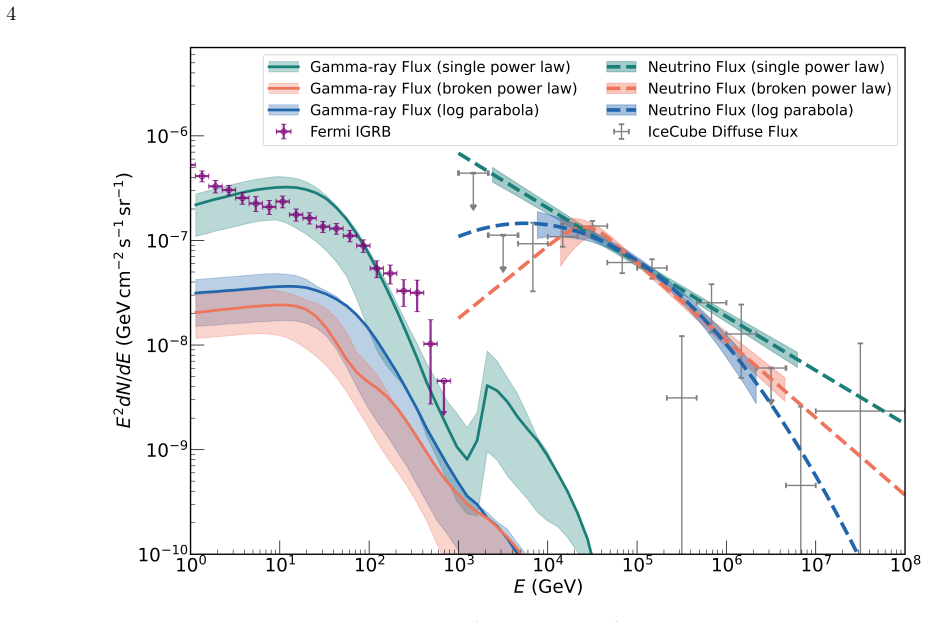
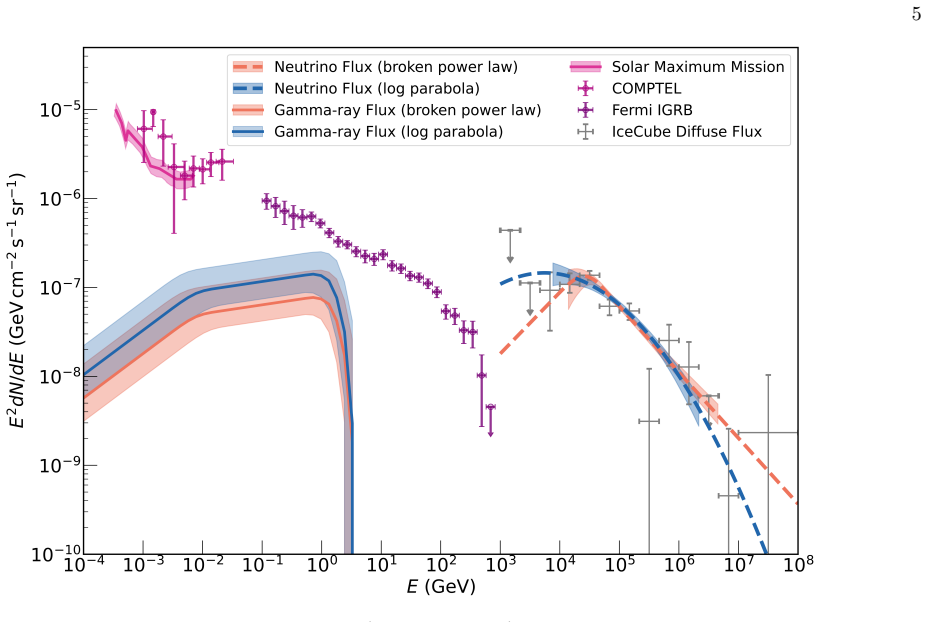
The measured neutrino spectrum, including the break at 30 TeV, is accommodated by protons following dN_p/dE_p ∝ E_p^{-3.1} interacting with a target photon field of typical energy 0.3 keV through the delta resonance; the accompanying gamma rays cascade and contribute at the 10 percent level to the isotropic gamma-ray background at 3 GeV, reducing the tension with existing measurements.
What carries the argument
The Δ-baryon resonance in pγ interactions, which fixes the neutrino production threshold for 0.3 keV target photons and thereby imprints a spectral break at 30 TeV.
If this is right
- The observed neutrino break directly traces the delta resonance threshold for the stated photon energy.
- Gamma rays from the same sources cascade to MeV-GeV energies and contribute roughly 10 percent of the isotropic gamma-ray background at 3 GeV.
- The model lowers the expected contribution of neutrino sources to the isotropic gamma-ray background above 10 GeV.
- The sources that produce the neutrinos would also account for the bulk of extragalactic cosmic rays above the ankle.
Where Pith is reading between the lines
- Multi-messenger searches could look for the predicted soft X-ray emission correlated with the neutrino arrival directions.
- The same resonance mechanism would predict a corresponding feature in the gamma-ray spectrum at lower energies once cascades are modeled in detail.
- If the photon field energy varies across sources, the break position could shift and future IceCube data could map that distribution.
- The scenario links the high-energy neutrino sky to compact objects that are bright in soft X-rays but not in GeV gamma rays.
Load-bearing premise
The target photons can be treated as monoenergetic at 0.3 keV and the entire neutrino flux comes from one uniform population of sources with proton index exactly -3.1.
What would settle it
A high-statistics neutrino spectrum that shows no break near 30 TeV or a break at an energy inconsistent with 0.3 keV photons would rule out the delta-resonance explanation.
Figures

read the original abstract
Recent measurements of the diffuse cosmic neutrino flux by IceCube show evidence for a spectral break at an energy near $E_\nu \sim 30$ TeV. In this letter, we suggest that this feature may be due to the $\Delta$-baryon resonance in $p\gamma$ interactions. We show that the measured spectrum, including the observed break, can be naturally accommodated by a flux of protons accelerated with a spectrum $dN_p /dE_p \propto E_p^{-3.1}$ interacting with X-rays of typical energy $E_{\gamma} \sim 0.3\,{\rm keV}$. We also point out that the presence of this spectral break significantly reduces the contribution of neutrino sources to the isotropic gamma-ray background, alleviating the longstanding tension between these measurements. In the $\Delta$-resonance scenario, the gamma rays accompanying neutrino production cascade down to MeV-GeV energies and contribute at the $\sim 10\%$ level to the isotropic gamma-ray background at $\sim 3$~GeV. If our proposal is realized, it may imply that we have identified the dominant sources that produce the extragalactic cosmic rays.
Editorial analysis
A structured set of objections, weighed in public.
Referee Report
Summary. The manuscript proposes that the spectral break in the IceCube diffuse neutrino flux near 30 TeV arises from the Δ resonance in proton-photon interactions. It argues that a proton spectrum dN_p/dE_p ∝ E_p^{-3.1} interacting with X-rays of typical energy ~0.3 keV can accommodate the observed neutrino spectrum, including the break, while also reducing the associated contribution to the isotropic gamma-ray background to ~10% at 3 GeV, potentially identifying the sources of extragalactic cosmic rays.
Significance. Should the proposal hold after addressing the spectral-shape details, it would offer a physically motivated explanation for the neutrino spectral feature based on a standard resonance, easing the tension with gamma-ray background measurements and suggesting a dominant source population for cosmic rays. The quantification of the gamma-ray cascade contribution at the 10% level provides a concrete, testable implication.
major comments (2)
- [Abstract] Abstract: The parameters (proton index of -3.1 and E_γ ∼ 0.3 keV) are selected to position the Δ resonance (E_p E_γ ≈ 0.32 GeV²) at the observed break energy of ~30 TeV. This renders the 'natural accommodation' a consistency adjustment rather than an independent derivation, as noted in the abstract's description of the measured spectrum.
- [Abstract] Abstract: Under the stated assumptions of a single typical photon energy and a uniform proton spectrum across a single population of sources, the neutrino flux would exhibit a resonance-induced peak (bump) from the Breit-Wigner form of σ_Δ rather than a break in the spectral index. The abstract does not specify how the model produces the reported change in spectral slope without invoking a distribution of photon energies or source properties, which are excluded by the single-population assumption.
minor comments (1)
- The abstract refers to 'the measured spectrum, including the observed break' without citing the specific IceCube reference or data set used for comparison.
Simulated Author's Rebuttal
We thank the referee for the careful and constructive review. The comments highlight important clarifications needed in the abstract regarding parameter motivation and spectral shape. We respond point by point below and will revise the manuscript accordingly.
read point-by-point responses
-
Referee: [Abstract] Abstract: The parameters (proton index of -3.1 and E_γ ∼ 0.3 keV) are selected to position the Δ resonance (E_p E_γ ≈ 0.32 GeV²) at the observed break energy of ~30 TeV. This renders the 'natural accommodation' a consistency adjustment rather than an independent derivation, as noted in the abstract's description of the measured spectrum.
Authors: We agree that the quoted values are selected to align the resonance with the observed break. The proton index -3.1 is nevertheless motivated by standard expectations from diffusive shock acceleration (slightly steeper than the canonical -2 due to propagation or other effects), and 0.3 keV is representative of X-ray energies in plausible source populations such as AGN. The claim of 'natural accommodation' refers to the resonance feature appearing at the correct energy under these standard assumptions rather than requiring exotic tuning. We will revise the abstract to emphasize the physical motivation of the parameters and remove any implication of an independent derivation. revision: yes
-
Referee: [Abstract] Abstract: Under the stated assumptions of a single typical photon energy and a uniform proton spectrum across a single population of sources, the neutrino flux would exhibit a resonance-induced peak (bump) from the Breit-Wigner form of σ_Δ rather than a break in the spectral index. The abstract does not specify how the model produces the reported change in spectral slope without invoking a distribution of photon energies or source properties, which are excluded by the single-population assumption.
Authors: This is a substantive point. With strictly monoenergetic target photons the Breit-Wigner resonance produces a peaked feature rather than a simple change in power-law index. Our calculation approximates the photon field by a single typical energy while assuming a modest spread in photon energies (or equivalent source-to-source variation) within the single population; this spread smooths the resonance into the observed break. The abstract's phrasing is too terse on this point. We will revise the abstract to clarify the approximation and add a short explanatory paragraph in the main text describing how the spectral shape is obtained. revision: yes
Circularity Check
Proton index -3.1 and E_γ=0.3 keV chosen to place Δ resonance at observed 30 TeV break
specific steps
-
fitted input called prediction
[Abstract]
"We show that the measured spectrum, including the observed break, can be naturally accommodated by a flux of protons accelerated with a spectrum dN_p /dE_p ∝ E_p^{-3.1} interacting with X-rays of typical energy E_γ ∼ 0.3 keV."
The quoted values of the spectral index and photon energy are not derived from independent data or theory; they are the minimal choice that forces the Δ resonance peak (via E_p E_γ ≈ 0.32 GeV²) to coincide with the observed break location, after which the output neutrino spectrum is forced to track the input E_p^{-3.1} away from the resonance.
full rationale
The paper's central claim is that the observed spectral break is accommodated by protons with index exactly -3.1 on 0.3 keV photons. These two numerical inputs are selected so the resonance condition E_p E_γ ≈ 0.32 GeV² maps the feature to ~30 TeV, after which the neutrino yield inherits the input power-law slope away from the resonance. This reduces the 'accommodation' to a parameter adjustment that reproduces the input data by construction rather than an independent derivation from first principles or external constraints. No self-citation chain or ansatz smuggling is present in the text; the circularity is limited to the fitted-input step.
Axiom & Free-Parameter Ledger
free parameters (2)
- proton spectral index =
-3.1
- typical photon energy =
0.3 keV
axioms (1)
- domain assumption The Delta resonance dominates p-gamma interactions near the relevant center-of-mass energy
Reference graph
Works this paper leans on
-
[1]
Unified Schemes for Radio-Loud Active Galactic Nuclei
Urry, C. Megan and Padovani, Paolo. Unified schemes for radio-loud active galactic nuclei. Publ. Astron. Soc. Pac. 1995. doi:10.1086/133630. arXiv:astro-ph/9506063
work page internal anchor Pith review Pith/arXiv arXiv doi:10.1086/133630 1995
-
[2]
Impact of muon and pion cooling on the neutrino spectrum of NGC 1068
Blanco, Carlos and Hooper, Dan and Linden, Tim and Pinetti, Elena. Impact of muon and pion cooling on the neutrino spectrum of NGC 1068. Phys. Rev. D. 2026. doi:10.1103/4rxm-kqpd. arXiv:2509.15421
-
[3]
Alves Batista, Rafael and others. CRPropa 3.2 an advanced framework for high-energy particle propagation in extragalactic and galactic spaces. JCAP. 2022. doi:10.1088/1475-7516/2022/09/035. arXiv:2208.00107
-
[4]
Ajello, M. and Di Mauro, M. and Paliya, V. S. and Garrappa, S. The -Ray Emission of Star-forming Galaxies. Astrophys. J. 2020. arXiv:2003.05493
arXiv 2020
-
[5]
Astroparticles from X-Ray Binary Coronae
Fang, Ke and Halzen, Francis and Heinz, Sebastian and Gallagher, John S. Astroparticles from X-Ray Binary Coronae. Astrophys. J. Lett. 2024. arXiv:2410.02119
arXiv 2024
-
[6]
Fiorillo, Damiano F. G. and Petropoulou, Maria and Comisso, Luca and Peretti, Enrico and Sironi, Lorenzo. TeV Neutrinos and Hard X-Rays from Relativistic Reconnection in the Corona of NGC 1068. Astrophys. J. 2024. arXiv:2310.18254
arXiv 2024
-
[7]
Winter, Walter and Fiorillo, Damiano F. G. and Buson, Sara. Single-source-class interpretation of the diffuse astrophysical neutrino flux. 2026. arXiv:2603.15754
Pith/arXiv arXiv 2026
-
[8]
The nature of the Diffuse Gamma-Ray Background
Fornasa, Mattia and S \'a nchez-Conde, Miguel A. The nature of the Diffuse Gamma-Ray Background. Phys. Rept. 2015. arXiv:1502.02866
Pith/arXiv arXiv 2015
-
[9]
Ajello, M. and others. The Origin of the Extragalactic Gamma-Ray Background and Implications for Dark-Matter Annihilation. Astrophys. J. Lett. 2015. arXiv:1501.05301
Pith/arXiv arXiv 2015
-
[10]
Radio Galaxies Dominate the High-Energy Diffuse Gamma-Ray Background
Hooper, Dan and Linden, Tim and Lopez, Alejandro. Radio Galaxies Dominate the High-Energy Diffuse Gamma-Ray Background. JCAP. 2016. arXiv:1604.08505
Pith/arXiv arXiv 2016
-
[11]
Di Mauro, Mattia and Donato, Fiorenza. Composition of the Fermi-LAT isotropic gamma-ray background intensity: Emission from extragalactic point sources and dark matter annihilations. Phys. Rev. D. 2015. arXiv:1501.05316
Pith/arXiv arXiv 2015
-
[12]
IceCube population constraints on neutrino emission by Fermi-LAT detected active galactic nuclei
Hori, Sam and others. IceCube population constraints on neutrino emission by Fermi-LAT detected active galactic nuclei. PoS. 2025. arXiv:2507.07098
arXiv 2025
-
[13]
Evaluating the Contribution of Active Galactic Nuclei to the Diffuse High-Energy Neutrino Flux
Jain, Samyak and Hooper, Dan and Halzen, Francis. Evaluating the Contribution of Active Galactic Nuclei to the Diffuse High-Energy Neutrino Flux. 2026. arXiv:2602.02390
arXiv 2026
-
[14]
Aartsen, M. G. and others. The contribution of Fermi-2LAC blazars to the diffuse TeV-PeV neutrino flux. Astrophys. J. 2017. arXiv:1611.03874
Pith/arXiv arXiv 2017
-
[15]
Revisiting AGN as the source of IceCube s diffuse neutrino flux
Smith, Daniel and Hooper, Dan and Vieregg, Abigail. Revisiting AGN as the source of IceCube s diffuse neutrino flux. JCAP. 2021. arXiv:2007.12706
arXiv 2021
-
[16]
Active Galactic Nuclei and the Origin of IceCube's Diffuse Neutrino Flux
Hooper, Dan and Linden, Tim and Vieregg, Abby. Active Galactic Nuclei and the Origin of IceCube's Diffuse Neutrino Flux. JCAP. 2019. arXiv:1810.02823
Pith/arXiv arXiv 2019
-
[17]
Ackermann, M. and others. Resolving the Extragalactic -Ray Background above 50 GeV with the Fermi Large Area Telescope. Phys. Rev. Lett. 2016. arXiv:1511.00693
Pith/arXiv arXiv 2016
-
[18]
Ackermann, M. and others. The spectrum of isotropic diffuse gamma-ray emission between 100 MeV and 820 GeV. Astrophys. J. 2015. arXiv:1410.3696
Pith/arXiv arXiv 2015
-
[19]
Aghanim, N. and others. Planck 2018 results. VI. Cosmological parameters. Astron. Astrophys. 2020. arXiv:1807.06209
Pith/arXiv arXiv 2018
-
[20]
and Engel, Ralph and Rachen, J
Mucke, A. and Engel, Ralph and Rachen, J. P. and Protheroe, R. J. and Stanev, Todor. SOPHIA: Monte Carlo simulations of photohadronic processes in astrophysics. Comput. Phys. Commun. 2000. arXiv:astro-ph/9903478
Pith/arXiv arXiv 2000
-
[21]
On the Origin of High-energy Neutrinos from NGC 1068: The Role of Nonthermal Coronal Activity
Inoue, Yoshiyuki and Khangulyan, Dmitry and Doi, Akihiro. On the Origin of High-energy Neutrinos from NGC 1068: The Role of Nonthermal Coronal Activity. Astrophys. J. Lett. 2020. arXiv:1909.02239
arXiv 2020
-
[22]
Hidden Hearts of Neutrino Active Galaxies
Murase, Kohta. Hidden Hearts of Neutrino Active Galaxies. Astrophys. J. Lett. 2022. arXiv:2211.04460
arXiv 2022
-
[23]
A Case for Radio Galaxies as the Sources of IceCube's Astrophysical Neutrino Flux
Hooper, Dan. A Case for Radio Galaxies as the Sources of IceCube's Astrophysical Neutrino Flux. JCAP. 2016. arXiv:1605.06504
Pith/arXiv arXiv 2016
-
[24]
Abbasi, R. and others. Observation of high-energy neutrinos from the Galactic plane. Science. 2023. arXiv:2307.04427
arXiv 2023
-
[25]
Hummer, S. and Ruger, M. and Spanier, F. and Winter, W. Simplified models for photohadronic interactions in cosmic accelerators. Astrophys. J. 2010. arXiv:1002.1310
Pith/arXiv arXiv 2010
-
[26]
Hidden Cosmic-Ray Accelerators as an Origin of TeV-PeV Cosmic Neutrinos
Murase, Kohta and Guetta, Dafne and Ahlers, Markus. Hidden Cosmic-Ray Accelerators as an Origin of TeV-PeV Cosmic Neutrinos. Phys. Rev. Lett. 2016. arXiv:1509.00805
Pith/arXiv arXiv 2016
-
[27]
Aartsen, M. G. and others. First observation of PeV-energy neutrinos with IceCube. Phys. Rev. Lett. 2013. arXiv:1304.5356
Pith/arXiv arXiv 2013
-
[28]
Aartsen, M. G. and others. Evidence for High-Energy Extraterrestrial Neutrinos at the IceCube Detector. Science. 2013. arXiv:1311.5238
Pith/arXiv arXiv 2013
-
[29]
Abbasi, R. and others. Evidence for a Spectral Break or Curvature in the Spectrum of Astrophysical Neutrinos from 5 TeV--10 PeV. Phys. Rev. Lett. 2026. arXiv:2507.22233
arXiv 2026
-
[30]
Abbasi, R. and others. Improved measurements of the TeV-PeV extragalactic neutrino spectrum from joint analyses of IceCube tracks and cascades. Phys. Rev. D. 2026. arXiv:2507.22234
Pith/arXiv arXiv 2026
-
[31]
Abbasi, R. and others. Evidence for neutrino emission from the nearby active galaxy NGC 1068. Science. 2022. arXiv:2211.09972
arXiv 2022
-
[32]
Aartsen, M. G. and others. Neutrino emission from the direction of the blazar TXS 0506+056 prior to the IceCube-170922A alert. Science. 2018. arXiv:1807.08794
Pith/arXiv arXiv 2018
-
[33]
TXS 0506+056 with Updated IceCube Data
Luszczak, William and others. TXS 0506+056 with Updated IceCube Data. PoS. 2023. arXiv:2307.14559
arXiv 2023
-
[34]
The MeV cosmic gamma-ray background measured with SMM
Watanabe, K and Leising, MD and Share, GH and Kinzer, RL. The MeV cosmic gamma-ray background measured with SMM. AIP Conference Proceedings. 2000. doi:10.1063/1.1303252
-
[35]
Weidenspointner, G. and others. AIP Conf. Proc. 2000. arXiv:astro-ph/0012332
Pith/arXiv arXiv 2000
-
[36]
Aartsen, M. G. and others. Measurements using the inelasticity distribution of multi-TeV neutrino interactions in IceCube. Phys. Rev. D. 2019. arXiv:1808.07629
Pith/arXiv arXiv 2019
-
[37]
Aartsen, M. G. and others. Characteristics of the diffuse astrophysical electron and tau neutrino flux with six years of IceCube high energy cascade data. Phys. Rev. Lett. 2020. arXiv:2001.09520
arXiv 2020
-
[38]
Abbasi, R. and others. The IceCube high-energy starting event sample: Description and flux characterization with 7.5 years of data. Phys. Rev. D. 2021. arXiv:2011.03545
arXiv 2021
-
[39]
An NGC 1068-informed Understanding of Neutrino Emission of the Active Galactic Nucleus TXS 0506+056
Khatee Zathul, Arifa and Moulai, Marjon and Fang, Ke and Halzen, Francis. An NGC 1068-informed Understanding of Neutrino Emission of the Active Galactic Nucleus TXS 0506+056. Astrophys. J. 2025. arXiv:2411.14598
arXiv 2025
-
[40]
Stecker, Floyd W. and Venters, Tonia M. Components of the Extragalactic Gamma Ray Background. Astrophys. J. 2011. arXiv:1012.3678
Pith/arXiv arXiv 2011
-
[41]
Abbasi, R. and others. Improved Characterization of the Astrophysical Muon neutrino Flux with 9.5 Years of IceCube Data. Astrophys. J. 2022. arXiv:2111.10299
arXiv 2022
-
[42]
Roth, Matt A. and Krumholz, Mark R. and Crocker, Roland M. and Celli, Silvia. The diffuse -ray background is dominated by star-forming galaxies. Nature. 2021. arXiv:2109.07598
arXiv 2021
-
[43]
Di Mauro, M. and Calore, F. and Donato, F. and Ajello, M. and Latronico, L. Diffuse -ray emission from misaligned active galactic nuclei. Astrophys. J. 2014. arXiv:1304.0908
Pith/arXiv arXiv 2014
-
[44]
Star-Forming Galaxies Significantly Contribute to the Isotropic Gamma-Ray Background
Linden, Tim. Star-Forming Galaxies Significantly Contribute to the Isotropic Gamma-Ray Background. Phys. Rev. D. 2017. arXiv:1612.03175
Pith/arXiv arXiv 2017
-
[45]
Kneiske, Tanja M. and Bretz, T. and Mannheim, K. and Hartmann, D. H. Implications of cosmological gamma-ray absorption. 2. Modification of gamma-ray spectra. Astron. Astrophys. 2004. arXiv:astro-ph/0309141
Pith/arXiv arXiv 2004
-
[46]
Stecker, Floyd W. and Malkan, M. A. and Scully, S. T. Intergalactic photon spectra from the far ir to the uv lyman limit for 0 < Z < 6 and the optical depth of the universe to high energy gamma-rays. Astrophys. J. 2006. arXiv:astro-ph/0510449
Pith/arXiv arXiv 2006
-
[47]
Astronomy & Astrophysics , volume=
Franceschini, Alberto and Rodighiero, Giulia and Vaccari, Mattia , title=. Astronomy & Astrophysics , volume=. arXiv:arXiv:0805.1841v2
-
[48]
Gilmore, R. C. and Somerville, R. S. and Primack, J. R. and Dominguez, A. Semi-analytic modeling of the EBL and consequences for extragalactic gamma-ray spectra. Mon. Not. Roy. Astron. Soc. 2012. arXiv:1104.0671
Pith/arXiv arXiv 2012
-
[49]
and Finke, Justin and Ajello, Marco and Primack, Joel R
Saldana-Lopez, Alberto and Dom \' nguez, Alberto and P \'e rez-Gonz \'a lez, Pablo G. and Finke, Justin and Ajello, Marco and Primack, Joel R. and Paliya, Vaidehi S. and Desai, Abhishek. An observational determination of the evolving extragalactic background light from the multiwavelength HST/CANDELS survey in the Fermi and CTA era. Mon. Not. Roy. Astron....
arXiv 2021
-
[50]
and Ajello, Marco and Dominguez, Alberto and Desai, Abhishek and Hartmann, Dieter H
Finke, Justin D. and Ajello, Marco and Dominguez, Alberto and Desai, Abhishek and Hartmann, Dieter H. and Paliya, Vaidehi S. and Saldana-Lopez, Alberto. Modeling the Extragalactic Background Light and the Cosmic Star Formation History. Astrophys. J. 2022. arXiv:2210.01157
arXiv 2022
-
[51]
Abbasi, R. and others. Time-integrated Southern-sky Neutrino Source Searches with 10 yr of IceCube Starting-track Events at Energies Down to 1 TeV. Astrophys. J. 2026. arXiv:2501.16440
arXiv 2026
-
[52]
Aartsen, M. G. and others. Observation of High-Energy Astrophysical Neutrinos in Three Years of IceCube Data. Phys. Rev. Lett. 2014. arXiv:1405.5303
Pith/arXiv arXiv 2014
-
[53]
Fang, Ke and Gallagher, John S. and Halzen, Francis. The TeV Diffuse Cosmic Neutrino Spectrum and the Nature of Astrophysical Neutrino Sources. Astrophys. J. 2022. arXiv:2205.03740
arXiv 2022
-
[54]
and Ajello, Marco and Dominguez, Alberto and Desai, Abhishek and Hartmann, Dieter H
Finke, Justin D. and Ajello, Marco and Dominguez, Alberto and Desai, Abhishek and Hartmann, Dieter H. and Paliya, Vaidehi S. and Saldana-Lopez, Alberto , title =. doi:10.5281/zenodo.7023073 , url =
-
[55]
Berezinsky, V. S. and Smirnov, A. Yu. Cosmic neutrinos of ultra-high energies and detection possibility. Astrophys. Space Sci. 1975. doi:10.1007/BF00643157
-
[56]
Berezinsky, V. and Kalashev, O. High energy electromagnetic cascades in extragalactic space: physics and features. Phys. Rev. D. 2016. arXiv:1603.03989
Pith/arXiv arXiv 2016
-
[57]
Y. Revealing the high-redshift star formation rate with gamma-ray bursts , eprint = "0804.4008", archivePrefix = "arXiv", journal = "Astrophys. J.", volume=
-
[58]
Dominguez, A. and others. Extragalactic Background Light Inferred from AEGIS Galaxy SED-type Fractions. Mon. Not. Roy. Astron. Soc. 2011. arXiv:1007.1459
Pith/arXiv arXiv 2011
-
[59]
Alves Batista, Rafael and others. CRPropa 3.2 an advanced framework for high-energy particle propagation in extragalactic and galactic spaces. JCAP. 2022. arXiv:2208.00107
arXiv 2022
discussion (0)
Sign in with ORCID, Apple, or X to comment. Anyone can read and Pith papers without signing in.