Neural Acquisition & Representation of Subsurface Scattering
Pith reviewed 2026-06-28 15:22 UTC · model grok-4.3
The pith
A U-Net CNN trained on 3D scans and projector-camera captures predicts pixel-level subsurface scattering responses that match real data and generalize to unseen materials.
A machine-rendered reading of the paper's core claim, the machinery that carries it, and where it could break.
Core claim
Reconstructing dense pixel footprints via a U-Net CNN that takes 3D scans as input allows the model to produce relit color images whose footprints are almost identical to those measured from real-world projector illumination; training the same network on multiple views and objects yields representations that generalize directly to unseen subsurface scattering materials.
What carries the argument
U-Net CNN that maps 3D scanning input to dense pixel footprint responses for subsurface light transport
If this is right
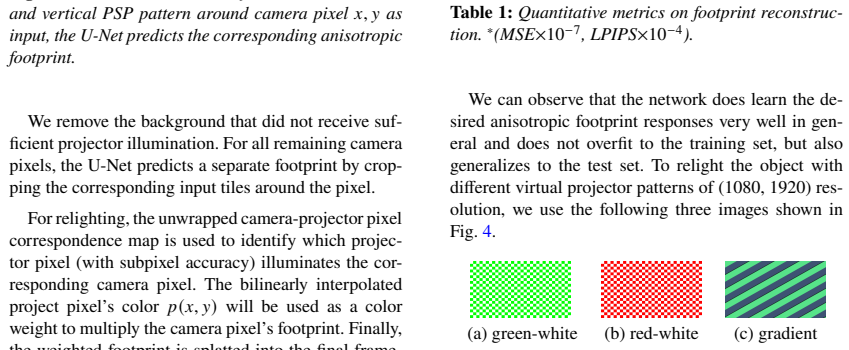
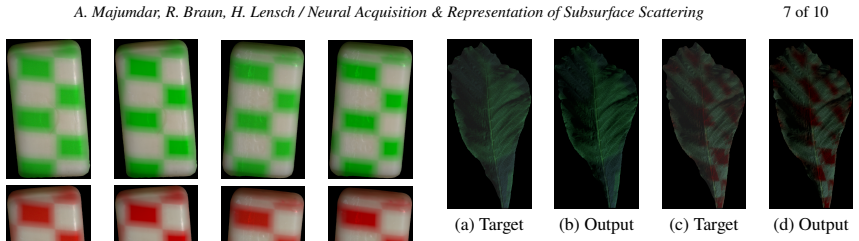
- Relighting with arbitrary high-resolution projector patterns becomes feasible from the predicted footprints.
- The same trained model supports multiple views across multiple objects without per-object retraining.
- Learned representations transfer to unseen subsurface scattering materials.
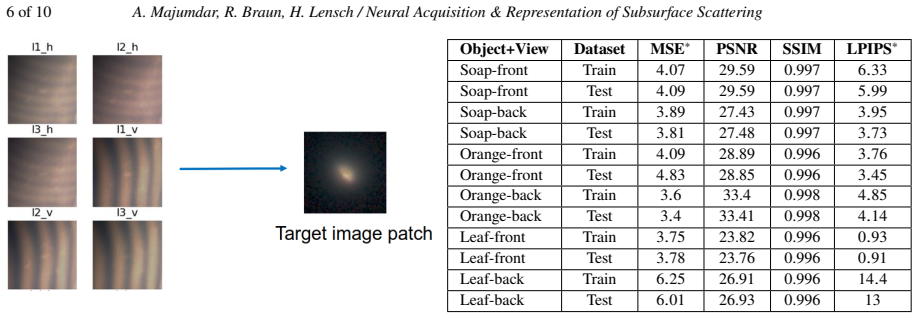
- Qualitative and quantitative matches to real captured images confirm the footprints are faithful.
Where Pith is reading between the lines
- The footprint representation might serve as a compact intermediate for other inverse-rendering tasks that currently rely on full volumetric simulation.
- Similar acquisition pipelines could be tested on dynamic or time-varying scattering if the capture setup is extended to video rates.
- The approach implicitly suggests that many participating-media effects in graphics could be replaced by surface-footprint predictors trained once on diverse examples.
Load-bearing premise
The method assumes that 3D scanning combined with phase-shifted projector-camera patterns can supply training data sufficient for the network to learn accurate footprints across varied objects.
What would settle it
Apply the trained model to a new scattering material never seen in training, generate relit images under the same projector patterns, and compare them pixel-for-pixel to fresh real captures; large systematic differences would falsify the generalization claim.
Figures



read the original abstract
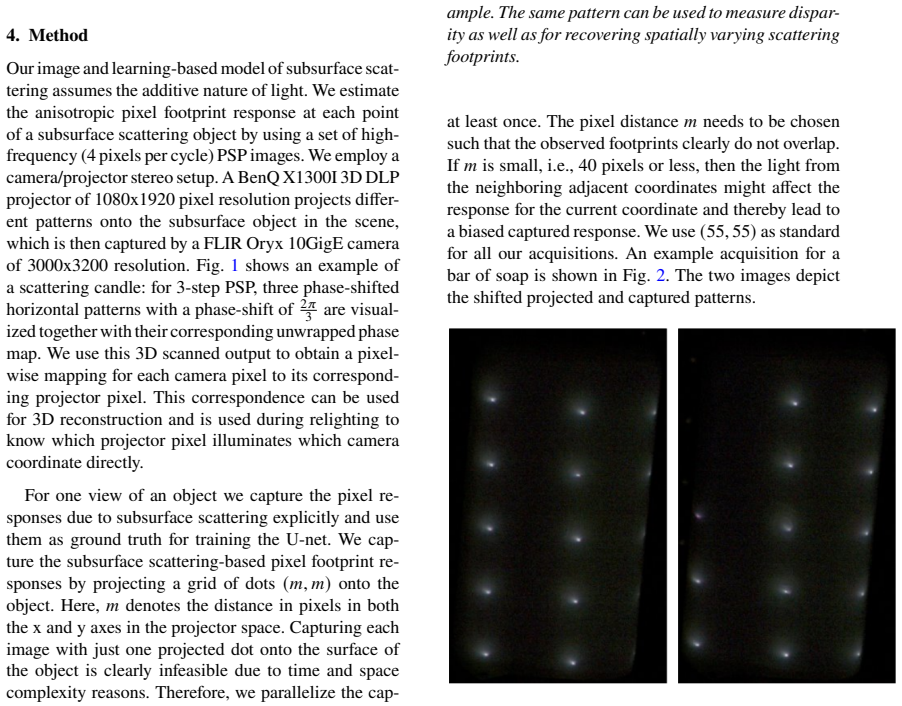
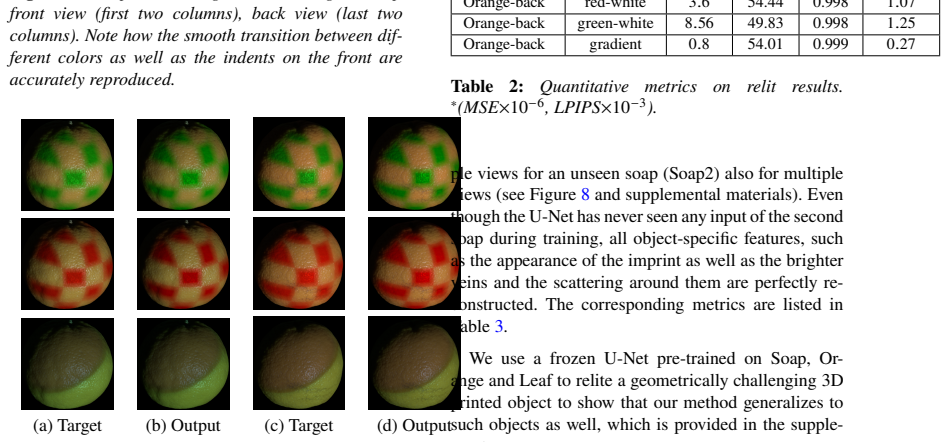
We present a method to acquire and estimate the sub-surface scattering properties of light transport at a highly detailed level by learning the pixel footprint response at each point on the object surface. The reconstruction leverages 3D scanning techniques as input to a U-Net CNN. A stereo projector-camera setup using phase-shifted profilometry (PSP) patterns efficiently captures the data for a variety of scattering objects. Reconstructing dense pixel footprints allows for relighting with arbitrary high-resolution projector patterns. The final output is a relit color image. Qualitative and quantitative comparison against illuminated real-world captured images demonstrate that the predicted footprints are almost identical to the actual responses. The same model is trained for multiple views across multiple objects such that the learned representations can be used to generalize to unseen sub-surface scattering materials as well.
Editorial analysis
A structured set of objections, weighed in public.
Referee Report
Summary. The paper presents a neural method to acquire and represent subsurface scattering by learning per-pixel footprint responses of light transport. It takes 3D scans as input to a U-Net CNN, captures training data via a stereo projector-camera system using phase-shifted profilometry (PSP) patterns, and produces relit images under arbitrary high-resolution projector patterns. The model is trained across multiple views and objects to enable generalization to unseen scattering materials, with the central empirical claim that predicted footprints are almost identical to real captured responses.
Significance. If the quantitative comparisons and generalization results hold with rigorous metrics, the work would offer a practical data-driven pipeline for high-detail subsurface scattering acquisition and relighting, potentially reducing reliance on hand-crafted physical models in computer graphics and vision applications.
major comments (2)
- [Abstract] Abstract: the claim that 'predicted footprints are almost identical to the actual responses' and that quantitative comparisons were performed is unsupported by any reported metrics, error bars, or description of the comparison protocol; this is load-bearing for the central claim and must be addressed with concrete numbers and methodology in the results section.
- The reconstruction pipeline (3D scan input to U-Net, PSP capture) is described at a high level but lacks details on loss functions, training data statistics, or how the pixel footprints are represented and decoded for relighting; these elements are necessary to assess reproducibility and whether the generalization claim is supported.
Simulated Author's Rebuttal
We thank the referee for the constructive feedback. The two major comments highlight areas where the manuscript can be strengthened for clarity and rigor. We address each point below and will revise accordingly.
read point-by-point responses
-
Referee: [Abstract] Abstract: the claim that 'predicted footprints are almost identical to the actual responses' and that quantitative comparisons were performed is unsupported by any reported metrics, error bars, or description of the comparison protocol; this is load-bearing for the central claim and must be addressed with concrete numbers and methodology in the results section.
Authors: We agree that the abstract claim requires explicit quantitative support. The manuscript states that quantitative comparisons were performed against captured images, but the current version does not report specific metrics, error bars, or the evaluation protocol in sufficient detail. In the revised manuscript we will add these elements to the results section, including concrete numbers (e.g., mean absolute error or Pearson correlation between predicted and measured footprints), standard deviations across multiple test samples, and a clear description of the comparison protocol. revision: yes
-
Referee: The reconstruction pipeline (3D scan input to U-Net, PSP capture) is described at a high level but lacks details on loss functions, training data statistics, or how the pixel footprints are represented and decoded for relighting; these elements are necessary to assess reproducibility and whether the generalization claim is supported.
Authors: We acknowledge that the methods section provides only a high-level description. The revised manuscript will expand this section to include: (1) the exact loss function used for training the U-Net, (2) training data statistics (number of objects, views, and total footprint samples), and (3) the representation of pixel footprints and the decoding procedure that enables relighting under arbitrary high-resolution projector patterns. These additions will directly support assessment of reproducibility and the generalization results. revision: yes
Circularity Check
No significant circularity
full rationale
The paper presents an empirical acquisition and learning pipeline: PSP patterns and 3D scans are captured as input, a U-Net is trained to predict pixel footprints, and outputs are validated by direct comparison to separately captured real illuminated images. No derivation, equation, or loss is shown that reduces a claimed prediction to a fitted parameter or self-citation by construction. Generalization claims rest on held-out objects and views rather than re-using the training targets as the evaluation metric. The argument is therefore self-contained against external captured data.
Axiom & Free-Parameter Ledger
axioms (1)
- domain assumption U-Net architecture can learn the mapping from 3D scans to pixel footprints
Reference graph
Works this paper leans on
-
[1]
Delio Vicini and Vladlen Koltun and Wenzel Jakob , title =
-
[3]
Journal of the Optical Society of America A , volume =
Simeon Geiger and Philipp Hank and Alwin Kienle , title =. Journal of the Optical Society of America A , volume =
-
[4]
Per Christensen and Julian Fong and Jonathan Shade and Wayne Wooten and Brenden Schubert and Andrew Kensler and Stephen Friedman and Charlie Kilpatrick and Cliff Ramshaw and Marc Bannister and Brenton Rayner and Jonathan Brouillat and Max Liani , title =
-
[5]
Luca Fascione and Johannes Hanika and Mark Leone and Marc Droske and Jorge Schwarzhaupt and Tomáš Davidovič and Andrea Weidlich and Johannes Meng , title =
-
[6]
Kingma, Diederik P. and Welling, Max , biburl =. Auto-Encoding Variational Bayes , added-at =. 2nd International Conference on Learning Representations,. http://arxiv.org/abs/1312.6114v10 , eprintclass =
-
[7]
Learning Structured Output Representation using Deep Conditional Generative Models , url =
Sohn, Kihyuk and Lee, Honglak and Yan, Xinchen , booktitle =. Learning Structured Output Representation using Deep Conditional Generative Models , url =
-
[8]
Che and F
C. Che and F. Luan and S. Zhao and K. Bala and I. Gkioulekas , title =. IEEE International Conference on Computational Photography (ICCP) , DOI =
-
[9]
U-Net: Convolutional Networks for Biomedical Image Segmentation
Ronneberger, Olaf and Fischer, Philipp and Brox, Thomas , biburl =. U-Net: Convolutional Networks for Biomedical Image Segmentation. , url =. CoRR , keywords =
-
[12]
Optics and Lasers in Engineering , volume =
Chao Zuo and Lei Huang and Minliang Zhang and Qian Chen and Anand Asundi , title =. Optics and Lasers in Engineering , volume =. doi:Optics and Lasers in Engineering , year =
-
[13]
Optics and Lasers in Engineering , DOI =
Xiaoyu He and Qian Kemao , title =. Optics and Lasers in Engineering , DOI =
-
[14]
Chen, Tongbo and Seidel, Hans-Peter and Lensch, Hendrik P. A. , booktitle=. Modulated phase-shifting for 3D scanning , year=
-
[15]
Chen, Tongbo and Lensch, Hendrik P. A. and Fuchs, Christian and Seidel, Hans-Peter , booktitle=. Polarization and Phase-Shifting for 3D Scanning of Translucent Objects , year=
-
[16]
, booktitle=
Gupta, Mohit and Nayar, Shree K. , booktitle=. Micro Phase Shifting , year=
-
[17]
Embedded phase shifting: Robust phase shifting with embedded signals , year=
Moreno, Daniel and Son, Kilho and Taubin, Gabriel , booktitle=. Embedded phase shifting: Robust phase shifting with embedded signals , year=
-
[18]
and van Dam, Andries and Feiner, Stephen K
Foley, James D. and van Dam, Andries and Feiner, Stephen K. and Hughes, John F. and Phillips, R. , TITLE =
-
[20]
Proceedings of the 34th International Conference on Neural Information Processing Systems , articleno =
Ho, Jonathan and Jain, Ajay and Abbeel, Pieter , title =. Proceedings of the 34th International Conference on Neural Information Processing Systems , articleno =. 2020 , isbn =
2020
-
[21]
Medical Imaging with Deep Learning , year=
Attention U-Net: Learning Where to Look for the Pancreas , author=. Medical Imaging with Deep Learning , year=
-
[22]
and Li-wei He and Cutler, R
Malvar, H.S. and Li-wei He and Cutler, R. , booktitle=. High-quality linear interpolation for demosaicing of Bayer-patterned color images , year=
-
[23]
Demosaicing With Directional Filtering and a posteriori Decision , year=
Menon, Daniele and Andriani, Stefano and Calvagno, Giancarlo , journal=. Demosaicing With Directional Filtering and a posteriori Decision , year=
-
[24]
2011 , note =
Getreuer, Pascal , journal =. 2011 , note =
2011
-
[25]
Embrace the Gap: VAEs Perform Independent Mechanism Analysis , url =
Reizinger, Patrik and Gresele, Luigi and Brady, Jack and von K\". Embrace the Gap: VAEs Perform Independent Mechanism Analysis , url =. Advances in Neural Information Processing Systems , editor =
-
[26]
Don t Blame the ELBO! A Linear VAE Perspective on Posterior Collapse , url =
Lucas, James and Tucker, George and Grosse, Roger B and Norouzi, Mohammad , booktitle =. Don t Blame the ELBO! A Linear VAE Perspective on Posterior Collapse , url =
-
[27]
Posterior Collapse and Latent Variable Non-identifiability , url =
Wang, Yixin and Blei, David and Cunningham, John P , booktitle =. Posterior Collapse and Latent Variable Non-identifiability , url =
-
[28]
The Usual Suspects?
Dai, Bin and Wang, Ziyu and Wipf, David , booktitle =. The Usual Suspects?. 2020 , editor =
2020
-
[29]
Biomedical Imaging and Sensing Conference , volume=
Development of measurement system for subsurface scattering light of skin and analysis of its age-related changes , author=. Biomedical Imaging and Sensing Conference , volume=. 2023 , organization=
2023
-
[30]
Proceedings of the 27th annual conference on Computer graphics and interactive techniques , pages=
Acquiring the reflectance field of a human face , author=. Proceedings of the 27th annual conference on Computer graphics and interactive techniques , pages=
-
[31]
Proceedings of the 14th Eurographics workshop on Rendering , pages=
Wavelet environment matting , author=. Proceedings of the 14th Eurographics workshop on Rendering , pages=
-
[32]
ACM Transactions on Graphics (ToG) , volume=
Compressive light transport sensing , author=. ACM Transactions on Graphics (ToG) , volume=. 2009 , publisher=
2009
-
[34]
, author=
Primal-dual coding to probe light transport. , author=. ACM Trans. Graph. , volume=
-
[35]
Garg, Gaurav and Talvala, Eino-Ville and Levoy, Marc and Lensch, Hendrik P. A. , year =. Symposium on Rendering , editor =
-
[37]
ACM Transactions on Graphics (TOG) , volume=
Neural light transport for relighting and view synthesis , author=. ACM Transactions on Graphics (TOG) , volume=. 2021 , publisher=
2021
-
[38]
ACM Transactions on Graphics (ToG) , volume=
Image based relighting using neural networks , author=. ACM Transactions on Graphics (ToG) , volume=. 2015 , publisher=
2015
-
[40]
, author=
Optical computing for fast light transport analysis. , author=. ACM Trans. Graph. , volume=. 2010 , publisher=
2010
-
[41]
Proceedings of the 28th annual conference on Computer graphics and interactive techniques , pages=
A practical model for subsurface light transport , author=. Proceedings of the 28th annual conference on Computer graphics and interactive techniques , pages=
-
[42]
ACM Transactions on Graphics (ToG) , volume=
Analysis of human faces using a measurement-based skin reflectance model , author=. ACM Transactions on Graphics (ToG) , volume=. 2006 , publisher=
2006
-
[43]
The Thirty-eighth Annual Conference on Neural Information Processing Systems , year=
Subsurface Scattering for Gaussian Splatting , author=. The Thirty-eighth Annual Conference on Neural Information Processing Systems , year=
-
[44]
Advances in Neural Information Processing Systems , volume=
Neural relightable participating media rendering , author=. Advances in Neural Information Processing Systems , volume=
-
[45]
European Conference on Computer Vision , pages=
Neural radiance transfer fields for relightable novel-view synthesis with global illumination , author=. European Conference on Computer Vision , pages=. 2022 , organization=
2022
-
[47]
Computer Graphics Forum , volume=
Combining confocal imaging and descattering , author=. Computer Graphics Forum , volume=. 2008 , organization=
2008
-
[48]
Applied optics , volume=
Spatially resolved absolute diffuse reflectance measurements for noninvasive determination of the optical scattering and absorption coefficients of biological tissue , author=. Applied optics , volume=. 1996 , publisher=
1996
-
[49]
: Renderman: An advanced path-tracing architecture for movie rendering
Christensen P., Fong J., Shade J., Wooten W., Schubert B., Kensler A., Friedman S., Kilpatrick C., Ramshaw C., Bannister M., Rayner B., Brouillat J., Liani M. : Renderman: An advanced path-tracing architecture for movie rendering. ACM TOG 37 (2018)
2018
-
[50]
Chen T., Lensch H. P. A., Fuchs C., Seidel H.-P. : Polarization and phase-shifting for 3d scanning of translucent objects. In 2007 IEEE Conference on Computer Vision and Pattern Recognition (2007), pp. 1--8. https://doi.org/10.1109/CVPR.2007.383209 doi:10.1109/CVPR.2007.383209
-
[51]
Chen T., Seidel H.-P., Lensch H. P. A. : Modulated phase-shifting for 3d scanning. In 2008 IEEE Conference on Computer Vision and Pattern Recognition (2008), pp. 1--8. https://doi.org/10.1109/CVPR.2008.4587836 doi:10.1109/CVPR.2008.4587836
-
[52]
: Acquiring the reflectance field of a human face
Debevec P., Hawkins T., Tchou C., Duiker H.-P., Sarokin W., Sagar M. : Acquiring the reflectance field of a human face. In Proceedings of the 27th annual conference on Computer graphics and interactive techniques (2000), pp. 145--156
2000
-
[53]
: Subsurface scattering for gaussian splatting
Dihlmann J.-N., Majumdar A., Engelhardt A., Braun R., Lensch H. : Subsurface scattering for gaussian splatting. In The Thirty-eighth Annual Conference on Neural Information Processing Systems (2025)
2025
-
[54]
: The usual suspects? R eassessing blame for VAE posterior collapse
Dai B., Wang Z., Wipf D. : The usual suspects? R eassessing blame for VAE posterior collapse. In Proceedings of the 37th International Conference on Machine Learning (13--18 Jul 2020), III H. D., Singh A., (Eds.), vol. 119 of Proceedings of Machine Learning Research, PMLR, pp. 2313--2322. URL: https://proceedings.mlr.press/v119/dai20c.html
2020
-
[55]
Fuchs C., Heinz M., Levoy M., Seidel H.-P., Lensch H. P. : Combining confocal imaging and descattering. In Computer Graphics Forum (2008), vol. 27, Wiley Online Library, pp. 1245--1253
2008
-
[56]
: Manuka: A batch-shading architecture for spectral path tracing in movie production
Fascione L., Hanika J., Leone M., Droske M., Schwarzhaupt J., Davidovič T., Weidlich A., Meng J. : Manuka: A batch-shading architecture for spectral path tracing in movie production. ACM TOG 37 (2018)
2018
-
[57]
: Malvar-He-Cutler Linear Image Demosaicking
Getreuer P. : Malvar-He-Cutler Linear Image Demosaicking . Image Processing On Line 1 (2011), 83--89. https://doi.org/10.5201/ipol.2011.g_mhcd
-
[58]
: Improved topography reconstruction of volume scattering objects using structured light
Geiger S., Hank P., Kienle A. : Improved topography reconstruction of volume scattering objects using structured light. Journal of the Optical Society of America A 39 (2022)
2022
-
[59]
Goesele M., Lensch H. P. A., Lang J., Fuchs C., Seidel H.-P. : Disco: acquisition of translucent objects. ACM Trans. Graph. 23, 3 (Aug. 2004), 835–844. URL: https://doi.org/10.1145/1015706.1015807, https://doi.org/10.1145/1015706.1015807 doi:10.1145/1015706.1015807
-
[60]
Gupta M., Nayar S. K. : Micro phase shifting. In 2012 IEEE Conference on Computer Vision and Pattern Recognition (2012), pp. 813--820. https://doi.org/10.1109/CVPR.2012.6247753 doi:10.1109/CVPR.2012.6247753
-
[61]
Garg G., Talvala E.-V., Levoy M., Lensch H. P. A. : Symmetric Photography: Exploiting Data-sparseness in Reflectance Fields . In Symposium on Rendering (2006), Akenine-Moeller T., Heidrich W., (Eds.), The Eurographics Association. https://doi.org/10.2312/EGWR/EGSR06/251-262 doi:10.2312/EGWR/EGSR06/251-262
-
[62]
He X., Kemao Q. : A comparative study on temporal phase unwrapping methods in high-speed fringe projection profilometry. Optics and Lasers in Engineering 142 (2021). https://doi.org/https://doi.org/10.1016/j.optlaseng.2021.106613 doi:https://doi.org/10.1016/j.optlaseng.2021.106613
-
[63]
Jensen H. W., Marschner S. R., Levoy M., Hanrahan P. : A practical model for subsurface light transport. In Proceedings of the 28th Annual Conference on Computer Graphics and Interactive Techniques (New York, NY, USA, 2001), SIGGRAPH '01, Association for Computing Machinery, p. 511–518. URL: https://doi.org/10.1145/383259.383319, https://doi.org/10.1145/3...
-
[64]
W., Marschner S
Jensen H. W., Marschner S. R., Levoy M., Hanrahan P. : A practical model for subsurface light transport. In Proceedings of the 28th annual conference on Computer graphics and interactive techniques (2001), pp. 511--518
2001
-
[65]
: Development of measurement system for subsurface scattering light of skin and analysis of its age-related changes
Kikuchi K., Katsuyama M., Shibata T., Hardeberg J., Yuasa T., Aizu Y. : Development of measurement system for subsurface scattering light of skin and analysis of its age-related changes. In Biomedical Imaging and Sensing Conference (2023), vol. 12608, SPIE, pp. 123--126
2023
-
[66]
S., Hibst R., Steiner R., Wilson B
Kienle A., Lilge L., Patterson M. S., Hibst R., Steiner R., Wilson B. C. : Spatially resolved absolute diffuse reflectance measurements for noninvasive determination of the optical scattering and absorption coefficients of biological tissue. Applied optics 35, 13 (1996), 2304--2314
1996
-
[67]
C., Lo W.-Y., Doll \'a r P., Girshick R
Kirillov A., Mintun E., Ravi N., Mao H., Rolland C., Gustafson L., Xiao T., Whitehead S., Berg A. C., Lo W.-Y., Doll \'a r P., Girshick R. : Segment anything. arXiv:2304.02643 (2023)
Pith/arXiv arXiv 2023
-
[68]
B., Norouzi M
Lucas J., Tucker G., Grosse R. B., Norouzi M. : Don t blame the elbo! a linear vae perspective on posterior collapse. In Advances in Neural Information Processing Systems (2019), Wallach H., Larochelle H., Beygelzimer A., d Alch\' e -Buc F., Fox E., Garnett R., (Eds.), vol. 32, Curran Associates, Inc. URL: https://proceedings.neurips.cc/paper_files/paper/...
2019
-
[69]
: Neural radiance transfer fields for relightable novel-view synthesis with global illumination
Lyu L., Tewari A., Leimk \"u hler T., Habermann M., Theobalt C. : Neural radiance transfer fields for relightable novel-view synthesis with global illumination. In European Conference on Computer Vision (2022), Springer, pp. 153--169
2022
-
[70]
: Demosaicing with directional filtering and a posteriori decision
Menon D., Andriani S., Calvagno G. : Demosaicing with directional filtering and a posteriori decision. IEEE Transactions on Image Processing 16, 1 (2007), 132--141. https://doi.org/10.1109/TIP.2006.884928 doi:10.1109/TIP.2006.884928
-
[71]
: Embedded phase shifting: Robust phase shifting with embedded signals
Moreno D., Son K., Taubin G. : Embedded phase shifting: Robust phase shifting with embedded signals. In 2015 IEEE Conference on Computer Vision and Pattern Recognition (CVPR) (2015), pp. 2301--2309. https://doi.org/10.1109/CVPR.2015.7298843 doi:10.1109/CVPR.2015.7298843
-
[72]
: High-quality linear interpolation for demosaicing of bayer-patterned color images
Malvar H., wei He L., Cutler R. : High-quality linear interpolation for demosaicing of bayer-patterned color images. In 2004 IEEE International Conference on Acoustics, Speech, and Signal Processing (2004), vol. 3, pp. iii--485. https://doi.org/10.1109/ICASSP.2004.1326587 doi:10.1109/ICASSP.2004.1326587
-
[73]
Nayar S. K., Krishnan G., Grossberg M. D., Raskar R. : Fast separation of direct and global components of a scene using high frequency illumination. ACM Trans. Graph. 25, 3 (July 2006), 935–944. URL: https://doi.org/10.1145/1141911.1141977, https://doi.org/10.1145/1141911.1141977 doi:10.1145/1141911.1141977
-
[74]
O'Toole M., Kutulakos K. N. : Optical computing for fast light transport analysis. ACM Trans. Graph. 29, 6 (2010), 164
2010
-
[75]
O'Toole M., Raskar R., Kutulakos K. N. : Primal-dual coding to probe light transport. ACM Trans. Graph. 31, 4 (2012), 39--1
2012
-
[76]
L., Lee M., Heinrich M., Misawa K., Mori K., McDonagh S., Hammerla N
Oktay O., Schlemper J., Folgoc L. L., Lee M., Heinrich M., Misawa K., Mori K., McDonagh S., Hammerla N. Y., Kainz B., Glocker B., Rueckert D. : Attention u-net: Learning where to look for the pancreas. In Medical Imaging with Deep Learning (2018). URL: https://openreview.net/forum?id=Skft7cijM
2018
-
[77]
: Wavelet environment matting
Peers P., Dutr \'e P. : Wavelet environment matting. In Proceedings of the 14th Eurographics workshop on Rendering (2003), pp. 157--166
2003
-
[78]
K., Lamond B., Ghosh A., Matusik W., Ramamoorthi R., Debevec P
Peers P., Mahajan D. K., Lamond B., Ghosh A., Matusik W., Ramamoorthi R., Debevec P. : Compressive light transport sensing. ACM Transactions on Graphics (ToG) 28, 1 (2009), 1--18
2009
-
[79]
: U-net: Convolutional networks for biomedical image segmentation
Ronneberger O., Fischer P., Brox T. : U-net: Convolutional networks for biomedical image segmentation. CoRR (2015). URL: http://dblp.uni-trier.de/db/journals/corr/corr1505.html
2015
-
[80]
u gelgen J., Zietlow D., Sch\
Reizinger P., Gresele L., Brady J., von K\" u gelgen J., Zietlow D., Sch\" o lkopf B., Martius G., Brendel W., Besserve M. : Embrace the gap: Vaes perform independent mechanism analysis. In Advances in Neural Information Processing Systems (2022), Koyejo S., Mohamed S., Agarwal A., Belgrave D., Cho K., Oh A., (Eds.), vol. 35, Curran Associates, Inc., pp. ...
2022
-
[81]
R., Horowitz M., Levoy M., Lensch H
Sen P., Chen B., Garg G., Marschner S. R., Horowitz M., Levoy M., Lensch H. P. A. : Dual photography. In ACM SIGGRAPH 2005 Papers (New York, NY, USA, 2005), SIGGRAPH '05, Association for Computing Machinery, p. 745–755. URL: https://doi.org/10.1145/1186822.1073257, https://doi.org/10.1145/1186822.1073257 doi:10.1145/1186822.1073257
-
[82]
: A learned shape-adaptive subsurface scattering model
Vicini D., Koltun V., Jakob W. : A learned shape-adaptive subsurface scattering model. ACM TOG 38 (2019)
2019
-
[83]
Wang Y., Blei D., Cunningham J. P. : Posterior collapse and latent variable non-identifiability. In Advances in Neural Information Processing Systems (2021), Ranzato M., Beygelzimer A., Dauphin Y., Liang P., Vaughan J. W., (Eds.), vol. 34, Curran Associates, Inc., pp. 5443--5455. URL: https://proceedings.neurips.cc/paper_files/paper/2021/file/2b6921f2c64d...
2021
-
[84]
W., et al
Weyrich T., Matusik W., Pfister H., Bickel B., Donner C., Tu C., McAndless J., Lee J., Ngan A., Jensen H. W., et al. : Analysis of human faces using a measurement-based skin reflectance model. ACM Transactions on Graphics (ToG) 25, 3 (2006), 1013--1024
2006
-
[85]
R., Gao R., Funkhouser T., Wu J
Yu H.-X., Guo M., Fathi A., Chang Y.-Y., Chan E. R., Gao R., Funkhouser T., Wu J. : Learning object-centric neural scattering functions for free-viewpoint relighting and scene composition. arXiv preprint arXiv:2303.06138 (2023)
arXiv 2023
-
[86]
: Phase shifting algorithms for fringe projection profilometry: A review
Zuo C., Feng S., Huang L., Tao T., Yin W., Chen Q. : Phase shifting algorithms for fringe projection profilometry: A review. Optics and Lasers in Engineering 109 (2018). https://doi.org/doi:10.1016/j.optlaseng.2018.04.019 doi:doi:10.1016/j.optlaseng.2018.04.019
-
[87]
: Temporal phase unwrapping algorithms for fringe projection profilometry: A comparative review
Zuo C., Huang L., Zhang M., Chen Q., Asundi A. : Temporal phase unwrapping algorithms for fringe projection profilometry: A comparative review. Optics and Lasers in Engineering 85 (2016). https://doi.org/Optics and Lasers in Engineering doi:Optics and Lasers in Engineering
2016
-
[88]
: Neural relighting with subsurface scattering by learning the radiance transfer gradient
Zhu S., Saito S., Bozic A., Aliaga C., Darrell T., Lassner C. : Neural relighting with subsurface scattering by learning the radiance transfer gradient. arXiv preprint arXiv:2306.09322 (2023)
arXiv 2023
discussion (0)
Sign in with ORCID, Apple, or X to comment. Anyone can read and Pith papers without signing in.