REVIEW 4 major objections 5 minor 21 references
Sensor-Placement-Agnostic Sonomyography: Toward Continuous High-Dimensional Control by Users with Tetraplegia
T0 review · 4 major / 5 minor · reviewed 2026-08-01 · deepseek-v4-flash
Pith's one-line read The paper's central claim is that a single ultrasound probe placed almost anywhere on the body yields continuous cursor control from arbitrary tissue motion after a three-pose calibration, with a 2-DOF extension achieving multi-axis control
desk verdict A resourceful pilot with a genuinely useful placement-agnostic SMG idea; the abstract sells the claim harder than the data support. read the letter →
The pith
A machine-rendered reading of the paper's core claim, the machinery that carries it, and where it could break.
The reading
What carries the argument
The load-bearing object is a linear mean-projection control law. For each tracked point, calibration records its neutral, up, and down positions; the live cursor position is the average across points of how far the current point has moved along the neutral-to-up line, normalized by the calibration distance and clamped to [0,1]. For 2-DOF, a computer-guided calibration adds a 'right' pose at which at least roughly half the points move within 30 degrees of orthogonal to their up motion, and the same projection is applied along each axis. This turns raw image motion into a bounded, continuous, unitless signal with no training data and makes the algorithm indifferent to which tissue is moving.
What would settle it
Take a sensor placement that passes the 1-DOF calibration but whose 'up' and 'right' feature-displacement vectors are mostly within 30 degrees of orthogonal (|cosine| ≤ 0.5) for fewer than half the tracked points. The paper's criterion predicts 2-DOF calibration should fail or couple; if independent 2-DOF control still emerges, the orthogonality assumption is not the deciding factor. Symmetrically, if a placement with the criterion satisfied yields no independent axes, the sufficiency claim is falsified.
Extended reading notes
Core claim
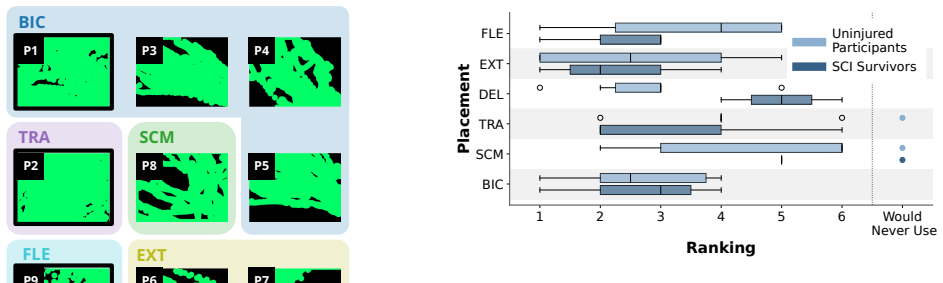
The central claim: a control signal can be read out of arbitrary tissue deformation with no learned model. Roughly 30 trackable points are selected in the brightness-mode ultrasound image; the user defines neutral, up, and down poses; the live cursor position is the average, across points, of the current position's progress along the neutral-to-up vector, normalized and clamped. The same geometric rule works on biceps, neck, shoulder, and wrist sites, using passive tissue motion when the underlying muscle is not voluntarily active. All nine participants (three with cervical spinal cord injury) achieved continuous 1-DOF control at all six placements, with best errors under 5.5% (often under 4
Load-bearing premise
The system's load-bearing premise is that the chosen sensor spot always provides enough trackable image features moving far enough — and, for 2-DOF, in sufficiently orthogonal directions — between the user's calibration poses, and that the resulting linear projection stays accurate for minutes despite tracker drift; the paper itself reports placements where this failed.
Editorial extensions
If this is right
- Continuous 1-DOF control works at all tested body locations, including placements where the user has no voluntary control of the underlying muscle, because the tracker uses passive tissue motion.
- Three-pose calibration makes it practical to quickly test many sensor locations and motions, letting each user find the control site that best fits their residual function and preference.
- Since the best placement varied by user and every placement was best for at least one participant, placement-agnosticism is a functional requirement for heterogeneous tetraplegic populations, not just a convenience.
- Single-probe 2-DOF control is feasible: all participants could modulate both axes and all three SCI participants traversed the full 2D workspace, supporting high-dimensional control without additional hardware.
- Performance is best during slow, held motions and degrades with speed and time due to optical-flow drift, so the current system is a proof point for the approach rather than a finished interface.
Reading between the lines
- If the geometric readout works at arbitrary sites, a natural next system is a 'body scan' calibration where a clinician sweeps one probe over several regions and software automatically recommends the placement with the largest, most orthogonal feature motions — something the paper's data implicitly enables.
- The 2-DOF coupling and 'binding' the authors observe suggest the independence assumption, not the image content, is the bottleneck; a nonlinear decoder or signal-decomposition step trained on the same three-pose calibration could recover more independent axes.
- The finding that passive tissue motion carries usable control signals expands the candidate body surface for tetraplegic users beyond innervated muscles; head and neck placements could serve users with no arm function, which the authors flag but did not yet recruit.
- The anti-correlation between calibration motion size and error points to a testable refinement: automatically rescaling or amplifying small feature displacements before projection could improve control for users with limited range of motion.
Editorial analysis
A structured set of objections, weighed in public.
Referee Report
Summary. The paper presents a real-time sonomyography (SMG) control system based on sparse Lucas–Kanade optical flow tracking of B-mode ultrasound features. A 1-DOF controller is calibrated from three user-defined poses (neutral, up, down) and maps the average normalized displacement of tracked points to cursor position (Eq. 1). A preliminary 2-DOF extension adds a computer-aided calibration that asks users to find a second motion approximately orthogonal to the first. The system is evaluated on 3 cervical SCI survivors and 6 uninjured participants across 6 sensor placements, with an abstract claim that all participants achieved continuous 1-DOF control at all tested sensor locations and <5.5% tracking error at least one placement, and that the 2-DOF results constitute the first location-agnostic multi-DOF continuous SMG control demonstration. The authors also release code and data via OpenMyoControl on SimTK.
Significance. If the claims hold, the work is significant: it offers a calibration-lean, placement-agnostic alternative to data-hungry SMG/sEMG decoders, with a plausible mechanism for exploiting passive tissue motion for users with tetraplegia. Strengths include the open-source release, real-time operation, inclusion of SCI participants, and exploration of anatomically diverse sensor locations. The central 1-DOF idea is simple and intuitive, and the paper is honest about several limitations in Section VI. However, the headline claims outrun the evidence: the evaluation protocol pre-screened sensor placements, incomplete trials are folded into averages, and the 2-DOF 'location-agnostic' claim rests on a single self-selected placement per participant. These issues are fixable with more transparent reporting and qualified claims, so the result is not fatally compromised.
major comments (4)
- [§IV-C and §III-A] The placement-agnostic claim is undermined by the evaluation protocol. §IV-C states that probe placement was 'adjusted as needed by investigators based on real-time inspection of the ultrasound image to ensure sufficient adherence to section III-A-defined signal qualities.' Because the tested locations were thus filtered to satisfy the algorithm's preconditions (trackable features, sufficient displacement, and, for 2-DOF, orthogonality), the abstract's 'all tested sensor locations' cannot be read as evidence for arbitrary placement. To support the central claim, the paper should report the number of initial attachment failures, the number/type of adjustments per placement, and ideally include a condition in which placements are chosen without real-time image-based correction.
- [Fig. 3 and §V-A.2] The reporting of incomplete trials is misleading. The Fig. 3 caption says values are averaged across 'all successful trials' while asterisks indicate participants who 'were unable to complete all trials' for given placements/motions (participants 2, 5, 7; BIC, TRA, DEL, FLE, SCM). These non-completions are silently absorbed into the per-placement means, so the statement in §V-A.2 that 'every participant demonstrated some level of control with every sensor placement' and the abstract's 'all participants achieved continuous 1-DOF control at all tested sensor locations' are not supported. The paper should report trial completion rates separately, treat incomplete configurations as failures in any aggregate claim, and provide a defined criterion for 'control' (e.g., RMSE relative to a no-control or chance baseline).
- [§V-A.1 and §V-A.2] No error bars, confidence intervals, or chance baseline are provided for the primary 1-DOF results. RMSE is reported as a unitless fraction of screen height, but without a comparison to chance-level tracking (e.g., cursor held at center, uncontrolled drift, or a random mapping) the numerical RMSE values do not themselves establish that a participant achieved voluntary 'control.' This is particularly important for the strongest claim, '<5.5% tracking error at at least one placement,' which needs a statistical or pre-specified threshold. Adding per-participant/per-placement variability and a null-condition comparison would make the claim falsifiable and reproducible.
- [§V-B, Fig. 6, Fig. 7] The 2-DOF 'location-agnostic' claim is not supported by the experimental design. Each participant was tested at a single self-selected sensor location, with unlimited recalibration and repositioning (§IV-D), and the results show substantial coupling, 'binding,' and inaccessible workspace regions for several participants (Fig. 6). The abstract's 'location-agnostic multi-DOF continuous SMG-based control' should be qualified to 'single arbitrary location per participant' or 'proof-of-concept at a user-selected location.' The quantitative success criteria for the drawing task (Fig. 7) should also be stated.
minor comments (5)
- [§V-A.4 / Fig. 5] The regression in Fig. 5 has R²=0.0466; the phrase 'significantly anticorrelated' is technically true (p=0.002) but the effect size is very small. Please temper the wording and discuss practical relevance.
- [§III-D] The 2-DOF orthogonality threshold ('at least 50% of available points within 30°') is presented as an empirical choice. A sensitivity analysis or at least a note on how this threshold affects calibration success would strengthen the paper.
- [§IV-C] The statement that functional attachment locations were 'largely easy to find' (footnote 1) is anecdotal. Please report the actual number of placement attempts and adjustments per participant.
- [General] Some formatting issues: '12×12cm' should be '12 cm × 12 cm'; '29.2±14.2y' should be formatted consistently; the OpenMyoControl release should include a version/access date.
- [§V-A.3 / Fig. 4] The exemplar trajectory is illustrative but not quantitatively representative. Consider reporting median/quartile trajectories or a summary statistic for the qualitative claims about overshoot and saturation.
Circularity Check
No significant circularity: the calibration defines a control law, and the evaluation measures behavioral tracking on that law rather than a fitted prediction.
full rationale
The paper's central derivation is a signal-processing construction, not a predictive model. Equation (1) defines the cursor position as the mean projected displacement of optical-flow-tracked points relative to user-defined neutral/up/down poses; it is an implemented control law rather than a quantity fitted to outcome data. The tracking task then measures how well users can hold intermediate positions on that calibrated mapping, which is a standard user-calibration loop, not a fitted-input-called-prediction: no held-out prediction is made from fitted parameters, and trajectory error is an external behavioral measurement. The only self-citations ([6], [7]) are background for the optical-flow approach; the algorithm is fully specified in Sections III-B/C using Lucas-Kanade from OpenCV, so those citations are not load-bearing. The protocol's real-time placement adjustment (Section IV-C) and recalibration allowance could weaken the external claim of placement-agnosticism, but that is a sampling/validity limitation (acknowledged in footnote 1), not circular reasoning, because placement selection does not enter Eq. (1) as a fitted parameter and no equation reduces to its input. Similarly, the computer-aided 'right' calibration in Section III-D selects a pose with orthogonal feature motion, but the drawing task evaluates independent modulation beyond the calibration points. Therefore no circular step is present.
Assumptions & free parameters
free parameters (4)
- feature counts (60 initial, <=30 tracked) =
60 / 30
- border exclusion fraction =
20% of image border
- 2-DOF orthogonality threshold =
30 degrees
- minimum orthogonal-feature fraction =
50%
assumptions (6)
- domain assumption Lucas-Kanade optical flow assumes brightness constancy and small inter-frame motion between ultrasound frames.
- domain assumption Tissue deformation between calibration poses is approximately linear, so the mean-projection cursor mapping (Eq. 1) is valid.
- domain assumption User-selected calibration poses bracket the range of intended control and remain stable across the trial.
- domain assumption RMSE relative to screen height is a meaningful measure of control performance; a chance-level or no-control baseline is not needed.
- domain assumption At non-innervated sensor sites, residual or passive tissue motion can still drive the cursor.
- standard math Principal component analysis identifies the direction of maximal feature spread for resampling.
Cite this review
Pith. "Pith review of Sensor-Placement-Agnostic Sonomyography: Toward Continuous High-Dimensional Control by Users with Tetraplegia." pith.science (2026). https://pith.science/paper/Y6TWJGLC
@misc{pith2026260726401,
  author       = {Pith},
  title        = {Pith review of: Sensor-Placement-Agnostic Sonomyography: Toward Continuous High-Dimensional Control by Users with Tetraplegia},
  year         = {2026},
  howpublished = {\url{https://pith.science/paper/Y6TWJGLC}},
  note         = {Machine review of arXiv:2607.26401}
}
read the original abstract
Sonomyography (SMG) enables continuous device control via ultrasound-measured muscle deformation signals, but existing SMG interfaces generally require substantial user- and sensor-location-specific training data and provide only one proportional signal or task-specific classification. We present a real-time, sensor-placement-agnostic SMG control system based on sparse optical flow tracking that enables continuous 1-DOF control after minimal calibration (3 pose definitions). We also present a preliminary expansion of this method that augments this algorithm with a short computer-aided calibration to enable 2-DOF control. We evaluate both 1- and 2-DOF systems' performance for a preliminary cohort of 3 cervical spinal cord injury survivors and 6 uninjured individuals across 6 sensor placements spanning the arm, neck, and upper torso. As assessed by a cursor trajectory tracking task, all participants achieved continuous 1-DOF control at all tested sensor locations (even those that relied on passive tissue motions), with all participants achieving <5.5% tracking error using at least one placement (and many <4% across many). All participants were also able to modulate 2D cursor position via the 2-DOF system, with varying levels of control authority, and several were able to complete a 2D drawing task, constituting the first (to our knowledge) demonstration of location-agnostic multi-DOF continuous SMG-based control. These results highlight the promise of SMG to enable rapidly calibratable, high-dimensional, sensor-placement-agnostic device control by users with tetraplegia, and also illuminate key challenges in both signal processing and practical system deployment. To enable further development by scientific and user communities, developed algorithms have been open-sourced as part of the OpenMyoControl project on SimTK (simtk.org/projects/openmyocontrol).
Figures


Figures from the paper (4 more)



Reference graph
Works this paper leans on
-
[1]
A review and ap- praisal of clinically prevalent control devices for electrically powered wheelchairs,
G. I. Henderson, M. J. Dolan, and C. J. Geggie, “A review and ap- praisal of clinically prevalent control devices for electrically powered wheelchairs,”Technology and Disability, vol. 25, no. 4, pp. 221–232, 2013
2013
-
[2]
Control of a wheelchair-mounted 6DOF assistive robot with chin and finger joysticks,
I. Rulik, M. S. H. Sunnyet al., “Control of a wheelchair-mounted 6DOF assistive robot with chin and finger joysticks,”Frontiers in Robotics and AI, vol. 9, p. 885610, 2022
2022
-
[3]
Controlling a robotic arm for functional tasks using a wireless head-joystick: A case study of a child with congenital absence of upper and lower limbs,
S. Aspelund, P. Patelet al., “Controlling a robotic arm for functional tasks using a wireless head-joystick: A case study of a child with congenital absence of upper and lower limbs,”PLOS One, vol. 15, no. 8, p. e0226052, 2020
2020
-
[4]
Comparative study on different adaptation approaches concerning a sip and puff controller for a powered wheelchair,
I. Mougharbel, R. El-Hajjet al., “Comparative study on different adaptation approaches concerning a sip and puff controller for a powered wheelchair,” in2013 Science and Information Conference. IEEE, 2013, pp. 597–603
2013
-
[5]
Sonomyography for Control of Upper-Limb Prostheses: Current State and Future Directions,
S. M. Engdahl, S. A. Acu ˜naet al., “Sonomyography for Control of Upper-Limb Prostheses: Current State and Future Directions,”JPO: Journal of Prosthetics and Orthotics, vol. 36, no. 3, p. 174, Jul. 2024
2024
-
[6]
Muscle deformation correlates with output force during isometric contraction,
L. A. Hallock, A. Veluet al., “Muscle deformation correlates with output force during isometric contraction,” inBioRob. IEEE, 2020
2020
-
[7]
Toward Real-Time Muscle Force Inference and Device Control via Optical-Flow-Tracked Muscle De- formation,
L. A. Hallock, B. Sudet al., “Toward Real-Time Muscle Force Inference and Device Control via Optical-Flow-Tracked Muscle De- formation,”IEEE TNSRE, vol. 29, pp. 2625–2634, 2021
2021
-
[8]
Targeting recovery: Priorities of the spinal cord- injured population,
K. D. Anderson, “Targeting recovery: Priorities of the spinal cord- injured population,”Journal of Neurotrauma, vol. 21, no. 10, pp. 1371–1383, 2004
2004
Show all 21 references
-
[9]
Traumatic spinal cord injury facts and figures at a glance,
National Spinal Cord Injury Statistical Center, “Traumatic spinal cord injury facts and figures at a glance,” 2024, accessed: 2025-06-26
2024
-
[10]
Jaco assistive robot user guide,
Kinova, “Jaco assistive robot user guide,” https://assistive. kinovarobotics.com/uploads/EN-UG-007-Jaco-user-guide-R05.pdf, 2021, accessed: 2025-06-26
2021
-
[11]
emg2pose: A Large and Diverse Benchmark for Surface Electromyographic Hand Pose Estimation,
S. Salter, R. Warrenet al., “emg2pose: A Large and Diverse Benchmark for Surface Electromyographic Hand Pose Estimation,” Dec. 2024, arXiv:2412.02725 [cs]. [Online]. Available: http://arxiv. org/abs/2412.02725
2024 arXiv
-
[12]
Proprioceptive Sonomyographic Control: A novel method for intuitive and proportional control of multiple degrees-of-freedom for individuals with upper extremity limb loss,
A. S. Dhawan, B. Mukherjeeet al., “Proprioceptive Sonomyographic Control: A novel method for intuitive and proportional control of multiple degrees-of-freedom for individuals with upper extremity limb loss,”Scientific Reports, vol. 9, no. 1, p. 9499, Jul. 2019
2019
-
[13]
Review of sEMG for Robot Control: Tech- niques and Applications,
T. Song, Z. Yanet al., “Review of sEMG for Robot Control: Tech- niques and Applications,”Applied Sciences, vol. 13, no. 17, p. 9546, Jan. 2023
2023
-
[14]
A Sonomyography-Based Muscle Computer Interface for Individuals With Spinal Cord Injury,
M. Shenbagam, A. T. Kamathamet al., “A Sonomyography-Based Muscle Computer Interface for Individuals With Spinal Cord Injury,” IEEE Journal of Biomedical and Health Informatics, vol. 28, no. 5, pp. 2713–2722, May 2024
2024
-
[15]
An iterative image registration technique with an application to stereo vision,
B. D. Lucas and T. Kanade, “An iterative image registration technique with an application to stereo vision,” inProceedings of Imaging Understanding Workshop, 1981, pp. 121–130
1981
-
[16]
The OpenCV Library,
G. Bradski, “The OpenCV Library,”Dr. Dobb’s Journal of Software Tools, pp. 120–125, 2000
2000
-
[17]
Good features to track,
J. Shi and Tomasi, “Good features to track,” inCVPR, Jun. 1994, pp. 593–600, iSSN: 1063-6919
1994
-
[18]
Measuring emotion: The Self- Assessment Manikin and the Semantic Differential,
M. M. Bradley and P. J. Lang, “Measuring emotion: The Self- Assessment Manikin and the Semantic Differential,”Journal of Behav- ior Therapy and Experimental Psychiatry, vol. 25, no. 1, pp. 49–59, 1994
1994
-
[19]
A technique for the measurement of attitudes,
R. Likert, “A technique for the measurement of attitudes,”Archives of Psychology, 1932
1932
-
[20]
Uncertainty Quantification of Lucas Kanade Feature Track and Application to Visual Odometry,
X. I. Wong and M. Majji, “Uncertainty Quantification of Lucas Kanade Feature Track and Application to Visual Odometry,” inCVPR Workshops, Jul. 2017, pp. 950–958, iSSN: 2160-7516
2017
-
[21]
Learning to control complex robots using high-dimensional body-machine interfaces,
J. Lee, T. Gebrekristoset al., “Learning to control complex robots using high-dimensional body-machine interfaces,”ACM Transactions on Human–Robot Interaction, vol. 13, no. 3, pp. 1–20, 2024
2024
Reviewed August 1, 2026 · model on record in the stance chip above.
Discussion (0). Continue with ORCID to comment.