Hyperbolicity-Preserving Stochastic Galerkin Methods for Conservation Laws Based on Associative Truncated Products on Polynomial Spaces
Pith reviewed 2026-06-27 08:46 UTC · model grok-4.3
The pith
Associative truncated products on polynomial spaces let stochastic Galerkin discretizations of hyperbolic conservation laws keep their flux Jacobian hyperbolic.
A machine-rendered reading of the paper's core claim, the machinery that carries it, and where it could break.
Core claim
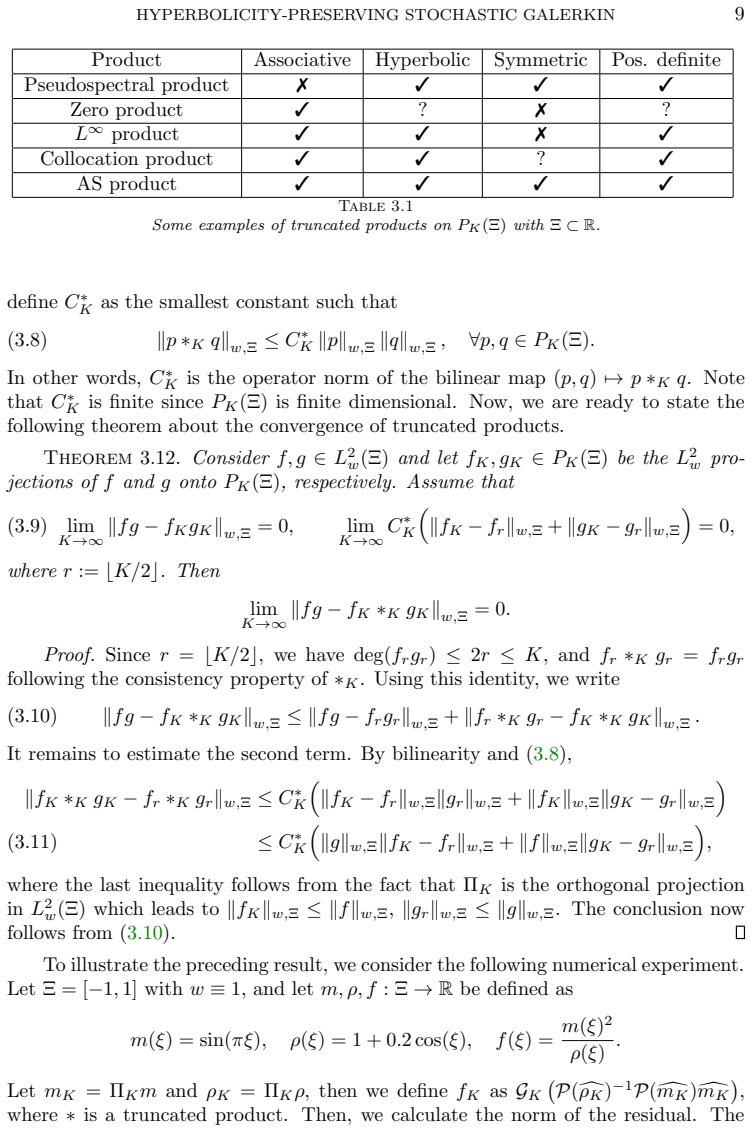
We develop a novel framework for constructing hyperbolicity-preserving stochastic Galerkin systems based on associative truncated products on polynomial spaces. In one stochastic dimension, we characterize associative truncated products through a single polynomial datum and identify examples with useful symmetry, positivity, and spectral properties, including collocation products and an associative symmetric product based on Gaussian quadrature nodes. We prove a consistency result showing that, under suitable projection-error assumptions, these products converge to the classical product as the polynomial degree grows. For systems with rational fluxes, we derive sufficient conditions under wh
What carries the argument
associative truncated product on polynomial spaces, which forces the flux Jacobian blocks to commute and thereby preserves hyperbolicity of the stochastic Galerkin system
If this is right
- For any rational flux, the derived conditions guarantee that the stochastic Galerkin system stays hyperbolic on the admissible set.
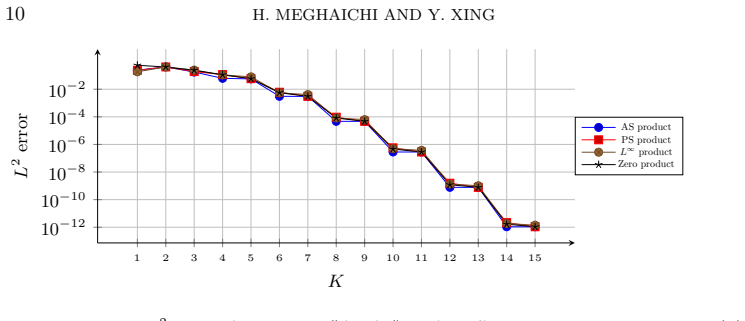
- The computed stochastic Galerkin states for the one-dimensional isothermal and compressible Euler equations remain hyperbolic while delivering accurate statistical moments.
- The new products converge to the ordinary product with growing polynomial degree whenever the projection-error assumptions hold.
- The framework supplies explicit examples (collocation products and the Gaussian-quadrature symmetric product) that already satisfy the required symmetry and positivity properties.
Where Pith is reading between the lines
- If an associative truncated product can be constructed in several stochastic dimensions, the same hyperbolicity argument would apply to multi-dimensional uncertainty quantification.
- The rational-flux condition suggests the method may extend directly to other conservation laws whose fluxes are ratios of polynomials, such as certain shallow-water or magnetohydrodynamic models.
Load-bearing premise
Under suitable projection-error assumptions the truncated products converge to the classical product as the polynomial degree grows.
What would settle it
A concrete counter-example in which a rational-flux system satisfies the stated sufficient conditions yet the stochastic Galerkin Jacobian still has non-commuting blocks and loses hyperbolicity.
Figures


read the original abstract
Stochastic Galerkin discretizations of nonlinear hyperbolic conservation laws may lose hyperbolicity because the standard pseudospectral product is generally nonassociative, leading to non-commuting blocks in the flux Jacobian matrix. We develop a novel framework for constructing hyperbolicity-preserving stochastic Galerkin systems based on associative truncated products on polynomial spaces. In one stochastic dimension, we characterize associative truncated products through a single polynomial datum and identify examples with useful symmetry, positivity, and spectral properties, including collocation products and an associative symmetric product based on Gaussian quadrature nodes. We prove a consistency result showing that, under suitable projection-error assumptions, these products converge to the classical product as the polynomial degree grows. For systems with rational fluxes, we derive sufficient conditions under which the resulting stochastic Galerkin flux remains hyperbolic on the corresponding admissible set. Applications to the one-dimensional isothermal and compressible Euler equations show accurate statistical approximation and robust hyperbolicity preservation of the computed stochastic Galerkin states.
Editorial analysis
A structured set of objections, weighed in public.
Referee Report
Summary. The paper develops a framework for hyperbolicity-preserving stochastic Galerkin discretizations of nonlinear hyperbolic conservation laws via associative truncated products on polynomial spaces. In one stochastic dimension, associative truncated products are characterized by a single polynomial datum; examples include collocation products and an associative symmetric product based on Gaussian quadrature nodes. A consistency result is proved under suitable projection-error assumptions, showing convergence to the classical product as polynomial degree grows. Sufficient conditions are derived for the SG flux to remain hyperbolic on the admissible set when the flux is rational. Numerical applications to the isothermal and compressible Euler equations demonstrate accurate statistical approximations while preserving hyperbolicity.
Significance. If the projection-error assumptions hold for the constructed products, the framework supplies a systematic algebraic construction that restores hyperbolicity to SG systems, directly addressing a well-known obstacle in applying polynomial chaos methods to hyperbolic conservation laws. The explicit characterization via a single polynomial datum and the derivation of hyperbolicity conditions for rational fluxes are constructive contributions that could be reused beyond the Euler examples.
major comments (1)
- [Abstract (consistency result paragraph)] Abstract (consistency result paragraph): the claim that the new products converge to the classical product rests on unspecified 'suitable projection-error assumptions,' yet the manuscript provides no verification that these assumptions are satisfied by the concrete constructions (collocation products or the Gaussian-quadrature symmetric product). Without this verification the consistency result does not establish that the hyperbolicity-preserving SG system converges to the original conservation law, which is load-bearing for the central justification of the method.
Simulated Author's Rebuttal
We thank the referee for the careful reading and constructive feedback. The single major comment is addressed below; we agree it identifies a gap in the current presentation and will revise accordingly.
read point-by-point responses
-
Referee: [Abstract (consistency result paragraph)] Abstract (consistency result paragraph): the claim that the new products converge to the classical product rests on unspecified 'suitable projection-error assumptions,' yet the manuscript provides no verification that these assumptions are satisfied by the concrete constructions (collocation products or the Gaussian-quadrature symmetric product). Without this verification the consistency result does not establish that the hyperbolicity-preserving SG system converges to the original conservation law, which is load-bearing for the central justification of the method.
Authors: We agree that the consistency result is conditional on the projection-error assumptions and that the manuscript does not supply explicit verification for the collocation products or the Gaussian-quadrature symmetric product. This weakens the link between the abstract consistency statement and the concrete constructions. In the revised manuscript we will add a short subsection (or appendix) that verifies the assumptions for both families. For collocation products the projection error is identically zero by the exact interpolation property at the nodes. For the quadrature-based symmetric product we will supply explicit bounds on the projection errors that follow from standard Gaussian quadrature error estimates, confirming the required decay as the polynomial degree tends to infinity. revision: yes
Circularity Check
No significant circularity; derivation is self-contained algebraic construction
full rationale
The paper defines associative truncated products on polynomial spaces via a single polynomial datum, constructs explicit examples (collocation and Gaussian-quadrature symmetric products), and derives consistency and hyperbolicity conditions from those definitions plus stated projection-error assumptions. No load-bearing step reduces by construction to a fitted parameter renamed as prediction, a self-citation chain, or an ansatz smuggled from prior work; the framework is built directly from polynomial algebra without the target results being equivalent to the inputs. The consistency claim is conditional on external assumptions rather than tautological, and the hyperbolicity conditions for rational fluxes follow from the algebraic properties without circular reduction.
Axiom & Free-Parameter Ledger
axioms (1)
- domain assumption Suitable projection-error assumptions hold so that truncated products converge to the classical product
invented entities (1)
-
Associative truncated products on polynomial spaces
no independent evidence
Reference graph
Works this paper leans on
-
[1]
and Schwab,
Mishra, S. and Schwab,. Sparse Tensor Multi-Level. Mathematics of Computation , volume =
-
[2]
Feireisl, Eduard and. Monte. Stochastics and Partial Differential Equations: Analysis and Computations , issn =
-
[3]
Multilevel
Barth, Andrea and Lang, Annika and Schwab, Christoph , year = 2013, month = mar, journal =. Multilevel
2013
-
[4]
An Introduction to
Pareschi, Lorenzo and Russo, Giovanni , year = 2001, volume =. An Introduction to
2001
-
[5]
Curves and
Abate, Marco and Tovena, Francesca , year = 2012, series =. Curves and
2012
-
[6]
Modern differential geometry of curves and surfaces with
Abbena, Elsa and Salamon, Simon and Gray, Alfred , year = 2006, month = jun, series =. Modern differential geometry of curves and surfaces with
2006
-
[7]
and Mishra, S
Abgrall, R. and Mishra, S. , year = 2017, month = jan, series =. Chapter 19 -. Handbook of
2017
-
[8]
Handbook of mathematical functions with formulas, graphs, and mathematical tables , author =
-
[9]
Adaptivity and
Adjerid, Slimane and Baccouch, Mahboub , year = 2014, pages =. Adaptivity and. Recent
2014
-
[10]
Asymptotically exact discontinuous
Adjerid, Slimane and Weinhart, Thomas , year = 2014, month = feb, journal =. Asymptotically exact discontinuous
2014
-
[11]
Adjerid, Slimane and Lin, Tao and Meghaichi, Haroun , year = 2025, month = oct, number =. Construction of. arXiv , keywords =:2510.12018 , primaryclass =
arXiv 2025
-
[12]
Computer Methods in Applied Mechanics and Engineering , volume =
An enriched immersed finite element method for interface problems with nonhomogeneous jump conditions , author =. Computer Methods in Applied Mechanics and Engineering , volume =
-
[13]
Journal of Scientific Computing , volume =
Error estimates for an immersed finite element method for second order hyperbolic equations in inhomogeneous media , author =. Journal of Scientific Computing , volume =
-
[14]
Adjerid, Slimane and Lin, Tao and Meghaichi, Haroun , year = 2025, month = apr, journal =. The
2025
-
[15]
International Journal of Numerical Analysis and Modeling , volume =
High degree immersed finite element spaces by a least squares method , author =. International Journal of Numerical Analysis and Modeling , volume =
-
[16]
International Journal of Numerical Analysis and Modeling , volume =
Higher degree immersed finite element methods for second-order elliptic interface problems , author =. International Journal of Numerical Analysis and Modeling , volume =
-
[17]
Computers & Mathematics with Applications , volume =
Higher degree immersed finite element spaces constructed according to the actual interface , author =. Computers & Mathematics with Applications , volume =
-
[18]
and Moon, K
Adjerid, S. and Moon, K. , year = 2014, pages =. A higher order immersed discontinuous. Advances in
2014
-
[19]
Computer Methods in Applied Mechanics and Engineering , volume =
A high order geometry conforming immersed finite element for elliptic interface problems , author =. Computer Methods in Applied Mechanics and Engineering , volume =
-
[20]
An immersed discontinuous finite element method for
Adjerid, Slimane and Chaabane, Nabil and Lin, Tao , year = 2015, month = aug, journal =. An immersed discontinuous finite element method for
2015
-
[21]
An immersed discontinuous finite element method for the
Adjerid, Slimane and Chaabane, Nabil and Lin, Tao and Yue, Pengtao , year = 2019, month = dec, journal =. An immersed discontinuous finite element method for the
2019
-
[22]
An immersed discontinuous
Adjerid, Slimane and Moon, Kihyo , year = 2019, month = jan, journal =. An immersed discontinuous
2019
-
[23]
An immersed discontinuous
Adjerid, Slimane and Lin, Tao and Meghaichi, Haroun , year = 2023, month = jan, journal =. An immersed discontinuous
2023
-
[24]
An improved superconvergence error estimate for the
Adjerid, Slimane and Chaabane, Nabil , year = 2015, month = dec, journal =. An improved superconvergence error estimate for the
2015
-
[25]
Adjerid, Slimane and Lin, Tao and Haroun, Meghaichi , year = 2025, month = oct, abstract =. A
2025
-
[26]
Applied Numerical Mathematics , volume =
A p-th degree immersed finite element for boundary value problems with discontinuous coefficients , author =. Applied Numerical Mathematics , volume =
-
[27]
Computers & Mathematics with Applications , volume =
A study of high-order immersed finite element spaces by pointwise interface conditions on curved interfaces , author =. Computers & Mathematics with Applications , volume =
-
[28]
Adjerid, Hamza and Borggaard, Jeff , year = 2024, month = jul, pages =. Sum of. 2024
2024
-
[29]
A superconvergent discontinuous
Adjerid, Slimane and Mechai, Idir , year = 2014, month = jan, journal =. A superconvergent discontinuous
2014
-
[30]
BIT Numerical Mathematics , volume =
A unified immersed finite element error analysis for one-dimensional interface problems , author =. BIT Numerical Mathematics , volume =
-
[31]
and Khamsi, Mohamed A
Aksoy, Asuman G. and Khamsi, Mohamed A. , year = 2010, series =. A
2010
-
[32]
Zeitschrift f\"ur angewandte Mathematik und Physik ZAMP , volume =
Energy methods for a parabolic-hyperbolic interface problem arising in electromagnetism , author =. Zeitschrift f\"ur angewandte Mathematik und Physik ZAMP , volume =
-
[33]
, year = 1993, month = jan, journal =
Alpert, Bradley K. , year = 1993, month = jan, journal =. A
1993
-
[34]
and Gaiceanu, Marian and Stanculescu, Marilena and Andrei, Paul Cristian , year = 2021, pages =
Andrei, Horia and Micu, Dan D. and Gaiceanu, Marian and Stanculescu, Marilena and Andrei, Paul Cristian , year = 2021, pages =. Advanced. Numerical
2021
-
[35]
Numerical
Angermann, Lutz and Knabner, Peter , year = 2003, series =. Numerical
2003
-
[36]
Formulae and software for particular solutions to the elastic wave equation in curved geometries , author =
-
[37]
SIAM Journal on Numerical Analysis , volume =
An interior penalty finite element method with discontinuous elements , author =. SIAM Journal on Numerical Analysis , volume =
-
[38]
Arnold, D. N. and Brezzi, F. and Fortin, M. , year = 1984, month = dec, journal =. A stable finite element for the
1984
-
[39]
and Brezzi, Franco and Cockburn, Bernardo and Marini, L
Arnold, Douglas N. and Brezzi, Franco and Cockburn, Bernardo and Marini, L. Donatella , year = 2002, month = jan, journal =. Unified analysis of discontinuous
2002
-
[40]
SIAM Journal on Scientific Computing , volume =
Randomized approach to nonlinear inversion combining random and optimized simultaneous sources and detectors , author =. SIAM Journal on Scientific Computing , volume =
-
[41]
Axler, Sheldon , year = 2024, series =. Linear
2024
-
[42]
Computing , volume =
The finite element method for elliptic equations with discontinuous coefficients , author =. Computing , volume =
-
[43]
Galerkin
Babu. Galerkin. SIAM Journal on Numerical Analysis , volume =. 4101097 , eprinttype =
-
[44]
Solving elliptic boundary value problems with uncertain coefficients by the finite element method: the stochastic formulation , shorttitle =
Babu. Solving elliptic boundary value problems with uncertain coefficients by the finite element method: the stochastic formulation , shorttitle =. Computer Methods in Applied Mechanics and Engineering , series =
-
[45]
Babu. A. SIAM Journal on Numerical Analysis , volume =
-
[46]
A posteriori local discontinuous
Baccouch, Mahboub and Adjerid, Slimane , year = 2015, month = feb, journal =. A posteriori local discontinuous
2015
-
[47]
A convergent adaptive finite element stochastic
Bachmayr, Markus and Eigel, Martin and Eisenmann, Henrik and Voulis, Igor , year = 2025, month = mar, number =. A convergent adaptive finite element stochastic. arXiv , keywords =:2403.13770 , primaryclass =
arXiv 2025
-
[48]
Computer Physics Communications , volume =
An implicit particle-in-cell model based on anisotropic immersed-finite-element method , author =. Computer Physics Communications , volume =
-
[49]
Computers & Mathematics with Applications , series =
An improved immersed finite element particle-in-cell method for plasma simulation , author =. Computers & Mathematics with Applications , series =
-
[50]
Computers & Mathematics with Applications , volume =
Modeling and an immersed finite element method for an interface wave equation , author =. Computers & Mathematics with Applications , volume =
-
[51]
and Jureidini, Wadi N
Baker, Garth A. and Jureidini, Wadi N. and Karakashian, Ohannes A. , year = 1990, month = dec, journal =. Piecewise solenoidal vector fields and the
1990
-
[52]
2006 , journal =
Gas flow in pipeline networks , author =. 2006 , journal =
2006
-
[53]
Equal-order stabilized finite elements with nitsche for the stationary navier-
Bansal, Aparna and Barnafi, Nicol. Equal-order stabilized finite elements with nitsche for the stationary navier-. Computer Methods in Applied Mechanics and Engineering , volume =
-
[54]
Numerical
Bartels, S. Numerical
-
[55]
On the propagation of statistical model parameter uncertainty in
Barth, Timothy , year = 2012, month = oct, journal =. On the propagation of statistical model parameter uncertainty in
2012
-
[56]
Numerische Mathematik , volume =
Norms and exclusion theorems , author =. Numerische Mathematik , volume =
-
[57]
Mathematical Models and Methods in Applied Sciences , volume =
The. Mathematical Models and Methods in Applied Sciences , volume =
-
[58]
Higher-order immersed finite element spaces for second-order elliptic interface problems with quadratic interface , booktitle =
-
[59]
Entropy-
Bender, Janina and. Entropy-. Communications on Applied Mathematics and Computation , volume =
-
[60]
and Borio, A
Berrone, S. and Borio, A. , year = 2017, month = jul, journal =. Orthogonal polynomials in badly shaped polygonal elements for the
2017
-
[61]
Proceedings of the Conference on Matrix Methods in Structural Mechanics , pages =
The generation of interelement compatible stiffness and mass matrices by the use of interpolation formulae , author =. Proceedings of the Conference on Matrix Methods in Structural Mechanics , pages =
-
[62]
Journal of Functional Analysis , volume =
Nonnegative functions as squares or sums of squares , author =. Journal of Functional Analysis , volume =
-
[63]
Borggaard, Jeff and Zietsman, Lizette , year = 2020, month = jul, pages =. The. 2020
2020
-
[64]
SIAM Review , volume =
Optimization methods for large-scale machine learning , author =. SIAM Review , volume =
-
[65]
Braess, Dietrich , year = 2007, edition =. Finite
2007
-
[66]
Advances in Computational Mathematics , volume =
A finite element method for interface problems in domains with smooth boundaries and interfaces , author =. Advances in Computational Mathematics , volume =
-
[67]
and Sung, Li-Yeng , year = 2005, month = jun, journal =
Brenner, Susanne C. and Sung, Li-Yeng , year = 2005, month = jun, journal =. C 0
2005
-
[68]
and Scott, L
Brenner, Susanne C. and Scott, L. Ridgway , year = 2002, series =. The
2002
-
[69]
Mathematical Models and Methods in Applied Sciences , volume =
Virtual element methods on meshes with small edges or faces , author =. Mathematical Models and Methods in Applied Sciences , volume =
-
[70]
, year = 2020, month = jun, journal =
Burman, Erik and Hansbo, Peter and Larson, Mats G. , year = 2020, month = jun, journal =. Cut
2020
-
[71]
and Massing, Andr
Burman, Erik and Claus, Susanne and Hansbo, Peter and Larson, Mats G. and Massing, Andr. International Journal for Numerical Methods in Engineering , volume =
-
[72]
Computer Methods in Applied Mechanics and Engineering , volume =
Unfitted hybrid high-order methods for the wave equation , author =. Computer Methods in Applied Mechanics and Engineering , volume =
-
[73]
Globally
Cai, Zhenning and Fan, Yuwei and Li, Ruo , year = 2014, journal =. Globally
2014
-
[74]
Cai, Ying and Chen, Jinru and Wang, Nan , year = 2021, month = aug, journal =. A
2021
-
[75]
Advances in Computational Mathematics , volume =
Quadratic immersed finite element spaces and their approximation capabilities , author =. Advances in Computational Mathematics , volume =
-
[76]
Canizares, Priscilla and Murari, Davide and Sch. Hamiltonian. arXiv , langid =:2410.18262 , primaryclass =
-
[77]
Yousuff and Quarteroni, Alfio and Zang, Thomas A
Canuto, Claudio and Hussaini, M. Yousuff and Quarteroni, Alfio and Zang, Thomas A. , year = 1988, publisher =. Spectral
1988
-
[78]
Communications in Nonlinear Science and Numerical Simulation , volume =
A huygens immersed-finite-element particle-in-cell method for modeling plasma-surface interactions with moving interface , author =. Communications in Nonlinear Science and Numerical Simulation , volume =
-
[79]
Journal of Computational and Applied Mathematics , series =
Immersed finite element methods for unbounded interface problems with periodic structures , author =. Journal of Computational and Applied Mathematics , series =
-
[80]
Journal of Scientific Computing , volume =
Immersed virtual element methods for elliptic interface problems in two dimensions , author =. Journal of Scientific Computing , volume =
discussion (0)
Sign in with ORCID, Apple, or X to comment. Anyone can read and Pith papers without signing in.