WaveDiT: Distribution-Aware Wavelet Flow Matching for Efficient 3D Brain MRI Synthesis
Pith reviewed 2026-06-27 18:38 UTC · model grok-4.3
The pith
WaveDiT performs full-resolution 3D brain MRI synthesis on a single GPU by running conditional flow matching inside 3D Haar wavelet coefficient space with band-wise uncertainty prediction.
A machine-rendered reading of the paper's core claim, the machinery that carries it, and where it could break.
Core claim
The central claim is that a conditional flow-matching model defined directly on 3D Haar wavelet coefficients, equipped with band-wise heteroscedastic uncertainty estimates derived from higher-order wavelet statistics, produces full-resolution brain MRIs under single-GPU memory and time limits while achieving tighter distribution match and stronger performance on brain-age prediction and anatomical segmentation agreement than existing diffusion, latent-diffusion, and wavelet baselines.
What carries the argument
Conditional flow matching inside 3D Haar discrete wavelet transform coefficient space, with predicted log-variance fed into both the flow objective and the conditioning pathway to handle input-dependent variance across wavelet bands.
If this is right
- Full-resolution 3D generative augmentation becomes feasible on ordinary single-GPU hardware.
- Generated volumes exhibit closer statistical alignment to real multi-site MRI distributions.
- Brain-age regression and anatomical region agreement improve over diffusion, latent, and earlier wavelet methods.
- The same single-GPU training and inference regime scales to larger cohorts without specialized infrastructure.
Where Pith is reading between the lines
- The uncertainty-aware wavelet representation could be tested on other volumetric modalities such as CT or PET to check whether the same memory savings appear.
- If the band-wise variance modeling proves robust, it might allow direct synthesis at even higher resolutions or with thinner slices without additional hardware.
- The approach leaves open whether the same wavelet-flow backbone can be conditioned on non-imaging variables such as age, sex, or disease labels while preserving the reported efficiency gains.
Load-bearing premise
The 3D Haar wavelet coefficient representation together with per-band uncertainty estimates retains enough anatomical detail and distributional properties to support reliable downstream clinical tasks.
What would settle it
Running the same downstream brain-age prediction and region-level segmentation evaluation on the multi-site cohort and finding no improvement (or a clear drop) in accuracy or Dice scores relative to the diffusion and latent baselines would falsify the central claim.
Figures

read the original abstract
Large and demographically balanced datasets are essential for reliable neuroimaging biomarkers. Full-resolution 3D brain MRI synthesis can support data augmentation in this setting, but existing approaches either incur prohibitive computational cost at volumetric scale or rely on lossy latent compression that may compromise anatomical detail. As a result, practical 3D generative augmentation often requires specialized compute infrastructure. We propose WaveDiT, a conditional flow matching framework operating in the coefficient space of a 3D Haar Discrete Wavelet Transform. The model combines factorized spatio-depth attention with band-wise heteroscedastic uncertainty modeling derived from higher-order wavelet statistics. Predicted log-variance is integrated directly into both the flow objective and conditioning pathway, enabling adaptive precision consistent with the heavy-tailed and input-dependent variance structure of anatomical detail. This formulation supports full-resolution 3D synthesis under practical memory and time constraints on a single modern GPU. Evaluation on a multi-site cohort demonstrates improved alignment between generated and real MRI distributions, together with enhanced downstream brain age prediction and region-level anatomical agreement relative to diffusion, latent, and wavelet-based baselines. Code is available at https://github.com/sisinflab/WaveDiT
Editorial analysis
A structured set of objections, weighed in public.
Referee Report
Summary. The paper introduces WaveDiT, a conditional flow matching model that operates directly in the coefficient space of a 3D Haar discrete wavelet transform for full-resolution 3D brain MRI synthesis. It employs factorized spatio-depth attention and band-wise heteroscedastic uncertainty modeling (derived from higher-order wavelet statistics) that is integrated into both the flow objective and conditioning. The method is claimed to enable practical single-GPU synthesis while improving distribution alignment, brain-age prediction accuracy, and region-level anatomical agreement over diffusion, latent, and wavelet baselines on a multi-site cohort. Code is released.
Significance. If the central claims hold, the work would provide a practical route to high-resolution 3D generative augmentation for neuroimaging without specialized hardware, directly addressing the need for demographically balanced datasets. The combination of wavelet-domain flow matching with input-dependent uncertainty modeling is a distinctive technical contribution; the public code release further strengthens reproducibility.
major comments (2)
- [Evaluation / downstream tasks] The strongest empirical claim (enhanced brain-age prediction and region-level agreement) rests on the assumption that the 3D Haar DWT coefficient space plus band-wise log-variance conditioning preserves the high-frequency anatomical cues that drive age-related structural variation. The manuscript provides no ablation that isolates the contribution of high-frequency sub-bands, no quantitative comparison of frequency content before/after the inverse transform, and no analysis of blocky artifacts known to arise with Haar bases. Without such evidence the downstream gains could be an artifact of the evaluation protocol rather than proof that the generative model succeeded in the wavelet domain.
- [Method formulation] The abstract and method description assert that predicted log-variance is integrated into both the flow objective and conditioning pathway, yet no explicit equation is given for the heteroscedastic flow-matching loss or for how the variance modulates the velocity field. This omission makes it impossible to verify that the uncertainty modeling is distribution-aware in the claimed sense or that it is not simply re-weighting the standard CFM objective.
minor comments (2)
- [Experiments] The multi-site cohort description should include explicit subject counts per site and scanner parameters to allow assessment of domain-shift handling.
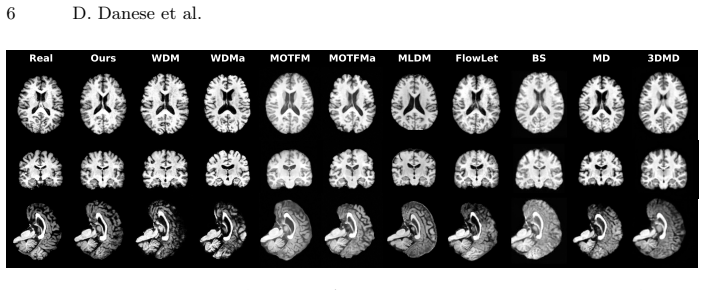
- [Figures] Figure captions for qualitative results should state the exact slice location and windowing used so that visual comparisons are reproducible.
Simulated Author's Rebuttal
We thank the referee for the constructive feedback. The comments highlight areas where additional clarity and analysis will strengthen the manuscript. We address each major comment below and will revise accordingly.
read point-by-point responses
-
Referee: [Evaluation / downstream tasks] The strongest empirical claim (enhanced brain-age prediction and region-level agreement) rests on the assumption that the 3D Haar DWT coefficient space plus band-wise log-variance conditioning preserves the high-frequency anatomical cues that drive age-related structural variation. The manuscript provides no ablation that isolates the contribution of high-frequency sub-bands, no quantitative comparison of frequency content before/after the inverse transform, and no analysis of blocky artifacts known to arise with Haar bases. Without such evidence the downstream gains could be an artifact of the evaluation protocol rather than proof that the generative model succeeded in the wavelet domain.
Authors: We agree that the current evaluation would benefit from explicit isolation of high-frequency contributions and artifact analysis. In the revised manuscript we will add (i) an ablation that systematically masks or removes high-frequency wavelet sub-bands and reports the resulting change in brain-age prediction and region-level metrics, (ii) a quantitative frequency-content comparison (power spectra) of real versus reconstructed volumes before and after the inverse DWT, and (iii) both qualitative examples and quantitative metrics (edge sharpness, local variance) addressing potential blocky artifacts. These additions will allow readers to directly assess whether the observed downstream improvements are attributable to faithful modeling of anatomical detail in the wavelet domain. revision: yes
-
Referee: [Method formulation] The abstract and method description assert that predicted log-variance is integrated into both the flow objective and conditioning pathway, yet no explicit equation is given for the heteroscedastic flow-matching loss or for how the variance modulates the velocity field. This omission makes it impossible to verify that the uncertainty modeling is distribution-aware in the claimed sense or that it is not simply re-weighting the standard CFM objective.
Authors: We acknowledge that the explicit mathematical formulation is missing from the current text. In the revision we will insert the precise heteroscedastic conditional flow-matching objective, showing how the predicted per-band log-variance enters both the loss (as an adaptive weighting term derived from higher-order wavelet statistics) and the conditioning pathway that modulates the velocity-field prediction. This will make the distribution-aware character of the model verifiable and distinguish it from simple re-weighting of the standard CFM loss. revision: yes
Circularity Check
No circularity detected; derivation self-contained
full rationale
The provided abstract and description outline a conditional flow matching model in 3D Haar wavelet coefficient space with band-wise heteroscedastic uncertainty, but contain no equations, self-citations, or derivation steps that reduce by construction to fitted inputs or prior author results. Claims rest on empirical downstream evaluations (brain age prediction, distribution alignment) rather than tautological redefinitions or forced predictions. No load-bearing self-citation chains or ansatz smuggling are identifiable from the given text, making the approach externally falsifiable via the reported multi-site cohort results.
Axiom & Free-Parameter Ledger
Reference graph
Works this paper leans on
-
[1]
PLoS biology 20(4), e3001627 (2022)
Benkarim, O., Paquola, C., Park, B.y., Kebets, V., Hong, S.J., Vos de Wael, R., Zhang, S., Yeo, B.T., Eickenberg, M., Ge, T., et al.: Population heterogeneity in clinical cohorts affects the predictive accuracy of brain imaging. PLoS biology 20(4), e3001627 (2022)
2022
-
[2]
In: ICLR (2024)
Chen, R.T.Q., Lipman, Y.: Flow matching on general geometries. In: ICLR (2024)
2024
-
[3]
Chen, S., Ma, K., Zheng, Y.: Med3d: Transfer learning for 3d medical image anal- ysis. CoRRabs/1904.00625(2019)
Pith/arXiv arXiv 1904
-
[4]
Scientific Data 11(1), 1330 (Dec 2024)
Chintapalli, S.S., Wang, R., Yang, Z., Tassopoulou, V., Yu, F., Bashyam, V., Erus, G., Chaudhari, P., Shou, H., Davatzikos, C.: Generative models of MRI-derived neuroimaging features and associated dataset of 18,000 samples. Scientific Data 11(1), 1330 (Dec 2024)
2024
-
[5]
NeuroImage163, 115–124 (2017)
Cole, J.H., Poudel, R.P., Tsagkrasoulis, D., Caan, M.W., Steves, C., Spector, T.D., Montana,G.:Predictingbrainagewithdeeplearningfromrawimagingdataresults in a reliable and heritable biomarker. NeuroImage163, 115–124 (2017)
2017
-
[6]
In: ICML
Crowson, K., Baumann, S.A., Birch, A., Abraham, T.M., Kaplan, D.Z., Shippole, E.: Scalable high-resolution pixel-space image synthesis with hourglass diffusion transformers. In: ICML. OpenReview.net (2024)
2024
-
[7]
arXiv preprint (2025)
Danese, D., et al.: Flowlet: Wavelet-based flow matching for efficient 3d brain mri synthesis. arXiv preprint (2025)
2025
-
[8]
Brain Informatics11(1), 33 (2024)
De Bonis, M.L.N., Fasano, G., Lombardi, A., Ardito, C., Ferrara, A., Di Sciascio, E., Di Noia, T.: Explainable brain age prediction: a comparative evaluation of morphometric and deep learning pipelines. Brain Informatics11(1), 33 (2024)
2024
-
[9]
NeuroImage224, 117401 (2021) 10 D
Dinsdale, N.K., Bluemke, E., Smith, S.M., Arya, Z., Vidaurre, D., Jenkinson, M., Namburete, A.I.: Learning patterns of the ageing brain in mri using deep convolu- tional networks. NeuroImage224, 117401 (2021) 10 D. Danese et al
2021
-
[10]
Dufumier, B., Grigis, A., Victor, J., Ambroise, C., Frouin, V., Duchesnay, E.: Openbhb: a large-scale multi-site brain mri data-set for age prediction and debiasing. NeuroImage263, 119637 (2022). https://doi.org/10.1016/j.neuroimage.2022.119637, https://baobablab.github.io/bhb/dataset
-
[11]
Fonov, V., Evans, A., McKinstry, R., Almli, C., Collins, D.: Unbiased non- linear average age-appropriate brain templates from birth to adulthood. NeuroImage47, S102 (2009). https://doi.org/10.1016/S1053-8119(09)70884-5, https://www.sciencedirect.com/science/article/pii/S1053811909708845, organiza- tion for Human Brain Mapping 2009 Annual Meeting
-
[12]
In: DGM4MICCAI@MICCAI
Friedrich, P., Wolleb, J., Bieder, F., Durrer, A., Cattin, P.C.: WDM: 3d wavelet diffusion models for high-resolution medical image synthesis. In: DGM4MICCAI@MICCAI. Springer (2024)
2024
-
[13]
NeuroImage219, 117012 (2020)
Henschel, L., Conjeti, S., Estrada, S., Diers, K., Fischl, B., Reuter, M.: Fastsurfer - A fast and accurate deep learning based neuroimaging pipeline. NeuroImage219, 117012 (2020)
2020
-
[14]
In: ECCV (10)
Heo, B., Park, S., Han, D., Yun, S.: Rotary position embedding for vision trans- former. In: ECCV (10). Springer (2024)
2024
-
[15]
In: NeurIPS (2020)
Ho, J., Jain, A., Abbeel, P.: Denoising diffusion probabilistic models. In: NeurIPS (2020)
2020
-
[16]
doi:https://doi.org/10.1006/nimg.2002.1132
Jenkinson, M., Bannister, P., Brady, M., Smith, S.: Improved optimization for the robust and accurate linear registration and motion correction of brain images. NeuroImage17(2), 825–841 (2002). https://doi.org/10.1006/nimg.2002.1132
-
[17]
Kendall, A., Gal, Y.: What uncertainties do we need in bayesian deep learning for computer vision? In: NIPS. pp. 5574–5584 (2017)
2017
-
[18]
CoRR (2022)
Khader, F., Mueller-Franzes, G., Arasteh, S.T., Han, T., Haarburger, C., Schulze- Hagen, M., Schad, P., Engelhardt, S., Baeßler, B., Foersch, S., Stegmaier, J., Kuhl, C., Nebelung, S., Kather, J.N., Truhn, D.: Medical diffusion - denoising diffusion probabilistic models for 3d medical image generation. CoRR (2022)
2022
-
[19]
In: ICLR (2023)
Lipman, Y., Chen, R.T.Q., Ben-Hamu, H., Nickel, M., Le, M.: Flow matching for generative modeling. In: ICLR (2023)
2023
-
[20]
In: ICLR
Liu, X., Gong, C., Liu, Q.: Flow straight and fast: Learning to generate and transfer data with rectified flow. In: ICLR. OpenReview.net (2023)
2023
-
[21]
Marcus, D.S., Fotenos, A.F., Csernansky, J.G., Morris, J.C., Buckner, R.L.: Open access series of imaging studies: longitudinal MRI data in nondemented and de- mented older adults. J. Cogn. Neurosci. (2010), sites.wustl.edu/oasisbrains/
2010
-
[22]
Scientific Reports13(1), 12098 (Jul 2023)
Müller-Franzes, G., Niehues, J.M., Khader, F., Arasteh, S.T., Haarburger, C., Kuhl, C., Wang, T., Han, T., Nolte, T., Nebelung, S., Kather, J.N., Truhn, D.: A multimodal comparison of latent denoising diffusion probabilistic models and gen- erative adversarial networks for medical image synthesis. Scientific Reports13(1), 12098 (Jul 2023)
2023
-
[23]
Neurology74(3), 201–209 (Jan 2010), https://adni.loni.usc.edu/
Petersen, R.C., Aisen, P.S., Beckett, L.A., Donohue, M.C., Gamst, A.C., Harvey, D.J., Jack, Jr, C.R., Jagust, W.J., Shaw, L.M., Toga, A.W., Trojanowski, J.Q., Weiner, M.W.: Alzheimer’s disease neuroimaging initiative (ADNI): clinical char- acterization. Neurology74(3), 201–209 (Jan 2010), https://adni.loni.usc.edu/
2010
-
[24]
In: MICCAI Workshop on Deep Generative Models (2022)
Pinaya, W.H., Tudosiu, P.D., Dafflon, J., Da Costa, P.F., Fernandez, V., Nachev, P., Ourselin, S., Cardoso, M.J.: Brain imaging generation with latent diffusion models. In: MICCAI Workshop on Deep Generative Models (2022)
2022
-
[25]
IEEE Transactions on Cognitive and Developmental Systems (2025) WaveDiT 11
Rahman, M.T., Orka, N.A., Khan, A., Liò, P., Moni, M.A.: Understanding neu- rocognition with deep learning and mri: A systematic review. IEEE Transactions on Cognitive and Developmental Systems (2025) WaveDiT 11
2025
-
[26]
In: CVPR
Rombach, R., Blattmann, A., Lorenz, D., Esser, P., Ommer, B.: High-resolution image synthesis with latent diffusion models. In: CVPR. IEEE (2022)
2022
-
[27]
In: ICLR (2022)
Seitzer, M., Tavakoli, A., Antic, D., Martius, G.: On the pitfalls of heteroscedastic uncertainty estimation with probabilistic neural networks. In: ICLR (2022)
2022
-
[28]
Smith, S.M.: Fast robust automated brain extraction. Hum. Brain Mapp.17(3), 143–155 (Nov 2002)
2002
-
[29]
Tudosiu, P., Pinaya, W.H.L., Costa, P.F.D., Dafflon, J., Patel, A., Borges, P., Fer- nandez, V., Graham, M.S., Gray, R.J., Nachev, P., Ourselin, S., Cardoso, M.J.: Realistic morphology-preserving generative modelling of the brain. Nat. Mac. In- tell.6(7), 811–819 (2024)
2024
-
[30]
IEEE Trans
Tustison, N.J., Avants, B.B., Cook, P.A., Zheng, Y., Egan, A., Yushkevich, P.A., Gee, J.C.: N4ITK: improved N3 bias correction. IEEE Trans. Med. Imaging (2010)
2010
-
[31]
IEEE Trans
Wang, H., Liu, Z., Sun, K., Wang, X., Shen, D., Cui, Z.: 3d meddiffusion: A 3d medical latent diffusion model for controllable and high-quality medical image generation. IEEE Trans. Medical Imaging44(12), 4960–4972 (2025)
2025
-
[32]
arXiv preprint arXiv:2503.00266 (2025)
Yazdani, M., Medghalchi, Y., Ashrafian, P., Hacihaliloglu, I., Shahriari, D.: Flow matching for medical image synthesis: Bridging the gap between speed and quality. arXiv preprint arXiv:2503.00266 (2025)
arXiv 2025
-
[33]
In: NeurIPS
Zhang, B., Sennrich, R.: Root mean square layer normalization. In: NeurIPS. pp. 12360–12371 (2019)
2019
-
[34]
In: MICCAI (2)
Zhang, X., Pak, D.H., Ahn, S.S., Li, X., You, C., Staib, L.H., Sinusas, A.J., Wong, A.L.N., Duncan, J.S.: Heteroscedastic uncertainty estimation framework for unsu- pervised registration. In: MICCAI (2). Springer (2024)
2024
discussion (0)
Sign in with ORCID, Apple, or X to comment. Anyone can read and Pith papers without signing in.