KiDS-Legacy: Joint analysis of second- and third-order cosmic shear
Pith reviewed 2026-06-27 08:42 UTC · model grok-4.3
The pith
Joint second- and third-order cosmic shear analysis from KiDS-Legacy breaks the S8 degeneracy to give separate constraints on Ω_m.
A machine-rendered reading of the paper's core claim, the machinery that carries it, and where it could break.
Core claim
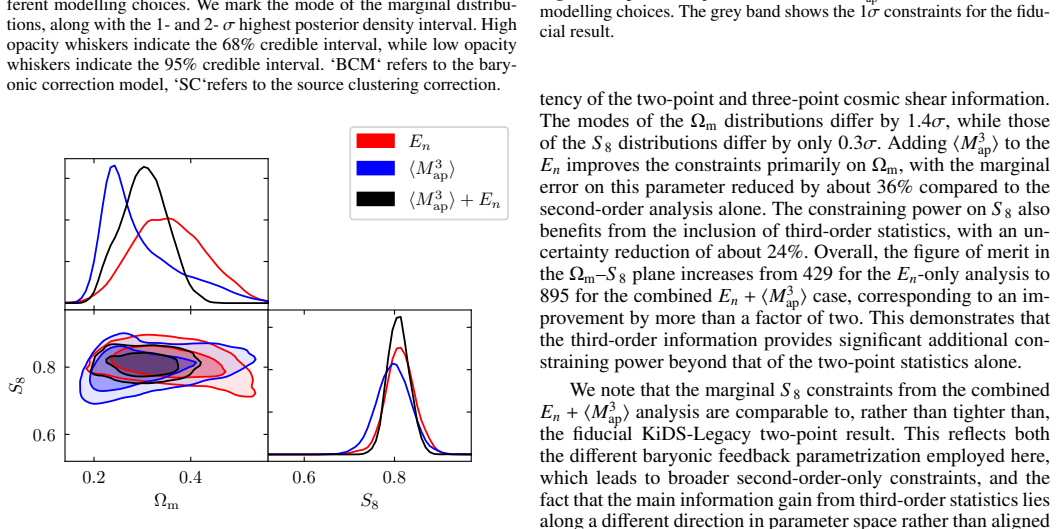
A joint analysis of COSEBIs at scales between 2' and 300' with third-order aperture mass moments at scales between 4' and 32' in the KiDS-Legacy data set yields Ω_m = 0.297^{+0.056}_{-0.040} and S_8 = 0.806^{+0.025}_{-0.023}. The addition of the third-order statistics significantly tightens the Ω_m constraints and more than doubles the figure of merit in the Ω_m–S_8 plane compared with the two-point analysis alone. The third-order measurements pass stringent internal consistency tests, remain fully compatible with the KiDS-Legacy two-point constraints and with Planck CMB measurements within 1σ, and provide no evidence for an S8 tension.
What carries the argument
The joint likelihood of COSEBIs (second-order E-/B-mode integrals) and third-order aperture mass moments, together with a redshift- and mass-dependent intrinsic alignment model, a baryon correction model validated on multiple hydrodynamical simulations, and corrections for reduced shear and source clustering.
If this is right
- Ω_m constraints tighten substantially once third-order moments are included.
- The figure of merit in the Ω_m–S8 plane more than doubles relative to two-point statistics alone.
- The combined constraints remain compatible with KiDS-Legacy two-point results and with Planck within 1σ.
- Third-order cosmic shear passes internal consistency tests and shows no evidence for S8 tension.
- The method is now mature enough to be applied to forthcoming surveys.
Where Pith is reading between the lines
- The same joint second-plus-third-order pipeline could be run on Euclid or LSST data to test whether the current Ω_m and S8 values hold at higher precision.
- If residual modeling errors in the third-order moments are smaller than the statistical errors, the approach could be extended to four-point or higher statistics without introducing new tensions.
- Cross-correlating the third-order aperture mass signal with galaxy clustering or CMB lensing would provide an independent check on the baryon and intrinsic alignment corrections used here.
Load-bearing premise
The third-order aperture mass moments are modeled with sufficient accuracy once the baryon correction and redshift- and mass-dependent intrinsic alignment models are applied, so that any residual mismatch would not bias the joint constraints.
What would settle it
An independent weak-lensing survey reporting Ω_m or S8 values lying outside the reported 68% intervals while employing comparable third-order modeling and passing the same internal consistency tests.
Figures




read the original abstract
Weak lensing by large-scale structure is a powerful cosmological probe. While most analyses rely on second-order correlations, these are primarily sensitive to the parameter combination $S_8 = \sigma_8 (\Omega_m/0.3)^{0.5}$, limiting their ability to constrain $\Omega_m$ and other cosmological parameters independently. Higher-order statistics capture non-Gaussian features of the density field and can therefore break parameter degeneracies and extract more cosmological information from weak lensing surveys. We present a joint analysis of second- and third-order cosmic shear in the final data release of the Kilo-Degree Survey (KiDS-Legacy). We combine COSEBIs (Complete Orthogonal Sets of E-/B-mode Integrals) at scales between 2' and 300' with third-order aperture mass moments at scales between 4' and 32' to perform a joint analysis of second- and third-order statistics. Compared to previous KiDS analyses, we implement several methodological advances: an intrinsic alignment model with redshift and mass dependence, a baryon correction model validated on multiple hydrodynamical simulations, and corrections for reduced shear and source clustering. Combining COSEBIs with third-order aperture mass statistics in KiDS-Legacy yields $\Omega_m = 0.297^{+0.056}_{-0.040}$ and $S_8 = 0.806^{+0.025}_{-0.023}$, significantly tightening the $\Omega_m$ constraints and more than doubling the figure of merit in the $\Omega_m$--$S_8$ plane compared to the two-point analysis alone. The third-order measurements pass stringent internal consistency tests, are fully compatible with the KiDS-Legacy 2-point constraints, other 2+3-point lensing results and with Planck CMB measurements within $1\sigma$, providing no evidence for an $S_8$ tension and demonstrating the maturity of 3-point cosmic shear as a key probe for forthcoming surveys.
Editorial analysis
A structured set of objections, weighed in public.
Referee Report
Summary. The manuscript presents a joint cosmological analysis of KiDS-Legacy weak-lensing data combining second-order COSEBIs (scales 2'–300') with third-order aperture mass moments (scales 4'–32'). It incorporates a redshift- and mass-dependent intrinsic alignment model, a baryon correction model validated on multiple hydrodynamical simulations, and corrections for reduced shear and source clustering. The resulting constraints are Ω_m = 0.297^{+0.056}_{-0.040} and S_8 = 0.806^{+0.025}_{-0.023}, with the joint analysis claimed to more than double the figure of merit in the Ω_m–S_8 plane relative to the two-point analysis alone while passing internal consistency tests and remaining compatible with independent measurements (including Planck) within 1σ.
Significance. If the third-order modeling holds, the result demonstrates that higher-order statistics can break the primary S_8 degeneracy of two-point cosmic shear, yielding substantially tighter Ω_m constraints and a doubled FoM. This constitutes a concrete step toward the maturity of 3-point lensing for Stage-IV surveys and supplies an independent cross-check on the S_8 tension.
major comments (2)
- [Modeling section (third-order aperture mass moments)] The headline Ω_m constraint and FoM improvement rest on the accuracy of the third-order aperture mass modeling (abstract and modeling section). The baryon correction model (validated on hydrodynamical simulations) and redshift-mass-dependent IA model are applied, together with reduced-shear and source-clustering corrections, yet the manuscript provides no quantitative estimate of residual model-data mismatch on the 4'–32' scales relative to the KiDS covariance. Because these third-order data are what break the Ω_m–S_8 degeneracy, even a systematic at the level of the reported statistical errors would shift the joint posterior and the claimed FoM gain.
- [Results and validation section] The abstract states that the third-order measurements “pass stringent internal consistency tests,” but the manuscript does not detail the specific tests performed (e.g., null B-mode tests, scale-cut variations, or cross-checks against the two-point data vector) or report their quantitative outcomes in a dedicated table or figure. Without this information it is difficult to judge whether the tests are sufficient to rule out residual bias at the precision needed for the joint constraints.
minor comments (2)
- [Abstract] The abstract reports the FoM improvement only qualitatively (“more than doubling”); quoting the numerical FoM values for both the two-point and joint analyses would improve clarity.
- [Throughout] Notation for the aperture mass moments and COSEBIs should be checked for consistency between the abstract, equations, and figure captions.
Simulated Author's Rebuttal
We thank the referee for their constructive and detailed report. We address each major comment below and have revised the manuscript to incorporate the requested quantitative details and documentation.
read point-by-point responses
-
Referee: [Modeling section (third-order aperture mass moments)] The headline Ω_m constraint and FoM improvement rest on the accuracy of the third-order aperture mass modeling (abstract and modeling section). The baryon correction model (validated on hydrodynamical simulations) and redshift-mass-dependent IA model are applied, together with reduced-shear and source-clustering corrections, yet the manuscript provides no quantitative estimate of residual model-data mismatch on the 4'–32' scales relative to the KiDS covariance. Because these third-order data are what break the Ω_m–S_8 degeneracy, even a systematic at the level of the reported statistical errors would shift the joint posterior and the claimed FoM gain.
Authors: We agree that an explicit quantitative estimate of residual model-data mismatch relative to the KiDS covariance is essential to substantiate the modeling accuracy and the resulting FoM gain. Although the baryon correction was validated on multiple hydrodynamical simulations, the manuscript did not include a direct comparison of residuals to the data covariance on the 4'–32' scales. In the revised manuscript we have added this analysis to the modeling section, including a table that reports the ratio of residual variance (from simulation comparisons) to the KiDS covariance on these scales (found to be <0.25 across bins). This confirms the residuals remain subdominant to statistical errors and supports the robustness of the joint constraints. revision: yes
-
Referee: [Results and validation section] The abstract states that the third-order measurements “pass stringent internal consistency tests,” but the manuscript does not detail the specific tests performed (e.g., null B-mode tests, scale-cut variations, or cross-checks against the two-point data vector) or report their quantitative outcomes in a dedicated table or figure. Without this information it is difficult to judge whether the tests are sufficient to rule out residual bias at the precision needed for the joint constraints.
Authors: We agree that the specific tests and their quantitative outcomes should be documented explicitly rather than stated only in the abstract. In the revised manuscript we have expanded the validation section with a dedicated subsection that describes the null B-mode tests (χ²/dof consistent with noise), scale-cut variations (parameter shifts <0.5σ), and cross-checks against the two-point data vector. Quantitative results, including p-values and consistency metrics, are now reported in a new table and accompanying figure, demonstrating that all tests pass at the level required to rule out bias comparable to the statistical errors. revision: yes
Circularity Check
No circularity: standard likelihood fit of joint 2+3-point shear data to cosmology
full rationale
The paper reports posterior constraints on Ω_m and S_8 obtained by fitting a joint data vector (COSEBIs + third-order aperture mass moments) to a cosmological model that includes external modeling components (redshift/mass-dependent IA, baryon corrections validated on hydro simulations, reduced-shear and source-clustering corrections). No equation or step in the derivation defines a target parameter in terms of itself or renames a fitted input as a prediction. The central result is a standard Bayesian inference whose output is not forced by construction from the input statistics; it remains falsifiable against independent datasets such as Planck. Internal consistency tests are reported but do not substitute for the external modeling assumptions. This is the normal, non-circular case for a survey cosmology analysis.
Axiom & Free-Parameter Ledger
axioms (2)
- domain assumption The baryon correction model validated on multiple hydrodynamical simulations accurately captures the effect of baryons on the third-order statistics.
- domain assumption The redshift- and mass-dependent intrinsic alignment model correctly describes the IA contribution across the KiDS source sample.
Reference graph
Works this paper leans on
-
[1]
A&A, in press (Euclid Q1 SI),
Euclid: Quick Data Release (Q1) -- The connection between galaxy close encounters and radio activity. A&A, in press (Euclid Q1 SI),
-
[2]
A&A, in press (Euclid Q1 SI),
Euclid: Quick Data Release (Q1) – Secondary nuclei in early-type galaxies. A&A, in press (Euclid Q1 SI),
-
[3]
Euclid Quick Data Release (Q1). XXXVII. Searching for giant gravitational arcs in galaxy clusters with mask region-based convolutional neural networks. A&A, in press,
-
[4]
Quenching precedes bulge formation in dense environments but follows it in the field
Euclid Quick Data Release (Q1). Quenching precedes bulge formation in dense environments but follows it in the field. A&A, in press (Euclid Q1 SI),
-
[5]
The average far-infrared properties of Euclid-selected star-forming galaxies
Euclid Quick Data Release (Q1). The average far-infrared properties of Euclid-selected star-forming galaxies. A&A, in press (Euclid Q1 SI),
-
[6]
Spectroscopic unveiling of highly ionised lines at z = 2.48--3.88
Euclid Quick Data Release (Q1). Spectroscopic unveiling of highly ionised lines at z = 2.48--3.88. A&A, submitted (Euclid Q1 SI) , keywords =
-
[7]
Hunting for luminous z > 6 galaxies in the Euclid Deep Fields – forecasts and first bright detections
Euclid Quick Data Release (Q1). Hunting for luminous z > 6 galaxies in the Euclid Deep Fields – forecasts and first bright detections. A&A, in press (Euclid Q1 SI),
-
[8]
A&A, accepted (Euclid Q1 SI) , keywords =
Euclid Quick Data Release (Q1) - Data release overview. A&A, accepted (Euclid Q1 SI) , keywords =
-
[9]
A&A, in press (Euclid Q1 SI),
Euclid Quick Data Release (Q1): VIS processing and data products. A&A, in press (Euclid Q1 SI),
-
[10]
NIR processing and data products
Euclid Quick Data Release (Q1). NIR processing and data products. A&A, in press (Euclid Q1 SI),
-
[11]
From images to multiwavelength catalogues: the Euclid MERge Processing Function
Euclid Quick Data Release (Q1). From images to multiwavelength catalogues: the Euclid MERge Processing Function. A&A, in press (Euclid Q1 SI),
-
[12]
Photometric redshifts and physical properties of galaxies through the PHZ processing function
Euclid Quick Data Release (Q1). Photometric redshifts and physical properties of galaxies through the PHZ processing function. A&A, in press (Euclid Q1 SI),
-
[13]
A&A, in press (Euclid Q1 SI),
Euclid Quick Data Release (Q1): From spectrograms to spectra: the SIR spectroscopic Processing Function. A&A, in press (Euclid Q1 SI),
-
[14]
A&A, in press (Euclid Q1 SI),
Euclid Quick Data Release (Q1) - Characteristics and limitations of the spectroscopic measurements. A&A, in press (Euclid Q1 SI),
-
[15]
Exploring galaxy morphology across cosmic time through Sersic fits
Euclid Quick Data Release (Q1). Exploring galaxy morphology across cosmic time through Sersic fits. A&A, in press (Euclid Q1 SI),
-
[16]
A&A, accepted (Euclid Q1 SI) , keywords =
Euclid Quick Data Release (Q1): First visual morphology catalogue. A&A, accepted (Euclid Q1 SI) , keywords =
-
[17]
A&A, in press (Euclid Q1 SI),
Euclid Quick Data Release (Q1), A first look at the fraction of bars in massive galaxies at z<1. A&A, in press (Euclid Q1 SI),
-
[18]
A&A, in press (Euclid Q1 SI),
Euclid Quick Data Release (Q1) Exploring galaxy properties with a multi-modal foundation model. A&A, in press (Euclid Q1 SI),
-
[19]
A&A, submitted (Euclid Q1 SI) , keywords =
Euclid Quick Data Release (Q1): The evolution of the passive-density and morphology-density relations between z=0.25 and z=1. A&A, submitted (Euclid Q1 SI) , keywords =
-
[20]
A first view of the star-forming main sequence in the Euclid Deep Fields
Euclid Quick Data Release (Q1). A first view of the star-forming main sequence in the Euclid Deep Fields. A&A, in press (Euclid Q1 SI),
-
[21]
A probabilistic classification of quenched galaxies
Euclid Quick Data Release (Q1). A probabilistic classification of quenched galaxies. A&A, in press (Euclid Q1 SI),
-
[22]
Optical and near-infrared identification and classification of point-like X-ray selected sources
Euclid Quick Data Release (Q1). Optical and near-infrared identification and classification of point-like X-ray selected sources. A&A, in press (Euclid Q1 SI),
-
[23]
A&A, in press (Euclid Q1 SI),
Euclid Quick Data Release (Q1) -- First Euclid statistical study of galaxy mergers and their connection to active galactic nuclei. A&A, in press (Euclid Q1 SI),
-
[24]
First Euclid statistical study of the active galactic nuclei contribution fraction
Euclid Quick Data Release (Q1). First Euclid statistical study of the active galactic nuclei contribution fraction. A&A, in press (Euclid Q1 SI),
-
[25]
A&A, in press (Euclid Q1 SI),
Euclid Quick Data Release (Q1) First study of red quasars selection. A&A, in press (Euclid Q1 SI),
-
[26]
The active galaxies of Euclid
Euclid Quick Data Release (Q1). The active galaxies of Euclid. A&A, in press (Euclid Q1 SI),
-
[27]
Euclid Quick Data Release (Q1): Euclid spectroscopy of QSOs. 1. Identification and redshift determination of 3500 bright QSOs. A&A, in press,. doi:10.48550/arXiv.2512.08803 , archivePrefix =. 2512.08803 , primaryClass =
-
[28]
Active galactic nuclei identification using diffusion-based inpainting of Euclid VIS images
Euclid Quick Data Release (Q1). Active galactic nuclei identification using diffusion-based inpainting of Euclid VIS images. A&A, in press (Euclid Q1 SI),
-
[29]
An investigation of optically faint, red objects in the Euclid Deep Fields
Euclid Quick Data Release (Q1). An investigation of optically faint, red objects in the Euclid Deep Fields. A&A, in press (Euclid Q1 SI),
-
[30]
Extending the quest for little red dots to z<4
Euclid Quick Data Release (Q1). Extending the quest for little red dots to z<4. A&A, in press (Euclid Q1 SI),
-
[31]
A&A, submitted (Euclid Q1 SI) , keywords =
Euclid Quick Data Release (Q1): Identification of massive galaxy candidates at the end of the Epoch of Reionisation. A&A, submitted (Euclid Q1 SI) , keywords =. doi:10.48550/arXiv.2511.11943 , archivePrefix =. 2511.11943 , primaryClass =
-
[32]
A&A, accepted (Euclid Q1 SI) , keywords =
Euclid Quick Data Release (Q1): The Strong Lensing Discovery Engine A -- System overview and lens catalogue. A&A, accepted (Euclid Q1 SI) , keywords =
-
[33]
A&A, in press (Euclid Q1 SI),
Euclid Quick Data Release (Q1) The Strong Lensing Discovery Engine B -- Early strong lens candidates from visual inspection of high velocity dispersion galaxies. A&A, in press (Euclid Q1 SI),
-
[34]
The Strong Lensing Discovery Engine C -- Finding lenses with machine learning
Euclid Quick Data Release (Q1). The Strong Lensing Discovery Engine C -- Finding lenses with machine learning. A&A, in press (Euclid Q1 SI),
-
[35]
The Strong Lensing Discovery Engine D -- Double-source-plane lens candidates
Euclid Quick Data Release (Q1). The Strong Lensing Discovery Engine D -- Double-source-plane lens candidates. A&A, in press (Euclid Q1 SI),
-
[36]
The Strong Lensing Discovery Engine E - Ensemble classification of strong gravitational lenses: lessons for Data Release 1
Euclid Quick Data Release (Q1). The Strong Lensing Discovery Engine E - Ensemble classification of strong gravitational lenses: lessons for Data Release 1. A&A, accepted (Euclid Q1 SI) , keywords =
-
[37]
LEMON -- Lens Modelling with Neural networks
Euclid Quick Data Release (Q1). LEMON -- Lens Modelling with Neural networks. Automated and fast modelling of Euclid gravitational lenses with a singular isothermal ellipsoid mass profile. A&A, in press (Euclid Q1 SI),
-
[38]
From simulations to sky: Advancing machine-learning lens detection with real Euclid data
Euclid Quick Data Release (Q1). From simulations to sky: Advancing machine-learning lens detection with real Euclid data. A&A, in press (Euclid Q1 SI),. doi:10.48550/arXiv.2512.05899 , archivePrefix =. 2512.05899 , primaryClass =
-
[39]
The first catalogue of strong-lensing galaxy clusters
Euclid Quick Data Release (Q1). The first catalogue of strong-lensing galaxy clusters. A&A, in press (Euclid Q1 SI),
-
[40]
Combined and galaxy density catalogues at z> 1.3 and detection of significant passive galaxy overdensities in overdense regions
Euclid Quick Data Release (Q1). Combined and galaxy density catalogues at z> 1.3 and detection of significant passive galaxy overdensities in overdense regions. A&A, submitted (Euclid Q1 SI) , keywords =
-
[41]
Euclid Quick Data Release (Q1). The Euclid view on Planck galaxy protocluster candidates: towards a probe of the highest sites of star formation at cosmic noon. A&A, submitted (Euclid Q1 SI) , keywords =. doi:10.48550/arXiv.2503.21304 , archivePrefix =. 2503.21304 , primaryClass =
-
[42]
First detections from the galaxy cluster workflow
Euclid Quick Data Release (Q1). First detections from the galaxy cluster workflow. A&A, in press (Euclid Q1 SI),. doi:10.48550/arXiv.2503.19196 , archivePrefix =. 2503.19196 , primaryClass =
-
[43]
A&A, submittted (Euclid Q1 SI) , keywords =
EMU and Euclid: Detection of a radio-optical galaxy clustering cross-correlation signal between the Evolutionary Map of the Universe and Euclid. A&A, submittted (Euclid Q1 SI) , keywords =. doi:10.48550/arXiv.2511.22732 , archivePrefix =. 2511.22732 , primaryClass =
-
[44]
The role of cosmic connectivity in shaping galaxy clusters
Euclid Quick Data Release (Q1). The role of cosmic connectivity in shaping galaxy clusters. A&A, in press (Euclid Q1 SI),
-
[45]
Galaxy shapes and alignments in the cosmic web
Euclid Quick Data Release (Q1). Galaxy shapes and alignments in the cosmic web. A&A, in press (Euclid Q1 SI),
-
[46]
A&A, in press (Euclid Q1 SI),
Euclid Quick Data Release (Q1): A photometric search for ultracool dwarfs in the Euclid Deep Fields. A&A, in press (Euclid Q1 SI),
-
[47]
A&A, submitted (Euclid Q1 SI) , keywords =
Euclid Quick Data Release (Q1) -- Spectroscopic search, classification and analysis of ultracool dwarfs in the Deep Fields. A&A, submitted (Euclid Q1 SI) , keywords =
-
[48]
A&A, submitted (Euclid Q1 SI) , keywords =
Euclid Quick Data Release (Q1) Ultracool dwarfs in the Euclid Deep Field North. A&A, submitted (Euclid Q1 SI) , keywords =
-
[49]
A&A, in press (Euclid Q1 SI),
Euclid: Quick Data Release (Q1) - Photometric studies of known transients. A&A, in press (Euclid Q1 SI),
-
[50]
A census of dwarf galaxies across a range of distances and environments
Euclid Quick Data Release (Q1). A census of dwarf galaxies across a range of distances and environments. A&A, in press (Euclid Q1 SI),
-
[51]
Overview of the Euclid mission
Euclid - I. Overview of the Euclid mission , DOI= "10.1051/0004-6361/202450810", url= "https://doi.org/10.1051/0004-6361/202450810", journal =
-
[53]
Euclid - III. The NISP Instrument , DOI= "10.1051/0004-6361/202450786", url= "https://doi.org/10.1051/0004-6361/202450786", journal =
-
[54]
Euclid - IV. The NISP Calibration Unit , DOI= "10.1051/0004-6361/202450345", url= "https://doi.org/10.1051/0004-6361/202450345", journal =
-
[55]
Euclid - V. The Flagship galaxy mock catalogue: A comprehensive simulation for the Euclid , DOI= "10.1051/0004-6361/202450853", url= "https://doi.org/10.1051/0004-6361/202450853", journal =
-
[56]
Euclid: Early Release Observations – Programme overview and pipeline for compact- and diffuse-emission photometry , DOI= "10.1051/0004-6361/202450803", url= "https://doi.org/10.1051/0004-6361/202450803", journal =
-
[57]
Euclid: Early Release Observations – A glance at free-floating newborn planets in the σ Orionis cluster , DOI= "10.1051/0004-6361/202450793", url= "https://doi.org/10.1051/0004-6361/202450793", journal =
-
[58]
Euclid: Early Release Observations – Unveiling the morphology of two Milky Way globular clusters out to their periphery , DOI= "10.1051/0004-6361/202449696", url= "https://doi.org/10.1051/0004-6361/202449696", journal =
-
[59]
Euclid: Early Release Observations – Deep anatomy of nearby galaxies , DOI= "10.1051/0004-6361/202450781", url= "https://doi.org/10.1051/0004-6361/202450781", journal =
-
[60]
Euclid: Early Release Observations – Globular clusters in the Fornax galaxy cluster, from dwarf galaxies to the intracluster field , DOI= "10.1051/0004-6361/202450784", url= "https://doi.org/10.1051/0004-6361/202450784", journal =
-
[61]
Euclid: Early Release Observations – Overview of the Perseus cluster and analysis of its luminosity and stellar mass functions , DOI= "10.1051/0004-6361/202450996", url= "https://doi.org/10.1051/0004-6361/202450996", journal =
-
[62]
Euclid: Early Release Observations – Dwarf galaxies in the Perseus galaxy cluster , DOI= "10.1051/0004-6361/202450799", url= "https://doi.org/10.1051/0004-6361/202450799", journal =
-
[63]
Euclid: Early Release Observations – The intracluster light and intracluster globular clusters of the Perseus cluster , DOI= "10.1051/0004-6361/202450772", url= "https://doi.org/10.1051/0004-6361/202450772", journal =
-
[64]
Euclid: The Early Release Observations Lens Search Experiment , DOI= "10.1051/0004-6361/202451868", url= "https://doi.org/10.1051/0004-6361/202451868", journal =
-
[65]
Euclid: Early Release Observations – A preview of the Euclid era through a galaxy cluster magnifying lens , DOI= "10.1051/0004-6361/202450776", url= "https://doi.org/10.1051/0004-6361/202450776", journal =
-
[66]
Euclid: Early Release Observations – NISP-only sources and the search for luminous z = 6–8 galaxies , DOI= "10.1051/0004-6361/202450794", url= "https://doi.org/10.1051/0004-6361/202450794", journal =
-
[67]
Euclid Early Release Observations
-
[68]
Euclid Quick Release Q1
-
[69]
Euclid Quick Release Q2
-
[70]
Euclid Data Release 1
-
[71]
ESA Datalabs: Digital Innovation in Space Science. Space Data Management. Studies in Big Data , year = 2024, volume =. doi:10.1007/978-981-97-0041-7_1 , adsurl =
-
[72]
Properties and performance of the NISP signal estimator
Euclid. Properties and performance of the NISP signal estimator. A&A, submitted , keywords =. doi:10.48550/arXiv.2602.03574 , archivePrefix =. 2602.03574 , primaryClass =
-
[73]
A&A, submitted , keywords =
Euclid: Galaxy SED reconstruction in the PHZ processing function: impact on the PSF and the role of medium-band filters. A&A, submitted , keywords =
-
[74]
Euclid: VI. NISP-P optical ghosts. , keywords =. doi:10.1051/0004-6361/202555106 , archivePrefix =. 2507.11072 , primaryClass =
-
[75]
Far-infrared predictions for Euclid galaxy catalogues: cluster, protocluster, and field
Euclid preparation. Far-infrared predictions for Euclid galaxy catalogues: cluster, protocluster, and field. A&A, submitted , keywords =. doi:10.48550/arXiv.2603.13195 , archivePrefix =. 2603.13195 , primaryClass =
-
[76]
Simulated galaxy catalogues for non-standard cosmological models
Euclid preparation. Simulated galaxy catalogues for non-standard cosmological models. A&A, submitted , keywords =. doi:10.48550/arXiv.2603.13148 , archivePrefix =. 2603.13148 , primaryClass =
-
[77]
Impact of galaxy intrinsic alignment modelling choices on Euclid 3x2pt cosmology
Euclid preparation. Impact of galaxy intrinsic alignment modelling choices on Euclid 3x2pt cosmology. A&A, submitted , keywords =. doi:10.48550/arXiv.2602.16448 , archivePrefix =. 2602.16448 , primaryClass =
-
[78]
Euclid preparation. Decomposing components of the extragalactic background light using multi-band intensity mapping cross-correlations. A&A, submitted , keywords =. doi:10.48550/arXiv.2601.21111 , archivePrefix =. 2601.21111 , primaryClass =
work page internal anchor Pith review Pith/arXiv arXiv doi:10.48550/arxiv.2601.21111
-
[79]
Galaxy power spectrum modelling in redshift space
Euclid preparation. Galaxy power spectrum modelling in redshift space. A&A, submitted , keywords =. doi:10.48550/arXiv.2601.20826 , archivePrefix =. 2601.20826 , primaryClass =
-
[80]
Euclid preparation. LXXXVIII. 3D reconstruction of the cosmic web with simulated Euclid Deep spectroscopic samples. A&A, in press,. doi:10.48550/arXiv.2601.10709 , archivePrefix =. 2601.10709 , primaryClass =
work page internal anchor Pith review Pith/arXiv arXiv doi:10.48550/arxiv.2601.10709
-
[81]
Calibrated intrinsic galaxy alignments in the Euclid Flagship simulation
Euclid preparation. Calibrated intrinsic galaxy alignments in the Euclid Flagship simulation. A&A, accepted , keywords =
discussion (0)
Sign in with ORCID, Apple, or X to comment. Anyone can read and Pith papers without signing in.