Recognition: 2 theorem links
· Lean TheoremEuclid preparation. Decomposing components of the extragalactic background light using multi-band intensity mapping cross-correlations
Pith reviewed 2026-05-16 10:01 UTC · model grok-4.3
The pith
Multi-band intensity mapping cross-correlations with cosmic shear and galaxy clustering decompose the extragalactic background light into integrated galaxy light, intra-halo light, and epoch of reionization components.
A machine-rendered reading of the paper's core claim, the machinery that carries it, and where it could break.
Core claim
A joint halo-model framework in which intra-halo light follows a mass- and redshift-dependent luminosity scaling, integrated galaxy light is set by an evolving Schechter luminosity function, and epoch of reionization emission is modelled with population II and III stellar emissivities recovers all fiducial parameters within 1 sigma when fitting auto- and cross-power spectra from ten spectral bands, reduces 1 sigma uncertainties on intra-halo light parameters by 10-35 percent relative to intensity mapping alone, and improves epoch of reionization star-formation efficiency parameters by 20-35 percent.
What carries the argument
The joint halo-model framework parametrizing intra-halo light luminosity with mass and redshift dependence, integrated galaxy light with an evolving Schechter function, and epoch of reionization with binned stellar emissivities, applied to multi-band auto- and cross-power spectra with cosmic shear and galaxy clustering.
If this is right
- Recovers all fiducial parameters within 1 sigma
- Reduces uncertainties on intra-halo light parameters by 10-35 percent
- Improves epoch of reionization star-formation efficiency parameters by 20-35 percent
- Tightens the inferred intra-halo light fraction versus halo mass over 10 to the 11 to 10 to the 14 solar masses with 5-30 percent smaller uncertainties
- Extends star-formation rate density constraints to redshift approximately 11 with 22-31 percent uncertainty reductions
Where Pith is reading between the lines
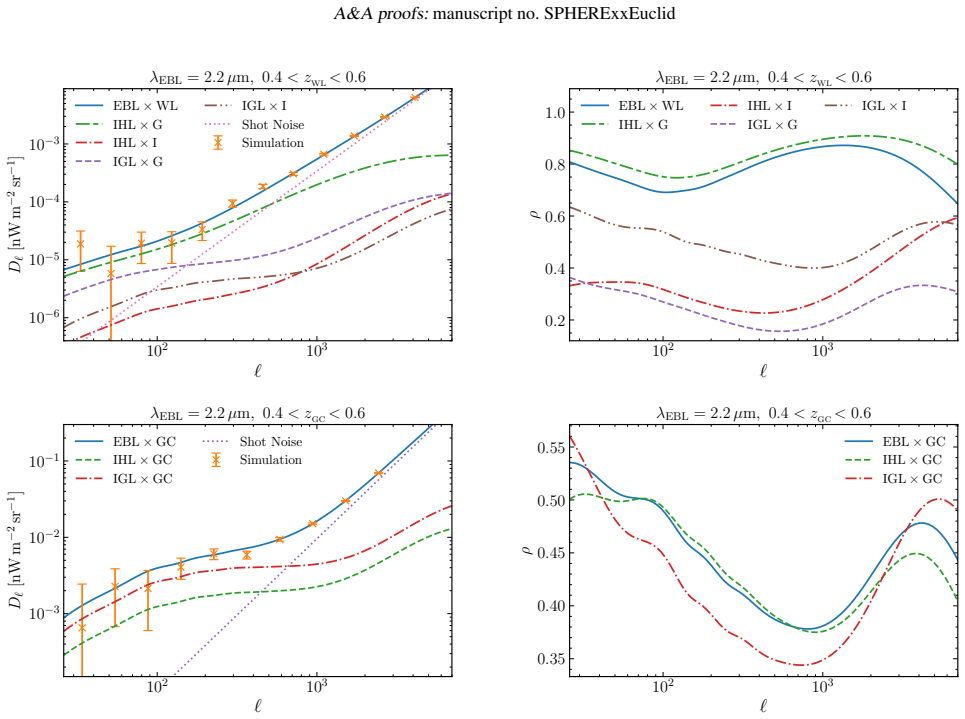
- Cross-correlations show stronger coupling of intra-halo light than integrated galaxy light to the cosmic shear field, which enhances component separation.
- The epoch of reionization contribution shows negligible correlation with cosmic shear and galaxy clustering, which aids its isolation in the background light.
- This approach may allow tighter constraints on the intra-halo light fraction across a range of halo masses when applied to actual survey data.
- Extending star-formation rate density measurements to higher redshifts could help resolve questions about the total light from early galaxies.
Load-bearing premise
The halo-model framework assumes specific parametric forms for the intra-halo light luminosity scaling with mass and redshift, an evolving Schechter function for integrated galaxy light, and binned stellar emissivities for epoch of reionization that capture the relevant astrophysics.
What would settle it
If real multi-band observations yield power spectra that deviate significantly from the model predictions or if the parameter uncertainties do not decrease as expected when including cross-correlations.
Figures





read the original abstract
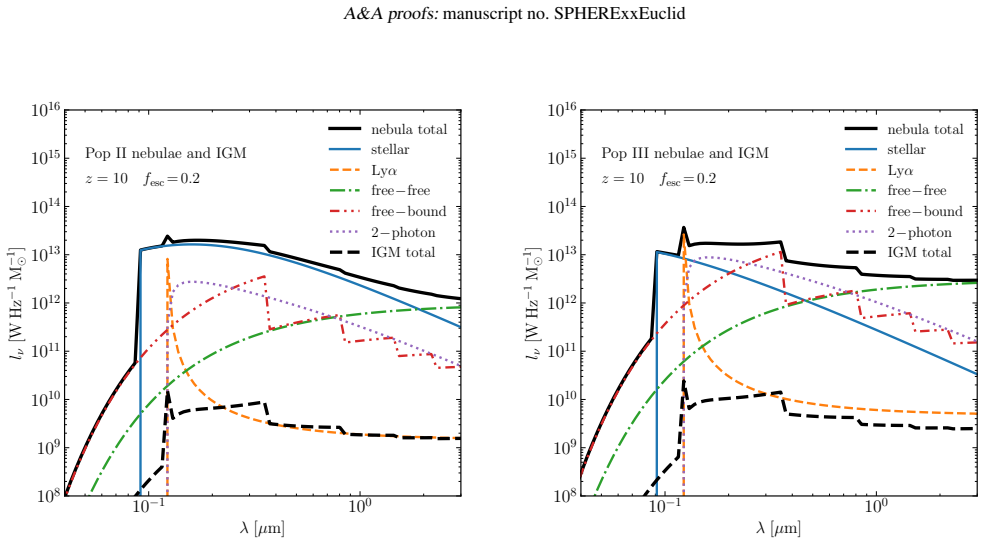
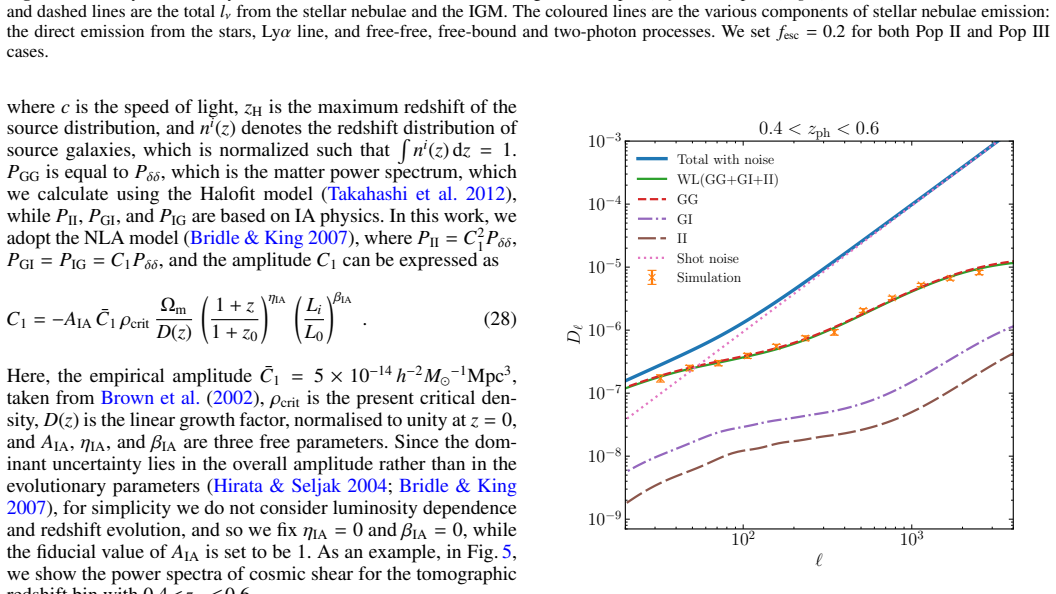
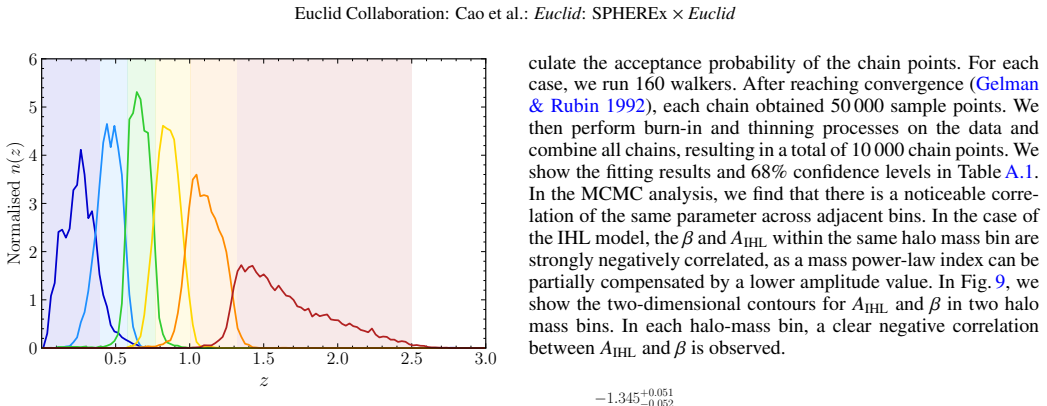
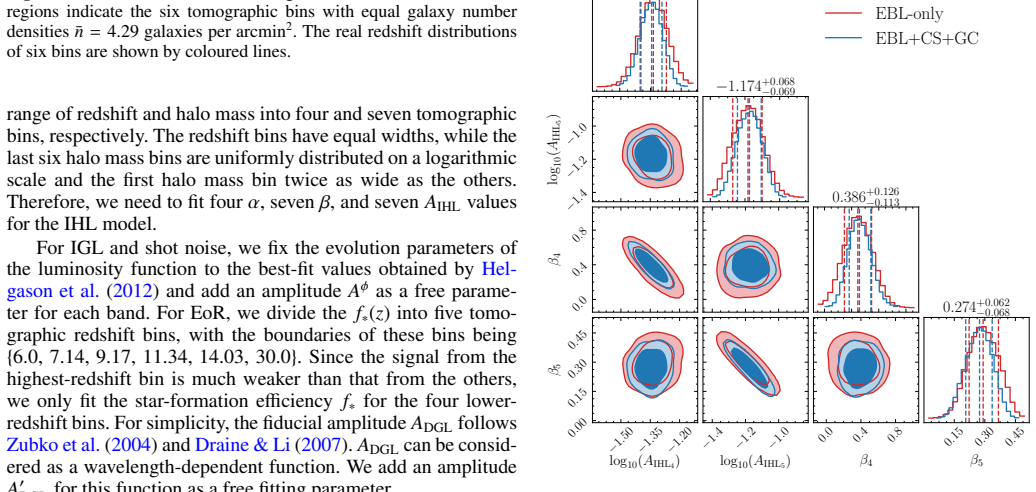
The extragalactic background light (EBL) fluctuations in the optical/near-IR encode the cumulative integrated galaxy light (IGL), diffuse intra-halo light (IHL), and high-$z$ sources from the epoch of reionisation (EoR), but they are difficult to disentangle with auto-spectra alone. We aim to decompose the EBL into its principal constituents using multi-band intensity mapping combined with cosmic shear and galaxy clustering. We develop a joint halo-model framework in which IHL follows a mass- and redshift-dependent luminosity scaling, IGL is set by an evolving Schechter luminosity function, and EoR emission is modelled with Pop II/III stellar emissivities and a binned star-formation efficiency. Using mock surveys in a flat $\Lambda$CDM cosmology with ten spectral bands spanning 0.75-5.0$\rm \mu m$ in the NEP deep fields over about 100$\deg^2$ with source detections down to AB=20.5 for masking, and six redshift bins to $z=2.5$, we fit auto- and cross-power spectra using a MCMC method. The combined SPHEREx$\times$Euclid analysis recovers all fiducial parameters within 1$\sigma$ and reduces 1$\sigma$ uncertainties on IHL parameters by 10-35% relative to SPHEREx EBL-only, while EoR star-formation efficiency parameters improve by 20-35%. Cross-correlations reveal a stronger coupling of IHL than IGL to the shear field, enhancing component separation; conversely, the EoR contribution shows negligible correlation with cosmic shear and galaxy clustering, aiding its isolation in the EBL. Relative to the SPHEREx EBL-only case, the inferred IHL fraction as a function of halo mass is significantly tightened over $10^{11}-10^{14} M_{\odot}$, with uncertainties reduced by 5-30%, and the resulting star-formation rate density constraints extend to $z\sim 11$, with uncertainty reductions of 22-31%.
Editorial analysis
A structured set of objections, weighed in public.
Referee Report
Summary. The manuscript develops a joint halo-model framework to decompose extragalactic background light (EBL) fluctuations into integrated galaxy light (IGL), intra-halo light (IHL), and epoch-of-reionization (EoR) components. It combines multi-band intensity mapping from SPHEREx with Euclid cosmic shear and galaxy clustering, using parametric forms (mass- and redshift-dependent IHL luminosity scaling, evolving Schechter function for IGL, binned Pop II/III emissivities for EoR). Mock surveys in ten bands (0.75-5.0 μm) over ~100 deg² are generated in flat ΛCDM, masked to AB=20.5, and fitted via MCMC to auto- and cross-power spectra in six redshift bins to z=2.5. The combined SPHEREx×Euclid analysis recovers all fiducial parameters within 1σ, reduces 1σ uncertainties on IHL parameters by 10-35% and on EoR star-formation efficiency by 20-35% relative to SPHEREx EBL-only, and tightens the IHL fraction versus halo mass over 10^11-10^14 M_⊙ while extending star-formation rate density constraints to z~11.
Significance. If the results hold, the work provides a concrete demonstration that cross-correlations (particularly IHL-shear coupling versus EoR isolation) can improve component separation in EBL studies, yielding measurable uncertainty reductions on IHL and high-z star-formation parameters. The mock recovery test with known inputs supplies a clear internal benchmark for the method under the assumed parametric model, which is a strength for a preparation paper.
major comments (1)
- [§2 and §4] §2 (Halo-model framework) and §4 (MCMC results): the reported 10-35% uncertainty reductions on IHL parameters and 20-35% on EoR efficiency are obtained exclusively from mocks generated with the identical parametric forms (mass- and redshift-dependent IHL scaling, evolving Schechter IGL, binned EoR emissivities) used in the fit. While this demonstrates internal consistency and 1σ recovery, it leaves untested whether the quoted gains survive realistic astrophysical deviations (e.g., altered IHL mass slope or non-Schechter IGL), which is load-bearing for the broader claim of applicability to real data.
minor comments (2)
- [Abstract] Abstract: the statement 'six redshift bins to z=2.5' should explicitly indicate whether these bins apply to the intensity-mapping fields, the shear measurements, or both, to avoid ambiguity for readers.
- [Figure captions and §4.1] Figure captions and §4.1: the power-spectrum plots would benefit from explicit indication (e.g., shaded bands or tabulated ratios) of the uncertainty reduction achieved by the cross-correlations, to visually support the quantitative claims.
Simulated Author's Rebuttal
We thank the referee for the constructive review and recommendation for minor revision. We address the major comment below, acknowledging the scope of our mock-based tests while defending the paper's contribution as a preparation study.
read point-by-point responses
-
Referee: [§2 and §4] §2 (Halo-model framework) and §4 (MCMC results): the reported 10-35% uncertainty reductions on IHL parameters and 20-35% on EoR efficiency are obtained exclusively from mocks generated with the identical parametric forms (mass- and redshift-dependent IHL scaling, evolving Schechter IGL, binned EoR emissivities) used in the fit. While this demonstrates internal consistency and 1σ recovery, it leaves untested whether the quoted gains survive realistic astrophysical deviations (e.g., altered IHL mass slope or non-Schechter IGL), which is load-bearing for the broader claim of applicability to real data.
Authors: We agree that the reported uncertainty reductions are obtained from mocks generated with the same parametric forms used in the fit, constituting an internal consistency test rather than a validation against model misspecification. This approach is standard for preparation papers to benchmark the pipeline and quantify the gains from cross-correlations under controlled conditions with known inputs. The physical motivations for the chosen parametric forms (mass- and redshift-dependent IHL scaling, evolving Schechter function, binned EoR emissivities) are detailed in §2, and the cross-correlation benefits (stronger IHL-shear coupling, EoR isolation) are demonstrated within this framework. We do not claim the gains hold for arbitrary deviations from the model. In revision, we will add a dedicated paragraph in the discussion and conclusions explicitly stating this limitation, tempering applicability claims to real data, and outlining plans for future robustness tests with varied astrophysical models. revision: yes
Circularity Check
No significant circularity; recovery tested on independent mocks with known a priori inputs
full rationale
The paper's central results consist of MCMC fits to mock auto- and cross-power spectra generated from the same halo-model parametrization (IHL mass/redshift luminosity scaling, evolving Schechter IGL, binned Pop II/III EoR emissivities). This is a standard forecast exercise in which the true input values are fixed independently of the fit, allowing direct verification that all fiducial parameters are recovered within 1σ and that cross-correlations tighten uncertainties by the stated percentages. No equation reduces by construction to its own inputs, no fitted parameter is renamed as a prediction, and no load-bearing premise rests on self-citation chains or imported uniqueness theorems. The derivation of the joint likelihood and component-separation benefits remains self-contained against the explicitly stated model assumptions.
Axiom & Free-Parameter Ledger
free parameters (3)
- IHL mass- and redshift-dependent luminosity scaling
- Evolving Schechter luminosity function parameters
- Binned EoR star-formation efficiency
axioms (2)
- standard math Flat Lambda-CDM background cosmology
- domain assumption Halo-model description of clustering and lensing
Lean theorems connected to this paper
-
IndisputableMonolith/Foundation/RealityFromDistinction.leanreality_from_one_distinction unclear?
unclearRelation between the paper passage and the cited Recognition theorem.
joint halo-model framework in which IHL follows a mass- and redshift-dependent luminosity scaling, IGL is set by an evolving Schechter luminosity function, and EoR emission is modelled with Pop II/III stellar emissivities and a binned star-formation efficiency... MCMC method
-
IndisputableMonolith/Cost/FunctionalEquation.leanwashburn_uniqueness_aczel unclear?
unclearRelation between the paper passage and the cited Recognition theorem.
IHL luminosity... f_IHL(M) = A_IHL (M/10^12 M_⊙)^β ... Schechter function Φ(M_abs|z)
What do these tags mean?
- matches
- The paper's claim is directly supported by a theorem in the formal canon.
- supports
- The theorem supports part of the paper's argument, but the paper may add assumptions or extra steps.
- extends
- The paper goes beyond the formal theorem; the theorem is a base layer rather than the whole result.
- uses
- The paper appears to rely on the theorem as machinery.
- contradicts
- The paper's claim conflicts with a theorem or certificate in the canon.
- unclear
- Pith found a possible connection, but the passage is too broad, indirect, or ambiguous to say the theorem truly supports the claim.
Forward citations
Cited by 2 Pith papers
-
\textit{Euclid} preparation. Baryon acoustic oscillations extraction techniques: comparison and optimisation
End-to-end validation on Euclid-like mocks shows RecSym and RecIso reconstruction yield unbiased BAO measurements, improving figure of merit for Omega_m and H0 rs by factor of ~3 across 0.9<z<1.8.
-
Euclid preparation. Three-dimensional galaxy clustering in configuration space: Three-point correlation function estimation
Euclid collaboration develops and validates direct and spherical-harmonic estimators plus a random-split optimization for measuring the three-point galaxy correlation function at the scale of the full Euclid survey.
Reference graph
Works this paper leans on
-
[1]
Report of the Dark Energy Task Force
Albrecht, A., Bernstein, G., Cahn, R., et al. 2006, arXiv:astro-ph/0609591
work page internal anchor Pith review Pith/arXiv arXiv 2006
- [2]
- [3]
-
[4]
Asgari, M., Lin, C.-A., Joachimi, B., et al. 2021, A&A, 645, A104
work page 2021
- [5]
-
[6]
Blazek, J. A., MacCrann, N., Troxel, M. A., & Fang, X. 2019, Phys. Rev. D, 100, 103506
work page 2019
-
[7]
Bock, J. J., Aboobaker, A. M., Adamo, J., et al. 2025, arXiv:2511.02985
-
[8]
Bouwens, R. J., Illingworth, G. D., Oesch, P. A., et al. 2015, ApJ, 803, 34
work page 2015
-
[9]
Brandt, T. D. & Draine, B. T. 2012, ApJ, 744, 129
work page 2012
- [10]
-
[11]
Brown, M. L., Taylor, A. N., Hambly, N. C., & Dye, S. 2002, MNRAS, 333, 501
work page 2002
- [12]
-
[13]
Cao, Y ., Gong, Y ., Meng, X.-M., et al. 2018, MNRAS, 480, 2178
work page 2018
-
[14]
2017, in Proceedings of the European Physical Society Conference on High Energy Physics
Carretero, J., Tallada, P., Casals, J., et al. 2017, in Proceedings of the European Physical Society Conference on High Energy Physics. 5-12 July, 488
work page 2017
- [15]
-
[16]
P., Werner, M., Akeson, R., et al
Crill, B. P., Werner, M., Akeson, R., et al. 2020, in Society of Photo-Optical In- strumentation Engineers (SPIE) Conference Series, V ol. 11443, Space Tele- scopes and Instrumentation 2020: Optical, Infrared, and Millimeter Wave, ed. M. Lystrup & M. D. Perrin, 114430I
work page 2020
-
[17]
Dicke, R. H., Peebles, P. J. E., Roll, P. G., & Wilkinson, D. T. 1965, ApJ, 142, 414
work page 1965
- [18]
-
[19]
Cosmology with the SPHEREX All-Sky Spectral Survey
Dole, H., Rieke, G. H., Lagache, G., et al. 2004, ApJS, 154, 93 Doré, O., Bock, J., Ashby, M., et al. 2014, arXiv:1412.4872 Doré, O., Werner, M. W., Ashby, M., et al. 2016, arXiv:1606.07039 Doré, O., Werner, M. W., Ashby, M. L. N., et al. 2018, arXiv:1805.05489
work page internal anchor Pith review Pith/arXiv arXiv 2004
-
[20]
Draine, B. T. & Li, A. 2007, ApJ, 657, 810 Euclid Collaboration: Blanchard, A., Camera, S., Carbone, C., et al. 2020, A&A, 642, A191 Euclid Collaboration: Castander, F., Fosalba, P., Stadel, J., et al. 2025, A&A, 697, A5 Euclid Collaboration: Desprez, G., Paltani, S., Coupon, J., et al. 2020, A&A, 644, A31 Euclid Collaboration: Mellier, Y ., Abdurro’uf, A...
work page 2007
- [21]
-
[22]
Fernandez, E. R., Iliev, I. T., Komatsu, E., & Shapiro, P. R. 2012, ApJ, 750, 20
work page 2012
-
[23]
Fernandez, E. R. & Komatsu, E. 2006, ApJ, 646, 703
work page 2006
-
[24]
Fernandez, E. R., Komatsu, E., Iliev, I. T., & Shapiro, P. R. 2010, ApJ, 710, 1089
work page 2010
-
[25]
Finkelstein, S. L. 2016, PASA, 33, e037
work page 2016
-
[26]
Finkelstein, S. L., Ryan, Jr., R. E., Papovich, C., et al. 2015, ApJ, 810, 71
work page 2015
-
[27]
Fixsen, D. J., Dwek, E., Mather, J. C., Bennett, C. L., & Shafer, R. A. 1998, ApJ, 508, 123
work page 1998
-
[28]
Foreman-Mackey, D., Hogg, D. W., Lang, D., & Goodman, J. 2013, PASP, 125, 306
work page 2013
- [29]
- [30]
-
[31]
Hirata, C. M. & Seljak, U. 2004, Phys. Rev. D, 70, 063526
work page 2004
-
[32]
Hu, W. & Okamoto, T. 2002, ApJ, 574, 566 Ivezi´c, Ž., Kahn, S. M., Tyson, J. A., et al. 2019, ApJ, 873, 111
work page 2002
- [33]
- [34]
-
[35]
Kashlinsky, A., Arendt, R. G., Mather, J., & Moseley, S. H. 2005, Nature, 438, 45
work page 2005
-
[36]
Kashlinsky, A., Arendt, R. G., Mather, J., & Moseley, S. H. 2007, ApJ, 654, L5
work page 2007
-
[37]
Lagache, G., Dole, H., & Puget, J. L. 2003, MNRAS, 338, 555
work page 2003
-
[38]
Euclid Definition Study Report
Laureijs, R., Amiaux, J., Arduini, S., et al. 2011, ESA/SRE(2011)12, arXiv:1110.3193
work page internal anchor Pith review Pith/arXiv arXiv 2011
- [39]
-
[40]
Limber, D. N. 1953, ApJ, 117, 134
work page 1953
- [41]
-
[42]
LSST Science Book, Version 2.0
LoVerde, M. & Afshordi, N. 2008, Phys. Rev. D, 78, 123506 LSST Science Collaboration: Abell, P. A., Allison, J., Anderson, S. F., et al. 2009, arXiv:0912.0201
work page internal anchor Pith review Pith/arXiv arXiv 2008
- [43]
- [44]
-
[45]
McLeod, D. J., McLure, R. J., Dunlop, J. S., et al. 2015, MNRAS, 450, 3032
work page 2015
-
[46]
Metropolis, N., Rosenbluth, A. W., Rosenbluth, M. N., Teller, A. H., & Teller, E. 1953, J. Chem. Phys., 21, 1087
work page 1953
-
[47]
2015, Nature Communications, 6, 7945
Mitchell-Wynne, K., Cooray, A., Gong, Y ., et al. 2015, Nature Communications, 6, 7945
work page 2015
- [48]
-
[49]
Oesch, P. A., Bouwens, R. J., Illingworth, G. D., et al. 2014, ApJ, 786, 108
work page 2014
-
[50]
Peacock, J. A., Schneider, P., Efstathiou, G., et al. 2006, ESA-ESO Working Group on “Fundamental Cosmology”, “ESA-ESO Working Group on ”Fun- damental Cosmology“, Edited by J.A. Peacock et al. ESA, 2006.” Planck Collaboration. 2020, A&A, 641, A6
work page 2006
-
[51]
Puget, J. L., Abergel, A., Bernard, J. P., et al. 1996, A&A, 308, L5
work page 1996
-
[52]
Purcell, C. W., Bullock, J. S., & Zentner, A. R. 2008, MNRAS, 391, 550
work page 2008
- [53]
-
[54]
R., Bromm, V ., & Kamionkowski, M
Santos, M. R., Bromm, V ., & Kamionkowski, M. 2002, MNRAS, 336, 1082
work page 2002
- [55]
-
[56]
Sheth, R. K. & Tormen, G. 1999, MNRAS, 308, 119
work page 1999
-
[57]
Sun, G., Mirocha, J., Mebane, R. H., & Furlanetto, S. R. 2021, MNRAS, 508, 1954
work page 2021
-
[58]
Takahashi, R., Sato, M., Nishimichi, T., Taruya, A., & Oguri, M. 2012, ApJ, 761, 152
work page 2012
-
[59]
2020, Astronomy and Computing, 32, 100391
Tallada, P., Carretero, J., Casals, J., et al. 2020, Astronomy and Computing, 32, 100391
work page 2020
- [60]
-
[61]
Troxel, M. A. & Ishak, M. 2015, Phys. Rep., 558, 1
work page 2015
-
[62]
Zemcov, M., Smidt, J., Arai, T., et al. 2014, Science, 346, 732
work page 2014
-
[63]
2011, Scientia Sinica Physica, Mechanica & Astronomica, 41, 1441
Zhan, H. 2011, Scientia Sinica Physica, Mechanica & Astronomica, 41, 1441
work page 2011
-
[64]
Zheng, Z., Berlind, A. A., Weinberg, D. H., et al. 2005, ApJ, 633, 791
work page 2005
-
[65]
Zubko, V ., Dwek, E., & Arendt, R. G. 2004, ApJS, 152, 211 1 Department of Physics & Astronomy, University of California
work page 2004
-
[66]
Padova, Via Marzolo 8, 35131 Padova, Italy 91 INFN-Padova, Via Marzolo 8, 35131 Padova, Italy 92 Institut für Theoretische Physik, University of Heidelberg, Philosophenweg 16, 69120 Heidelberg, Germany 93 Institut de Recherche en Astrophysique et Planétologie (IRAP), Université de Toulouse, CNRS, UPS, CNES, 14 Av. Edouard Belin, 31400 Toulouse, France 94 ...
work page 2008
discussion (0)
Sign in with ORCID, Apple, or X to comment. Anyone can read and Pith papers without signing in.