REVIEW 3 major objections 7 minor 3 cited by
The Hidden Dimensions of LLM Alignment: A Multi-Dimensional Analysis of Orthogonal Safety Directions
T0 review · 3 major / 7 minor · reviewed 2026-08-07 · deepseek-v4-flash
Pith's one-line read This paper establishes that safety-aligned refusal behavior in large language models is jointly controlled by a dominant direction and multiple smaller, interpretable feature directions in a safety residual space, and that removing…
desk verdict Multi-dimensional safety directions are real, and the trigger-removal attack is worth taking seriously, but PLRP faithfulness and missing controls need fixing before the mechanism claims fully land. read the letter →
The pith
A machine-rendered reading of the paper's core claim, the machinery that carries it, and where it could break.
The reading
What carries the argument
Safety Residual Space: the affine map $S(x)=Wx+b$ fit to the representation shift between the pre-finetuning and post-finetuning model at each layer, so that the learned alignment behavior lives in the span of $W-I$; singular value decomposition yields orthogonal components $L_N$-$C_K$, with $L_N$-$C_1$ the dominant refusal direction. Partial Layer-wise Relevance Propagation (PLRP) projects activations onto the span of selected directions, decomposes the projected norm into relevance scores, and back-propagates those scores through the transformer with the epsilon rule to assign token-level relevance. The trigger-removal attack uses these token attributions to build a blacklist, and an LLM iteratively rephrases harmful prompts to avoid the blacklisted tokens.
What would settle it
Take a fixed PAIR jailbreak prompt, compute PLRP relevance for the non-dominant direction L14-C6 on the safety fine-tuned model, and remove only the single highest-relevance trigger token while keeping all other tokens fixed. If the model's refusal rate on PAIR prompts does not fall in the direction predicted by the component's projection shift, the PLRP attribution is unfaithful and the causal link between trigger tokens, non-dominant directions, and refusal is broken.
Extended reading notes
Core claim
The central discovery is that the activation shift induced by safety fine-tuning on Llama 3.1 8B is approximately low-rank and linear, and its first singular component (the dominant direction) predicts refusal behavior, while the remaining orthogonal components are individually interpretable features such as hypothetical narrative, creative-writing framing, and the 'Sure, I'm happy to help' affirmative pattern. The paper provides causal evidence that suppressing the component associated with PAIR-like affirmative patterns selectively removes the model's ability to refuse PAIR prompts, and that suppressing most non-dominant directions while leaving dominant components intact lowers refusal rates on jailbreak prompts. It also introduces a trigger-removal attack: PLRP relevance scores identify the tokens that activate the safety directions, an LLM rephrases harmful prompts to avoid those tokens, and the rewritten prompts retain roughly 40% success after safety fine-tuning on samples of the attack while baseline attacks drop to near zero.
Load-bearing premise
The load-bearing premise is that Partial Layer-wise Relevance Propagation faithfully attributes the projected activation components back to specific input tokens; if that back-propagation is unfaithful, the semantic labels on the directions and the trigger-removal attack lose their grounding.
Editorial extensions
If this is right
- If the multi-direction picture is right, refusal cannot be fully understood or manipulated through a single probe vector; safety mechanisms live on a subspace and depend on the balance among its components.
- Suppressing one non-dominant direction (L14-C6) selectively disables refusal for PAIR prompts while preserving refusal for other attack families, so interventions on learned safety must be evaluated per jailbreak family, not just by overall refusal rate.
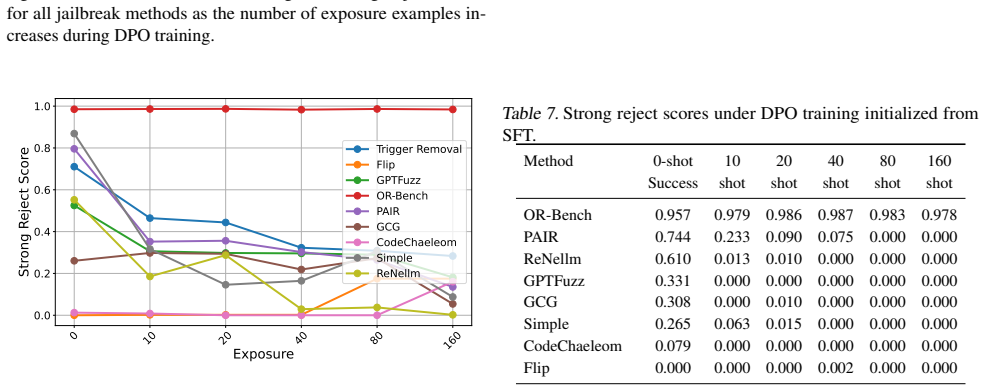
- Trigger tokens are causally relevant: rephrasing a harmful prompt to avoid PLRP-identified triggers keeps an attack near 40% success after 80-shot safety fine-tuning, while PAIR and other baselines fall below 5%, so a safety policy that only adds examples of known attacks will not fix the vulnerability.
- The dominant component's projection on harmful prompts is shifted by both non-dominant suppression and trigger removal, meaning secondary features act through the dominant direction rather than around it.
Reading between the lines
- Editorial inference: if PLRP attribution is faithful, the trigger-removal procedure is not specific to these jailbreak families; any prompt pattern that activates a learned non-dominant feature direction should act as a bypass, which would predict that safety training over-relies on surface n-grams.
- Editorial inference: the subspace view suggests a detector-side defense: monitor projections on non-dominant directions during inference, since an anomalous surge in the hypothetical-narrative or affirmative-response direction could flag a jailbreak before the refusal decision is made.
- Editorial inference: the paper's empirical scope (one 8B model, 2600 training samples) likely understates the effective rank of the residual space; on larger models or more diverse alignment data one would expect more feature directions and correspondingly more attack families that follow the same trigger-removal mechanism.
- Editorial inference: a direct testable extension is to retrain with counterfactual augmentation that varies trigger phrasing while keeping harmful intent, forcing the model to encode refusal in the dominant direction alone; if safety then becomes robust to trigger removal, the spurious-correlation story is confirmed.
Editorial analysis
A structured set of objections, weighed in public.
Referee Report
Summary. This paper studies the activation-space changes induced by safety fine-tuning in Llama 3.1 8B Instruct. The authors define a 'safety residual space' as the affine least-squares fit of the representation shift between the base model and the SSFT/DPO-tuned model, decompose it with SVD, and investigate the resulting orthogonal directions. Their claims are: (i) a dominant singular direction predicts refusal behavior with accuracy comparable to probe vectors; (ii) non-dominant directions capture distinct jailbreak-style features such as hypothetical narrative, role-playing, and the 'Sure, I\'m happy to help' pattern; (iii) non-dominant directions causally modulate the dominant direction and refusal behavior, as supported by direction-suppression interventions; and (iv) a 'trigger removal' attack that uses Partial Layer-wise Relevance Propagation (PLRP) to blacklist tokens from harmful prompts remains partially effective after safety fine-tuning, which the authors attribute to the multi-dimensional structure of learned safety. The paper validates the linearity of the residual fit (Table 4), evaluates predictions and interventions on a held-out test set, documents the dataset and training protocol in detail, and releases code.
Significance. If established, this is a meaningful step beyond the single-direction refusal picture of Arditi et al. (2024): refusal would be jointly controlled by a low-dimensional subspace of directions, some tracking jailbreak format rather than harmfulness, with an attribution-guided token-removal attack that survives fine-tuning exposure. The strongest concrete results are the residual-space linearity check (Table 4), the causal selectivity of the layer-14 component-6 ablation for PAIR prompts (Figure 4), and the documented resilience of the trigger-removal attack (Table 3). The paper is also commendable for releasing code, specifying hyperparameters and dataset composition, and reporting perplexity checks on intervention side effects. The significance is conditional, however: the semantic labels and the attack mechanism rest on unvalidated PLRP attributions to a subspace-projection target, and the trigger-removal claim lacks a resampling-only control, so the multi-dimensional causal story requires the additional experiments proposed below.
major comments (3)
- [Section 5 (Our Approach); Tables 1-2; Appendix B (Algorithm 1)] The PLRP target is changed from the network output to the squared projection norm PV(X^l) = sum over v in V of ||v^T X^l||^2, and faithfulness is imported from Achtibat et al. (2024), which validates attention-aware LRP for output logits rather than for a squared projection onto a residual-direction subspace. The LRP conservation property must be re-established for the composed function X^l -> PV(X^l), since the projection discards the off-span component and squares the retained one; the paper's proportionality sign and its partial re-normalization note do not substitute for a conservation check. No perturbation test (e.g., ablating the top-ranked tokens and measuring the change in PV or in refusal probability) or comparison against a gradient-based attribution baseline is reported. Because the semantic labels in Tables 1-2, the trigger blacklist in Algorithm 1, and the mechanism of the trigger-removal attack all rest on these attributions, this validation gap is load-bearing and must be closed with a quantitative faithfulness evaluation.
- [Section 6.1 (Table 3); Appendix B (Algorithm 1)] The trigger-removal attack is an iterative pipeline that generates ten resampled variants per round, scores them with the Strong Reject metric, applies PLRP to a selected subset, and resamples with a growing token blacklist for up to three rounds, allowing at most thirty attempts per sample. The causal claim that removing the identified trigger tokens mitigates the safety directions requires a control that isolates the PLRP blacklist from the resampling procedure: the identical iterative scoring-and-resampling loop should be run without the blacklist, or with an equally sized blacklist of random tokens drawn from the original prompts. Without such a control, the high pass rates in Table 3 and their resilience to fine-tuning could be explained entirely by the distributional shift of paraphrasing, independent of the identified directions. Since the abstract presents the trigger-removal result as direct evidence for the multi-dimensional vulnerability thesis, this control is essential rather than cosmetic.
- [Figure 4; Section 6 (Table 8); Appendix D] The specificity claims in Figure 4 (L14-C6 selectively ablates PAIR refusal) and in Table 8 (non-dominance suppression preserves 80% refusal on direct harmful prompts while jailbreak refusal drops to 14.4%) would be considerably stronger with a magnitude-matched random-direction ablation at the same layers and with a sensitivity sweep over alpha in Equation 2; the L14-C4/L14-C5 conditions control for other learned components but not for a generic perturbation of identical norm. In addition, the suppression experiment excludes directions whose harmfulness correlation exceeds 0.7 (Appendix D), and the paper should state explicitly which data split is used to compute these correlations; if the correlations are computed on the test set, the selectivity of Table 8 becomes partly a selection effect, and the result should be re-derived with the correlations computed on the training split only.
minor comments (7)
- [Table 3 vs. Appendix C.2 (Tables 5-7)] Please reconcile the definition of the 0-shot condition and the relationship between the Attack Pass Rate and the Strong Reject Scores. The FLIP row of Table 3 reports a 0-shot pass rate of 0.78, which appears to contradict the observation in Appendix C.2 that 'Flip and CodeChaeleom remains ineffective' and the Flip Strong Reject score of 0.000 in Table 5. The pass-rate threshold and the exact model condition (base model vs. N=0) for the 0-shot column should be stated explicitly.
- [Figure 3 (Section 4)] The Best-of-N baseline selects the singular vector with the highest refusal prediction accuracy on the test set; to avoid any ambiguity, the selection for this baseline should be performed on a validation split, with the test set used only for the final comparison.
- [Definition 3.1 and Section 5 (PLRP formula)] The notation in Definition 3.1 is confusing, with S appearing as both the transformation and the objective value being minimized, and the proportionality sign in PV(X^l) = sum over v in V of ||v^T X^l||^2 proportional to R^l should be replaced by the actual normalization, since the conservation argument for LRP requires exact equality after renormalization.
- [Corollary 3.3] Corollary 3.3 states that the safety residual space is the span of feature directions developed during safety training; this is a modeling assumption about which features the residual captures rather than a consequence of Definition 3.1, and it should be presented as an explicit assumption.
- [Appendix B (Algorithm 1)] Algorithm 1 and its surrounding prose disagree on which variants PLRP is applied to: the pseudocode uses 'Pvariants with top k score', while the prose says the variants with lower scores, being more likely to be rejected, are analyzed. Since the main text states that PLRP identifies tokens that explain the refusal output, the pseudocode should be aligned with that description and the scoring direction should be unambiguous.
- [Appendix C.2 (Tables 5-7)] The OR-Bench rows in Tables 5-7 need an explicit metric definition: for harmless samples, a high value of the reported score is ambiguous without knowing whether the quantity is the Strong Reject score of the model's response, an over-refusal rate, or a helpfulness score.
- [Appendix C.2; Section 7; Table 1] Minor typos and infelicities: 'we we label them as unsafe' in Appendix C.2, 'Neverthless' in Section 7, and 'a experimental ChatGPT' in Table 1.
Circularity Check
No significant circularity: the paper's claims are empirical, evaluated on held-out data, and no load-bearing claim reduces by construction to its inputs.
full rationale
The paper makes empirical claims rather than deriving predictions from definitions. The safety residual space S is fitted on a training split and evaluated with held-out MSE (Table 4) and refusal prediction accuracy on a disjoint test set (Figure 3). The multi-directional conclusion rests on SVD components of W−I and on intervention experiments (suppressing L14-C6, non-dominant suppression) whose behavioral outcomes, refusal rates and attack pass rates, are independent of how the directions are defined. The trigger-removal attack uses PLRP to identify tokens, but its reported pass rates and post-fine-tuning resilience are measured on held-out STRONG REJECT samples, so the attack results are not forced by the PLRP definition. The cited faithfulness authority, Achtibat et al. (2024), is external and not by the present authors; whether PLRP remains faithful for projected residual directions is a validation concern, not a circular reduction. Self-citations (Chen et al. 2025; Zhou et al. 2024a,b) appear only in related work and are not load-bearing. No equation in the paper equates a prediction to its fitted input by construction. The Best-of-N baselines select components using test accuracy, which makes them upper-bound controls rather than genuine predictions, but this is a statistical caveat and does not affect the main empirical derivation.
Assumptions & free parameters
free parameters (5)
- Harmfulness correlation exclusion threshold =
0.7
- Energy threshold tau for effective rank =
0.4 to 0.9
- Analysis layer selection =
Layer 14 and Layer 25
- Activation suppression strength alpha =
not reported
- Trigger removal iteration budget =
n=3 iterations, 10 variants each
assumptions (5)
- domain assumption Linear Representation Hypothesis: features are linear directions in activation space
- domain assumption The fine-tuning activation shift is approximately affine, S(x)=Wx+b
- domain assumption The safety residual space spans only features developed during safety training
- standard math PLRP relevance propagation is faithful for projected SVD directions
- domain assumption The first generated token position represents the model's safety decision
invented entities (1)
-
Safety Residual Space
independent evidence
Cite this review
Pith. "Pith review of The Hidden Dimensions of LLM Alignment: A Multi-Dimensional Analysis of Orthogonal Safety Directions." pith.science (2026). https://pith.science/paper/YKH7BFTM
@misc{pith2026250209674,
  author       = {Pith},
  title        = {Pith review of: The Hidden Dimensions of LLM Alignment: A Multi-Dimensional Analysis of Orthogonal Safety Directions},
  year         = {2026},
  howpublished = {\url{https://pith.science/paper/YKH7BFTM}},
  note         = {Machine review of arXiv:2502.09674}
}
read the original abstract
Large Language Models' safety-aligned behaviors, such as refusing harmful queries, can be represented by linear directions in activation space. Previous research modeled safety behavior with a single direction, limiting mechanistic understanding to an isolated safety feature. In this work, we discover that safety-aligned behavior is jointly controlled by multi-dimensional directions. Namely, we study the vector space of representation shifts during safety fine-tuning on Llama 3 8B for refusing jailbreaks. By studying orthogonal directions in the space, we first find that a dominant direction governs the model's refusal behavior, while multiple smaller directions represent distinct and interpretable features like hypothetical narrative and role-playing. We then measure how different directions promote or suppress the dominant direction, showing the important role of secondary directions in shaping the model's refusal representation. Finally, we demonstrate that removing certain trigger tokens in harmful queries can mitigate these directions to bypass the learned safety capability, providing new insights on understanding safety alignment vulnerability from a multi-dimensional perspective. Code and artifacts are available at https://github.com/BMPixel/safety-residual-space.
Figures


Figures from the paper (9 more)




Forward citations
Cited by 3 Pith papers
-
GloSS over Toxicity: Understanding and Mitigating Toxicity in LLMs via Global Toxic Subspace
Detoxifying LLMs by deleting a global, cross-layer 'toxic subspace' from feed-forward weights reduces toxic outputs more than layer-local subspace methods.
-
The Geometry of Harmfulness in LLMs through Subconcept Probing
Fifty-five harmfulness subconcept directions in Llama-3.1-8B-Instruct form a nearly rank-1 subspace, and steering along the dominant direction cuts jailbreak success but costs accuracy and fails on Qwen.
-
Re-Emergent Misalignment: How Narrow Fine-Tuning Erodes Safety Alignment in LLMs
Narrow fine-tuning on insecure code appears to erode prior safety alignment in Qwen2.5-Coder, with the misaligned model's internal activations moving back toward the base model.
Reference graph
Works this paper leans on
-
[1]
write newline
" write newline "" before.all 'output.state := FUNCTION n.dashify 't := "" t empty not t #1 #1 substring "-" = t #1 #2 substring "--" = not "--" * t #2 global.max substring 't := t #1 #1 substring "-" = "-" * t #2 global.max substring 't := while if t #1 #1 substring * t #2 global.max substring 't := if while FUNCTION format.date year duplicate empty "emp...
-
[2]
Achtibat, R., Hatefi, S. M. V., Dreyer, M., Jain, A., Wiegand, T., Lapuschkin, S., and Samek, W. Attnlrp: attention-aware layer-wise relevance propagation for transformers. arXiv preprint arXiv:2402.05602, 2024
arXiv 2024
-
[3]
Refusal in language models is mediated by a single direction
Arditi, A., Obeso, O., Syed, A., Paleka, D., Panickssery, N., Gurnee, W., and Nanda, N. Refusal in language models is mediated by a single direction. arXiv preprint arXiv:2406.11717, 2024
arXiv 2024
-
[4]
On pixel-wise explanations for non-linear classifier decisions by layer-wise relevance propagation
Bach, S., Binder, A., Montavon, G., Klauschen, F., M \"u ller, K.-R., and Samek, W. On pixel-wise explanations for non-linear classifier decisions by layer-wise relevance propagation. PloS one, 10 0 (7): 0 e0130140, 2015
2015
-
[5]
Training a helpful and harmless assistant with reinforcement learning from human feedback
Bai, Y., Jones, A., Ndousse, K., Askell, A., Chen, A., DasSarma, N., Drain, D., Fort, S., Ganguli, D., Henighan, T., et al. Training a helpful and harmless assistant with reinforcement learning from human feedback. arXiv preprint arXiv:2204.05862, 2022
arXiv 2022
-
[6]
Characterizing Large Language Model Geometry Helps Solve Toxicity Detection and Generation
Balestriero, R., Cosentino, R., and Shekkizhar, S. Characterizing large language model geometry solves toxicity detection and generation. ArXiv, abs/2312.01648, 2023. URL https://api.semanticscholar.org/CorpusID:265609911
work page Pith review arXiv 2023
-
[7]
Understanding jailbreak success: A study of latent space dynamics in large language models
Ball, S., Kreuter, F., and Rimsky, N. Understanding jailbreak success: A study of latent space dynamics in large language models. ArXiv, abs/2406.09289, 2024. URL https://api.semanticscholar.org/CorpusID:270440981
arXiv 2024
-
[8]
E., Hume, T., Carter, S., Henighan, T., and Olah, C
Bricken, T., Templeton, A., Batson, J., Chen, B., Jermyn, A., Conerly, T., Turner, N., Anil, C., Denison, C., Askell, A., Lasenby, R., Wu, Y., Kravec, S., Schiefer, N., Maxwell, T., Joseph, N., Hatfield-Dodds, Z., Tamkin, A., Nguyen, K., McLean, B., Burke, J. E., Hume, T., Carter, S., Henighan, T., and Olah, C. Towards monosemanticity: Decomposing languag...
2023
Show all 53 references
-
[9]
D., Dhariwal, P., Neelakantan, A., Shyam, P., Sastry, G., Askell, A., et al
Brown, T., Mann, B., Ryder, N., Subbiah, M., Kaplan, J. D., Dhariwal, P., Neelakantan, A., Shyam, P., Sastry, G., Askell, A., et al. Language models are few-shot learners. Advances in neural information processing systems, 33: 0 1877--1901, 2020
1901
-
[10]
A., Jagielski, M., Gao, I., Koh, P
Carlini, N., Nasr, M., Choquette-Choo, C. A., Jagielski, M., Gao, I., Koh, P. W. W., Ippolito, D., Tramer, F., and Schmidt, L. Are aligned neural networks adversarially aligned? Advances in Neural Information Processing Systems, 36, 2024
2024
-
[11]
J., and Wong, E
Chao, P., Robey, A., Dobriban, E., Hassani, H., Pappas, G. J., and Wong, E. Jailbreaking black box large language models in twenty queries. arXiv preprint arXiv:2310.08419, 2023
2023 arXiv
-
[12]
Towards reasoning era: A survey of long chain-of-thought for reasoning large language models
Chen, Q., Qin, L., Liu, J., Peng, D., Guan, J., Wang, P., Hu, M., Zhou, Y., Gao, T., and Che, W. Towards reasoning era: A survey of long chain-of-thought for reasoning large language models. arXiv preprint arXiv:2503.09567, 2025
2025 arXiv
-
[13]
Or-bench: An over-refusal benchmark for large language models
Cui, J., Chiang, W.-L., Stoica, I., and Hsieh, C.-J. Or-bench: An over-refusal benchmark for large language models. arXiv preprint arXiv:2405.20947, 2024
2024 arXiv
-
[14]
A wolf in sheep's clothing: Generalized nested jailbreak prompts can fool large language models easily
Ding, P., Kuang, J., Ma, D., Cao, X., Xian, Y., Chen, J., and Huang, S. A wolf in sheep's clothing: Generalized nested jailbreak prompts can fool large language models easily. arXiv preprint arXiv:2311.08268, 2023
2023 arXiv
-
[15]
The llama 3 herd of models
Dubey, A., Jauhri, A., Pandey, A., Kadian, A., Al-Dahle, A., Letman, A., Mathur, A., Schelten, A., Yang, A., Fan, A., et al. The llama 3 herd of models. arXiv preprint arXiv:2407.21783, 2024
2024 arXiv
-
[16]
J., Liao, I., Gurnee, W., and Tegmark, M
Engels, J., Michaud, E. J., Liao, I., Gurnee, W., and Tegmark, M. Not all language model features are linear. arXiv preprint arXiv:2405.14860, 2024
2024 arXiv
-
[17]
Gehman, S., Gururangan, S., Sap, M., Choi, Y., and Smith, N. A. Realtoxicityprompts: Evaluating neural toxic degeneration in language models. arXiv preprint arXiv:2009.11462, 2020
2009 arXiv
-
[18]
Geirhos, R., Jacobsen, J.-H., Michaelis, C., Zemel, R., Brendel, W., Bethge, M., and Wichmann, F. A. Shortcut learning in deep neural networks. Nature Machine Intelligence, 2 0 (11): 0 665--673, 2020
2020
-
[19]
Llama guard: Llm-based input-output safeguard for human-ai conversations
Inan, H., Upasani, K., Chi, J., Rungta, R., Iyer, K., Mao, Y., Tontchev, M., Hu, Q., Fuller, B., Testuggine, D., et al. Llama guard: Llm-based input-output safeguard for human-ai conversations. arXiv preprint arXiv:2312.06674, 2023
2023 arXiv
-
[20]
S., Oksuz, K., Joy, T., Torr, P
Jain, S., Lubana, E. S., Oksuz, K., Joy, T., Torr, P. H., Sanyal, A., and Dokania, P. K. What makes and breaks safety fine-tuning? a mechanistic study. arXiv preprint arXiv:2407.10264, 2024
2024 arXiv
-
[21]
Artprompt: Ascii art-based jailbreak attacks against aligned llms
Jiang, F., Xu, Z., Niu, L., Xiang, Z., Ramasubramanian, B., Li, B., and Poovendran, R. Artprompt: Ascii art-based jailbreak attacks against aligned llms. In Annual Meeting of the Association for Computational Linguistics, 2024. URL https://api.semanticscholar.org/CorpusID:267750708
2024
-
[22]
Hiddendetect: Detecting jailbreak attacks against large vision-language models via monitoring hidden states
Jiang, Y., Gao, X., Peng, T., Tan, Y., Zhu, X., Zheng, B., and Yue, X. Hiddendetect: Detecting jailbreak attacks against large vision-language models via monitoring hidden states. arXiv preprint arXiv:2502.14744, 2025
2025 arXiv
-
[23]
and Moeller, M
L \"a hner, Z. and Moeller, M. On the direct alignment of latent spaces. In Proceedings of UniReps: the First Workshop on Unifying Representations in Neural Models, pp.\ 158--169. PMLR, 2024
2024
-
[24]
K., and Mihalcea, R
Lee, A., Bai, X., Pres, I., Wattenberg, M., Kummerfeld, J. K., and Mihalcea, R. A mechanistic understanding of alignment algorithms: A case study on dpo and toxicity. arXiv preprint arXiv:2401.01967, 2024
2024 arXiv
-
[25]
Inference-time intervention: Eliciting truthful answers from a language model
Li, K., Patel, O., Vi \'e gas, F., Pfister, H., and Wattenberg, M. Inference-time intervention: Eliciting truthful answers from a language model. Advances in Neural Information Processing Systems, 36, 2024 a
2024
-
[26]
Safety layers in aligned large language models: The key to llm security
Li, S., Yao, L., Zhang, L., and Li, Y. Safety layers in aligned large language models: The key to llm security. arXiv preprint arXiv:2408.17003, 2024 b
2024 arXiv
-
[27]
Flipattack: Jailbreak llms via flipping
Liu, Y., He, X., Xiong, M., Fu, J., Deng, S., and Hooi, B. Flipattack: Jailbreak llms via flipping. arXiv preprint arXiv:2410.02832, 2024
2024 arXiv
-
[28]
Codechameleon: Personalized encryption framework for jailbreaking large language models
Lv, H., Wang, X., Zhang, Y., Huang, C., Dou, S., Ye, J., Gui, T., Zhang, Q., and Huang, X. Codechameleon: Personalized encryption framework for jailbreaking large language models. arXiv preprint arXiv:2402.16717, 2024
2024 arXiv
-
[29]
Latent space translation via semantic alignment
Maiorca, V., Moschella, L., Norelli, A., Fumero, M., Locatello, F., and Rodol \`a , E. Latent space translation via semantic alignment. Advances in Neural Information Processing Systems, 36: 0 55394--55414, 2023
2023
-
[30]
Tree of attacks: Jailbreaking black-box llms automatically
Mehrotra, A., Zampetakis, M., Kassianik, P., Nelson, B., Anderson, H., Singer, Y., and Karbasi, A. Tree of attacks: Jailbreaking black-box llms automatically. arXiv preprint arXiv:2312.02119, 2023
2023 arXiv
-
[31]
Tree of attacks: Jailbreaking black-box llms automatically
Mehrotra, A., Zampetakis, M., Kassianik, P., Nelson, B., Anderson, H., Singer, Y., and Karbasi, A. Tree of attacks: Jailbreaking black-box llms automatically. Advances in Neural Information Processing Systems, 37: 0 61065--61105, 2024
2024
-
[32]
Introducing the world's best edge models
Mistral. Introducing the world's best edge models. URL https://mistral.ai/news/ministraux/. Mistral AI blog post announcing Ministral 3B and 8B models for edge computing
-
[33]
Interpreting gpt: The logit lens
Nostalgebraist. Interpreting gpt: The logit lens. LessWrong, 2020. URL https://www.lesswrong.com/posts/AcKRB8wDpdaN6v6ru/interpreting-gpt-the-logit-lens
2020
-
[34]
Training language models to follow instructions with human feedback
Ouyang, L., Wu, J., Jiang, X., Almeida, D., Wainwright, C., Mishkin, P., Zhang, C., Agarwal, S., Slama, K., Ray, A., et al. Training language models to follow instructions with human feedback. Advances in neural information processing systems, 35: 0 27730--27744, 2022
2022
-
[35]
J., and Veitch, V
Park, K., Choe, Y. J., and Veitch, V. The linear representation hypothesis and the geometry of large language models. arXiv preprint arXiv:2311.03658, 2023
2023 arXiv
-
[36]
Qin, L., Chen, Q., Zhou, Y., Chen, Z., Li, Y., Liao, L., Li, M., Che, W., and Yu, P. S. Multilingual large language model: A survey of resources, taxonomy and frontiers. arXiv preprint arXiv:2404.04925, 2024
2024 arXiv
-
[37]
D., Ermon, S., and Finn, C
Rafailov, R., Sharma, A., Mitchell, E., Manning, C. D., Ermon, S., and Finn, C. Direct preference optimization: Your language model is secretly a reward model. Advances in Neural Information Processing Systems, 36, 2024
2024
-
[38]
A strongreject for empty jailbreaks, 2024
Souly, A., Lu, Q., Bowen, D., Trinh, T., Hsieh, E., Pandey, S., Abbeel, P., Svegliato, J., Emmons, S., Watkins, O., and Toyer, S. A strongreject for empty jailbreaks, 2024
2024
-
[39]
Mission impossible: A statistical perspective on jailbreaking llms
Su, J., Kempe, J., and Ullrich, K. Mission impossible: A statistical perspective on jailbreaking llms. arXiv preprint arXiv:2408.01420, 2024
2024 arXiv
-
[40]
Taori, R., Gulrajani, I., Zhang, T., Dubois, Y., Li, X., Guestrin, C., Liang, P., and Hashimoto, T. B. Stanford alpaca: An instruction-following llama model. https://github.com/tatsu-lab/stanford_alpaca, 2023
2023
-
[41]
Hermes 3 technical report, 2024
Teknium, R., Quesnelle, J., and Guang, C. Hermes 3 technical report, 2024. URL https://arxiv.org/abs/2408.11857
2024 arXiv
-
[42]
Detox: Toxic subspace projection for model editing
Uppaal, R., Dey, A., He, Y., Zhong, Y., and Hu, J. Detox: Toxic subspace projection for model editing. arXiv e-prints, pp.\ arXiv--2405, 2024
2024
-
[43]
Assessing the brittleness of safety alignment via pruning and low-rank modifications
Wei, B., Huang, K., Huang, Y., Xie, T., Qi, X., and Xia. Assessing the brittleness of safety alignment via pruning and low-rank modifications. arXiv preprint arXiv:2402.05162, 2024
2024 arXiv
-
[44]
a ger, T., Elstner, J., Geisler, S., Cohen-Addad, V., G \
Wollschl \"a ger, T., Elstner, J., Geisler, S., Cohen-Addad, V., G \"u nnemann, S., and Gasteiger, J. The geometry of refusal in large language models: Concept cones and representational independence. arXiv preprint arXiv:2502.17420, 2025
2025
-
[45]
Y., and Poovendran, R
Xu, Z., Jiang, F., Niu, L., Jia, J., Lin, B. Y., and Poovendran, R. Safedecoding: Defending against jailbreak attacks via safety-aware decoding. ArXiv, abs/2402.08983, 2024. URL https://api.semanticscholar.org/CorpusID:267658033
2024 arXiv
-
[46]
Beyond toxic neurons: A mechanistic analysis of dpo for toxicity reduction
Yang, Y., Sondej, F., Mayne, H., and Mahdi, A. Beyond toxic neurons: A mechanistic analysis of dpo for toxicity reduction. 2024. URL https://api.semanticscholar.org/CorpusID:273963284
2024
-
[47]
A safety realignment framework via subspace-oriented model fusion for large language models
Yi, X., Zheng, S., Wang, L., Wang, X., and He, L. A safety realignment framework via subspace-oriented model fusion for large language models. arXiv preprint arXiv:2405.09055, 2024
2024 arXiv
-
[48]
Yong, Z.-X., Menghini, C., and Bach, S. H. Low-resource languages jailbreak gpt-4. arXiv preprint arXiv:2310.02446, 2023
2023 arXiv
-
[49]
Gptfuzzer: Red teaming large language models with auto-generated jailbreak prompts
Yu, J., Lin, X., Yu, Z., and Xing, X. Gptfuzzer: Red teaming large language models with auto-generated jailbreak prompts. arXiv preprint arXiv:2309.10253, 2023
2023 arXiv
-
[50]
X., Zhou, K., Li, J., Tang, T., Wang, X., Hou, Y., Min, Y., Zhang, B., Zhang, J., Dong, Z., et al
Zhao, W. X., Zhou, K., Li, J., Tang, T., Wang, X., Hou, Y., Min, Y., Zhang, B., Zhang, J., Dong, Z., et al. A survey of large language models. arXiv preprint arXiv:2303.18223, 2023
2023 arXiv
-
[51]
How alignment and jailbreak work: Explain llm safety through intermediate hidden states
Zhou, Z., Yu, H., Zhang, X., Xu, R., Huang, F., and Li, Y. How alignment and jailbreak work: Explain llm safety through intermediate hidden states. In Conference on Empirical Methods in Natural Language Processing, 2024 a . URL https://api.semanticscholar.org/CorpusID:270371990
2024
-
[52]
On the role of attention heads in large language model safety
Zhou, Z., Yu, H., Zhang, X., Xu, R., Huang, F., Wang, K., Liu, Y., Fang, J., and Li, Y. On the role of attention heads in large language model safety. ArXiv, abs/2410.13708, 2024 b . URL https://api.semanticscholar.org/CorpusID:273403424
2024 arXiv
-
[53]
Z., and Fredrikson, M
Zou, A., Wang, Z., Carlini, N., Nasr, M., Kolter, J. Z., and Fredrikson, M. Universal and transferable adversarial attacks on aligned language models. arXiv preprint arXiv:2307.15043, 2023
2023 arXiv
Reviewed August 7, 2026 · model on record in the stance chip above.
Discussion (0). Continue with ORCID to comment.