REVIEW 3 major objections 5 minor 132 references
Chemical Abundances in the Nuclear Star Cluster of the Milky Way: alpha-Element Trends and Their Similarities with the Inner Bulge
T0 review · 3 major / 5 minor · reviewed 2026-08-11 · deepseek-v4-flash
Pith's one-line read The Milky Way's nuclear star cluster formed through the same rapid, early star-formation episode as the inner bulge.
desk verdict Careful differential Mg/Ca/Si abundances for nine NSC M giants, but the oxygen-dependent temperature scale and the tiny sample keep the inner-bulge similarity in the 'promising, not proven' category. read the letter →
The pith
A machine-rendered reading of the paper's core claim, the machinery that carries it, and where it could break.
The reading
What carries the argument
The argument is carried by a strictly differential abundance analysis: the nine Nuclear Star Cluster giants and the 50 solar-neighborhood comparison giants were observed with the same high-resolution near-infrared setup, reduced with the same pipeline, and analyzed with the same spectral synthesis, line list, and stellar parameter scale, so systematic errors largely cancel when the trends are compared. The diagnostic quantity is the $\alpha$-to-iron ratio $[\alpha/\mathrm{Fe}]$ as a function of $[\mathrm{Fe/H}]$, where the $\alpha$ elements (Mg, Si, Ca) come predominantly from short-lived massive stars and iron builds up on longer timescales, making the trend a recorder of star-formation rate and duration. The effective temperatures are anchored by OH lines under an assumed oxygen-to-iron trend taken from disk stars, and the paper explicitly notes that an error in this trend would shift temperatures by 50–100 K and $\alpha$ abundances by 0.05–0.10 dex.
What would settle it
Measure oxygen directly, for example through O I lines or asteroseismic temperatures, for the same nine stars and recompute the alpha-element trends; if the revised trends no longer overlap the inner-bulge sequence within the quoted uncertainties, the paper's central comparison fails.
Extended reading notes
Core claim
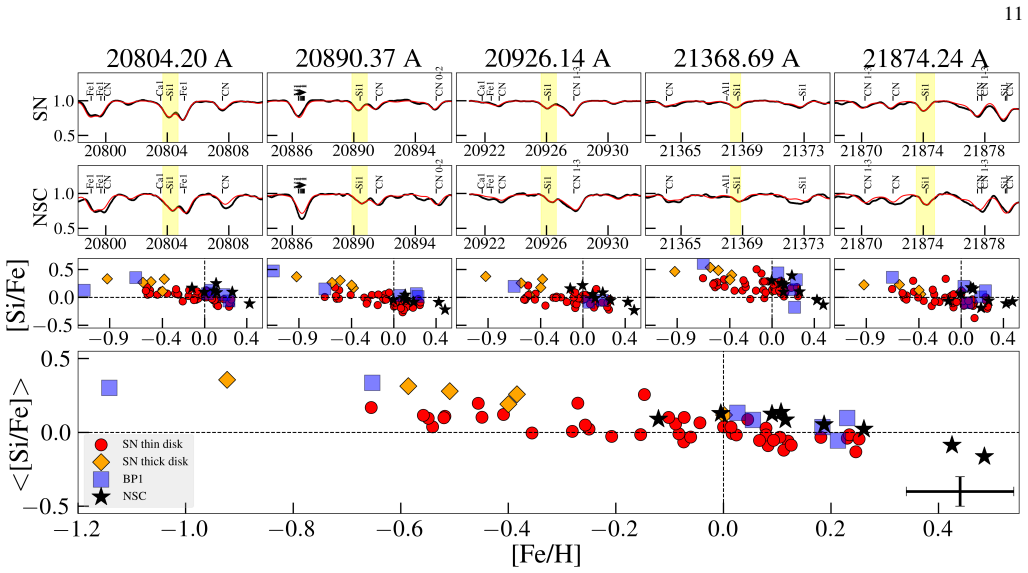
The central claim is that the alpha-element trends of the Nuclear Star Cluster's M giants, measured as [Mg/Fe], [Si/Fe], and [Ca/Fe] against [Fe/H], are chemically indistinguishable from those of inner-bulge stars: enhanced relative to solar-neighborhood thin-disk stars, steadily decreasing with metallicity, and still declining at supersolar values, with the two most metal-rich stars showing subsolar ratios. The paper argues that this pattern records a high star-formation rate early in the cluster's life, because alpha elements are released quickly by massive stars while iron accumulates over longer timescales from Type Ia supernovae. On that basis it concludes that the NSC population most likely shares the evolutionary history of the inner bulge, that its metal-rich stars formed in situ, and that a dominant star-formation burst around 5 Gyr ago is disfavored.
Load-bearing premise
The analysis assumes that the oxygen-to-iron trend measured in thick-disk stars also applies to Nuclear Star Cluster stars when their temperatures are set from OH lines; if that assumption is wrong, the temperatures shift by tens of kelvins and the alpha-element abundances by about a tenth of a dex, which is enough to blur the claimed match with the inner bulge.
Editorial extensions
If this is right
- The Nuclear Star Cluster's alpha-element trend is enhanced and declines with metallicity, placing the cluster on the inner-disk chemical sequence shared with the inner bulge.
- A recent, dominant star-formation burst in the cluster is disfavored in favor of an early, rapid formation epoch.
- The metal-rich population of the Nuclear Star Cluster most likely formed in situ rather than being assembled from infalling stellar clusters.
- Chemical abundance patterns of extragalactic nuclear star clusters in Milky Way-type galaxies could serve as proxies for their host galaxies' evolutionary processes.
Reading between the lines
- If a larger sample confirms that the two most metal-rich stars have genuinely subsolar alpha ratios, the declining trend would constrain how much late iron enrichment from Type Ia supernovae has occurred in the cluster.
- Independent oxygen abundances for the same stars, from O I lines or asteroseismic temperatures, would directly test the assumed temperature scale and either harden or weaken the similarity with the inner bulge.
- Chemical-evolution modeling of these nine stars could put an upper limit on the mass fraction of a ~3 Gyr intermediate-age population that would remain hidden in the alpha-element trends.
- Extending the same differential method to nitrogen, carbon, and odd-Z elements in the Nuclear Star Cluster could separate the early rapid-enrichment signal from later gas infall and sharpen the formation chronology.
Editorial analysis
A structured set of objections, weighed in public.
Referee Report
Summary. The paper presents high-resolution (R~45,000) IGRINS H+K spectra of nine M giants in the Milky Way's Nuclear Star Cluster, determines Mg, Si, and Ca abundances via spectral synthesis with non-LTE corrections, and compares them differentially with a 50-star solar-neighborhood M-giant sample and an inner-bulge sample analyzed with the same method. It reports enhanced [alpha/Fe] ratios that decrease with [Fe/H], including subsolar values at the two highest metallicities, finds that the NSC trends follow the inner-bulge trend and the high-alpha envelope of the metal-rich thin disk, and interprets this as evidence for an early, rapid star-formation history shared with the inner bulge, disfavoring a recent dominant starburst. The analysis is carefully designed as a differential study, but the small sample size and a key systematic assumption in the temperature scale (the assumed [O/Fe] trend used to set Teff) limit the strength of the conclusions.
Significance. If the reported trends hold, the paper provides an important observational constraint on NSC formation: it links the NSC chemistry to the inner-disk sequence and argues against a dominant recent star-formation burst. The study's strengths are its genuinely differential design (same instrument, wavelength range, resolution, reduction pipeline, line list, and analysis technique for the NSC, solar-neighborhood, and inner-bulge samples), the use of a 50-star control sample to select reliable spectral lines, non-LTE corrections, and the inclusion of dynamical and extinction-based membership checks. The qualitative claim of enhanced, decreasing alpha trends is supported by the nine stars at the 0.05-0.15 dex random-precision level, but the systematic caveats below must be addressed before the conclusion can be accepted as robust.
major comments (3)
- [Section 3.3.1, Table 2] The effective-temperature scale is set by OH lines using an assumed [O/Fe] versus [Fe/H] relation for thick-disk stars (Amarsi et al. 2019), and Table 2 lists [O/Fe] values from this same functional form rather than from measured oxygen. The authors state that a 0.2 dex change in the assumed oxygen abundance shifts Teff by 50-100 K and the derived alpha abundances by 0.05-0.10 dex. This is load-bearing because the conclusion that [alpha/Fe] decreases at the highest metallicities and matches the inner-bulge trend depends on this temperature scale: if the true NSC oxygen trend is higher than the thick-disk relation at [Fe/H] > 0.3, the high-metallicity Teff values would be systematically too cool and the derived [alpha/Fe] too high, flattening the decline and weakening the claimed similarity. Since the inner-bulge sample (Nandakumar et al. 2024b) was analyzed with the same assumption, a shared systematic could produce apparent agreement rather than a real chemical similarity. The quoted 0.05-0.15 dex random uncertainties (Section 4.1) do not include this effect. Please re-derive Teff and [alpha/Fe] under several alternative [O/Fe] relations (e.g., thin-disk, flat, or a relation allowed by the NSC data) and show that the decreasing trend and the inner-bulge similarity persist, or provide an independent Teff anchor.
- [Section 4.2, Figure 7] The claim that 'the NSC [alpha/Fe] trend shows a clear and steady decrease with increasing metallicity, with the two most metal-rich stars displaying subsolar ratios' rests on only two stars at [Fe/H] ~ 0.42 and 0.48 (Feld31 and Feld84), while the polynomial fit in the right panel of Figure 7 explicitly excludes these same two stars because the solar-neighborhood sample has no counterparts there. With nine stars total and two carrying the 'subsolar at high metallicity' feature, the statistical weight of this feature is very small. Please report the significance of the decreasing trend with and without these two stars, and show their [alpha/Fe] values with the systematic uncertainties from the oxygen-trend assumption included; if the subsolar values are within 1-sigma of solar, the conclusions in Sections 5 and 6 should be correspondingly softened.
- [Section 4.2, Ca lines] For calcium, the K-band lines are discarded after showing systematic discrepancies with the H-band lines, and the final [Ca/Fe] trend is based on only three H-band lines in 'quite blended regions.' The text states that the K-band lines give abundances 'systematically and significantly higher than expected' at high metallicity, so the decreasing Ca trend is partly a consequence of this line-selection choice. Since Ca is one of the three elements in the mean alpha trend, please quantify how the K-band lines would change the [Ca/Fe] trend and the mean [alpha/Fe] trend, and justify the selection by showing the line-by-line comparison rather than only describing it.
minor comments (5)
- [References] The bibliography entry 'Kocher, J. 2024, Title' is an incomplete placeholder and must be filled in.
- [Section 1] There are minor typographical errors: 'Galacitc' should be 'Galactic' and 'analaysed' should be 'analysed.'
- [Section 3.3.1] The sentence 'A lowering of the assumed oxygen abundance ... is found to result to systematically lower temperatures' should read 'results in.'
- [Section 4.2] The statement that H-band lines are expected to have lower S/N than several potentially useful K-band lines is in tension with the subsequent statement that the K-band lines show larger scatter; please clarify that the issue is not S/N but systematic offsets.
- [Figure 7 caption] The caption should explicitly state, as the text does, that the two most metal-rich NSC stars are excluded from the polynomial fit because there are no solar-neighborhood counterparts at those metallicities.
Circularity Check
No significant circularity: alpha abundances are measured from independent Mg/Si/Ca lines, and the assumed oxygen trend is a stated systematic that does not define the reported trends.
full rationale
The central claim—that NSC M giants show declining, enhanced [alpha/Fe] trends similar to the inner bulge—is an observational result derived from spectral synthesis fits to Mg, Si, and Ca lines (Section 3.4, Figures 4–6), not from the conclusion itself. The comparison samples (solar neighborhood, inner bulge) were observed and analyzed with the same instrument, line list, and stellar-parameter method, making the comparison differential and systematics-cancelling rather than circular. The one genuinely load-bearing assumption is the [O/Fe]–[Fe/H] relation used to set Teff from OH lines (Section 3.3.1); the paper explicitly states that 'a weakness of the method is the assumption of the oxygen trend versus metallicity' and quantifies the effect as 0.2 dex in O leading to 50–100 K in Teff and 0.05–0.10 dex in alpha. This is a systematic uncertainty, not a circular reduction: the alpha abundances are not defined in terms of the assumed O trend, and the adopted thick-disk O trend is conservative in the sense that lowering the assumed O (moving toward a thin-disk assumption) would raise the derived alpha abundances, so the reported enhancement is not manufactured by the assumption. The decreasing alpha trend is also not produced by the assumption, since the assumed O trend declines with [Fe/H] and would tend to boost high-metallicity alphas, flattening rather than creating the observed decrease. The iterative check described in Section 3.3.1 (evaluating the O assumption against derived alpha trends) is a self-consistency loop, but it is not used to define the reported trends, and the paper openly labels the assumption a weakness. Self-citations to Nandakumar et al. (2023, 2024a, 2024b) are method and comparison references from the same group, but the method has external validation (e.g., asteroseismic gravity checks) and the inner-bulge sample is an independent dataset analyzed consistently, so the self-citations are not load-bearing circularity. No fitted parameter is renamed as a prediction, and no uniqueness theorem is imported. Overall circularity score: 1.
Assumptions & free parameters
free parameters (1)
- [O/Fe] versus [Fe/H] relation (assumed oxygen trend) =
Amarsi et al. (2019) thick disk relation
assumptions (5)
- domain assumption MARCS 1D stellar atmosphere models with non-LTE corrections for C, N, O, Mg, Si, Ca, and Fe are accurate for M giants in the NSC.
- domain assumption The recommended line list from Nandakumar et al. (2023, 2024a) is appropriate for M giants, and the excluded Ca K-band lines are unreliable at high metallicity.
- ad hoc to paper The [O/Fe] versus [Fe/H] relation for thick disk stars applies to the NSC stars.
- domain assumption The targets are genuine NSC members.
- domain assumption Yonsei-Yale isochrones provide reliable surface gravities for old, low-mass M giants.
Cite this review
Pith. "Pith review of Chemical Abundances in the Nuclear Star Cluster of the Milky Way: alpha-Element Trends and Their Similarities with the Inner Bulge." pith.science (2026). https://pith.science/paper/YKLPJXM5
@misc{pith2026241204528,
  author       = {Pith},
  title        = {Pith review of: Chemical Abundances in the Nuclear Star Cluster of the Milky Way: alpha-Element Trends and Their Similarities with the Inner Bulge},
  year         = {2026},
  howpublished = {\url{https://pith.science/paper/YKLPJXM5}},
  note         = {Machine review of arXiv:2412.04528}
}
read the original abstract
A chemical characterization of the Galactic Center is essential for understanding its formation and structural evolution. Trends of alpha-elements, such as Mg, Si, and Ca, serve as powerful diagnostic tools, offering insights into star-formation rates and gas-infall history. However, high extinction has previously hindered such studies. In this study, we present a detailed chemical abundance analysis of M giants in the Milky Way's Nuclear Star Cluster (NSC), focusing on alpha-element trends with metallicity. High-resolution, near-infrared spectra were obtained using the IGRINS spectrograph on the Gemini South telescope for nine M giants. Careful selection of spectral lines, based on a solar-neighborhood control sample of 50 M giants, was implemented to minimize systematic uncertainties. Our findings show enhanced alpha-element abundances in the predominantly metal-rich NSC stars, consistent with trends in the inner bulge. The NSC stars follow the high-[alpha/Fe] envelope seen in the solar vicinity's metal-rich population, indicating a high star-formation rate. The alpha-element trends decrease with increasing metallicity, also at the highest metallicities. Our results suggest the NSC population likely shares a similar evolutionary history with the inner bulge, challenging the idea of a recent dominant star formation burst. This connection between the NSC and the inner-disk sequence suggests that the chemical properties of extragalactic NSCs of Milky Way type galaxies could serve as a proxy for understanding the host galaxies' evolutionary processes.
Figures


Figures from the paper (4 more)



Reference graph
Works this paper leans on
-
[1]
Adibekyan, V . Z., Santos, N. C., Sousa, S. G., & Israelian, G. 2011, A&A, 535, L11, doi: 10.1051/0004-6361/201118240
-
[2]
2021, MNRAS, 503, 5826, doi: 10.1093/mnras/stab322
Agertz, O., Renaud, F., Feltzing, S., et al. 2021, MNRAS, 503, 5826, doi: 10.1093/mnras/stab322
-
[3]
M., Liljegren, S., & Nissen, P
Amarsi, A. M., Liljegren, S., & Nissen, P. E. 2022, A&A, 668, A68, doi: 10.1051/0004-6361/202244542
-
[4]
Amarsi, A. M., Nissen, P. E., & Sk´ulad´ottir, ´A. 2019, A&A, 630, A104, doi: 10.1051/0004-6361/201936265
-
[5]
M., Lind, K., Osorio, Y ., et al
Amarsi, A. M., Lind, K., Osorio, Y ., et al. 2020, A&A, 642, A62, doi: 10.1051/0004-6361/202038650
-
[6]
2014, MNRAS, 444, 3738, doi: 10.1093/mnras/stu1683 Astropy Collaboration, Price-Whelan, A
Arca-Sedda, M., & Capuzzo-Dolcetta, R. 2014, MNRAS, 444, 3738, doi: 10.1093/mnras/stu1683 Astropy Collaboration, Price-Whelan, A. M., Lim, P. L., et al. 2022, ApJ, 935, 167, doi: 10.3847/1538-4357/ac7c74
-
[7]
2020, MNRAS, 492, 4500, doi: 10.1093/mnras/staa140
Baba, J., & Kawata, D. 2020, MNRAS, 492, 4500, doi: 10.1093/mnras/staa140
-
[8]
Bensby, T., Feltzing, S., Gould, A., et al. 2017, A&A, 605, A89, doi: 10.1051/0004-6361/201730560 Bijavara Seshashayana, S., J¨onsson, H., D’Orazi, V ., et al. 2024, A&A, 689, A120, doi: 10.1051/0004-6361/202451056
Show all 132 references
-
[9]
2016, ARA&A, 54, 529, doi: 10.1146/annurev-astro-081915-023441
Bland-Hawthorn, J., & Gerhard, O. 2016, ARA&A, 54, 529, doi: 10.1146/annurev-astro-081915-023441
2016 doi
-
[10]
2012, MNRAS, 427, 127, doi: 10.1111/j.1365-2966.2012.21948.x
Bressan, A., Marigo, P., Girardi, L., et al. 2012, MNRAS, 427, 127, doi: 10.1111/j.1365-2966.2012.21948.x
2012
-
[11]
Brooke, J. S. A., Bernath, P. F., Western, C. M., et al. 2016, JQSRT, 168, 142, doi: 10.1016/j.jqsrt.2015.07.021
2016 doi
-
[12]
1993, ApJ, 415, 616, doi: 10.1086/173189
Capuzzo-Dolcetta, R. 1993, ApJ, 415, 616, doi: 10.1086/173189
1993 doi
-
[13]
S., Sellgren, K., & Balachandran, S
Carr, J. S., Sellgren, K., & Balachandran, S. C. 2000, ApJ, 530, 307, doi: 10.1086/308340
2000 doi
-
[14]
K., Gerhard, O., et al
Chatzopoulos, S., Fritz, T. K., Gerhard, O., et al. 2015, MNRAS, 447, 948, doi: 10.1093/mnras/stu2452
2015 doi
-
[15]
M., et al
Chen, Z., Do, T., Ghez, A. M., et al. 2023, ApJ, 944, 79, doi: 10.3847/1538-4357/aca8ad
2023 doi
-
[16]
Cox, N. L. J., Cami, J., Kaper, L., et al. 2014, A&A, 569, A117, doi: 10.1051/0004-6361/201323061
2014 doi
-
[17]
V ., et al
Cunha, K., Sellgren, K., Smith, V . V ., et al. 2007, ApJ, 669, 1011, doi: 10.1086/521813 da Silva, L., Girardi, L., Pasquini, L., et al. 2006, A&A, 458, 609, doi: 10.1051/0004-6361:20065105 Delgado Mena, E., Moya, A., Adibekyan, V ., et al. 2019, A&A, 624, A78, doi: 10.1051/0...
2007 doi
-
[18]
Demarque, P., Woo, J.-H., Kim, Y .-C., & Yi, S. K. 2004, ApJS, 155, 667, doi: 10.1086/424966 Di Matteo, P. 2016, PASA, 33, e027, doi: 10.1017/pasa.2016.11
2004 doi
-
[19]
2018, ApJL, 855, L5, doi: 10.3847/2041-8213/aaaec3
Do, T., Kerzendorf, W., Konopacky, Q., et al. 2018, ApJL, 855, L5, doi: 10.3847/2041-8213/aaaec3
2018 doi
-
[20]
F., et al
Dong, H., Sch¨odel, R., Williams, B. F., et al. 2017, MNRAS, 471, 3617, doi: 10.1093/mnras/stx1836
2017 doi
-
[21]
2016, ApJS, 222, 8, doi: 10.3847/0067-0049/222/1/8
Dotter, A. 2016, ApJS, 222, 8, doi: 10.3847/0067-0049/222/1/8
2016 doi
-
[22]
2022, A&A, 662, A81, doi: 10.1051/0004-6361/202142990
Ebenbichler, A., Postel, A., Przybilla, N., et al. 2022, A&A, 662, A81, doi: 10.1051/0004-6361/202142990
2022 doi
-
[23]
Cox, N. L. J. 2017, A&A, 600, A129, doi: 10.1051/0004-6361/201630088
2017 doi
-
[24]
2014, A&A, 570, A2, doi: 10.1051/0004-6361/201423777
Feldmeier, A., Neumayer, N., Seth, A., et al. 2014, A&A, 570, A2, doi: 10.1051/0004-6361/201423777
2014 doi
-
[25]
2017a, MNRAS, 464, 194, doi: 10.1093/mnras/stw2339
Feldmeier-Krause, A., Kerzendorf, W., Neumayer, N., et al. 2017a, MNRAS, 464, 194, doi: 10.1093/mnras/stw2339
-
[26]
2017b, MNRAS, 466, 4040, doi: 10.1093/mnras/stw3377
Feldmeier-Krause, A., Zhu, L., Neumayer, N., et al. 2017b, MNRAS, 466, 4040, doi: 10.1093/mnras/stw3377
-
[27]
2015, A&A, 584, A2, doi: 10.1051/0004-6361/201526336 16
Feldmeier-Krause, A., Neumayer, N., Sch¨odel, R., et al. 2015, A&A, 584, A2, doi: 10.1051/0004-6361/201526336 16
2015 doi
-
[28]
2020, MNRAS, 494, 396, doi: 10.1093/mnras/staa703
Feldmeier-Krause, A., Kerzendorf, W., Do, T., et al. 2020, MNRAS, 494, 396, doi: 10.1093/mnras/staa703
2020 doi
-
[29]
2018, A&A, 616, A180, doi: 10.1051/0004-6361/201732509
Fragkoudi, F., Di Matteo, P., Haywood, M., et al. 2018, A&A, 616, A180, doi: 10.1051/0004-6361/201732509
2018 doi
- [30]
-
[31]
K., Chatzopoulos, S., Gerhard, O., et al
Fritz, T. K., Chatzopoulos, S., Gerhard, O., et al. 2016, ApJ, 821, 44, doi: 10.3847/0004-637X/821/1/44
2016 doi
-
[32]
A., Lee, J.-J., Han, I., et al
Galazutdinov, G. A., Lee, J.-J., Han, I., et al. 2017, MNRAS, 467, 3099, doi: 10.1093/mnras/stx330
2017 doi
-
[33]
2024, A&A, 689, A190, doi: 10.1051/0004-6361/202449881
Gallego-Cano, E., Fritz, T., Sch¨odel, R., et al. 2024, A&A, 689, A190, doi: 10.1051/0004-6361/202449881
2024 doi
-
[34]
2020, A&A, 634, A71, doi: 10.1051/0004-6361/201935303
Gallego-Cano, E., Sch¨odel, R., Nogueras-Lara, F., et al. 2020, A&A, 634, A71, doi: 10.1051/0004-6361/201935303
2020 doi
-
[35]
Geballe, T. R. 2016, in Journal of Physics Conference Series, V ol. 728, Journal of Physics Conference Series, 062005, doi: 10.1088/1742-6596/728/6/062005
2016 doi
-
[36]
R., Najarro, F., Figer, D
Geballe, T. R., Najarro, F., Figer, D. F., Schlegelmilch, B. W., & de La Fuente, D. 2011, Nature, 479, 200, doi: 10.1038/nature10527
2011 doi
-
[37]
A., Mucciarelli, A., Origlia, L., et al
Gonzalez, O. A., Mucciarelli, A., Origlia, L., et al. 2020, The Messenger, 180, 18, doi: 10.18727/0722-6691/5196
2020 doi
- [38]
-
[39]
Grevesse, N., Asplund, M., & Sauval, A. J. 2007, SSRv, 130, 105, doi: 10.1007/s11214-007-9173-7
2007 doi
-
[40]
2017, MNRAS, 472, 3637, doi: 10.1093/mnras/stx2201 Guerc ¸o, R., Smith, V
Grisoni, V ., Spitoni, E., Matteucci, F., et al. 2017, MNRAS, 472, 3637, doi: 10.1093/mnras/stx2201 Guerc ¸o, R., Smith, V . V ., Cunha, K., et al. 2022, MNRAS, 516, 2801, doi: 10.1093/mnras/stac2393
2017 doi
-
[41]
2012, in Society of Photo-Optical Instrumentation Engineers (SPIE) Conference Series, V ol
Gully-Santiago, M., Wang, W., Deen, C., & Jaffe, D. 2012, in Society of Photo-Optical Instrumentation Engineers (SPIE) Conference Series, V ol. 8450, Modern Technologies in Space- and Ground-based Telescopes and Instrumentation II, ed. R. Navarro, C. R. Cunningham, & E. Prieto...
2012 doi
-
[42]
2008, A&A, 486, 951
Gustafsson, B., Edvardsson, B., Eriksson, K., et al. 2008, A&A, 486, 951
2008
-
[43]
2022, ApJS, 262, 2, doi: 10.3847/1538-4365/ac7567
Hamano, S., Kobayashi, N., Kawakita, H., et al. 2022, ApJS, 262, 2, doi: 10.3847/1538-4365/ac7567
2022 doi
-
[44]
2012, in Society of Photo-Optical Instrumentation Engineers (SPIE) Conference
Han, J.-Y ., Yuk, I.-S., Ko, K., et al. 2012, in Society of Photo-Optical Instrumentation Engineers (SPIE) Conference
2012
-
[45]
8550, Optical Systems Design 2012, ed
Series, V ol. 8550, Optical Systems Design 2012, ed. D. G
2012
-
[46]
Smith, J.-L. M. Tissot, L. Mazuray, T. E. Kidger, F. Wyrowski, J. M. Raynor, R. Wartmann, S. David, A. Erdmann, A. P. Wood, P. Ben´ıtez, & M. C. de la Fuente, 85501B, doi: 10.1117/12.981169
-
[47]
P., Seth, A., Cappellari, M., & Quinn, T
Hartmann, M., Debattista, V . P., Seth, A., Cappellari, M., & Quinn, T. R. 2011, MNRAS, 418, 2697, doi: 10.1111/j.1365-2966.2011.19659.x
2011
-
[48]
2018, A&A, 618, A78, doi: 10.1051/0004-6361/201731363
Haywood, M., Di Matteo, P., Lehnert, M., et al. 2018, A&A, 618, A78, doi: 10.1051/0004-6361/201731363
2018 doi
-
[49]
D., Katz, D., & G´omez, A
Haywood, M., Di Matteo, P., Lehnert, M. D., Katz, D., & G´omez, A. 2013, A&A, 560, A109, doi: 10.1051/0004-6361/201321397
2013 doi
- [50]
-
[51]
L., Pietrinferni, A., Cassisi, S., et al
Hidalgo, S. L., Pietrinferni, A., Cassisi, S., et al. 2018, ApJ, 856, 125, doi: 10.3847/1538-4357/aab158
2018 doi
-
[52]
A., Hasselquist, S., Shetrone, M., et al
Holtzman, J. A., Hasselquist, S., Shetrone, M., et al. 2018, AJ, 156, 125, doi: 10.3847/1538-3881/aad4f9
2018 doi
-
[53]
Hunter, J. D. 2007, Computing in Science and Engineering, 9, 90, doi: 10.1109/MCSE.2007.55
2007 doi
-
[54]
S., et al
Jeong, U., Chun, M.-Y ., Oh, J. S., et al. 2014, in Society of Photo-Optical Instrumentation Engineers (SPIE) Conference
2014
-
[55]
9154, High Energy, Optical, and Infrared Detectors for Astronomy VI, ed
Series, V ol. 9154, High Energy, Optical, and Infrared Detectors for Astronomy VI, ed. A. D. Holland & J. Beletic, 91541X, doi: 10.1117/12.2055589
-
[56]
I., Rich, R
Johnson, C. I., Rich, R. M., Young, M. D., et al. 2020, MNRAS, 499, 2357, doi: 10.1093/mnras/staa2393
2020 doi
-
[57]
I., Rich, R
Johnson, C. I., Rich, R. M., Simion, I. T., et al. 2022, MNRAS, 515, 1469, doi: 10.1093/mnras/stac1840 J¨onsson, H., Allende Prieto, C., Holtzman, J. A., et al. 2018, AJ, 156, 126, doi: 10.3847/1538-3881/aad4f5
2022 doi
-
[58]
I., Marchetti, T., et al
Joyce, M., Johnson, C. I., Marchetti, T., et al. 2023, ApJ, 946, 28, doi: 10.3847/1538-4357/acb692
2023 doi
-
[59]
Kordopatis, G., Wyse, R. F. G., Gilmore, G., et al. 2015, A&A, 582, A122, doi: 10.1051/0004-6361/201526258
2015 doi
-
[60]
J., et al
Kordopatis, G., Schultheis, M., McMillan, P. J., et al. 2023, A&A, 669, A104, doi: 10.1051/0004-6361/202244283
2023 doi
-
[61]
Launhardt, R., Zylka, R., & Mezger, P. G. 2002, A&A, 384, 112, doi: 10.1051/0004-6361:20020017
2002 doi
-
[62]
2017, Igrins/Plp 2.2.0,
Lee, J.-J., Gullikson, K., & Kaplan, K. 2017, Igrins/Plp 2.2.0,
2017
-
[63]
Zenodo, Zenodo, doi: 10.5281/zenodo.845059
-
[64]
E., Rothman, L
Li, G., Gordon, I. E., Rothman, L. S., et al. 2015, ApJS, 216, 15, doi: 10.1088/0067-0049/216/1/15
2015 doi
-
[65]
J., Chun, S.-H., Hong, S., & Lee, Y .-W
Lim, D., Koch-Hansen, A. J., Chun, S.-H., Hong, S., & Lee, Y .-W. 2022, A&A, 666, A62, doi: 10.1051/0004-6361/202243877
2022 doi
-
[66]
2019, A&A, 625, A141, doi: 10.1051/0004-6361/201834247
Lomaeva, M., J¨onsson, H., Ryde, N., Schultheis, M., & Thorsbro, B. 2019, A&A, 625, A141, doi: 10.1051/0004-6361/201834247
2019 doi
-
[67]
2018, in Society of Photo-Optical Instrumentation Engineers (SPIE) Conference
Mace, G., Sokal, K., Lee, J.-J., et al. 2018, in Society of Photo-Optical Instrumentation Engineers (SPIE) Conference
2018
-
[68]
10702, Ground-based and Airborne Instrumentation for Astronomy VII, ed
Series, V ol. 10702, Ground-based and Airborne Instrumentation for Astronomy VII, ed. C. J. Evans, L. Simard, & H. Takami, 107020Q, doi: 10.1117/12.2312345
-
[69]
K., et al
Manea, C., Hawkins, K., Ness, M. K., et al. 2023, arXiv e-prints, arXiv:2310.15257. https://arxiv.org/abs/2310.15257 17
2023 arXiv
-
[70]
2012, in Astronomical Society of the Pacific Conference Series, V ol
Mastrobuono-Battisti, A., & Capuzzo-Dolcetta, R. 2012, in Astronomical Society of the Pacific Conference Series, V ol. 453, Advances in Computational Astrophysics: Methods, Tools, and Outcome, ed. R. Capuzzo-Dolcetta, M. Limongi, & A. Tornamb`e, 237, doi: 10.48550/arXiv.1109.6620
-
[71]
2011, Nature, 477, 188, doi: 10.1038/nature10359
Matsunaga, N., Kawadu, T., Nishiyama, S., et al. 2011, Nature, 477, 188, doi: 10.1038/nature10359
2011 doi
-
[72]
2021, A&A Rv, 29, 5, doi: 10.1007/s00159-021-00133-8
Matteucci, F. 2021, A&A Rv, 29, 5, doi: 10.1007/s00159-021-00133-8
2021 doi
-
[73]
2019, MNRAS, 487, 5363, doi: 10.1093/mnras/stz1647
Matteucci, F., Grisoni, V ., Spitoni, E., et al. 2019, MNRAS, 487, 5363, doi: 10.1093/mnras/stz1647
2019 doi
-
[74]
2020, MNRAS, 494, 5534, doi: 10.1093/mnras/staa1118
Matteucci, F., Vasini, A., Grisoni, V ., & Schultheis, M. 2020, MNRAS, 494, 5534, doi: 10.1093/mnras/staa1118
2020 doi
-
[75]
1997, ARA&A, 35, 503, doi: 10.1146/annurev.astro.35.1.503 Mel´endez, J., Asplund, M., Alves-Brito, A., et al
McWilliam, A. 1997, ARA&A, 35, 503, doi: 10.1146/annurev.astro.35.1.503 Mel´endez, J., Asplund, M., Alves-Brito, A., et al. 2008, A&A, 484, L21, doi: 10.1051/0004-6361:200809398
1997 doi
-
[76]
W., Emerson, J
Minniti, D., Lucas, P. W., Emerson, J. P., et al. 2010, NewA, 15, 433, doi: 10.1016/j.newast.2009.12.002
2010 doi
-
[77]
2012, in Society of Photo-Optical Instrumentation Engineers (SPIE) Conference
Moon, B., Wang, W., Park, C., et al. 2012, in Society of Photo-Optical Instrumentation Engineers (SPIE) Conference
2012
-
[78]
8450, Modern Technologies in Space- and Ground-based Telescopes and Instrumentation II, ed
Series, V ol. 8450, Modern Technologies in Space- and Ground-based Telescopes and Instrumentation II, ed. R. Navarro, C. R. Cunningham, & E. Prieto, 845048, doi: 10.1117/12.925702
-
[79]
2023, A&A, 675, A23, doi: 10.1051/0004-6361/202346149
Nandakumar, G., Ryde, N., Casagrande, L., & Mace, G. 2023, A&A, 675, A23, doi: 10.1051/0004-6361/202346149
2023 doi
-
[80]
2024a, A&A, 684, A15, doi: 10.1051/0004-6361/202348462
Nandakumar, G., Ryde, N., Forsberg, R., et al. 2024a, A&A, 684, A15, doi: 10.1051/0004-6361/202348462
-
[81]
2018, MNRAS, 478, 4374, doi: 10.1093/mnras/sty1255
Nandakumar, G., Ryde, N., Schultheis, M., et al. 2018, MNRAS, 478, 4374, doi: 10.1093/mnras/sty1255
2018 doi
-
[82]
2024b, ApJ, 964, 96, doi: 10.3847/1538-4357/ad22dc
Nandakumar, G., Ryde, N., Mace, G., et al. 2024b, ApJ, 964, 96, doi: 10.3847/1538-4357/ad22dc
-
[83]
2012, ApJ, 756, 22, doi: 10.1088/0004-637X/756/1/22 —
Ness, M., Freeman, K., Athanassoula, E., et al. 2012, ApJ, 756, 22, doi: 10.1088/0004-637X/756/1/22 —. 2013, MNRAS, 430, 836, doi: 10.1093/mnras/sts629
2012 doi
-
[84]
2020, A&A Rv, 28, 4, doi: 10.1007/s00159-020-00125-0
Neumayer, N., Seth, A., & B¨oker, T. 2020, A&A Rv, 28, 4, doi: 10.1007/s00159-020-00125-0
2020 doi
-
[85]
2023, A&A, 671, A94, doi: 10.1051/0004-6361/202245374
Nieuwmunster, N., Nandakumar, G., Spitoni, E., et al. 2023, A&A, 671, A94, doi: 10.1051/0004-6361/202245374
2023 doi
-
[86]
2024, A&A, 685, A93, doi: 10.1051/0004-6361/202349000
Nieuwmunster, N., Schultheis, M., Sormani, M., et al. 2024, A&A, 685, A93, doi: 10.1051/0004-6361/202349000
2024 doi
-
[87]
2006, ApJ, 638, 839, doi: 10.1086/499038
Nishiyama, S., Nagata, T., Kusakabe, N., et al. 2006, ApJ, 638, 839, doi: 10.1086/499038
2006 doi
-
[88]
2013, ApJL, 769, L28, doi: 10.1088/2041-8205/769/2/L28
Nishiyama, S., Yasui, K., Nagata, T., et al. 2013, ApJL, 769, L28, doi: 10.1088/2041-8205/769/2/L28
2013 doi
-
[89]
2022, A&A, 666, A72, doi: 10.1051/0004-6361/202244411
Nogueras-Lara, F. 2022, A&A, 666, A72, doi: 10.1051/0004-6361/202244411
2022 doi
-
[90]
2021a, ApJ, 920, 97, doi: 10.3847/1538-4357/ac185e —
Nogueras-Lara, F., Sch¨odel, R., & Neumayer, N. 2021a, ApJ, 920, 97, doi: 10.3847/1538-4357/ac185e —. 2021b, A&A, 653, A133, doi: 10.1051/0004-6361/202140996
-
[91]
T., Dong, H., et al
Nogueras-Lara, F., Gallego-Calvente, A. T., Dong, H., et al. 2018, A&A, 610, A83, doi: 10.1051/0004-6361/201732002
2018 doi
-
[92]
T., et al
Nogueras-Lara, F., Sch¨odel, R., Gallego-Calvente, A. T., et al. 2019, A&A, 631, A20, doi: 10.1051/0004-6361/201936263 —. 2020, Nature Astronomy, 4, 377, doi: 10.1038/s41550-019-0967-9
2019 doi
-
[93]
2023, A&A, 680, A75, doi: 10.1051/0004-6361/202347421
Nogueras-Lara, F., Feldmeier-Krause, A., Sch¨odel, R., et al. 2023, A&A, 680, A75, doi: 10.1051/0004-6361/202347421
2023 doi
-
[94]
S., Park, C., Cha, S.-M., et al
Oh, J. S., Park, C., Cha, S.-M., et al. 2014, in Society of Photo-Optical Instrumentation Engineers (SPIE) Conference
2014
-
[95]
9147, Ground-based and Airborne Instrumentation for Astronomy V , ed
Series, V ol. 9147, Ground-based and Airborne Instrumentation for Astronomy V , ed. S. K. Ramsay, I. S. McLean, & H. Takami, 914739, doi: 10.1117/12.2055651
-
[96]
T., Yuk, I.-S., et al
Park, C., Jaffe, D. T., Yuk, I.-S., et al. 2014, in Society of Photo-Optical Instrumentation Engineers (SPIE) Conference
2014
-
[97]
9147, Ground-based and Airborne Instrumentation for Astronomy V , ed
Series, V ol. 9147, Ground-based and Airborne Instrumentation for Astronomy V , ed. S. K. Ramsay, I. S. McLean, & H. Takami, 91471D, doi: 10.1117/12.2056431
-
[98]
L., Kyuberis, A
Polyansky, O. L., Kyuberis, A. A., Zobov, N. F., et al. 2018, MNRAS, 480, 2597, doi: 10.1093/mnras/sty1877
2018 doi
-
[99]
P., et al
Renaud, F., Agertz, O., Andersson, E. P., et al. 2021a, MNRAS, 503, 5868, doi: 10.1093/mnras/stab543
-
[100]
I., et al
Renaud, F., Agertz, O., Read, J. I., et al. 2021b, MNRAS, 503, 5846, doi: 10.1093/mnras/stab250
-
[101]
M., Ryde, N., Thorsbro, B., et al
Rich, R. M., Ryde, N., Thorsbro, B., et al. 2017, AJ, 154, 239, doi: 10.3847/1538-3881/aa970a
2017 doi
-
[102]
S., Girardi, L., Miglio, A., et al
Rodrigues, T. S., Girardi, L., Miglio, A., et al. 2014, MNRAS, 445, 2758, doi: 10.1093/mnras/stu1907
2014 doi
-
[103]
S., Bossini, D., Miglio, A., et al
Rodrigues, T. S., Bossini, D., Miglio, A., et al. 2017, MNRAS, 467, 1433, doi: 10.1093/mnras/stx120
2017 doi
-
[104]
2017, A&A, 601, A140, doi: 10.1051/0004-6361/201629160
Rojas-Arriagada, A., Recio-Blanco, A., de Laverny, P., et al. 2017, A&A, 601, A140, doi: 10.1051/0004-6361/201629160
2017 doi
-
[105]
2020, MNRAS, 499, 1037, doi: 10.1093/mnras/staa2807
Rojas-Arriagada, A., Zasowski, G., Schultheis, M., et al. 2020, MNRAS, 499, 1037, doi: 10.1093/mnras/staa2807
2020 doi
-
[106]
K., Rich, R
Ryde, N., Fritz, T. K., Rich, R. M., et al. 2016a, ApJ, 831, 40, doi: 10.3847/0004-637X/831/1/40
-
[107]
2015, A&A, 573, A14, doi: 10.1051/0004-6361/201424486
Ryde, N., & Schultheis, M. 2015, A&A, 573, A14, doi: 10.1051/0004-6361/201424486
2015 doi
-
[108]
2016b, AJ, 151, 1, doi: 10.3847/0004-6256/151/1/1
Ryde, N., Schultheis, M., Grieco, V ., et al. 2016b, AJ, 151, 1, doi: 10.3847/0004-6256/151/1/1
-
[109]
2010, A&A, 509, A20, doi: 10.1051/0004-6361/200912687
Ryde, N., Gustafsson, B., Edvardsson, B., et al. 2010, A&A, 509, A20, doi: 10.1051/0004-6361/200912687
2010 doi
-
[110]
2022, in American Astronomical Society Meeting Abstracts, V ol
Sawczynec, E., Mace, G., Gully-Santiago, M., & Jaffe, D. 2022, in American Astronomical Society Meeting Abstracts, V ol. 54, American Astronomical Society Meeting Abstracts, 203.06 Sch¨odel, R., Feldmeier, A., Kunneriath, D., et al. 2014a, A&A, 566, A47, doi: 10.1051/0004-6361...
2022 doi
-
[111]
2015, A&A, 584, A45, doi: 10.1051/0004-6361/201527027
Schultheis, M., Cunha, K., Zasowski, G., et al. 2015, A&A, 584, A45, doi: 10.1051/0004-6361/201527027
2015 doi
-
[112]
2020, A&A, 642, A81, doi: 10.1051/0004-6361/202038327
Schultheis, M., Rojas-Arriagada, A., Cunha, K., et al. 2020, A&A, 642, A81, doi: 10.1051/0004-6361/202038327
2020 doi
-
[113]
M., Kormendy, J., et al
Shen, J., Rich, R. M., Kormendy, J., et al. 2010, ApJL, 720, L72, doi: 10.1088/2041-8205/720/1/L72
2010 doi
-
[114]
C., Lucas, P
Smith, L. C., Lucas, P. W., Kurtev, R., et al. 2018, MNRAS, 474, 1826, doi: 10.1093/mnras/stx2789
2018 doi
-
[115]
S., Brooke, J
Sneden, C., Lucatello, S., Ram, R. S., Brooke, J. S. A., & Bernath, P. 2014, ApJS, 214, 26, doi: 10.1088/0067-0049/214/2/26
2014 doi
-
[116]
C., Sanders, J
Sormani, M. C., Sanders, J. L., Fritz, T. K., et al. 2022, MNRAS, 512, 1857, doi: 10.1093/mnras/stac639
2022 doi
-
[117]
M., & Kuijken, K
Soto, M., Rich, R. M., & Kuijken, K. 2007, ApJL, 665, L31, doi: 10.1086/521098
2007 doi
-
[118]
Taylor, M. B. 2005, in Astronomical Society of the Pacific Conference Series, V ol. 347, Astronomical Data Analysis Software and Systems XIV , ed. P. Shopbell, M. Britton, & R. Ebert, 29
2005
-
[119]
2018, ApJ, 866, 52, doi: 10.3847/1538-4357/aadb97
Thorsbro, B., Ryde, N., Schultheis, M., et al. 2018, ApJ, 866, 52, doi: 10.3847/1538-4357/aadb97
2018 doi
-
[120]
M., et al
Thorsbro, B., Ryde, N., Rich, R. M., et al. 2020, ApJ, 894, 26, doi: 10.3847/1538-4357/ab8226
2020 doi
-
[121]
2023, ApJL, 958, L18, doi: 10.3847/2041-8213/ad08b1
Thorsbro, B., Forsberg, R., Kordopatis, G., et al. 2023, ApJL, 958, L18, doi: 10.3847/2041-8213/ad08b1
2023 doi
-
[122]
1993, in ASP Conf
Tody, D. 1993, in ASP Conf. Ser. 52: Astronomical Data Analysis Software and Systems II, ed. R. J. Hanisch, R. J. V . Brissenden, & J. Barnes, 173
1993
-
[123]
A., & Piskunov, N
Valenti, J. A., & Piskunov, N. 1996, A&AS, 118, 595 —. 2012, SME: Spectroscopy Made Easy. http://ascl.net/1202.013 van der Walt, S., Colbert, S. C., & Varoquaux, G. 2011, Computing in Science and Engineering, 13, 22, doi: 10.1109/MCSE.2011.37
1996 doi
-
[124]
2019, MNRAS, 482, 1525, doi: 10.1093/mnras/sty2672
Vasiliev, E. 2019, MNRAS, 482, 1525, doi: 10.1093/mnras/sty2672
2019 doi
-
[125]
E., et al
Virtanen, P., Gommers, R., Oliphant, T. E., et al. 2020, Nature Methods, 17, 261, doi: 10.1038/s41592-019-0686-2
2020 doi
-
[126]
J., & Jaffe, D
Wang, W., Gully-Santiago, M., Deen, C., Mar, D. J., & Jaffe, D. T. 2010, in Society of Photo-Optical Instrumentation Engineers (SPIE) Conference Series, V ol. 7739, Modern Technologies in Space- and Ground-based Telescopes and Instrumentation, ed. E. Atad-Ettedgui & D. Lemke, ...
2010 doi
- [127]
-
[128]
T., Barnes, S., et al
Yuk, I.-S., Jaffe, D. T., Barnes, S., et al. 2010, in Society of Photo-Optical Instrumentation Engineers (SPIE) Conference
2010
-
[129]
7735, Ground-based and Airborne Instrumentation for Astronomy III, ed
Series, V ol. 7735, Ground-based and Airborne Instrumentation for Astronomy III, ed. I. S. McLean, S. K. Ramsay, & H. Takami, 77351M, doi: 10.1117/12.856864
-
[130]
2015, ApJ, 798, 35, doi: 10.1088/0004-637X/798/1/35
Zasowski, G., M´enard, B., Bizyaev, D., et al. 2015, ApJ, 798, 35, doi: 10.1088/0004-637X/798/1/35
2015 doi
-
[131]
2019, ApJ, 870, 138, doi: 10.3847/1538-4357/aaeff4
Zasowski, G., Schultheis, M., Hasselquist, S., et al. 2019, ApJ, 870, 138, doi: 10.3847/1538-4357/aaeff4
2019 doi
-
[132]
A., et al
Zoccali, M., Vasquez, S., Gonzalez, O. A., et al. 2017, A&A, 599, A12, doi: 10.1051/0004-6361/201629805
2017 doi
Reviewed August 11, 2026 · model on record in the stance chip above.
Discussion (0). Continue with ORCID to comment.