Toward Entanglement Bootstrap for Conformal Field Theory in Any Dimension
Pith reviewed 2026-06-27 08:48 UTC · model grok-4.3
The pith
A wavefunction of a quantum critical point determines a Hamiltonian whose spectrum reproduces conformal field theory features in any dimension.
A machine-rendered reading of the paper's core claim, the machinery that carries it, and where it could break.
Core claim
Given any quantum critical wavefunction, a reconstructed Hamiltonian is defined such that for known regularized approximate CFT groundstates on the icosahedron and the fuzzy sphere the input state is close to the groundstate and the spectrum on the unit sphere exhibits CFT properties with integer descendant spacing and matching low-lying energies. This yields an automated method to improve finite-size effects in a fixed Hilbert space.
What carries the argument
The reconstructed Hamiltonian, defined from the wavefunction in a manner analogous to lower-dimensional cases, that serves as the parent Hamiltonian for the critical state.
If this is right
- The reconstruction works in arbitrary spacetime dimensions.
- It applies to both the icosahedral and fuzzy-sphere regularizations of CFT states.
- The method improves the effective description by reducing finite-size corrections.
- The spectral match validates that the reconstructed operator captures the conformal symmetry.
Where Pith is reading between the lines
- If successful more broadly, this could enable determining CFT operator content directly from ground-state wavefunctions without an explicit Hamiltonian.
- The approach might extend to other critical systems beyond CFTs.
- Numerical verification on additional dimensions or states would strengthen the case for generality.
Load-bearing premise
That success with the specific approximate CFT states tested on the icosahedron and fuzzy sphere means the reconstruction procedure is valid for arbitrary quantum critical wavefunctions in any dimension.
What would settle it
A counterexample consisting of a quantum critical wavefunction for which the reconstructed Hamiltonian has a significantly different ground state or a spectrum lacking integer spacing and CFT energy matches would falsify the proposed generality.
Figures




read the original abstract
Given a quantum critical wavefunction in any dimension, we propose a reconstructed Hamiltonian, analogous to the ones previously found for 1+1d CFT and for 2+1d bosonic liquid topologically-ordered states. We test numerically that, for known regularized approximate CFT groundstates (on the icosahedron and the fuzzy sphere), (1) they are close to the groundstate of their reconstructed Hamiltonian, and (2) the spectrum of their reconstructed Hamiltonian on the unit sphere has CFT properties (integer spacing of descendants) and matches known low-lying energies. We show that this provides an automated method to improve the finite-size effects in a fixed Hilbert space.
Editorial analysis
A structured set of objections, weighed in public.
Referee Report
Summary. The manuscript proposes a reconstructed Hamiltonian for a quantum critical wavefunction in any dimension, by analogy with prior entanglement-bootstrap constructions in 1+1d CFTs and 2+1d topologically ordered states. Numerical tests are reported on two regularized approximate CFT ground states (icosahedral and fuzzy-sphere regularizations) showing that these states are close to the ground state of the reconstructed Hamiltonian and that the spectrum of the reconstructed Hamiltonian on the unit sphere exhibits CFT features, including integer spacing of descendants and agreement with known low-lying energies. The construction is presented as an automated method for mitigating finite-size effects within a fixed Hilbert space.
Significance. If the numerical evidence can be quantified and the procedure shown to apply beyond the two tested regularizations, the work would supply a practical tool for extracting effective Hamiltonians directly from wavefunctions in higher-dimensional critical systems. The explicit analogy to established lower-dimensional bootstrap methods is a clear strength, and the automated finite-size improvement is a useful practical contribution. The significance remains conditional on stronger documentation of the tests and on evidence that success is not tied to the specific regularizations employed.
major comments (3)
- [Abstract] Abstract: the claim that numerical tests demonstrate success is load-bearing for the central claim, yet no quantitative measures (overlaps, distances, error bars, or fit metrics) are supplied to substantiate 'close' or 'matches'. Without these, the strength of the evidence cannot be assessed.
- [Reconstruction procedure] Reconstruction procedure: because the Hamiltonian is defined directly from the input wavefunction, it is unclear whether the reported spectral match on the unit sphere constitutes an independent check or is partly tautological with the fitting procedure. Clarification of the independence of the test is required.
- [Numerical tests] Numerical tests: the evidence is restricted to two specific regularized states (icosahedron and fuzzy sphere). No general argument or additional tests are given to support applicability to arbitrary quantum critical wavefunctions in any dimension, rendering the extrapolation from these examples untested.
minor comments (1)
- [Abstract] The abstract would benefit from a brief statement of the quantitative criteria used to judge agreement between spectra.
Simulated Author's Rebuttal
We thank the referee for the constructive report. We address each major comment below and will revise the manuscript to strengthen the presentation where appropriate.
read point-by-point responses
-
Referee: [Abstract] Abstract: the claim that numerical tests demonstrate success is load-bearing for the central claim, yet no quantitative measures (overlaps, distances, error bars, or fit metrics) are supplied to substantiate 'close' or 'matches'. Without these, the strength of the evidence cannot be assessed.
Authors: We agree that quantitative measures are needed to substantiate the claims. In the revised manuscript we will report explicit values: the overlap between each input wavefunction and the ground state of its reconstructed Hamiltonian, the Frobenius distance between the reconstructed Hamiltonian and the original regularized Hamiltonian, and the root-mean-square deviation of the lowest ten energies from known CFT values, together with error bars obtained from the regularization parameters. revision: yes
-
Referee: [Reconstruction procedure] Reconstruction procedure: because the Hamiltonian is defined directly from the input wavefunction, it is unclear whether the reported spectral match on the unit sphere constitutes an independent check or is partly tautological with the fitting procedure. Clarification of the independence of the test is required.
Authors: The reconstruction defines the Hamiltonian from the wavefunction so that the input state is approximately its ground state by construction. The spectral test, however, is performed by diagonalizing the same reconstructed Hamiltonian in the distinct Hilbert space of the unit-sphere regularization. Neither the integer spacing of descendants nor the numerical agreement with known CFT energies is imposed during reconstruction; both emerge as predictions. We will add an explicit paragraph in Section 3 clarifying this separation of the reconstruction step from the unit-sphere diagonalization. revision: yes
-
Referee: [Numerical tests] Numerical tests: the evidence is restricted to two specific regularized states (icosahedron and fuzzy sphere). No general argument or additional tests are given to support applicability to arbitrary quantum critical wavefunctions in any dimension, rendering the extrapolation from these examples untested.
Authors: The construction itself is dimension-independent and follows the same entanglement-bootstrap logic used in 1+1d and 2+1d. The two regularizations tested are representative of different geometries and cutoff schemes. While we do not claim a rigorous universality proof, the success across these cases supports the method's broader applicability. In revision we will add a paragraph in the discussion section that explicitly frames the results as a proof-of-principle demonstration and notes that further tests on other wavefunctions would be valuable. revision: partial
Circularity Check
No significant circularity detected
full rationale
The paper proposes a reconstruction procedure for a Hamiltonian from a given critical wavefunction and reports numerical tests showing that the input states are close to its ground state while the reconstructed spectrum exhibits CFT-like features on two specific regularized examples. These tests are framed as empirical validation rather than tautological consequences of the definition. No load-bearing self-citations, uniqueness theorems imported from prior author work, or explicit reductions where a 'prediction' equals a fitted input by construction are identifiable from the abstract or description. The central claim rests on numerical evidence for the tested cases, which remains independent of the reconstruction definition itself.
Axiom & Free-Parameter Ledger
Reference graph
Works this paper leans on
-
[1]
The simplest such objects are the platonic solids, among which we focus on the icosahedron
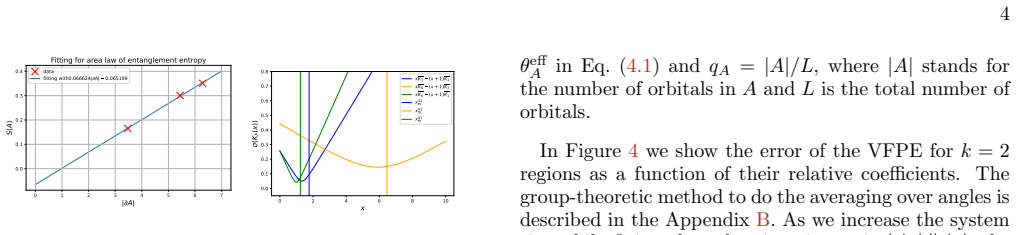
ICOSAHEDRON We wish to study a quantum critical spin model on a discretization of the 2-sphere that preserves as much as possible of theSO(3) symmetry. The simplest such objects are the platonic solids, among which we focus on the icosahedron. The icosahedral group is a large subgroup ofSO(3) in the sense that the dimensions of its representations are lar...
-
[2]
FUZZY SPHERE A recent breakthrough in regularizing 2+1d QFT, building on previous work using a fuzzy torus [35, 36], is the use of the fuzzy sphere [37–52]. The big advan- tages of the fuzzy sphere are that it exactly preserves theSO(3) spatial rotation symmetry while having small overlap between basis functions, and that the size of the single-particle H...
-
[3]
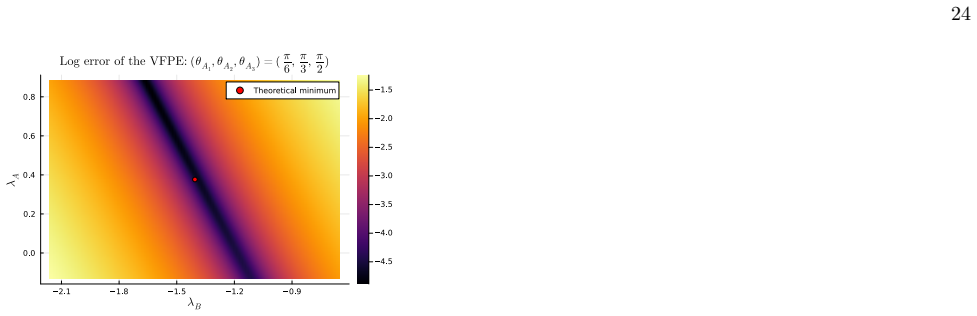
As we have seen in the examples above, the VFPE will have a finite error
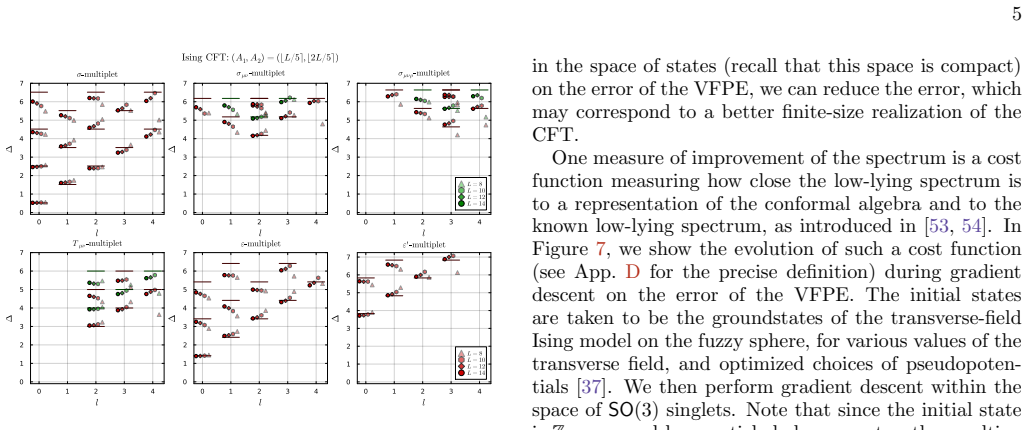
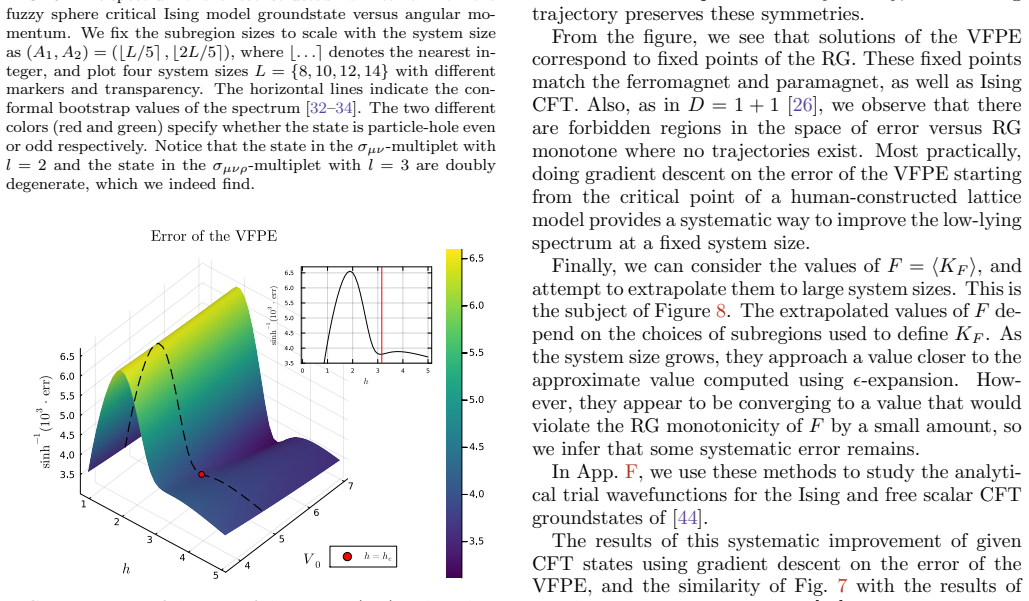
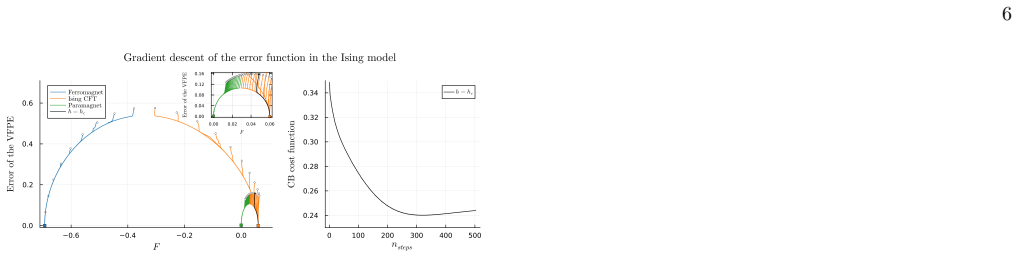
SYSTEMATIC IMPROVEMENT Suppose we are given the numerical groundstate of an arbitrary quantum critical Hamiltonian (perhaps the one people like best) as a finite-size approximation to a CFT groundstate. As we have seen in the examples above, the VFPE will have a finite error. By doing gradient descent in the space of states (recall that this space is comp...
-
[4]
Finite-size scaling 11
Explicit decomposition 10 C. Finite-size scaling 11
-
[5]
The aspirational field theory quantities 11
-
[6]
UV regulation via the fuzzy sphere 12
-
[7]
The error of the VFPE 13
-
[8]
The eigenvalues and eigenvectors 14
-
[9]
More numerical results for Ising CFT 18 E
The eigenvalues and eigenvectors: take 2 14 D. More numerical results for Ising CFT 18 E. Results for other CFTs 19 F. Entanglement bootstrap from trial CFT wavefunctions 20 G. Real space cut 21 References 25 Appendix A: Details on the fuzzy sphere numerics In this appendix, we provide a brief review of the use of the fuzzy sphere as a regulator of 2+1d C...
-
[10]
The unitary operator corresponding to particle-hole sym- metry acts asU ph |s, m, z2, p, i⟩=p|s,−m, z 2, p, i⟩
That is, ⟨s, m, z2, p, i|KA|s, m, z′ 2, p′, j⟩= 0 ifz 2 ̸=z ′ 2.(A.11) Particle-hole symmetry is a little more interesting be- cause it does not commute with theSO(3) rotation group. The unitary operator corresponding to particle-hole sym- metry acts asU ph |s, m, z2, p, i⟩=p|s,−m, z 2, p, i⟩. That is, it flips the angular momentum along thez-direction m→...
-
[11]
The full Hilbert space enjoys an action ofSU(2) orb ×SU(2) spin, acting respectively by sphere ro- tations and flavor rotations
Counting irreps In this subsection we give a representation-theoretic algorithm to count the multiplicity of the irrep labelled (ℓorbital, sspin) in the decomposition of the many body Hilbert space. The full Hilbert space enjoys an action ofSU(2) orb ×SU(2) spin, acting respectively by sphere ro- tations and flavor rotations. (The fact that the latter is ...
-
[12]
However, the numerical basis used by FuzzifiED implements the subgroupU(1)⋊ Z 2 ⊂SU(2) rather than the fullSU(2) spin rotation symmetry
Explicit decomposition The decomposition (B.3) is adapted to the fullSU(2)× SU(2) symmetry. However, the numerical basis used by FuzzifiED implements the subgroupU(1)⋊ Z 2 ⊂SU(2) rather than the fullSU(2) spin rotation symmetry. We therefore need to rewrite the above decomposition in a form adapted to fixedS z sectors. In this basis, the Hilbert space dec...
-
[13]
=” kX i=1 λiSθi and eK“=
The aspirational field theory quantities Given a set of angles{θ i}and corresponding weights {λi}, we consider the following quantity in field theory. K“=” kX i=1 λiK θi ,(C.1) whereK θi denotes the entanglement Hamiltonian asso- ciated with the region defined by a polar cap of opening angleθ i, and K θi is the average ofK θi over all configu- rations rel...
-
[14]
Concretely, we consider a family of systems realized on fuzzy spheres with varying radiiRand study the limitR→ ∞
UV regulation via the fuzzy sphere To regulate the quantities introduced above, we use the fuzzy sphere as a UV regulator. Concretely, we consider a family of systems realized on fuzzy spheres with varying radiiRand study the limitR→ ∞. (Recall thatR∼√ L.) Given a CFT, we pick a particular realization on the fuzzy sphere, which yields a family of Hamilton...
-
[15]
In particular, the quantities we study below are:
UV independence Based on this UV regularization scheme, we say a quantity is UV independent, if its value computed at each system size, converges asR→ ∞. In particular, the quantities we study below are:
-
[16]
whether (err R)2 =⟨0| eK ReK R|0⟩ →0,
-
[17]
the eigenvalues and eigenvectors of eK R
-
[18]
We first write down the ansatz for flat space, and then summarize the correspond- ing ansatz for the sphere
Assumptions To carry out the analysis, we make the following as- sumptions about the entropyS θi,R and the reduced en- tanglement Hamiltonian eKθi,R. We first write down the ansatz for flat space, and then summarize the correspond- ing ansatz for the sphere. On a flat space, whereAis a disk of radiusR, we as- sume the entropy and reduced entanglement Hami...
-
[19]
The RG monotoneF The goal is determine the number of anglesθ i required such that FR →FasR→ ∞.(C.9) Since the leading term inS θi,R =µ 1,θi R−F+O(1/R) is UV dependent, two radii are needed to extract the UV- independent quantityF, such that the UV dependent terms cancel out
-
[20]
Consider the case of a single angleθwith weightλ= 1, then eK R = eK θ,R
The error of the VFPE The goal is determine the number of anglesθ i required such that ⟨ψ|eK ReK R|ψ⟩ →0 asR→ ∞(C.10) Let us see if one radius is sufficient. Consider the case of a single angleθwith weightλ= 1, then eK R = eK θ,R. Applying the ansatz eq. (C.8), eK R = eK CF T R + sin(θ)R·E x∈S2(R),ˆn h Oˆn 0 (x) + αθ R Oˆn 1 (x) +O(1/R 2) i =c θ R HCF T R...
-
[21]
Let’s see if one region is sufficient
The eigenvalues and eigenvectors The goal is determine the number of anglesθ i required for the eigenvalues and eigenvectors of eK R to converge as R→ ∞. Let’s see if one region is sufficient. For a single angleθwith weightλ= 1, recall from eq. (C.11) that eK R =c θ R HCF T R + sin(θ)R·E x∈S2(R),ˆn Oˆn 0 (x) +O(1/R 2) The question is whetherR·E x,ˆnOˆn 0 ...
-
[22]
This is essentially correct, but there is a subtlety when ∆ min ≥2
The eigenvalues and eigenvectors: take 2 The argument above suggests that for ∆ min >1, a single angle suffices for the eigenvalues and eigenvectors to converge. This is essentially correct, but there is a subtlety when ∆ min ≥2. Consider the perturbationH CF T 1 +ϵ R S2(1) d2xO(x) on the unit sphere in field theory. If the second term were a bounded oper...
-
[23]
where the near term has⟨ψ|O(x)∂ rO(y)|ψ⟩ ∼O(1/δ 2∆+1) with measureO(δ 2)
Therefore, we predict that⟨ϕ 2|KA|gs⟩should be independent ofL, which it is. where the near term has⟨ψ|O(x)∂ rO(y)|ψ⟩ ∼O(1/δ 2∆+1) with measureO(δ 2). Assembling these estimates, the matrix in the basis{|ψ⟩,|ψ ′⟩}is 0O(ϵ δ 1−∆) O(ϵ δ1−∆)O(δ −1) +O(ϵ δ 2−∆) (C.36) We can now read off the behavior in each regime from the matrix above. If we holdϵfixed and t...
-
[24]
Pk=3 i=1 λth Ai = 0,
-
[25]
Pk=3 i=1 λth Ai |∂Ai|= 0,
-
[26]
Pk=3 i=1 λth Ai VAi = 1, where|∂A i|= sinθ Ai andV Ai = 2πsin(θ Ai /2)4/sinθ Ai. As above, the angleθ Ai is obtained by assuming that the ratio of the number of orbitals in regionAand the total number of orbitals is equal to the ratio of the areaAand the total area of the sphere:θ Ai = arccos(1−2|A i|/L). In recent attempts to minimize finite-size effects...
-
[27]
Horizontal lines indicate the conformal bootstrap values of the spectrum
We fix the system sizeL= 12 and plot the spectrum for various subregion sizes, using different markers and shades. Horizontal lines indicate the conformal bootstrap values of the spectrum. Red or green indicates whether the state is particle-hole even or odd respectively. and this is what we do for the Ising phase diagram in Figure 14. To define the cost ...
-
[28]
The two plots show the results forL= 6 and L= 8 orbitals
(denoted, perhaps optimistically, as ‘Ising CFT’ and ‘Free scalar CFT’, respectively). The two plots show the results forL= 6 and L= 8 orbitals. ForL= 6, all these initial states flow to the same Ising fixed point. ForL= 8, the groundstate of the Hamiltonian for the free scalar CFT identified in [44] flows to a different state, but the analytical ansatz f...
-
[29]
Conformal Field Theory Ground States as Critical Points of an Entropy Function,
T.-C. Lin and J. McGreevy, “Conformal Field Theory Ground States as Critical Points of an Entropy Function,”Phys. Rev. Lett.131(2023), no. 25 251602, 2303.05444. 1, 2, 3
arXiv 2023
-
[30]
Strict area law implies commuting parent Hamiltonian,
I. H. Kim, T.-C. Lin, D. Ranard, and B. Shi, “Strict area law implies commuting parent Hamiltonian,” 2404.05867. 1
-
[31]
Chiral gapped states are universally non-topological,
X. Li, T.-C. Lin, Y. Alavirad, and J. McGreevy, “Chiral gapped states are universally non-topological,” 2510.23720. 1
-
[32]
Critical exponents in 3.99 dimensions,
K. G. Wilson and M. E. Fisher, “Critical exponents in 3.99 dimensions,”Phys. Rev. Lett.28(1972) 240–243. 1
1972
-
[33]
The Conformal Bootstrap: Theory, Numerical Techniques, and Applications,
D. Poland, S. Rychkov, and A. Vichi, “The Conformal Bootstrap: Theory, Numerical Techniques, and Applications,”Rev. Mod. Phys.91(2019) 015002, 1805.04405. 1
Pith/arXiv arXiv 2019
-
[34]
Towards 3D CFT Cartography with the Stress Tensor Bootstrap,
R. S. Erramilli and M. S. Mitchell, “Towards 3D CFT Cartography with the Stress Tensor Bootstrap,” 2602.13383. 1
-
[35]
Fusion rules from entanglement,
B. Shi, K. Kato, and I. H. Kim, “Fusion rules from entanglement,”Annals Phys.418(2020) 168164, 1906.09376. 1
arXiv 2020
-
[36]
Domain Wall Topological Entanglement Entropy,
B. Shi and I. H. Kim, “Domain Wall Topological Entanglement Entropy,”Phys. Rev. Lett.126(2021), no. 14 141602,2008.11794
arXiv 2021
-
[37]
Verlinde formula from entanglement,
B. Shi, “Verlinde formula from entanglement,”Phys. Rev. Res.2(2020), no. 2 023132,1911.01470
arXiv 2020
-
[38]
Characterizing topological order by the information convex,
B. Shi and Y.-M. Lu, “Characterizing topological order by the information convex,”Phys. Rev. B99(2019), no. 3 035112,1801.01519
Pith/arXiv arXiv 2019
-
[39]
Seeing topological entanglement through the information convex,
B. Shi, “Seeing topological entanglement through the information convex,”Phys. Rev. Research.1(2019) 033048,1810.01986
arXiv 2019
-
[40]
Entanglement bootstrap approach for gapped domain walls,
B. Shi and I. H. Kim, “Entanglement bootstrap approach for gapped domain walls,”Phys. Rev. B103 (2021), no. 11 115150,2008.11793
arXiv 2021
-
[41]
J.-L. Huang, J. McGreevy, and B. Shi, “Knots and entanglement,”2112.08398. 1
-
[42]
Modular commutator in gapped quantum many-body systems,
I. H. Kim, B. Shi, K. Kato, and V. V. Albert, “Modular commutator in gapped quantum many-body systems,” Phys. Rev. B106(2022), no. 7 075147,2110.10400
arXiv 2022
-
[43]
Chiral Central Charge from a Single Bulk Wave Function,
I. H. Kim, B. Shi, K. Kato, and V. V. Albert, “Chiral Central Charge from a Single Bulk Wave Function,” Physical Review Letters128(Apr., 2022) 176402, 2110.06932
arXiv 2022
-
[44]
Remote detectability from entanglement bootstrap I: Kirby’s torus trick,
B. Shi, J.-L. Huang, and J. McGreevy, “Remote detectability from entanglement bootstrap I: Kirby’s torus trick,”SciPost Phys.18(2025), no. 4 126, 2301.07119. 1
arXiv 2025
-
[45]
Universal Lower Bound on Topological Entanglement Entropy,
I. H. Kim, M. Levin, T.-C. Lin, D. Ranard, and B. Shi, “Universal Lower Bound on Topological Entanglement Entropy,”Phys. Rev. Lett.131(2023), no. 16 166601, 2302.00689
arXiv 2023
-
[46]
Chiral Virasoro algebra from a single wavefunction,
I. H. Kim, X. Li, T.-C. Lin, J. McGreevy, and B. Shi, “Chiral Virasoro algebra from a single wavefunction,” Annals Phys.471(2024) 169849,2403.18410
arXiv 2024
-
[47]
Conformal geometry from entanglement,
I. H. Kim, X. Li, T.-C. Lin, J. McGreevy, and B. Shi, “Conformal geometry from entanglement,”SciPost Physics18(Mar., 2025) 102,2404.03725
arXiv 2025
-
[48]
Strict Area Law Entanglement versus Chirality,
X. Li, T.-C. Lin, J. McGreevy, and B. Shi, “Strict Area Law Entanglement versus Chirality,”Phys. Rev. Lett. 134(2025), no. 18 180402,2408.10306
arXiv 2025
-
[49]
Immersed figure-8 annuli and a strong isomorphism conjecture,
B. Shi, “Immersed figure-8 annuli and a strong isomorphism conjecture,”2309.17155
-
[50]
Classifying 2D topological phases: mapping ground states to string-nets,
I. H. Kim and D. Ranard, “Classifying 2D topological phases: mapping ground states to string-nets,” 2405.17379
-
[51]
Topological Mixed States: Axiomatic Approaches and Phases of Matter,
T.-H. Yang, B. Shi, and J. Y. Lee, “Topological Mixed States: Axiomatic Approaches and Phases of Matter,” 2506.04221. 1
-
[52]
Towards a derivation of holographic entanglement entropy,
H. Casini, M. Huerta, and R. C. Myers, “Towards a derivation of holographic entanglement entropy,”JHEP 05(2011) 036,1102.0440. 1, 2
Pith/arXiv arXiv 2011
-
[53]
Entanglement hamiltonians in two-dimensional conformal field theory,
J. Cardy and E. Tonni, “Entanglement hamiltonians in two-dimensional conformal field theory,”J. Stat. Mech. 1612(2016), no. 12 123103,1608.01283. 1, 2
Pith/arXiv arXiv 2016
-
[54]
A systematic search for conformal field theories in very small spaces,
X. Li, T.-C. Lin, and J. McGreevy, “A systematic search for conformal field theories in very small spaces,” 2509.04596. 1, 3, 5, 22
-
[55]
On the RG running of the entanglement entropy of a circle,
H. Casini and M. Huerta, “On the RG running of the entanglement entropy of a circle,”Phys. Rev. D85 (2012) 125016,1202.5650. 2
Pith/arXiv arXiv 2012
-
[56]
Mutual information and the F-theorem,
H. Casini, M. Huerta, R. C. Myers, and A. Yale, “Mutual information and the F-theorem,”JHEP10 (2015) 003,1506.06195. 2
Pith/arXiv arXiv 2015
-
[57]
Local approximations of global Hamiltonian from inclusion of algebras,
Y. Chen, N. Lashkari, and K. L. Leung, “Local approximations of global Hamiltonian from inclusion of algebras,”2512.25062. 2
-
[58]
Entanglement Entropy of Gapped Phases and Topological Order in Three dimensions,
T. Grover, A. M. Turner, and A. Vishwanath, “Entanglement Entropy of Gapped Phases and Topological Order in Three dimensions,”Phys.Rev. B84(2011) 195120,1108.4038. 2
Pith/arXiv arXiv 2011
-
[59]
3D Ising CFT and exact diagonalization on icosahedron: The power of conformal perturbation theory,
B.-X. Lao and S. Rychkov, “3D Ising CFT and exact diagonalization on icosahedron: The power of conformal perturbation theory,”SciPost Phys.15(2023), no. 6 243,2307.02540. 3
arXiv 2023
-
[60]
Solving the 3D Ising Model with the Conformal Bootstrap,
S. El-Showk, M. F. Paulos, D. Poland, S. Rychkov, D. Simmons-Duffin, and A. Vichi, “Solving the 3D Ising Model with the Conformal Bootstrap,”Phys. Rev. D86 (2012) 025022,1203.6064. 4, 5
Pith/arXiv arXiv 2012
-
[61]
S. El-Showk, M. F. Paulos, D. Poland, S. Rychkov, D. Simmons-Duffin, and A. Vichi, “Solving the 3d Ising Model with the Conformal Bootstrap II. c-Minimization and Precise Critical Exponents,”J. Stat. Phys.157 (2014) 869,1403.4545
Pith/arXiv arXiv 2014
-
[62]
Precision Islands in the Ising andO(N) Models,
F. Kos, D. Poland, D. Simmons-Duffin, and A. Vichi, “Precision Islands in the Ising andO(N) Models,” JHEP08(2016) 036,1603.04436. 4, 5
Pith/arXiv arXiv 2016
-
[63]
M. Ippoliti, R. S. K. Mong, F. F. Assaad, and M. P. Zaletel, “Half-filled Landau levels: A continuum and sign-free regularization for three-dimensional quantum critical points,”Phys. Rev. B98(Dec., 2018) 235108, 1810.00009. 4
Pith/arXiv arXiv 2018
-
[64]
Phases of the (2 +1 ) Dimensional SO(5) Nonlinear Sigma Model with Topological Term,
Z. Wang, M. P. Zaletel, R. S. K. Mong, and F. F. Assaad, “Phases of the (2 +1 ) Dimensional SO(5) Nonlinear Sigma Model with Topological Term,”Phys. Rev. Lett.126(Jan., 2021) 045701,2003.08368. 4
arXiv 2021
-
[65]
W. Zhu, C. Han, E. Huffman, J. S. Hofmann, and Y.-C. He, “Uncovering Conformal Symmetry in the 3D Ising Transition: State-Operator Correspondence from a Quantum Fuzzy Sphere Regularization,”Phys. Rev. X 13(2023), no. 2 021009,2210.13482. 4, 5, 7, 8, 17, 19, 26 22, 23, 24
arXiv 2023
-
[66]
Quantum Monte Carlo simulation of the 3D Ising transition on the fuzzy sphere,
J. S. Hofmann, F. Goth, W. Zhu, Y.-C. He, and E. Huffman, “Quantum Monte Carlo simulation of the 3D Ising transition on the fuzzy sphere,”SciPost Phys. Core7(2024) 028,2310.19880
arXiv 2024
-
[67]
Operator Product Expansion Coefficients of the 3D Ising Criticality via Quantum Fuzzy Spheres,
L. Hu, Y.-C. He, and W. Zhu, “Operator Product Expansion Coefficients of the 3D Ising Criticality via Quantum Fuzzy Spheres,”Phys. Rev. Lett.131(2023), no. 3 031601,2303.08844
arXiv 2023
-
[68]
Z. Zhou, L. Hu, W. Zhu, and Y.-C. He, “SO(5) Deconfined Phase Transition under the Fuzzy-Sphere Microscope: Approximate Conformal Symmetry, Pseudo-Criticality, and Operator Spectrum,”Phys. Rev. X14(2024), no. 2 021044,2306.16435
arXiv 2024
-
[69]
L. Hu, W. Zhu, and Y.-C. He, “Entropic F function of three-dimensional Ising conformal field theory via fuzzy sphere regularization,”Phys. Rev. B111(2025), no. 15 155151,2401.17362. 21
arXiv 2025
-
[70]
Regularizing 3D Conformal Field Theories via Anyons on the Fuzzy Sphere,
C. Voinea, R. Fan, N. Regnault, and Z. Papi´ c, “Regularizing 3D Conformal Field Theories via Anyons on the Fuzzy Sphere,”Phys. Rev. X15(2025), no. 3 031007,2411.15299
arXiv 2025
-
[71]
3D Conformal Field Theories with Sp(N) Global Symmetry on a Fuzzy Sphere,
Z. Zhou and Y.-C. He, “3D Conformal Field Theories with Sp(N) Global Symmetry on a Fuzzy Sphere,” Phys. Rev. Lett.135(2025), no. 2 026504,2410.00087
arXiv 2025
-
[72]
Free real scalar CFT on fuzzy sphere: spectrum, algebra and wavefunction ansatz,
Y.-C. He, “Free real scalar CFT on fuzzy sphere: spectrum, algebra and wavefunction ansatz,” 2506.14904. 5, 19, 20, 21, 22
-
[73]
Z. Zhou, C. Wang, and Y.-C. He, “Chern-Simons-matter conformal field theory on fuzzy sphere: Confinement transition of Kalmeyer-Laughlin chiral spin liquid,”2507.19580
-
[74]
Free Majorana Fermion Meets Gauged Ising Conformal Field Theory on the Fuzzy Sphere,
Z. Zhou, D. Gaiotto, and Y.-C. He, “Free Majorana Fermion Meets Gauged Ising Conformal Field Theory on the Fuzzy Sphere,”2509.08038. 20
-
[75]
TheO(N) Free-Scalar and Wilson-Fisher Conformal Field Theories on the Fuzzy Sphere,
W. Guo, Z. Zhou, T.-C. Wei, and Y.-C. He, “TheO(N) Free-Scalar and Wilson-Fisher Conformal Field Theories on the Fuzzy Sphere,”2512.02234. 20, 21
-
[76]
Yang-Lee Quantum Criticality in Various Dimensions,
E. Arguello Cruz, I. R. Klebanov, G. Tarnopolsky, and Y. Xin, “Yang-Lee Quantum Criticality in Various Dimensions,”2505.06369
-
[77]
Conformal scalar field theory from Ising tricriticality on the fuzzy sphere,
J. Taylor, C. Voinea, Z. Papi´ c, and R. Fan, “Conformal scalar field theory from Ising tricriticality on the fuzzy sphere,”2506.22539
-
[78]
Critical Majorana Fermion at a Topological Quantum Hall Bilayer Transition,
C. Voinea, W. Zhu, N. Regnault, and Z. Papi´ c, “Critical Majorana Fermion at a Topological Quantum Hall Bilayer Transition,”Phys. Rev. Lett.136(2026), no. 7 076601,2509.08036
arXiv 2026
-
[79]
Emergence of 3D Superconformal Ising Criticality on the Fuzzy Sphere,
Y. Tang, C. Voinea, L. Hu, Z. Papi´ c, and W. Zhu, “Emergence of 3D Superconformal Ising Criticality on the Fuzzy Sphere,”2512.25054
-
[80]
A. Dey, L. Herviou, C. Mudry, and A. L¨ auchli, “Conformal Data for the O(3) Wilson-Fisher Conformal Field Theory from Fuzzy Sphere Realization of the Quantum Rotor Model,”2510.09755. 4, 7, 20, 21
discussion (0)
Sign in with ORCID, Apple, or X to comment. Anyone can read and Pith papers without signing in.