REVIEW 4 major objections 5 minor 25 references
Breaking the Curse of Multilinguality in Many-to-Many Speech-to-Text Translation via a Resource-Aware Mixture of Speech Encoders
T0 review · 4 major / 5 minor · reviewed 2026-08-08 · deepseek-v4-flash
Pith's one-line read A resource-aware mixture of speech encoders breaks the curse of multilinguality in many-to-many speech-to-text translation, improving high-, medium-, and low-resource languages simultaneously.
desk verdict A comprehensive many-to-many S2TT system that beats larger baselines, but the causal claim for MoSE is not isolated from an ablation that doubles encoder parameters. read the letter →
The pith
A machine-rendered reading of the paper's core claim, the machinery that carries it, and where it could break.
The reading
What carries the argument
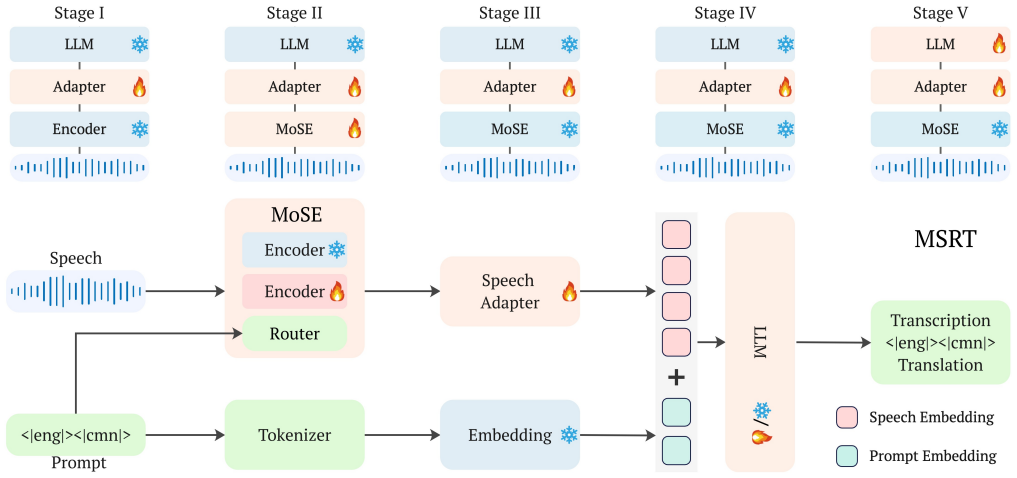
The load-bearing mechanism is the resource-aware Mixture of Speech Encoders (MoSE), which pairs a frozen Whisper encoder (for high-resource languages) with a trainable Whisper-initialized encoder (for medium- and low-resource languages). An explicit language router selects the expert from the source-language token in the prompt, so the assignment is deterministic and requires neither a learned gate nor a balancing loss. Because both experts share the same architecture, their outputs are compatible with a single shared Q-Former and MLP adapter; the frozen expert anchors the speech interface while the trainable expert absorbs language-specific acoustic patterns. The accompanying five-stage curriculum (ASR alignment, expert specialization, translation activation, end-to-end SRT, joint LoRA adaptation) is what lets the model align speech to text with roughly 10 hours of paired data per language.
What would settle it
Train an MSRT variant whose single shared encoder has the same parameter budget as the two experts together, with identical curriculum and data; if its average COMET on the six-language X→44 ablation set reaches 75.1 or higher, then the role-separation mechanism is not needed to explain MoSE's gains.
Extended reading notes
Core claim
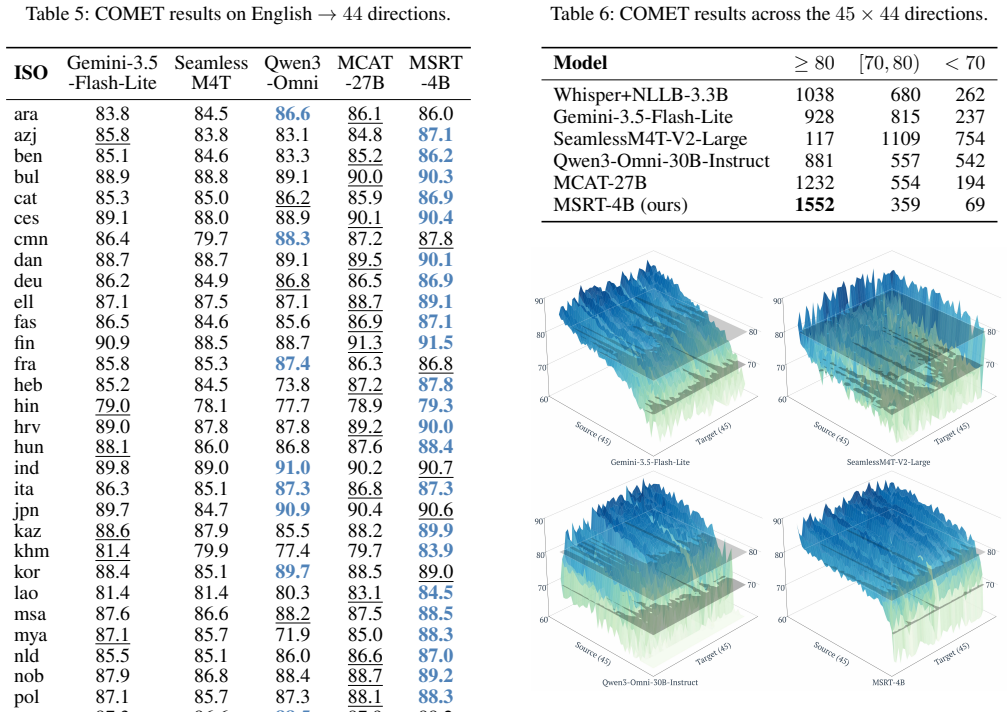
The paper's central discovery is that explicit, language-level routing between two homogeneous speech encoders with asymmetric training roles removes the capacity competition that hurts underrepresented languages. The frozen expert keeps the pretrained Whisper representations intact for the fifteen high-resource languages, while the trainable expert adapts to the thirty medium- and low-resource languages; one expert is active per utterance, so inference cost stays that of a single encoder. On the FLEURS benchmark covering all 45×44 non-identity directions, MSRT-4B reports an average COMET of 83.3, with 1,552 of 1,980 directions scoring at least 80, ahead of substantially larger baselines. Ablations show consistent gains across resource groups — 3.0, 2.2, and 1.4 COMET points for low-, medium-, and high-resource languages respectively — which the authors interpret as direct evidence that the curse of multilinguality is broken rather than merely redistributed.
Load-bearing premise
The paper attributes the benefit to role separation rather than to adding a second encoder, but its ablation compares one encoder against two encoders, so an equal-capacity single-encoder control is missing.
Editorial extensions
If this is right
- A 4B-parameter speech-to-text translation model can cover all 45×44 directions among 45 languages with average COMET 83.3, outperforming a 27B and a 30B baseline and an API model.
- Low-resource source languages benefit most from the two-expert split, receiving a 3.0-point COMET gain, while high-resource languages still improve by 1.4 points, so multilingual breadth need not cost high-resource quality.
- Ten hours of paired speech per language, combined with the five-stage curriculum, is sufficient to reach usable translation quality across resource levels, and scaling to 429.6 hours on CoVoST-2 adds a further 2.0-point average gain.
- Explicit language-level routing without learned gates or balancing loss retains single-encoder inference cost while providing specialization, suggesting that token-level load balancing is unnecessary for this task.
- English-centric evaluation understates coverage: on the full many-to-many grid, a cascade baseline and the API degrade substantially on non-English source speech, whereas the proposed model stays consistent.
Reading between the lines
- If the role-separation effect is confirmed against an equal-capacity single encoder, the same router idea could be applied to other modalities and tasks where resource imbalance creates interference, such as multilingual ASR with dialect variation or low-resource visual speech.
- The explicit router also makes the model's behavior inspectable: one can test whether the trainable expert has actually learned language-specific acoustic features by probing its representations on held-out low-resource languages, a prediction the paper does not directly verify.
- The 10-hour-per-language data requirement suggests that with deliberate curriculum ordering, data scales far below typical paired corpora; extending the curriculum to more stages or self-supervised speech features might push the boundary further, but that is a hypothesis, not a claim of the paper.
Editorial analysis
A structured set of objections, weighed in public.
Referee Report
Summary. The paper proposes MSRT, a many-to-many speech-to-text translation system built around a resource-aware Mixture of Speech Encoders (MoSE). MoSE routes each source utterance to one of two homogeneous Whisper encoders: a frozen expert for high-resource languages and a trainable expert for medium- and low-resource languages. The model is trained with a five-stage curriculum using roughly 10 hours of paired FLEURS speech per language and is evaluated on all 45×44 non-identity FLEURS directions plus CoVoST-2. The central claim is that MoSE 'breaks the curse of multilinguality': it improves high-, medium-, and low-resource languages simultaneously, with the largest gains on low-resource speech. MSRT-4B reports an average COMET of 83.3, with 1,552 directions at or above 80, outperforming larger baselines including MCAT-27B, Qwen3-Omni, and a Gemini API.
Significance. If the stated results hold, the contribution is substantial: MSRT-4B is a compact system that covers a very large translation grid, and the paper includes a comprehensive 1,980-direction evaluation, resource-level analysis, cross-dataset results on CoVoST-2, and a release of code and models. The resource-level expert assignment is grounded in an external benchmark (SeamlessM4T), and the five-stage curriculum addresses an important data-efficiency problem in multilingual S2TT. The main weakness is that the causal mechanism behind the reported gains is not isolated: the ablation that supports the 'resource-aware role separation' claim is confounded with encoder parameter count, and no error bars or significance tests are provided. The evaluation also uses FLEURS for both training and evaluation without stating the split. These issues are fixable, but they are load-bearing for the paper's headline claim.
major comments (4)
- [Ablation Study, Table 7] The central claim that MoSE's asymmetric expert roles, rather than additional encoder capacity, cause the gains is not isolated. The 1-expert condition uses one Whisper encoder, while the 2-expert condition uses two, so the reported improvement from 70.0 to 75.1 COMET conflates the routing mechanism with a roughly doubled encoder parameter budget. The 3-expert condition (75.3 COMET) adds little over the 2-expert condition, which is also consistent with a capacity-saturation account. Please add an equal-capacity single-encoder control (for example, a single encoder with comparable total parameters) or a two-encoder condition with random or resource-agnostic routing, and report per-resource-group differences with variance or significance tests. Without such a control, the abstract's 'thereby breaking the curse of multilinguality' is not established.
- [Resource-Level Analysis, Figure 4] The reported gains of 3.0, 2.2, and 1.4 COMET points for low-, medium-, and high-resource languages are presented as evidence that MoSE improves all groups simultaneously, but the exact comparison underlying Figure 4 is not specified in the text. If these numbers come from the same 1-expert versus 2-expert ablation as Table 7, they inherit the parameter-count confound. Please state explicitly which configurations are compared in Figure 4, and re-analyze the resource-level gains once the equal-capacity control from the previous comment is available.
- [Experimental Settings] The paper uses FLEURS for multilingual ASR pre-training, for S2TT training (approximately 10 hours per language), and for the reported 45×44 evaluation, but it never states which FLEURS split is used for evaluation. Because the training and evaluation data come from the same corpus, the split must be specified to rule out overlap or leakage (for example, using the FLEURS dev set for model selection and reporting test-set numbers). Please state the split explicitly and clarify whether any FLEURS training utterances overlap with the evaluation set.
- [Experimental Settings / Parameter Efficiency] The model is repeatedly described as a '4B-parameter model' and as having 'only 4B parameters,' but MoSE consists of two Whisper encoders in addition to the MiLMMT-4B LLM, the Q-Former, and the MLP. The total parameter count is therefore larger than 4B, and the parameter-efficiency comparison against Qwen3-Omni-30B and MCAT-27B depends on what is counted. Please report the total parameter count with and without the two encoders, and adjust the '4B' claim accordingly (for example, by stating that 4B refers to the LLM backbone only).
minor comments (5)
- [Abstract] There are typographical issues in the abstract, such as 'significantsuccess' and 'therebybreaking', which should be corrected before publication.
- [Table 1] The prompt notation in Table 1 (for example, 'Text<|eng|><|cmn|>MT') is cryptic; please add a legend or caption explaining what each token and column means, and how the prompt is constructed for each training stage.
- [Introduction] The sentence 'This manuscript is an arXiv preprint.' appears in the introduction and is not appropriate for a journal submission; it should be removed.
- [Limitations] The Limitations section is a single sentence stating that translation quality is bounded by the LLM's underlying MT performance. Given that the resource-level analysis is central to the paper, please expand on how this bound interacts with the reported low-resource gains and whether the LLM's MT knowledge is sufficient for all 45 languages.
- [Data Scaling, Figure 5] The description of MSRT-4B-SFT mentions 429.6 hours of CoVoST-2 speech but does not specify the training recipe (for example, learning rate, epochs, or whether this is a continuation of the full curriculum); please provide these details for reproducibility.
Circularity Check
No significant circularity: results are empirical comparisons against external benchmarks and fixed resource groupings.
full rationale
The paper's central claim is empirical: MSRT-4B with MoSE achieves higher COMET scores than external baselines and an internal single-encoder variant. No load-bearing step reduces to its own input by construction. Resource-level grouping in Table 3 is fixed by an external definition (SeamlessM4T), not fitted to the reported gains. The router assignment (frozen expert for high-resource, trainable expert for medium/low-resource) is a design choice, and the reported gains are measured on the FLEURS benchmark; there is no fitted parameter later renamed as a prediction. The only self-citations are to the authors' earlier LLM-SRT curriculum work and the MCAT baseline; these are used as design precedent and benchmark comparison, and the central MoSE result does not depend on their validity. The ablation in Table 7 does confound expert count with total encoder parameters, so the causal attribution to resource-aware specialization rather than capacity is under-supported; however, this is an experimental-control weakness, not circularity, because the improvement is not forced by construction. The Limitations section explicitly bounds translation quality by the pretrained LLM's MT ability, which is an honest external constraint rather than a circular step. No specific circular reduction can be quoted, so the appropriate finding is no circularity.
Assumptions & free parameters
free parameters (4)
- Resource-level expert assignment (language-to-expert table) =
15 high -> frozen expert, 30 medium/low -> trainable expert
- Number of speech experts =
2
- LoRA rank and alpha =
r=16, alpha=32
- Q-Former query count =
80
assumptions (4)
- domain assumption Whisper's pretrained representations are useful for all 45 languages, including low-resource ones
- domain assumption SeamlessM4T resource-level labels are a valid basis for optimal encoder grouping
- domain assumption MiLMMT-4B contains sufficient machine translation knowledge for all 45 target languages
- domain assumption FLEURS test samples are not leaked into the 10-hour-per-language training set
Cite this review
Pith. "Pith review of Breaking the Curse of Multilinguality in Many-to-Many Speech-to-Text Translation via a Resource-Aware Mixture of Speech Encoders." pith.science (2026). https://pith.science/paper/YL5HM35H
@misc{pith2026260804586,
  author       = {Pith},
  title        = {Pith review of: Breaking the Curse of Multilinguality in Many-to-Many Speech-to-Text Translation via a Resource-Aware Mixture of Speech Encoders},
  year         = {2026},
  howpublished = {\url{https://pith.science/paper/YL5HM35H}},
  note         = {Machine review of arXiv:2608.04586}
}
abstract
Multimodal large language models (MLLMs) have achieved significant success in speech-to-text translation (S2TT). However, when processing multilingual speech inputs, a single speech encoder shared across all languages suffers from the curse of multilinguality: languages at different resource levels compete for limited representation capacity, leading to strong high-resource performance but substantial degradation on low-resource speech. To address this problem and improve multilingual consistency, we propose MSRT, a novel framework built around a resource-aware Mixture of Speech Encoders (MoSE). MoSE uses an explicit language router to assign each utterance to an appropriate expert encoder. A frozen expert preserves high-resource language capabilities, while a trainable expert adapts to and specializes in medium- and low-resource languages. We further introduce a five-stage curriculum learning strategy that substantially reduces data dependence, requiring only 10 hours of paired S2TT data per language for effective alignment. We conduct extensive experiments on 45 languages, systematically evaluating all $45 \times 44$ translation directions. Our 4B-parameter model achieves state-of-the-art performance, outperforming substantially larger baselines. Empirical analyses show that MoSE improves high-, medium-, and low-resource languages simultaneously, with the largest gains on low-resource speech, thereby breaking the curse of multilinguality without compromising high-resource performance. To support future multilingual S2TT research, we release our code and models.
Figures

Figures from the paper (2 more)


Reference graph
Works this paper leans on
-
[1]
Proceedings of the 63rd Annual Meeting of the Association for Computational Linguistics (Volume 1: Long Papers) , pages=
Making llms better many-to-many speech-to-text translators with curriculum learning , author=. Proceedings of the 63rd Annual Meeting of the Association for Computational Linguistics (Volume 1: Long Papers) , pages=
-
[2]
Findings of the Association for Computational Linguistics: ACL 2024 , pages=
Pushing the limits of zero-shot end-to-end speech translation , author=. Findings of the Association for Computational Linguistics: ACL 2024 , pages=
2024
-
[3]
Proceedings of the 58th annual meeting of the association for computational linguistics , pages=
Unsupervised cross-lingual representation learning at scale , author=. Proceedings of the 58th annual meeting of the association for computational linguistics , pages=
-
[4]
arXiv preprint arXiv:2605.23463 , year=
Stepaudio 2.5 technical report , author=. arXiv preprint arXiv:2605.23463 , year=
-
[5]
Common Voice: A Massively-Multilingual Speech Corpus
Ardila, Rosana and Branson, Megan and Davis, Kelly and Kohler, Michael and Meyer, Josh and Henretty, Michael and Morais, Reuben and Saunders, Lindsay and Tyers, Francis and Weber, Gregor. Common Voice: A Massively-Multilingual Speech Corpus. Proceedings of the Twelfth Language Resources and Evaluation Conference. 2020
2020
-
[6]
Blevins, Terra and Limisiewicz, Tomasz and Gururangan, Suchin and Li, Margaret and Gonen, Hila and Smith, Noah A. and Zettlemoyer, Luke. Breaking the Curse of Multilinguality with Cross-lingual Expert Language Models. Proceedings of the 2024 Conference on Empirical Methods in Natural Language Processing. 2024. doi:10.18653/v1/2024.emnlp-main.604
-
[7]
SLAM-LLM: A Modular, Open-Source Multimodal Large Language Model Framework and Best Practice for Speech, Language, Audio and Music Processing , year=
Ma, Ziyang and Yang, Guanrou and Chen, Wenxi and Gao, Zhifu and Du, Yexing and Li, Xiquan and Zheng, Zhisheng and Zhu, Haina and Zhuo, Jianheng and Song, Zheshu and Xu, Ruiyang and Wang, Tiranrui and Yang, Yifan and Zhu, Yanqiao and Niu, Zhikang and Xue, Liumeng and Ma, Yinghao and Yuan, Ruibin and Zhang, Shiliang and Yu, Kai and Chng, Eng Siong and Chen,...
-
[8]
arXiv preprint arXiv:2308.11596 , year =
Barrault, Lo. arXiv preprint arXiv:2308.11596 , year =
Show all 25 references
-
[9]
2022 IEEE Spoken Language Technology Workshop , pages =
Conneau, Alexis and Ma, Min and Khanuja, Simran and Zhang, Yu and Axelrod, Vera and Dalmia, Siddharth and Riesa, Jason and Rivera, Clara and Bapna, Ankur , title =. 2022 IEEE Spoken Language Technology Workshop , pages =. 2023 , publisher =
2022
-
[10]
IEEE/ACM Transactions on Audio, Speech, and Language Processing , year =
Du, Yexing and Liu, Kaiyuan and Pan, Youcheng and Yang, Bo and Deng, Keqi and Chen, Xie and Xiang, Yang and Liu, Ming and Qin, Bing and Wang, Yaowei , title =. IEEE/ACM Transactions on Audio, Speech, and Language Processing , year =
-
[11]
and Shen, Yelong and Wallis, Phillip and Allen-Zhu, Zeyuan and Li, Yuanzhi and Wang, Shean and Wang, Lu and Chen, Weizhu , title =
Hu, Edward J. and Shen, Yelong and Wallis, Phillip and Allen-Zhu, Zeyuan and Li, Yuanzhi and Wang, Shean and Wang, Lu and Chen, Weizhu , title =. International Conference on Learning Representations , year =
-
[12]
Proceedings of the 40th International Conference on Machine Learning , pages =
Li, Junnan and Li, Dongxu and Savarese, Silvio and Hoi, Steven , title =. Proceedings of the 40th International Conference on Machine Learning , pages =
-
[13]
Scaling Neural Machine Translation to 200 Languages , journal =
-
[14]
Proceedings of the Third Conference on Machine Translation , pages =
Post, Matt , title =. Proceedings of the Third Conference on Machine Translation , pages =
-
[15]
Proceedings of the 40th International Conference on Machine Learning , pages =
Radford, Alec and Kim, Jong Wook and Xu, Tao and Brockman, Greg and McLeavey, Christine and Sutskever, Ilya , title =. Proceedings of the 40th International Conference on Machine Learning , pages =
-
[16]
Proceedings of the Seventh Conference on Machine Translation , pages =
Rei, Ricardo and De Souza, Jos. Proceedings of the Seventh Conference on Machine Translation , pages =
-
[17]
2026 , eprint =
Shang, Yuzhe and Gao, Pengzhi and Liu, Wei and Luan, Jian and Su, Jinsong , title =. 2026 , eprint =
2026
-
[18]
Uni-MoE: Scaling Unified Multimodal LLMs With Mixture of Experts , year=
Li, Yunxin and Jiang, Shenyuan and Hu, Baotian and Wang, Longyue and Zhong, Wanqi and Luo, Wenhan and Ma, Lin and Zhang, Min , journal=. Uni-MoE: Scaling Unified Multimodal LLMs With Mixture of Experts , year=
-
[19]
Advances in Neural Information Processing Systems , volume=
Simulmega: Moe routers are advanced policy makers for simultaneous speech translation , author=. Advances in Neural Information Processing Systems , volume=
-
[20]
Enhancing Speech Large Language Models with Prompt-Aware Mixture of Audio Encoders
Shan, Weiqiao and Li, Yuang and Zhang, Yuhao and Luo, Yingfeng and Xu, Chen and Zhao, Xiaofeng and Meng, Long and Lu, Yunfei and Zhang, Min and Yang, Hao and Xiao, Tong and Zhu, JingBo. Enhancing Speech Large Language Models with Prompt-Aware Mixture of Audio Encoders. Proceed...
2025 doi
-
[21]
arXiv preprint arXiv:2312.11805 , year=
Gemini: a family of highly capable multimodal models , author=. arXiv preprint arXiv:2312.11805 , year=
-
[22]
D ialect M o E : An End-to-End Multi-Dialect Speech Recognition Model with Mixture-of-Experts
Zhou, Jie and Gao, Shengxiang and Yu, Zhengtao and Dong, Ling and Wang, Wenjun. D ialect M o E : An End-to-End Multi-Dialect Speech Recognition Model with Mixture-of-Experts. Proceedings of the 23rd Chinese National Conference on Computational Linguistics (Volume 1: Main Confe...
2024
-
[23]
Proceedings of the 58th Annual Meeting of the Association for Computational Linguistics , pages =
Sperber, Matthias and Paulik, Matthias , title =. Proceedings of the 58th Annual Meeting of the Association for Computational Linguistics , pages =
-
[24]
Proceedings of Interspeech , pages =
Wang, Changhan and Wu, Anne and Gu, Jiatao and Pino, Juan , title =. Proceedings of Interspeech , pages =
-
[25]
arXiv preprint arXiv:2509.17765 , year =
Xu, Jin and Guo, Zhifang and Hu, Hangrui and Chu, Yunfei and Wang, Xiong and He, Jinzheng and Wang, Yuxuan and Shi, Xian and He, Ting and Zhu, Xinfa and others , title =. arXiv preprint arXiv:2509.17765 , year =
Reviewed August 8, 2026 · model on record in the stance chip above.
Discussion (0). Continue with ORCID to comment.