A unified framework of fully decoupled, bound-preserving and energy-dissipative schemes for two-phase flow in porous media
Pith reviewed 2026-06-29 05:49 UTC · model grok-4.3
The pith
A framework builds first- and second-order schemes for two-phase porous media flow that stay fully decoupled while preserving saturation bounds, energy dissipation, and local mass conservation.
A machine-rendered reading of the paper's core claim, the machinery that carries it, and where it could break.
Core claim
The authors establish a unified framework that generates fully discrete first- and second-order schemes for the thermodynamically consistent two-phase flow model, rigorously proving that the schemes are uniquely solvable, fully decoupled, bound-preserving for both phases, energy-dissipative in the original sense, and locally mass-conserving. The decoupling arises from subtracting the two mass conservation equations, while bound preservation follows from the logarithmic singularity at saturation limits of zero and one. Strict convexity of the associated discrete energy functionals underpins the solvability proofs, and an error estimate is given for the first-order scheme in the ell^infty(0,T;
What carries the argument
Subtraction of the two-phase mass conservation equations to produce a fully decoupled algebraic system, together with strictly convex discrete energy functionals whose logarithmic singularities enforce the saturation bounds.
If this is right
- Unique solvability of the algebraic systems follows directly once the discrete energies are shown to be strictly convex.
- Saturation values for both phases remain in (0,1) by the singular behavior of the logarithmic term without additional limiting or projection steps.
- The schemes dissipate exactly the same energy functional that appears in the continuous model.
- Local mass conservation holds separately for each phase at the discrete level.
- The first-order scheme satisfies an a priori error bound in the stated mixed space-time norm for the saturations.
Where Pith is reading between the lines
- The subtraction-based decoupling may reduce the size of the linear systems that must be solved at each time step compared with fully coupled approaches.
- The same convexity argument could be used to select time-stepping methods in related multiphase or reactive transport models.
- The framework's emphasis on original energy dissipation suggests it could be combined with adaptive time-stepping that respects long-time stability.
- Numerical examples in the paper already indicate practical efficiency; systematic comparison with existing coupled schemes on heterogeneous media would quantify the gain.
Load-bearing premise
The discrete energy functionals must remain strictly convex for the chosen time discretizations.
What would settle it
A concrete time discretization for which the associated discrete energy functional fails to be strictly convex, producing either non-unique solutions or loss of one of the five listed properties in a numerical test.
Figures
read the original abstract
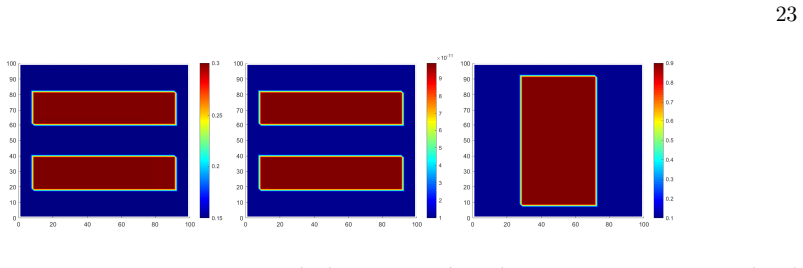
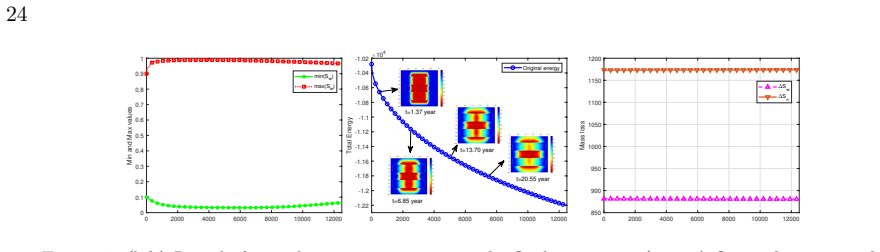
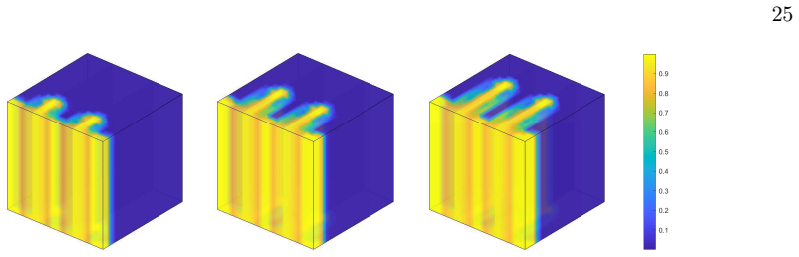
Developing high-order numerical schemes for two-phase flow in porous media that preserve key physical properties remains a significant challenge in numerical analysis. In this article, we propose a general framework to construct fully discrete first- and second-order numerical schemes for thermodynamically consistent model of incompressible and immiscible two-phase flow in porous media. The proposed schemes are rigorously proved to ensure five fundamental properties: (i) unique solvability; (ii) full decoupling; (iii) bound preservation for both phases; (iv) original energy dissipation; (v) local mass conservation for both phases. The key to ensure the unique solvability lies in guaranteeing the strict convexity of the discrete energy functionals associated with the constructed schemes. Departing from the coupled solution approach for the pressure and saturation variables, the proposed approach breaks traditional paradigm by subtracting the two-phase mass conservation equations to derive a fully decoupled system. In addition, the bound-preserving property for both phases is established by leveraging the singular nature of the logarithmic term around the limit values of $0$ and $1$. A rigorous error estimate for the first-order scheme, in the $\ell^{\infty}(0,T; H_h^{-1} (\Omega)) \cap \ell^{2}(0,T; \ell^2(\Omega))$ norm for the saturations of two phases, is established. Finally, various numerical examples are presented to verify the theoretical results and demonstrate the efficiency of the proposed schemes.
Editorial analysis
A structured set of objections, weighed in public.
Referee Report
Summary. The manuscript proposes a unified framework to construct fully discrete first- and second-order schemes for a thermodynamically consistent model of incompressible, immiscible two-phase flow in porous media. The schemes are asserted to satisfy five properties—unique solvability (via strict convexity of discrete energies), full decoupling (via subtraction of mass-conservation equations), bound preservation (via logarithmic singularity), energy dissipation, and local mass conservation—together with an ℓ^∞(0,T;H_h^{-1})∩ℓ²(0,T;ℓ²) error estimate for the first-order scheme.
Significance. If the convexity arguments and associated proofs are complete and gap-free, the framework would constitute a useful advance in structure-preserving methods for porous-media flows by simultaneously achieving decoupling and the listed physical invariants.
major comments (1)
- [Unique-solvability / convexity argument (abstract and construction sections)] The claim that unique solvability follows from strict convexity of the discrete energy functionals (abstract) is load-bearing for the entire framework, yet the manuscript supplies neither the explicit first- or second-order schemes nor a Hessian/second-variation calculation confirming that the convexity constant remains positive independently of mesh size and time step for the logarithmic potential after mass-conservation subtraction. Without this verification the existence argument collapses.
Simulated Author's Rebuttal
We thank the referee for the careful reading of the manuscript and the constructive feedback. We address the single major comment below.
read point-by-point responses
-
Referee: The claim that unique solvability follows from strict convexity of the discrete energy functionals (abstract) is load-bearing for the entire framework, yet the manuscript supplies neither the explicit first- or second-order schemes nor a Hessian/second-variation calculation confirming that the convexity constant remains positive independently of mesh size and time step for the logarithmic potential after mass-conservation subtraction. Without this verification the existence argument collapses.
Authors: We agree that the manuscript would be strengthened by an explicit presentation of the first- and second-order schemes together with a detailed second-variation (Hessian) calculation. Although the abstract and construction sections state that strict convexity of the discrete energies is guaranteed after the mass-conservation subtraction, we will revise those sections to display the concrete schemes and to supply the explicit Hessian analysis. The revised calculation will confirm that the convexity constant remains positive and independent of mesh size and time step for the logarithmic potential. This addition will render the unique-solvability argument complete. revision: yes
Circularity Check
No circularity: claims rest on new constructions and convexity proofs
full rationale
The paper constructs first- and second-order schemes for the two-phase flow model and states that unique solvability follows from proving strict convexity of the associated discrete energy functionals. The abstract and description supply no equations showing that convexity is defined in terms of the solvability result itself, nor any fitted parameter renamed as a prediction, nor load-bearing self-citation chains. The five listed properties are presented as consequences of the new decoupling approach and singular logarithmic potential, with an error estimate also claimed. No step reduces by the paper's own equations to its inputs by construction; the derivation is therefore self-contained.
Axiom & Free-Parameter Ledger
axioms (2)
- domain assumption The continuous model is thermodynamically consistent
- domain assumption Strict convexity of the discrete energy functionals guarantees unique solvability
Reference graph
Works this paper leans on
-
[1]
Chavent and J
G. Chavent and J. Jaffr ´e, Mathematical models and finite elements for reservoir simul ation: single phase, multiphase and multicomponent flows through porous media , Elsevier, 1986
1986
-
[2]
H. Chen, J. Kou, S. Sun, and T. Zhang , Fully mass-conservative impes schemes for incompressible two-phase flow in porous media , Computer Methods in Applied Mechanics and Engineering, 35 0 (2019), pp. 641–663
2019
-
[3]
J. Chen, S. Sun, and X. W ang , A numerical method for a model of two-phase flow in a coupled fr ee flow and porous media system , Journal of Computational Physics, 268 (2014), pp. 1–16
2014
-
[4]
W. Chen, J. Jing, C. W ang, X. W ang, and S. M.Wise , A modified Crank-Nicolson numerical scheme for the Flory-Huggins Cahn-Hilliard model , Communications in Computational Physics, 31 (2022), pp. 6 0– 93. 26
2022
-
[5]
W. Chen, C. W ang, X. W ang, and S. M. Wise , Positivity-preserving, energy stable numerical schemes for the Cahn-Hilliard equation with logarithmic potential , Journal of Computational Physics: X, 3 (2019), p. 100031
2019
-
[6]
Z. Chen, G. Huan, and B. Li , An improved impes method for two-phase flow in porous media , Transport in porous media, 54 (2004), pp. 361–376
2004
-
[7]
Z. Chen, G. Huan, and Y. Ma , Computational methods for multiphase flows in porous media , SIAM, 2006
2006
-
[8]
S. E. Cho , Stability analysis of unsaturated soil slopes considering water-air flow caused by rainfall infiltra- tion, Engineering Geology, 211 (2016), pp. 184–197
2016
-
[9]
A. Ern, I. Mozolevski, and L. Schuh , Discontinuous galerkin approximation of two-phase flows in hetero- geneous porous media with discontinuous capillary pressur es, Computer Methods in Applied Mechanics and Engineering, 199 (2010), pp. 1491–1501
2010
-
[10]
Galusinski and M
C. Galusinski and M. Saad , Two compressible immiscible fluids in porous media , Journal of Differential Equations, 244 (2008), pp. 1741–1783
2008
-
[11]
H. Gao, J. Kou, S. Sun, and X. W ang , Thermodynamically consistent modeling of two-phase incom - pressible flows in heterogeneous and fractured media , Oil & Gas Science and Technology–Revue d’IFP Energies nouvelles, 75 (2020), p. 32
2020
-
[12]
Girault, B
V. Girault, B. Riviere, and L. Cappanera , A finite element method for degenerate two-phase flow in porous media. part i: Well-posedness , Journal of Numerical Mathematics, 29 (2021), pp. 81–101
2021
-
[13]
Hoteit and A
H. Hoteit and A. Firoozabadi , Numerical modeling of two-phase flow in heterogeneous perme able media with different capillarity pressures , Advances in Water Resources, 31 (2008), pp. 56–73
2008
-
[14]
A. Hunt, R. Ewing, and B. Ghanbarian , Percolation theory for flow in porous media , vol. 880, Springer, 2014
2014
-
[15]
Joekar-Niasar and S
V. Joekar-Niasar and S. Hassanizadeh , Analysis of fundamentals of two-phase flow in porous media using dynamic pore-network models: A review , Critical reviews in environmental science and technology , 42 (2012), pp. 1895–1976
2012
-
[16]
Kim and R
J.-M. Kim and R. R. P arizek , Numerical simulation of the noordbergum effect resulting fro m groundwater pumping in a layered aquifer system , Journal of Hydrology, 202 (1997), pp. 231–243
1997
-
[17]
Klieber and B
W. Klieber and B. Riviere , Adaptive simulations of two-phase flow by discontinuous gal erkin methods , Computer Methods in Applied Mechanics and Engineering, 196 (2006), pp. 404–419
2006
-
[18]
J. Kou, X. W ang, S. Du, and S. Sun , An energy stable linear numerical method for thermodynamic ally consistent modeling of two-phase incompressible flow in por ous media, Journal of Computational Physics, 451 (2022), p. 110854
2022
-
[19]
Leng and H
H. Leng and H. Chen , HDG methods for incompressible and immiscible two-phase flo w in porous media: the existence and convergence of discrete solutions , ESAIM: Mathematical Modelling and Numerical Analysis, 59 (2025), pp. 2763–2788
2025
-
[20]
X. Li, Y. Yan, and H. Chen , A class of high-order physics-preserving schemes for therm odynamically con- sistent model of incompressible and immiscible two-phase fl ow in porous media, Journal of Computational Physics, 529 (2025), p. 113864
2025
-
[21]
C. Liu, C. W ang, S. M.Wise, X. Yue, and S. Zhou , A positivity-preserving, energy stable and conver- gent numerical scheme for the Poisson-Nernst-Planck syste m, Mathematics of Computation, 90 (2021), pp. 2071–2106
2021
-
[22]
M. A. Murad, M. Borges, J. A. Obreg ´on, and M. Correa , A new locally conservative numerical method for two-phase flow in heterogeneous poroelastic medi a, Computers and Geotechnics, 48 (2013), pp. 192–207
2013
-
[23]
J. Shen, J. Xu, and J. Yang , The scalar auxiliary variable (SA V) approach for gradient fl ows, Journal of Computational Physics, 353 (2018), pp. 407–416
2018
-
[24]
W ang and S
C. W ang and S. M. Wise , An energy stable and convergent finite-difference scheme for t he modified phase field crystal equation , SIAM Journal on Numerical Analysis, 49 (2011), pp. 945–969
2011
-
[25]
X. Yang, J. Zhao, and Q. W ang , Numerical approximations for the molecular beam epitaxial growth model based on the invariant energy quadratization method , Journal of Computational Physics, 333 (2017), pp. 104–127
2017
discussion (0)
Sign in with ORCID, Apple, or X to comment. Anyone can read and Pith papers without signing in.