REVIEW 4 major objections 6 minor 1 cited by
AgentAlign: Misalignment-Adapted Multi-Agent Perception for Resilient Inter-Agent Sensor Correlations
T0 review · 4 major / 6 minor · reviewed 2026-08-11 · deepseek-v4-flash
Pith's one-line read AgentAlign: aligning camera and LiDAR features across noisy agents restores cooperative perception, posting state-of-the-art scores on V2X-Real and V2XSet-Noise.
desk verdict A promising idea for misalignment-robust cooperative perception, but the paper's own V2X-Real numbers contradict each other and the SOTA claim is not self-consistent. read the letter →
The pith
A machine-rendered reading of the paper's core claim, the machinery that carries it, and where it could break.
The reading
What carries the argument
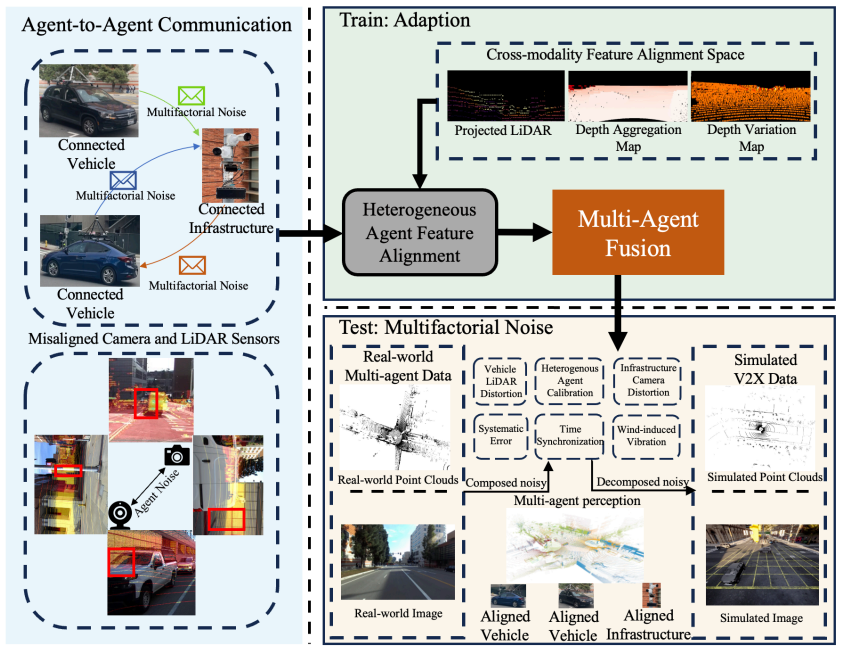
The cross-modality feature alignment space (CFAS) starts with LiDAR points projected into the camera image; the sparse depth map is densified by a 7-by-7 max-pooling window, and depth gradients in four directions are concatenated to form a depth variation map. The heterogeneous agent feature alignment (HAFA) module concatenates camera features with that depth variation map and applies a convolution-plus-activation to produce an information-attention map that gates which modality each agent relies on. The aligned features are then lifted into bird's-eye view using depth-based scattering and fused across agents with a transformer encoder, the same structure used in prior intermediate-fusion cooperative perception.
What would settle it
Collect field measurements of calibration drift, vibration, and synchronization errors from a deployed infrastructure camera/LiDAR suite over several months, build a test set whose noise matches those measured distributions, and compare AgentAlign against standard intermediate fusion on it; if the method's margin shrinks to within a few AP points, the claimed real-world robustness is not established.
Extended reading notes
Core claim
The paper's central claim is that multi-sensor misalignment in multi-agent perception can be absorbed at the feature level rather than corrected at the sensor level. A cross-modality feature alignment space (CFAS), built by projecting LiDAR into dense depth maps and adding depth-gradient variation, gives camera and LiDAR features a common representation. A heterogeneous agent feature alignment mechanism (HAFA) then learns an information-attention map that dynamically reweights the modalities for each agent, down-weighting whichever stream is corrupted by noise. Under multifactorial noise this restores cooperative detection accuracy, and the paper reports state-of-the-art results on V2X-Real and on its introduced V2XSet-Noise dataset.
Load-bearing premise
The central claim rests on the assumption that the synthetic noise models used to build V2XSet-Noise (sinusoidal wind vibration at 2 Hz, uniform calibration perturbations inside ±0.5 degrees and meters, 0.1 s synchronization delay, and systematic errors inside ±0.1) match the distribution of real sensor misalignment in deployed vehicle-to-everything systems.
Editorial extensions
If this is right
- If the reported gains hold, infrastructure installation tolerances can be relaxed: cameras and LiDARs no longer need frequent manual recalibration to keep cooperative perception accurate.
- The V2XSet-Noise benchmark provides a controlled way to test how any cooperative perception method degrades under calibration error, vibration, time-sync lag, distortion, and systematic bias.
- The CFAS depth-variation representation is a reusable building block for any camera-LiDAR fusion task with sparse depth, not only V2X.
- HAFA's gating could be read as a reliability estimate, potentially useful for deciding which agents' data to transmit under bandwidth constraints.
Reading between the lines
- The paper's noise magnitudes are synthetic and untested against field measurements, so the practical size of the gain may depend on how well those ranges match a specific deployment site.
- If HAFA learns to downweight a modality under misalignment, the same attention could be exposed as an interpretable sensor-health signal for diagnostics.
- The method's benefit is demonstrated on detection only; tracking and prediction pipelines that consume these features might not inherit the full gain.
Editorial analysis
A structured set of objections, weighed in public.
Referee Report
Summary. The paper proposes AgentAlign, a cooperative perception framework that aligns multi-modal features across heterogeneous agents (vehicles and infrastructure) to be robust to sensor misalignment and multifactorial noise. The method introduces a cross-modality feature alignment space (CFAS) that densifies projected LiDAR depth and computes depth gradients, plus a heterogeneous agent feature alignment (HAFA) mechanism that learns an information-attention map to weight camera and LiDAR features. The authors construct a V2XSet-Noise dataset by applying hand-crafted noise models (calibration error, wind vibration, camera distortion, LiDAR motion distortion, time asynchrony, systematic error) to V2XSet and OPV2V, and evaluate on V2X-Real, noisy OPV2V, and V2XSet-Noise, reporting state-of-the-art AP numbers. The central claim is that AgentAlign achieves SOTA performance on real-world multifactorial noise benchmarks.
Significance. If the reported results are correct and reproducible, the work addresses a real and underexplored problem: fragile inter-agent sensor correlations under realistic misalignment. The proposed CFAS and HAFA modules are simple and potentially generalizable, and the V2XSet-Noise dataset could serve as a useful robustness benchmark. However, the paper currently provides no code, no data, no error bars, and no ablations on the real dataset that match the headline numbers, which severely limits the verifyability of the claims. The core architectural ideas deserve consideration, but the evidence presented is not yet at the standard required for publication.
major comments (4)
- [§4.3, Table 1 vs §4.4, Table 4] The headline SOTA claim is internally contradicted by the paper's own ablation. Table 1 reports the complete AgentAlign model at 62.6% AP@0.3 and 60.4% AP@0.5 on V2X-Real, while Table 4 reports the full configuration (Cam. + Depth Agg. + Depth Var. + HAFA) at 49.9% AP@0.3 and 38.4% AP@0.5 on the same dataset. No difference in evaluation split, noise injection, checkpoint selection, or metric definition is stated. Both numbers cannot describe the same configuration under the same protocol. The authors must reconcile this discrepancy, explain any protocol difference, and report which number is the actual result for the full model.
- [§3.5 and §4.2 (V2XSet-Noise)] The simulated noise evaluation is only as meaningful as the realism of the noise models. The parameters (2 Hz sinusoidal vibration, uniform calibration perturbations of ±0.5° and ±0.5 m, 0.1 s synchronization delay, systematic errors in ±0.1) are chosen by the authors without validation against field measurements or an established benchmark. Moreover, the method is explicitly designed to counter these specific noise types, so the V2XSet-Noise results do not provide independent evidence of real-world robustness. The real-world V2X-Real results would supply that evidence, but they are called into question by the Table 1/Table 4 contradiction.
- [§4.3, Tables 1–3] The comparison tables omit the strongest cited multi-modal cooperative perception methods. For instance, HM-ViT [26] and V2X-ViT [30], both cited in the paper, are not included in any comparison, and CooperFuse [37] is also absent. Additionally, no error bars or multiple-run statistics are provided, so the reported improvements (e.g., 62.6 vs 58.6 on V2X-Real) cannot be assessed for statistical significance. The authors should add comparisons to these relevant methods and report variance.
- [§4.1 (Implementation Details)] The training protocol is underspecified. The paper states that the LiDAR and camera streams are trained separately and then HAFA is trained for 10 epochs, but it does not report the total training schedule, learning rates, batch size, optimizer, number of agents during training, or the exact data split (train/val/test) for V2XSet-Noise and V2X-Real. Without these details, the experiments are not reproducible, especially since code and data are promised only for future release.
minor comments (6)
- [§4.4 heading] The heading reads "Abalation Studies" and should be corrected to "Ablation Studies."
- [§3.5 heading] The heading "Time Sychronization" contains a typo; it should be "Time Synchronization."
- [§3.5, Calibration Error] The phrase "can be particularly series" should be "can be particularly serious."
- [§4.2] The paper uses AP@0.3/0.5 for V2X-Real but AP@0.5/0.7 for V2XSet-Noise and OPV2V. The choice of different IoU thresholds across datasets should be justified, as it makes cross-dataset comparisons confusing.
- [Supplementary, Eq. (2)] In the supplementary, Eq. (2) uses a notation with fXc and fXl that is not standard; this is likely a typographical artifact. Please define all symbols consistently.
- [References] Several references are incomplete or inconsistent (e.g., [5] formats authors as "Wen Yang; Zheng Gong; ..." with semicolons). The authors should verify the reference list.
Circularity Check
No derivation-level circularity: the headline result is anchored by an external real-world benchmark; only the simulated-noise evaluation is partially self-referential.
-
other
[Section 3.5 (V2X Multifactorial Noise) and Section 4.2 (Evaluation and Dataset)]
"To evaluate the impact of different types of noise and assess the robustness of AgentAlign, we constructed a new dataset, V2XSet-Noise, based on simulated V2XSet[30] to explicitly account for real-world sensor noise in V2X communication scenarios. ... All noise is added in a controlled manner, resulting in a total of 11,447 frames in our dataset."
The V2XSet-Noise benchmark is generated by the authors from V2XSet, also from the same group, using corruption types and magnitudes chosen in this paper (e.g., +/-0.5 degree and +/-0.5 m calibration perturbations, 2 Hz sinusoidal vibration, 0.1 s asynchrony, +/-0.1 systematic errors). AgentAlign's CFAS and HAFA modules are explicitly designed to counter exactly these misalignment types, so the simulated-benchmark robustness claim re-tests the paper's own assumptions rather than an independently specified corruption distribution. This is evaluation-level self-reference, not a derivation where an output equation reduces to an input by construction, and the V2X-Real external benchmark anchors the central SOTA claim, so the severity is low.
full rationale
I walked the claimed derivation chain: multi-modal feature extraction, CFAS projection and depth-variation construction, HAFA attention-based alignment, multi-agent fusion, and evaluation on V2X-Real, V2XSet-Noise, and noisy OPV2V. No equation in the method is defined in terms of the target metric; no fitted parameter is renamed as a prediction; no load-bearing uniqueness theorem or ansatz is imported from self-citations. Citations to prior work by the same group are uses of public datasets and baselines (V2X-Real, OPV2V, HM-ViT) and are externally checkable. The only partially circular element is the V2XSet-Noise benchmark, whose noise model is authored in this paper; but because the headline comparison on V2X-Real is an independent external benchmark, the central state-of-the-art claim has independent content. The apparent inconsistency between Table 1 (62.6/60.4 AP) and Table 4 (49.9/38.4 AP) for the full model on V2X-Real is a consistency and correctness concern, not a circularity step, because it does not exhibit a reduction of an output to an input by construction; accordingly it is not scored here.
Assumptions & free parameters
free parameters (5)
- calibration error range =
-0.5 to 0.5 degrees; -0.5 to 0.5 m
- wind vibration amplitude and frequency =
0.5 degrees, 2 Hz
- time synchronization delay =
0.1 s
- systematic error range =
-0.1 to 0.1 m and degrees
- perspective distortion alpha =
0.007, 0.014, 0.021, 0.028
assumptions (3)
- domain assumption The simulated noise models in Section 3.5 are representative of real-world multifactorial sensor misalignment.
- domain assumption The learned information-attention map Imap can generalize to misalignment types beyond those seen in training.
- domain assumption The LiDAR and camera backbones (PointPillars, LSS) remain effective when their inputs are corrupted by the simulated noise.
invented entities (2)
-
Cross-modality feature alignment space (CFAS)
independent evidence
-
Heterogeneous agent feature alignment (HAFA) mechanism
independent evidence
Cite this review
Pith. "Pith review of AgentAlign: Misalignment-Adapted Multi-Agent Perception for Resilient Inter-Agent Sensor Correlations." pith.science (2026). https://pith.science/paper/YLG5SQB7
@misc{pith2026241206142,
  author       = {Pith},
  title        = {Pith review of: AgentAlign: Misalignment-Adapted Multi-Agent Perception for Resilient Inter-Agent Sensor Correlations},
  year         = {2026},
  howpublished = {\url{https://pith.science/paper/YLG5SQB7}},
  note         = {Machine review of arXiv:2412.06142}
}
read the original abstract
Cooperative perception has attracted wide attention given its capability to leverage shared information across connected automated vehicles (CAVs) and smart infrastructures to address sensing occlusion and range limitation issues. However, existing research overlooks the fragile multi-sensor correlations in multi-agent settings, as the heterogeneous agent sensor measurements are highly susceptible to environmental factors, leading to weakened inter-agent sensor interactions. The varying operational conditions and other real-world factors inevitably introduce multifactorial noise and consequentially lead to multi-sensor misalignment, making the deployment of multi-agent multi-modality perception particularly challenging in the real world. In this paper, we propose AgentAlign, a real-world heterogeneous agent cross-modality feature alignment framework, to effectively address these multi-modality misalignment issues. Our method introduces a cross-modality feature alignment space (CFAS) and heterogeneous agent feature alignment (HAFA) mechanism to harmonize multi-modality features across various agents dynamically. Additionally, we present a novel V2XSet-noise dataset that simulates realistic sensor imperfections under diverse environmental conditions, facilitating a systematic evaluation of our approach's robustness. Extensive experiments on the V2X-Real and V2XSet-Noise benchmarks demonstrate that our framework achieves state-of-the-art performance, underscoring its potential for real-world applications in cooperative autonomous driving. The controllable V2XSet-Noise dataset and generation pipeline will be released in the future.
Figures


Figures from the paper (6 more)


Forward citations
Cited by 1 Pith paper
-
SimBEV2X: A Large-Scale Dataset and Data Generation Tool for Multi-Task Vehicle-to-Everything Cooperative Perception
SimBEV2X delivers a large-scale synthetic V2X dataset and generator with multi-task annotations, plus an attention fusion model that improves fused/lidar performance.
Reference graph
Works this paper leans on
-
[26]
Hm-vit: Hetero-modal vehicle-to-vehicle cooperative percep- tion with vision transformer
Hao Xiang, Runsheng Xu, and Jiaqi Ma. Hm-vit: Hetero-modal vehicle-to-vehicle cooperative percep- tion with vision transformer. In Proceedings of the IEEE/CVF International Conference on Computer Vi- sion, pages 284–295, 2023. 4
work page 2023
-
[30]
V2x-vit: Vehicle-to- everything cooperative perception with vision trans- former
Runsheng Xu, Hao Xiang, Zhengzhong Tu, Xin Xia, Ming-Hsuan Yang, and Jiaqi Ma. V2x-vit: Vehicle-to- everything cooperative perception with vision trans- former. arXiv preprint arXiv:2203.10638, 2022. 6
arXiv 2022
-
[37]
Cooperfuse: A real-time cooperative perception fusion framework
Zhaoliang Zheng, Xin Xia, Letian Gao, Hao Xiang, and Jiaqi Ma. Cooperfuse: A real-time cooperative perception fusion framework. In 2024 IEEE Intelli- gent Vehicles Symposium (IV), pages 533–538, 2024. 6 10 AgentAlign: Misalignment-Adapted Multi-Agent Perception for Resilient Inter-Agent Sensor Correlations Supplementary Material
work page 2024
-
[1]
Pei An, Yingshuo Gao, Liheng Wang, Yanfei Chen, and Jie Ma. Online extrinsic calibration on lidar- camera system with lidar intensity attention and struc- tural consistency loss. Remote Sensing, 14(11):2525,
-
[2]
Parallel driving os: A ubiquitous operating system for autonomous driv- ing in cpss
Long Chen, Yunqing Zhang, Bin Tian, Yunfeng Ai, Dongpu Cao, and Fei-Yue Wang. Parallel driving os: A ubiquitous operating system for autonomous driv- ing in cpss. IEEE Transactions on Intelligent Vehicles, 7(4):886–895, 2022. 1
work page 2022
-
[3]
Qi Chen, Xu Ma, Sihai Tang, Jingda Guo, Qing Yang, and Song Fu. F-cooper: Feature based cooperative perception for autonomous vehicle edge computing system using 3d point clouds. In Proceedings of the 4th ACM/IEEE Symposium on Edge Computing, pages 88–100, 2019. 4, 7, 8
work page 2019
-
[4]
Wind- induced self-excited loads on bridges
ZQ Chen, XD Yu, G Yang, and BF Spencer Jr. Wind- induced self-excited loads on bridges. Journal of Structural Engineering, 131(12):1783–1793, 2005. 6
work page 2005
-
[5]
Wen Yang; Zheng Gong; Baifu Huang; Xiaoping Hong. Lidar with velocity: Correcting moving ob- jects point cloud distortion from oscillating scanning lidars by fusion with camera. IEEE Transactions on Intelligent Vehicles, 7(2):234–245, 2022. 6
work page 2022
Show all 49 references
-
[6]
Where2comm: Communication- efficient collaborative perception via spatial confi- dence maps
Yue Hu, Shaoheng Fang, Zixing Lei, Yiqi Zhong, and Siheng Chen. Where2comm: Communication- efficient collaborative perception via spatial confi- dence maps. In Advances in Neural Information Processing Systems, pages 4874–4886. Curran Asso- ciates, Inc., 2022. 1
2022
-
[7]
Where2comm: Communication- efficient collaborative perception via spatial confi- dence maps
Yue Hu, Shaoheng Fang, Zixing Lei, Yiqi Zhong, and Siheng Chen. Where2comm: Communication- efficient collaborative perception via spatial confi- dence maps. Advances in neural information process- ing systems, 35:4874–4886, 2022. 3, 7, 8
2022
-
[8]
General, single-shot, target-less, and automatic lidar-camera extrinsic calibration toolbox
Kenji Koide, Shuji Oishi, Masashi Yokozuka, and At- suhiko Banno. General, single-shot, target-less, and automatic lidar-camera extrinsic calibration toolbox. In 2023 IEEE International Conference on Robotics and Automation (ICRA) , pages 11301–11307. IEEE,
2023
-
[9]
Pointpillars: Fast encoders for object detection from point clouds
Alex H Lang, Sourabh V ora, Holger Caesar, Lubing Zhou, Jiong Yang, and Oscar Beijbom. Pointpillars: Fast encoders for object detection from point clouds. In Proc. IEEE/CVF Conf. Comput. Vis. Pattern Recog- nit, pages 12697–12705, 2019. 4, 7, 8
2019
-
[10]
Learning distilled collaboration graph for multi-agent perception
Yiming Li, Shunli Ren, Pengxiang Wu, Siheng Chen, Chen Feng, and Wenjun Zhang. Learning distilled collaboration graph for multi-agent perception. In Thirty-fifth Conference on Neural Information Pro- cessing Systems (NeurIPS 2021), 2021. 1
2021
-
[11]
V2x- sim: Multi-agent collaborative perception dataset and benchmark for autonomous driving
Yiming Li, Dekun Ma, Ziyan An, Zixun Wang, Yiqi Zhong, Siheng Chen, and Chen Feng. V2x- sim: Multi-agent collaborative perception dataset and benchmark for autonomous driving. IEEE Robotics and Automation Letters, 2022. 1, 4
2022
-
[12]
A systematic survey of con- trol techniques and applications in connected and au- tomated vehicles
Wei Liu, Min Hua, Zhiyun Deng, Zonglin Meng, Yan- jun Huang, Chuan Hu, Shunhui Song, Letian Gao, Changsheng Liu, Bin Shuai, Amir Khajepour, Lu Xiong, and Xin Xia. A systematic survey of con- trol techniques and applications in connected and au- tomated vehicles. IEEE Internet ...
2023
-
[13]
When2com: Multi-agent perception via communication graph grouping
Yen-Cheng Liu, Junjiao Tian, Nathaniel Glaser, and Zsolt Kira. When2com: Multi-agent perception via communication graph grouping. In Proceedings of the IEEE/CVF Conference on computer vision and pat- tern recognition, pages 4106–4115, 2020. 1
2020
-
[14]
Bev- fusion: Multi-task multi-sensor fusion with unified bird’s-eye view representation
Zhijian Liu, Haotian Tang, Alexander Amini, Xinyu Yang, Huizi Mao, Daniela L Rus, and Song Han. Bev- fusion: Multi-task multi-sensor fusion with unified bird’s-eye view representation. In 2023 IEEE interna- tional conference on robotics and automation (ICRA), pages 2774–2781. ...
2023
-
[15]
Hydro-3d: Hybrid object detection and tracking for cooperative perception using 3d lidar
Zonglin Meng, Xin Xia, Runsheng Xu, Wei Liu, and Jiaqi Ma. Hydro-3d: Hybrid object detection and tracking for cooperative perception using 3d lidar. IEEE Transactions on Intelligent Vehicles, 8(8):4069– 4080, 2023. 1
2023
-
[16]
To- ward foundation models for inclusive object detec- tion: Geometry-and category-aware feature extraction across road user categories
Zonglin Meng, Xin Xia, and Jiaqi Ma. To- ward foundation models for inclusive object detec- tion: Geometry-and category-aware feature extraction across road user categories. IEEE Transactions on Systems, Man, and Cybernetics: Systems, pages 1–11,
-
[17]
Urban flood mapping with residual patch similarity learning
Bo Peng, Xinyi Liu, Zonglin Meng, and Qunying Huang. Urban flood mapping with residual patch similarity learning. In Proceedings of the 3rd ACM SIGSPATIAL International Workshop on AI for Ge- ographic Knowledge Discovery , page 40–47, New York, NY , USA, 2019. Association for ...
2019
-
[18]
Patch similarity convolutional neural network for urban flood extent mapping using bi-temporal 9 satellite multispectral imagery
Bo Peng, Zonglin Meng, Qunying Huang, and Caixia Wang. Patch similarity convolutional neural network for urban flood extent mapping using bi-temporal 9 satellite multispectral imagery. Remote Sensing , 11 (21), 2019. 1
2019
-
[19]
Lift, splat, shoot: En- coding images from arbitrary camera rigs by implic- itly unprojecting to 3d
Jonah Philion and Sanja Fidler. Lift, splat, shoot: En- coding images from arbitrary camera rigs by implic- itly unprojecting to 3d. In Proceedings of the Euro- pean Conference on Computer Vision, 2020. 6
2020
-
[20]
Position determines perspective: Investigating perspective distortion for image foren- sics of faces
Chuan Sheng Tan, Lingjie Zhou, Qing Yan, Qing Zhao, and Kui Ma. Position determines perspective: Investigating perspective distortion for image foren- sics of faces. In Proceedings of the IEEE Conference on Computer Vision and Pattern Recognition (CVPR) Workshops, 2017. 3
2017
-
[21]
Efficientnet: Rethinking model scaling for convolutional neural networks
Mingxing Tan and Quoc Le. Efficientnet: Rethinking model scaling for convolutional neural networks. In International conference on machine learning , pages 6105–6114. PMLR, 2019. 4
2019
-
[22]
Perspective dis- tortion modeling, learning and compensation
Joachim Valente and Stefano Soatto. Perspective dis- tortion modeling, learning and compensation. In Pro- ceedings of the IEEE Conference on Computer Vi- sion and Pattern Recognition Workshops, pages 9–16,
-
[23]
Smart mobility digital twin based automated vehicle naviga- tion system: A proof of concept
Kui Wang, Zongdian Li, Kazuma Nonomura, Tao Yu, Kei Sakaguchi, Omar Hashash, and Walid Saad. Smart mobility digital twin based automated vehicle naviga- tion system: A proof of concept. IEEE Transactions on Intelligent Vehicles, 9(3):4348–4361, 2024. 1
2024
-
[24]
V2vnet: Vehicle-to-vehicle communication for joint perception and prediction
Tsun-Hsuan Wang, Sivabalan Manivasagam, Ming Liang, Bin Yang, Wenyuan Zeng, and Raquel Urtasun. V2vnet: Vehicle-to-vehicle communication for joint perception and prediction. In Computer Vision–ECCV 2020: 16th European Conference, Glasgow, UK, Au- gust 23–28, 2020, Proceedings,...
2020
-
[25]
An automated driving systems data ac- quisition and analytics platform
Xin Xia, Zonglin Meng, Xu Han, Hanzhao Li, Takahiro Tsukiji, Runsheng Xu, Zhaoliang Zheng, and Jiaqi Ma. An automated driving systems data ac- quisition and analytics platform. Transportation Re- search Part C: Emerging Technologies , 151:104120,
-
[27]
V2x-real: a largs-scale dataset for vehicle-to-everything cooperative percep- tion
Hao Xiang, Zhaoliang Zheng, Xin Xia, Runsheng Xu, Letian Gao, Zewei Zhou, Xu Han, Xinkai Ji, Mingxi Li, Zonglin Meng, et al. V2x-real: a largs-scale dataset for vehicle-to-everything cooperative percep- tion. arXiv preprint arXiv:2403.16034 , 2024. 1, 2, 7
2024 arXiv
-
[28]
Opencda: an open cooperative driving automation framework integrated with co-simulation
Runsheng Xu, Yi Guo, Xu Han, Xin Xia, Hao Xiang, and Jiaqi Ma. Opencda: an open cooperative driving automation framework integrated with co-simulation. In 2021 IEEE International Intelligent Transporta- tion Systems Conference (ITSC), Proc. IEEE 24th Int. Conf. Intell. Transp....
2021
-
[29]
Opv2v: An open bench- mark dataset and fusion pipeline for perception with vehicle-to-vehicle communication
Runsheng Xu, Hao Xiang, Xin Xia, Xu Han, Jin- long Liu, and Jiaqi Ma. Opv2v: An open bench- mark dataset and fusion pipeline for perception with vehicle-to-vehicle communication. arXiv preprint arXiv:2109.07644, 2021. 3, 7, 8
2021 arXiv
-
[31]
Bridging the domain gap for multi-agent perception
Runsheng Xu, Jinlong Li, Xiaoyu Dong, Hongkai Yu, and Jiaqi Ma. Bridging the domain gap for multi-agent perception. In 2023 IEEE International Conference on Robotics and Automation (ICRA) , pages 6035–6042,
2023
-
[32]
The opencda open-source ecosystem for cooperative driving au- tomation research
Runsheng Xu, Hao Xiang, Xu Han, Xin Xia, Zonglin Meng, Chia-Ju Chen, and Jiaqi Ma. The opencda open-source ecosystem for cooperative driving au- tomation research. arXiv preprint arXiv:2301.07325,
-
[33]
Dair-v2x: A large- scale dataset for vehicle-infrastructure cooperative 3d object detection
Haibao Yu, Yizhen Luo, Mao Shu, Yiyi Huo, Zebang Yang, Yifeng Shi, Zhenglong Guo, Hanyu Li, Xing Hu, Jirui Yuan, and Zaiqing Nie. Dair-v2x: A large- scale dataset for vehicle-infrastructure cooperative 3d object detection. In Proceedings of the IEEE/CVF Conference on Computer ...
2022
-
[34]
Systematic error mod- eling and bias estimation
Feihu Zhang and Alois Knoll. Systematic error mod- eling and bias estimation. Sensors, 16(5):729, 2016. 6
2016
-
[35]
Numerical simulation study of vibra- tion characteristics of cantilever traffic signal support structure under wind environment
Meng Zhang, Zhichao Zhou, Guifeng Zhao, and Fang- fang Wang. Numerical simulation study of vibra- tion characteristics of cantilever traffic signal support structure under wind environment. CMES - Computer Modeling in Engineering and Sciences , 134(1):673– 698, 2022. 6
2022
-
[36]
Z. Zhang. A flexible new technique for camera cali- bration. IEEE Transactions on Pattern Analysis and Machine Intelligence, 22(11):1330–1334, 2000. 2, 6
2000
-
[39]
Miscalibration in the extrinsic parameters can lead to misaligned sensor data, negatively impacting the performance of perception algorithms
Sensor Calibration Error Accurate sensor calibration is essential for aligning data from different sensors, such as cameras and LiDARs, into a common coordinate frame. Miscalibration in the extrinsic parameters can lead to misaligned sensor data, negatively impacting the perfo...
-
[40]
To emulate these real-world impacts on LiDAR and camera sensors, we introduce rotational and positional noise into our multi-agent system
Wind-Induced Vibration Noise Infrastructure sensors mounted at elevated positions are sus- ceptible to wind-induced vibrations, affecting the accuracy of the collected data. To emulate these real-world impacts on LiDAR and camera sensors, we introduce rotational and positional...
-
[41]
Infrastructure Camera Distortion Elevated or angled infrastructure cameras frequently cap- ture images that exhibit perspective distortions due to their mounting position and viewing angle. These distortions impact the spatial accuracy of visual data, particularly in scenarios...
2017
-
[42]
= (−αW, 0) Point 2: (x2, y2) = (W, 0) → (x′ 2, y′
-
[43]
= ((1 + α)W, 0) Point 3: (x3, y3) = (W, H) → (x′ 3, y′
-
[44]
= (W, H) Point 4: (x4, y4) = (0, H) → (x′ 4, y′
-
[45]
• Low Distortion (1/2): α = 0.014: Represents a moderate horizontal shift, introducing noticeable skew
= (0, H) Solved the homography matrix: H = 1 + 2α αW H −αW 0 1 + 2 α 0 0 2α H 1 The parameter α is adjusted to achieve the following lev- els of distortion, which determines the horizontal displace- ment of the top corners.: • Minimal Distortion (1/4): α = 0.007: S...
-
[46]
These distortions arise from changes in the ego vehicle’s position 3 Figure 6
V ehicle LiDAR Distortion Vehicle-mounted LiDAR sensors frequently experience motion-induced distortions due to the continuous scanning of the environment while the vehicle is in motion. These distortions arise from changes in the ego vehicle’s position 3 Figure 6. Visual repr...
-
[47]
Visual representation of detection results using both camera and LiDAR data
Time Synchronization Time synchronization is a fundamental challenge in multi- sensor systems, particularly in V2X (vehicle-to-everything) scenarios, where data from heterogeneous sensors like Li- DAR and cameras must be temporally aligned to ensure ac- 5 Figure 9. Visual repr...
-
[48]
Factors such as temperature changes, moisture, and corrosion can cause sensors to shift to incorrect posi- tions, resulting in persistent offsets that affect detection ac- curacy
Systematic Error In real V2X systems, sensors may experience fixed mis- alignment errors due to external environmental interfer- ence [34]. Factors such as temperature changes, moisture, and corrosion can cause sensors to shift to incorrect posi- tions, resulting in persistent...
-
[49]
8 and Fig
Qualitative Detection Results To demonstrate the effectiveness and resilience of our pro- posed network, we present qualitative results across various challenging detection scenarios in the V2X-Real dataset, as shown in Fig. 8 and Fig. 9. In Fig. 8, the detection re- sults of ...
-
[621]
Springer, 2020. 1, 3
2020
Reviewed August 11, 2026 · model on record in the stance chip above.
Discussion (0). Continue with ORCID to comment.