REVIEW 4 major objections 4 minor 1 cited by
DreamGrasp: Zero-Shot 3D Multi-Object Reconstruction from Partial-View Images for Robotic Manipulation
T0 review · 4 major / 4 minor · reviewed 2026-08-06 · deepseek-v4-flash
Pith's one-line read Two partial RGB views plus pretrained diffusion 'imagination' yield per-object 3D geometry that suffices for single-pass robotic decluttering and target retrieval.
desk verdict Solid engineering contribution that pushes score distillation from single-object generation to multi-object recognition; the evidence is conditional, and the main risk is hidden-region hallucination the paper itself admits. read the letter →
The pith
A machine-rendered reading of the paper's core claim, the machinery that carries it, and where it could break.
The reading
What carries the argument
The load-bearing mechanism is score distillation sampling (SDS) applied to a 3D Gaussian Splatting scene, with a differentiable renderer whose output is repeatedly denoised by a pretrained diffusion model and whose denoising error is backpropagated into the 3D representation. Zero123 contributes the view-conditioned prior that hallucinates novel views of unseen geometry; a text-conditioned Stable Diffusion contributes the instance-level prior aligned with ChatGPT-generated text descriptions; the Surface-Invariant Feature Regularizer (SIFR) is a closed-form term that penalizes variation of normalized instance features along surface-tangent directions, so contrastive features cluster cleanly even for touching objects. The instance-wise refinement stage then applies separate SDS, rendering, and outlier-removal passes per segmented object, which is what turns a rough scene-level model into a per-object one.
What would settle it
Take a set of objects whose true backside or interior is known, such as a cup with a cavity or an object with a strongly asymmetric back, reconstruct each from the same two front views, and compare rendered depth from novel back or top-down viewpoints against ground truth; if the hallucinated surface fills the cup cavity or the back depth exceeds the chosen tolerance, the claim of accurate unobserved geometry is refuted. A concrete version is the paper's own observation that cup interiors come out overfilled, which can be turned into a systematic pass-fail metric.
Extended reading notes
Core claim
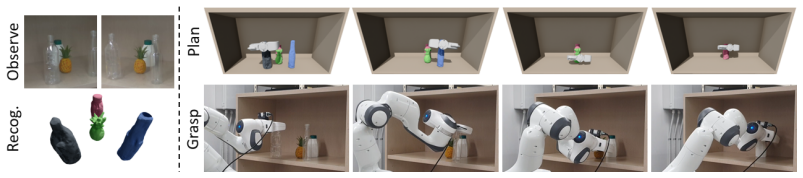
DreamGrasp's central claim is that zero-shot instance-wise 3D reconstruction from sparse partial views is achievable by combining two pretrained 2D diffusion priors: Zero123 for view-conditioned novel-view synthesis and Stable Diffusion for text-conditioned appearance. The coarse stage fits a Gaussian Splatting scene with per-Gaussian instance features, supervised jointly by an RGB rendering loss, Zero123 score distillation, contrastive learning on 2D instance masks, and a new surface-invariant feature regularizer that keeps feature values constant along object surfaces. The refinement stage then isolates each object by clustering those features, resolves instance correspondences across views by bipartite matching, and optimizes each object independently with an instance-wise rendering loss, further Zero123 supervision, text-guided score distillation from automatically generated prompts, and periodic outlier removal. In the paper's experiments this pipeline recovers accurate scene- and instance-level depth on novel views and supports real-world collision-free decluttering of four-object scenes in five of five trials and target retrieval in four of five trials.
Load-bearing premise
The diffusion models' imagined views of unobserved regions are assumed to be geometrically truthful, not merely plausible-looking from the input cameras; the paper itself notes that its system 'may produce geometry that merely looks correct from the input views even if the actual 3D surface is incorrect.'
Editorial extensions
If this is right
- A single recognition pass from two front RGB views suffices to plan the whole decluttering sequence, since each instance's geometry is available upfront and the scene model can be updated by removing picked objects.
- Transparent and reflective objects become tractable without depth sensing, because supervision comes from RGB rendering and diffusion priors rather than from measured depth.
- Instance-wise geometry enables collision checking between the gripper, the grasped object, and surrounding objects, which is the difference between successful four-object decluttering and collision-prone behavior.
- Because the output is a Gaussian scene, rendered depth can be TSDF-fused into meshes or point clouds, so existing depth-based grasp planners can be applied without retraining.
- Text descriptions for refinement are generated automatically by an MLLM, keeping the whole pipeline zero-shot and free of manual annotation.
Reading between the lines
- If the generative priors confidently hallucinate wrong backside geometry, rendering-based accuracy metrics will not expose it; tasks that depend on hidden concavities, such as reaching inside a cup, are the stricter test of whether the imagined geometry is true.
- SIFR is a transferable device: enforcing surface-tangent invariance in learned 3D features could improve other sparse-view feature-lifting pipelines, including open-vocabulary or language-grounded segmentation.
- The coarse-then-per-instance recipe suggests a modular route to sparse-view recognition in general: seed geometry with a view-conditioned generative prior, then refine each segment with its own text-conditioned prior, rather than training one multi-object model.
- Distilling additional vision-language embeddings into the Gaussian features would let the same single pass answer queries like 'the red mug in the back' without re-running segmentation, an extension the paper itself flags.
Editorial analysis
A structured set of objections, weighed in public.
Referee Report
Summary. DreamGrasp proposes a framework for instance-wise 3D reconstruction from two partial-view RGB images without depth input, targeting robotic manipulation in cluttered scenes. It first builds a coarse 3D Gaussian Splatting scene with learned instance features, using Zero123-based Score Distillation Sampling (SDS) and contrastive learning with a new Surface-Invariant Feature Regularizer (SIFR). It then refines each object instance separately using an RGB mask loss, Zero123 supervision, text-conditioned SDS from Stable Diffusion, and periodic outlier removal. The paper reports synthetic recognition experiments on 80 cluttered scenes (2–5 objects from YCB and TablewareNet) and real-robot sequential decluttering and target retrieval experiments (five trials each), claiming high depth accuracy, mask IoU, and task success rates.
Significance. If the claimed performance holds, the framework is significant: it offers a zero-shot, no-fine-tuning route to instance-wise geometry from sparse RGB in shelf-like environments, where depth sensors fail and full-view coverage is unavailable. The paper contributes a complete pipeline, a novel regularizer with a closed-form expression, and a detailed appendix documenting implementation choices. The authors are also transparent about limitations, which strengthens the report. However, the evidence does not yet match the breadth of the claims: the recognition comparison is confined to the authors' own ablations, the hidden-region geometry on which the manipulation claim rests is not isolated by the reported metrics, and the real-robot success rates are five-trial point estimates with no confidence intervals.
major comments (4)
- [§7, Eqs. (9), (12), Tables 1 and 3] The load-bearing assumption of the method is that the pretrained diffusion priors supply correct geometry for unobserved regions. The Limitations section explicitly concedes that the system 'may produce geometry that merely looks correct from the input views—even if the actual 3D surface is incorrect.' The only supervision that reaches unobserved regions is the SDS losses in Eqs. (9) and (12); Eqs. (8) and (5) constrain only the two observed viewpoints. The depth-accuracy metrics in Tables 1 and 3 average over all rendered novel-view pixels, including surfaces visible in the input images, so they do not quantify hallucination in hidden or back-facing regions. Please report depth accuracy and mask IoU separately for pixels whose corresponding 3D surface is visible from at least one input camera versus pixels that are hidden in all inputs, with scene- and instance-level breakdowns, and provide failure examples from the hidden-region subset. Without this, the manipulation claim—collision checking relies on geometry of occluded objects—is not supported.
- [§5.1, Table 1] The only comparators are CGC and Zero123*, both of which are constructed by removing components from DreamGrasp. The abstract and conclusion claim that DreamGrasp 'circumvents limitations of prior methods' and recovers geometry more reliably than existing approaches, but no published method is evaluated in the recognition experiments. Because the experimental setup uses two partial views and ground-truth masks, it should be feasible to adapt at least one existing partial-view reconstruction or instance-recognition method (e.g., T2SQNet [6], or a two-view variant of a Zero123-based method) as an external baseline. If that is not feasible, the superiority claims should be scaled back to improvements over the authors' own ablations.
- [§5.1, §5.2] The synthetic recognition experiments are run with simulation-derived ground-truth instance masks and class-label text prompts, so the components that automatically produce masks (SAM) and text (ChatGPT) are not evaluated in the controlled setup. Since these components are part of the full pipeline and can introduce errors (the paper itself notes mask incompleteness due to occlusions), the recognition results overestimate the performance of the complete system as described. I ask for an ablation that runs at least one synthetic scene set through SAM-predicted masks and MLLM-generated prompts, or a real-world recognition evaluation with these components, to measure the sensitivity of the pipeline to upstream perception errors.
- [§5.2, Tables 2] The manipulation claims are based on n=5 trials per condition with point-estimate success rates and no confidence intervals. For 5/5 successes, a 95% Clopper-Pearson interval is approximately [0.55, 1.00]; for the reported 80% retrieval success (4/5) it is even wider. The comparison to baselines in decluttering is correspondingly underpowered. Please add binomial confidence intervals and, ideally, more trials or scene/setup variation, so the 'high success rates' claim is statistically meaningful.
minor comments (4)
- [Table 3 and Appendix E.1] The table header 'Extened' should be 'Extended', and the class name 'nottle' in Appendix E.1 should be 'bottle'.
- [Eq. (11)] Equation (11) includes 'L_reg' as an additional loss term, but L_reg is never defined; please either define it or remove it.
- [§5.1, Appendix E.1] The depth thresholds δ are reported as 0.05, 0.10, and 0.20, but the paper does not state whether these are absolute distances in meters or relative depth errors; please specify to aid interpretation.
- [Abstract and §1] The term 'zero-shot' is used loosely: the pipeline invokes SAM and ChatGPT at inference time and relies on pretrained diffusion models. The paper should clarify in the introduction exactly which components are zero-shot in the sense of requiring no fine-tuning, and which are pretrained tools used at inference.
Circularity Check
No circularity found: the reconstruction target is never used to set the method's constants; the generative priors are external, and evaluation uses held-out novel views.
full rationale
DreamGrasp's derivation chain is an optimization fit to observed RGB images, instance masks, text prompts, and gradients from pretrained external diffusion models. The target geometry (ground-truth depth and meshes) appears only in evaluation, specifically in the novel-view depth-accuracy and mask-IoU metrics of Section 5.1 and Tables 1 and 3, never in any training loss. The coarse-stage losses (Eqs. 8-11) and refinement losses (Eqs. 5, 12-13) all take observed images, masks, text, and pretrained model outputs as inputs; none is defined in terms of the quantity being predicted. The claim that unobserved regions can be filled by generative priors is an empirical assumption about the priors' quality, structurally the same as relying on any pretrained network, and Section 7 explicitly flags the corresponding failure mode (geometry that "merely looks correct from the input views")—which is a correctness caveat, not a circular step. The same-author citations (e.g., [6] and [28]) are used as prior-task context rather than as justification for reconstruction correctness, and no uniqueness theorem or fitted parameter is imported from them. The central claim therefore has independent content and is not forced by definition or by self-citation.
Assumptions & free parameters
free parameters (6)
- Instance clustering threshold δ =
0.9
- Text SDS classifier-free guidance scale s =
10
- Zero123 classifier-free guidance scale s =
3
- Loss weights λ_render, λ_Zero123, λ_CC, λ_SIFR, λ_instance_render, λ_instance_SDS =
e.g., 1000, 0.1, 0.001, 0.0001, 1000, 0.1/0.01
- SIFR metric eigenvalue ratio d =
100
- DBSCAN epsilon for outlier removal =
0.04
assumptions (6)
- domain assumption Camera intrinsics and extrinsics are known for all input views.
- domain assumption Zero123's image-conditioned diffusion prior is valid for cluttered multi-object scenes with occlusions.
- domain assumption Text-conditioned Stable Diffusion under SDS with guidance scale 10 regularizes object geometry toward the correct instance rather than a text-plausible object.
- domain assumption Surface normals estimated from the Gaussian density field are accurate enough for SIFR.
- domain assumption SAM-derived masks and MLLM-generated text prompts in real experiments are of sufficient quality.
- standard math Standard differentiable rendering and score distillation machinery from prior work is accepted as background.
Cite this review
Pith. "Pith review of DreamGrasp: Zero-Shot 3D Multi-Object Reconstruction from Partial-View Images for Robotic Manipulation." pith.science (2026). https://pith.science/paper/YLKQOVD5
@misc{pith2026250705627,
  author       = {Pith},
  title        = {Pith review of: DreamGrasp: Zero-Shot 3D Multi-Object Reconstruction from Partial-View Images for Robotic Manipulation},
  year         = {2026},
  howpublished = {\url{https://pith.science/paper/YLKQOVD5}},
  note         = {Machine review of arXiv:2507.05627}
}
read the original abstract
Partial-view 3D recognition -- reconstructing 3D geometry and identifying object instances from a few sparse RGB images -- is an exceptionally challenging yet practically essential task, particularly in cluttered, occluded real-world settings where full-view or reliable depth data are often unavailable. Existing methods, whether based on strong symmetry priors or supervised learning on curated datasets, fail to generalize to such scenarios. In this work, we introduce DreamGrasp, a framework that leverages the imagination capability of large-scale pre-trained image generative models to infer the unobserved parts of a scene. By combining coarse 3D reconstruction, instance segmentation via contrastive learning, and text-guided instance-wise refinement, DreamGrasp circumvents limitations of prior methods and enables robust 3D reconstruction in complex, multi-object environments. Our experiments show that DreamGrasp not only recovers accurate object geometry but also supports downstream tasks like sequential decluttering and target retrieval with high success rates.
Figures


Figures from the paper (5 more)


Forward citations
Cited by 1 Pith paper
-
ScrewSplat: An End-to-End Method for Articulated Object Recognition
A method that recovers the 3D shape and the rotation or sliding axis of each movable part of an object from RGB video alone, by jointly optimizing randomly initialized screw axes with Gaussian Splatting.
Reference graph
Works this paper leans on
-
[6]
Y . H. Kim, S. Kim, Y . Lee, and F. C. Park. T 2sqnet: A recognition model for manipulating partially observed transparent tableware objects. In8th Annual Conference on Robot Learning
-
[1]
S. Kim, T. Ahn, Y . Lee, J. Kim, M. Y . Wang, and F. C. Park. Dsqnet: A deformable model- based supervised learning algorithm for grasping unknown occluded objects.IEEE Transac- tions on Automation Science and Engineering, 20(3):1721–1734, 2022
work page 2022
- [2]
-
[3]
J. Ichnowski, Y . Avigal, J. Kerr, and K. Goldberg. Dex-nerf: Using a neural radiance field to grasp transparent objects.arXiv preprint arXiv:2110.14217, 2021
arXiv 2021
-
[4]
J. Kerr, L. Fu, H. Huang, Y . Avigal, M. Tancik, J. Ichnowski, A. Kanazawa, and K. Goldberg. Evo-nerf: Evolving nerf for sequential robot grasping of transparent objects. In6th annual conference on robot learning, 2022
work page 2022
-
[5]
J. Lee, S. M. Kim, Y . Lee, and Y . M. Kim. Nfl: Normal field learning for 6-dof grasping of transparent objects.IEEE Robotics and Automation Letters, 9(1):819–826, 2023. 9
work page 2023
-
[7]
Q. Dai, Y . Zhu, Y . Geng, C. Ruan, J. Zhang, and H. Wang. Graspnerf: Multiview-based 6-dof grasp detection for transparent and specular objects using generalizable nerf. In2023 IEEE International Conference on Robotics and Automation (ICRA), pages 1757–1763. IEEE, 2023
work page 2023
-
[8]
R. Liu, R. Wu, B. Van Hoorick, P. Tokmakov, S. Zakharov, and C. V ondrick. Zero-1-to-3: Zero-shot one image to 3d object. InProceedings of the IEEE/CVF international conference on computer vision, pages 9298–9309, 2023
2023
Show all 49 references
-
[9]
G. Qian, J. Mai, A. Hamdi, J. Ren, A. Siarohin, B. Li, H.-Y . Lee, I. Skorokhodov, P. Wonka, S. Tulyakov, et al. Magic123: One image to high-quality 3d object generation using both 2d and 3d diffusion priors.arXiv preprint arXiv:2306.17843, 2023
2023 arXiv
-
[10]
J. Tang, J. Ren, H. Zhou, Z. Liu, and G. Zeng. Dreamgaussian: Generative gaussian splatting for efficient 3d content creation.arXiv preprint arXiv:2309.16653, 2023
2023 arXiv
-
[11]
M. Liu, C. Xu, H. Jin, L. Chen, M. Varma T, Z. Xu, and H. Su. One-2-3-45: Any single image to 3d mesh in 45 seconds without per-shape optimization.Advances in Neural Information Processing Systems, 36:22226–22246, 2023
2023
-
[12]
Y . Liu, C. Lin, Z. Zeng, X. Long, L. Liu, T. Komura, and W. Wang. Syncdreamer: Generat- ing multiview-consistent images from a single-view image.arXiv preprint arXiv:2309.03453, 2023
2023 arXiv
-
[13]
Long, Y .-C
X. Long, Y .-C. Guo, C. Lin, Y . Liu, Z. Dou, L. Liu, Y . Ma, S.-H. Zhang, M. Habermann, C. Theobalt, et al. Wonder3d: Single image to 3d using cross-domain diffusion. InProceedings of the IEEE/CVF conference on computer vision and pattern recognition, pages 9970–9980, 2024
2024
-
[14]
S. Tang, J. Chen, D. Wang, C. Tang, F. Zhang, Y . Fan, V . Chandra, Y . Furukawa, and R. Ran- jan. Mvdiffusion++: A dense high-resolution multi-view diffusion model for single or sparse- view 3d object reconstruction. InEuropean Conference on Computer Vision, pages 175–191. Sp...
2024
-
[15]
M. C. Silva, M. Dahaghin, M. Toso, and A. Del Bue. Contrastive gaussian clustering: Weakly supervised 3d scene segmentation.arXiv preprint arXiv:2404.12784, 2024
2024 arXiv
-
[16]
Kirillov, E
A. Kirillov, E. Mintun, N. Ravi, H. Mao, C. Rolland, L. Gustafson, T. Xiao, S. Whitehead, A. C. Berg, W.-Y . Lo, P. Doll´ar, and R. Girshick. Segment anything.arXiv:2304.02643, 2023
2023 arXiv
-
[17]
Gpt-4o: Introducing our new flagship model.https://openai.com/index/ gpt-4o, 2024
OpenAI. Gpt-4o: Introducing our new flagship model.https://openai.com/index/ gpt-4o, 2024. Accessed: 2025-04-08
2024
-
[18]
Mildenhall, P
B. Mildenhall, P. P. Srinivasan, M. Tancik, J. T. Barron, R. Ramamoorthi, and R. Ng. Nerf: Representing scenes as neural radiance fields for view synthesis.Communications of the ACM, 65(1):99–106, 2021
2021
-
[19]
Kerbl, G
B. Kerbl, G. Kopanas, T. Leimk ¨uhler, and G. Drettakis. 3d gaussian splatting for real-time radiance field rendering.ACM Trans. Graph., 42(4):139–1, 2023
2023
-
[20]
Rombach, A
R. Rombach, A. Blattmann, D. Lorenz, P. Esser, and B. Ommer. High-resolution image syn- thesis with latent diffusion models, 2021
2021
-
[21]
Poole, A
B. Poole, A. Jain, J. T. Barron, and B. Mildenhall. Dreamfusion: Text-to-3d using 2d diffusion. arXiv preprint arXiv:2209.14988, 2022. 10
2022 arXiv
-
[22]
R. Shi, H. Chen, Z. Zhang, M. Liu, C. Xu, X. Wei, L. Chen, C. Zeng, and H. Su. Zero123++: a single image to consistent multi-view diffusion base model.arXiv preprint arXiv:2310.15110, 2023
2023 arXiv
-
[23]
A. Zeng, S. Song, M. Nießner, M. Fisher, J. Xiao, and T. Funkhouser. 3dmatch: Learning local geometric descriptors from rgb-d reconstructions. InCVPR, 2017
2017
-
[24]
Mahler, J
J. Mahler, J. Liang, S. Niyaz, M. Laskey, R. Doan, X. Liu, J. A. Ojea, and K. Goldberg. Dex- net 2.0: Deep learning to plan robust grasps with synthetic point clouds and analytic grasp metrics.arXiv preprint arXiv:1703.09312, 2017
2017 arXiv
-
[25]
Breyer, J
M. Breyer, J. J. Chung, L. Ott, R. Siegwart, and J. Nieto. V olumetric grasping network: Real- time 6 dof grasp detection in clutter. InConference on Robot Learning, pages 1602–1611. PMLR, 2021
2021
-
[26]
B. Lim, J. Kim, J. Kim, Y . Lee, and F. C. Park. Equigraspflow: Se (3)-equivariant 6-dof grasp pose generative flows. In8th Annual Conference on Robot Learning, 2024
2024
-
[27]
Satish, J
V . Satish, J. Mahler, and K. Goldberg. On-policy dataset synthesis for learning robot grasping policies using fully convolutional deep networks.IEEE Robotics and Automation Letters, 4 (2):1357–1364, 2019
2019
-
[28]
S. Kim, Y . H. Kim, Y . Lee, and F. C. Park. Leveraging 3d reconstruction for mechanical search on cluttered shelves. In7th Annual Conference on Robot Learning, 2023
2023
-
[29]
Calli, A
B. Calli, A. Walsman, A. Singh, S. Srinivasa, P. Abbeel, and A. M. Dollar. Benchmarking in manipulation research: Using the yale-cmu-berkeley object and model set.IEEE Robotics & Automation Magazine, 22(3):36–52, 2015
2015
-
[30]
Coumans and Y
E. Coumans and Y . Bai. Pybullet, a python module for physics simulation for games, robotics and machine learning. 2016
2016
-
[31]
B. O. Community.Blender - a 3D modelling and rendering package. Blender Foundation, Stichting Blender Foundation, Amsterdam, 2018. URLhttp://www.blender.org
2018
-
[32]
L. Yang, B. Kang, Z. Huang, X. Xu, J. Feng, and H. Zhao. Depth anything: Unleashing the power of large-scale unlabeled data. InCVPR, 2024
2024
-
[33]
Melas-Kyriazi, I
L. Melas-Kyriazi, I. Laina, C. Rupprecht, and A. Vedaldi. Realfusion: 360deg reconstruction of any object from a single image. InProceedings of the IEEE/CVF conference on computer vision and pattern recognition, pages 8446–8455, 2023
2023
-
[34]
Radford, J
A. Radford, J. W. Kim, C. Hallacy, A. Ramesh, G. Goh, S. Agarwal, G. Sastry, A. Askell, P. Mishkin, J. Clark, et al. Learning transferable visual models from natural language supervi- sion. InInternational conference on machine learning, pages 8748–8763. PmLR, 2021
2021
-
[35]
Caron, H
M. Caron, H. Touvron, I. Misra, H. J ´egou, J. Mairal, P. Bojanowski, and A. Joulin. Emerging properties in self-supervised vision transformers. InProceedings of the IEEE/CVF interna- tional conference on computer vision, pages 9650–9660, 2021
2021
-
[36]
D. J. Tan, N. Navab, and F. Tombari. 6d object pose estimation with depth images: A seam- less approach for robotic interaction and augmented reality.arXiv preprint arXiv:1709.01459, 2017
2017 arXiv
-
[37]
D. Cai, J. Heikkil ¨a, and E. Rahtu. Ove6d: Object viewpoint encoding for depth-based 6d object pose estimation. InProceedings of the IEEE/CVF Conference on Computer Vision and Pattern Recognition, pages 6803–6813, 2022. 11
2022
-
[38]
T. Cao, F. Luo, Y . Fu, W. Zhang, S. Zheng, and C. Xiao. Dgecn: A depth-guided edge convolu- tional network for end-to-end 6d pose estimation. InProceedings of the IEEE/CVF Conference on Computer Vision and Pattern Recognition, pages 3783–3792, 2022
2022
-
[39]
Y . Tang, J. Chen, Z. Yang, Z. Lin, Q. Li, and W. Liu. Depthgrasp: Depth completion of transparent objects using self-attentive adversarial network with spectral residual for grasping. In2021 IEEE/RSJ International Conference on Intelligent Robots and Systems (IROS), pages 571...
2021
-
[40]
Fang, H.-S
H. Fang, H.-S. Fang, S. Xu, and C. Lu. Transcg: A large-scale real-world dataset for transpar- ent object depth completion and a grasping baseline.IEEE Robotics and Automation Letters, 7(3):7383–7390, 2022
2022
-
[41]
Rashid, S
A. Rashid, S. Sharma, C. M. Kim, J. Kerr, L. Y . Chen, A. Kanazawa, and K. Goldberg. Lan- guage embedded radiance fields for zero-shot task-oriented grasping. In7th Annual Conference on Robot Learning, 2023
2023
-
[42]
P. Wang, L. Liu, Y . Liu, C. Theobalt, T. Komura, and W. Wang. Neus: Learning neural implicit surfaces by volume rendering for multi-view reconstruction.arXiv preprint arXiv:2106.10689, 2021
2021 arXiv
-
[43]
H. Wang, X. Du, J. Li, R. A. Yeh, and G. Shakhnarovich. Score jacobian chaining: Lifting pretrained 2d diffusion models for 3d generation. InProceedings of the IEEE/CVF conference on computer vision and pattern recognition, pages 12619–12629, 2023
2023
-
[44]
A. Liu, C. Lin, Y . Liu, X. Long, Z. Dou, H.-X. Guo, P. Luo, and W. Wang. Part123: part-aware 3d reconstruction from a single-view image. InACM SIGGRAPH 2024 Conference Papers, pages 1–12, 2024
2024
-
[45]
Sohl-Dickstein, E
J. Sohl-Dickstein, E. Weiss, N. Maheswaranathan, and S. Ganguli. Deep unsupervised learn- ing using nonequilibrium thermodynamics. InInternational conference on machine learning, pages 2256–2265. pmlr, 2015
2015
-
[46]
J. Ho, A. Jain, and P. Abbeel. Denoising diffusion probabilistic models.Advances in neural information processing systems, 33:6840–6851, 2020
2020
-
[47]
Ho and T
J. Ho and T. Salimans. Classifier-free diffusion guidance.arXiv preprint arXiv:2207.12598, 2022
2022 arXiv
-
[48]
Huang, J
Y . Huang, J. Wang, Y . Shi, B. Tang, X. Qi, and L. Zhang. Dreamtime: An improved optimiza- tion strategy for diffusion-guided 3d generation.arXiv preprint arXiv:2306.12422, 2023
2023 arXiv
-
[49]
Ester, H.-P
M. Ester, H.-P. Kriegel, J. Sander, X. Xu, et al. A density-based algorithm for discovering clusters in large spatial databases with noise. Inkdd, volume 96, pages 226–231, 1996. 12 Appendix A Related Works A.1 3D Recognition for Robotic Object Manipulation Previous studies on...
1996
Reviewed August 6, 2026 · model on record in the stance chip above.
Discussion (0). Sign in to comment.