A critical look at low-scale cosmological phase transitions in the PTA era
Pith reviewed 2026-07-03 09:20 UTC · model grok-4.3
The pith
The parameter region favored by PTA observations for low-scale phase transitions in a dark Abelian Higgs model lies near the boundary of effective field theory validity, where the predicted gravitational wave signal remains disfavored by th
A machine-rendered reading of the paper's core claim, the machinery that carries it, and where it could break.
Core claim
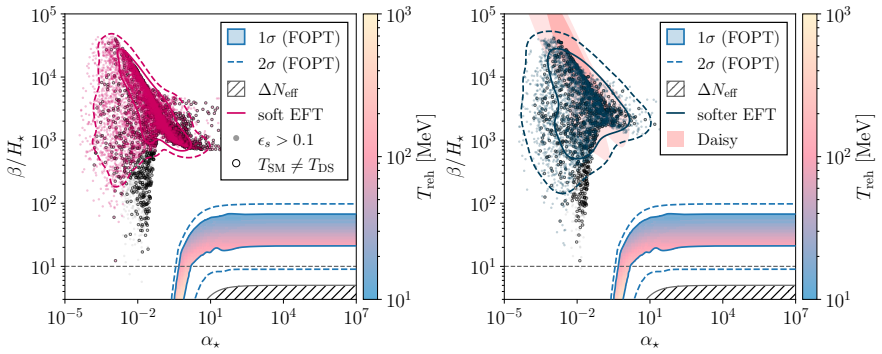
Using dimensionally reduced high-temperature effective field theory in a dark Abelian Higgs sector, the parameter region favored by current PTA observations lies close to the boundary of validity of the effective field theory, where higher-dimensional operators become increasingly important. Even within this controlled region, the predicted signal remains disfavored by the PTA data, despite the substantial shifts induced by higher-order thermal corrections.
What carries the argument
Dimensionally reduced high-temperature effective field theory for the dark Abelian Higgs sector, incorporating thermal resummation, higher-order matching corrections, and higher-dimensional operators.
Load-bearing premise
The dark Abelian Higgs sector is an appropriate minimal model for PTA-relevant phase transitions and the dimensionally reduced EFT accurately describes the thermodynamics without significant non-perturbative effects.
What would settle it
A future PTA data release that either detects a stochastic gravitational wave background spectrum matching the amplitude and shape predicted inside the controlled EFT region or that tightens constraints to fully exclude that region would test the disfavor conclusion.
Figures



read the original abstract
Motivated by the recent evidence for a stochastic gravitational-wave (GW) background reported by pulsar timing array (PTA) collaborations, we perform a precision study of low-scale phase transitions in a dark Abelian Higgs sector, a minimal gauge theory of spontaneous symmetry breaking relevant for cosmological phase transitions. Using dimensionally reduced high-temperature effective field theory, we quantify the impact of thermal resummation, higher-order matching corrections, and higher-dimensional operators on the phase-transition thermodynamics and the resulting GW signal. We find that the parameter region favored by current PTA observations lies close to the boundary of validity of the effective field theory, where higher-dimensional operators become increasingly important. Even within this controlled region, the predicted signal remains disfavored by the PTA data, despite the substantial shifts induced by higher-order thermal corrections. We further delineate parameter regions where the dark and visible sectors are thermally and hydrodynamically coupled or decoupled, and revisit the dark matter phenomenology, identifying asymmetric freeze-out as naturally compatible with both the observed relic abundance and the gauge couplings favored by strong phase transitions. Our results underscore the importance of systematically controlled finite-temperature calculations for reliable GW predictions from low-scale cosmological phase transitions.
Editorial analysis
A structured set of objections, weighed in public.
Referee Report
Summary. The manuscript performs a precision analysis of low-scale cosmological phase transitions in a minimal dark Abelian Higgs model using dimensionally reduced high-temperature effective field theory. It quantifies the effects of thermal resummation, higher-order matching corrections, and higher-dimensional operators on the phase-transition thermodynamics and resulting gravitational-wave (GW) spectrum. The central claim is that the parameter region favored by current PTA observations lies near the boundary of EFT validity, where higher-dimensional operators become important, and that even within the controlled region the predicted GW signal remains disfavored by PTA data despite substantial shifts from the corrections. The work also maps regions of thermal/hydrodynamic coupling between dark and visible sectors and revisits dark-matter phenomenology, identifying asymmetric freeze-out as compatible with the relic abundance and strong phase-transition couplings.
Significance. If the quantitative conclusions hold, the paper provides a useful cautionary benchmark for the PTA-era literature by demonstrating that controlled EFT calculations can shift predictions substantially yet still leave simple dark-sector models in tension with the data. The explicit delineation of EFT validity boundaries and the discussion of sector coupling are constructive contributions that future studies of low-scale transitions can build upon.
major comments (2)
- [Abstract and §4] Abstract and §4 (results on PTA comparison): the statement that the predicted signal 'remains disfavored by the PTA data' is load-bearing for the central claim, yet the abstract supplies no quantitative measure (e.g., tension in sigma, Bayes factor, or overlap with the 95 % PTA contour). The main text must make this comparison explicit, ideally with a table or figure that reports the predicted peak frequency and amplitude for the PTA-favored benchmark points both before and after the higher-order corrections.
- [§3] §3 (EFT validity analysis): the assertion that the PTA-favored region lies 'close to the boundary of validity' is central, but the precise numerical criterion used to delineate the 'controlled region' (e.g., the size of the higher-dimensional operator contribution relative to the leading terms, or the value of the expansion parameter) is not stated. Without this definition it is difficult to judge whether the quoted region truly remains under perturbative control once the operators are included.
minor comments (2)
- [§2] Notation for the dimensionally reduced parameters (e.g., the 3D gauge coupling and scalar mass parameters) should be introduced once with a clear mapping to the 4D Lagrangian parameters; repeated redefinitions across sections make the matching formulas harder to follow.
- [Figures 3-5] Figure captions for the GW spectra should explicitly state the values of the higher-dimensional operator coefficients used in each curve so that readers can reproduce the size of the reported shifts.
Simulated Author's Rebuttal
We thank the referee for their careful reading of the manuscript and for the constructive comments. We address each major point below and have revised the text to incorporate the requested clarifications and quantitative details.
read point-by-point responses
-
Referee: [Abstract and §4] Abstract and §4 (results on PTA comparison): the statement that the predicted signal 'remains disfavored by the PTA data' is load-bearing for the central claim, yet the abstract supplies no quantitative measure (e.g., tension in sigma, Bayes factor, or overlap with the 95 % PTA contour). The main text must make this comparison explicit, ideally with a table or figure that reports the predicted peak frequency and amplitude for the PTA-favored benchmark points both before and after the higher-order corrections.
Authors: We agree that an explicit quantitative comparison strengthens the central claim. In the revised manuscript we have added a table in §4 that lists the predicted peak frequency and amplitude for the PTA-favored benchmark points both before and after the higher-order corrections. The table also reports the fractional overlap of each prediction with the 95 % PTA contour, confirming that the signals remain outside the favored region even after the corrections are included. revision: yes
-
Referee: [§3] §3 (EFT validity analysis): the assertion that the PTA-favored region lies 'close to the boundary of validity' is central, but the precise numerical criterion used to delineate the 'controlled region' (e.g., the size of the higher-dimensional operator contribution relative to the leading terms, or the value of the expansion parameter) is not stated. Without this definition it is difficult to judge whether the quoted region truly remains under perturbative control once the operators are included.
Authors: We accept that the numerical criterion should have been stated explicitly. The revised §3 now defines the controlled region as the parameter space in which the relative contribution of higher-dimensional operators to the effective potential remains below 15 % (equivalently, where the relevant expansion parameter is smaller than 0.3). This definition is used to delineate the boundary and to locate the PTA-favored points relative to it. revision: yes
Circularity Check
No significant circularity
full rationale
The paper applies standard dimensional reduction to a 3D EFT for the dark Abelian Higgs model, incorporating thermal resummation, higher-order matching, and higher-dimensional operators via explicit perturbative calculations. The central claim—that PTA-favored parameters lie near the EFT validity boundary and that the GW signal remains disfavored even after corrections—is derived from these computations rather than from any fitted input renamed as a prediction, self-definitional loop, or load-bearing self-citation. No ansatz is smuggled via prior work, no uniqueness theorem is invoked to force the result, and the model choice is presented as a minimal benchmark without reduction to its own outputs. The derivation chain remains self-contained against external benchmarks.
Axiom & Free-Parameter Ledger
axioms (1)
- domain assumption Applicability of dimensionally reduced high-temperature EFT to the dark Abelian Higgs model for phase transition calculations
Reference graph
Works this paper leans on
-
[1]
Neutrino masses and mixings and...
A. Strumia and F. Vissani,Neutrino masses and mixings and...[hep-ph/0606054]
work page internal anchor Pith review Pith/arXiv arXiv
-
[2]
Y. Cai, J. Herrero-Garc´ ıa, M. A. Schmidt, A. Vicente, and R. R. Volkas,From the trees to the forest: a review of radiative neutrino mass models,Front. in Phys.5(2017) 63 [1706.08524]
work page internal anchor Pith review Pith/arXiv arXiv 2017
-
[3]
Sajjad Atharet al.,Status and perspectives of neutrino physics,Prog
M. Sajjad Atharet al.,Status and perspectives of neutrino physics,Prog. Part. Nucl. Phys.124 (2022) 103947 [2111.07586]. 62
-
[4]
V. C. Rubin, N. Thonnard, and W. K. Ford, Jr.,Rotational properties of 21 SC galaxies with a large range of luminosities and radii, from NGC 4605 /R = 4kpc/ to UGC 2885 /R = 122 kpc/,Astrophys. J.238(1980) 471
1980
-
[5]
Planck 2018 results. VI. Cosmological parameters
A. Bosma,21-cm line studies of spiral galaxies. 2. The distribution and kinematics of neutral hydrogen in spiral galaxies of various morphological types.,Astron. J.86(1981) 1825. [6]PlanckCollaboration, N. Aghanimet al.,Planck 2018 results. VI. Cosmological parameters, Astron. Astrophys.641(2020) A6 [1807.06209]
work page internal anchor Pith review Pith/arXiv arXiv 1981
-
[6]
G. Bertone and D. Hooper,History of dark matter,Rev. Mod. Phys.90(2018) 045002 [1605.04909]. [8]WMAPCollaboration, C. L. Bennettet al.,Nine-Year Wilkinson Microwave Anisotropy Probe (WMAP) Observations: Final Maps and Results,Astrophys. J. Suppl.208(2013) 20 [1212.5225]
work page internal anchor Pith review Pith/arXiv arXiv 2018
-
[7]
The Waning of the WIMP? A Review of Models, Searches, and Constraints
G. Arcadi, M. Dutra, P. Ghosh,et al.,The waning of the WIMP? A review of models, searches, and constraints,Eur. Phys. J. C78(2018) 203 [1703.07364]
work page internal anchor Pith review Pith/arXiv arXiv 2018
-
[8]
C. Caprini, M. Hindmarsh, S. Huber,et al.,Science with the space-based interferometer eLISA. II: Gravitational waves from cosmological phase transitions,JCAP04(2016) 001 [1512.06239]. [11]LISACollaboration, P. Amaro-Seoaneet al.,Laser Interferometer Space Antenna, [1702.00786]
work page internal anchor Pith review Pith/arXiv arXiv 2016
-
[9]
W.-H. Ruan, Z.-K. Guo, R.-G. Cai, and Y.-Z. Zhang,Taiji program: Gravitational-wave sources, Int. J. Mod. Phys. A35(2020) 2050075 [1807.09495]
- [10]
- [11]
-
[12]
M. J. Ramsey-Musolf, T. V. I. Tenkanen, and V. Q. Tran,Refining Gravitational Wave and Collider Physics Dialogue via Singlet Scalar Extension,[2409.17554]. [16]NANOGravCollaboration, Z. Arzoumanianet al.,The NANOGrav 12.5 yr Data Set: Search for an Isotropic Stochastic Gravitational-wave Background,Astrophys. J. Lett.905(2020) L34 [2009.04496]. [17]NANOGr...
-
[13]
B. Goncharovet al.,On the Evidence for a Common-spectrum Process in the Search for the Nanohertz Gravitational-wave Background with the Parkes Pulsar Timing Array,Astrophys. J. Lett.917(2021) L19 [2107.12112]
-
[14]
D. J. Reardonet al.,Search for an Isotropic Gravitational-wave Background with the Parkes Pulsar Timing Array,Astrophys. J. Lett.951(2023) L6 [2306.16215]
work page internal anchor Pith review Pith/arXiv arXiv 2023
-
[15]
H. Xuet al.,Searching for the Nano-Hertz Stochastic Gravitational Wave Background with the Chinese Pulsar Timing Array Data Release I,Res. Astron. Astrophys.23(2023) 075024 [2306.16216]
work page internal anchor Pith review Pith/arXiv arXiv 2023
- [16]
-
[17]
R. w. Hellings and G. s. Downs,UPPER LIMITS ON THE ISOTROPIC GRAVITATIONAL RADIATION BACKGROUND FROM PULSAR TIMING ANALYSIS,Astrophys. J. Lett.265 (1983) L39
1983
-
[18]
H. Middleton, A. Sesana, S. Chen, A. Vecchio, W. Del Pozzo, and P. A. Rosado,Retracted: Correction to: Massive black hole binary systems and the NANOGrav 12.5 yr results,Mon. Not. Roy. Astron. Soc.502(2021) L99 [2011.01246]
-
[19]
D. Izquierdo-Villalba, A. Sesana, S. Bonoli, and M. Colpi,Massive black hole evolution models confronting the n-Hz amplitude of the stochastic gravitational wave background,Mon. Not. Roy. Astron. Soc.509(2021) 3488 [2108.11671]
-
[20]
M. Cury lo and T. Bulik,Predictions for LISA and PTA based on SHARK galaxy simulations, Astron. Astrophys.660(2022) A68 [2108.11232]
-
[21]
M. Milosavljevic and D. Merritt,The Final parsec problem,AIP Conf. Proc.686(2003) 201 [astro-ph/0212270]. [30]NANOGravCollaboration, A. Afzalet al.,The NANOGrav 15-year Data Set: Search for Signals from New Physics,[2306.16219]
work page internal anchor Pith review Pith/arXiv arXiv 2003
-
[22]
W. Buchmuller, V. Domcke, and K. Schmitz,From NANOGrav to LIGO with metastable cosmic strings,Phys. Lett. B811(2020) 135914 [2009.10649]
- [23]
-
[24]
Dynamical generation of the weak and Dark Matter scale
T. Hambye and A. Strumia,Dynamical generation of the weak and Dark Matter scale,Phys. Rev. D88(2013) 055022 [1306.2329]
work page internal anchor Pith review Pith/arXiv arXiv 2013
-
[25]
C. D. Carone and R. Ramos,Classical scale-invariance, the electroweak scale and vector dark matter,Phys. Rev. D88(2013) 055020 [1307.8428]. 64
work page internal anchor Pith review Pith/arXiv arXiv 2013
-
[26]
M. Kierkla, A. Karam, and B. Swiezewska,Conformal model for gravitational waves and dark matter: a status update,JHEP03(2023) 007 [2210.07075]
-
[27]
M. Kierkla, B. Swiezewska, T. V. I. Tenkanen, and J. van de Vis,Gravitational waves from supercooled phase transitions: dimensional transmutation meets dimensional reduction,JHEP 02(2024) 234 [2312.12413]
-
[28]
M. Kierkla, P. Schicho, B. Swiezewska, T. V. I. Tenkanen, and J. van de Vis,Finite-temperature bubble nucleation with shifting scale hierarchies,JHEP07(2025) 153 [2503.13597]
-
[29]
Thermodynamical uncertainties for primordial black holes from cosmological phase transitions
M. Kierkla, N. Ramberg, P. Schicho, and D. Schmitt,Thermodynamical uncertainties for primordial black holes from cosmological phase transitions,Phys. Rev. D113(2026) 095024 [2506.15496]
work page internal anchor Pith review Pith/arXiv arXiv 2026
- [30]
- [31]
-
[32]
J. Gon¸ calves, D. Marfatia, A. P. Morais, and R. Pasechnik,Supercooled phase transitions in conformal dark sectors explain NANOGrav data,Phys. Lett. B869(2025) 139829 [2501.11619]
-
[33]
M. Christiansen, E. Madge, C. Puchades-Ib´ a˜ nez, M. E. Ramirez-Quezada, and P. Schwaller, Beyond the daisy chain: running and the 3D EFT view of supercooled phase transitions,JHEP 05(2026) 014 [2511.02910]
-
[34]
G. C. Dorsch, S. J. Huber, and J. M. No,A strong electroweak phase transition in the 2HDM after LHC8,JHEP10(2013) 029 [1305.6610]
work page internal anchor Pith review Pith/arXiv arXiv 2013
-
[35]
K. Hashino, M. Kakizaki, S. Kanemura, P. Ko, and T. Matsui,Gravitational waves and Higgs boson couplings for exploring first order phase transition in the model with a singlet scalar field, Phys. Lett. B766(2017) 49 [1609.00297]
work page internal anchor Pith review Pith/arXiv arXiv 2017
-
[36]
N. Benincasa, A. Hryczuk, K. Kannike, and M. Laletin,Phase transitions and gravitational waves in a model ofZ 3 scalar dark matter,JHEP02(2024) 207 [2312.04627]
-
[37]
K. Kajantie, M. Karjalainen, M. Laine, and J. Peisa,Three-dimensional U(1) gauge + Higgs theory as an effective theory for finite temperature phase transitions,Nucl. Phys. B520(1998) 345 [hep-lat/9711048]
work page internal anchor Pith review Pith/arXiv arXiv 1998
- [38]
-
[39]
Revisiting Big-Bang Nucleosynthesis Constraints on Long-Lived Decaying Particles
M. Kawasaki, K. Kohri, T. Moroi, and Y. Takaesu,Revisiting Big-Bang Nucleosynthesis Con- straints on Long-Lived Decaying Particles,Phys. Rev. D97(2018) 023502 [1709.01211]
work page internal anchor Pith review Pith/arXiv arXiv 2018
-
[40]
T. Bringmann, P. F. Depta, T. Konstandin, K. Schmidt-Hoberg, and C. Tasillo,Does NANOGrav observe a dark sector phase transition?,JCAP11(2023) 053 [2306.09411]. 65
-
[41]
A. Addazi, Y.-F. Cai, A. Marciano, and L. Visinelli,Have pulsar timing array methods detected a cosmological phase transition?,Phys. Rev. D109(2024) 015028 [2306.17205]
- [42]
- [43]
-
[44]
Tuning the violins: dark sector phase transition mod- els for the PTA signal (Feb
T. Bringmann, T. Konstandin, J. Matuszak, K. Schmidt-Hoberg, and C. Tasillo,Tuning the violins: dark sector phase transition models for the PTA signal,[2602.09092]
- [45]
-
[46]
P. Di Bari and M. H. Rahat,Split Majoron model confronts the NANOGrav signal and cosmo- logical tensions,Phys. Rev. D110(2024) 055019 [2307.03184]
- [47]
-
[48]
W.-Z. Feng and Z.-H. Zhang,Gauge-independent gravitational waves from a minimal darkU(1) sector with viable dark matter candidates,[2602.14866]
- [49]
-
[50]
Ginsparg,First and second order phase transitions in gauge theories at finite temperature, Nucl
P. Ginsparg,First and second order phase transitions in gauge theories at finite temperature, Nucl. Phys. B170(1980) 388
1980
-
[51]
Appelquist and R
T. Appelquist and R. D. Pisarski,High-temperature Yang-Mills theories and three-dimensional quantum chromodynamics,Phys. Rev. D23(1981) 2305
1981
-
[52]
3D Physics and the Electroweak Phase Transition: Perturbation Theory
K. Farakos, K. Kajantie, K. Rummukainen, and M. E. Shaposhnikov,3-D physics and the elec- troweak phase transition: Perturbation theory,Nucl. Phys. B425(1994) 67 [hep-ph/9404201]
work page internal anchor Pith review Pith/arXiv arXiv 1994
-
[53]
Generic Rules for High Temperature Dimensional Reduction and Their Application to the Standard Model
K. Kajantie, M. Laine, K. Rummukainen, and M. E. Shaposhnikov,Generic rules for high temperature dimensional reduction and their application to the standard model,Nucl. Phys. B 458(1996) 90 [hep-ph/9508379]
work page internal anchor Pith review Pith/arXiv arXiv 1996
-
[54]
Effective Field Theory Approach to High-Temperature Thermodynamics
E. Braaten and A. Nieto,Effective field theory approach to high temperature thermodynamics, Phys. Rev. D51(1995) 6990 [hep-ph/9501375]
work page internal anchor Pith review Pith/arXiv arXiv 1995
-
[55]
Is There a Hot Electroweak Phase Transition at $m_H\gsim m_W$?
K. Kajantie, M. Laine, K. Rummukainen, and M. E. Shaposhnikov,Is there a hot electroweak phase transition atm H ≳m W ?,Phys. Rev. Lett.77(1996) 2887 [hep-ph/9605288]
work page internal anchor Pith review Pith/arXiv arXiv 1996
-
[56]
O. Gould and J. Hirvonen,Effective field theory approach to thermal bubble nucleation,Phys. Rev. D104(2021) 096015 [2108.04377]. 66
-
[57]
J. L¨ ofgren, M. J. Ramsey-Musolf, P. Schicho, and T. V. I. Tenkanen,Nucleation at Finite Temperature: A Gauge-Invariant Perturbative Framework,Phys. Rev. Lett.130(2023) 251801 [2112.05472]
-
[58]
J. Hirvonen, J. L¨ ofgren, M. J. Ramsey-Musolf, P. Schicho, and T. V. I. Tenkanen,Computing the gauge-invariant bubble nucleation rate in finite temperature effective field theory,JHEP07 (2022) 135 [2112.08912]
-
[59]
O. Gould and T. V. I. Tenkanen,On the perturbative expansion at high temperature and impli- cations for cosmological phase transitions,JHEP06(2021) 069 [2104.04399]
-
[60]
E. J. Weinberg,Vacuum decay in theories with symmetry breaking by radiative corrections,Phys. Rev. D47(1993) 4614 [hep-ph/9211314]
work page internal anchor Pith review Pith/arXiv arXiv 1993
-
[61]
Gauge independence of the bubble nucleation rate in theories with radiative symmetry breaking
D. Metaxas and E. J. Weinberg,Gauge independence of the bubble nucleation rate in theories with radiative symmetry breaking,Phys. Rev. D53(1996) 836 [hep-ph/9507381]
work page internal anchor Pith review Pith/arXiv arXiv 1996
-
[62]
On the gauge dependence of vacuum transitions at finite temperature
M. Garny and T. Konstandin,On the gauge dependence of vacuum transitions at finite temper- ature,JHEP07(2012) 189 [1205.3392]
work page internal anchor Pith review Pith/arXiv arXiv 2012
-
[63]
A. Ekstedt, P. Schicho, and T. V. I. Tenkanen,Cosmological phase transitions at three loops: The final verdict on perturbation theory,Phys. Rev. D110(2024) 096006 [2405.18349]
-
[64]
Higher-dimensional operators at finite-temperature affect gravitational-wave predictions
F. Bernardo, P. Klose, P. Schicho, and T. V. I. Tenkanen,Higher-dimensional operators at finite temperature affect gravitational-wave predictions,JHEP08(2025) 109 [2503.18904]
work page internal anchor Pith review Pith/arXiv arXiv 2025
-
[65]
Model Discrimination in Gravitational Wave spectra from Dark Phase Transitions
D. Croon, V. Sanz, and G. White,Model Discrimination in Gravitational Wave spectra from Dark Phase Transitions,JHEP08(2018) 203 [1806.02332]
work page internal anchor Pith review Pith/arXiv arXiv 2018
-
[66]
Higgs-field Portal into Hidden Sectors
B. Patt and F. Wilczek,Higgs-field portal into hidden sectors,[hep-ph/0605188]
work page internal anchor Pith review Pith/arXiv arXiv
-
[67]
M. Pospelov, A. Ritz, and M. B. Voloshin,Secluded WIMP Dark Matter,Phys. Lett. B662 (2008) 53 [0711.4866]
work page internal anchor Pith review Pith/arXiv arXiv 2008
-
[68]
Heavy Dark Matter Through the Higgs Portal
J. March-Russell, S. M. West, D. Cumberbatch, and D. Hooper,Heavy Dark Matter Through the Higgs Portal,JHEP07(2008) 058 [0801.3440]
work page internal anchor Pith review Pith/arXiv arXiv 2008
-
[69]
Galison and A
P. Galison and A. Manohar,TWO Z’s OR NOT TWO Z’s?,Phys. Lett. B136(1984) 279
1984
-
[70]
Holdom,Two U(1)’s and Epsilon Charge Shifts,Phys
B. Holdom,Two U(1)’s and Epsilon Charge Shifts,Phys. Lett. B166(1986) 196
1986
- [71]
-
[72]
M. Escudero Abenza,Precision early universe thermodynamics made simple:N effand neutrino decoupling in the Standard Model and beyond,JCAP05(2020) 048 [2001.04466]
-
[73]
D. J. Fixsen, E. S. Cheng, J. M. Gales, J. C. Mather, R. A. Shafer, and E. L. Wright,The Cosmic Microwave Background spectrum from the full COBE FIRAS data set,Astrophys. J. 473(1996) 576 [astro-ph/9605054]
work page internal anchor Pith review Pith/arXiv arXiv 1996
-
[74]
The evolution of CMB spectral distortions in the early Universe
J. Chluba and R. A. Sunyaev,The evolution of CMB spectral distortions in the early Universe, Mon. Not. Roy. Astron. Soc.419(2012) 1294 [1109.6552]. 67
work page internal anchor Pith review Pith/arXiv arXiv 2012
-
[75]
Particle decays during the cosmic dark ages
X.-L. Chen and M. Kamionkowski,Particle decays during the cosmic dark ages,Phys. Rev. D 70(2004) 043502 [astro-ph/0310473]. [85]PlanckCollaboration, N. Aghanimet al.,Planck 2018 results. I. Overview and the cosmological legacy of Planck,Astron. Astrophys.641(2020) A1 [1807.06205]
work page internal anchor Pith review Pith/arXiv arXiv 2004
-
[76]
J. L. Feng and J. Kumar,The WIMPless Miracle: Dark-Matter Particles without Weak-Scale Masses or Weak Interactions,Phys. Rev. Lett.101(2008) 231301 [0803.4196]
work page internal anchor Pith review Pith/arXiv arXiv 2008
-
[77]
J. L. Feng, H. Tu, and H.-B. Yu,Thermal Relics in Hidden Sectors,JCAP10(2008) 043 [0808.2318]
work page internal anchor Pith review Pith/arXiv arXiv 2008
-
[78]
N. Arkani-Hamed, D. P. Finkbeiner, T. R. Slatyer, and N. Weiner,A Theory of Dark Matter, Phys. Rev. D79(2009) 015014 [0810.0713]
work page internal anchor Pith review Pith/arXiv arXiv 2009
-
[79]
N. F. Bell, Y. Cai, and R. K. Leane,Dark Forces in the Sky: Signals from Z’ and the Dark Higgs,JCAP08(2016) 001 [1605.09382]
work page internal anchor Pith review Pith/arXiv arXiv 2016
-
[80]
How to save the WIMP: global analysis of a dark matter model with two s-channel mediators
M. Duerr, F. Kahlhoefer, K. Schmidt-Hoberg, T. Schwetz, and S. Vogl,How to save the WIMP: global analysis of a dark matter model with two s-channel mediators,JHEP09(2016) 042 [1606.07609]
work page internal anchor Pith review Pith/arXiv arXiv 2016
discussion (0)
Sign in with ORCID, Apple, or X to comment. Anyone can read and Pith papers without signing in.