Seeing the Scene Matters: Revealing Forgetting in Video Understanding Models with a Scene-Aware Long-Video Benchmark
Pith reviewed 2026-05-14 22:02 UTC · model grok-4.3
The pith
Vision-language models forget long-range scene context in videos, shown by a new benchmark with sharp accuracy drops.
A machine-rendered reading of the paper's core claim, the machinery that carries it, and where it could break.
Core claim
Current VLMs exhibit significant forgetting of long-range context when answering scene-level questions on long videos, as measured by the new SceneBench benchmark; this forgetting is partially mitigated by Scene-RAG, which retrieves and integrates relevant scene context to improve accuracy by 2.50 percent.
What carries the argument
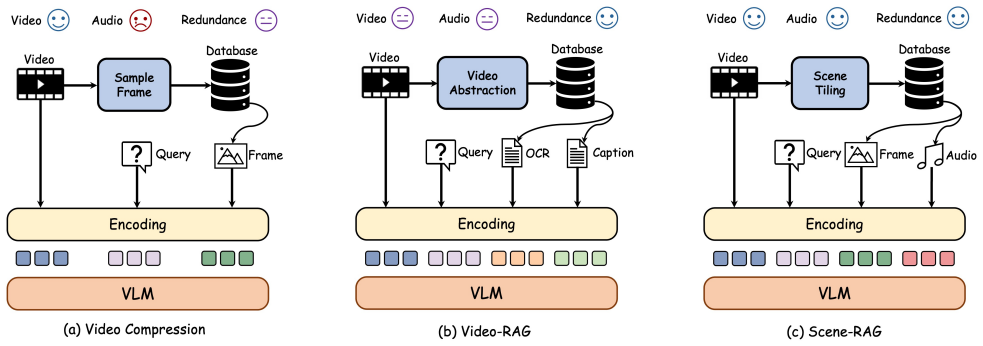
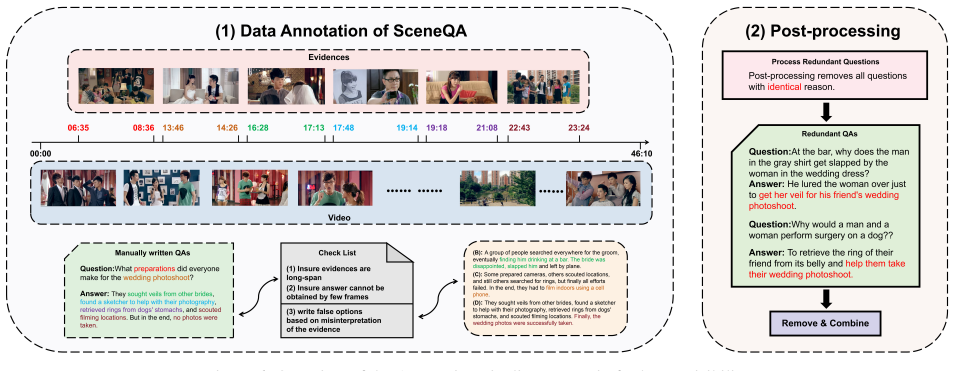
SceneBench, a benchmark of scene-level questions on long videos where each scene is a coherent segment with stable visual and semantic context, together with Scene-RAG, a retrieval-augmented method that maintains a dynamic memory of prior scenes.
If this is right
- VLMs need stronger internal mechanisms for retaining information across scene boundaries in long videos.
- Existing fine-grained or summarization benchmarks miss the specific failure mode of scene-level forgetting.
- Retrieval-based memory augmentation can serve as an immediate practical improvement for long-video tasks.
- Future model designs should incorporate explicit scene segmentation to reduce context loss.
Where Pith is reading between the lines
- Architectures that maintain an explicit scene-indexed memory might reduce forgetting more reliably than post-hoc retrieval.
- The same pattern of progressive context loss could appear in long-document or multi-image reasoning tasks.
- Systematic comparison of Scene-RAG across different base VLMs would identify which model components lose scene information fastest.
Load-bearing premise
That the chosen scene definition and question set isolate long-range forgetting without other confounds from video selection or question design.
What would settle it
Run the same scene-level questions on the same videos but supply explicit scene boundaries and short summaries to the model; if accuracy does not rise substantially, the forgetting diagnosis would be weakened.
Figures



read the original abstract
Long video understanding (LVU) remains a core challenge in multimodal learning. Although recent vision-language models (VLMs) have made notable progress, existing benchmarks mainly focus on either fine-grained perception or coarse summarization, offering limited insight into temporal understanding over long contexts. In this work, we define a scene as a coherent segment of a video in which both visual and semantic contexts remain consistent, aligning with human perception. This leads us to a key question: can current VLMs reason effectively over long, scene-level contexts? To answer this, we introduce a new benchmark, SceneBench, designed to provide scene-level challenges. Our evaluation reveals a sharp drop in accuracy when VLMs attempt to answer scene-level questions, indicating significant forgetting of long-range context. To further validate these findings, we propose Scene Retrieval-Augmented Generation (Scene-RAG), which constructs a dynamic scene memory by retrieving and integrating relevant context across scenes. This Scene-RAG improves VLM performance by +2.50%, confirming that current models still struggle with long-context retention. We hope SceneBench will encourage future research toward VLMs with more robust, human-like video comprehension.
Editorial analysis
A structured set of objections, weighed in public.
Referee Report
Summary. The paper claims that vision-language models (VLMs) exhibit significant forgetting of long-range context when reasoning over long videos. It defines a 'scene' as a coherent video segment with consistent visual and semantic context, introduces the SceneBench benchmark to test scene-level understanding, reports a sharp accuracy drop on scene-level questions as evidence of forgetting, and proposes Scene-RAG (a retrieval-augmented generation approach using dynamic scene memory) that yields a +2.5% performance gain.
Significance. If the benchmark construction and controls are shown to isolate long-range forgetting without confounds from question difficulty or segmentation artifacts, the work would usefully highlight a limitation in current VLMs and motivate retrieval-based methods for long-video tasks. The introduction of SceneBench and the modest but positive Scene-RAG result provide a concrete starting point for future LVU research, though the small gain and missing validation details reduce the strength of the forgetting interpretation.
major comments (3)
- [§3] §3 (Benchmark Construction): The scene segmentation procedure is described only at a high level (coherent segments with consistent visual/semantic context) without specifying the feature extractor, similarity metric, threshold, or human validation protocol. This detail is load-bearing for the central claim, as the accuracy drop could arise from inconsistent boundaries or segmentation artifacts rather than isolated long-range forgetting.
- [§4.1] §4.1 (Evaluation Results): The reported accuracy drops on scene-level questions lack statistical significance tests, error bars, or controls that match local vs. cross-scene question difficulty and complexity. Without these, it remains unclear whether the drop specifically indicates forgetting or reflects general VLM weaknesses on multi-event reasoning.
- [§5] §5 (Scene-RAG): The +2.5% improvement is presented without ablations on retrieval components, comparisons to simpler baselines (e.g., extended context windows), or analysis of which scene boundaries benefit most. This weakens the validation that the gain confirms long-context retention issues rather than generic retrieval benefits.
minor comments (2)
- [Abstract] Abstract: The phrase 'sharp drop in accuracy' is used without any quantitative values or comparison to prior benchmarks, reducing immediate informativeness.
- [§2] Notation: The definition of 'scene' is repeated across sections without a formal mathematical characterization (e.g., no explicit consistency metric), which could be clarified for reproducibility.
Simulated Author's Rebuttal
We thank the referee for the constructive and detailed feedback. We have addressed each major comment below with point-by-point responses. Where the concerns are valid, we have revised the manuscript accordingly to improve clarity, rigor, and reproducibility while preserving the core contributions of SceneBench and the forgetting analysis.
read point-by-point responses
-
Referee: [§3] §3 (Benchmark Construction): The scene segmentation procedure is described only at a high level (coherent segments with consistent visual and semantic context) without specifying the feature extractor, similarity metric, threshold, or human validation protocol. This detail is load-bearing for the central claim, as the accuracy drop could arise from inconsistent boundaries or segmentation artifacts rather than isolated long-range forgetting.
Authors: We agree that additional implementation details are necessary for reproducibility and to strengthen the isolation of long-range forgetting. In the revised manuscript, we will expand §3 to specify the feature extractor (CLIP ViT-B/32 embeddings), the similarity metric (cosine similarity), the boundary detection threshold (0.75), and the human validation protocol (three independent annotators reviewing 200 segments with reported inter-annotator agreement of 82% Cohen's kappa). These additions will directly address potential segmentation artifacts. revision: yes
-
Referee: [§4.1] §4.1 (Evaluation Results): The reported accuracy drops on scene-level questions lack statistical significance tests, error bars, or controls that match local vs. cross-scene question difficulty and complexity. Without these, it remains unclear whether the drop specifically indicates forgetting or reflects general VLM weaknesses on multi-event reasoning.
Authors: We acknowledge the importance of statistical controls. The revised version will include error bars (standard deviation across five random seeds), paired t-tests demonstrating significance of the scene-level accuracy drop (p < 0.01), and difficulty-matched controls where local and scene-level questions were rated for complexity by human annotators to ensure comparable reasoning demands. This will better isolate the forgetting effect from general multi-event weaknesses. revision: yes
-
Referee: [§5] §5 (Scene-RAG): The +2.5% improvement is presented without ablations on retrieval components, comparisons to simpler baselines (e.g., extended context windows), or analysis of which scene boundaries benefit most. This weakens the validation that the gain confirms long-context retention issues rather than generic retrieval benefits.
Authors: We agree that further validation would strengthen the interpretation. In revision, we will add ablations on Scene-RAG components (e.g., retrieval vs. memory integration), direct comparisons to extended-context baselines where model limits permit, and a breakdown of gains by number of scene boundaries crossed. While the gain is modest, the scene-specific design differentiates it from generic retrieval; we will clarify this distinction without overstating the result. revision: partial
Circularity Check
No circularity: empirical benchmark evaluation with independent definitions and results
full rationale
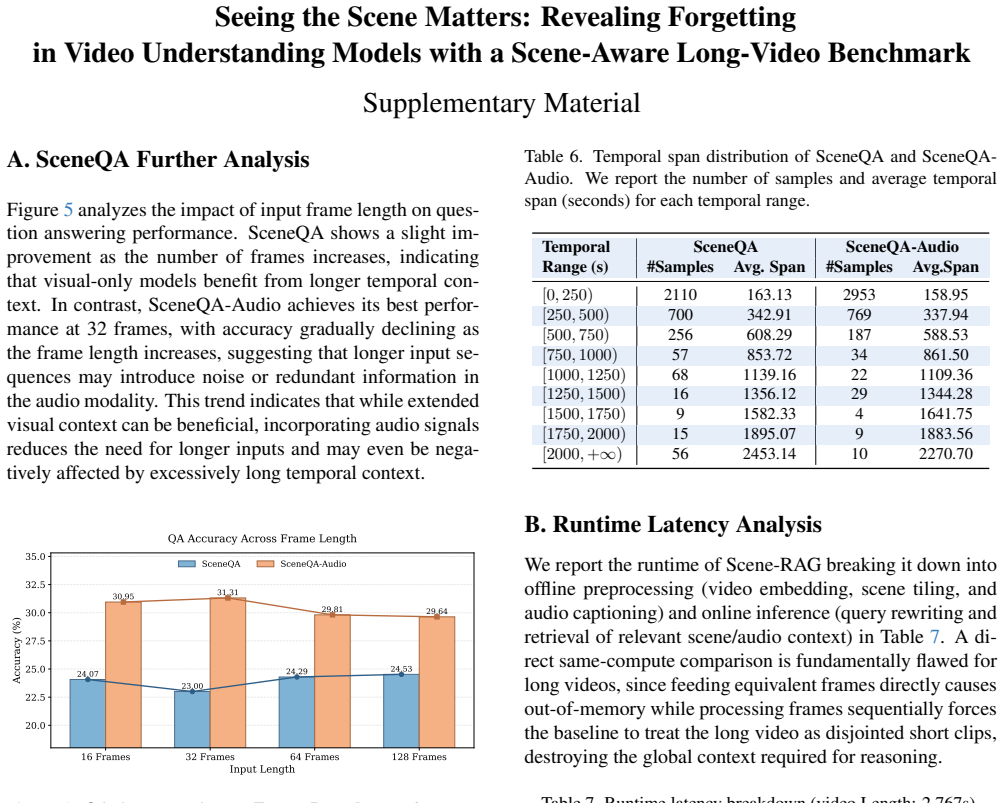
The paper defines scenes as coherent video segments with consistent visual/semantic context, introduces SceneBench for scene-level questions, reports accuracy drops on existing VLMs, and shows +2.5% gain from the proposed Scene-RAG method. No equations, fitted parameters, or derivations are present. The central claims rest on new empirical measurements rather than any self-referential reduction, self-citation chain, or renaming of prior results. The evaluation is self-contained against external model benchmarks.
Axiom & Free-Parameter Ledger
axioms (1)
- domain assumption A scene is a coherent segment of a video in which both visual and semantic contexts remain consistent, aligning with human perception.
invented entities (2)
-
SceneBench
no independent evidence
-
Scene-RAG
no independent evidence
discussion (0)
Sign in with ORCID, Apple, or X to comment. Anyone can read and Pith papers without signing in.