REVIEW 3 major objections 4 minor 97 references
Heating the dark matter halo with dark radiation from supernovae
T0 review · 3 major / 4 minor · reviewed 2026-08-12 · deepseek-v4-flash
Pith's one-line read Supernova energy carried by light dark-sector particles can flatten the cusps of dwarf-galaxy dark halos, turning observed core sizes into a bound on new-particle energy loss.
desk verdict A credible but profile-dependent new bound on supernova energy loss to dark radiation; the qualitative mechanism holds, the quantitative headline does not. read the letter →
The pith
A machine-rendered reading of the paper's core claim, the machinery that carries it, and where it could break.
The reading
What carries the argument
The argument rests on the gravitational binding-energy comparison between two halo profiles. The cusped NFW profile, \(\rho_{\rm NFW}(r)=\rho_0 $r_s^{3}$/[r(r+r_s)^2]\), is the initial state; the cored profile \(\rho_c(r)=\tanh(r/r_c)\rho_{\rm NFW}+[1-\tanh(r/r_c)]^2 M_{\rm NFW}(r)/(4\pi $r^{2}$ r_c)\) recovers NFW at large radius and gives a finite central density. The energy cost of the transition is half the difference of the potential energies \(W=-4\pi G\$int_0^{{r_{200}}$} dr\,r\rho(r)M(r)\), by the virial theorem. Observational input comes from the virial mass and the density at 150 pc of each dSph, which sets the largest core radius compatible with data; a stellar initial mass function fixes the number of supernova progenitors, converting core size into \(\eta\). On the particle side, the carrying objects are template production rates in the supernova core (nucleon bremsstrahlung, semi-Compton scattering, neutrino coalescence), a halo column-density opacity condition \(\tau=\langle\$\sigma$ v\rangle\rho_A/m_\chi>1\), and a classification by whether the emitted particle is stable or decays promptly to dark matter.
What would settle it
If better stellar-kinematic data resolved a core in a dwarf spheroidal that is larger than the supernova budget allows—meaning the required \(\eta\) exceeds a few times \($10^{{-5}}$\) under the adopted profile and perfect absorption—then supernova dark radiation alone could not be the cusp-flattening agent; conversely, a nearby galactic supernova whose neutrino signal excludes the benchmark couplings at the required emissivity would close the proposed parameter space.
Extended reading notes
Core claim
The central claim is that the energy required to turn an NFW cusp into a cored halo is within reach of the integrated type-II supernova budget of a dwarf galaxy. For the eight classical dSphs, the paper uses the largest core radius allowed at \(2\$\sigma$\) by the density measured at 150 pc to compute \(\$\Delta$ E_{\max}\), finding values around \($10^{{51}}$\)–\($10^{{52}}$\) erg, with Fornax an outlier near \(2\$times10^{{54}}$\) erg. Dividing by the total supernova energy from a standard broken-power-law stellar initial mass function gives an upper limit on the fraction \(\eta\equiv E_{\rm new}/E_{\rm SN}\): no dwarf is consistent with an injection above a few times \($10^{{-5}}$\), and the preferred cores cluster around a few times \($10^{{-6}}$\). The energetics argument is deliberately independent of the particle model; it needs only an order-one absorption efficiency of the emitted dark radiation by the halo. The model-building part shows that the required dark-sector couplings can be realized with dark matter masses below about 10 MeV.
Load-bearing premise
The quantitative limits assume the tanh-based cored halo profile is the right description of a heated halo; with the alternative cored-NFW profile the required energy is 20–40 times larger, and the paper itself notes that significant astrophysical uncertainty remains.
Editorial extensions
If this is right
- Observed dwarf-spheroidal core radii become an upper limit on the fraction of supernova energy that can be carried off by any light beyond-Standard-Model particle, independent of the particle's identity.
- The preferred cores in the eight classical dSphs all point to a similar fractional energy release, around a few times \(10^{-6}\) of the supernova energy budget, hinting at a common mechanism.
- Energy injection above a few times \(10^{-5}\) of the supernova budget is incompatible with all eight dwarfs under the adopted cored profile, so a viable dark-radiation channel must keep \(\eta\) below that.
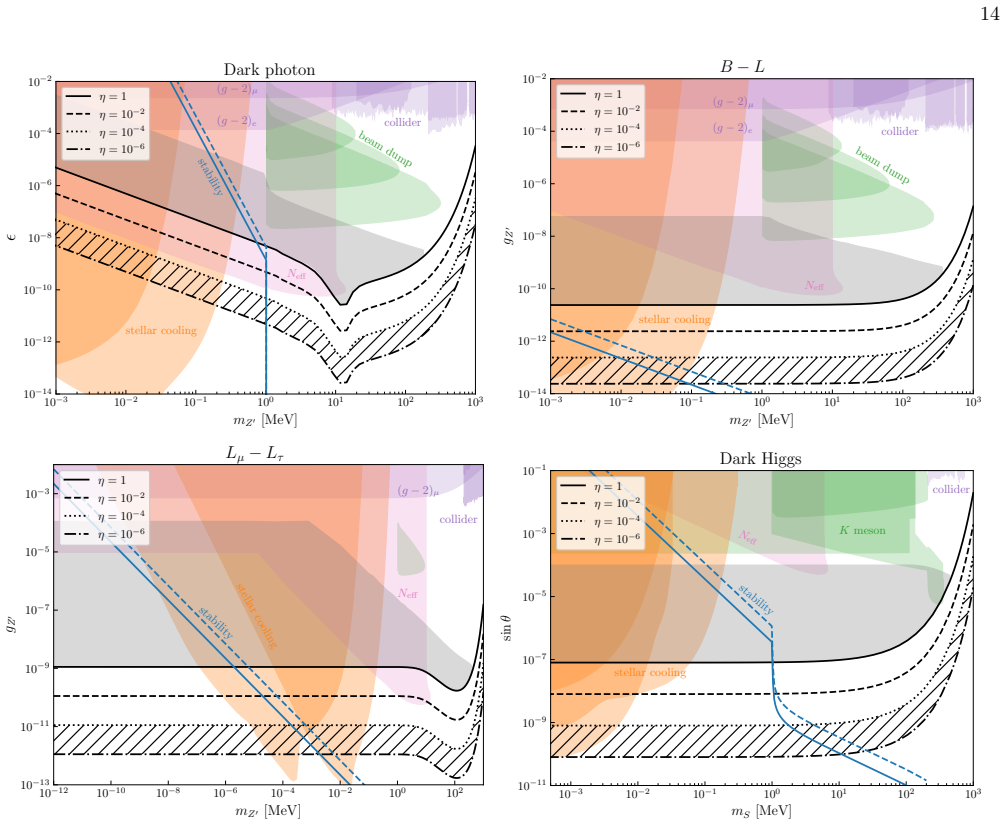
- In the dark photon, dark Higgs, \(B-L\), and \(L_\mu-L_\tau\) benchmark models, there is open parameter space where supernovae emit the required dark radiation and the halo absorbs it while the couplings still evade the SN1987A cooling bounds.
- The mechanism operates in two regimes: a stable light mediator scattering off dark matter, or a mediator decaying to dark matter particles that then scatter; both favor dark matter masses up to roughly 10 MeV with sizable dark-sector couplings.
Reading between the lines
- By the same energetics, the argument should apply to other dwarf galaxies and to the Milky Way's dark subhalos, so a larger sample could sharpen the \(\eta\) window and test whether the similar core sizes are coincidental.
- The profile choice is the main lever: settling whether the tanh-based or the alternative cored-NFW profile describes real halos would shift the derived limits by the factor of 20–40 the paper quotes and would decide whether Draco and Leo II can constrain the mechanism at all.
- The same binding-energy comparison could constrain any energy source coupled to dark matter—for instance baryonic feedback or dark-matter self-interactions—by asking which mechanisms can afford the measured core sizes.
- A future galactic supernova with detailed neutrino observations could test the required couplings directly, because the parameter space that heats halos should also leave an imprint on the neutrino cooling curve.
Editorial analysis
A structured set of objections, weighed in public.
Referee Report
Summary. The paper proposes that a small fraction of type-II supernova energy, emitted as dark radiation and absorbed by the dark-matter halo, can transform a cuspy NFW halo into a cored halo in dwarf spheroidal galaxies. It estimates the required energy as half the difference in gravitational binding energy between a cored and an NFW profile, combines this with stellar masses and an IMF-based supernova count to derive upper limits on the fractional energy release eta for eight classical dSphs, and concludes that preferred core sizes point to eta of a few times 10^-6 with no dSph allowing more than a few times 10^-5. The second half studies production and opacity of a generic Z' and four benchmark models (dark photon, B-L, L_mu-L_tau, dark Higgs), showing that parts of their parameter spaces can satisfy the production and energy-deposition requirements.
Significance. If robust, the mechanism provides a new, largely model-independent astrophysical window on light beyond-Standard-Model particles, with sensitivity in the eta range 10^-6 to 10^-5 that is much smaller than typical SN1987A cooling fractions. The paper is transparent about its main assumptions, explicitly reports the factor-of-20-40 sensitivity to the cored-profile choice, and gives a concrete set of benchmark models rather than stopping at the model-independent energy bookkeeping. The central quantitative claim, however, is not yet robust because the headline eta range is governed by the adopted cored-profile ansatz; the alternative profile quoted by the authors shifts the numbers substantially. The qualitative mechanism is plausible and worth publishing after the quantitative claims are bracketed or better justified.
major comments (3)
- [§II.A, Eq. (6)–(9)] The quantitative central claim is not robust to the choice of cored halo profile. The paper's own comparison with the alternative cored-NFW profile of Eq. (9) raises the required energy by a factor of 20-40, which shifts the preferred eta band and the individual upper limits by the same factor. Because the abstract and conclusions present eta of a few times 10^-6 to 10^-5 as the main result, the profile choice is load-bearing; the manuscript needs either a stronger argument that Eq. (6) is the correct profile family for these galaxies or a central claim phrased as an interval spanning both profile choices. The statement in §II.A that 'significant astrophysical uncertainty remains' is appropriate but currently relegated to a caveat rather than reflected in the headline numbers.
- [Table I, Fig. 2, §II.A] The strongest eta upper limits for Draco and Leo II are not data-derived. For both galaxies the 2-sigma lower limit on rho(150 pc) exceeds the NFW prediction, so the adopted core-radius upper limits of 0.095 kpc and 0.158 kpc are imposed by hand rather than obtained from a profile fit. The paper acknowledges in §II.B that the choice of r_c is 'somewhat arbitrary', but these hand-set values nevertheless enter Fig. 2 as constraints. This should be either removed from the headline limit or replaced by a propagation of the stellar-kinematic uncertainties, so the reader can see how much of the central constraint is assumption rather than measurement.
- [§III.B, Eq. (27); §III.A] The conversion from optical depth to energy deposition is treated as a step function: tau > 1 is taken to mean order-one energy transfer, with no radiation-transport or thermalization modeling. Since the benchmark-model conclusions in §IV rely on the halo being 'opaque' enough to deposit the energy that drives the cusp-core transformation, this assumption should be tested at least with a simple attenuation or energy-deposition model. The paper's caveat that modeling radiation transport is tricky is honest, but it leaves the efficiency of the proposed heating mechanism unquantified in the regime where the new physics is not fully opaque.
minor comments (4)
- [§II.A] The text says 'viral mass' in the paragraph following Eq. (3); this should be 'virial mass'.
- [§II.B, Eq. (14)] Please state explicitly the units of M_* in Eq. (14) and reconcile them with Table I, whose stellar masses are quoted in units of 10^6 solar masses.
- [§IV, Fig. 5 caption] There is a duplicated word 'we we' in Sec. IV, and the Fig. 5 caption says 'loose' where 'lose' is meant; a general proofreading pass would help.
- [Figs. 3 and 5] The string '19931126' appears as a stray label in Figs. 3 and 5; please remove it or explain its meaning in the captions.
Circularity Check
No significant circularity: the η limits are derived from observed core radii via an energy-budget comparison, and the profile dependence is an acknowledged modeling uncertainty rather than a self-referential loop.
full rationale
The central derivation is self-contained. The paper takes observed halo parameters (M200 and ρ(150pc)) from Read et al. [50], constructs an NFW profile and a cored profile, computes the gravitational binding-energy difference ΔE = (Wc − WNFW)/2, and compares it with the total supernova energy Etot estimated from stellar masses and an IMF. The resulting η constraints are therefore extracted from data rather than used to predict the same data. The cored profile of Eq. (6) is an adopted ansatz from an external simulation-motivated reference, and the paper explicitly tests the alternative cored-NFW profile of Eq. (9), reporting a factor 20–40 shift in required energy; this is a clearly stated astrophysical systematic, not a circular step. Self-citations [58] and [83] supply independent stellar-cooling and Neff constraints used only to delimit benchmark-model parameter space; they are not load-bearing for the energetic argument. No fitted parameter is renamed as a prediction, and no uniqueness claim or ansatz is imported from the authors' own prior work to force the conclusion. The quantitative central claim is conditional on the adopted profile family, but that conditionality is transparent and does not make the derivation equivalent to its inputs by construction.
Assumptions & free parameters
free parameters (3)
- Core radius upper limit r_c =
0.095 to 1.56 kpc per dSph (Table I)
- Halo opacity threshold sigma =
About 1.0e-25 cm^2 times (m_chi/MeV)
- Supernova emission duration Delta t =
10 s
assumptions (7)
- standard math The virial theorem E = W/2 and the gravitational potential energy formula Eq. (8) describe the binding energy of the halo.
- domain assumption The initial dark matter halo follows an NFW profile with the concentration-mass relation of Ref. [51], Eq. (4).
- domain assumption The stellar population of each dSph follows the Kroupa IMF with supernova progenitors in the 8-50 solar mass range.
- domain assumption The SFHo-18.6 supernova profile from Ref. [32] is representative, and the static approximation E_new approximately L Delta t holds.
- ad hoc to paper The tanh-based cored profile of Ref. [52], Eq. (6), is the appropriate description of a cored halo.
- ad hoc to paper If the halo optical depth exceeds unity, order-one energy deposition is assumed; no radiation transport or thermalization modeling is performed.
- domain assumption The dark matter halo consists of equal numbers of chi and chi-bar, so the averaged scattering cross section can be used.
Cite this review
Pith. "Pith review of Heating the dark matter halo with dark radiation from supernovae." pith.science (2026). https://pith.science/paper/YOUAI6R2
@misc{pith2026241118052,
  author       = {Pith},
  title        = {Pith review of: Heating the dark matter halo with dark radiation from supernovae},
  year         = {2026},
  howpublished = {\url{https://pith.science/paper/YOUAI6R2}},
  note         = {Machine review of arXiv:2411.18052}
}
abstract
Supernova explosions are among the most extreme events in the Universe, making them a promising environment in which to search for the effects of light, weakly coupled new particles. As significant sources of energy, they are known to have an important effect on the dynamics of ordinary matter in their host galaxies but their potential impact on the dark matter (DM) halo remains less explored. In this work, we investigate the possibility that some fraction of the supernova energy is released via the form of dark radiation into the DM halo. Based on evaluation of energetics, we find that even a small fraction of the total SN energy is sufficient to change the overall shape of the DM halo and transform a cuspy halo into a cored one. This may help to explain the cores that are observed in some dwarf galaxies. Alternatively, one can interpret the upper limit on the size of a possible DM core as an upper limit on the energy that can go into light particles beyond the SM. These arguments are largely independent of a concrete model for the new physics. Nevertheless, it is important to ensure that the conditions we need, i.e.~significant supernova emissivity of dark radiation and the opacity of DM halo to the dark radiation, can be met in actual models. To demonstrate this, we study four simple benchmark models: the dark photon, dark Higgs, and gauged $B-L$ and $L_\mu - L_\tau$ models -- all provide light weakly coupled particles serving as the dark radiation. Assuming a sizable coupling of the dark radiation to DM, we find that all of the benchmark models have a significant part of the parameter space that meets the conditions. Interestingly, the couplings allowed by observations of SN1987A can have a significant effect on the halo of dwarf spheroidal galaxies.
Figures


Figures from the paper (3 more)


Reference graph
Works this paper leans on
-
[1]
Astrophysical methods to constrain axions and other novel particle phenomena,
G. G. Raffelt, “Astrophysical methods to constrain axions and other novel particle phenomena,” Phys. Rept. 198 (1990) 1–113
1990
-
[2]
Astrophysical Axion Bounds: The 2024 Edition,
A. Caputo and G. Raffelt, “Astrophysical Axion Bounds: The 2024 Edition,” PoS COSMICWISPers (2024) 041, arXiv:2401.13728 [hep-ph]
arXiv 2024
-
[3]
Theory of core-collapse supernovae,
H. T. Janka, K. Langanke, A. Marek, G. Mart ´ ınez-Pinedo, and B. M¨ uller, “Theory of core-collapse supernovae,”Physics Reports 442 no. 1-6, (Apr., 2007) 38–74, arXiv:astro-ph/0612072 [astro-ph]
arXiv 2007
-
[4]
G. G. Raffelt, Stars as laboratories for fundamental physics: The astrophysics of neutrinos, axions, and other weakly interacting particles. 5, 1996
1996
-
[5]
Bounds on Exotic Particle Interactions from SN 1987a,
G. Raffelt and D. Seckel, “Bounds on Exotic Particle Interactions from SN 1987a,” Phys. Rev. Lett.60 (1988) 1793
1988
-
[6]
Supernova Bounds on Resonant Active-Sterile Neutrino Conversions
H. Nunokawa, J. T. Peltoniemi, A. Rossi, and J. W. F. Valle, “Supernova bounds on resonant active sterile neutrino conversions,” Phys. Rev. D56 (1997) 1704–1713, arXiv:hep-ph/9702372
work page Pith review arXiv 1997
-
[7]
Supernova bound on keV-mass sterile neutrinos reexamined,
G. G. Raffelt and S. Zhou, “Supernova bound on keV-mass sterile neutrinos reexamined,” Phys. Rev. D83 (2011) 093014, arXiv:1102.5124 [hep-ph]
arXiv 2011
-
[8]
Production of keV Sterile Neutrinos in Supernovae: New Constraints and Gamma Ray Observables,
C. A. Arg¨ uelles, V. Brdar, and J. Kopp, “Production of keV Sterile Neutrinos in Supernovae: New Constraints and Gamma Ray Observables,” Phys. Rev. D99 no. 4, (2019) 043012, arXiv:1605.00654 [hep-ph]
arXiv 2019
Show all 97 references
-
[9]
Neutrino magnetic moment portal and supernovae: New constraints and multimessenger opportunities,
V. Brdar, A. de Gouvˆ ea, Y.-Y. Li, and P. A. N. Machado, “Neutrino magnetic moment portal and supernovae: New constraints and multimessenger opportunities,” Phys. Rev. D107 no. 7, (2023) 073005, arXiv:2302.10965 [hep-ph]
2023 arXiv
-
[10]
Comprehensive constraints on heavy sterile neutrinos from core-collapse supernovae,
P. Carenza, G. Lucente, L. Mastrototaro, A. Mirizzi, and P. D. Serpico, “Comprehensive constraints on heavy sterile neutrinos from core-collapse supernovae,” Phys. Rev. D109 no. 6, (2024) 063010, arXiv:2311.00033 [hep-ph]
2024 arXiv
-
[11]
Axions from SN 1987a,
M. S. Turner, “Axions from SN 1987a,” Phys. Rev. Lett.60 (1988) 1797
1988
-
[12]
Supernova 1987A Constraints on Sub-GeV Dark Sectors, Millicharged Particles, the QCD Axion, and an Axion-like Particle,
J. H. Chang, R. Essig, and S. D. McDermott, “Supernova 1987A Constraints on Sub-GeV Dark Sectors, Millicharged Particles, the QCD Axion, and an Axion-like Particle,” JHEP 09 (2018) 051, arXiv:1803.00993 [hep-ph]
2018 arXiv
-
[13]
Improved axion emissivity from a supernova via nucleon-nucleon bremsstrahlung,
P. Carenza, T. Fischer, M. Giannotti, G. Guo, G. Mart ´ ınez-Pinedo, and A. Mirizzi, “Improved axion emissivity from a supernova via nucleon-nucleon bremsstrahlung,” JCAP 10 no. 10, (2019) 016, arXiv:1906.11844 [hep-ph]. [Erratum: JCAP 05, E01 (2020)]
2019 arXiv
-
[14]
From Supernovae to Neutron Stars: A Systematic Approach to Axion Production at Finite Density,
K. Springmann, M. Stadlbauer, S. Stelzl, and A. Weiler, “From Supernovae to Neutron Stars: A Systematic Approach to Axion Production at Finite Density,” arXiv:2410.10945 [hep-ph]
-
[15]
A Universal Bound on QCD Axions from Supernovae,
K. Springmann, M. Stadlbauer, S. Stelzl, and A. Weiler, “A Universal Bound on QCD Axions from Supernovae,” arXiv:2410.19902 [hep-ph]
-
[16]
Axion Astrophysics,
P. Carenza, M. Giannotti, J. Isern, A. Mirizzi, and O. Straniero, “Axion Astrophysics,” arXiv:2411.02492 [hep-ph]
-
[17]
Constraints on Light Hidden Sector Gauge Bosons from Supernova Cooling,
J. B. Dent, F. Ferrer, and L. M. Krauss, “Constraints on Light Hidden Sector Gauge Bosons from Supernova Cooling,” arXiv:1201.2683 [astro-ph.CO]
-
[18]
Supernova Bounds on the Dark Photon Using its Electromagnetic Decay,
D. Kazanas, R. N. Mohapatra, S. Nussinov, V. L. Teplitz, and Y. Zhang, “Supernova Bounds on the Dark Photon Using its Electromagnetic Decay,” Nucl. Phys. B890 (2014) 17–29, arXiv:1410.0221 [hep-ph]
2014 arXiv
-
[19]
Revisiting Supernova 1987A Constraints on Dark Photons,
J. H. Chang, R. Essig, and S. D. McDermott, “Revisiting Supernova 1987A Constraints on Dark Photons,” JHEP 01 (2017) 107, arXiv:1611.03864 [hep-ph]
2017 arXiv
-
[20]
New constraint from supernova explosions on light particles beyond the Standard Model,
A. Sung, H. Tu, and M.-R. Wu, “New constraint from supernova explosions on light particles beyond the Standard Model,” Phys. Rev. D99 no. 12, (2019) 121305, arXiv:1903.07923 [hep-ph]
2019 arXiv
-
[21]
Supernova Muons: New Constraints on Z’ Bosons, Axions and ALPs,
D. Croon, G. Elor, R. K. Leane, and S. D. McDermott, “Supernova Muons: New Constraints on Z’ Bosons, Axions and ALPs,” JHEP 01 (2021) 107, arXiv:2006.13942 [hep-ph]
2021 arXiv
-
[22]
Cooling of young neutron stars and dark gauge bosons,
D. K. Hong, C. S. Shin, and S. Yun, “Cooling of young neutron stars and dark gauge bosons,” Phys. Rev. D103 no. 12, (2021) 123031, arXiv:2012.05427 [hep-ph]
2021 arXiv
-
[23]
Dark gauge boson production from neutron stars via nucleon-nucleon bremsstrahlung,
C. S. Shin and S. Yun, “Dark gauge boson production from neutron stars via nucleon-nucleon bremsstrahlung,” JHEP 02 (2022) 133, arXiv:2110.03362 [hep-ph]. 21
2022 arXiv
-
[24]
Dark gauge boson emission from supernova pions,
C. S. Shin and S. Yun, “Dark gauge boson emission from supernova pions,” Phys. Rev. D108 no. 5, (2023) 055014, arXiv:2211.15677 [hep-ph]
2023 arXiv
-
[25]
Nucleon-nucleon bremsstrahlung of dark gauge bosons and revised supernova constraints,
E. Rrapaj and S. Reddy, “Nucleon-nucleon bremsstrahlung of dark gauge bosons and revised supernova constraints,” Phys. Rev. C94 no. 4, (2016) 045805, arXiv:1511.09136 [nucl-th]
2016 arXiv
-
[26]
Probing Light Thermal Dark-Matter With a Higgs Portal Mediator,
G. Krnjaic, “Probing Light Thermal Dark-Matter With a Higgs Portal Mediator,” Phys. Rev. D94 no. 7, (2016) 073009, arXiv:1512.04119 [hep-ph]
2016 arXiv
-
[27]
Stellar cooling bounds on new light particles: plasma mixing effects,
E. Hardy and R. Lasenby, “Stellar cooling bounds on new light particles: plasma mixing effects,” JHEP 02 (2017) 033, arXiv:1611.05852 [hep-ph]
2017 arXiv
-
[28]
Supernova bounds on new scalars from resonant and soft emission,
E. Hardy, A. Sokolov, and H. Stubbs, “Supernova bounds on new scalars from resonant and soft emission,” arXiv:2410.17347 [hep-ph]
-
[29]
Majorons and Supernova Cooling,
K. Choi and A. Santamaria, “Majorons and Supernova Cooling,” Phys. Rev. D42 (1990) 293–306
1990
-
[30]
Supernova Constraints on Massive (Pseudo)Scalar Coupling to Neutrinos,
L. Heurtier and Y. Zhang, “Supernova Constraints on Massive (Pseudo)Scalar Coupling to Neutrinos,” JCAP 02 (2017) 042, arXiv:1609.05882 [hep-ph]
2017 arXiv
-
[31]
Stellar probes of dark sector-photon interactions,
X. Chu, J.-L. Kuo, J. Pradler, and L. Semmelrock, “Stellar probes of dark sector-photon interactions,” Phys. Rev. D100 no. 8, (2019) 083002, arXiv:1908.00553 [hep-ph]
2019 arXiv
-
[32]
Muons in Supernovae: Implications for the Axion-Muon Coupling,
R. Bollig, W. DeRocco, P. W. Graham, and H.-T. Janka, “Muons in Supernovae: Implications for the Axion-Muon Coupling,” Phys. Rev. Lett.125 no. 5, (2020) 051104, arXiv:2005.07141 [hep-ph]. [Erratum: Phys.Rev.Lett. 126, 189901 (2021)]
2020 arXiv
-
[33]
Revisiting supernova constraints on a light CP-even scalar,
P. S. B. Dev, R. N. Mohapatra, and Y. Zhang, “Revisiting supernova constraints on a light CP-even scalar,” JCAP 08 (2020) 003, arXiv:2005.00490 [hep-ph]. [Erratum: JCAP 11, E01 (2020)]
2020 arXiv
-
[34]
Supernova Constraints on Dark Flavored Sectors,
J. M. Camalich, J. Terol-Calvo, L. Tolos, and R. Ziegler, “Supernova Constraints on Dark Flavored Sectors,” Phys. Rev. D 103 no. 12, (2021) L121301, arXiv:2012.11632 [hep-ph]
2021 arXiv
-
[35]
Muonic boson limits: Supernova redux,
A. Caputo, G. Raffelt, and E. Vitagliano, “Muonic boson limits: Supernova redux,” Phys. Rev. D105 no. 3, (2022) 035022, arXiv:2109.03244 [hep-ph]
2022 arXiv
-
[36]
Strong Supernova 1987A Constraints on Bosons Decaying to Neutrinos,
D. F. G. Fiorillo, G. G. Raffelt, and E. Vitagliano, “Strong Supernova 1987A Constraints on Bosons Decaying to Neutrinos,” Phys. Rev. Lett.131 no. 2, (2023) 021001, arXiv:2209.11773 [hep-ph]
2023 arXiv
-
[37]
Probing non-standard neutrino interactions with a light boson from next galactic and diffuse supernova neutrinos,
K. Akita, S. H. Im, and M. Masud, “Probing non-standard neutrino interactions with a light boson from next galactic and diffuse supernova neutrinos,” JHEP 12 (2022) 050, arXiv:2206.06852 [hep-ph]
2022 arXiv
-
[38]
Limits on heavy neutral leptons, Z ′ bosons and majorons from high-energy supernova neutrinos,
K. Akita, S. H. Im, M. Masud, and S. Yun, “Limits on heavy neutral leptons, Z ′ bosons and majorons from high-energy supernova neutrinos,” JHEP 07 (2024) 057, arXiv:2312.13627 [hep-ph]
2024 arXiv
-
[39]
Chiral Z’ in F ASER, F ASER2, DUNE, and ILC beam dump experiments,
K. Asai, A. Das, J. Li, T. Nomura, and O. Seto, “Chiral Z’ in F ASER, F ASER2, DUNE, and ILC beam dump experiments,” Phys. Rev. D106 no. 9, (2022) 095033, arXiv:2206.12676 [hep-ph]
2022 arXiv
-
[40]
Supernova emission of secretly interacting neutrino fluid: Theoretical foundations,
D. F. G. Fiorillo, G. G. Raffelt, and E. Vitagliano, “Supernova emission of secretly interacting neutrino fluid: Theoretical foundations,” Phys. Rev. D109 no. 2, (2024) 023017, arXiv:2307.15122 [hep-ph]
2024 arXiv
-
[41]
Supernova limits on muonic dark forces,
C. A. Manzari, J. Martin Camalich, J. Spinner, and R. Ziegler, “Supernova limits on muonic dark forces,” Phys. Rev. D 108 no. 10, (2023) 103020, arXiv:2307.03143 [hep-ph]
2023 arXiv
-
[42]
Large Neutrino Secret Interactions Have a Small Impact on Supernovae,
D. F. G. Fiorillo, G. G. Raffelt, and E. Vitagliano, “Large Neutrino Secret Interactions Have a Small Impact on Supernovae,” Phys. Rev. Lett.132 no. 2, (2024) 021002, arXiv:2307.15115 [hep-ph]
2024 arXiv
-
[43]
Supernovae Time Profiles as a Probe of New Physics at Neutrino Telescopes,
J. Lazar, Y.-Y. Li, C. A. Arguelles, and V. Brdar, “Supernovae Time Profiles as a Probe of New Physics at Neutrino Telescopes,” arXiv:2403.09781 [hep-ph]
-
[44]
The next galactic supernova can uncover mass and couplings of particles decaying to neutrinos,
B. Telalovic, D. F. G. Fiorillo, P. Mart ´ ınez-Mirav´ e, E. Vitagliano, and M. Bustamante, “The next galactic supernova can uncover mass and couplings of particles decaying to neutrinos,” JCAP 11 (2024) 011, arXiv:2406.15506 [hep-ph]
2024 arXiv
-
[45]
Self-interacting dark sectors in supernovae are fluid,
D. F. G. Fiorillo and E. Vitagliano, “Self-interacting dark sectors in supernovae are fluid,” arXiv:2404.07714 [hep-ph]
-
[46]
A Universal density profile from hierarchical clustering,
J. F. Navarro, C. S. Frenk, and S. D. M. White, “A Universal density profile from hierarchical clustering,” Astrophys. J. 490 (1997) 493–508, arXiv:astro-ph/9611107
1997 arXiv
-
[47]
Small-Scale Challenges to the ΛCDM Paradigm,
J. S. Bullock and M. Boylan-Kolchin, “Small-Scale Challenges to the ΛCDM Paradigm,” Ann. Rev. Astron. Astrophys. 55 (2017) 343–387, arXiv:1707.04256 [astro-ph.CO]
2017 arXiv
-
[48]
The coupling between the core/cusp and missing satellite problems,
J. Penarrubia, A. Pontzen, M. G. Walker, and S. E. Koposov, “The coupling between the core/cusp and missing satellite problems,” Astrophys. J. Lett.759 (2012) L42, arXiv:1207.2772 [astro-ph.GA]
2012 arXiv
-
[49]
Constraining neutrino-DM interactions with Milky Way dwarf spheroidals and supernova neutrinos,
S. Heston, S. Horiuchi, and S. Shirai, “Constraining neutrino-DM interactions with Milky Way dwarf spheroidals and supernova neutrinos,” arXiv:2402.08718 [hep-ph]
-
[50]
Dark matter heats up in dwarf galaxies,
J. I. Read, M. G. Walker, and P. Steger, “Dark matter heats up in dwarf galaxies,” Mon. Not. Roy. Astron. Soc.484 no. 1, (2019) 1401–1420, arXiv:1808.06634 [astro-ph.GA]
2019 arXiv
-
[51]
Cold dark matter haloes in the Planck era: evolution of structural parameters for Einasto and NFW profiles,
A. A. Dutton and A. V. Macci` o, “Cold dark matter haloes in the Planck era: evolution of structural parameters for Einasto and NFW profiles,” Mon. Not. Roy. Astron. Soc.441 no. 4, (2014) 3359–3374, arXiv:1402.7073 [astro-ph.CO]
2014 arXiv
-
[52]
Dark matter cores all the way down,
J. I. Read, O. Agertz, and M. L. M. Collins, “Dark matter cores all the way down,” Mon. Not. Roy. Astron. Soc.459 no. 3, (2016) 2573–2590, arXiv:1508.04143 [astro-ph.GA]
2016 arXiv
-
[53]
How to break the density-anisotropy degeneracy in spherical stellar systems,
J. I. Read and P. Steger, “How to break the density-anisotropy degeneracy in spherical stellar systems,” Mon. Not. Roy. Astron. Soc.471 no. 4, (Nov., 2017) 4541–4558, arXiv:1701.04833 [astro-ph.GA]
2017 arXiv
-
[54]
Binney and S
J. Binney and S. Tremaine, Galactic Dynamics: Second Edition. 2008
2008
-
[55]
The Initial mass function of stars: Evidence for uniformity in variable systems,
P. Kroupa, “The Initial mass function of stars: Evidence for uniformity in variable systems,” Science 295 (2002) 82–91, arXiv:astro-ph/0201098
2002 arXiv
-
[56]
Galactic stellar and substellar initial mass function,
G. Chabrier, “Galactic stellar and substellar initial mass function,” Publ. Astron. Soc. Pac.115 (2003) 763–796, arXiv:astro-ph/0304382. 22
2003 arXiv
-
[57]
Stellar limits on scalars from electron-nucleus bremsstrahlung,
S. Bottaro, A. Caputo, G. Raffelt, and E. Vitagliano, “Stellar limits on scalars from electron-nucleus bremsstrahlung,” JCAP 07 (2023) 071, arXiv:2303.00778 [hep-ph]
2023 arXiv
-
[58]
Production rates of dark photons and Z ′ in the Sun and stellar cooling bounds,
S.-P. Li and X.-J. Xu, “Production rates of dark photons and Z ′ in the Sun and stellar cooling bounds,” JCAP 09 (2023) 009, arXiv:2304.12907 [hep-ph]
2023 arXiv
-
[59]
Are There Real Goldstone Bosons Associated with Broken Lepton Number?,
Y. Chikashige, R. N. Mohapatra, and R. D. Peccei, “Are There Real Goldstone Bosons Associated with Broken Lepton Number?,” Phys. Lett. B98 (1981) 265–268
1981
-
[60]
How dark is the νR-philic dark photon?,
G. Chauhan and X.-J. Xu, “How dark is the νR-philic dark photon?,” JHEP 04 (2021) 003, arXiv:2012.09980 [hep-ph]
2021 arXiv
-
[61]
Probing the νR-philic Z’ at DUNE near detectors,
G. Chauhan, P. S. B. Dev, and X.-J. Xu, “Probing the νR-philic Z’ at DUNE near detectors,” Phys. Lett. B841 (2023) 137907, arXiv:2204.11876 [hep-ph]
2023 arXiv
-
[62]
Solar axion flux from the axion-electron coupling,
J. Redondo, “Solar axion flux from the axion-electron coupling,” JCAP 12 (2013) 008, arXiv:1310.0823 [hep-ph]
2013 arXiv
-
[63]
Itzykson and J
C. Itzykson and J. B. Zuber, Quantum Field Theory. International Series In Pure and Applied Physics. McGraw-Hill, New York, 1980
1980
-
[64]
Dark matter produced from right-handed neutrinos,
S.-P. Li and X.-J. Xu, “Dark matter produced from right-handed neutrinos,” JCAP 06 (2023) 047, arXiv:2212.09109 [hep-ph]
2023 arXiv
-
[65]
Low-Energy Supernovae Severely Constrain Radiative Particle Decays,
A. Caputo, H.-T. Janka, G. Raffelt, and E. Vitagliano, “Low-Energy Supernovae Severely Constrain Radiative Particle Decays,” Phys. Rev. Lett.128 no. 22, (2022) 221103, arXiv:2201.09890 [astro-ph.HE]
2022 arXiv
-
[66]
Making dark matter out of light: freeze-in from plasma effects,
C. Dvorkin, T. Lin, and K. Schutz, “Making dark matter out of light: freeze-in from plasma effects,” Phys. Rev. D99 no. 11, (2019) 115009, arXiv:1902.08623 [hep-ph]. [Erratum: Phys.Rev.D 105, 119901 (2022)]
2019 arXiv
-
[67]
Sterile Neutrinos,
B. Dasgupta and J. Kopp, “Sterile Neutrinos,” Phys. Rept. 928 (2021) 1–63, arXiv:2106.05913 [hep-ph]
2021 arXiv
-
[68]
Sterile neutrinos in cosmology,
K. N. Abazajian, “Sterile neutrinos in cosmology,” Phys. Rept. 711-712 (2017) 1–28, arXiv:1705.01837 [hep-ph]
2017 arXiv
-
[69]
A White Paper on keV Sterile Neutrino Dark Matter,
M. Drewes et al., “A White Paper on keV Sterile Neutrino Dark Matter,” JCAP 01 (2017) 025, arXiv:1602.04816 [hep-ph]
2017 arXiv
-
[70]
Boosting the production of sterile neutrino dark matter with self-interactions,
M. D. Astros and S. Vogl, “Boosting the production of sterile neutrino dark matter with self-interactions,” JHEP 03 (2024) 032, arXiv:2307.15565 [hep-ph]
2024 arXiv
-
[71]
Thermalizing sterile neutrino dark matter,
R. S. L. Hansen and S. Vogl, “Thermalizing sterile neutrino dark matter,” Phys. Rev. Lett.119 no. 25, (2017) 251305, arXiv:1706.02707 [hep-ph]
2017 arXiv
-
[72]
Dark matter produced from neutrinos,
M. Hufnagel and X.-J. Xu, “Dark matter produced from neutrinos,” JCAP 01 no. 01, (2022) 043, arXiv:2110.09883 [hep-ph]
2022 arXiv
-
[73]
Imprints of light dark matter on the evolution of cosmic neutrinos,
I. R. Wang and X.-J. Xu, “Imprints of light dark matter on the evolution of cosmic neutrinos,” JCAP 05 (2024) 050, arXiv:2312.17151 [hep-ph]
2024 arXiv
-
[74]
Two U(1)’s and Epsilon Charge Shifts,
B. Holdom, “Two U(1)’s and Epsilon Charge Shifts,” Phys. Lett. B166 (1986) 196–198
1986
-
[75]
New stellar constraints on dark photons,
H. An, M. Pospelov, and J. Pradler, “New stellar constraints on dark photons,” Phys. Lett. B725 (2013) 190–195, arXiv:1302.3884 [hep-ph]
2013 arXiv
-
[76]
Serendipity in dark photon searches,
P. Ilten, Y. Soreq, M. Williams, and W. Xue, “Serendipity in dark photon searches,” JHEP 06 (2018) 004, arXiv:1801.04847 [hep-ph]
2018 arXiv
-
[77]
Search for Neutral Metastable Penetrating Particles Produced in the SLAC Beam Dump,
J. D. Bjorken, S. Ecklund, W. R. Nelson, A. Abashian, C. Church, B. Lu, L. W. Mo, T. A. Nunamaker, and P. Rassmann, “Search for Neutral Metastable Penetrating Particles Produced in the SLAC Beam Dump,” Phys. Rev. D38 (1988) 3375
1988
-
[78]
A Search for Short Lived Axions in an Electron Beam Dump Experiment,
E. M. Riordan et al., “A Search for Short Lived Axions in an Electron Beam Dump Experiment,” Phys. Rev. Lett.59 (1987) 755
1987
-
[79]
An Unambiguous Search for a Light Higgs Boson,
M. Davier and H. Nguyen Ngoc, “An Unambiguous Search for a Light Higgs Boson,” Phys. Lett. B229 (1989) 150–155
1989
-
[80]
Search for a Dark Photon in e+e− Collisions at BaBar,
BaBar Collaboration, J. P. Lees et al., “Search for a Dark Photon in e+e− Collisions at BaBar,” Phys. Rev. Lett.113 no. 20, (2014) 201801, arXiv:1406.2980 [hep-ex]
2014 arXiv
-
[81]
Search for the dark photon in π0 decays,
NA48/2 Collaboration, J. R. Batley et al., “Search for the dark photon in π0 decays,” Phys. Lett.B746 (2015) 178–185, arXiv:1504.00607 [hep-ex]
2015 arXiv
-
[82]
Search for A′ → µ+µ− decays,
LHCb Collaboration, R. Aaij et al., “Search for A′ → µ+µ− decays,” arXiv:1910.06926 [hep-ex]
1910
-
[83]
Neff constraints on light mediators coupled to neutrinos: the dilution-resistant effect,
S.-P. Li and X.-J. Xu, “ Neff constraints on light mediators coupled to neutrinos: the dilution-resistant effect,” JHEP 10 (2023) 012, arXiv:2307.13967 [hep-ph]
2023 arXiv
-
[84]
Massive hidden photons as lukewarm dark matter,
J. Redondo and M. Postma, “Massive hidden photons as lukewarm dark matter,” JCAP 02 (2009) 005, arXiv:0811.0326 [hep-ph]
2009 arXiv
-
[85]
Dark Photon Decay Beyond The Euler-Heisenberg Limit,
S. D. McDermott, H. H. Patel, and H. Ramani, “Dark Photon Decay Beyond The Euler-Heisenberg Limit,” Phys. Rev. D 97 no. 7, (2018) 073005, arXiv:1705.00619 [hep-ph]
2018 arXiv
-
[86]
Indirect Searches for Dark Photon-Photon Tridents in Celestial Objects,
T. Linden, T. T. Q. Nguyen, and T. M. P. Tait, “Indirect Searches for Dark Photon-Photon Tridents in Celestial Objects,” arXiv:2402.01839 [hep-ph]
-
[87]
X-Ray Constraints on Dark Photon Tridents,
T. Linden, T. T. Q. Nguyen, and T. M. P. Tait, “X-Ray Constraints on Dark Photon Tridents,” arXiv:2406.19445 [hep-ph]
-
[88]
Probing the muon g − 2 with future beam dump experiments,
R. Coy and X.-J. Xu, “Probing the muon g − 2 with future beam dump experiments,” JHEP 10 (2021) 189, arXiv:2108.05147 [hep-ph]
2021 arXiv
-
[89]
Search for a muonic dark force at BABAR,
BaBar Collaboration, J. P. Lees et al., “Search for a muonic dark force at BABAR,” Phys. Rev. D94 no. 1, (2016) 011102, arXiv:1606.03501 [hep-ex]
2016 arXiv
-
[90]
Search for an Lµ − Lτ gauge boson using Z → 4µ events in proton-proton collisions at √s = 13 TeV,
CMS Collaboration, A. M. Sirunyan et al., “Search for an Lµ − Lτ gauge boson using Z → 4µ events in proton-proton collisions at √s = 13 TeV,” Phys. Lett. B792 (2019) 345–368, arXiv:1808.03684 [hep-ex]
2019 arXiv
-
[91]
Cosmological implications of gauged U(1) B−L on ∆N ef fin the CMB and BBN,
H. Esseili and G. D. Kribs, “Cosmological implications of gauged U(1) B−L on ∆N ef fin the CMB and BBN,” JCAP 05 (2024) 110, arXiv:2308.07955 [hep-ph]
2024 arXiv
-
[92]
Low-energy interactions of scalar and pseudoscalar Higgs bosons with baryons,
H.-Y. Cheng, “Low-energy interactions of scalar and pseudoscalar Higgs bosons with baryons,” Phys. Lett. B219 (1989) 23 347–353
1989
-
[93]
Remarks on Higgs Boson Interactions with Nucleons,
M. A. Shifman, A. I. Vainshtein, and V. I. Zakharov, “Remarks on Higgs Boson Interactions with Nucleons,” Phys. Lett. B 78 (1978) 443–446
1978
-
[94]
Stellar cooling limits on light scalar boson revisited,
Y. Yamamoto and K. Yoshioka, “Stellar cooling limits on light scalar boson revisited,” Phys. Lett. B843 (2023) 138027, arXiv:2303.03123 [hep-ph]
2023 arXiv
-
[95]
Long Lived Light Scalars as Probe of Low Scale Seesaw Models,
P. S. B. Dev, R. N. Mohapatra, and Y. Zhang, “Long Lived Light Scalars as Probe of Low Scale Seesaw Models,” Nucl. Phys. B 923 (2017) 179–221, arXiv:1703.02471 [hep-ph]
2017 arXiv
-
[96]
The Anatomy of electro-weak symmetry breaking. I: The Higgs boson in the standard model,
A. Djouadi, “The Anatomy of electro-weak symmetry breaking. I: The Higgs boson in the standard model,” Phys. Rept. 457 (2008) 1–216, arXiv:hep-ph/0503172
2008 arXiv
-
[97]
Simple Rules for Discontinuities in Finite Temperature Field Theory,
H. A. Weldon, “Simple Rules for Discontinuities in Finite Temperature Field Theory,” Phys. Rev. D28 (1983) 2007
1983
Reviewed August 12, 2026 · model on record in the stance chip above.
Discussion (0). Continue with ORCID to comment.