REVIEW 4 major objections 5 minor 30 references
MRI super-resolution in ten sampling steps using a diffusion bridge model
T0 review · 4 major / 5 minor · reviewed 2026-08-14 · deepseek-v4-flash
Pith's one-line read SR-DBM, a diffusion bridge model, reconstructs high-resolution MRI from low-resolution input in ten sampling steps, and on 7T brain T1 and prostate T2-weighted images it reports the best PSNR, SSIM, and GMSD among ten methods.
desk verdict A clean application of RDBM to MRI super-resolution with a promising 10-step deterministic sampler, but the headline significance claim rests on an unspecified statistical unit that could invalidate it. read the letter →
The pith
A machine-rendered reading of the paper's core claim, the machinery that carries it, and where it could break.
The reading
What carries the argument
The central object is the h-transformed mean-reverting OU bridge with coefficients $\psi_t=\sinh(S_T-S_t)/\sinh(S_T)$ and $\omega_t^2=2\nu\sinh(S_t)\sinh(S_T-S_t)/\sinh(S_T)$, using the cumulative drift $S_t$ from a cosine schedule. The mean coefficient interpolates from 1 to 0, and the noise scale vanishes at both endpoints; this is what lets the reverse trajectory start at $x_{\mathrm{LR}}$ and end at the predicted $\hat{x}_{\mathrm{HR}}$ in closed-form updates. The network's job is to estimate the residual $\hat{x}_{\mathrm{HR}}-x_{\mathrm{LR}}$ rather than the absolute image.
What would settle it
Scan the same patients twice, once with a fast low-resolution protocol and once with a slow high-resolution protocol, and check whether SR-DBM still beats the nine baselines on PSNR, SSIM, and GMSD on the real paired data; if the advantage shrinks or reverses, the central claim is an artifact of synthetic downsampling.
Extended reading notes
Core claim
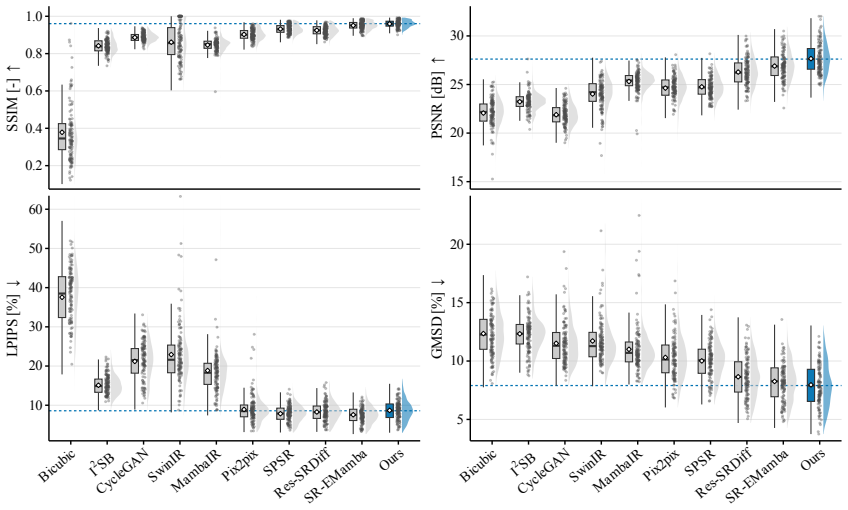
SR-DBM formulates super-resolution as continuous-time stochastic transport between the HR image at time zero and the LR image at the terminal time. The forward process is a mean-reverting Ornstein-Uhlenbeck SDE whose stationary mean is the LR image, conditioned by Doob's h-transform to end exactly at the LR image; its marginals are Gaussian with mean $x_{\mathrm{LR}}+\psi_t(x_{\mathrm{HR}}-x_{\mathrm{LR}})$ and variance $\omega_t^2 I$, so intermediate states are convex interpolations plus controlled noise. A network trained to predict the clean HR image under an $\ell_1$ plus LPIPS objective drives a deterministic reverse trajectory over ten strided steps. On the two datasets the paper reports top means for PSNR (brain $27.66\pm1.52$ dB, prostate $27.87\pm2.29$ dB), SSIM (0.96, 0.80), and GMSD (7.96%, 8.38%), each statistically significant versus all nine baselines, while on LPIPS the model ranks behind SR-EMamba and a few others; the paper attributes this to a perception-distortion trade-off.
Load-bearing premise
The argument leans on the assumption that low-resolution images produced by downsampling full-resolution scans capture what a real fast MRI acquisition produces, including its noise and artifacts.
Editorial extensions
If this is right
- Diffusion-based MRI super-resolution can be run in ten network evaluations, cutting sampling cost relative to methods that need hundreds of steps.
- Because reconstruction starts from the measured low-resolution image rather than Gaussian noise, fidelity-oriented restoration is more direct.
- The continuous-time bridge generalizes residual-shifting diffusion, so improvements carry over to that family of image-restoration models.
- Clinically, the results support using faster low-resolution acquisitions followed by SR to preserve fine structures and lesions in brain and prostate imaging, with reduced scan time.
- Perceptual quality remains a separate axis: LPIPS scores trail some baselines, and the paper's own discussion points to perceptual objectives as future work.
Reading between the lines
- Our inference: the same h-transformed bridge construction should transfer to other paired inverse problems in medical imaging (for example, PET-to-CT synthesis or artifact removal) whenever a low-quality input can be pinned as the terminal state, although the paper only tests MRI super-resolution.
- Our inference: because the method ranks lower on LPIPS while winning on PSNR, SSIM, and GMSD, combining the bridge with a perceptual or adversarial term could yield a single model that leads on all four metrics; the paper mentions adding perceptual objectives but does not test this.
- Our inference: the deterministic ten-step sampler is the key practical claim; comparing the reconstruction at S=1, 2, 5, 10, and 20 steps would directly map the cost-quality curve, something the paper only partially characterizes.
Signed reviews
Editorial analysis
A structured set of objections, weighed in public.
Referee Report
Summary. The manuscript proposes SR-DBM, a diffusion bridge model for MRI super-resolution. The forward process is a mean-reverting Ornstein-Uhlenbeck SDE whose stationary mean is the low-resolution image, conditioned via a Doob h-transform to start at the high-resolution image and end at the low-resolution image. The reverse process is trained with a combined L1 and LPIPS objective and reconstructs the HR image with a deterministic ten-step sampler. The method is evaluated on 7T brain T1 MP2RAGE maps and ProstateX T2-weighted prostate images against nine baselines, reporting PSNR, SSIM, GMSD, and LPIPS. The reported results show the best PSNR, SSIM, and GMSD on both datasets, while LPIPS is not the best on either dataset. The central claim is that the PSNR, SSIM, and GMSD gains are statistically significant relative to all comparison methods.
Significance. If the quantitative claims hold, SR-DBM is a useful and practical instantiation of a continuous diffusion bridge for MRI super-resolution: it requires only ten network evaluations, the bridge coefficients are given in closed form, and the training and sampling algorithms are clearly specified. The evaluation on two anatomies and contrasts against nine diverse baselines is a solid empirical contribution to the medical imaging super-resolution literature. At the same time, the significance is currently constrained by the unspecified statistical unit of the Wilcoxon tests, the absence of baseline training protocols and effect sizes, the unfulfilled promised analysis of step-count trade-offs, and the gap between the clinical significance statement and the synthetic downsampling evaluation. The theoretical construction largely follows an existing external framework ([17]); this is acceptable for an application paper but should be framed accordingly.
major comments (4)
- [Section 2.7, Tables 2-3, and Section 1 contribution bullet] The unit of the paired Wilcoxon signed-rank test is never specified, despite the contribution bullet promising 'per-patient paired statistics and effect sizes.' The test set comprises 2,552 brain slices from 21 patients and 2,668 prostate slices from 66 patients; if slices are treated as independent observations, the effective sample size is inflated by roughly 120-fold (brain) and 40-fold (prostate), and the reported mean PSNR gap of 0.76 dB (brain) and 0.72 dB (prostate) over SR-EMamba may become statistically significant even when patient-level differences are not. Since the abstract's headline claim that SR-DBM achieved 'statistically significant gains over every comparison method' rests entirely on these tests, the authors must state the unit of analysis, report patient-level paired statistics (e.g., per-patient median slice metrics) and effect sizes, or justify slice-level independence. As written, the central quantitative claim is not verifiable.
- [Section 2.7 and Section 3] No training or implementation details are given for the nine comparison methods. The paper does not state which official implementations were used, how hyperparameters were chosen, whether each baseline was retrained on the same downsampled data and the same train/test split, or for how many epochs. Unequal training effort is a standard confound in head-to-head super-resolution comparisons; without these details, the reported superiority over baselines such as SR-EMamba, SwinIR, and Res-SRDiff cannot be independently reproduced or assessed as fair.
- [Section 2.6 and Section 4] The low-resolution inputs are produced by synthetic downsampling of fully sampled high-resolution images (4x in-plane for the brain data; 9x in-plane and 2x through-plane for the prostate data). This models only a limited form of resolution loss and does not include the noise, motion, slice profile, or aliasing that characterize true rapid MRI acquisitions. The Discussion and Significance statements that SR-DBM may 'reduce scan time' and 'support improved lesion delineation' therefore extrapolate beyond the evaluation presented. The authors should temper these claims or add validation on prospectively acquired low-resolution data.
- [Section 1 contribution bullet 2 and Section 4] The introduction claims the paper will 'characterise reconstruction quality and inference cost as a function of the number of sampling steps,' but the manuscript reports only T=100 and S=10 and contains no ablation or cost analysis over S. The Discussion lists such a characterization as future work, which contradicts the contribution statement. The authors should either add this analysis or remove the claim from the contribution list.
minor comments (5)
- [Tables 2 and 3] Table 3 reports SSIM values in percentage-like units (e.g., 79.51±4.74 for the proposed method), whereas Table 2 reports SSIM as fractions (0.96±0.02). The scale should be unified or explicitly labeled to avoid confusion.
- [Abstract and Section 3.1] The phrase 'statistically significant gains over every comparison method' is ambiguous, since on the brain LPIPS comparison the difference from Pix2pix is not significant (p=0.71) and several methods have significantly lower LPIPS than SR-DBM. Please state explicitly that the significance claim applies to PSNR, SSIM, and GMSD rather than to all reported metrics.
- [Section 2.6] The downsampling procedure is not fully specified: the paper does not state the interpolation kernel, whether anti-aliasing filtering was applied, or whether the same kernel was used for both spatial axes. This information is needed to reproduce the exact low-resolution inputs.
- [Section 2.2.2] The reduction of the KL divergence to the L1 plus LPIPS objective in Eq. (7) is stated in a single sentence ('after dropping the time-dependent weights'); a short derivation or a reference to the corresponding derivation in [17] would allow readers to verify the objective.
- [Section 2.5 and Section 3] Although the title emphasizes ten sampling steps, no wall-clock inference time or computational cost comparison with the baselines is reported. The efficiency claim would be strengthened by reporting runtime per volume or per slice.
Circularity Check
No significant circularity: the headline result is an empirical benchmark and the bridge construction follows the external RDBM framework rather than being defined in terms of the reported metrics.
full rationale
The paper's central claim is an empirical evaluation on held-out test slices: SR-DBM is trained on a non-overlapping split and compared with nine baselines on PSNR, SSIM, GMSD, and LPIPS. The mathematical objects (mean-reverting OU process, Doob h-transform, bridge coefficients in Eq. (2), training objective in Eq. (7), and sampler update in Eq. (8)) are either derived from the forward marginal in the paper or attributed to the external residual diffusion bridge model [17]; none of these equations is defined in terms of the test metrics. The hyperparameters nu=1e-4 and lambda=4 are stated as fixed choices in Sections 2.2.2 and 2.3, not fitted to the reported PSNR/SSIM/GMSD values, so there is no fitted-input-called-prediction loop. Self-citations to Res-SRDiff [14] and SR-EMamba [23] are used as baselines and prior work to extend, not as justification for the central quantitative claim, so they are not load-bearing. The paper explicitly says it 'instantiate[s] the generalised residual diffusion bridge [17] for MRI super-resolution', so it is not disguising a prior result as a new derivation. I find no step where a prediction reduces by construction to an input. Separate reporting concerns, such as the contribution bullet promising 'per-patient paired statistics and effect sizes' while Section 2.7 specifies only a Wilcoxon signed-rank test without stating the unit of analysis and no effect sizes appearing, are completeness and statistical-reporting issues, not circularity. The synthetic-downsampling limitation is an external-validity concern, also not circularity.
Assumptions & free parameters
free parameters (4)
- ν (global noise level) =
1e-4
- λ (loss weight) =
4
- T (training steps) =
100
- S (sampling steps) =
10
assumptions (5)
- domain assumption Doob's h-transform of the mean-reverting OU SDE (Eq. 1) yields the bridge with Gaussian marginals (Eq. 3) and the coefficient formulas (Eq. 2).
- domain assumption LPIPS is a valid training loss and perceptual metric for T1 MP2RAGE and T2w MRI.
- domain assumption Synthetic downsampling of HR images approximates real low-resolution MRI acquisition.
- domain assumption Image samples used in the Wilcoxon test are independent.
- standard math The cosine schedule from Nichol and Dhariwal [19] provides a valid drift schedule for the OU bridge.
Cite this review
Pith. "Pith review of MRI super-resolution in ten sampling steps using a diffusion bridge model." pith.science (2026). https://pith.science/paper/YTGNYBA4
@misc{pith2026260808819,
  author       = {Pith},
  title        = {Pith review of: MRI super-resolution in ten sampling steps using a diffusion bridge model},
  year         = {2026},
  howpublished = {\url{https://pith.science/paper/YTGNYBA4}},
  note         = {Machine review of arXiv:2608.08819}
}
abstract
Objective. MRI provides excellent soft-tissue contrast, but long acquisition times can cause patient discomfort and lead to motion artifacts, forcing a trade-off between spatial resolution and scan time. Diffusion-based super-resolution (SR) reconstructs high-resolution (HR) images from low-resolution (LR) inputs, but typically needs many sampling steps and initializes from a Gaussian prior ill-suited to image restoration. We developed an efficient diffusion framework that reconstructs HR MRI directly from LR data. Approach. We propose super-resolution diffusion bridge model (SR-DBM), a super-resolution diffusion bridge model that casts SR as a stochastic transport between the LR and HR image distributions. Through a Doob's h-transform of a mean-reverting stochastic differential equation, SR-DBM pins the process to the paired HR and LR images at its endpoints, initializing reconstruction from the measured anatomy rather than from Gaussian noise. The HR image is recovered by a deterministic reverse trajectory in which a network predicts the clean image at each of only ten sampling steps. We evaluated SR-DBM on ultra-high-field 7T brain T1 MP2RAGE maps and pelvic T2-weighted prostate images against nine comparison methods using PSNR, SSIM, GMSD, and LPIPS. Main results. SR-DBM attained the highest PSNR and SSIM and the lowest GMSD on both datasets (brain: 27.66+-1.52 dB, 0.96+-0.02, 7.96+-1.86$; prostate: 27.87+-2.29 dB, 0.80+-0.05, 8.38+- 1.44), with statistically significant gains over every comparison method (two-sided Wilcoxon signed-rank test with Holm correction, p<0.05). The strongest baseline, SR-EMamba, ranked second. Qualitatively, SR-DBM produced the smallest residual errors and best preserved fine structures and lesions.
Figures


Figures from the paper (2 more)


Reference graph
Works this paper leans on
-
[17]
Residual diffusion bridge model for image restoration
Hebaixu Wang, Jing Zhang, Haoyang Chen, Haonan Guo, Di Wang, Jiayi Ma, and Bo Du. Residual diffusion bridge model for image restoration. In Proceedings of the IEEE/CVF Conference on Computer Vision and Pattern Recognition , pages 8375–8386, 2026. 5, 7, and 9
work page 2026
-
[1]
Mp2rage, a self bias-field corrected sequence for improved segmentation and t1-mapping at high field
José P Marques, Tobias Kober, Gunnar Krueger, Wietske van der Zwaag, Pierre- François Van de Moortele, and Rolf Gruetter. Mp2rage, a self bias-field corrected sequence for improved segmentation and t1-mapping at high field. Neuroimage, 49(2):1271–1281, 2010. 4
work page 2010
-
[2]
Prostate cancer: multiparametric mr imaging for detection, localization, and staging
Caroline MA Hoeks, Jelle O Barentsz, Thomas Hambrock, Derya Yakar, Diederik M Somford, Stijn WTPJ Heijmink, Tom WJ Scheenen, Pieter C Vos, Henkjan Huisman, Inge M van Oort, et al. Prostate cancer: multiparametric mr imaging for detection, localization, and staging. Radiology, 261(1):46–66, 2011. 4 27
work page 2011
-
[3]
Systematic review and meta-analysis of ai-driven mri motion artifact detection and correction
Mojtaba Safari, Zach Eidex, Richard LJ Qiu, Matthew Goette, Tonghe Wang, and Xiaofeng Yang. Systematic review and meta-analysis of ai-driven mri motion artifact detection and correction. Physica Medica, 141:105704, 2026. 4
work page 2026
-
[4]
Image super-resolution: A comprehensive review, recent trends, challenges and appli- cations
Dawa Chyophel Lepcha, Bhawna Goyal, Ayush Dogra, and Vishal Goyal. Image super-resolution: A comprehensive review, recent trends, challenges and appli- cations. Information Fusion, 91:230–260, 2023. 4
work page 2023
-
[5]
Mri super-resolution with deep learning: A comprehensive survey
Mohammad Khateri, Serge Vasylechko, Morteza Ghahremani, Liam Timms, Deniz Kocanaogullari, Simon K Warfield, Camilo Jaimes, Davood Karimi, Ale- jandra Sierra, Jussi Tohka, et al. Mri super-resolution with deep learning: A comprehensive survey. arXiv preprint arXiv:2511.16854 , 2025. 4
arXiv 2025
-
[6]
Generative adversarial network in medical imaging: A review
Xin Yi, Ekta Walia, and Paul Babyn. Generative adversarial network in medical imaging: A review. Medical image analysis , 58:101552, 2019. 4
work page 2019
-
[7]
Structure-preserving super resolution with gradient guidance
Cheng Ma, Yongming Rao, Yean Cheng, Ce Chen, Jiwen Lu, and Jie Zhou. Structure-preserving super resolution with gradient guidance. In Proceedings of the IEEE/CVF conference on computer vision and pattern recognition , pages 7769–7778, 2020. 4 and 15
work page 2020
Show all 30 references
-
[8]
Swinir: Image restoration using swin transformer
Jingyun Liang, Jiezhang Cao, Guolei Sun, Kai Zhang, Luc Van Gool, and Radu Timofte. Swinir: Image restoration using swin transformer. In Proceedings of the IEEE/CVF international conference on computer vision , pages 1833–1844,
-
[9]
Mambair: A simple baseline for image restoration with state-space model
Hang Guo, Jinmin Li, Tao Dai, Zhihao Ouyang, Xudong Ren, and Shu-Tao Xia. Mambair: A simple baseline for image restoration with state-space model. In European conference on computer vision , pages 222–241. Springer, 2024. 4 and 15
2024
-
[10]
Self-supervised adversarial diffusion models for fast mri reconstruction
Mojtaba Safari, Zach Eidex, Shaoyan Pan, Richard LJ Qiu, and Xiaofeng Yang. Self-supervised adversarial diffusion models for fast mri reconstruction. Medical Physics, 52(6):3888–3899, 2025. 5
2025
-
[11]
Cycle-guided denoising diffusion probability model for 3d cross-modality mri synthesis
Shaoyan Pan, Zach Eidex, Mojtaba Safari, Richard Qiu, and Xiaofeng Yang. Cycle-guided denoising diffusion probability model for 3d cross-modality mri synthesis. In Medical Imaging 2025: Clinical and Biomedical Imaging , volume 13410, pages 515–522. SPIE, 2025. 5
2025
-
[12]
Residual- shifted diffusion model for efficient and accurate mri-based pet synthesis
Saahil Mardhekar, Mojtaba Safari, Kelly Mei, Mingzhe Hu, Shansong Wang, Ethan Nie, Zach Eidex, Qiang Li, Richard LJ Qiu, Hui Mao, et al. Residual- shifted diffusion model for efficient and accurate mri-based pet synthesis. In Medical Imaging 2026: Clinical and Biomedical Imagin...
2026
-
[13]
High- resolution mri synthesis using a data-driven framework with denoising diffusion probabilistic modeling
Chih-Wei Chang, Junbo Peng, Mojtaba Safari, Elahheh Salari, Shaoyan Pan, Justin Roper, Richard LJ Qiu, Yuan Gao, Hui-Kuo Shu, Hui Mao, et al. High- resolution mri synthesis using a data-driven framework with denoising diffusion probabilistic modeling. Physics in Medicine & Bio...
2024
-
[14]
Mri super-resolution reconstruc- 29 tion using efficient diffusion probabilistic model with residual shifting
Mojtaba Safari, Shansong Wang, Zach Eidex, Qiang Li, Richard L J Qiu, Erik H Middlebrooks, David S Yu, and Xiaofeng Yang. Mri super-resolution reconstruc- 29 tion using efficient diffusion probabilistic model with residual shifting. Physics in Medicine & Biology , 70(12):125008...
2025
-
[15]
Efficient diffusion model for image restoration by residual shifting
Zongsheng Yue, Jianyi Wang, and Chen Change Loy. Efficient diffusion model for image restoration by residual shifting. IEEE Transactions on Pattern Analysis and Machine Intelligence , 47(1):116–130, 2024. 5, 6, and 7
2024
-
[16]
I ˆ2 sb: Image-to-image schr\” odinger bridge
Guan-Horng Liu, Arash Vahdat, De-An Huang, Evangelos A Theodorou, Weili Nie, and Anima Anandkumar. I ˆ2 sb: Image-to-image schr\” odinger bridge. arXiv preprint arXiv:2302.05872 , 2023. 5, 15, and 24
2023 arXiv
-
[18]
Score-based generative modeling through stochastic differential equations
Yang Song, Jascha Sohl-Dickstein, Diederik P Kingma, Abhishek Kumar, Ste- fano Ermon, and Ben Poole. Score-based generative modeling through stochastic differential equations. arXiv preprint arXiv:2011.13456 , 2020. 7
2011 arXiv
-
[19]
Improved denoising diffusion probabilistic models
Alexander Quinn Nichol and Prafulla Dhariwal. Improved denoising diffusion probabilistic models. In International conference on machine learning , pages 8162–8171. PMLR, 2021. 12
2021
-
[20]
7 t lesion-attenuated magnetization- 30 prepared gradient echo acquisition for detection of posterior fossa demyelinating lesions in multiple sclerosis
Erik H Middlebrooks, Vishal Patel, Xiangzhi Zhou, Sina Straub, John V Mur- ray Jr, Amit K Agarwal, Lela Okromelidze, Rahul B Singh, Alfonso S Lopez Chiriboga, Erin M Westerhold, et al. 7 t lesion-attenuated magnetization- 30 prepared gradient echo acquisition for detection of ...
2024
-
[21]
Prostatex challenges for computerized classification of prostate lesions from multiparametric magnetic resonance images
Samuel G Armato III, Henkjan Huisman, Karen Drukker, Lubomir Hadjiiski, Justin S Kirby, Nicholas Petrick, George Redmond, Maryellen L Giger, Kenny Cha, Artem Mamonov, et al. Prostatex challenges for computerized classification of prostate lesions from multiparametric magnetic ...
2018
-
[22]
Fast robust automated brain extraction
Stephen M Smith. Fast robust automated brain extraction. Human brain map- ping, 17(3):143–155, 2002. 14
2002
-
[23]
Efficient vision mamba for mri super-resolution via hybrid selective scanning
Mojtaba Safari, Shansong Wang, Vanessa L Wildman, Mingzhe Hu, Zach Eidex, Chih-Wei Chang, Erik H Middlebrooks, Richard LJ Qiu, Pretesh Patel, Ashesh B Jani, et al. Efficient vision mamba for mri super-resolution via hybrid selective scanning. Medical Physics, 53(5):e70508, 2026...
2026
-
[24]
Image-to-image translation with conditional adversarial networks
Phillip Isola, Jun-Yan Zhu, Tinghui Zhou, and Alexei A Efros. Image-to-image translation with conditional adversarial networks. In Proceedings of the IEEE conference on computer vision and pattern recognition , pages 1125–1134, 2017. 15
2017
-
[25]
Unpaired image- to-image translation using cycle-consistent adversarial networks
Jun-Yan Zhu, Taesung Park, Phillip Isola, and Alexei A Efros. Unpaired image- to-image translation using cycle-consistent adversarial networks. In Proceedings of the IEEE international conference on computer vision , pages 2223–2232, 2017. 15 31
2017
-
[26]
Image qual- ity assessment: from error visibility to structural similarity
Zhou Wang, Alan C Bovik, Hamid R Sheikh, and Eero P Simoncelli. Image qual- ity assessment: from error visibility to structural similarity. IEEE transactions on image processing , 13(4):600–612, 2004. 15
2004
-
[27]
Gradient magnitude similarity deviation: A highly efficient perceptual image quality index
Wufeng Xue, Lei Zhang, Xuanqin Mou, and Alan C Bovik. Gradient magnitude similarity deviation: A highly efficient perceptual image quality index. IEEE transactions on image processing , 23(2):684–695, 2013. 15
2013
-
[28]
The unreasonable effectiveness of deep features as a perceptual metric
Richard Zhang, Phillip Isola, Alexei A Efros, Eli Shechtman, and Oliver Wang. The unreasonable effectiveness of deep features as a perceptual metric. In Pro- ceedings of the IEEE conference on computer vision and pattern recognition , pages 586–595, 2018. 15
2018
-
[29]
Medfusiongan: multimodal medical image fusion using an unsupervised deep generative adversarial network
Mojtaba Safari, Ali Fatemi, and Louis Archambault. Medfusiongan: multimodal medical image fusion using an unsupervised deep generative adversarial network. BMC Medical Imaging , 23(1):203, Dec 2023. 15
2023
-
[30]
The perception-distortion tradeoff
Yochai Blau and Tomer Michaeli. The perception-distortion tradeoff. In Proceed- ings of the IEEE conference on computer vision and pattern recognition , pages 6228–6237, 2018. 24 32
2018
Reviewed August 14, 2026 · model on record in the stance chip above.
Discussion (0). Continue with ORCID to comment.