Fully optimised variational simulation of a dynamical quantum phase transition on a trapped-ion quantum computer
Pith reviewed 2026-05-23 03:17 UTC · model grok-4.3
The pith
A variational quantum circuit matrix product state on a trapped-ion processor simulates the transverse-field Ising model's dynamical quantum phase transition and exposes a simple underlying evolution.
A machine-rendered reading of the paper's core claim, the machinery that carries it, and where it could break.
Core claim
By fully optimising a quantum circuit matrix product state ansatz with a fidelity cost function and using measured values as stochastic corrections to a classical extrapolation, the time evolution of a translationally invariant state through the dynamical quantum phase transition of the transverse-field Ising model is followed on a trapped-ion quantum processor, demonstrating the feasibility of variational quantum time-evolution and revealing a hitherto hidden simplicity in the dynamics.
What carries the argument
The quantum circuit matrix product state ansatz, optimised for time-evolution using a fidelity cost function and augmented by stochastic corrections from measurements to a classical extrapolation of ansatz parameters, which represents and tracks the many-body wavefunction.
If this is right
- Variational quantum time-evolution becomes feasible for many-body systems whose dynamics require delicate phase cancellations on present trapped-ion devices.
- The evolution of the transverse-field Ising model through the dynamical quantum phase transition possesses a simpler structure than had been apparent.
- Stochastic corrections drawn from circuit measurements can reduce the sampling overhead of variational simulations.
- The same optimisation and correction strategy can be applied to other quantum many-body models that exhibit dynamical phase transitions.
Where Pith is reading between the lines
- The approach could be benchmarked on alternative quantum hardware to isolate the contribution of the trapped-ion platform.
- The uncovered simplicity might suggest new classical variational approximations for dynamical quantum phase transitions.
- Scaling the circuit depth or system size would test whether the method remains accurate for larger instances of the same model.
Load-bearing premise
The quantum circuit matrix product state ansatz, when optimised with a fidelity cost function and corrected by stochastic measurement values, captures the transverse-field Ising model wavefunction dynamics without introducing significant bias or error.
What would settle it
Exact classical or theoretical calculations of observables at the dynamical quantum phase transition point that deviate markedly from the variational simulation results beyond the level expected from sampling noise alone.
Figures



read the original abstract
We time-evolve a translationally invariant quantum state on the Quantinuum H1-1 trapped-ion quantum processor, studying the dynamical quantum phase transition of the transverse field Ising model. This physics requires a delicate cancellation of phases in the many-body wavefunction and presents a tough challenge for current quantum devices. We follow the dynamics using a quantum circuit matrix product state ansatz, optimised for the time-evolution using a fidelity cost function. Sampling costs are mitigated by using the measured values of this circuit as stochastic corrections to a simple classical extrapolation of the ansatz parameters. Our results demonstrate the feasibility of variational quantum time-evolution and reveal a hitherto hidden simplicity of the evolution of the transverse-field Ising model through the dynamical quantum phase transition.
Editorial analysis
A structured set of objections, weighed in public.
Referee Report
Summary. The paper reports a variational simulation of the dynamical quantum phase transition (DQPT) in the transverse-field Ising model (TFIM) on the Quantinuum H1-1 trapped-ion processor. A quantum circuit matrix product state (QC-MPS) ansatz is time-evolved by optimizing a fidelity cost function; measured circuit values supply stochastic corrections to a classical extrapolation of the ansatz parameters. The central claims are that this hybrid procedure demonstrates the feasibility of variational quantum time-evolution for phase-sensitive many-body dynamics and reveals an unexpected simplicity in the TFIM evolution across the DQPT.
Significance. If the hybrid QC-MPS procedure with stochastic corrections is shown to reproduce the Loschmidt amplitude without introducing uncontrolled bias, the work would establish a concrete route for near-term hardware to address dynamical many-body problems that are sensitive to phase cancellations. The reported simplicity in the parameter trajectories, if robust, could also motivate simpler classical models for DQPTs in integrable systems.
major comments (2)
- [Abstract / hybrid procedure description] The abstract states that measured values supply “stochastic corrections to a simple classical extrapolation,” yet no section supplies an a-priori bound on the bias or variance of these corrections, nor a controlled comparison against exact diagonalization that isolates the correction term. Because the Loschmidt amplitude in the DQPT regime relies on delicate many-body phase cancellations, any systematic offset in the corrected parameters would directly affect the reported location or visibility of the dynamical singularity; this validation is load-bearing for the feasibility claim.
- [Results / discussion of simplicity] The claim of a “hitherto hidden simplicity” of the TFIM evolution through the DQPT is presented as a result of the simulation, but the manuscript does not quantify how the corrected parameter trajectories deviate from or simplify relative to an uncorrected classical extrapolation or to exact MPS dynamics. Without such a metric (e.g., in a results figure or table comparing trajectories), the interpretation remains interpretive rather than demonstrated.
minor comments (2)
- [Abstract] The abstract would benefit from stating the qubit number, circuit depth, and number of shots used, to allow immediate assessment of the experimental scale.
- [Methods] Notation for the fidelity cost function and the precise form of the classical extrapolation ansatz should be defined explicitly (ideally with an equation) before the results are discussed.
Simulated Author's Rebuttal
We thank the referee for their careful reading and constructive comments on our manuscript. We address each major point below and outline the revisions we will make to strengthen the validation and quantification of our results.
read point-by-point responses
-
Referee: [Abstract / hybrid procedure description] The abstract states that measured values supply “stochastic corrections to a simple classical extrapolation,” yet no section supplies an a-priori bound on the bias or variance of these corrections, nor a controlled comparison against exact diagonalization that isolates the correction term. Because the Loschmidt amplitude in the DQPT regime relies on delicate many-body phase cancellations, any systematic offset in the corrected parameters would directly affect the reported location or visibility of the dynamical singularity; this validation is load-bearing for the feasibility claim.
Authors: We agree that an explicit, controlled validation isolating the stochastic corrections is necessary to support the feasibility claim given the phase sensitivity of the Loschmidt amplitude. The manuscript currently demonstrates agreement of the final hardware results with theoretical expectations but does not include a side-by-side isolation of the correction term against pure classical extrapolation or exact diagonalization. In the revised manuscript we will add a dedicated comparison (new figure or appendix) using exact diagonalization on small systems (N ≤ 8) to quantify the bias and variance of the corrections, including hardware error bars, thereby allowing direct assessment of any systematic offset. revision: yes
-
Referee: [Results / discussion of simplicity] The claim of a “hitherto hidden simplicity” of the TFIM evolution through the DQPT is presented as a result of the simulation, but the manuscript does not quantify how the corrected parameter trajectories deviate from or simplify relative to an uncorrected classical extrapolation or to exact MPS dynamics. Without such a metric (e.g., in a results figure or table comparing trajectories), the interpretation remains interpretive rather than demonstrated.
Authors: We accept that the claim of hidden simplicity would be strengthened by a quantitative metric rather than relying on visual inspection of the trajectories. The manuscript presents the parameter trajectories in a figure and notes their apparent simplicity across the DQPT, but does not report explicit deviation measures. We will revise the results section to include a quantitative comparison, for example by adding an inset or table that reports the L2 deviation of the corrected trajectories from both the uncorrected classical extrapolation and from exact MPS dynamics (where computable), thereby making the interpretation demonstrable rather than interpretive. revision: yes
Circularity Check
No significant circularity; derivation is self-contained
full rationale
The paper presents a variational quantum time-evolution method using a QC-MPS ansatz optimized via fidelity cost function, with measured circuit values supplying stochastic corrections to a classical parameter extrapolation. No quoted equations or sections reduce any central prediction or result to a fitted input by construction, self-citation load-bearing premise, or ansatz smuggled via prior author work. The approach relies on independent quantum hardware measurements for corrections, providing external grounding rather than internal redefinition. The reader's assessment of score 2 aligns with the absence of any load-bearing step that collapses to the paper's own inputs.
Axiom & Free-Parameter Ledger
Lean theorems connected to this paper
-
IndisputableMonolith/Cost/FunctionalEquation.leanwashburn_uniqueness_aczel unclear?
unclearRelation between the paper passage and the cited Recognition theorem.
optimised for the time-evolution using a fidelity cost function... measured values of this circuit as stochastic corrections to a simple classical extrapolation of the ansatz parameters
-
IndisputableMonolith/Foundation/DimensionForcing.leanalexander_duality_circle_linking unclear?
unclearRelation between the paper passage and the cited Recognition theorem.
dynamical quantum phase transition of the transverse field Ising model... Loschmidt echo
What do these tags mean?
- matches
- The paper's claim is directly supported by a theorem in the formal canon.
- supports
- The theorem supports part of the paper's argument, but the paper may add assumptions or extra steps.
- extends
- The paper goes beyond the formal theorem; the theorem is a base layer rather than the whole result.
- uses
- The paper appears to rely on the theorem as machinery.
- contradicts
- The paper's claim conflicts with a theorem or certificate in the canon.
- unclear
- Pith found a possible connection, but the passage is too broad, indirect, or ambiguous to say the theorem truly supports the claim.
Forward citations
Cited by 3 Pith papers
-
Dynamical Criticality Behind Energy-Storage Singularities in Quantum Batteries
In free-fermion quantum batteries, the condition for a dynamical quantum phase transition equals perfect normalized charging of the critical momentum mode, producing nonanalytic long-time stored energy and sharp SNR s...
-
Dynamical Criticality Behind Energy-Storage Singularities in Quantum Batteries
Dynamical quantum phase transitions in free-fermion quantum batteries produce nonanalytic singularities in long-time stored energy by making critical momentum modes charge perfectly at specific times.
-
A unified quantum computing quantum Monte Carlo framework through structured state preparation
Structured state preparation in QCQMC improves energy accuracy over pure variational methods across molecular, condensed-matter, nuclear, and graph problems.
Reference graph
Works this paper leans on
-
[1]
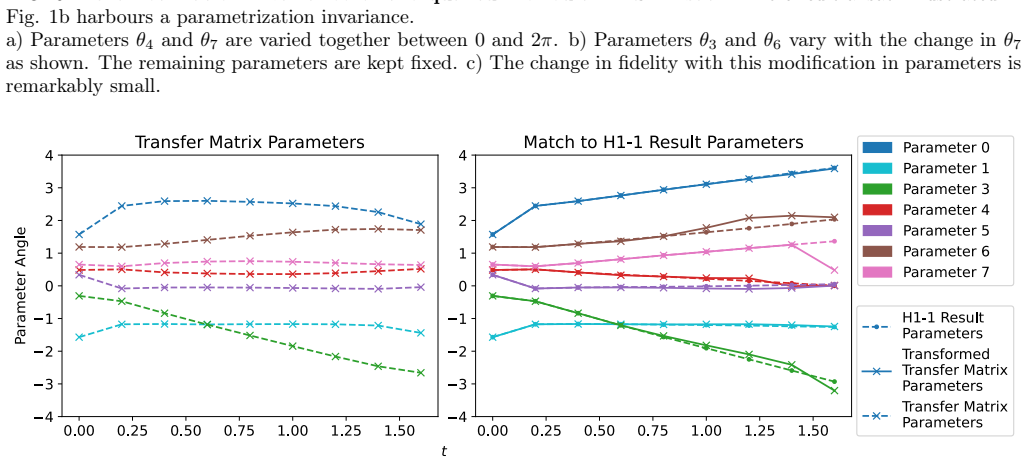
= Rz(ϕ′ 0)Rx(ϕ′ 1)Rz(ϕ′ 4). (D2) Other gauge rotations can only be realised approximately with a fidelity that varies depending upon the state. Reparametrisation Invariance: Alongside this gauge freedom, the ansatz also harbours an approximate reparametrization invariance. As illustrated in Fig. 6, different sets of parameters describe the same state, in ...
-
[2]
Bardeen, J., Cooper, L. N. & Schrieffer, J. R. The- ory of superconductivity. Phys. Rev. 108, 1175–1204 (1957). URL https://link.aps.org/doi/10.1103/ PhysRev.108.1175
work page 1957
-
[3]
K., K., Dorda, G. & Pepper, M. New method for high- accuracy determination of the fine-structure constant based on quantized hall resistance.Phys. Rev. Lett.45, 494–497 (1980). URL https://link.aps.org/doi/10. 1103/PhysRevLett.45.494
work page 1980
-
[4]
Savary, L. & Balents, L. Quantum spin liquids: A review. Rep. Prog. Phys.80, 016502 (2016). URL https://dx. doi.org/10.1088/0034-4885/80/1/016502
-
[5]
White, S. R. Density matrix formulation for quantum renormalization groups. Phys. Rev. Lett.69, 2863–2866 (1992)
work page 1992
-
[6]
Östlund, S. & Rommer, S. Thermodynamic limit of den- sity matrix renormalization.Phys. Rev. Lett.75, 3537– 3540 (1995)
work page 1995
-
[7]
Perez-Garcia, D., Verstraete, F., Wolf, M. M. & Cirac, J. I. Matrix product state representations. Quantum Info. Comput. 7, 401–430 (2007)
work page 2007
-
[8]
The density-matrix renormaliza- tion group in the age of matrix product states
Schollwöck, U. The density-matrix renormaliza- tion group in the age of matrix product states. Ann. Phys. (NY) 326, 96 – 192 (2011). URL http://www.sciencedirect.com/science/article/ pii/S0003491610001752. January 2011 Special Issue
work page 2011
-
[9]
Variational quantum algorithms
Cerezo, M.et al. Variational Quantum Algorithms.Nat Rev Phys 3, 625–644 (2021). URLhttp://arxiv.org/ abs/2012.09265. 2012.09265
-
[10]
Schön, C., Solano, E., Verstraete, F., Cirac, J. I. & Wolf, M. M. Sequential generation of entangled multiqubit states. Phys. Rev. Lett.95, 110503 (2005)
work page 2005
- [12]
-
[13]
Lin, S.-H., Dilip, R., Green, A. G., Smith, A. & Pollmann, F. Real- and imaginary-time evolution with compressed quantum circuits. PRX Quantum 2, 010342 (2021). URL https://link.aps.org/doi/10. 1103/PRXQuantum.2.010342
work page 2021
-
[14]
Barratt, F. et al. Parallel quantum simulation of large systems on small nisq computers.npj Quantum Informa- tion 7, 1–7 (2021)
work page 2021
-
[15]
Wecker, D., Hastings, M. B. & Troyer, M. Progress to- 11 wards practical quantum variational algorithms. Phys. Rev. A 92, 042303 (2015)
work page 2015
-
[17]
Sachdev, S.Quantum phase transitions(Cambridge uni- versity press, 2011)
work page 2011
- [18]
-
[19]
Dborin, J. et al. Simulating groundstate and dy- namical quantum phase transitions on a supercon- ducting quantum computer. Nat Commun 13, 5977 (2022). URL https://www.nature.com/articles/ s41467-022-33737-4
work page 2022
-
[20]
Quantum criticality: competing ground states in low dimensions.Science 288, 475–480 (2000)
Sachdev, S. Quantum criticality: competing ground states in low dimensions.Science 288, 475–480 (2000)
work page 2000
-
[21]
Pollmann, F., Mukerjee, S., Green, A. G. & Moore, J. E. Dynamicsafterasweepthroughaquantumcriticalpoint. Physical Review E81, 020101 (2010)
work page 2010
-
[22]
Heyl, M., Polkovnikov, A. & Kehrein, S. Dy- namical quantum phase transitions in the transverse- field ising model. Phys. Rev. Lett. 110, 135704 (2013). URL https://link.aps.org/doi/10.1103/ PhysRevLett.110.135704
work page 2013
-
[23]
Guo, X.-Y. et al. Observation of a dynami- cal quantum phase transition by a superconducting qubit simulation. Phys. Rev. Applied 11, 044080 (2019). URL https://link.aps.org/doi/10.1103/ PhysRevApplied.11.044080
work page 2019
-
[24]
Xu, K. et al. Probing dynamical phase transitions with a superconducting quantum simulator. Sci- ence Advances 6, eaba4935 (2020). URL https:// www.science.org/doi/abs/10.1126/sciadv.aba4935. https://www.science.org/doi/pdf/10.1126/sciadv.aba4935
-
[25]
Spall, J. C.et al. Multivariate stochastic approximation using a simultaneous perturbation gradient approxima- tion. IEEE transactions on automatic control37, 332– 341 (1992)
work page 1992
-
[26]
Foss-Feig, M. et al. Holographic quantum algorithms for simulating correlated spin systems.Phys. Rev. Res. 3, 033002 (2021). URLhttps://link.aps.org/doi/10. 1103/PhysRevResearch.3.033002
work page 2021
-
[27]
Gopalakrishnan, S. & Lamacraft, A. Unitary circuits of finite depth and infinite width from quantum channels. Phys. Rev. B 100, 064309 (2019). URLhttps://link. aps.org/doi/10.1103/PhysRevB.100.064309
-
[28]
Kim, I. H. Noise-resilient preparation of quantum many- body ground states. arXiv preprint arXiv:1703.00032 (2017). URL http://arxiv.org/abs/1703.00032. 1703.00032
work page internal anchor Pith review Pith/arXiv arXiv 2017
-
[29]
Schön, C., Solano, E., Verstraete, F., Cirac, J. I. & Wolf, M. M. Sequential generation of entan- gled multiqubit states. Phys. Rev. Lett. 95, 110503 (2005). URL https://link.aps.org/doi/10.1103/ PhysRevLett.95.110503
work page 2005
-
[30]
Schön, C., Hammerer, K., Wolf, M. M., Cirac, J. I. & Solano, E. Sequential generation of matrix-product states in cavity qed. Phys. Rev. A 75, 032311 (2007). URL https://link.aps.org/doi/10.1103/ PhysRevA.75.032311
work page 2007
-
[31]
Puig, R., Drudis, M., Thanasilp, S. & Holmes, Z. Varia- tional quantum simulation: a case study for understand- ing warm starts (2024). URLhttps://arxiv.org/abs/ 2404.10044. 2404.10044
-
[32]
Rodriguez-Nieva, J. F. & Scheurer, M. S. Identifying topological order through unsupervised machine learn- ing. Nature Physics 15, 790–795 (2019)
work page 2019
-
[33]
Carrasquilla, J. & Melko, R. G. Machine learning phases of matter. Nature Physics 13, 431–434 (2017)
work page 2017
-
[34]
Metz, F. & Bukov, M. Self-correcting quantum many- body control using reinforcement learning with tensor networks. arXiv preprint arXiv:2201.11790(2022)
-
[35]
Bharti, K.et al.Noisy intermediate-scale quantum algo- rithms. Rev. Mod. Phys.94, 015004 (2022). URLhttps: //link.aps.org/doi/10.1103/RevModPhys.94.015004
-
[36]
Indeed, this portability is demonstrated by the fact that thecostfunctionfortimeevolutionwasfirstprofiled( mu- tatis mutandis), butnotoptimised, onGoogle’sSycamore superconducting architecture [18]
-
[37]
Wei, Z.-Y., Malz, D. & Cirac, J. I. Sequential genera- tion of projected entangled-pair states.Physical Review Letters 128, 010607 (2022)
work page 2022
-
[38]
Banuls, M.-C., Pérez-García, D., Wolf, M. M., Ver- straete, F. & Cirac, J. I. Sequentially generated states for the study of two-dimensional systems.Physical Review A 77, 052306 (2008)
work page 2008
- [39]
-
[40]
White, C. D., Zaletel, M., Mong, R. S. K. & Refael, G. Quantum dynamics of thermalizing systems.Phys. Rev. B 97, 035127 (2018). URLhttps://link.aps.org/doi/ 10.1103/PhysRevB.97.035127
-
[41]
Hallam, A., Morley, J. & Green, A. G. The lyapunov spectra of quantum thermalisation.Nature communica- tions 10, 1–8 (2019)
work page 2019
-
[42]
W., Rakovszky, T., Pollmann, F
von Keyserlingk, C. W., Rakovszky, T., Pollmann, F. & Sondhi, S. L. Operator hydrodynamics, otocs, and entanglement growth in systems without conservation laws. Phys. Rev. X 8, 021013 (2018). URL https: //link.aps.org/doi/10.1103/PhysRevX.8.021013
-
[43]
Rakovszky, T., von Keyserlingk, C. W. & Pollmann, F. Dissipation-assisted operator evolution method for capturing hydrodynamic transport. Phys. Rev. B 105, 075131 (2022). URL https://link.aps.org/doi/10. 1103/PhysRevB.105.075131
work page 2022
-
[44]
Arute, F. et al. Quantum supremacy using a programmable superconducting processor. Nature 574, 505–510 (2019). URL https://www.nature.com/ articles/s41586-019-1666-5
work page 2019
-
[45]
Ayral, T. et al. Density-matrix renormalization group algorithm for simulating quantum circuits with a finite fidelity. PRX Quantum 4, 020304 (2023). URL https: //link.aps.org/doi/10.1103/PRXQuantum.4.020304
-
[46]
Gray, J. & Kourtis, S. Hyper-optimized tensor network contraction. Quantum 5, 410 (2021). URLhttps://doi. org/10.22331/q-2021-03-15-410
-
[47]
Pan, F., Chen, K. & Zhang, P. Solving the sampling problem of the sycamore quantum circuits.Phys. Rev. Lett. 129, 090502 (2022). URLhttps://link.aps.org/ doi/10.1103/PhysRevLett.129.090502
-
[48]
Kim, Y. et al. Evidence for the utility of quan- tum computing before fault tolerance. Nature 618, 500—505 (2023). URL https://doi.org/10.1038/ s41586-023-06096-3
work page 2023
-
[49]
Tindall, J., Fishman, M., Stoudenmire, E. M. & Sels, D. Efficient tensor network simulation of ibm’s ea- 12 gle kicked ising experiment. PRX Quantum 5, 010308 (2024). URL https://link.aps.org/doi/10.1103/ PRXQuantum.5.010308
work page 2024
-
[50]
Begušić, T., Gray, J. & Chan, G. K.-L. Fast and converged classical simulations of evidence for the utility of quantum computing before fault tolerance. Science Advances 10, eadk4321 (2024). URL https:// www.science.org/doi/abs/10.1126/sciadv.adk4321. https://www.science.org/doi/pdf/10.1126/sciadv.adk4321
-
[51]
Oseledets, I. V. Tensor-train decomposition. SIAM Journal on Scientific Computing 33, 2295–2317 (2011). URL https://doi.org/10.1137/090752286. https://doi.org/10.1137/090752286
- [52]
-
[53]
The computational power of random quantum circuits in arbitrary geometries (2024)
DeCross, M.et al. The computational power of random quantum circuits in arbitrary geometries (2024). URL https://arxiv.org/abs/2406.02501. 2406.02501
- [54]
-
[55]
Garcia-Escartin, J. C. & Chamorro-Posada, P. swap test and hong-ou-mandel effect are equivalent.Phys. Rev. A 87, 052330 (2013). URL https://link.aps.org/doi/ 10.1103/PhysRevA.87.052330
-
[56]
Michailidis, A. A., Turner, C. J., Papić, Z., Abanin, D. A. & Serbyn, M. Slow quantum thermalization and many- body revivals from mixed phase space. Phys. Rev. X 10, 011055 (2020). URL https://link.aps.org/doi/ 10.1103/PhysRevX.10.011055
discussion (0)
Sign in with ORCID, Apple, or X to comment. Anyone can read and Pith papers without signing in.