REVIEW 4 major objections 7 minor 123 references
Stellar bars systematically slow the orbital decay of massive black hole pairs, and a machine-learning emulator trained on 100,000 orbital integrations transfers that effect to cosmological galaxy populations.
Reviewed by Pith at T0; open to challenge. T0 means a machine referee read the full paper against a public rubric. the ladder, T0–T4 →
T0 review · deepseek-v4-flash
2026-08-01 00:43 UTC pith:YTUCJBUU
load-bearing objection A credible NF emulator with a solid held-out validation, but the bar effect it reports is inherited from training data whose dynamical friction uses one fixed rotation curve; stress-test that before believing the TNG50 conclusions. the 4 major comments →
Emulating the complex galactic-scale orbital dynamics of LISA massive black hole pairs with normalizing flows
The pith
A machine-rendered reading of the paper's core claim, the machinery that carries it, and where it could break.
Core claim
Bars demote binary formation. In the semi-analytical model, the fraction of secondary massive black holes that reach 10 pc from the galactic centre within a Hubble time is 53.3 percent in non-barred galaxies and 45.2 percent in barred galaxies; among barred galaxies the fraction decreases with increasing bar mass and decreasing bar length. The conditional normalizing flow trained on these runs reproduces the decay-time distributions across mass, radius, and orbital-circularity selections, with probability-probability coverage close to the diagonal. When the emulator is applied to TNG50 galaxies, treating barred galaxies as barred rather than as non-barred reduces the cumulative fraction of b
What carries the argument
Conditional normalizing flow: a neural spline flow that maps a one-dimensional standard normal distribution to the target distribution of binary-formation times via an invertible transformation conditioned on nine physical features (black hole mass, initial position and velocity, bar mass fraction, bar length, and a barred/non-barred flag). The flow is trained by maximum likelihood on about 1.1 x 10^5 semi-analytical orbital integrations of a secondary massive black hole in a multi-component galactic remnant with a rotating bar; once trained, it samples decay-time distributions orders of magnitude faster than the simulations, capturing the stochasticity of the dynamics rather than a single p
Load-bearing premise
Every dynamical-friction force in all 10^5 semi-analytical runs is computed from one fixed galactic rotation curve—taken from a single barred galaxy with a particular bar mass, pattern speed, and scale lengths—regardless of the bar mass, length, and pattern speed of the run itself.
What would settle it
Take a subsample of the SAM initial conditions, recompute the galactic rotation curve for each run from its own bar mass, length, and pattern speed, and re-integrate the orbits; if the resulting decay-time distributions and the sign or magnitude of the bar dependence change significantly, then the emulator's bar effect is an artifact of the fixed curve.
If this is right
- If bars demote decay as claimed, population forecasts for LISA and other mHz gravitational-wave detectors will need to include galaxy morphology, not just dynamical friction in symmetric potentials.
- Treating all galaxies as non-barred—as past SAM-based population studies have done—overestimates the number of massive black hole binaries that form by up to about five percent cumulatively, and by more for barred-only subsamples.
- The emulator's speed (about 10^7 samples in seconds) makes it feasible to propagate full orbital-decay distributions through large cosmological volumes, which was previously intractable with direct integration.
- The methodology transfers to other stochastic sub-grid astrophysical processes where per-system integration is well understood but population-scale sampling is too expensive.
- The learned dependence on bar mass, length, and pattern speed is a testable prediction that full N-body simulations of merger remnants can check directly.
Where Pith is reading between the lines
- If the fixed-rotation-curve assumption biases the drag in the training data, then the emulator's learned bar dependence—and the five-percent cumulative effect—could be partly an artifact of that choice; re-running a subset of SAM runs with per-run rotation curves would settle this.
- The claim implies that galaxy populations with higher bar fractions at a given redshift should show relatively fewer massive black hole binaries; comparing different cosmological simulations with different bar fractions could test this statistically.
- The emulator is conditioned on bar mass fraction and length but not on bar pattern speed or shape; extending the conditioning vector to include those parameters might reveal additional bar effects, including resonances that the current fixed-curve model cannot capture.
- A stronger, direct test would be to run a few live, self-consistent N-body simulations of barred merger remnants and compare their decay-time distributions with the emulator's predictions for the same initial conditions.
Editorial analysis
A structured set of objections, weighed in public.
Referee Report
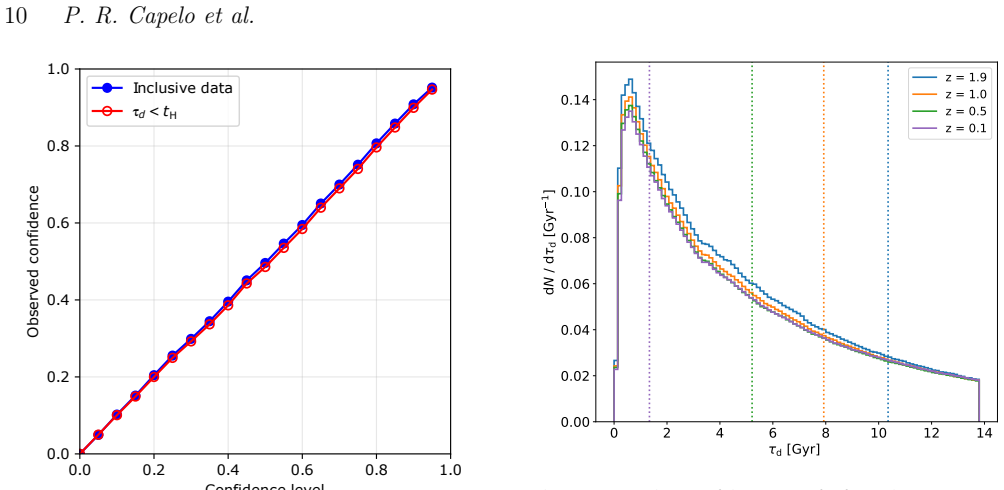
Summary. The paper presents a conditional normalizing-flow emulator for the decay time τ_d of a secondary massive black hole inspiralling in a merger remnant with a rotating stellar bar. The training set consists of 10^5 new semi-analytical integrations plus 10,075 non-barred runs from B22, with bar mass, length, and pattern speed varied at fixed total stellar mass. The emulator is validated on a held-out 20% of the SAM data (Fig. 3, P-P plot in Fig. 4) and then applied to TNG50 galaxies by replacing the SAM bar features with mordor-measured bar fractions and lengths, plus a host-mass rescaling of τ_d. The central astrophysical claim is that stellar bars slightly demote MBH binary formation: barred SAM runs have a 45.2% decay fraction within a Hubble time versus 53.3% for non-barred runs, and the TNG50 bar-aware versus bar-agnostic comparison shows up to ~5% fewer cumulative events (Figs. 7–8).
Significance. If the emulator is a faithful surrogate, the paper offers a genuinely useful tool: conditional normalizing flows are a natural way to preserve the stochasticity of DF-driven orbital decay, the held-out validation is a proper non-circular test, and the computational speedup (10^7 samples in ~15 s) makes population-scale application feasible. The use of Sobol sampling, the explicit calibration check, and the public TNG50+mordor data are strengths. The TNG50 analysis is best read as a proof-of-concept propagation of the SAM's learned bar dependence rather than an independent discovery; the authors themselves call it a proof of concept in Section 4. The main risk to the headline claim is the fixed rotation curve used in all DF calculations and the ambiguity in the bar-agnostic counterfactual, both of which bear directly on the magnitude and even the sign of the reported bar effect.
major comments (4)
- [§2.1.1, footnote 2] All 10^5 SAM runs compute dynamical friction from a single rotation curve, that of a B22 barred galaxy with M_bar=3×10^9 M⊙, ω_bar=40 km/s/kpc, and scale lengths (5,2,0.3) kpc, while M_bar is varied over a factor of 10, a_bar over 1–9 kpc, and ω_bar over 23–122 km/s/kpc via Eq. (6). The cited B22 result concerns barred vs non-barred at fixed total stellar mass, not the range explored here. Since the Chandrasekhar drag depends on the local velocity distribution (not just the potential), the learned f_bar/a_bar dependence — and hence the TNG50 bar effect in Figs. 7–8 — could be artificially created, suppressed, or reversed. Please rerun a subset of the SAM (or at least a few representative M_bar, a_bar, ω_bar combinations) with self-consistent rotation curves and quantify the change in the τ_d distributions and in the decay fraction as a function of bar properties.
- [§2.4, Figs. 7–8] The 'bar-agnostic' evaluation is described as 'setting x_bar = 0 for all galaxies,' but the conditioning vector also contains f_bar and a_bar. Please specify explicitly what values f_bar and a_bar take when x_bar is set to 0. If they remain at the TNG-measured barred values, the model receives a feature combination never seen in training (non-barred with non-zero bar mass/length), which would invalidate the comparison. If they are set to 0 (or to the B22 nominal a_bar=5 kpc), then the counterfactual is not the same TNG galaxy without its bar but the SAM's idealized non-barred model with rescaled disc/bulge masses; this should be stated and its effect on the magnitude of the 5% difference discussed.
- [§3.3, Figs. 7–8] The headline quantitative statement is that bars reduce the cumulative binary fraction by 'up to five per cent,' but no uncertainty is reported on these cumulative fractions. The P-P plot in Fig. 4 shows good calibration of the marginal predictive distribution, but that does not directly give error bars on the redshift-binned fractions or on the difference between the solid and dashed curves in Fig. 7. Please provide confidence intervals (e.g., by bootstrapping over TNG galaxies and/or over multiple NF training seeds) so the reader can assess whether the 5% effect is significant relative to emulator and sampling noise.
- [§2.2] The treatment of non-decaying systems (τ_d = ∞) is described only as 'resampled by extrapolating the finite-τ_d distribution tail into larger times than allowed,' with no specification of the extrapolation method. This is not a purely cosmetic detail: roughly half of the training systems do not decay within t_H, and the 'inclusive' calibration in Fig. 4 includes these extrapolated values, which can make the model look better calibrated than it is in the physically relevant range. Please specify the extrapolation procedure, justify that it does not bias the CDF for τ_d < t_H, and show the P-P plot restricted to τ_d < t_H as the primary calibration diagnostic.
minor comments (7)
- [§3.2, Fig. 3] The agreement between SAM and emulator histograms is shown by overplotting without a quantitative divergence metric. Please add a two-sample test (KS or AD) or a proper scoring rule (e.g., CRPS) for the overall and conditional distributions.
- [Abstract / §4] The abstract's 'Our results show that stellar bars can alter the distribution...' could be read as an independent cosmological finding; since the bar dependence originates in the SAM training data and the TNG analysis propagates it, I suggest phrasing such as 'our emulator, trained on barred/non-barred SAM simulations, predicts...' to avoid overclaiming.
- [§2.1.1, Eq. (6)] The pattern-speed relation is a polynomial fitted to a single galaxy's rotation curve; if the fixed-curve assumption is revisited, Eq. (6) and the ω_bar range should be re-derived consistently.
- [§2.1.1, footnote 4] The B22 non-barred runs stopped at t_H rather than 2t_H, while the new barred runs stop at 2t_H. Please state explicitly how this inconsistency is handled in the tail-extrapolation step for the mixed training set.
- [§2.4] The post-processing mass rescaling τ_d ∝ M_host^{1/2} is acknowledged as approximate, but the paper does not report the range of M⋆,tng50/M⋆ factors actually present after the lower-mass cut; a sentence with the median and 5–95% range would help the reader judge the extrapolation depth.
- [§2.3 / Table B1] The TNG50 barred-galaxy sample is restricted to f_bar and a_bar within SAM ranges, while the non-barred sample is not restricted by any analogous structural constraint. Please state whether this asymmetry could bias the bar-aware versus bar-agnostic comparison.
- [Data Availability] The data availability statement says data will be shared 'on reasonable request.' For a machine-learning-based method, releasing the trained model and the training/validation splits (or a public code repository) would considerably strengthen reproducibility.
Circularity Check
No significant circularity: the NF emulator is validated on held-out SAM data, and the TNG50 application is a conditional evaluation on external TNG50 morphology inputs; the fixed B22 rotation curve is a modeling caveat, not a circular reduction.
full rationale
The derivation chain is compositional rather than circular. The SAM generates decay times from dynamical integrations over varied bar and MBH parameters; the conditional normalizing flow is trained on an 80/20 split and evaluated on the held-out validation set (Fig. 3 and the PP plot in Fig. 4), including conditional checks on MBH mass, radius, and circularity. This is a genuine out-of-sample test, not a restatement of the training data. The TNG50 application is a forward pass of the trained conditional distribution using externally measured TNG50 bar fractions, bar lengths, and bar flags; Section 2.4 replaces only fbar and abar with TNG50 values and samples the rest of the conditioning vector from SAM validation runs. That is a Monte Carlo evaluation of p(tau_d | c), not a fit to TNG50 outcomes, so the resulting bar-aware versus bar-agnostic comparison is a counterfactual on the learned conditional model. The conclusion that bars demote binary formation is inherited from the SAM physics, but inheritance from training data is the intended role of an emulator, not circularity by construction. The main caveat, footnote 2 in Section 2.1.1, is that all DF computations use one B22 rotation curve regardless of the run's own bar mass, length, and pattern speed. This is a potentially important approximation that could bias the learned bar dependence, and B22 is prior work with overlapping authors, but the bar dependence in the SAM arises from integrating the bar potential, and the cited B22 similarity result is an external falsifiable claim rather than a self-imported uniqueness theorem. No equation in the paper makes the predicted quantity equal to a fitted input by definition, and no fitted parameter is relabeled as a prediction. Therefore no circular step is exhibited; the low score reflects only a minor self-citation/assumption, not circularity.
Axiom & Free-Parameter Ledger
free parameters (5)
- Bar pattern-speed polynomial coefficients (Eq. 6) =
ω_bar = (0.21 a³ − 5.56 a² + 47.13 a + 80.15)/a_bar, a ∈ [1,9] kpc
- Fixed dynamical-friction rotation curve =
B22 barred-galaxy curve (M_bar=3×10^9 M⊙, ω=40 km/s/kpc, scales 5/2/0.3 kpc) used for all runs
- Bar/disc/bulge mass-compensation slope =
0.1 factor in Eqs 7-8 (abulge/abar terms)
- Tail extrapolation of non-decaying systems =
τ_d = ∞ values resampled from extrapolated finite-τ_d tail
- Occupation fraction f_occ =
0.1 (constant)
axioms (7)
- domain assumption Chandrasekhar dynamical friction with the fixed B22 rotation curve and a constant Coulomb logarithm describes the secondary MBH's orbital decay above 10 pc
- domain assumption Galactic components (halo, bulge, disc) and the bar's mass, length, and pattern speed are constant over the multi-Gyr integration
- domain assumption Binary formation is defined by the secondary reaching 10 pc from the primary; no gas dynamics, MBH feedback, or mass growth at these scales
- domain assumption TNG50 galaxies are represented by the four SAM features via cross joint sampling: only f_bar and a_bar are replaced, plus a global τ_DF ∝ M_host^{1/2} rescaling
- domain assumption The isotropic/uniform SAM sampling of MBH initial conditions represents the distribution of secondary MBHs in TNG50 merger remnants
- domain assumption TNG50's volume is representative of the Universe for the rate estimates
- standard math Normalizing-flow density estimation via the change-of-variables formula is valid for this conditional target
read the original abstract
Massive black hole (MBH) pairs, formed in galaxy mergers, may coalesce in a burst of gravitational waves. Estimating the coalescence time-scales and rates is a long-standing astrophysical problem, essential to inform predictions for future gravitational-wave detectors such as the Laser Interferometer Space Antenna, but remains challenging: MBH orbital decay in realistic galactic environments is complex and stochastic, and non-axisymmetric structures such as stellar bars can perturb MBH pair dynamics, delaying or accelerating binary formation and undermining the assumption that dynamical friction alone sets the inspiral duration. Capturing this evolution requires simulations too expensive to run at population scale. Here we present an artificial-intelligence framework that emulates the galactic-scale orbital decay of an inspiralling MBH using conditional normalizing flows trained on a large suite of semi-analytical orbital integrations. Our model captures the evolution of secondary MBHs orbiting within multi-component galactic merger remnants featuring rotating stellar discs and bars, across a broad range of MBH masses, orbital configurations, and bar properties. The trained emulator reproduces the simulations' decay-time distributions while reducing computational cost by orders of magnitude. For the first time, we apply this model to galaxy populations drawn from a cosmological simulation, exploiting morphological information on barred and non-barred galaxies to infer MBH binary formation time-scales across cosmic time. Our results show that stellar bars can alter the distribution of MBH binary formation times. More broadly, this demonstrates how simulation-based, surrogate machine-learning emulators can unlock a class of astrophysical problems where the physics is well understood system-by-system but intractable at scale.
Figures




Reference graph
Works this paper leans on
-
[1]
Agazie G., et al., 2023a, @doi [ ] 10.3847/2041-8213/acdac6 , https://ui.adsabs.harvard.edu/abs/2023ApJ...951L...8A 951, L8
-
[2]
Agazie G., et al., 2023b, @doi [ ] 10.3847/2041-8213/ace18b , https://ui.adsabs.harvard.edu/abs/2023ApJ...952L..37A 952, L37
-
[3]
Amaro-Seoane P., et al., 2023, @doi [Living Reviews in Relativity] 10.1007/s41114-022-00041-y , https://ui.adsabs.harvard.edu/abs/2023LRR....26....2A 26, 2
-
[4]
Bairagi A., Wandelt B., Villaescusa-Navarro F., 2025, @doi [ ] 10.1051/0004-6361/202554602 , https://ui.adsabs.harvard.edu/abs/2025A&A...703A.301B 703, A301
-
[5]
Battistini L., et al., 2026, @doi [ ] 10.1051/0004-6361/202659543 , https://ui.adsabs.harvard.edu/abs/2026A&A...710A.232B 710, A232
-
[6]
Begelman M. C., Blandford R. D., Rees M. J., 1980, @doi [ ] 10.1038/287307a0 , https://ui.adsabs.harvard.edu/abs/1980Natur.287..307B 287, 307
doi:10.1038/287307a0 1980
-
[7]
Princeton University Press, Princeton
Binney J., Tremaine S., 2008, Galactic Dynamics: Second Edition . Princeton University Press, Princeton
2008
-
[8]
Bird S., Ni Y., Di Matteo T., Croft R., Feng Y., Chen N., 2022, @doi [ ] 10.1093/mnras/stac648 , https://ui.adsabs.harvard.edu/abs/2022MNRAS.512.3703B 512, 3703
-
[9]
Blumenthal K. A., Barnes J. E., 2018, @doi [ ] 10.1093/mnras/sty1605 , https://ui.adsabs.harvard.edu/abs/2018MNRAS.479.3952B 479, 3952
-
[10]
Blumenthal G. R., Faber S. M., Primack J. R., Rees M. J., 1984, @doi [ ] 10.1038/311517a0 , https://ui.adsabs.harvard.edu/abs/1984Natur.311..517B 311, 517
doi:10.1038/311517a0 1984
-
[11]
Bogdanovi \'c T., Miller M. C., Blecha L., 2022, @doi [Living Reviews in Relativity] 10.1007/s41114-022-00037-8 , https://ui.adsabs.harvard.edu/abs/2022LRR....25....3B 25, 3
-
[12]
Bondi H., 1952, @doi [ ] 10.1093/mnras/112.2.195 , https://ui.adsabs.harvard.edu/abs/1952MNRAS.112..195B 112, 195
-
[13]
Bondi H., Hoyle F., 1944, @doi [ ] 10.1093/mnras/104.5.273 , https://ui.adsabs.harvard.edu/abs/1944MNRAS.104..273B 104, 273
-
[14]
Bonetti M., Bortolas E., Lupi A., Dotti M., Raimundo S. I., 2020, @doi [ ] 10.1093/mnras/staa964 , https://ui.adsabs.harvard.edu/abs/2020MNRAS.494.3053B 494, 3053
-
[15]
Bonetti M., Bortolas E., Lupi A., Dotti M., 2021, @doi [ ] 10.1093/mnras/stab222 , https://ui.adsabs.harvard.edu/abs/2021MNRAS.502.3554B 502, 3554
-
[16]
R., Zana T., Mayer L., Bonetti M., Dotti M., Davies M
Bortolas E., Capelo P. R., Zana T., Mayer L., Bonetti M., Dotti M., Davies M. B., Madau P., 2020, @doi [ ] 10.1093/mnras/staa2628 , https://ui.adsabs.harvard.edu/abs/2020MNRAS.498.3601B 498, 3601
-
[17]
Bortolas E., Bonetti M., Dotti M., Lupi A., Capelo P. R., Mayer L., Sesana A., 2022, @doi [ ] 10.1093/mnras/stac645 , https://ui.adsabs.harvard.edu/abs/2022MNRAS.512.3365B 512, 3365
-
[18]
Princeton University Press, Princeton
Bovy J., 2026, Dynamics and Astrophysics of Galaxies . Princeton University Press, Princeton
2026
-
[19]
Buttigieg S., Sijacki D., Moore C. J., Bourne M. A., 2025, @doi [ ] 10.1093/mnras/staf1336 , https://ui.adsabs.harvard.edu/abs/2025MNRAS.542.2019B 542, 2019
-
[20]
Capelo P. R., Dotti M., 2017, @doi [ ] 10.1093/mnras/stw2872 , https://ui.adsabs.harvard.edu/abs/2017MNRAS.465.2643C 465, 2643
-
[21]
R., Volonteri M., Dotti M., Bellovary J
Capelo P. R., Volonteri M., Dotti M., Bellovary J. M., Mayer L., Governato F., 2015, @doi [ ] 10.1093/mnras/stu2500 , https://ui.adsabs.harvard.edu/abs/2015MNRAS.447.2123C 447, 2123
-
[22]
R., Dotti M., Volonteri M., Mayer L., Bellovary J
Capelo P. R., Dotti M., Volonteri M., Mayer L., Bellovary J. M., Shen S., 2017, @doi [ ] 10.1093/mnras/stx1067 , https://ui.adsabs.harvard.edu/abs/2017MNRAS.469.4437C 469, 4437
-
[23]
Capelo P. R., Feruglio C., Hickox R. C., Tombesi F., 2023, in , Handbook of X-ray and Gamma-ray Astrophysics. Springer Nature Singapore, p. 126, @doi 10.1007/978-981-16-4544-0_115-1
-
[24]
Capelo P. R., Mangiagli A., Zwick L., Mayer L., Volonteri M., 2026, arXiv e-prints, https://ui.adsabs.harvard.edu/abs/2026arXiv260625020C p. arXiv:2606.25020
Pith/arXiv arXiv 2026
-
[25]
Cavanagh M. K., Bekki K., Groves B. A., Pfeffer J., 2022, @doi [ ] 10.1093/mnras/stab3786 , https://ui.adsabs.harvard.edu/abs/2022MNRAS.510.5164C 510, 5164
-
[26]
Chakraborty S., Gallerani S., Di Mascia F., Zana T., Valentini M., Carniani S., Vito F., Bhatt M., 2025, @doi [ ] 10.1051/0004-6361/202452926 , https://ui.adsabs.harvard.edu/abs/2025A&A...698A.268C 698, A268
-
[27]
Chandrasekhar S., 1943, @doi [ ] 10.1086/144517 , https://ui.adsabs.harvard.edu/abs/1943ApJ....97..255C 97, 255
doi:10.1086/144517 1943
-
[28]
Charnock T., Lavaux G., Wandelt B. D., 2018, @doi [ ] 10.1103/PhysRevD.97.083004 , https://ui.adsabs.harvard.edu/abs/2018PhRvD..97h3004C 97, 083004
-
[29]
Chen N., Ni Y., Tremmel M., Di Matteo T., Bird S., DeGraf C., Feng Y., 2022, @doi [ ] 10.1093/mnras/stab3411 , https://ui.adsabs.harvard.edu/abs/2022MNRAS.510..531C 510, 531
-
[30]
Colpi M., et al., 2024, @doi [arXiv e-prints] 10.48550/arXiv.2402.07571 , https://ui.adsabs.harvard.edu/abs/2024arXiv240207571C p. arXiv:2402.07571
-
[31]
Crenshaw J. F., Kalmbach J. B., Gagliano A., Yan Z., Connolly A. J., Malz A. I., Schmidt S. J., The LSST Dark Energy Science Collaboration 2024, @doi [ ] 10.3847/1538-3881/ad54bf , https://ui.adsabs.harvard.edu/abs/2024AJ....168...80C 168, 80
-
[32]
Damiano A., Valentini M., Borgani S., Tornatore L., Murante G., Ragagnin A., Ragone-Figueroa C., Dolag K., 2024, @doi [ ] 10.1051/0004-6361/202450021 , https://ui.adsabs.harvard.edu/abs/2024A&A...692A..81D 692, A81
-
[33]
Dattathri S., van den Bosch F. C., Banik U., Weinberg M., Natarajan P., Li Z., Dekel A., 2025, @doi [arXiv e-prints] 10.48550/arXiv.2511.11804 , https://ui.adsabs.harvard.edu/abs/2025arXiv251111804D p. arXiv:2511.11804
-
[34]
Dax M., Green S. R., Gair J., Macke J. H., Buonanno A., Sch \"o lkopf B., 2021, @doi [ ] 10.1103/PhysRevLett.127.241103 , https://ui.adsabs.harvard.edu/abs/2021PhRvL.127x1103D 127, 241103
-
[35]
De Rosa A., et al., 2019, @doi [ ] 10.1016/j.newar.2020.101525 , https://ui.adsabs.harvard.edu/abs/2019NewAR..8601525D 86, 101525
arXiv 2019
-
[36]
DeGraf C., Sijacki D., 2020, @doi [ ] 10.1093/mnras/stz3309 , https://ui.adsabs.harvard.edu/abs/2020MNRAS.491.4973D 491, 4973
-
[38]
Dehnen W., 1993, @doi [ ] 10.1093/mnras/265.1.250 , https://ui.adsabs.harvard.edu/abs/1993MNRAS.265..250D 265, 250
-
[39]
Durkan C., Bekasov A., Murray I., Papamakarios G., 2019, @doi [arXiv e-prints] 10.48550/arXiv.1906.04032 , https://ui.adsabs.harvard.edu/abs/2019arXiv190604032D p. arXiv:1906.04032
-
[40]
Eddington A. S., 1916, @doi [ ] 10.1093/mnras/77.1.16 , https://ui.adsabs.harvard.edu/abs/1916MNRAS..77...16E 77, 16
-
[41]
Einstein A., 1916, Sitzungsberichte der K \"o niglich Preussischen Akademie der Wissenschaften, https://ui.adsabs.harvard.edu/abs/1916SPAW.......688E pp 688--696
1916
-
[42]
Haidar H., et al., 2022, @doi [ ] 10.1093/mnras/stac1659 , https://ui.adsabs.harvard.edu/abs/2022MNRAS.514.4912H 514, 4912
-
[43]
Hernquist L., 1990, @doi [ ] 10.1086/168845 , https://ui.adsabs.harvard.edu/abs/1990ApJ...356..359H 356, 359
doi:10.1086/168845 1990
-
[44]
Hopkins P. F., Quataert E., 2010, @doi [ ] 10.1111/j.1365-2966.2010.17064.x , https://ui.adsabs.harvard.edu/abs/2010MNRAS.407.1529H 407, 1529
arXiv 2010
-
[45]
Hoyle F., Lyttleton R. A., 1939, @doi [Proceedings of the Cambridge Philosophical Society] 10.1017/S0305004100021150 , https://ui.adsabs.harvard.edu/abs/1939PCPS...35..405H 35, 405
-
[46]
Izquierdo-Villalba D., et al., 2026, arXiv e-prints, https://ui.adsabs.harvard.edu/abs/2026arXiv260500092I p. arXiv:2605.00092
Pith/arXiv arXiv 2026
-
[47]
Jimenez Rezende D., Mohamed S., 2015, @doi [arXiv e-prints] 10.48550/arXiv.1505.05770 , https://ui.adsabs.harvard.edu/abs/2015arXiv150505770J p. arXiv:1505.05770
-
[48]
Kacprzak T., Fluri J., Schneider A., Refregier A., Stadel J., 2023, @doi [ ] 10.1088/1475-7516/2023/02/050 , https://ui.adsabs.harvard.edu/abs/2023JCAP...02..050K 2023, 050
-
[49]
Katz M. L., Kelley L. Z., Dosopoulou F., Berry S., Blecha L., Larson S. L., 2020, @doi [ ] 10.1093/mnras/stz3102 , https://ui.adsabs.harvard.edu/abs/2020MNRAS.491.2301K 491, 2301
-
[50]
Kim J.-h., et al., 2016, @doi [ ] 10.3847/1538-4357/833/2/202 , https://ui.adsabs.harvard.edu/abs/2016ApJ...833..202K 833, 202
-
[51]
P., Ba J., 2015, in Proceedings of the 3rd International Conference on Learning Representations
Kingma D. P., Ba J., 2015, in Proceedings of the 3rd International Conference on Learning Representations. ( @eprint arXiv 1412.6980 )
Pith/arXiv arXiv 2015
-
[52]
Kormendy J., Ho L. C., 2013, @doi [ ] 10.1146/annurev-astro-082708-101811 , https://ui.adsabs.harvard.edu/abs/2013ARA&A..51..511K 51, 511
-
[53]
Koss M., Mushotzky R., Treister E., Veilleux S., Vasudevan R., Trippe M., 2012, @doi [ ] 10.1088/2041-8205/746/2/L22 , https://ui.adsabs.harvard.edu/abs/2012ApJ...746L..22K 746, L22
-
[54]
Krause M. G. H., et al., 2025, @doi [ ] 10.1017/pasa.2025.10120 , https://ui.adsabs.harvard.edu/abs/2025PASA...42..162K 42, e162
arXiv 2025
-
[55]
Le Conte Z. A., et al., 2024, @doi [ ] 10.1093/mnras/stae921 , https://ui.adsabs.harvard.edu/abs/2024MNRAS.530.1984L 530, 1984
-
[56]
Le Conte Z. A., et al., 2026, @doi [ ] 10.1093/mnras/staf2010 , https://ui.adsabs.harvard.edu/abs/2026MNRAS.545f2010L 545, staf2010
-
[57]
Li K., Bogdanovi \'c T., Ballantyne D. R., 2020a, @doi [ ] 10.3847/1538-4357/ab93c6 , https://ui.adsabs.harvard.edu/abs/2020ApJ...896..113L 896, 113
-
[58]
Li K., Bogdanovi \'c T., Ballantyne D. R., 2020b, @doi [ ] 10.3847/1538-4357/abc555 , https://ui.adsabs.harvard.edu/abs/2020ApJ...905..123L 905, 123
-
[59]
Li K., Bogdanovi \'c T., Ballantyne D. R., Bonetti M., 2022, @doi [ ] 10.3847/1538-4357/ac74b5 , https://ui.adsabs.harvard.edu/abs/2022ApJ...933..104L 933, 104
-
[60]
Li E.-K., et al., 2025, @doi [Reports on Progress in Physics] 10.1088/1361-6633/adc9be , https://ui.adsabs.harvard.edu/abs/2025RPPh...88e6901L 88, 056901
-
[61]
Long K., Murali C., 1992, @doi [ ] 10.1086/171764 , https://ui.adsabs.harvard.edu/abs/1992ApJ...397...44L 397, 44
doi:10.1086/171764 1992
-
[62]
Luo J., et al., 2016, @doi [Classical and Quantum Gravity] 10.1088/0264-9381/33/3/035010 , https://ui.adsabs.harvard.edu/abs/2016CQGra..33c5010L 33, 035010
-
[63]
Luo Z., Wang Y., Wu Y., Hu W., Jin G., 2021, @doi [Progress of Theoretical and Experimental Physics] 10.1093/ptep/ptaa083 , https://ui.adsabs.harvard.edu/abs/2021PTEP.2021eA108L 2021, 05A108
-
[64]
Marinacci F., et al., 2018, @doi [ ] 10.1093/mnras/sty2206 , https://ui.adsabs.harvard.edu/abs/2018MNRAS.480.5113M 480, 5113
-
[65]
Princeton University Press, Princeton
Merritt D., 2013, Dynamics and Evolution of Galactic Nuclei . Princeton University Press, Princeton
2013
-
[66]
Merritt D., Vasiliev E., 2011, @doi [ ] 10.1088/0004-637X/726/2/61 , https://ui.adsabs.harvard.edu/abs/2011ApJ...726...61M 726, 61
-
[67]
Milosavljevi \'c M., Merritt D., 2001, @doi [ ] 10.1086/323830 , https://ui.adsabs.harvard.edu/abs/2001ApJ...563...34M 563, 34
doi:10.1086/323830 2001
-
[68]
Naiman J. P., et al., 2018, @doi [ ] 10.1093/mnras/sty618 , https://ui.adsabs.harvard.edu/abs/2018MNRAS.477.1206N 477, 1206
-
[69]
Navarro J. F., Frenk C. S., White S. D. M., 1996, @doi [ ] 10.1086/177173 , https://ui.adsabs.harvard.edu/abs/1996ApJ...462..563N 462, 563
doi:10.1086/177173 1996
-
[70]
Nelson D., et al., 2018, @doi [ ] 10.1093/mnras/stx3040 , https://ui.adsabs.harvard.edu/abs/2018MNRAS.475..624N 475, 624
-
[71]
Nelson D., et al., 2019, @doi [ ] 10.1093/mnras/stz2306 , https://ui.adsabs.harvard.edu/abs/2019MNRAS.490.3234N 490, 3234
-
[72]
Ntampaka M., et al., 2019, @doi [ ] 10.3847/1538-4357/ab14eb , https://ui.adsabs.harvard.edu/abs/2019ApJ...876...82N 876, 82
-
[73]
C., 1999, @doi [ ] 10.1086/306858 , https://ui.adsabs.harvard.edu/abs/1999ApJ...513..252O 513, 252
Ostriker E. C., 1999, @doi [ ] 10.1086/306858 , https://ui.adsabs.harvard.edu/abs/1999ApJ...513..252O 513, 252
doi:10.1086/306858 1999
-
[74]
Papamakarios G., Nalisnick E., Jimenez Rezende D., Mohamed S., Lakshminarayanan B., 2021, @doi [The Journal of Machine Learning Research] 10.48550/arXiv.1912.02762 , https://ui.adsabs.harvard.edu/abs/2019arXiv191202762P 22, 2617
-
[75]
Park K., Bogdanovi \'c T., 2017, @doi [ ] 10.3847/1538-4357/aa65ce , https://ui.adsabs.harvard.edu/abs/2017ApJ...838..103P 838, 103
-
[76]
Park K., Bogdanovi \'c T., 2019, @doi [ ] 10.3847/1538-4357/ab3f30 , https://ui.adsabs.harvard.edu/abs/2019ApJ...883..209P 883, 209
-
[77]
Peschken N., okas E. L., 2019, @doi [ ] 10.1093/mnras/sty3277 , https://ui.adsabs.harvard.edu/abs/2019MNRAS.483.2721P 483, 2721
-
[78]
Pfeifle R. W., Weaver K. A., Secrest N. J., Rothberg B., Patton D. R., 2025, @doi [ ] 10.3847/1538-4365/adf845 , https://ui.adsabs.harvard.edu/abs/2025ApJS..281...25P 281, 25
-
[79]
Pfister H., Lupi A., Capelo P. R., Volonteri M., Bellovary J. M., Dotti M., 2017, @doi [ ] 10.1093/mnras/stx1853 , https://ui.adsabs.harvard.edu/abs/2017MNRAS.471.3646P 471, 3646
-
[80]
Pfister H., Volonteri M., Dubois Y., Dotti M., Colpi M., 2019, @doi [ ] 10.1093/mnras/stz822 , https://ui.adsabs.harvard.edu/abs/2019MNRAS.486..101P 486, 101
-
[81]
Pillepich A., et al., 2018a, @doi [ ] 10.1093/mnras/stx2656 , https://ui.adsabs.harvard.edu/abs/2018MNRAS.473.4077P 473, 4077
discussion (0)
Sign in with ORCID, Apple, or X to comment. Anyone can read and Pith papers without signing in.