Direct Optical Evidence of Late-Stage Infall in AB Aurigae: A Stagnant [O I] Reservoir and a Crushed Magnetosphere
Pith reviewed 2026-06-26 19:47 UTC · model grok-4.3
The pith
AB Aurigae hosts a stagnant Keplerian gas reservoir at 1 au that feeds late-stage infall and crushes the stellar magnetosphere.
A machine-rendered reading of the paper's core claim, the machinery that carries it, and where it could break.
Core claim
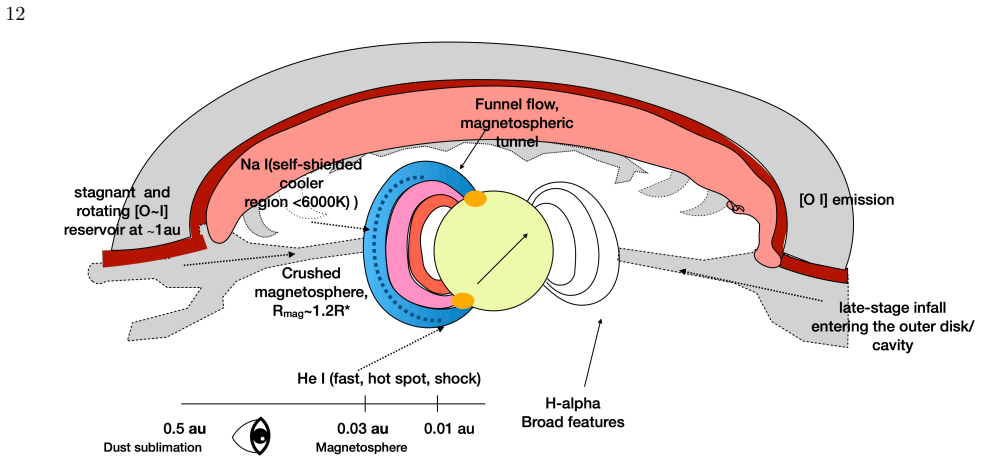
The [O I] emission is centered near the stellar rest velocity with symmetric broadening of ~35 km/s. Restricted to T <= 3800 K, this profile traces a stagnant, gravitationally bound Keplerian gas reservoir at ~1 au. Therefore, it provides strong optical evidence that late-stage infall accumulates in an inner gas reservoir and subsequently feeds the innermost dust cavity. From this reservoir, gas is transported inward and crashes onto the star, driving a highly active accretion rate of dM/dt ~4 x 10^-7 M_sun/yr. The associated ram pressure crushes the stellar magnetosphere to R_mag ~1.2 R_star, which explains the restricted He I free-fall velocities and the highly variable inner wind.
What carries the argument
The symmetric [O I] 6300, 6363 emission line profile, interpreted under the T <= 3800 K restriction as tracing a stagnant Keplerian gas reservoir at ~1 au.
If this is right
- Late-stage infall accumulates in an inner gas reservoir at ~1 au inside the dust cavity.
- Gas from the reservoir is transported inward to drive accretion at dM/dt ~4 x 10^-7 M_sun/yr.
- Ram pressure from the accretion crushes the magnetosphere to R_mag ~1.2 R_star.
- The crushed magnetosphere restricts He I free-fall velocities and produces highly variable inner wind.
- A stable slow H-alpha component traces an extended photoevaporative disk wind.
Where Pith is reading between the lines
- This reservoir mechanism may allow gas to cross planet-carved cavities in other transition disks.
- Similar [O I] observations in additional Herbig Ae systems could test whether such inner reservoirs are common.
- The crushed magnetosphere could alter the star-disk magnetic coupling and affect long-term stellar spin-down.
Load-bearing premise
The symmetric ~35 km/s broadening of the [O I] line, when restricted to T <= 3800 K, corresponds to Keplerian motion in a gravitationally bound reservoir at 1 au without major contributions from other kinematic components or non-thermal effects.
What would settle it
Future spectra showing asymmetric [O I] profiles or velocity widths inconsistent with Keplerian motion at 1 au would falsify the stagnant reservoir interpretation.
Figures

read the original abstract
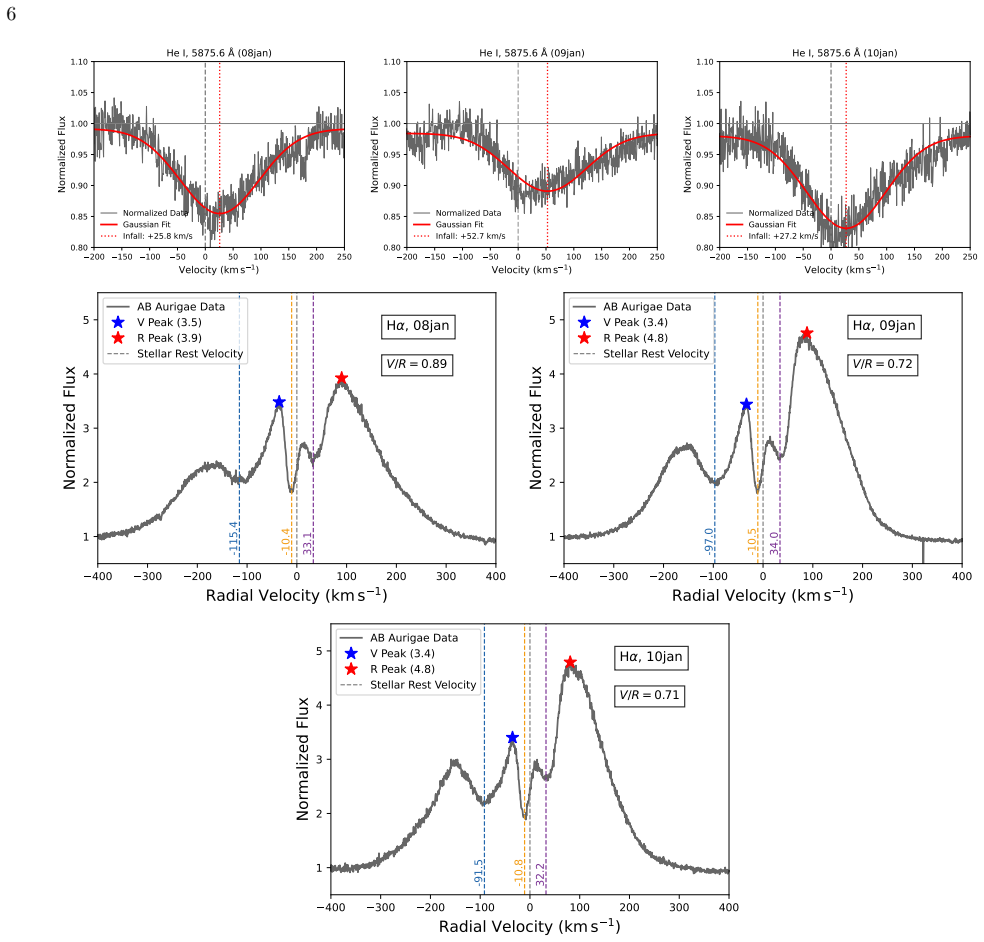
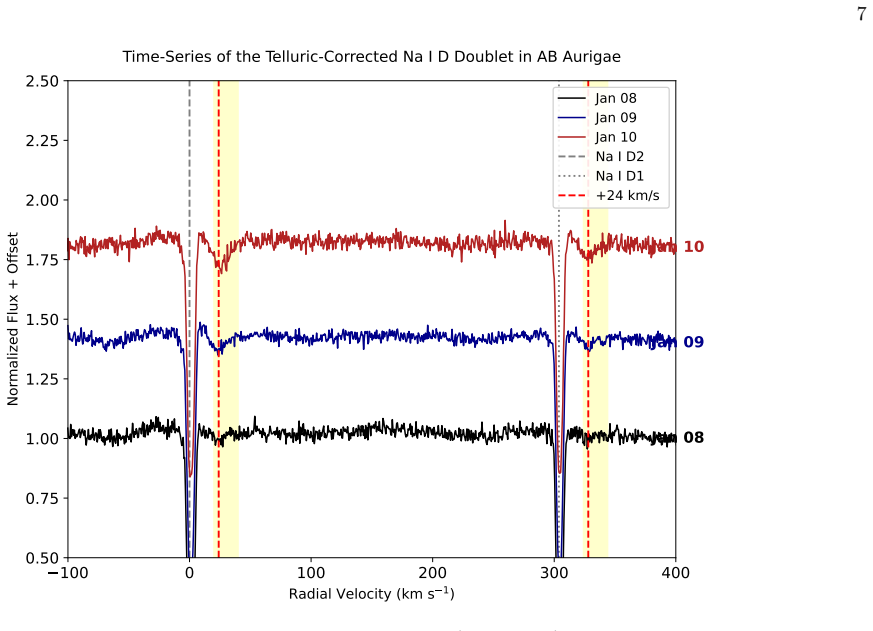
Massive planet-carved cavities in transition disks should theoretically throttle inward gas transport, challenging our understanding of how central stars maintain vigorous accretion. To investigate how macro-scale late-stage infall traverses these gaps, we present multi-epoch, extreme-resolution (R ~ 107,000) PARAS-2 optical spectroscopy of the benchmark Herbig Ae system AB Aurigae. By resolving the kinematics of H-alpha, He I 5876, [O I] 6300, 6363, and Na I D, we map the innermost accretion environment. We find that the [O I] emission is centered near the stellar rest velocity with symmetric broadening of ~ 35 km/s. Restricted to T <= 3800 K, this profile traces a stagnant, gravitationally bound Keplerian gas reservoir at ~ 1 au. Therefore, it provides strong optical evidence that late-stage infall accumulates in an inner gas reservoir and subsequently feeds the innermost dust cavity. From this reservoir, gas is transported inward and crashes onto the star, driving a highly active accretion rate of dM/dt ~ 4 x 10^-7 M_sun/yr. The associated ram pressure crushes the stellar magnetosphere to R_mag ~ 1.2 R_star, which explains the restricted He I free-fall velocities and the highly variable inner wind. We also isolate a stable, slow H-alpha wind component, likely tracing an extended photoevaporative disk wind.
Editorial analysis
A structured set of objections, weighed in public.
Referee Report
Summary. The paper presents multi-epoch, high-resolution (R~107,000) PARAS-2 optical spectroscopy of AB Aurigae, focusing on the kinematics of H-alpha, He I 5876, [O I] 6300/6363, and Na I D lines. The central claim is that the [O I] emission, centered at stellar rest velocity with symmetric ~35 km/s broadening, when restricted to T <= 3800 K, traces a stagnant, gravitationally bound Keplerian gas reservoir at ~1 au. This is interpreted as evidence that late-stage infall accumulates in this inner reservoir, feeds the dust cavity, drives an accretion rate of dM/dt ~4e-7 Msun/yr, and crushes the magnetosphere to R_mag ~1.2 R_star, while also identifying a stable slow H-alpha wind.
Significance. If the kinematic interpretation of the [O I] profile holds, the result would provide direct optical evidence for gas accumulation and transport across cavities in transition disks, addressing how stars sustain high accretion rates despite planet-carved gaps. The high spectral resolution and multi-epoch coverage are strengths that enable detailed line profile analysis, offering testable constraints on inner-disk dynamics and magnetospheric accretion models.
major comments (3)
- [Section on [O I] emission kinematics] The section analyzing the [O I] 6300,6363 line profiles: The assignment of the observed symmetric ~35 km/s broadening (centered at rest velocity) to purely Keplerian rotation at r~1 au under the T<=3800 K restriction assumes negligible non-thermal or turbulent contributions. No explicit calculation is provided showing that the thermal velocity width at 3800 K for [O I] is <<35 km/s or that multi-line excitation constraints independently justify the temperature cutoff; any additional broadening component would increase the inferred radius and undermine the stagnant inner-reservoir interpretation that underpins the late-stage infall and cavity-feeding claims.
- [Section on accretion and magnetosphere] The paragraphs deriving the accretion rate dM/dt ~4 x 10^{-7} M_sun/yr and magnetosphere radius R_mag ~1.2 R_star: These quantities are load-bearing for the ram-pressure crushing argument and the explanation of restricted He I velocities, yet the manuscript provides no explicit formulas, input parameters (e.g., how the reservoir density or velocity is obtained from the line width), or error propagation. The values appear to follow directly from the 1 au reservoir model without independent verification from the observed line fluxes or variability.
- [Methods and results on line profiles] Methods and results sections describing the line profile measurements: The abstract and interpretation cite a specific ~35 km/s width and T<=3800 K restriction, but no quantitative details (e.g., Gaussian or Voigt fits, error bars on the width, or how the temperature restriction is applied to the data) are reported. This absence prevents assessment of whether the profile is demonstrably inconsistent with wind or extended-disk components.
minor comments (2)
- [Abstract and observations section] The abstract states 'multi-epoch' observations but the main text should explicitly state the number of epochs, time baselines, and any detected variability in the [O I] profile to support the 'stagnant' characterization.
- [Throughout] Notation for the accretion rate (dM/dt) and magnetosphere radius (R_mag) should be defined consistently with standard symbols (e.g., Ṁ or Ṁdot) and units clarified in the first use.
Simulated Author's Rebuttal
We thank the referee for their thorough and insightful review. Their comments identify areas where additional quantitative rigor will strengthen the manuscript. We address each point below and have revised the manuscript to incorporate the requested calculations, formulas, and methodological details.
read point-by-point responses
-
Referee: The section analyzing the [O I] 6300,6363 line profiles: The assignment of the observed symmetric ~35 km/s broadening (centered at rest velocity) to purely Keplerian rotation at r~1 au under the T<=3800 K restriction assumes negligible non-thermal or turbulent contributions. No explicit calculation is provided showing that the thermal velocity width at 3800 K for [O I] is <<35 km/s or that multi-line excitation constraints independently justify the temperature cutoff; any additional broadening component would increase the inferred radius and undermine the stagnant inner-reservoir interpretation that underpins the late-stage infall and cavity-feeding claims.
Authors: We agree that an explicit calculation of the thermal broadening is required. For atomic oxygen at 3800 K the thermal velocity is v_th = sqrt(2kT/m) ≈ 1.98 km/s, which is much smaller than the observed 35 km/s width and confirms Keplerian dominance. The T ≤ 3800 K cutoff follows from standard excitation conditions for [O I] in Herbig Ae disks (derived from line ratios and models); we will add this calculation, the temperature justification, and an expanded discussion of why non-thermal or wind contributions are disfavored by the observed symmetry and multi-epoch stability. revision: yes
-
Referee: The paragraphs deriving the accretion rate dM/dt ~4 x 10^{-7} M_sun/yr and magnetosphere radius R_mag ~1.2 R_star: These quantities are load-bearing for the ram-pressure crushing argument and the explanation of restricted He I velocities, yet the manuscript provides no explicit formulas, input parameters (e.g., how the reservoir density or velocity is obtained from the line width), or error propagation. The values appear to follow directly from the 1 au reservoir model without independent verification from the observed line fluxes or variability.
Authors: We acknowledge the need for explicit derivations. The accretion rate is obtained as \dot{M} = M_res / t_orb where M_res is inferred from [O I] luminosity and density consistent with the 35 km/s velocity dispersion; R_mag follows from balancing ram pressure (using velocity and density from the line profile) against magnetic pressure via the standard truncation formula. We will insert the formulas, all input parameters (including how line width supplies velocity), error propagation, and cross-checks against observed He I velocities and line fluxes in the revised text. revision: yes
-
Referee: Methods and results sections describing the line profile measurements: The abstract and interpretation cite a specific ~35 km/s width and T<=3800 K restriction, but no quantitative details (e.g., Gaussian or Voigt fits, error bars on the width, or how the temperature restriction is applied to the data) are reported. This absence prevents assessment of whether the profile is demonstrably inconsistent with wind or extended-disk components.
Authors: We agree that quantitative fitting details must be provided. The 35 km/s width is the average from multi-Gaussian fits to the [O I] 6300 line across epochs, with uncertainties from fit covariance and epoch-to-epoch scatter. The temperature restriction is implemented via excitation diagnostics that exclude higher-T components. In revision we will add a Methods subsection describing the fitting procedure, error analysis, and explicit profile comparisons demonstrating inconsistency with wind or extended-disk models. revision: yes
Circularity Check
No circularity; claims are direct observational inferences
full rationale
The paper's load-bearing steps consist of measuring the [O I] line profile (centered at rest velocity, symmetric ~35 km/s width) from PARAS-2 spectra and interpreting it, under the T <= 3800 K restriction, as emission from bound Keplerian gas at ~1 au. This is a physical mapping from observed kinematics to a radial location using standard orbital velocity relations, not a mathematical derivation, fitted parameter, or self-citation that reduces the result to its own inputs by construction. No equations are presented that equate a prediction back to a fit, and the subsequent inferences (infall accumulation, accretion rate, magnetosphere crushing) follow from this interpretation rather than circularly presupposing it. The analysis is therefore self-contained against external spectroscopic benchmarks.
Axiom & Free-Parameter Ledger
free parameters (3)
- Temperature cutoff =
3800 K
- Accretion rate =
4 x 10^-7 M_sun/yr
- Magnetosphere radius =
1.2 R_star
axioms (2)
- domain assumption [O I] 6300, 6363 emission traces gas at T <= 3800 K in Keplerian orbit
- domain assumption The observed line profile broadening of ~35 km/s corresponds to orbital velocity at 1 au
Reference graph
Works this paper leans on
-
[1]
Acke, B., van den Ancker, M. E., & Dullemond, C. P. 2005, A&A, 436, 209, doi: 10.1051/0004-6361:20042484
-
[2]
Alecian, E., Wade, G. A., Catala, C., et al. 2013, MNRAS, 429, 1001, doi: 10.1093/mnras/sts383
-
[3]
Cieza, L. 2014, in Protostars and Planets VI, ed. H. Beuther, R. S. Klessen, C. P. Dullemond, & T. Henning, 475–496, doi: 10.2458/azu uapress 9780816531240-ch021
work page doi:10.2458/azu 2014
-
[4]
Andrews, S. M., & Williams, J. P. 2005, ApJ, 631, 1134, doi: 10.1086/432712
-
[5]
2024, A&A, 691, A12, doi: 10.1051/0004-6361/202450934
Baliwal, S., Sharma, R., Chakraborty, A., et al. 2024, A&A, 691, A12, doi: 10.1051/0004-6361/202450934
-
[6]
2019, ApJ, 870, 76, doi: 10.3847/1538-4357/aaf1aa
Banzatti, A., Pascucci, I., Edwards, S., et al. 2019, ApJ, 870, 76, doi: 10.3847/1538-4357/aaf1aa
-
[7]
2001, A&A, 366, 945, doi: 10.1051/0004-6361:20000353
Beust, H., Karmann, C., & Lagrange, A.-M. 2001, A&A, 366, 945, doi: 10.1051/0004-6361:20000353
-
[8]
2020, A&A, 637, L5, doi: 10.1051/0004-6361/202038008
Boccaletti, A., Di Folco, E., Pantin, E., et al. 2020, A&A, 637, L5, doi: 10.1051/0004-6361/202038008
-
[9]
1993, A&AS, 101, 629
Bohm, T., & Catala, C. 1993, A&AS, 101, 629
1993
-
[10]
1998, A&A, 340, 163
Bouret, J.-C., & Catala, C. 1998, A&A, 340, 163
1998
-
[11]
2000, A&A, 359, 1011
Bouret, J.-C., & Catala, C. 2000, A&A, 359, 1011
2000
-
[12]
Bouvier, J., Alencar, S. H. P., Harries, T. J., Johns-Krull, C. M., & Romanova, M. M. 2007, in Protostars and Planets V, ed. B. Reipurth, D. Jewitt, & K. Keil, 479, doi: 10.48550/arXiv.astro-ph/0603498
work page internal anchor Pith review Pith/arXiv arXiv doi:10.48550/arxiv.astro-ph/0603498 2007
-
[13]
2004, AJ, 128, 1294, doi: 10.1086/422733
Calvet, N., Muzerolle, J., Brice˜ no, C., et al. 2004, AJ, 128, 1294, doi: 10.1086/422733
-
[14]
Campbell-White, J., Manara, C. F., Benisty, M., et al. 2023, ApJ, 956, 25, doi: 10.3847/1538-4357/acf0c0
-
[15]
Cauley, P. W., & Johns-Krull, C. M. 2014, ApJ, 797, 112, doi: 10.1088/0004-637X/797/2/112
-
[16]
2004, ApJL, 606, L69, doi: 10.1086/421049
Chakraborty, A., Ge, J., & Mahadevan, S. 2004, ApJL, 606, L69, doi: 10.1086/421049
-
[17]
2018, AJ, 156, 3, doi: 10.3847/1538-3881/aac436
Chakraborty, A., Roy, A., Sharma, R., et al. 2018, AJ, 156, 3, doi: 10.3847/1538-3881/aac436
-
[18]
2024, Bulletin de la Societe Royale des Sciences de Liege, 93, 68, doi: 10.25518/0037-9565.11602
Neelam, J., et al. 2024, Bulletin de la Societe Royale des Sciences de Liege, 93, 68, doi: 10.25518/0037-9565.11602
-
[19]
2005, ApJL, 622, L133, doi: 10.1086/429540
Corder, S., Eisner, J., & Sargent, A. 2005, ApJL, 622, L133, doi: 10.1086/429540
-
[20]
Costigan, G., Scholz, A., Stelzer, B., et al. 2012, MNRAS, 427, 1344, doi: 10.1111/j.1365-2966.2012.22008.x
-
[21]
2022, Nature Astronomy, 6, 751, doi: 10.1038/s41550-022-01634-x de Winter, D., Grady, C
Currie, T., Lawson, K., Schneider, G., et al. 2022, Nature Astronomy, 6, 751, doi: 10.1038/s41550-022-01634-x de Winter, D., Grady, C. A., van den Ancker, M. E., P´ erez, M. R., & Eiroa, C. 1999, A&A, 343, 137
-
[22]
2003, ApJ, 590, 357, doi: 10.1086/374979
Nadalin, I. 2003, ApJ, 590, 357, doi: 10.1086/374979
-
[23]
Ercolano, B., & Owen, J. E. 2010, MNRAS, 406, 1553, doi: 10.1111/j.1365-2966.2010.16798.x
-
[24]
2017, Royal Society Open Science, 4, 170114, doi: 10.1098/rsos.170114
Ercolano, B., & Pascucci, I. 2017, Royal Society Open Science, 4, 170114, doi: 10.1098/rsos.170114
-
[25]
Fairlamb, J. R., Oudmaijer, R. D., Mendigut´ ıa, I., Ilee, J. D., & van den Ancker, M. E. 2015, MNRAS, 453, 976, doi: 10.1093/mnras/stv1576
-
[26]
Fairlamb, J. R., Oudmaijer, R. D., Mendigutia, I., Ilee, J. D., & van den Ancker, M. E. 2017, MNRAS, 464, 4721, doi: 10.1093/mnras/stw2643
-
[27]
Ferreira, J., Dougados, C., & Cabrit, S. 2006, A&A, 453, 785, doi: 10.1051/0004-6361:20054231 Garcia Lopez, R., Natta, A., Testi, L., & Habart, E. 2006, A&A, 459, 837, doi: 10.1051/0004-6361:20065575
-
[28]
Gontcharov, G. A. 2006, Astronomy Letters, 32, 759, doi: 10.1134/S1063773706110065
-
[29]
Gorti, U., Hollenbach, D., Najita, J., & Pascucci, I. 2011, ApJ, 735, 90, doi: 10.1088/0004-637X/735/2/90 Guzm´ an-D´ ıaz, J., Mendigut´ ıa, I., Montesinos, B., et al. 2021, A&A, 650, A182, doi: 10.1051/0004-6361/202039519
-
[30]
1995, ApJ, 452, 736, doi: 10.1086/176344
Hartigan, P., Edwards, S., & Ghandour, L. 1995, ApJ, 452, 736, doi: 10.1086/176344
-
[31]
2016, ARA&A, 54, 135, doi: 10.1146/annurev-astro-081915-023347
Hartmann, L., Herczeg, G., & Calvet, N. 2016, ARA&A, 54, 135, doi: 10.1146/annurev-astro-081915-023347
-
[32]
Herbig, G. H. 2007, AJ, 133, 2679, doi: 10.1086/517494
-
[33]
Hubrig, S., Carroll, T. A., Scholler, M., & Ilyin, I. 2015, MNRAS, 449, L118, doi: 10.1093/mnrasl/slv034
-
[34]
2013, ApJ, 767, 112, doi: 10.1088/0004-637X/767/2/112
Ingleby, L., Calvet, N., Herczeg, G., et al. 2013, ApJ, 767, 112, doi: 10.1088/0004-637X/767/2/112
-
[35]
1991, ApJL, 370, L39, doi: 10.1086/185972
Koenigl, A. 1991, ApJL, 370, L39, doi: 10.1086/185972
-
[36]
Kurosawa, R., Harries, T. J., & Symington, N. H. 2006, MNRAS, 370, 580, doi: 10.1111/j.1365-2966.2006.10527.x
-
[37]
Lad, K. A., Prasad, N. J. S. S. V., Bharadwaj, K., et al. 2025, Journal of Astronomical Telescopes, Instruments, and Systems, 11, 045003, doi: 10.1117/1.JATIS.11.4.045003 18
-
[38]
Manara, C. F., Testi, L., Natta, A., et al. 2014, A&A, 568, A18, doi: 10.1051/0004-6361/201323318 Mendigut´ ıa, I., Calvet, N., Montesinos, B., et al. 2011, A&A, 535, A99, doi: 10.1051/0004-6361/201117444 Mendigut´ ıa, I., Mora, A., Montesinos, B., et al. 2012, A&A, 543, A59, doi: 10.1051/0004-6361/201219110 Mendigut´ ıa, I., Campbell-White, J., Montesino...
work page internal anchor Pith review Pith/arXiv arXiv doi:10.1051/0004-6361/201323318 2014
-
[39]
2004, A&A, 419, 225, doi: 10.1051/0004-6361:20040096
Mora, A., Eiroa, C., Natta, A., et al. 2004, A&A, 419, 225, doi: 10.1051/0004-6361:20040096
-
[40]
2001, ApJ, 550, 944, doi: 10.1086/319779
Muzerolle, J., Calvet, N., & Hartmann, L. 2001, ApJ, 550, 944, doi: 10.1086/319779
-
[41]
2004, ApJ, 617, 406, doi: 10.1086/425260
Muzerolle, J., D’Alessio, P., Calvet, N., & Hartmann, L. 2004, ApJ, 617, 406, doi: 10.1086/425260
-
[42]
2020, ApJ, 903, 78, doi: 10.3847/1538-4357/abba3c Pi´ etu, V., Guilloteau, S., & Dutrey, A
Pascucci, I., Banzatti, A., Gorti, U., et al. 2020, ApJ, 903, 78, doi: 10.3847/1538-4357/abba3c Pi´ etu, V., Guilloteau, S., & Dutrey, A. 2005, A&A, 443, 945, doi: 10.1051/0004-6361:20042050
-
[43]
Piskunov, N. E., & Valenti, J. A. 2002, A&A, 385, 1095, doi: 10.1051/0004-6361:20020175
-
[44]
2020, A&A, 639, A11, doi: 10.1051/0004-6361/201936071
Rebollido, I., Eiroa, C., Montesinos, B., et al. 2020, A&A, 639, A11, doi: 10.1051/0004-6361/201936071
-
[45]
Hollenbach, D. 2013, ApJ, 772, 60, doi: 10.1088/0004-637X/772/1/60 Rivi` ere-Marichalar, P., Fuente, A., le Gal, R., et al. 2026, A&A, 707, A348, doi: 10.1051/0004-6361/202556096 Rodr´ ıguez D´ ıaz, L. F., & Oostra, B. 2017, in Revista Mexicana de Astronomia y Astrofisica Conference Series, Vol. 49, Revista Mexicana de Astronomia y Astrofisica Conference ...
-
[46]
2010, A&A, 516, L1, doi: 10.1051/0004-6361/201014720
Rousselet-Perraut, K., Benisty, M., Mourard, D., et al. 2010, A&A, 516, L1, doi: 10.1051/0004-6361/201014720
-
[47]
Salyk, C., Herczeg, G. J., Brown, J. M., et al. 2013, ApJ, 769, 21, doi: 10.1088/0004-637X/769/1/21
-
[48]
arXiv , author =:2105.12942 , journal =
Sharma, R., & Chakraborty, A. 2021, Journal of Astronomical Telescopes, Instruments, and Systems, 7, 038005, doi: 10.1117/1.JATIS.7.3.038005
-
[49]
1994, ApJ, 429, 781, doi: 10.1086/174363
Shu, F., Najita, J., Ostriker, E., et al. 1994, ApJ, 429, 781, doi: 10.1086/174363
-
[50]
P., & Natta, A
Sorelli, C., Grinin, V. P., & Natta, A. 1996, A&A, 309, 155
1996
-
[51]
2024, Nature, 633, 58, doi: 10.1038/s41586-024-07877-0
Speedie, J., Dong, R., Hall, C., et al. 2024, Nature, 633, 58, doi: 10.1038/s41586-024-07877-0
-
[52]
2025, ApJL, 981, L30, doi: 10.3847/2041-8213/adb7d5
Speedie, J., Dong, R., Teague, R., et al. 2025, ApJL, 981, L30, doi: 10.3847/2041-8213/adb7d5
-
[53]
2017, ApJ, 840, 32, doi: 10.3847/1538-4357/aa6af7
Tang, Y.-W., Guilloteau, S., Dutrey, A., et al. 2017, ApJ, 840, 32, doi: 10.3847/1538-4357/aa6af7
-
[54]
Monin, D. 2007, MNRAS, 376, 1145, doi: 10.1111/j.1365-2966.2007.11495.x
-
[55]
Wright, J. T., & Eastman, J. D. 2014, PASP, 126, 838, doi: 10.1086/678541
discussion (0)
Sign in with ORCID, Apple, or X to comment. Anyone can read and Pith papers without signing in.