Velocity-resolved [O I] 63,145 um, [C II] 158 um, and OH line mapping along the Orion BN/KL explosive outflow and irradiated shocks
Pith reviewed 2026-05-20 09:14 UTC · model grok-4.3
The pith
Velocity-resolved [O I] and [C II] maps show Orion BN/KL outflow emission arises from 30-40 km/s dissociative J-type shocks under external UV irradiation.
A machine-rendered reading of the paper's core claim, the machinery that carries it, and where it could break.
Core claim
The [O I] and [C II] intensities are consistent with emission from dissociative J-type shocks with velocities of 30-40 km/s and preshock gas densities of a few 10^4 cm^{-3}, illuminated by external UV radiation generated by surrounding fast shocks and possibly by massive (proto)stars in the region.
What carries the argument
Grids of magnetized dissociative J-type shock models that include external UV irradiation, against which the observed [O I] 63/145 and [O I] 63/[C II] line-wing intensity ratios are compared.
If this is right
- The total [O I] 63 and 145 um luminosity of 86.5 solar luminosities implies an outflow mass-loss rate of (9.1 +/- 2.6) x 10^{-3} solar masses per year.
- The outflow mass is estimated at 3.3 to 5.9 solar masses.
- Postshock gas reaches densities of 10^5 to 10^6 cm^{-3} and temperatures near 500 K.
- The OH 119 um line shows a P-Cygni profile spanning 160 km/s, matching the velocity width of the broadest CO lines.
Where Pith is reading between the lines
- Similar explosive outflows in other young clusters may be identified by searching for comparably high-velocity [O I] components with elevated [O I]/[C II] ratios.
- External UV from overlapping shocks could set the overall cooling and ionization balance across larger portions of the Orion molecular cloud.
- Higher-resolution mapping could isolate emission from individual shock surfaces embedded in the wide-angle outflow.
Load-bearing premise
The high observed line-wing ratios are produced by post-shock gas in magnetized dissociative J-type shocks rather than by UV-pumped PDRs or unresolved multiple velocity components.
What would settle it
Future spectra showing [O I] 63/145 or [O I] 63/[C II] ratios in the line wings that lie well outside the ranges predicted by the 30-40 km/s shock models at a few 10^4 cm^{-3} preshock density with added UV would rule out the shock interpretation.
Figures





read the original abstract
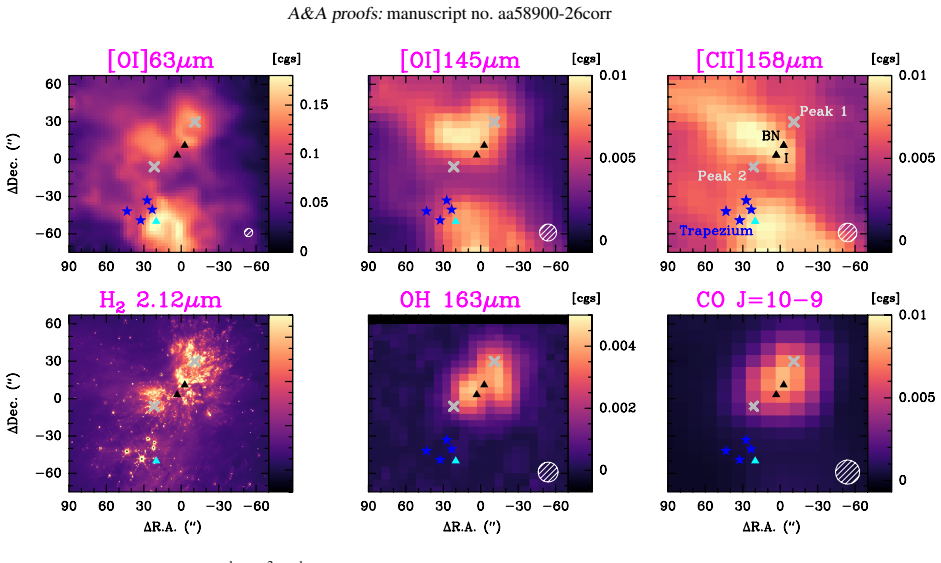
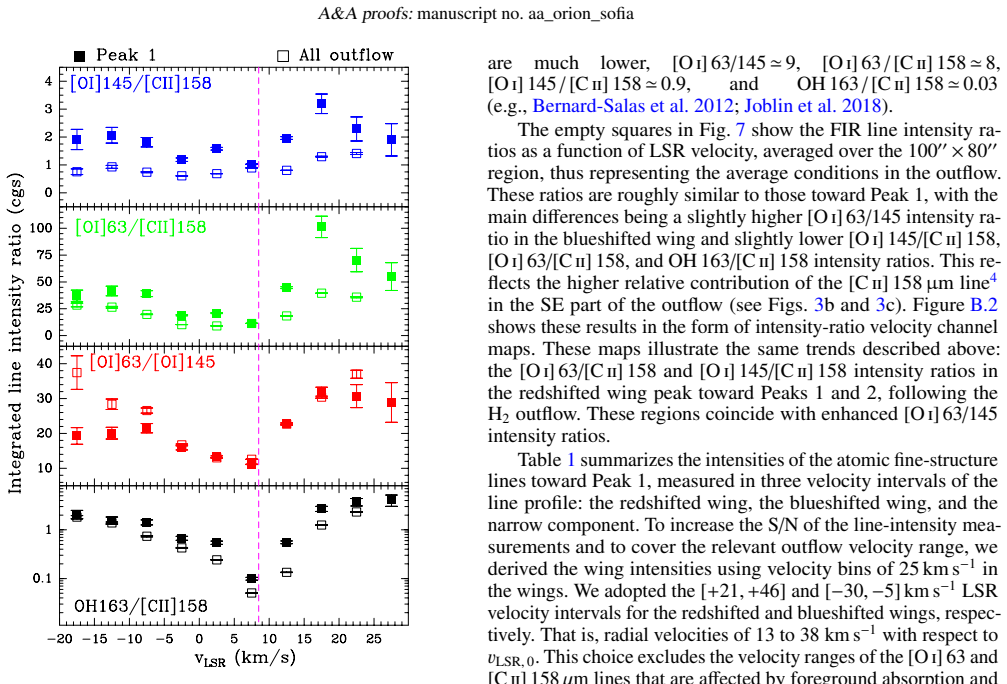
Stellar mergers produce explosive outflows that serve as transient sources of IR line luminosity and inject mechanical energy early into the natal molecular cloud. We present the first velocity-resolved maps of the [O I] 63 and 145 um fine-structure line emission from the wide-angle outflow in Orion BN/KL, the nearest explosive outflow. The data were obtained with SOFIA and include sensitive [C II] 158 um and OH maps. They allowed us to disentangle the quiescent cloud gas from the outflow, traced by a broader [O I] component with a line FWHM of about 20-30 km/s and exhibiting a spatial distribution similar to that of the shock-excited H2 emission seen with JWST. The OH 119 um line shows a prominent P-Cygni profile covering 160 km/s, similar to the very broad CO lines. The total [O I] 63 and 145 line luminosity is remarkably high, 86.5 L_sun, comparable to the H2 and CO line luminosities, implying an outflow mass-loss rate of (9.1+/-2.6)x10^-3 M_sun/yr and a mass of 3.3-5.9 M_sun. The [O I] 63 / 145 and [O I] 63 / [C II] 158 intensity ratios reach very high values in the line wings (20-30 and 40-60, respectively), exceeding those found in PDRs. These ratios are consistent with the presence of dense (10^5 to 10^6 cm^-3 ) and warm (~500 K) postshock gas. We analyzed the fine-structure line-wing intensities using magnetized shock models that include UV irradiation, to which the [C II] 158 line intensity is particularly sensitive. We find that the [O I] and [C II] intensities are consistent with emission from dissociative J-type shocks with velocities of 30-40 km/s and preshock gas densities of a few 10^4 cm^-3, illuminated by external UV radiation generated by surrounding fast shocks and possibly by massive (proto)stars in the region. We also report a broad [O I] emission feature around the BN star, which we attribute to an unresolved outflow or wind bow shock.
Editorial analysis
A structured set of objections, weighed in public.
Referee Report
Summary. The paper presents the first velocity-resolved SOFIA maps of [O I] 63,145 μm, [C II] 158 μm, and OH lines toward the Orion BN/KL explosive outflow. It isolates a broad (FWHM ~20-30 km/s) outflow component whose spatial distribution matches JWST H2 shocks, reports a total [O I] luminosity of 86.5 L⊙, derives an outflow mass-loss rate of (9.1±2.6)×10^{-3} M⊙ yr^{-1}, and shows that the high line-wing ratios ([O I] 63/145 = 20-30; [O I] 63/[C II] = 40-60) are consistent with magnetized dissociative J-type shocks (v_shock = 30-40 km/s, n_pre ~ few×10^4 cm^{-3}) illuminated by external UV from surrounding shocks and/or massive protostars. A broad [O I] feature near BN is also noted.
Significance. If the shock interpretation holds, the work supplies direct observational constraints on the physical conditions and energy injection in the nearest explosive outflow, including quantitative mass-loss and luminosity comparisons to H2 and CO. The velocity-resolved data and explicit model-grid comparison constitute a clear advance over prior unresolved observations. The reported luminosities and ratios are reproducible from the new SOFIA spectra and can be tested against future higher-resolution observations or refined shock grids.
major comments (1)
- [model comparison and line-ratio discussion] The central claim that the observed wing ratios require (or are uniquely matched by) 30-40 km/s dissociative J-shocks rests on the statement that they exceed PDR values. An explicit side-by-side comparison to a PDR grid at the relevant high G0 (generated by surrounding fast shocks) and n = 10^4-10^6 cm^{-3} is not shown; without it, the exclusion of UV-pumped PDR or blended-velocity-component alternatives remains incompletely demonstrated (see the model-analysis paragraph following the ratio measurements).
minor comments (2)
- [Results] The OH 119 μm P-Cygni profile is described as covering 160 km/s; a quantitative comparison of its velocity extent to the CO line wings would strengthen the kinematic linkage.
- [Discussion] Notation for the preshock density range (“a few 10^4 cm^{-3}”) could be made more precise by quoting the exact grid points used in the shock models.
Simulated Author's Rebuttal
We thank the referee for their careful reading of the manuscript and for the positive overall assessment. We address the single major comment below and will incorporate the requested clarification in the revised version.
read point-by-point responses
-
Referee: [model comparison and line-ratio discussion] The central claim that the observed wing ratios require (or are uniquely matched by) 30-40 km/s dissociative J-shocks rests on the statement that they exceed PDR values. An explicit side-by-side comparison to a PDR grid at the relevant high G0 (generated by surrounding fast shocks) and n = 10^4-10^6 cm^{-3} is not shown; without it, the exclusion of UV-pumped PDR or blended-velocity-component alternatives remains incompletely demonstrated (see the model-analysis paragraph following the ratio measurements).
Authors: We agree that an explicit side-by-side comparison to PDR models at high G0 and the relevant densities would make the exclusion of PDR or blended-component interpretations more complete. In the revised manuscript we will add a new panel or table that directly overlays the observed wing ratios ([O I] 63/145 = 20-30 and [O I] 63/[C II] = 40-60) on predictions from standard PDR codes (Meudon PDR and Cloudy) for G0 = 10^4–10^6 and n = 10^4–10^6 cm^{-3}. This comparison will show that even under the strong external UV fields expected from surrounding shocks, PDR models yield [O I] 63/145 ratios below ~10. We will also note that the spatial coincidence with the JWST H2 shocks and the ~20–30 km s^{-1} line widths already argue against significant blending with quiescent PDR gas. These additions will be placed immediately after the ratio measurements. revision: yes
Circularity Check
No significant circularity; central inferences drawn from new observations matched to independent external model grids
full rationale
The paper reports new velocity-resolved SOFIA maps of [O I], [C II] and OH lines and directly compares the observed line-wing intensity ratios (e.g., [O I] 63/145 ≈ 20-30 and [O I] 63/[C II] ≈ 40-60) to published magnetized dissociative J-type shock model grids that incorporate external UV irradiation. These models pre-exist the present observations and are not constructed or fitted from the current dataset; the velocity and density inferences (30-40 km/s, few × 10^4 cm^{-3}) are therefore external benchmarks rather than self-derived quantities. No equations, parameters, or uniqueness theorems are defined in terms of the target results, and no self-citation chain is invoked to close the argument. The derivation chain remains self-contained against external, falsifiable shock-model predictions.
Axiom & Free-Parameter Ledger
free parameters (2)
- shock velocity =
30-40 km/s
- preshock density =
few 10^4 cm^-3
axioms (2)
- domain assumption Line-wing emission arises from postshock gas in dissociative J-type shocks rather than PDR or other mechanisms
- domain assumption External UV radiation field is generated by surrounding fast shocks and massive (proto)stars
Lean theorems connected to this paper
-
IndisputableMonolith/Cost/FunctionalEquation.leanwashburn_uniqueness_aczel unclear?
unclearRelation between the paper passage and the cited Recognition theorem.
We analyzed the fine-structure line-wing intensities using magnetized shock models that include UV irradiation... consistent with emission from dissociative J-type shocks with velocities of 30-40 km s^{-1} and preshock gas densities of a few 10^4 cm^{-3}
-
IndisputableMonolith/Foundation/AlphaCoordinateFixation.leanJ_uniquely_calibrated_via_higher_derivative unclear?
unclearRelation between the paper passage and the cited Recognition theorem.
The [O I] 63/145 and [O I] 63/[C II] 158 intensity ratios reach very high values in the line wings (20-30 and 40-60, respectively)
What do these tags mean?
- matches
- The paper's claim is directly supported by a theorem in the formal canon.
- supports
- The theorem supports part of the paper's argument, but the paper may add assumptions or extra steps.
- extends
- The paper goes beyond the formal theorem; the theorem is a base layer rather than the whole result.
- uses
- The paper appears to rely on the theorem as machinery.
- contradicts
- The paper's claim conflicts with a theorem or certificate in the canon.
- unclear
- Pith found a possible connection, but the passage is too broad, indirect, or ambiguous to say the theorem truly supports the claim.
Reference graph
Works this paper leans on
-
[1]
Internal Velocities in the Orion Nebula: Large Proper-Motion Features. , keywords =. doi:10.1086/341044 , adsurl =
-
[2]
Detection of the CN Zeeman Effect in Molecular Clouds. , keywords =. doi:10.1086/311952 , adsurl =
-
[3]
Magnetic Fields in Molecular Clouds: Observations Confront Theory. , keywords =. doi:10.1086/307483 , adsurl =
-
[4]
Dispersion of Magnetic Fields in Molecular Clouds. II. , keywords =. doi:10.1088/0004-637X/706/2/1504 , archivePrefix =. 0909.5227 , primaryClass =
work page internal anchor Pith review Pith/arXiv arXiv doi:10.1088/0004-637x/706/2/1504
-
[5]
Soviet Physics Doklady , year = 1971, month = mar, volume =
A Model of the Interaction of the Solar Wind with the Interstellar Medium. Soviet Physics Doklady , year = 1971, month = mar, volume =
work page 1971
-
[6]
Exact Analytic Solutions for Stellar Wind Bow Shocks. , keywords =. doi:10.1086/309939 , adsurl =
-
[7]
The Becklin-Neugebauer Object as a Runaway B Star, Ejected 4000 years ago from the theta^1C system
The Becklin-Neugebauer Object as a Runaway B Star, Ejected 4000 Years Ago from the ^ 1 Orionis C System. , keywords =. doi:10.1086/421721 , archivePrefix =. astro-ph/0401552 , primaryClass =
work page internal anchor Pith review Pith/arXiv arXiv doi:10.1086/421721
-
[8]
Proper Motions of the BN Object and the Radio Source I in Orion: Where and When Did the BN Object Become a Runaway Star?. , keywords =. doi:10.1086/432052 , archivePrefix =. astro-ph/0504134 , primaryClass =
work page internal anchor Pith review Pith/arXiv arXiv doi:10.1086/432052
-
[9]
Structure of the Source I Disk in Orion-KL. , keywords =. doi:10.3847/1538-4357/ac391b , archivePrefix =. 2110.13838 , primaryClass =
-
[10]
The JCMT BISTRO Survey: The magnetic field strength in the Orion A filament
The JCMT BISTRO Survey: The Magnetic Field Strength in the Orion A Filament. , keywords =. doi:10.3847/1538-4357/aa80e5 , archivePrefix =. 1707.05269 , primaryClass =
work page internal anchor Pith review Pith/arXiv arXiv doi:10.3847/1538-4357/aa80e5
-
[11]
Low velocity shocks: signatures of turbulent dissipation in diffuse irradiated gas
Low-velocity shocks: signatures of turbulent dissipation in diffuse irradiated gas. , keywords =. doi:10.1051/0004-6361/201219928 , archivePrefix =. 1301.7598 , primaryClass =
work page internal anchor Pith review Pith/arXiv arXiv doi:10.1051/0004-6361/201219928
-
[12]
Models of irradiated molecular shocks
Models of irradiated molecular shocks. , keywords =. doi:10.1051/0004-6361/201834248 , archivePrefix =. 1901.04273 , primaryClass =
work page internal anchor Pith review Pith/arXiv arXiv doi:10.1051/0004-6361/201834248 1901
-
[13]
Shocks in the warm neutral medium. I. Theoretical model. , keywords =. doi:10.1051/0004-6361/202349067 , archivePrefix =. 2404.19533 , primaryClass =
-
[14]
Interstellar radiation field and dust temperatures in the diffuse interstellar medium and in giant molecular clouds. , keywords =
-
[15]
Small Protoplanetary Disks in the Orion Nebula Cluster and OMC1 with ALMA. , keywords =. doi:10.3847/1538-4357/ac29c2 , archivePrefix =. 2109.14592 , primaryClass =
-
[16]
The Orion Protostellar Explosion and Runaway Stars Revisited: Stellar Masses, Disk Retention, and an Outflow from the Becklin-Neugebauer Object. , keywords =. doi:10.3847/1538-4357/ab65f2 , archivePrefix =. 2001.00899 , primaryClass =
-
[17]
The circumstellar and nebular environment of the Becklin-Neugebauer object : lambda=2-5 micron spectroscopy. , keywords =. doi:10.1086/161526 , adsurl =
-
[18]
, year = 2005, month = sep, volume =
A circumstellar disk associated with a massive protostellar object. , year = 2005, month = sep, volume =. doi:10.1038/nature04012 , adsurl =
-
[19]
ALMA and VLA observations of recombination lines and continuum toward the Becklin-Neugebauer object in Orion. , keywords =. doi:10.1051/0004-6361/201220330 , archivePrefix =. 1210.1413 , primaryClass =
work page internal anchor Pith review Pith/arXiv arXiv doi:10.1051/0004-6361/201220330
-
[20]
Proper motions and distances of H2O maser sources. I. The outflow in Orion-KL. , keywords =. doi:10.1086/158764 , adsurl =
-
[21]
Kinematics of Orion-KL - Aperture synthesis maps of 86 GHz SO emission. , keywords =. doi:10.1086/160197 , adsurl =
-
[22]
The Ionized Circumstellar Envelopes of Orion Source I and the Becklin Neugebauer Object
The Ionized Circumstellar Envelopes of Orion Source I and the Becklin-Neugebauer Object. , keywords =. doi:10.1088/0004-637X/765/1/40 , archivePrefix =. 1211.0085 , primaryClass =
work page internal anchor Pith review Pith/arXiv arXiv doi:10.1088/0004-637x/765/1/40
-
[23]
Monitoring the Large Proper Motions of Radio Sources in the Orion BN/KL Region
Monitoring the Large Proper Motions of Radio Sources in the Orion BN/KL Region. , keywords =. doi:10.1086/590229 , archivePrefix =. 0805.3650 , primaryClass =
work page internal anchor Pith review Pith/arXiv arXiv doi:10.1086/590229
-
[24]
Self-generated ultraviolet radiation in molecular shock waves. I. Effects of Lyman , Lyman , and two-photon continuum. , keywords =. doi:10.1051/0004-6361/202038644 , archivePrefix =. 2010.01042 , primaryClass =
-
[25]
Self-generated ultraviolet radiation in molecular shock waves. II. CH ^ + and the interpretation of emission from shock ensembles. , keywords =. doi:10.1051/0004-6361/202141487 , archivePrefix =. 2111.14089 , primaryClass =
-
[26]
A 10,000 Years Old Explosion in DR21
A 10,000 Year Old Explosion in DR21. , keywords =. doi:10.1088/2041-8205/765/2/L29 , archivePrefix =. 1302.0208 , primaryClass =
work page internal anchor Pith review Pith/arXiv arXiv doi:10.1088/2041-8205/765/2/l29 2041
-
[27]
SOFIA FIFI-LS spectroscopy of DR21 Main: Energetics of the spatially resolved outflow from a high-mass protostar. , keywords =. doi:10.1051/0004-6361/202453109 , archivePrefix =. 2503.15059 , primaryClass =
-
[28]
Water in star-forming regions with Herschel (WISH). IV. A survey of low-J H _ 2 O line profiles toward high-mass protostars. , keywords =. doi:10.1051/0004-6361/201220976 , archivePrefix =. 1304.2949 , primaryClass =
work page internal anchor Pith review Pith/arXiv arXiv doi:10.1051/0004-6361/201220976
-
[29]
Spectroscopically resolved far-IR observations of the massive star-forming region G5.89--0.39
Spectroscopically resolved far-IR observations of the massive star-forming region G5.89-0.39. , keywords =. doi:10.1051/0004-6361/201526466 , archivePrefix =. 1510.00366 , primaryClass =
work page internal anchor Pith review Pith/arXiv arXiv doi:10.1051/0004-6361/201526466
-
[30]
Confirming the Explosive Outflow in G5.89 with ALMA. , keywords =. doi:10.3847/2041-8213/abbd3f , archivePrefix =. 2010.13835 , primaryClass =
-
[31]
An Explosive Outflow in IRAS 12326-6245 Revealed by ALMA
One, Two, Three ... An Explosive Outflow in IRAS 12326-6245 Revealed by ALMA. , keywords =. doi:10.3847/2041-8213/acfe71 , archivePrefix =. 2309.11386 , primaryClass =
-
[32]
Shock excitation of H _ 2 in the James Webb Space Telescope era. , keywords =. doi:10.1051/0004-6361/202346254 , archivePrefix =. 2307.04178 , primaryClass =
-
[33]
Very High Excitation Lines of H$_{2}$ in the Orion Molecular Cloud Outflow
Very High Excitation Lines of H2 in the Orion Molecular Cloud Outflow. , keywords =. doi:10.3847/1538-4357/aa619e , archivePrefix =. 1702.06184 , primaryClass =
work page internal anchor Pith review Pith/arXiv arXiv doi:10.3847/1538-4357/aa619e
-
[34]
The Orion fingers: H$_2$ temperatures and excitation in an explosive outflow
The Orion Fingers: H _ 2 Temperatures and Excitation in an Explosive Outflow. , keywords =. doi:10.3847/1538-4357/aab4f4 , archivePrefix =. 1803.01903 , primaryClass =
work page internal anchor Pith review Pith/arXiv arXiv doi:10.3847/1538-4357/aab4f4
-
[35]
Massive molecular outflows and negative feedback in ULIRGs observed by Herschel-PACS
Massive Molecular Outflows and Negative Feedback in ULIRGs Observed by Herschel-PACS. , keywords =. doi:10.1088/2041-8205/733/1/L16 , archivePrefix =. 1105.1731 , primaryClass =
work page internal anchor Pith review Pith/arXiv arXiv doi:10.1088/2041-8205/733/1/l16 2041
-
[36]
Molecular outflows in local ULIRGs: energetics from multi-transition OH analysis
Molecular Outflows in Local ULIRGs: Energetics from Multitransition OH Analysis. , keywords =. doi:10.3847/1538-4357/836/1/11 , archivePrefix =. 1612.08181 , primaryClass =
work page internal anchor Pith review Pith/arXiv arXiv doi:10.3847/1538-4357/836/1/11
-
[37]
A far-infrared molecular and atomic line survey of the Orion KL region. , keywords =. doi:10.1111/j.1365-2966.2006.10518.x , archivePrefix =. astro-ph/0605410 , primaryClass =
-
[38]
Far-infrared emission lines of CO and OH in the Orion-KL molecular shock. , keywords =. doi:10.1086/163612 , adsurl =
-
[39]
Excitation conditions in the Orion molecular cloud obtained from observations of ortho- and para-lines of H \ 2\. , keywords =. doi:10.1051/0004-6361:20065786 , adsurl =
-
[40]
Observational 2D model of H _ 2 emission from a bow shock in the Orion Molecular Cloud. , keywords =. doi:10.1051/0004-6361:20078100 , adsurl =
-
[41]
Mass loss rates from protostars and Ol(63 m) shock luminosities. , keywords =. doi:10.1016/0019-1035(85)90151-4 , adsurl =
-
[42]
Observations of [Si ii] (35 Micron) and [S i] (25 Micron) in Orion: Evidence for a Wind Shock near IRc2. , keywords =. doi:10.1086/170144 , adsurl =
-
[43]
Submillimeter Continuum Observations of NGC 7538. , keywords =. doi:10.1086/379646 , adsurl =
-
[44]
Millimeter interferometry of W3 IRS5: A Trapezium in the making
Millimeter interferometry of W3 IRS5: a trapezium in the making. , keywords =. doi:10.1051/0004-6361:200810158 , archivePrefix =. 0809.0292 , primaryClass =
work page internal anchor Pith review Pith/arXiv arXiv doi:10.1051/0004-6361:200810158
-
[45]
Excitation of O I and C I forbidden-line fine structure transitions by He and H2 - A neglected selection rule. , keywords =. doi:10.1093/mnras/228.1.101 , adsurl =
-
[46]
A new mid-infrared map of the BN/KL region using the Keck telescope
A New Mid-Infrared Map of the BN/KL Region Using the Keck Telescope. , keywords =. doi:10.1086/421373 , archivePrefix =. astro-ph/0404115 , primaryClass =
work page internal anchor Pith review Pith/arXiv arXiv doi:10.1086/421373
-
[47]
Identifying the outflow driving sources in Orion-KL
Identifying the Outflow Driving Sources in Orion-KL. , keywords =. doi:10.1086/589330 , archivePrefix =. 0804.2539 , primaryClass =
work page internal anchor Pith review Pith/arXiv arXiv doi:10.1086/589330
-
[48]
A JWST survey of the Trapezium Cluster & inner Orion Nebula. I. Observations & overview. arXiv e-prints , keywords =. doi:10.48550/arXiv.2310.03552 , archivePrefix =. 2310.03552 , primaryClass =
-
[49]
The OMC-1 molecular hydrogen outflow as a fragmented stellar wind bubble
The OMC-1 Molecular Hydrogen Outflow as a Fragmented Stellar Wind Bubble. , keywords =. doi:10.1086/118261 , archivePrefix =. astro-ph/9611058 , primaryClass =
work page internal anchor Pith review Pith/arXiv arXiv doi:10.1086/118261
-
[50]
Explosive ejection of matter associated with star formation in the Orion nebula. , keywords =. doi:10.1038/363054a0 , adsurl =
-
[51]
Detection of shocked atomic gas in the Kleinmann-Low nebula. , keywords =. doi:10.1086/184310 , adsurl =
-
[52]
A 3D view of the outflow in the Orion Molecular Cloud 1 (OMC-1)
A 3D view of the outflow in the Orion Molecular Cloud 1 (<ASTROBJ>OMC-1</ASTROBJ>). , keywords =. doi:10.1051/0004-6361/201117495 , archivePrefix =. 1203.3056 , primaryClass =
work page internal anchor Pith review Pith/arXiv arXiv doi:10.1051/0004-6361/201117495
-
[53]
A Multi-epoch Study of the Radio Continuum Emission of Orion Source. I. Constraints on the Disk Evolution of a Massive YSO and the Dynamical History of Orion BN/KL. , keywords =. doi:10.1088/0004-637X/728/1/15 , archivePrefix =. 1011.3799 , primaryClass =
work page internal anchor Pith review Pith/arXiv arXiv doi:10.1088/0004-637x/728/1/15
-
[54]
A model for the intense molecular line emission from OMC-1. , keywords =. doi:10.1086/183854 , adsurl =
-
[55]
High-velocity molecular jets. , keywords =. doi:10.1086/162397 , adsurl =
-
[56]
New members of the infrared cluster in the Orion molecular cloud. , keywords =. doi:10.1086/113272 , adsurl =
-
[57]
What is Powering the Orion Kleinmann-Low Infrared Nebula?. , keywords =. doi:10.1086/187913 , adsurl =
-
[58]
FEEDBACK: a SOFIA Legacy Program to Study Stellar Feedback in Regions of Massive Star Formation. , keywords =. doi:10.1088/1538-3873/aba840 , archivePrefix =. 2009.08730 , primaryClass =
-
[59]
Modeling Collisional Excitation of [O I] Fine Structure Line Emission from PDRs. I. Homogeneous Clouds. , keywords =. doi:10.3847/1538-4357/ab535e , adsurl =
-
[60]
Far-Infrared OH fluorescent emission in Sagittarius B2
Far-Infrared OH Fluorescent Emission in Sagittarius B2. , keywords =. doi:10.1086/343062 , archivePrefix =. astro-ph/0207498 , primaryClass =
work page internal anchor Pith review Pith/arXiv arXiv doi:10.1086/343062
-
[61]
Far-Infrared detection of neutral atomic oxygen toward the Horsehead Nebula
Far-Infrared Detection of Neutral Atomic Oxygen Toward the Horsehead Nebula. , keywords =. doi:10.1088/0004-637X/699/2/L165 , archivePrefix =. 0906.0691 , primaryClass =
work page internal anchor Pith review Pith/arXiv arXiv doi:10.1088/0004-637x/699/2/l165
-
[62]
Fine-structure relaxation of O( ^ 3 P) induced by collisions with He, H and H _ 2. , keywords =. doi:10.1093/mnras/stx2907 , adsurl =
-
[63]
Fast Molecular Shocks. II. Emission from Fast Dissociative Shocks. , keywords =. doi:10.1086/167794 , adsurl =
-
[64]
Spatial variation of the cooling lines in the Orion Bar from Herschel/PACS
Spatial variation of the cooling lines in the Orion Bar from Herschel/PACS. , keywords =. doi:10.1051/0004-6361/201118083 , archivePrefix =. 1111.3653 , primaryClass =
work page internal anchor Pith review Pith/arXiv arXiv doi:10.1051/0004-6361/201118083
-
[65]
Molecule Formation and Infrared Emission in Fast Interstellar Shocks. III. Results for J Shocks in Molecular Clouds. , keywords =. doi:10.1086/167595 , adsurl =
-
[66]
First Science Observations with SOFIA/FORCAST: 6 to 37 micron Imaging of the Central Orion Nebula
First Science Observations with SOFIA/FORCAST: 6-37 m Imaging of the Central Orion Nebula. , keywords =. doi:10.1088/2041-8205/749/2/L22 , archivePrefix =. 1202.4479 , primaryClass =
work page internal anchor Pith review Pith/arXiv arXiv doi:10.1088/2041-8205/749/2/l22 2041
-
[67]
First Science Observations with SOFIA/FORCAST: 6 TO 37 micron Imaging of Orion BN/KL
First Science Observations with SOFIA/FORCAST: 6-37 m Imaging of Orion BN/KL. , keywords =. doi:10.1088/2041-8205/749/2/L23 , archivePrefix =. 1202.4802 , primaryClass =
work page internal anchor Pith review Pith/arXiv arXiv doi:10.1088/2041-8205/749/2/l23 2041
-
[68]
The Water Vapor Abundance in Orion KL Outflows
The Water Vapor Abundance in Orion KL Outflows. , keywords =. doi:10.1086/508259 , archivePrefix =. astro-ph/0608336 , primaryClass =
work page internal anchor Pith review Pith/arXiv arXiv doi:10.1086/508259
-
[69]
Reversed Far-Infrared Line Emission from OH in Orion. , keywords =. doi:10.1086/185589 , adsurl =
-
[70]
O$_2$ Emission Toward Orion H$_2$ Peak 1 and the Role of FUV-Illuminated C-Shocks
O _ 2 Emission toward Orion H _ 2 Peak 1 and the Role of FUV-illuminated C-shocks. , keywords =. doi:10.1088/0004-637X/806/2/227 , archivePrefix =. 1505.03909 , primaryClass =
work page internal anchor Pith review Pith/arXiv arXiv doi:10.1088/0004-637x/806/2/227
-
[71]
Further Observations of Rotationally Excited Far-Infrared 16OH and 18OH Emission in Orion-KL: Tighter Constraints on the Nature of the Emitting Region. , keywords =. doi:10.1086/168224 , adsurl =
-
[72]
Far-IR Excited OH Lines from Orion KL Outflows
Far-Infrared Excited Hydroxyl Lines from Orion KL Outflows. , keywords =. doi:10.1086/503799 , archivePrefix =. astro-ph/0603077 , primaryClass =
work page internal anchor Pith review Pith/arXiv arXiv doi:10.1086/503799
-
[73]
Interpretation of Rotationally Excited Far-Infrared OH Emission in Orion-KL. , keywords =. doi:10.1086/165649 , adsurl =
-
[74]
Explosive Disintegration of a Massive Young Stellar System in Orion
Explosive Disintegration of a Massive Young Stellar System in Orion. , keywords =. doi:10.1088/0004-637X/704/1/L45 , archivePrefix =. 0907.3945 , primaryClass =
work page internal anchor Pith review Pith/arXiv arXiv doi:10.1088/0004-637x/704/1/l45
-
[75]
The Orion Fingers: Near-IR Adaptive Optics Imaging of an Explosive Protostellar Outflow
The Orion fingers: Near-IR adaptive optics imaging of an explosive protostellar outflow. , keywords =. doi:10.1051/0004-6361/201425073 , archivePrefix =. 1502.04711 , primaryClass =
work page internal anchor Pith review Pith/arXiv arXiv doi:10.1051/0004-6361/201425073
-
[76]
An atomic and molecular database for analysis of submillimetre line observations
An atomic and molecular database for analysis of submillimetre line observations. , keywords =. doi:10.1051/0004-6361:20041729 , archivePrefix =. astro-ph/0411110 , primaryClass =
work page internal anchor Pith review Pith/arXiv arXiv doi:10.1051/0004-6361:20041729
-
[77]
IEEE Transactions on Terahertz Science and Technology , keywords =
4GREAT A Four-Color Receiver for High-Resolution Airborne Terahertz Spectroscopy. IEEE Transactions on Terahertz Science and Technology , keywords =. doi:10.1109/TTHZ.2020.3042714 , archivePrefix =. 2012.05106 , primaryClass =
-
[78]
The first-light APEX submillimeter heterodyne instrument FLASH. , keywords =. doi:10.1051/0004-6361:20065413 , adsurl =
-
[79]
GREAT: the SOFIA high-frequency heterodyne instrument
GREAT: the SOFIA high-frequency heterodyne instrument. , keywords =. doi:10.1051/0004-6361/201218811 , archivePrefix =. 1203.2845 , primaryClass =
work page internal anchor Pith review Pith/arXiv arXiv doi:10.1051/0004-6361/201218811
-
[80]
GREAT/SOFIA atmospheric calibration
GREAT/SOFIA atmospheric calibration. , keywords =. doi:10.1051/0004-6361/201218925 , archivePrefix =. 1203.1661 , primaryClass =
work page internal anchor Pith review Pith/arXiv arXiv doi:10.1051/0004-6361/201218925
discussion (0)
Sign in with ORCID, Apple, or X to comment. Anyone can read and Pith papers without signing in.