Inverse-squeezing receivers for squeezed-state pulse-position modulation under ideal and phase-diffusion conditions
Pith reviewed 2026-07-01 04:59 UTC · model grok-4.3
The pith
Inverse squeezing maps squeezed-state PPM into an equivalent high-energy coherent-state PPM, giving a closed-form error probability.
A machine-rendered reading of the paper's core claim, the machinery that carries it, and where it could break.
Core claim
In the ideal case, inverse squeezing maps S-PPM into an equivalent coherent-state PPM signal with a large pulse energy, leading to a closed-form expression for the receiver error probability. The same receiver is then analyzed under common phase diffusion by a finite-path MAP rule that uses phase-averaged likelihoods. Numerical results show that IS-CPN outperforms conventional CPN under the same energy constraint and remains advantageous under phase noise and finite photon-number resolution.
What carries the argument
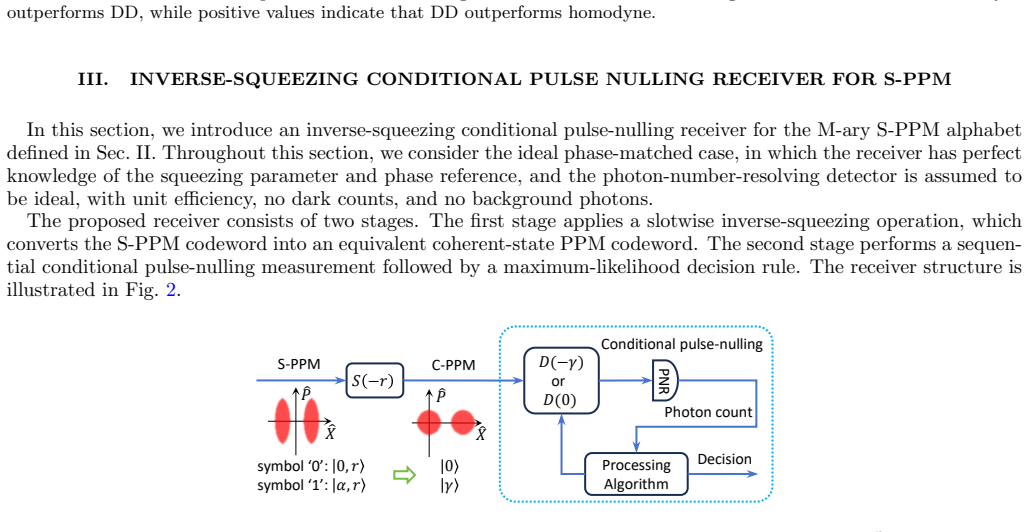
The inverse-squeezing conditional pulse-nulling (IS-CPN) receiver, which applies an inverse-squeezing operation to convert the incoming S-PPM waveform into an equivalent coherent-state PPM waveform before performing conditional nulling.
If this is right
- A closed-form error probability is available for the ideal IS-CPN receiver.
- IS-CPN achieves lower error rates than conventional CPN at identical average energy.
- The performance advantage persists when common phase diffusion is present.
- The advantage also persists when the detector has only finite photon-number resolution.
Where Pith is reading between the lines
- The same inverse-squeezing step could be applied to other squeezed-state modulation formats to obtain analytic performance bounds.
- Laboratory tests with existing squeezed-light sources would directly check whether the ideal-case gain survives realistic squeezing efficiency and loss.
- The mapping suggests that photon-efficient links could be built by trading squeezing for higher effective pulse energy without increasing transmitted power.
Load-bearing premise
Ideal noiseless squeezing and perfect inverse-squeezing operations are required for the exact mapping to an equivalent coherent-state PPM with boosted energy.
What would settle it
Measure the symbol-error probability of an IS-CPN receiver on laboratory squeezed vacuum and displaced squeezed states at known mean photon number; any statistically significant deviation from the closed-form expression derived under the ideal mapping would falsify the central equivalence.
Figures




read the original abstract
We introduce a squeezed-state pulse-position modulation (S-PPM) format, where the empty slots are squeezed vacuum states and the pulse slot is a displaced squeezed state. Based on this property, we propose an inverse-squeezing conditional pulse-nulling (IS-CPN) receiver. In the ideal case, inverse squeezing maps S-PPM into an equivalent coherent-state PPM signal with a large pulse energy, leading to a closed-form expression for the receiver error probability. We further analyze IS-CPN under common phase diffusion using a finite-path MAP formulation with phase-averaged likelihoods. Numerical results show that IS-CPN outperforms conventional CPN under the same energy constraint and remains advantageous under phase noise and finite photon-number resolution. These results demonstrate that combining squeezed-state modulation with inverse-squeezing conditional nulling can improve photon-efficient optical communication.
Editorial analysis
A structured set of objections, weighed in public.
Referee Report
Summary. The paper introduces squeezed-state pulse-position modulation (S-PPM), with the pulse slot as a displaced squeezed state and empty slots as squeezed vacuum. It proposes an inverse-squeezing conditional pulse-nulling (IS-CPN) receiver. In the ideal case, inverse squeezing maps S-PPM to equivalent coherent-state PPM with large pulse energy, yielding a closed-form receiver error probability. The analysis extends to phase diffusion via a finite-path MAP formulation using phase-averaged likelihoods. Numerical results indicate that IS-CPN outperforms conventional CPN under identical energy constraints and retains advantages under phase noise and finite photon-number resolution.
Significance. If the ideal-case mapping is rigorously established, the work advances photon-efficient optical communication by combining squeezed-state modulation with receiver-side inverse squeezing. The closed-form error probability provides analytical utility, and the MAP treatment of phase diffusion addresses a realistic impairment. Numerical comparisons under phase noise and finite resolution strengthen the practical implications. Credit is given for the explicit ideal-case derivation leading to the closed-form expression and for the reproducible numerical evaluation across conditions.
major comments (1)
- [ideal-case mapping and closed-form derivation] The central claim of a closed-form error probability rests on the exact mapping under ideal inverse squeezing (abstract). The derivation must explicitly compute the post-inverse-squeezing states for the displaced squeezed pulse slot and the squeezed-vacuum empty slots to confirm reduction to standard coherent-state PPM (with the stated large pulse energy) without residual squeezing or mismatch terms; any unaccounted deviation would invalidate the closed-form expression.
minor comments (1)
- Notation for the squeezing parameter r and the inverse-squeezing operation should be introduced with explicit definitions before the mapping is invoked.
Simulated Author's Rebuttal
We thank the referee for their thorough review and for highlighting the need for greater explicitness in the ideal-case derivation. We address the single major comment below and will incorporate the requested details in the revision.
read point-by-point responses
-
Referee: [ideal-case mapping and closed-form derivation] The central claim of a closed-form error probability rests on the exact mapping under ideal inverse squeezing (abstract). The derivation must explicitly compute the post-inverse-squeezing states for the displaced squeezed pulse slot and the squeezed-vacuum empty slots to confirm reduction to standard coherent-state PPM (with the stated large pulse energy) without residual squeezing or mismatch terms; any unaccounted deviation would invalidate the closed-form expression.
Authors: We agree that an explicit computation of the post-inverse-squeezing states strengthens the rigor of the central claim. In the revised manuscript we will add a dedicated paragraph (new subsection 2.1) that applies the inverse squeezing operator S(-r) to both the displaced squeezed state |α, r⟩ (pulse slot) and the squeezed vacuum |0, r⟩ (empty slots). This yields a coherent state |α e^r⟩ for the pulse slot (with effective energy scaled by the squeezing factor) and the vacuum state |0⟩ for the empty slots, with no residual squeezing or mismatch terms remaining under ideal conditions. The resulting signal is therefore exactly equivalent to coherent-state PPM with large pulse energy, directly justifying the closed-form error-probability expression already stated in the paper. We will also include the corresponding operator algebra steps for reproducibility. revision: yes
Circularity Check
No significant circularity; derivation relies on standard quantum optics mapping
full rationale
The paper's central claim derives a closed-form error probability by applying the inverse-squeezing operator to map ideal S-PPM (displaced squeezed pulse + squeezed vacuum) onto an equivalent coherent-state PPM whose energy then invokes the known PPM formula. This step is constructed from the definitions of the squeezing operator and displacement operator under the explicit ideal (lossless, matched-r) assumption stated in the abstract; it does not reduce to a fitted parameter, a self-citation chain, or an ansatz imported from the authors' prior work. No load-bearing step in the given text equates a prediction to its own input by construction, and the numerical comparisons under phase diffusion use a separate finite-path MAP formulation. The derivation is therefore self-contained against external quantum-optics benchmarks.
Axiom & Free-Parameter Ledger
axioms (2)
- standard math Squeezed vacuum and displaced squeezed states obey the standard bosonic commutation relations and can be transformed by ideal squeezing operators.
- domain assumption Phase diffusion can be modeled by a finite-path average over discrete phase values in the MAP detector.
Reference graph
Works this paper leans on
-
[1]
=|⟨0|0, r⟩| 2 = 1 coshr , v0 =p(n̸= 0|H ′
-
[2]
= 1−u 0, u1 =p(n= 0|H ′
-
[3]
=|⟨0|α, r⟩| 2 = 1 coshr exp −α2 (1 + tanhr) , v1 =p(n̸= 0|H ′
-
[4]
(13) Sinceu 1 < u0 for anyα >0, one hasv 1 > v0
= 1−u 1. (13) Sinceu 1 < u0 for anyα >0, one hasv 1 > v0. Therefore, under equal priors, the MAP rule reduces to the following intuitive decision strategy: if at least one slot clicks, choose uniformly among the clicked slots; if no slot clicks, choose uniformly among allMhypotheses. Without loss of generality, suppose the true hypothesis isH 1, so that t...
-
[5]
= 1√2πVx exp − x2 2Vx , p(x|H ′
-
[6]
no-click
= 1√2πVx exp −(x−α) 2 2Vx ,(17) whereV x = 1 4 e−2r. For equal priors, the optimal threshold isx=α/2. The false-alarm and miss probabilities are then identical and are given by ϵ=Q α/2√Vx =Q(αe r) =Q p Neff = 1 2 erfc r Neff 2 ! (18) whereQ(·) is the standard Gaussian Q-function. Then we adopt the following classical post-processing rule: if exactly one s...
-
[7]
= Z R pσϕ(ϕ)p(x|H ′ 0, ϕ) dϕ, ¯p(x|H′
-
[8]
(45) Letx th be the single-slot decision threshold
= Z R pσϕ(ϕ)p(x|H ′ 1, ϕ) dϕ. (45) Letx th be the single-slot decision threshold. The receiver declares the slot to be a pulse slot whenx > x th, and declares it to be an empty slot otherwise. The corresponding false-alarm and miss probabilities are pF (xth) = Z ∞ xth ¯p(x|H′
-
[9]
dx= Z R pσϕ(ϕ)Q xthp Vϕ ! dϕ, pM(xth) = Z xth −∞ ¯p(x|H′
-
[10]
(46) Unlike the ideal phase-matched case, these two probabilities are generally not equal
dx= Z R pσϕ(ϕ)Q αcosϕ−x thp Vϕ ! dϕ. (46) Unlike the ideal phase-matched case, these two probabilities are generally not equal. Therefore, the optimal homodyne threshold must be found numerically. TheM-ary decision is obtained using the same post-processing rule as in Sec. II. If exactly one slot is declared as the pulse slot, that slot is selected. If mo...
-
[11]
Formally, the stateρ i+1 is obtained fromρ i through a symmetry operatorTthat pushes each Kronecker factor by one position (modulo M) to the left
GUS reduction of the phase-diffused ensemble The geometrically uniform symmetry (GUS) structure of the PPM, whether C-PPM or S-PPM, constellation is apparent [11]. Formally, the stateρ i+1 is obtained fromρ i through a symmetry operatorTthat pushes each Kronecker factor by one position (modulo M) to the left. ρm ∼ |Ψ m⟩=T m−1 |Ψ1⟩, m= 1,· · ·, M.(A1) Unde...
-
[12]
SRM benchmark for high-order phase-diffused PPM To obtain a tractable quantum benchmark for high-order phase-diffused S-PPM, we employ the square-root mea- surement associated with the mixed-state ensemble{ρ pd m }M m=1. This measurement is not assumed to be the exact Helstrom measurement for general mixed-state ensembles; rather, it provides a physically...
-
[13]
curse of dimensionality
Efficient Numerical Construction of the Gram Matrix Although the SRM error probability has been analytically reduced to operations on the Gram matrixG, constructing Gexplicitly still suffers from the “curse of dimensionality” because the inner productsζ † i ζj reside in an exponentially large tensor-product space (N cut)M. Here we introduce an efficient n...
-
[14]
I. A. Burenkov, M. V. Jabir, and S. V. Polyakov, Practical quantum-enhanced receivers for classical communication, AVS Quantum Sci.3, 025301 (2021)
2021
-
[15]
C. W. Helstrom, Quantum detection and estimation theory, J. Stat. Phys.1, 231 (1969)
1969
-
[16]
S. Dolinar Jr, A near-optimum receiver structure for the detection of m-ary optical ppm signals, The Telecommunications and Data Acquisition Progress Report 42-72, October–December 1982 , 30 (1982)
1982
-
[17]
M. G. A. Paris, Nearly ideal binary communication in squeezed channels, Phys. Rev. A64, 014304 (2001)
2001
-
[18]
Chesi, S
G. Chesi, S. Olivares, and M. G. A. Paris, Squeezing-enhanced phase-shift-keyed binary communication in noisy channels, Phys. Rev. A97, 032315 (2018)
2018
-
[19]
Wang and X
Y. Wang and X. Chen, Joint modulation of 3-ppm and quantum squeezed states in communication systems, inIEEE INFOCOM 2022 - IEEE Conference on Computer Communications Workshops (INFOCOM WKSHPS)(2022) pp. 1–5
2022
-
[20]
E. Bai, J. Peng, T. Wu, K. Wen, F. Sun, C. Zhou, Y. Li, Z. Zhang, and C. Dong, Near-optimal discrimination of displaced squeezed binary signals using displacement, inverse-squeezing, and photon-number-resolving detection (2026), arXiv:2601.09073 [quant-ph]
work page internal anchor Pith review Pith/arXiv arXiv 2026
-
[21]
M. G. Genoni, S. Olivares, and M. G. A. Paris, Optical phase estimation in the presence of phase diffusion, Phys. Rev. Lett.106, 153603 (2011)
2011
-
[22]
M. N. Notarnicola and S. Olivares, A robust hybrid receiver for binary phase-shift keying discrimination in the presence of phase noise, Int. J. Quantum Inf.22, 2450008 (2024)
2024
-
[23]
Lambert, E
N. Lambert, E. Gigu‘ere, P. Menczel, B. Li, P. Hopf, G. Su’arez, M. Gali, J. Lishman, R. Gadhvi, R. Agarwal, A. Galicia, N. Shammah, P. Nation, J. R. Johansson, S. Ahmed, S. Cross, A. Pitchford, and F. Nori, Qutip 5: The quantum toolbox in Python, Phys. Rep.1153, 1 (2026)
2026
-
[24]
Cariolaro and G
G. Cariolaro and G. Pierobon, Theory of quantum pulse position modulation and related numerical problems, IEEE Trans. Commun58, 1213 (2010)
2010
-
[25]
Izumi, M
S. Izumi, M. Takeoka, K. Ema, and M. Sasaki, Quantum receivers with squeezing and photon-number-resolving detectors form-ary coherent state discrimination, Phys. Rev. A87, 042328 (2013)
2013
-
[26]
Humer, M
G. Humer, M. Peev, C. Schaeff, S. Ramelow, M. Stipˇ cevi´ c, and R. Ursin, A simple and robust method for estimating afterpulsing in single photon detectors, J. Lightwave Technol.33, 3098 (2015)
2015
-
[27]
J. Chen, J. Habif, Z. Dutton, R. Lazarus, and S. Guha, Optical codeword demodulation with error rates below standard quantum limit using a conditional nulling receiver, Nat. Photon.6(2012)
2012
discussion (0)
Sign in with ORCID, Apple, or X to comment. Anyone can read and Pith papers without signing in.