ErgoGlide: A Wearable Trackball Device for Ergonomic Text Entry in Virtual Reality
Pith reviewed 2026-06-28 18:00 UTC · model grok-4.3
The pith
A finger-worn trackball paired with a hive keyboard improves accuracy and ergonomics for text entry in virtual reality.
A machine-rendered reading of the paper's core claim, the machinery that carries it, and where it could break.
Core claim
ErgoGlide is a lightweight ring-style trackball that users rotate to choose characters on a hive-shaped virtual keyboard; three studies demonstrate that this setup yields higher typing accuracy, better ergonomics, and greater usability than prior VR text entry techniques, with measurable speed gains after training and reduced thumb movement from the keyboard design.
What carries the argument
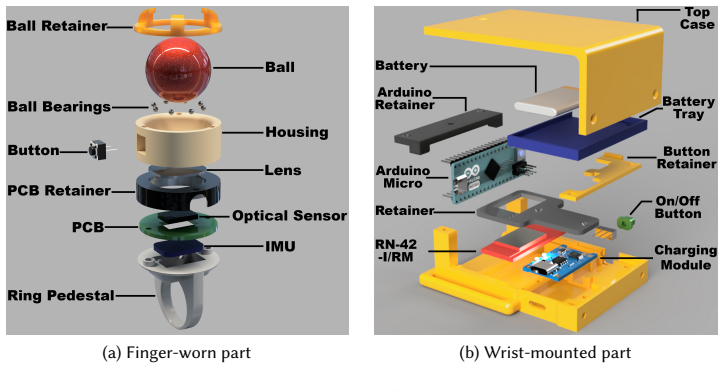
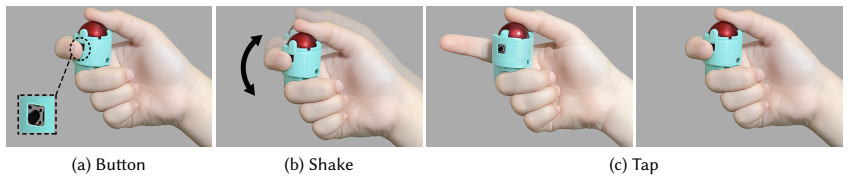
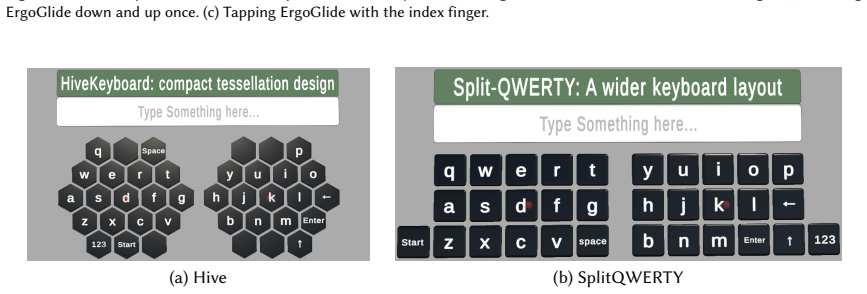
ErgoGlide, a small trackball worn like a ring on the finger, combined with a hive-like virtual keyboard where rotation selects keys.
If this is right
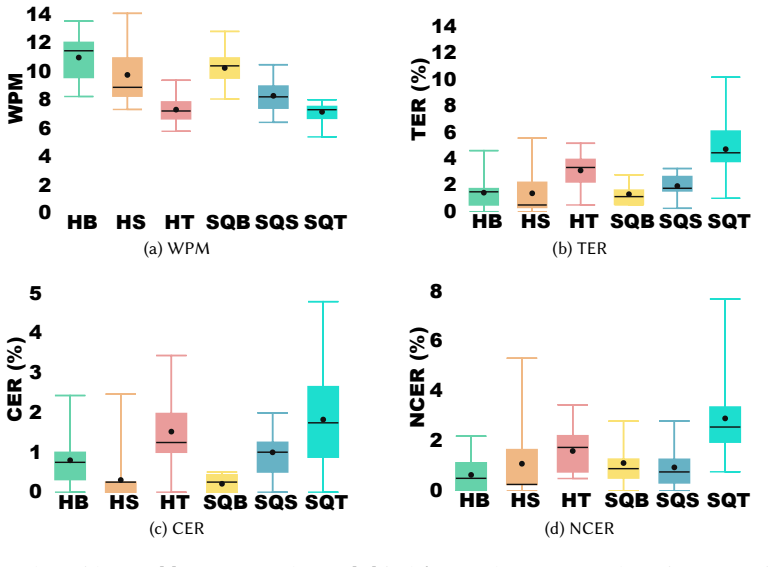
- Different key confirmation methods change measured text entry speed.
- The hive keyboard layout cuts the distance thumbs must travel during typing.
- Users reach higher typing speeds with ErgoGlide after a period of practice.
- The device outperforms previous VR text entry approaches on accuracy, comfort, and ease of use.
Where Pith is reading between the lines
- The same ring form factor could support one-handed operation in standing or walking VR scenarios where two-handed controllers are impractical.
- If the accuracy gains hold under longer sessions, the design may reduce fatigue-related errors in extended productivity tasks inside VR.
- Manufacturers could adapt the trackball sensor and hive layout to other head-worn displays without requiring changes to existing VR hand-tracking systems.
Load-bearing premise
The measured improvements in accuracy, ergonomics, and usability come from the device and keyboard rather than from how the study was run or who participated.
What would settle it
A controlled replication study that keeps participant pool, instructions, and confirmation method fixed while swapping only the input hardware and finds no accuracy or ergonomics difference.
Figures




read the original abstract
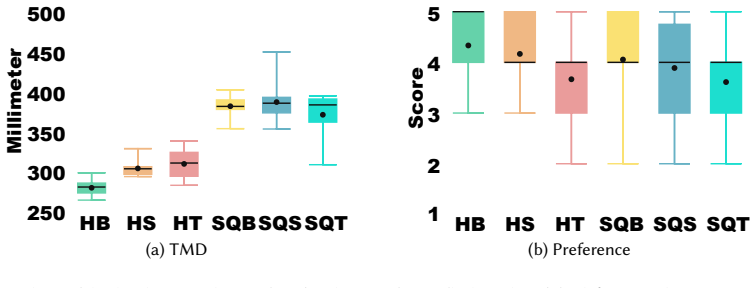
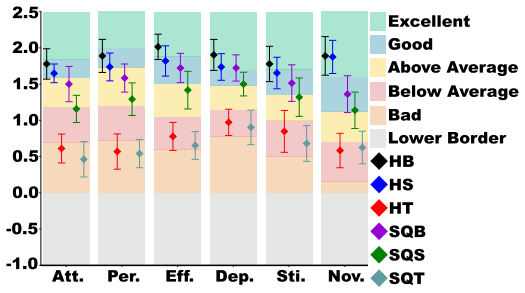
In virtual reality, it is challenging to achieve satisfactory text entry speed/accuracy, ergonomics, usability, and learnability. To address this issue, we developed ErgoGlide, a novel lightweight and compact wearable device that facilitates text entry tasks in virtual environments. The proposed ErgoGlide can be regarded as a small trackball that is wearable on a user's finger like a ring. By using ErgoGlide with a hive-like virtual keyboard, the user can rotate the ball for key selections, making text entry intuitive and accurate. We conducted three user studies to evaluate ErgoGlide and found that key confirmation techniques have significant effects on text entry speed and the hive-like keyboard design significantly reduced thumb movements. Furthermore, ErgoGlide can significantly improve typing accuracy, ergonomics, and usability over previous text entry methods. Experimental results also indicated that the typing speed of ErgoGlide can be notably improved after training.
Editorial analysis
A structured set of objections, weighed in public.
Referee Report
Summary. The paper introduces ErgoGlide, a lightweight wearable trackball device worn on the finger like a ring, paired with a hive-like virtual keyboard for text entry in VR. Users rotate the ball to select keys. Three user studies are reported to evaluate the device, claiming that key confirmation techniques significantly affect speed, the hive keyboard reduces thumb movements, ErgoGlide yields statistically significant gains in accuracy/ergonomics/usability over prior methods, and typing speed improves notably with training.
Significance. If the empirical claims are supported by properly reported statistics and controls, the work could offer a practical contribution to VR text-entry interfaces by addressing ergonomics and learnability limitations. The wearable form factor and specific keyboard design are novel elements that, if validated, would be of interest to the HCI community working on immersive input devices.
major comments (2)
- [Abstract / User Studies] Abstract and User Studies sections: The central claims of 'statistically significant improvements' in accuracy, ergonomics, and usability from three user studies are unsupported because no participant counts, counterbalancing details, statistical tests, p-values, error bars, exclusion criteria, or raw data are provided. This directly undermines evaluation of whether gains are attributable to ErgoGlide + hive keyboard rather than study-specific factors such as confirmation technique implementation or instructions.
- [User Studies] User Studies sections: The design does not describe how baseline methods were replicated with fidelity or how confirmation techniques were isolated from the hardware/keyboard variables; without such controls the attribution of effects to the device design cannot be assessed.
minor comments (1)
- [Abstract] Abstract: The phrase 'notably improved after training' is vague; specify the magnitude and statistical support if retained.
Simulated Author's Rebuttal
We thank the referee for the constructive feedback highlighting the need for more complete reporting of our user studies. We will revise the manuscript to address these points by adding the requested methodological and statistical details.
read point-by-point responses
-
Referee: [Abstract / User Studies] Abstract and User Studies sections: The central claims of 'statistically significant improvements' in accuracy, ergonomics, and usability from three user studies are unsupported because no participant counts, counterbalancing details, statistical tests, p-values, error bars, exclusion criteria, or raw data are provided. This directly undermines evaluation of whether gains are attributable to ErgoGlide + hive keyboard rather than study-specific factors such as confirmation technique implementation or instructions.
Authors: We agree that the current manuscript does not provide sufficient detail on the user study parameters and analyses. In the revised version, we will add participant counts for each of the three studies, counterbalancing procedures, the specific statistical tests and p-values, error bars on figures, exclusion criteria, and information on data availability. This will allow proper assessment of the reported improvements. revision: yes
-
Referee: [User Studies] User Studies sections: The design does not describe how baseline methods were replicated with fidelity or how confirmation techniques were isolated from the hardware/keyboard variables; without such controls the attribution of effects to the device design cannot be assessed.
Authors: We acknowledge that the descriptions of baseline replication and variable isolation require expansion. The revised User Studies sections will include details on how prior methods were implemented to match original specifications as closely as possible, along with explanations of how confirmation techniques were controlled or isolated relative to the hardware and keyboard factors. revision: yes
Circularity Check
No circularity: purely empirical user-study paper with no derivations or self-referential reductions
full rationale
The paper describes development of a wearable trackball device and reports outcomes from three user studies on typing speed, accuracy, ergonomics, and usability. No equations, fitted parameters, predictions derived from inputs, or self-citation chains appear in the provided text or abstract. All load-bearing claims rest on experimental measurements rather than any derivation that reduces to its own inputs by construction. This is the expected non-finding for an HCI device-evaluation paper.
Axiom & Free-Parameter Ledger
invented entities (1)
-
ErgoGlide wearable trackball device
no independent evidence
Reference graph
Works this paper leans on
-
[1]
Muhammad Abu Bakar, Yu-Ting Tsai, Hao-Han Hsueh, and Elena Carolina Li. 2023. CrowbarLimbs: A Fatigue-Reducing Virtual Reality Text Entry Metaphor.IEEE Transactions on Visualization and Computer Graphics29, 5 (2023), 2806–2815. doi:10.1109/TVCG.2023.3247060
-
[2]
Ahmed Sabbir Arif and Wolfgang Stuerzlinger. 2009. Analysis of Text Entry Performance Metrics. InProceedings of the IEEE Toronto International Conference Science and Technology for Humanity 2009 (IEEE TIC-STH 2009). 100–105. doi:10.1109/TIC-STH.2009.5444533
-
[3]
1998.Borg’s Perceived Exertion and Pain Scales
Gunnar Borg. 1998.Borg’s Perceived Exertion and Pain Scales. Human Kinetics
1998
-
[4]
Frederik Brudy, Christian Holz, Roman Rädle, Chi-Jui Wu, Steven Houben, Clemens Nylandsted Klokmose, and Nicolai Marquardt. 2019. Cross-Device Taxonomy: Survey, Opportunities and Challenges of Interactions Spanning Across Multiple Devices. InProceedings of the ACM Conference on Human Factors in Computing Systems 2019 (ACM CHI 2019). 1–28. doi:10.1145/3290...
-
[5]
Damien Brun, Charles Gouin-Vallerand, and Sébastien George. 2025. Design and Evaluation of a Versatile Text Input Device for Virtual and Immersive Workspaces.Human-Computer Interaction40, 6 (2025), 364–409. doi:10.1080/07370024.2024.2352705
-
[6]
Tafadzwa Joseph Dube and Ahmed Sabbir Arif. 2019. Text Entry in Virtual Reality: A Comprehensive Review of the Literature. InProceedings of the International Conference on Human-Computer Interaction 2019 (HCII 2019). 419–437. doi:10.1007/978-3-030-22643-5_33
-
[7]
Tafadzwa Joseph Dube, Kevin Johnson, and Ahmed Sabbir Arif. 2022. Shapeshifter: Gesture Typing in Virtual Reality with a Force-based Digital Thimble. InProceedings of the ACM Conference on Human Factors in Computing Systems 2022 - Extended Abstracts (ACM CHI 2022 EA). 230:1–230:9. doi:10.1145/3491101.3519679
-
[8]
Dudley, Hrvoje Benko, Daniel Wigdor, and Per Ola Kristensson
John J. Dudley, Hrvoje Benko, Daniel Wigdor, and Per Ola Kristensson. 2019. Performance Envelopes of Virtual Keyboard Text Input Strategies in Virtual Reality. InProceedings of the IEEE International Symposium on Mixed and Augmented Reality 2019 (IEEE ISMAR 2019). 289–300. doi:10.1109/ ISMAR.2019.00027
arXiv 2019
-
[9]
Dudley, Amy Karlson, Kashyap Todi, Hrvoje Benko, Matt Longest, Robert Wang, and Per Ola Kristensson
John J. Dudley, Amy Karlson, Kashyap Todi, Hrvoje Benko, Matt Longest, Robert Wang, and Per Ola Kristensson. 2024. Efficient Mid-Air Text Input Correction in Virtual Reality. InProceedings of the International Symposium on Mixed and Augmented Reality 2024 (IEEE ISMAR 2024). 893–902. doi:10.1109/ISMAR62088.2024.00105
-
[10]
Dudley, Keith Vertanen, and Per Ola Kristensson
John J. Dudley, Keith Vertanen, and Per Ola Kristensson. 2018. Fast and Precise Touch-Based Text Entry for Head-Mounted Augmented Reality with Variable Occlusion.ACM Transactions on Computer-Human Interaction25, 6 (2018), 1–40. doi:10.1145/3232163
-
[11]
Dudley, Jingyao Zheng, Aakar Gupta, Hrvoje Benko, Matt Longest, Robert Wang, and Per Ola Kristensson
John J. Dudley, Jingyao Zheng, Aakar Gupta, Hrvoje Benko, Matt Longest, Robert Wang, and Per Ola Kristensson. 2023. Evaluating the Performance of Hand-Based Probabilistic Text Input Methods on a Mid-Air Virtual Qwerty Keyboard.IEEE Transactions on Visualization and Computer Graphics 29, 11 (2023), 4567–4577. doi:10.1109/TVCG.2023.3320238
-
[12]
Fengyi Fang, Hongwei Zhang, Lishuang Zhan, Shihui Guo, Minying Zhang, Juncong Lin, Yipeng Qin, and Hongbo Fu. 2023. Handwriting Velcro: Endowing AR Glasses with Personalized and Posture-Adaptive Text Input Using Flexible Touch Sensor.Proceedings of the ACM on Interactive, Mobile, Wearable, and Ubiquitous Technologies6, 4 (2023), 1–31. doi:10.1145/3569461
-
[13]
Nicolas Fourrier, Guillaume Moreau, Mustapha Benaouicha, and Jean-Marie Normand. 2023. Handwriting for Efficient Text Entry in Industrial VR Applications: Influence of Board Orientation and Sensory Feedback on Performance.IEEE Transactions on Visualization and Computer Graphics29, 11 (2023), 4438–4448. doi:10.1109/TVCG.2023.3320215
-
[14]
Mikael Goldstein, Robert Book, Gunilla Alsiö, and Silvia Tessa. 1999. Non-Keyboard QWERTY Touch Typing: A Portable Input Interface for the Mobile User. InProceedings of the ACM Conference on Human Factors in Computing Systems 1999 (ACM CHI 1999). 32–39. doi:10.1145/302979.302984
-
[15]
Jens Grubert, Eyal Ofek, Michel Pahud, and Per Ola Kristensson. 2018. The Office of the Future: Virtual, Portable, and Global.IEEE Computer Graphics and Applications38, 6 (2018), 125–133. doi:10.1109/MCG.2018.2875609
-
[16]
Jens Grubert, Lukas Witzani, Eyal Ofek, Michel Pahud, Matthias Kranz, and Per Ola Kristensson. 2018. Effects of Hand Representations for Typing in Virtual Reality. InProceedings of the IEEE Conference on Virtual Reality and 3D User Interfaces 2018 (IEEE VR 2018). 151–158. doi:10.1109/VR.2018.8446250
-
[17]
Jens Grubert, Lukas Witzani, Eyal Ofek, Michel Pahud, Matthias Kranz, and Per Ola Kristensson. 2018. Text Entry in Immersive Head-Mounted Display-Based Virtual Reality Using Standard Keyboards. InProceedings of the IEEE Conference on Virtual Reality and 3D User Interfaces 2018 (IEEE VR 2018). 159–166. doi:10.1109/VR.2018.8446059
-
[18]
Yizheng Gu, Chun Yu, Zhipeng Li, Zhaoheng Li, Xiaoying Wei, and Yuanchun Shi. 2020. QwertyRing: Text Entry on Physical Surfaces Using a Ring. Proceedings of the ACM on Interactive, Mobile, Wearable and Ubiquitous Technologies4, 4 (2020), 128:1–128:29. doi:10.1145/3432204
-
[19]
Aakar Gupta, Cheng Ji, Hui-Shyong Yeo, Aaron Quigley, and Daniel Vogel. 2019. RotoSwype: Word-Gesture Typing Using a Ring. InProceedings of the ACM Conference on Human Factors in Computing Systems 2019 (ACM CHI 2019). 1–12. doi:10.1145/3290605.3300244
-
[20]
Sandra G. Hart. 2006. Nasa-Task Load Index (NASA-TLX); 20 Years Later.Proceedings of the Human Factors and Ergonomics Society Annual Meeting 50, 9 (2006), 904–908. doi:10.1177/154193120605000909
-
[21]
Zhenyi He, Christof Lutteroth, and Ken Perlin. 2022. TapGazer: Text Entry with Finger Tapping and Gaze-directed Word Selection. InProceedings of the ACM Conference on Human Factors in Computing Systems 2022 (ACM CHI 2022). 1–16. doi:10.1145/3491102.3501838
-
[22]
Dudley, and Per Ola Kristensson
Jinghui Hu, John J. Dudley, and Per Ola Kristensson. 2022. An Evaluation of Caret Navigation Methods for Text Editing in Augmented Reality. In Proceedings of the IEEE International Symposium on Mixed and Augmented Reality 2022 Adjunct (IEEE ISMAR 2022 Adjunct). 640–645. doi:10.1109/ ISMAR-ADJUNCT57072.2022.00132
arXiv 2022
-
[23]
Dudley, and Per Ola Kristensson
Jinghui Hu, John J. Dudley, and Per Ola Kristensson. 2024. SkiMR: Dwell-free Eye Typing in Mixed Reality. InProceedings of the IEEE Conference on Virtual Reality and 3D User Interfaces 2024 (IEEE VR 2024). 439–449. doi:10.1109/VR58804.2024.00065
-
[24]
Dudley, and Per Ola Kristensson
Jinghui Hu, John J. Dudley, and Per Ola Kristensson. 2025. Seeing and Touching the Air: Unraveling Eye-Hand Coordination in Mid-Air Gesture Typing for Mixed Reality. InProceedings of the ACM Conference on Human Factors in Computing Systems 2025 (ACM CHI 2025). 1222:1–1222:15. doi:10.1145/3706598.3713743
-
[25]
Haiyan Jiang and Dongdong Weng. 2020. HiPad: Text Entry for Head-Mounted Displays Using Circular Touchpad. InProceedings of the IEEE Conference on Virtual Reality and 3D User Interfaces 2020 (IEEE VR 2020). 692–703. doi:10.1109/VR46266.2020.00092
-
[26]
Florian Kern, Florian Niebling, and Marc Erich Latoschik. 2023. Text Input for Non-Stationary XR Workspaces: Investigating Tap and Word-Gesture Keyboards in Virtual and Augmented Reality.IEEE Transactions on Visualization and Computer Graphics29, 5 (2023), 2658–2669. doi:10.1109/TVCG. 2023.3247098
-
[27]
Florian Kern, Jonathan Tschanter, and Marc Erich Latoschik. 2024. Handwriting for Text Input and the Impact of XR Displays, Surface Alignments, and Sentence Complexities.IEEE Transactions on Visualization and Computer Graphics30, 5 (2024), 2357–2367. doi:10.1109/TVCG.2024.3372124
-
[28]
Junhyeok Kim, William Delamare, and Pourang Irani. 2018. ThumbText: Text Entry for Wearable Devices Using a Miniature Ring. InProceedings of the Graphics Interface Conference 2018 (GI 2018). 18–25. doi:10.20380/GI2018.04
-
[29]
Sooyoung Kim and Gerard Jounghyun Kim. 2004. Using Keyboards with Head Mounted Displays. InProceedings of the ACM International Conference on Virtual Reality Continuum and Its Applications in Industry 2004 (ACM VRCAI 2004). 336–343. doi:10.1145/1044588.1044662
-
[30]
Pascal Knierim, Valentin Schwind, Anna Maria Feit, Florian Nieuwenhuizen, and Niels Henze. 2018. Physical Keyboards in Virtual Reality: Analysis of Typing Performance and Effects of Avatar Hands. InProceedings of the ACM Conference on Human Factors in Computing Systems 2018 (ACM CHI 2018). 1–9. doi:10.1145/3173574.3173919
-
[31]
Bettina Laugwitz, Theo Held, and Martin Schrepp. 2008. Construction and Evaluation of a User Experience Questionnaire. InProceedings of the Symposium of the Workgroup Human-Computer Interaction and Usability Engineering of the Austrian Computer Society 2008. 63–76. doi:10.1007/978- 3-540-89350-9_6
-
[32]
Doyoung Lee, Jiwan Kim, and Ian Oakley. 2021. FingerText: Exploring and Optimizing Performance for Wearable, Mobile and One-Handed Typing. InProceedings of the ACM Conference on Human Factors in Computing Systems 2021 (ACM CHI 2021). 283:1–283:15. doi:10.1145/3411764.3445106
-
[33]
Jiaye Leng, Lili Wang, Xiaolong Liu, Xuehuai Shi, and Miao Wang. 2022. Efficient Flower Text Entry in Virtual Reality.IEEE Transactions on Visualization and Computer Graphics28, 11 (2022), 3662–3672. doi:10.1109/TVCG.2022.3203101
-
[34]
Jingyi Li, Luca Woik, and Andreas Butz. 2022. Designing Mobile MR Workspaces: Effects of Reality Degree and Spatial Configuration During Passenger Productivity in HMDs.Proceedings of the ACM on Human-Computer Interaction6, MHCI (2022), 1–17. doi:10.1145/3546716
-
[35]
Jia-Wei Lin, Ping-Hsuan Han, Jiun-Yu Lee, Yang-Sheng Chen, Ting-Wei Chang, Kuan-Wen Chen, and Yi-Ping Hung. 2017. Visualizing the Keyboard in Virtual Reality for Enhancing Immersive Experience. InProceedings of the ACM Special Interest Group on Computer Graphics and Interactive Techniques Conference 2017 (ACM SIGGRAPH 2017) Posters. 1–2. doi:10.1145/31021...
-
[36]
Zongjian Liu, Jieling He, Jianjiang Feng, and Jie Zhou. 2022. PrinType: Text Entry via Fingerprint Recognition.Proceedings of the ACM on Interactive, Mobile, Wearable and Ubiquitous Technologies6, 4 (2022), 174:1–174:31. doi:10.1145/3569491
-
[37]
Kent Lyons, Thad Starner, Daniel Plaisted, James Fusia, Amanda Lyons, Aaron Drew, and E. W. Looney. 2004. Twiddler Typing: One-Handed Chording Text Entry for Mobile Phones. InProceedings of the ACM Conference on Human Factors in Computing Systems 2004 (ACM CHI 2004). 671–678. doi:10.1145/985692.985777
-
[38]
Lystbæk, Ken Pfeuffer, Jens Emil Sloth Grønbæk, and Hans Gellersen
Mathias N. Lystbæk, Ken Pfeuffer, Jens Emil Sloth Grønbæk, and Hans Gellersen. 2022. Exploring Gaze for Assisting Freehand Selection-based Text Entry in AR.Proceedings of the ACM on Human-Computer Interaction6, ETRA (2022), 141:1–141:16. https://doi.org/10.1145/3530882
-
[39]
Lystbæk, Peter Rosenberg, Ken Pfeuffer, Jens Emil Grønbæk, and Hans Gellersen
Mathias N. Lystbæk, Peter Rosenberg, Ken Pfeuffer, Jens Emil Grønbæk, and Hans Gellersen. 2022. Gaze-Hand Alignment: Combining Eye Gaze and Mid-Air Pointing for Interacting with Menus in Augmented Reality.Proceedings of the ACM on Human-Computer Interaction6, ETRA (2022), 145:1–145:18. doi:10.1145/3530886
-
[40]
I Scott MacKenzie and R William Soukoreff. 2003. Phrase Sets for Evaluating Text Entry Techniques. InProceedings of the ACM Conference on Human Factors in Computing Systems 2003 - Extended Abstracts (ACM CHI 2003 EA). 754–755. doi:10.1145/765891.765971
-
[41]
Manuel Meier, Paul Streli, Andreas Fender, and Christian Holz. 2021. TapID: Rapid Touch Interaction in Virtual Reality Using Wearable Sensing. In Proceedings of the IEEE Conference on Virtual Reality and 3D User Interfaces 2021 (IEEE VR 2021). 519–528. doi:10.1109/VR50410.2021.00076
-
[42]
Daniel Natapov and I. Scott MacKenzie. 2010. The Trackball Controller: Improving the Analog Stick. InProceedings of the ACM International Academic Conference on the Future of Game Design and Technology 2010 (ACM Futureplay 2010). 175–182. doi:10.1145/1920778.1920803
-
[43]
Jan Noyes. 1983. The QWERTY Keyboard: A Review.International Journal of Man-Machine Studies18, 3 (1983), 265–281. doi:10.1016/S0020- 7373(83)80010-8
-
[44]
Eduardo G. Q. Palmeira, Alexandre Campos, Igor de Andrade Moraes, Alexandre Gomes de Siqueira, and Marcelo G. G. Ferreira. 2023. Quantifying the ‘Gorilla Arm’ Effect in a Virtual Reality Text Entry Task via Ray-Casting: A Preliminary Single-Subject Study. InProceedings of the ACM Symposium on Virtual and Augmented Reality 2023 (ACM SVR 2023). 274–278. doi...
-
[45]
Vijay Rajanna and John Paulin Hansen. 2018. Gaze Typing in Virtual Reality: Impact of Keyboard Design, Selection Method, and Motion. In Proceedings of the ACM Symposium on Eye Tracking Research & Applications, 2018 (ACM ETRA 2018). 15:1–15:10. doi:10.1145/3204493.3204541
-
[46]
Yunlei Ren, Yan Zhang, Zhitao Liu, and Ning Xie. 2024. Eye-Hand Typing: Eye Gaze Assisted Finger Typing via Bayesian Processes in AR.IEEE Transactions on Visualization and Computer Graphics30, 5 (2024), 2496–2506. doi:10.1109/TVCG.2024.3372106
-
[47]
Snow, Linguang Zhang, Jingming Dong, Keith Vertanen, Shugao Ma, and Robert Wang
Mark Richardson, Fadi Botros, Yangyang Shi, Pinhao Guo, Bradford J. Snow, Linguang Zhang, Jingming Dong, Keith Vertanen, Shugao Ma, and Robert Wang. 2024. StegoType: Surface Typing from Egocentric Cameras. InProceedings of the ACM Annual Symposium on User Interface Software and Technology 2024 (ACM UIST 2024). 83:1–83:14. doi:10.1145/3654777.3676343
-
[48]
Daniel Schneider, Alexander Otte, Travis Gesslein, Philipp Gagel, Bastian Kuth, Mohamad Shahm Damlakhi, Oliver Dietz, Eyal Ofek, Michel Pahud, Per Ola Kristensson, Jörg Müller, and Jens Grubert. 2019. ReconViguRation: Reconfiguring Physical Keyboards in Virtual Reality.IEEE Transactions on Visualization and Computer Graphics25, 11 (2019), 3190–3201. doi:1...
-
[49]
Dudley, and Per Ola Kristensson
Junxiao Shen, John J. Dudley, and Per Ola Kristensson. 2023. Fast and Robust Mid-Air Gesture Typing for AR Headsets using 3D Trajectory Decoding. IEEE Transactions on Visualization and Computer Graphics29, 11 (2023), 4622–4632. doi:10.1109/TVCG.2023.3320218
-
[50]
R. William Soukoreff and I. Scott MacKenzie. 2003. Metrics for Text Entry Research: An Evaluation of MSD and KSPC, and a New Unified Error Metric. InProceedings of the ACM Conference on Human Factors in Computing Systems 2003 (ACM CHI 2003). 113–120. doi:10.1145/642611.642632
-
[51]
Marco Speicher, Anna Maria Feit, Pascal Ziegler, and Antonio Krüger. 2018. Selection-based Text Entry in Virtual Reality. InProceedings of the ACM Conference on Human Factors in Computing Systems 2018 (ACM CHI 2018). 647. doi:10.1145/3173574.3174221
-
[52]
Paul Streli, Jiaxi Jiang, Andreas Rene Fender, Manuel Meier, Hugo Romat, and Christian Holz. 2022. TapType: Ten-finger text entry on everyday surfaces via Bayesian inference. InProceedings of the ACM Conference on Human Factors in Computing Systems 2022 (ACM CHI 2022). 497:1–497:16. doi:10.1145/3491102.3501878
-
[53]
Paul Streli, Mark Richardson, Fadi Botros, Shugao Ma, Robert Wang, and Christian Holz. 2024. TouchInsight: Uncertainty-aware Rapid Touch and Text Input for Mixed Reality from Egocentric Vision. InProceedings of the ACM Symposium on User Interface Software and Technology 2024 (ACM UIST 2024). 7:1–7:16. doi:10.1145/3654777.3676330
-
[54]
Ryo Takahashi, Masaaki Fukumoto, Changyo Han, Takuya Sasatani, Yoshiaki Narusue, and Yoshihiro Kawahara. 2020. TelemetRing: A Batteryless and Wireless Ring-Shaped Keyboard Using Passive Inductive Telemetry. InProceedings of the ACM Symposium on User Interface Software and Technology 2020 (ACM UIST 2020). 1161–1168. doi:10.1145/3379337.3415873
-
[55]
Julie Wagner, Stéphane Huot, and Wendy E. Mackay. 2012. BiTouch and BiPad: designing bimanual interaction for hand-held tablets. InProceedings of the ACM Conference on Human Factors in Computing Systems 2012 (ACM CHI 2012). 2317–2326. doi:10.1145/2207676.2208391
-
[56]
Tingjie Wan, Yushi Wei, Rongkai Shi, Junxiao Shen, Per Ola Kristensson, Katie Atkinson, and Hai-Ning Liang. 2024. Design and Evaluation of Controller-Based Raycasting Methods for Efficient Alphanumeric and Special Character Entry in Virtual Reality.IEEE Transactions on Visualization and Computer Graphics30, 9 (2024), 6493–6506. doi:10.1109/TVCG.2024.3349428
-
[57]
Xinyi Wang, Jin Meng, Haoyang Zhang, Ye Yan, Liang Xie, and Erwei Yin. 2023. Virtual Keyboard System Based on IMU Glove. InProceedings of the IEEE International Conference on Artificial Intelligence, Human-Computer Interaction and Robotics 2023 (IEEE AIHCIR 2023). 56–61. doi:10.1109/ AIHCIR61661.2023.00015
arXiv 2023
-
[58]
Eric Whitmire, Mohit Jain, Divye Jain, Greg Nelson, Ravi Karkar, Shwetak Patel, and Mayank Goel. 2017. DigiTouch: Reconfigurable Thumb-to-Finger Input and Text Entry on Head-Mounted Displays.Proceedings of the ACM on Interactive, Mobile, Wearable, and Ubiquitous Technologies1, 3 (2017), 1–21. doi:10.1145/3130978
-
[59]
Andrew D. Wilson and Maneesh Agrawala. 2006. Text Entry Using a Dual Joystick Game Controller. InProceedings of the ACM Conference on Human Factors in Computing Systems 2006 (ACM CHI 2006). 475–478. doi:10.1145/1124772.1124844
-
[60]
Jacob Wobbrock and Brad Myers. 2006. Trackball Text Entry for People with Motor Impairments. InProceedings of the ACM Conference on Human Factors in Computing Systems 2006 (ACM CHI 2006). 479–488. doi:10.1145/1124772.1124845
-
[61]
Jacob Wobbrock, Brad Myers, and Htet Aung. 2004. Writing with a Joystick: A Comparison of Date Stamp, Selection Keyboard, and EdgeWrite. In Proceedings of the Graphics Interface Conference 2004 (GI 2004). 1–8. doi:10.5555/1006058.1006059
-
[62]
Jacob O. Wobbrock and Brad A. Myers. 2006. From Letters to Words: Efficient Stroke-Based Word Completion for Trackball Text Entry. InProceedings of the ACM International SIGACCESS Conference on Computers and Accessibility 2006 (ACM ASSETS 2006). 2–9. doi:10.1145/1168987.1168990
-
[63]
Jian Wu, Ziteng Wang, Lili Wang, Yuhan Duan, and Jiaheng Li. 2024. FanPad: A Fan Layout Touchpad Keyboard for Text Entry in VR. InProceedings of the IEEE Conference on Virtual Reality and 3D User Interfaces 2024 (IEEE VR 2024). 222–232. doi:10.1109/VR58804.2024.00045
-
[64]
Wenge Xu, Hai-Ning Liang, Yuxuan Zhao, Tianyu Zhang, Difeng Yu, and Diego Monteiro. 2019. RingText: Dwell-Free and Hands-Free Text Entry for Mobile Head-Mounted Displays Using Head Motions.IEEE Transactions on Visualization and Computer Graphics25, 5 (2019), 1991–2001. doi:10.1109/TVCG.2019.2898736
-
[65]
Zheer Xu, Pui Chung Wong, Jun Gong, Te-Yen Wu, Aditya Shekhar Nittala, Xiaojun Bi, Jürgen Steimle, Hongbo Fu, Kening Zhu, and Xing-Dong Yang. 2019. TipText: Eyes-Free Text Entry on a Fingertip Keyboard. InProceedings of the ACM Symposium on User Interface Software and Technology 2019 (ACM UIST 2019). 883–899. doi:10.1145/3332165.3347865
-
[66]
Chun Yu, Yizheng Gu, Zhican Yang, Xin Yi, Hengliang Luo, and Yuanchun Shi. 2017. Tap, Dwell or Gesture?: Exploring Head-Based Text Entry Techniques for HMDs. InProceedings of the ACM Conference on Human Factors in Computing Systems 2017 (ACM CHI 2017). 4479–4488. doi:10.1145/3025453.3025964
-
[67]
Difeng Yu, Kaixuan Fan, Heng Zhang, Diego Monteiro, Wenge Xu, and Hai-Ning Liang. 2018. PizzaText: Text Entry for Virtual Reality Systems Using Dual Thumbsticks.IEEE Transactions on Visualization and Computer Graphics24, 11 (2018), 2927–2935. doi:10.1109/TVCG.2018.2868581
-
[68]
Mingrui Ray Zhang, Shumin Zhai, and Jacob O. Wobbrock. 2022. TypeAnywhere: A QWERTY-Based Text Entry Solution for Ubiquitous Computing. InProceedings of the ACM Conference on Human Factors in Computing Systems 2022 (ACM CHI 2022). 1–16. doi:10.1145/3491102.3517686
-
[69]
Jonker, Hrvoje Benko, and Aakar Gupta
Maozheng Zhao, Alec M Pierce, Ran Tan, Ting Zhang, Tianyi Wang, Tanya R. Jonker, Hrvoje Benko, and Aakar Gupta. 2023. Gaze Speedup: Eye Gaze Assisted Gesture Typing in Virtual Reality. InProceedings of the ACM International Conference on Intelligent User Interfaces 2023 (ACM IUI 2023). 595–606. doi:10.1145/3581641.3584072
discussion (0)
Sign in with ORCID, Apple, or X to comment. Anyone can read and Pith papers without signing in.