REVIEW 4 major objections 5 minor 67 references
A Reproducibility Study of Product-side Fairness in Bundle Recommendation
T0 review · 4 major / 5 minor · reviewed 2026-08-06 · deepseek-v4-flash
Pith's one-line read This paper claims that bundle-level fairness does not translate to item-level fairness in bundle recommendation, and that users who interact mostly with bundles receive fairer exposure at both levels.
desk verdict A useful first map of product-side fairness in bundle recommendation, with solid bundle-level results and item-level claims that rest on an unvalidated equal-split assumption. read the letter →
The pith
A machine-rendered reading of the paper's core claim, the machinery that carries it, and where it could break.
The reading
What carries the argument
The evaluation pipeline has three load-bearing pieces. First, exposure is computed with the geometric browsing model, giving each ranked bundle a decay-weighted visibility. Second, item-level exposure is derived from bundle exposure by splitting each bundle's exposure equally among its items, and each item's relevance is split the same way, so the six fairness metrics (EUR, RUR, EEL, EER, EED, logDP) can be applied at bundle and item levels. Third, users are split into bundle-oriented, neutral, and item-oriented groups by the ratio of bundle interactions to item interactions, which is what lets the paper attribute fairness differences to user tendency rather than only to algorithm or dataset.
What would settle it
A clickstream or gaze-log study of bundle pages that records which items are actually seen, not just which bundles are recommended, would settle the claim: if item-level attention inside bundles is skewed toward particular positions, the paper's item-level fairness rankings would need to be re-derived with that exposure model.
Extended reading notes
Core claim
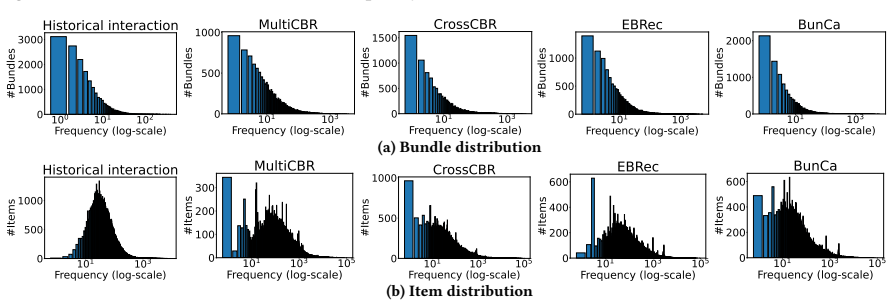
The paper's central claim is that product-side fairness in bundle recommendation is two-layered: systems expose bundles explicitly and the items inside them only indirectly, and these two layers do not move together. Across the Youshu, NetEase, and iFashion datasets, reproducing CrossCBR, MultiCBR, EBRec, and BunCa, it finds that bundle-level and item-level exposure distributions diverge, that popularity bias in historical interactions is amplified by the models, and that a fairer bundle-level ranking does not imply fairer item exposure. It further claims that user behavior modulates this: for users whose interaction history is dominated by bundles, the models' exposure distributions are fairer at both levels, while item-oriented users receive more uneven exposure. The paper interprets this as evidence that fairness interventions for bundle recommendation must be designed for both levels, and cannot be inherited from single-item fairness frameworks.
Load-bearing premise
The item-level fairness results depend on assuming that every item inside a bundle gets an equal share of the bundle's exposure and relevance; if real visibility inside bundles is uneven, those measured disparities are artifacts of that assumption.
Editorial extensions
If this is right
- Bundle-level fairness metrics alone are insufficient for bundle recommendation; evaluation should report item-level fairness as a separate quantity.
- Popularity bias in historical user-bundle interactions is amplified by all four reproduced methods, so debiasing input interactions is a leverage point for improving exposure fairness.
- User grouping by bundle-versus-item interaction tendency shows that bundle-oriented user segments receive fairer exposure, meaning fairness is partly a function of user behavior, not just algorithm or data.
- Because the fairness metrics often disagree, a single metric can mislead; multi-faceted evaluation is needed before concluding which method is fairer.
- A fairness-accuracy trade-off appears at the bundle level, but no method consistently dominates at the item level, so methods optimized for bundle fairness cannot be assumed to fix item exposure.
Reading between the lines
- Inference: the equal-splitting exposure assumption is a simplification; if item position or prominence inside bundles varies, real item exposure is likely less uniform than modeled, which would change the item-level conclusions.
- Inference: the user-tendency finding suggests a natural intervention: re-ranking or training toward bundle-oriented behavior might improve product-side fairness, but could also amplify existing user skew, which would require a controlled experiment to test.
- Inference: the dataset differences the paper ties to the c-score consistency measure hint that user-level consistency between bundle and item preferences could predict how well bundle-level fairness transfers to items; this is an implicit hypothesis worth testing.
- Inference: the metric disagreement observed here mirrors debates in single-item fairness and suggests that a robust summary, such as averaging across metrics or reporting Pareto fronts, may be needed for practical deployment.
Editorial analysis
A structured set of objections, weighed in public.
Referee Report
Summary. This paper presents a reproducibility study of product-side fairness in bundle recommendation (BR). The authors evaluate four BR methods (CrossCBR, MultiCBR, EBRec, BunCa) on three benchmark datasets (Youshu, NetEase, iFashion) using six exposure-based fairness metrics, measured at both the bundle and item levels. They define popularity-based groups for bundles and items, and partition users according to their tendency to interact with bundles versus individual items. The paper's central claims are that exposure patterns differ notably between bundles and items, that fairness conclusions depend heavily on the chosen metric, and that users who interact more frequently with bundles tend to receive fairer exposure at both levels. The authors release code for their study.
Significance. If the empirical findings hold, this is a useful first systematic study of product-side fairness in bundle recommendation, a setting where recommendations are made at the bundle level but downstream exposure and satisfaction occur at the item level. The paper identifies a real measurement gap and proposes a concrete evaluation protocol, including item-level fairness metrics adapted from ranking fairness. The released repository is a positive step for reproducibility. However, the item-level conclusions rest on an unvalidated equal-split exposure assumption, and the absence of variance reporting weakens the comparative and group-level claims. The significance is therefore conditional on the authors either validating that assumption or substantially tempering the item-level conclusions.
major comments (4)
- [§3.3.2, Eq. (1)–(5), Table 3, Figs. 6–8] The item-level exposure model is an unvalidated assumption. Specifically, item exposure is defined as a_L(i|i∈b)=a_L(b)/|b| and item relevance as y(i|i∈b)=y(b|u)/|b|. These definitions make every item-level fairness value in Table 3 and Figures 6–8(b) a deterministic transformation of bundle exposure, bundle size, and popularity-group labels. If real item exposure within bundles is non-uniform (e.g., due to position, visual prominence, or heterogeneous consumption), the item-level metrics and the claimed bundle-item divergence could change substantially. The paper provides no validation against an item-level engagement signal and no sensitivity analysis under alternative within-bundle exposure splits. This is load-bearing for the RQ1 and RQ2 item-level conclusions and for the central claim that fairness interventions must go beyond bundle-level assumptions. Please add a validation or a sensitivity analysis, or explicitly reframe the item-level results as conditional on the equal-split assumption.
- [§4, Table 3, Figs. 1–8] All results are reported as single-run point estimates, with no error bars, confidence intervals, or significance tests. The four BR methods are stochastic (random initialization, dropout, contrastive sampling), so observed differences between methods—for example, the claim in §4.2 that CrossCBR and EBRec tend to outperform others at the bundle level—may reflect seed variation rather than systematic differences. This is especially problematic for the small user groups in RQ3. Please report means and standard deviations over multiple random seeds and, where feasible, statistical significance tests for pairwise method comparisons.
- [§4.3, Table 2, Footnote 3] The user-tendency grouping is based on ad hoc thresholds (r_u > 1.1 for g1, r_u < 0.9 for g3, and the rest in g2), and the resulting groups are extremely imbalanced on Youshu, where g2 contains only 135 users. The RQ3 claim that bundle-oriented users receive fairer exposure is derived from comparisons across these groups in Figures 6–8. With such small group sizes and no variance estimates, the item-level patterns for g2 on Youshu could be dominated by noise. Please provide robustness checks with alternative thresholds, report group sizes and confidence intervals, or otherwise demonstrate that the RQ3 conclusions are not artifacts of the chosen split.
- [§3.5, Eq. (6), §4.1] Item popularity is computed from Y' = XZ + Y, which means item popularity inherits bundle-level interaction counts through the XZ term. This is not inherently wrong, but it makes the item popularity groups partially dependent on bundle popularity, and it interacts with the equal-split item exposure assumption. The RQ1 comparison of bundle and item distributional patterns (Figures 1–5) is therefore partly an artifact of how item popularity and item exposure are defined rather than a purely empirical observation about user behavior. Please discuss this dependence explicitly and, if possible, report sensitivity to alternative item-popularity definitions (e.g., using only Y or a version of XZ weighted by bundle size).
minor comments (5)
- [Table 3] The dataset name is spelled 'Netease' in the table header but 'NetEase' elsewhere; please unify the spelling.
- [Table 3 caption] The caption says 'underlined values represent the second-best,' but no underlining is visible in the provided text version; please ensure the final PDF rendering includes the underlining or revise the caption.
- [Figures 6–8] These figures are dense, and the legend appears only in part (a) of each figure; the subfigures in part (b) are not self-explanatory. Please add legends or a shared caption describing line styles and colors.
- [Eq. (7)] The tendency score r_u is a ratio of sums and may be undefined for users with no item interactions; please state how such users are handled (e.g., excluded or assigned to a group).
- [§2.2 and §3.2] The c-score is invoked from [49] but never defined in this paper; please provide a definition or a precise reference to the equation in [49].
Circularity Check
No significant circularity: item-level findings rest on an explicit equal-split proxy, but are not reduced to their inputs.
full rationale
This is an empirical reproducibility study, not a formal derivation. The only modeling choice that could look circular is the item-level exposure assumption in Section 3.3.2: item exposure is defined as bundle exposure divided by bundle size, and item relevance as bundle relevance divided by bundle size. This is an explicit and transparent proxy, not a hidden fitted parameter, and the paper does not claim to independently measure item-level exposure. The reported bundle/item differences are data-dependent consequences of this proxy together with actual bundle sizes and popularity group memberships; they are not equivalent to the definition by construction. Bundle-level fairness, metric disagreement, and user-tendency results are computed from model outputs and historical interactions and do not reduce to any fitted input. Self-citations to [34] and [49] are methodological references to prior evaluation protocols, not load-bearing evidence for the empirical claims. The equal-split assumption is a validity limitation (the item-level findings are conditional on it), but under the circularity rubric this is a correctness/robustness concern, not a circular reduction. No step in the paper's chain defines its conclusion into its premises.
Assumptions & free parameters
free parameters (4)
- Popularity group cut =
20% of interactions
- User tendency thresholds =
r_u > 1.1 for g1, r_u < 0.9 for g3
- Patience parameter gamma =
0.5
- Rank cutoff K =
20
assumptions (5)
- domain assumption The geometric browsing model captures real user exposure from ranked lists.
- domain assumption Each item inside a recommended bundle receives an equal share of the bundle's exposure.
- domain assumption Relevance of an item within a bundle equals the bundle's relevance divided by the bundle size.
- domain assumption Item popularity is faithfully represented by the reconstructed user-item matrix Y' = XZ + Y.
- domain assumption Popular versus unpopular is the relevant fairness partition for product-side fairness in BR.
Cite this review
Pith. "Pith review of A Reproducibility Study of Product-side Fairness in Bundle Recommendation." pith.science (2026). https://pith.science/paper/YYZ6UK7S
@misc{pith2026250714352,
  author       = {Pith},
  title        = {Pith review of: A Reproducibility Study of Product-side Fairness in Bundle Recommendation},
  year         = {2026},
  howpublished = {\url{https://pith.science/paper/YYZ6UK7S}},
  note         = {Machine review of arXiv:2507.14352}
}
read the original abstract
Recommender systems are known to exhibit fairness issues, particularly on the product side, where products and their associated suppliers receive unequal exposure in recommended results. While this problem has been widely studied in traditional recommendation settings, its implications for bundle recommendation (BR) remain largely unexplored. This emerging task introduces additional complexity: recommendations are generated at the bundle level, yet user satisfaction and product (or supplier) exposure depend on both the bundle and the individual items it contains. Existing fairness frameworks and metrics designed for traditional recommender systems may not directly translate to this multi-layered setting. In this paper, we conduct a comprehensive reproducibility study of product-side fairness in BR across three real-world datasets using four state-of-the-art BR methods. We analyze exposure disparities at both the bundle and item levels using multiple fairness metrics, uncovering important patterns. Our results show that exposure patterns differ notably between bundles and items, revealing the need for fairness interventions that go beyond bundle-level assumptions. We also find that fairness assessments vary considerably depending on the metric used, reinforcing the need for multi-faceted evaluation. Furthermore, user behavior plays a critical role: when users interact more frequently with bundles than with individual items, BR systems tend to yield fairer exposure distributions across both levels. Overall, our findings offer actionable insights for building fairer bundle recommender systems and establish a vital foundation for future research in this emerging domain.
Figures


Figures from the paper (5 more)


Reference graph
Works this paper leans on
-
[1]
Himan Abdollahpouri, Gediminas Adomavicius, Robin Burke, Ido Guy, Dietmar Jannach, Toshihiro Kamishima, Jan Krasnodebski, and Luiz Pizzato. 2020. Multi- stakeholder Recommendation: Survey and Research Directions. User Modeling and User-Adapted Interaction 30 (2020), 127–158
work page 2020
-
[2]
Himan Abdollahpouri and Masoud Mansoury. 2020. Multi-sided Exposure Bias in Recommendation. ACM KDD Workshop on Industrial Recommendation Systems (2020)
work page 2020
-
[3]
Alex Beutel, Jilin Chen, Tulsee Doshi, Hai Qian, Li Wei, Yi Wu, Lukasz Heldt, Zhe Zhao, Lichan Hong, Ed H Chi, et al . 2019. Fairness in Recommendation Ranking through Pairwise Comparisons. In Proceedings of the 25th ACM SIGKDD International Conference on Knowledge Discovery & Data Mining . 2212–2220
work page 2019
-
[4]
Asia J Biega, Krishna P Gummadi, and Gerhard Weikum. 2018. Equity of Attention: Amortizing Individual Fairness in Rankings. In The 41st international ACM SIGIR Conference on Research & Development in Information Retrieval . 405–414
work page 2018
-
[5]
Tuan-Nghia Bui, Huy-Son Nguyen, Cam-Van Thi Nguyen, Hoang-Quynh Le, and Duc-Trong Le. 2025. Personalized Diffusion Model Reshapes Cold-Start Bundle Recommendation. In Companion Proceedings of the ACM on Web Conference 2025 . 3088–3091
work page 2025
-
[6]
Tuan-Nghia Bui, Huy-Son Nguyen, Cam-Van Nguyen Thi, Hoang-Quynh Le, and Duc-Trong Le. 2024. BRIDGE: Bundle Recommendation via Instruction-Driven Generation. arXiv preprint arXiv:2412.18092 (2024)
work page Pith review arXiv 2024
-
[7]
Jianxin Chang, Chen Gao, Xiangnan He, Depeng Jin, and Yong Li. 2020. Bundle Recommendation with Graph Convolutional Networks. In Proceedings of the 43rd international ACM SIGIR Conference on Research and Development in Information Retrieval. 1673–1676
work page 2020
-
[8]
Jianxin Chang, Chen Gao, Xiangnan He, Depeng Jin, and Yong Li. 2021. Bundle recommendation and generation with graph neural networks. IEEE Transactions on Knowledge and Data Engineering 35, 3 (2021), 2326–2340
work page 2021
Show all 67 references
-
[9]
Liang Chen, Yang Liu, Xiangnan He, Lianli Gao, and Zibin Zheng. 2019. Matching User with Item Set: Collaborative Bundle Recommendation with Deep Attention Network. In IJCAI. 2095–2101
2019
-
[10]
Wen Chen, Pipei Huang, Jiaming Xu, Xin Guo, Cheng Guo, Fei Sun, Chao Li, Andreas Pfadler, Huan Zhao, and Binqiang Zhao. 2019. POG: Personalized Outfit Generation for Fashion Recommendation at Alibaba iFashion. In Proceedings of the 25th ACM SIGKDD International Conference on K...
2019
-
[11]
Abhisek Dash, Abhijnan Chakraborty, Saptarshi Ghosh, Animesh Mukherjee, and Krishna P Gummadi. 2022. FaiRIR: Mitigating Exposure Bias from Related Item Recommendations in Two-sided Platforms. IEEE Transactions on Computational Social Systems 10, 3 (2022), 1301–1313
2022
-
[12]
Yashar Deldjoo, Dietmar Jannach, Alejandro Bellogin, Alessandro Difonzo, and Dario Zanzonelli. 2024. Fairness in Recommender Systems: Research Landscape and Future Directions. User Modeling and User-Adapted Interaction 34, 1 (2024), 59–108
2024
-
[13]
Qilin Deng, Kai Wang, Minghao Zhao, Zhene Zou, Runze Wu, Jianrong Tao, Changjie Fan, and Liang Chen. 2020. Personalized Bundle Recommendation in Online Games. In Proceedings of the 29th ACM International Conference on Information & Knowledge Management . 2381–2388
2020
-
[14]
Fernando Diaz, Bhaskar Mitra, Michael D Ekstrand, Asia J Biega, and Ben Carterette. 2020. Evaluating Stochastic Rankings with Expected Exposure. In Proceedings of the 29th ACM International Conference on Information & Knowledge Management. 275–284
2020
-
[15]
Yujuan Ding, Zhihui Lai, PY Mok, and Tat-Seng Chua. 2023. Computational Technologies for Fashion Recommendation: A Survey. Comput. Surveys 56, 5 (2023), 1–45
2023
-
[16]
Xiaoyu Du, Kun Qian, Yunshan Ma, and Xinguang Xiang. 2023. Enhancing Item- level Bundle Representation for Bundle Recommendation. ACM Transactions on Recommender Systems (2023)
2023
-
[17]
Michael D Ekstrand, Anubrata Das, Robin Burke, Fernando Diaz, et al . 2022. Fairness in Information Access Systems. Foundations and Trends in Information Retrieval 16, 1-2 (2022), 1–177
2022
-
[18]
Chen Gao, Yu Zheng, Nian Li, Yinfeng Li, Yingrong Qin, Jinghua Piao, Yuhan Quan, Jianxin Chang, Depeng Jin, Xiangnan He, et al. 2023. A Survey of Graph Neural Networks for Recommender Systems: Challenges, Methods, and Direc- tions. ACM Transactions on Recommender Systems 1, 1 ...
2023
-
[19]
Yingqiang Ge, Shuchang Liu, Ruoyuan Gao, Yikun Xian, Yunqi Li, Xiangyu Zhao, Changhua Pei, Fei Sun, Junfeng Ge, Wenwu Ou, et al . 2021. Towards long- term fairness in recommendation. In Proceedings of the 14th ACM international conference on web search and data mining . 445–453
2021
-
[20]
Yingqiang Ge, Xiaoting Zhao, Lucia Yu, Saurabh Paul, Diane Hu, Chu-Cheng Hsieh, and Yongfeng Zhang. 2022. Toward Pareto Efficient Fairness-utility Trade- off in Recommendation through Reinforcement Learning. In Proceedings of the fifteenth ACM international Conference on Web S...
2022
-
[21]
Xavier Glorot and Yoshua Bengio. 2010. Understanding the Difficulty of Training Deep Feedforward Neural Networks. InProceedings of the Thirteenth International Conference on Artificial Intelligence and Statistics. JMLR Workshop and Conference Proceedings, 249–256
2010
-
[22]
Xiangnan He, Kuan Deng, Xiang Wang, Yan Li, Yongdong Zhang, and Meng Wang
-
[23]
Rashidul Islam, Kamrun Naher Keya, Ziqian Zeng, Shimei Pan, and James Foulds
-
[24]
Di Jin, Luzhi Wang, He Zhang, Yizhen Zheng, Weiping Ding, Feng Xia, and Shirui Pan. 2023. A Survey on Fairness-aware Recommender Systems. Information Fusion 100 (2023), 101906
2023
-
[25]
Kyungho Kim, Sunwoo Kim, Geon Lee, and Kijung Shin. 2024. Towards Better Utilization of Multiple Views for Bundle Recommendation. In Proceedings of the 33rd ACM International Conference on Information and Knowledge Management . 3827–3831
2024
-
[26]
Diederik Kingma and Jimmy Ba. 2015. Adam: A Method for Stochastic Optimiza- tion. In International Conference on Learning Representations (ICLR) . San Diego, CA, USA
2015
-
[27]
Kipf and Max Welling
Thomas N. Kipf and Max Welling. 2017. Semi-Supervised Classification with Graph Convolutional Networks. In 5th International Conference on Learning Representations, 2017, Conference Track Proceedings
2017
-
[28]
Ming Li, Sami Jullien, Mozhdeh Ariannezhad, and Maarten de Rijke. 2023. A Next Basket Recommendation Reality Check. ACM Transactions on Information Systems 41, 4 (2023), 1–29
2023
-
[29]
Ming Li, Lin Li, Xiaohui Tao, and Jimmy Xiangji Huang. 2024. MealRec+: A Meal Recommendation Dataset with Meal-Course Affiliation for Personalization and Healthiness. In Proceedings of the 47th International ACM SIGIR Conference on Research and Development in Information Retri...
2024
-
[30]
Ming Li, Yuanna Liu, Sami Jullien, Mozhdeh Ariannezhad, Andrew Yates, Moham- mad Aliannejadi, and Maarten de Rijke. 2024. Are We Really Achieving Better Beyond-Accuracy Performance in Next Basket Recommendation?. In Proceedings of the 47th International ACM SIGIR Conference on...
2024
-
[31]
Yunqi Li, Hanxiong Chen, Shuyuan Xu, Yingqiang Ge, Juntao Tan, Shuchang Liu, and Yongfeng Zhang. 2023. Fairness in Recommendation: Foundations, Methods, and Applications. ACM Transactions on Intelligent Systems and Technology 14, 5 (2023), 1–48
2023
-
[32]
Yunqi Li, Michiharu Yamashita, Hanxiong Chen, Dongwon Lee, and Yongfeng Zhang. 2023. Fairness in Job Recommendation under Quantity Constraints. In AAAI-23 Workshop on AI for Web Advertising
2023
-
[33]
Yuanna Liu, Ming Li, Mohammad Aliannejadi, and Maarten de Rijke. 2025. Repeat- Bias-Aware Optimization of Beyond-Accuracy Metrics for Next Basket Recom- mendation. In European Conference on Information Retrieval . Springer, 214–229
2025
-
[34]
Yuanna Liu, Ming Li, Mozhdeh Ariannezhad, Masoud Mansoury, Mohammad Aliannejadi, and Maarten de Rijke. 2024. Measuring item fairness in next basket recommendation: A reproducibility study. In European Conference on Information Retrieval. Springer, 210–225
2024
-
[35]
Zhongzhou Liu, Yuan Fang, and Min Wu. 2023. Mitigating Popularity Bias for Users and Items with Fairness-centric Adaptive Recommendation. ACM Transactions on Information Systems 41, 3 (2023), 1–27
2023
-
[36]
Yunshan Ma, Yingzhi He, Xiang Wang, Yinwei Wei, Xiaoyu Du, Yuyangzi Fu, and Tat-Seng Chua. 2024. MultiCBR: Multi-view Contrastive Learning for Bundle Recommendation. ACM Transactions on Information Systems 42, 4 (2024), 1–23
2024
-
[37]
Yunshan Ma, Yingzhi He, An Zhang, Xiang Wang, and Tat-Seng Chua. 2022. CrossCBR: Cross-view Contrastive Learning for Bundle Recommendation. In Proceedings of the 28th ACM SIGKDD Conference on Knowledge Discovery and Data Mining. 1233–1241
2022
-
[38]
Yunshan Ma, Xiaohao Liu, Yinwei Wei, Zhulin Tao, Xiang Wang, and Tat-Seng Chua. 2024. Leveraging multimodal features and item-level user feedback for bundle construction. In Proceedings of the 17th ACM International Conference on Web Search and Data Mining. 510–519
2024
-
[39]
Masoud Mansoury. 2022. Understanding and Mitigating Multi-sided Exposure Bias in Recommender Systems. ACM SIGWEB Newsletter 2022, Autumn (2022), 1–4
2022
-
[40]
Masoud Mansoury, Himan Abdollahpouri, Mykola Pechenizkiy, Bamshad Mobasher, and Robin Burke. 2020. Feedback loop and bias amplification in recommender systems. In Proceedings of the 29th ACM international conference on information & knowledge management . 2145–2148
2020
-
[41]
Masoud Mansoury, Bamshad Mobasher, and Herke van Hoof. 2024. Mitigating exposure bias in online learning to rank recommendation: A novel reward model for cascading bandits. In Proceedings of the 33rd ACM International Conference on Information and Knowledge Management . 1638–1648
2024
-
[42]
Rishabh Mehrotra, James McInerney, Hugues Bouchard, Mounia Lalmas, and Fernando Diaz. 2018. Towards a Fair Marketplace: Counterfactual Evaluation of the Trade-off between Relevance, Fairness & Satisfaction in Recommendation Systems. In Proceedings of the 27th ACM International...
2018
-
[43]
Mohammadmehdi Naghiaei, Hossein A Rahmani, and Yashar Deldjoo. 2022. CPFair: Personalized Consumer and Producer Fairness Re-ranking for Recom- mender Systems. In Proceedings of the 45th International ACM SIGIR Conference on Research and Development in Information Retrieval . 770–779
2022
-
[44]
Huy-Son Nguyen, Tuan-Nghia Bui, Long-Hai Nguyen, Duy-Cat Can, Cam- Van Thi Nguyen, Duc-Trong Le, and Hoang-Quynh Le. 2023. HHMC: a het- erogeneous x homogeneous graph-based network for multimodal cross-selling recommendation. In 2023 15th International Conference on Knowledge ...
2023
-
[45]
Huy-Son Nguyen, Tuan-Nghia Bui, Long-Hai Nguyen, Hung Hoang, Cam-Van Thi Nguyen, Hoang-Quynh Le, and Duc-Trong Le. 2024. Bundle Recommendation with Item-Level Causation-Enhanced Multi-view Learning. In Joint European Conference on Machine Learning and Knowledge Discovery in Da...
2024
-
[46]
Tao Qi, Fangzhao Wu, Chuhan Wu, Peijie Sun, Le Wu, Xiting Wang, Yongfeng Huang, and Xing Xie. 2022. ProFairRec: Provider Fairness-aware News Recom- mendation. In Proceedings of the 45th International ACM SIGIR Conference on Research and Development in Information Retrieval . 1164–1173
2022
-
[47]
Hossein A Rahmani, Mohammadmehdi Naghiaei, Mahdi Dehghan, and Moham- mad Aliannejadi. 2022. Experiments on Generalizability of User-oriented Fairness in Recommender Systems. In Proceedings of the 45th International ACM SIGIR Conference on Research and Development in Informatio...
2022
-
[48]
Ekstrand
Amifa Raj and Michael D. Ekstrand. 2022. Measuring Fairness in Ranked Results: An Analytical and Empirical Comparison. In Proceedings of the 45th International ACM SIGIR Conference on Research and Development in Information Retrieval . 726–736
2022
-
[49]
Yuyang Ren, Zhang Haonan, Luoyi Fu, Xinbing Wang, and Chenghu Zhou. 2023. Distillation-enhanced Graph Masked Autoencoders for Bundle Recommendation. In Proceedings of the 46th International ACM SIGIR Conference on Research and Development in Information Retrieval . 1660–1669
2023
-
[50]
Piotr Sapiezynski, Wesley Zeng, Ronald E Robertson, Alan Mislove, and Christo Wilson. 2019. Quantifying the Impact of User Attentionon fair Group Repre- sentation in Ranked Lists. In Companion proceedings of the 2019 world wide web conference. 553–562
2019
-
[51]
Ashudeep Singh and Thorsten Joachims. 2018. Fairness of Exposure in Rankings. In Proceedings of the 24th ACM SIGKDD International Conference on Knowledge Discovery & Data Mining . 2219–2228
2018
-
[52]
Meng Sun, Lin Li, Ming Li, Xiaohui Tao, Dong Zhang, Peipei Wang, and Jimmy Xi- angji Huang. 2024. A Survey on Bundle Recommendation: Methods, Applications, and Challenges. arXiv preprint arXiv:2411.00341 (2024)
2024
-
[53]
Zhu Sun, Kaidong Feng, Jie Yang, Hui Fang, Xinghua Qu, Yew-Soon Ong, and Wenyuan Liu. 2024. Revisiting Bundle Recommendation for Intent-aware Product Bundling. ACM Transactions on Recommender Systems 2, 3 (2024), 1–34
2024
-
[54]
Zhu Sun, Kaidong Feng, Jie Yang, Xinghua Qu, Hui Fang, Yew-Soon Ong, and Wenyuan Liu. 2024. Adaptive In-Context Learning with Large Language Mod- els for Bundle Generation. In Proceedings of the 47th International ACM SIGIR Conference on Research and Development in Information...
2024
-
[55]
Saúl Vargas and Pablo Castells. 2014. Improving Sales Diversity by Recommend- ing Users to Items. In Proceedings of the 8th ACM Conference on Recommender systems. 145–152
2014
-
[56]
Lequn Wang and Thorsten Joachims. 2021. User Fairness, Item Fairness, and Diversity for Rankings in Two-sided Markets. In Proceedings of the 2021 ACM SIGIR International Conference on Theory of Information Retrieval . 23–41
2021
-
[57]
Yifan Wang, Weizhi Ma, Min Zhang, Yiqun Liu, and Shaoping Ma. 2023. A Survey on the Fairness of Recommender Systems. ACM Transactions on Information Systems 41, 3 (2023), 1–43
2023
-
[58]
Yinwei Wei, Xiaohao Liu, Yunshan Ma, Xiang Wang, Liqiang Nie, and Tat-Seng Chua. 2023. Strategy-aware Bundle Recommender System. In Proceedings of the 46th International ACM SIGIR Conference on Research and Development in Information Retrieval. 1198–1207
2023
-
[59]
Chuhan Wu, Fangzhao Wu, Xiting Wang, Yongfeng Huang, and Xing Xie. 2021. Fairness-aware News Recommendation with Decomposed Adversarial Learning. In Proceedings of the AAAI Conference on Artificial Intelligence, Vol. 35. 4462–4469
2021
-
[60]
Chen Xu, Zhirui Deng, Clara Rus, Xiaopeng Ye, Yuanna Liu, Jun Xu, Zhicheng Dou, Ji-Rong Wen, and Maarten de Rijke. 2025. FairDiverse: A Comprehensive Toolkit for Fair and Diverse Information Retrieval Algorithms. arXiv preprint arXiv:2502.11883 (2025)
2025 arXiv
-
[61]
Chen Xu, Yuxin Li, Wenjie Wang, Liang Pang, Jun Xu, and Tat-Seng Chua. 2025. Bridging Jensen Gap for Max-Min Group Fairness Optimization in Recommenda- tion. arXiv preprint arXiv:2502.09319 (2025)
2025 arXiv
-
[62]
Ke Yang and Julia Stoyanovich. 2017. Measuring Fairness in Ranked Outputs. In Proceedings of the 29th International Conference on Scientific and Statistical Database Management. 1–6
2017
-
[63]
Meike Zehlike, Francesco Bonchi, Carlos Castillo, Sara Hajian, Mohamed Mega- hed, and Ricardo Baeza-Yates. 2017. FA*IR: A Fair Top-k Ranking Algorithm. In Proceedings of the 2017 ACM on Conference on Information and Knowledge Management. 1569–1578
2017
-
[64]
Sen Zhao, Wei Wei, Ding Zou, and Xianling Mao. 2022. Multi-view Intent Disentangle Graph Networks for Bundle Recommendation. In Proceedings of the AAAI Conference on Artificial Intelligence , Vol. 36. 4379–4387
2022
-
[65]
Zhi Zheng, Chao Wang, Tong Xu, Dazhong Shen, Penggang Qin, Xiangyu Zhao, Baoxing Huai, Xian Wu, and Enhong Chen. 2023. Interaction-aware Drug Package Recommendation via Policy Gradient. ACM Transactions on Information Systems 41, 1 (2023), 1–32
2023
-
[2020]
In Proceedings of the 43rd International ACM SIGIR Conference on Research and Development in Information Retrieval
LightGCN: Simplifying and Powering Graph Convolution Network for Recommendation. In Proceedings of the 43rd International ACM SIGIR Conference on Research and Development in Information Retrieval . 639–648
-
[2021]
In Proceedings of the Web Conference 2021
Debiasing Career Recommendations with Neural Fair Collaborative Filter- ing. In Proceedings of the Web Conference 2021 . 3779–3790
2021
Reviewed August 6, 2026 · model on record in the stance chip above.
Discussion (0). Continue with ORCID to comment.