Higher Berry curvature, second Chern numbers and magnetoelectric coupling in crystalline insulators
Pith reviewed 2026-06-25 19:04 UTC · model grok-4.3
The pith
Higher Berry curvature computed from infinite chains yields the second Chern number in quantized form.
A machine-rendered reading of the paper's core claim, the machinery that carries it, and where it could break.
Core claim
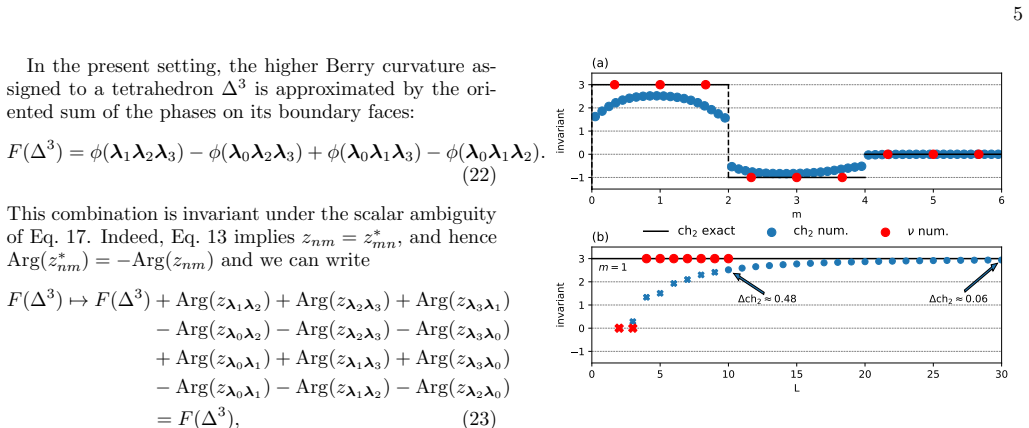
Representing the four-dimensional Chern insulator as infinite chains over the three-dimensional Brillouin zone and extracting its higher three-form Berry curvature via infinite matrix product states produces a Dixmier-Douady-Kapustin-Spodyneiko number whose phase diagram is exactly congruent to that of the second Chern number, thereby demonstrating a manifestly quantized computational method for the latter.
What carries the argument
The higher three-form Berry curvature extracted from the infinite matrix product state representation of the chains, which integrates to the Dixmier-Douady-Kapustin-Spodyneiko number over the three-dimensional Brillouin zone.
If this is right
- The phase diagram of the Dixmier-Douady-Kapustin-Spodyneiko number coincides exactly with the second Chern number diagram as a function of the mass term.
- Higher Berry curvature supplies a manifestly quantized procedure for obtaining second Chern numbers in crystalline insulators.
- The second Chern form links directly to the Chern-Simons axion coupling, which governs magnetoelectric response in three dimensions.
- Higher Berry phases arise in three-dimensional systems through this same connection.
Where Pith is reading between the lines
- The approach could be applied to other lattice models lacking closed-form second Chern expressions to extract their topological invariants numerically.
- Discrepancies arising from finite bond dimension in the matrix product states would serve as a practical diagnostic for convergence in future calculations.
- The method may extend to interacting systems where analytic Chern numbers are unavailable, provided the infinite-chain representation remains valid.
Load-bearing premise
The infinite matrix product state representation of each chain captures the complete higher three-form Berry curvature without truncation or convergence errors that would alter the integrated topological number.
What would settle it
A calculation on the same model that yields a Dixmier-Douady-Kapustin-Spodyneiko number differing from the known analytic second Chern number, or a case in which iMPS truncation visibly produces non-quantized values while the second Chern number remains quantized.
Figures



read the original abstract
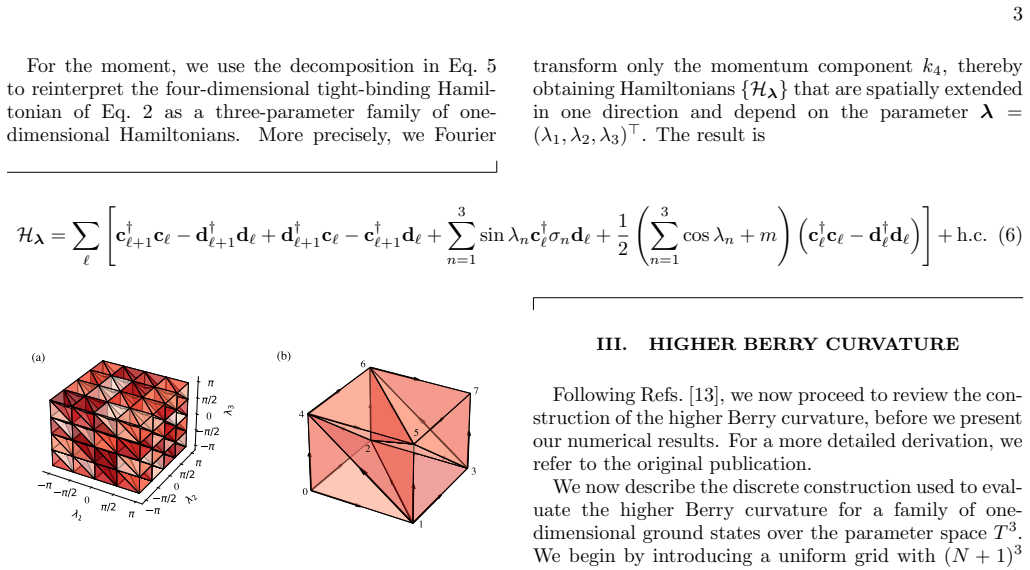
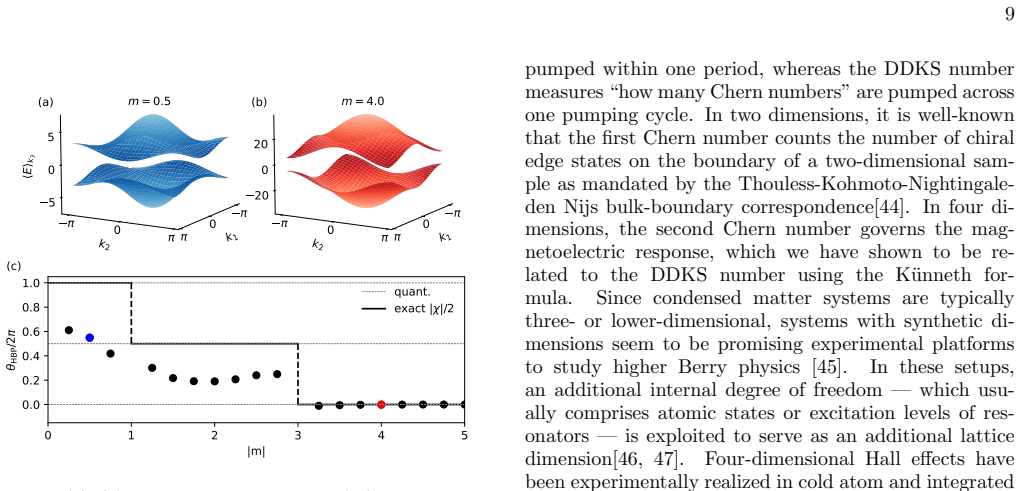
We rewrite a lattice model of the four-dimensional Chern insulator as a family of translationally-invariant infinite chains over the three-dimensional Brillouin zone and compute its higher three-form Berry curvature using infinite matrix product states (iMPS). We calculate the topological phase diagram of the associated Dixmier--Douady--Kapustin--Spodyneiko (DDKS) number as a function of the model's mass term, and show that it is exactly congruent to the phase diagram in terms of the second Chern number, the analytic expression of which is known for this particular model. This agreement demonstrates that higher Berry curvature can be used to compute second Chern numbers in a manifestly quantized manner. Motivated by the connection between the second Chern form and the Chern--Simons axion coupling, we study magnetoelectric coupling in three dimensions and its relation to higher Berry phases.
Editorial analysis
A structured set of objections, weighed in public.
Referee Report
Summary. The manuscript rewrites a lattice model of the four-dimensional Chern insulator as a family of translationally-invariant infinite chains over the three-dimensional Brillouin zone. Using infinite matrix product states (iMPS), the authors compute the higher three-form Berry curvature and extract the Dixmier-Douady-Kapustin-Spodyneiko (DDKS) number. They report that the resulting topological phase diagram versus the mass term is exactly congruent with the known analytic phase diagram of the second Chern number for this model. The work additionally examines the relation of higher Berry phases to magnetoelectric coupling in three dimensions.
Significance. If the numerical agreement is robust, the result provides a concrete demonstration that higher Berry curvature, when computed via iMPS, can yield manifestly quantized second Chern numbers. This supplies a computational route to higher topological invariants in crystalline insulators for which closed-form expressions are unavailable. The explicit comparison to an independent analytic benchmark and the discussion of magnetoelectric consequences add physical context and potential utility.
major comments (1)
- [Numerical results on DDKS number and phase diagram] The central claim of exact congruence between the DDKS phase diagram and the analytic second Chern number rests on the accuracy of the iMPS-derived three-form Berry curvature. The manuscript provides no explicit statement or data on convergence of the integrated DDKS number with respect to iMPS bond dimension D (or other cutoffs implicit in the infinite-chain representation). Without such tests, truncation errors in the curvature integrand could in principle preserve the integrated invariant coincidentally for this particular model.
Simulated Author's Rebuttal
We thank the referee for the careful reading of the manuscript and for the constructive comment. We address the major point below.
read point-by-point responses
-
Referee: The central claim of exact congruence between the DDKS phase diagram and the analytic second Chern number rests on the accuracy of the iMPS-derived three-form Berry curvature. The manuscript provides no explicit statement or data on convergence of the integrated DDKS number with respect to iMPS bond dimension D (or other cutoffs implicit in the infinite-chain representation). Without such tests, truncation errors in the curvature integrand could in principle preserve the integrated invariant coincidentally for this particular model.
Authors: We agree that explicit convergence tests are necessary to fully substantiate the numerical results and to exclude the possibility of coincidental quantization due to truncation. Although the calculations underlying the reported phase diagram were performed at bond dimensions where the DDKS number stabilizes to the expected integers (matching the analytic second Chern number within machine precision), the manuscript indeed lacks a dedicated statement or supplementary data on this convergence. In the revised manuscript we will add a new subsection (or appendix) together with a figure that shows the integrated DDKS number versus bond dimension D for representative mass values across the phase diagram. This will demonstrate that the invariant converges rapidly to the quantized values and that the reported congruence is robust. revision: yes
Circularity Check
No circularity; central claim validated by independent analytic benchmark
full rationale
The paper rewrites the 4D Chern insulator as a family of iMPS chains, extracts the higher three-form Berry curvature, integrates to the DDKS number, and reports exact congruence with the model's independently known analytic second Chern number. This external benchmark supplies grounding that is not internal to the paper's definitions or fits. No self-definitional steps, fitted inputs renamed as predictions, or load-bearing self-citations appear in the derivation chain; the result is therefore self-contained against an external reference.
Axiom & Free-Parameter Ledger
axioms (2)
- standard math Standard definitions of the Berry curvature and its higher-form generalizations in band theory
- domain assumption The lattice model is a valid representative of a 4D Chern insulator
Reference graph
Works this paper leans on
-
[1]
A. Kitaev, Toward a topological classification of many-body quantum states with short-range entangle- ment (2011), topological Quantum Computing Work- shop (Stony Brook, NY: Simons Center for Geome- try and Physics, Stony Brook University),http://scgp. stonybrook.edu/archives/1087
2011
-
[2]
Kitaev, On the classification of short-range entan- gled states (2013), talk at Simons Center, 2013-06-20, http://scgp.stonybrook.edu/video_portal/video
A. Kitaev, On the classification of short-range entan- gled states (2013), talk at Simons Center, 2013-06-20, http://scgp.stonybrook.edu/video_portal/video. php?id=2010
2013
-
[3]
Kitaev, Homotopy-theoretic approach to spt phases in action: Z16 classification of three- dimensional superconductors
A. Kitaev, Homotopy-theoretic approach to spt phases in action: Z16 classification of three- dimensional superconductors. (2015), symmetry and Topology in Quantum Matter Workshop, In- stitute for Pure and Applied Mathematics, Univer- sity of California, Los Angeles, California, 2015. http://www.ipam.ucla.edu/programs/workshops/ symmetry-and-topology-in-qu...
2015
-
[4]
F. D. M. Haldane, Model for a quantum hall effect with- out landau levels: Condensed-matter realization of the ”parity anomaly”, Phys. Rev. Lett.61, 2015 (1988)
2015
-
[5]
Pancharatnam, Generalized theory of interference, and its applications, Proceedings of the Indian Academy of Sciences - Section A44, 247 (1956)
S. Pancharatnam, Generalized theory of interference, and its applications, Proceedings of the Indian Academy of Sciences - Section A44, 247 (1956)
1956
-
[6]
M. V. Berry, Quantal phase factors accompanying adia- batic changes, Proceedings of the Royal Society of Lon- don. A. Mathematical and Physical Sciences392, 45 (1984)
1984
-
[7]
T. Fukui, Y. Hatsugai, and H. Suzuki, Chern num- bers in discretized brillouin zone: Efficient method of computing (spin) hall conductances, Journal of the Physical Society of Japan74, 1674 (2005), https://doi.org/10.1143/JPSJ.74.1674
-
[8]
Kapustin and L
A. Kapustin and L. Spodyneiko, Higher-dimensional gen- eralizations of berry curvature, Phys. Rev. B101, 235130 (2020)
2020
-
[9]
X. Wen, M. Qi, A. Beaudry, J. Moreno, M. J. Pflaum, D. Spiegel, A. Vishwanath, and M. Hermele, Flow of higher berry curvature and bulk-boundary correspon- dence in parametrized quantum systems, Phys. Rev. B 108, 125147 (2023)
2023
-
[10]
A. Kapustin and N. Sopenko, Local Noether the- orem for quantum lattice systems and topological invariants of gapped states, Journal of Mathe- matical Physics63, 10.1063/5.0085964 (2022), 091903, https://pubs.aip.org/aip/jmp/article- pdf/doi/10.1063/5.0085964/16563654/091903 1 online.pdf
-
[11]
A. Artymowicz, A. Kapustin, and N. Sopenko, Quantiza- tion of the higher berry curvature and the higher thouless pump (2023), arXiv:2305.06399 [math-ph]
-
[12]
Bachmann, W
S. Bachmann, W. De Roeck, M. Fraas, and T. Jappens, A classification of g-charge thouless pumps in 1d invertible states, Communications in Mathematical Physics405, 157 (2024)
2024
-
[13]
K. Shiozaki, N. Heinsdorf, and S. Ohyama, Higher berry curvature from matrix product states, arXiv preprint arXiv:2305.08109 (2023)
- [14]
-
[15]
Schollw¨ ock, The density-matrix renormalization group in the age of matrix product states, Annals of Physics 326, 96 (2011), january 2011 Special Issue
U. Schollw¨ ock, The density-matrix renormalization group in the age of matrix product states, Annals of Physics 326, 96 (2011), january 2011 Special Issue
2011
-
[16]
J. Haegeman, M. Mari¨ en, T. J. Osborne, and F. Verstraete, Geometry of matrix product states: Metric, parallel transport, and curva- ture, Journal of Mathematical Physics55, 021902 (2014), https://pubs.aip.org/aip/jmp/article- pdf/doi/10.1063/1.4862851/15641654/021902 1 online.pdf
- [17]
-
[18]
Ohyama and S
S. Ohyama and S. Ryu, Higher structures in matrix prod- uct states, Phys. Rev. B109, 115152 (2024)
2024
-
[19]
S. Ohyama and S. Ryu, Higher berry connection for matrix product states (2024), arXiv:2405.05327 [cond- mat.str-el]
-
[20]
Nakahara, Geometry, topology and physics (CRC press, 2018)
M. Nakahara, Geometry, topology and physics (CRC press, 2018)
2018
-
[21]
D. D. Spiegel, M. Qi, D. T. Stephen, M. Hermele, M. J. Pflaum, and A. Beaudry, A classifying space for phases of matrix product states, Communications in Mathematical Physics407, 17 (2025)
2025
-
[22]
Neuberger, Exactly massless quarks on the lattice, Physics Letters B417, 141 (1998)
H. Neuberger, Exactly massless quarks on the lattice, Physics Letters B417, 141 (1998)
1998
-
[23]
Hasenfratz, V
P. Hasenfratz, V. Laliena, and F. Niedermayer, The in- dex theorem in qcd with a finite cut-off1work supported in part by schweizerischer nationalfonds, by iberdrola, ciencia y tecnologia, espa˜ na and by the ministerio de ed- ucacion y cultura, espa˜ na.1, Physics Letters B427, 125 (1998)
1998
-
[24]
S. Aoki, H. Fukaya, M. Furuta, S. Matsuo, T. Onogi, and S. Yamaguchi, K-theoretic computation of the atiyah(–patodi)–singer index of lattice dirac operators, Progress of Theoretical and Experimental Physics2025, 063B09 (2025), https://academic.oup.com/ptep/article- pdf/2025/6/063B09/63552157/ptaf087.pdf
2025
-
[25]
X.-L. Qi, T. L. Hughes, and S.-C. Zhang, Topological field theory of time-reversal invariant insulators, Phys. Rev. B78, 195424 (2008)
2008
-
[26]
Wang and S.-C
Z. Wang and S.-C. Zhang, Topological invariants and ground-state wave functions of topological insulators on a torus, Phys. Rev. X4, 011006 (2014)
2014
-
[27]
Heinsdorf, The geometric memory of quantum wave functions, Ph.D
N. Heinsdorf, The geometric memory of quantum wave functions, Ph.D. thesis, University of British Columbia (2025)
2025
-
[28]
M. F. Golterman, K. Jansen, and D. B. Kaplan, Chern- simons currents and chiral fermions on the lattice, Physics Letters B301, 219 (1993)
1993
-
[29]
Creutz, Aspects of chiral symmetry and the lattice, Rev
M. Creutz, Aspects of chiral symmetry and the lattice, Rev. Mod. Phys.73, 119 (2001)
2001
-
[30]
Hauschild and F
J. Hauschild and F. Pollmann, Efficient numerical sim- ulations with Tensor Networks: Tensor Network Python (TeNPy), SciPost Phys. Lect. Notes , 5 (2018)
2018
-
[31]
Perez-Garcia, F
D. Perez-Garcia, F. Verstraete, M. M. Wolf, and J. I. Cirac, Matrix product state representations, Quantum Info. Comput.7, 401–430 (2007)
2007
-
[32]
Hauschild, J
J. Hauschild, J. Unfried, S. Anand, B. Andrews, M. Bintz, U. Borla, S. Divic, M. Drescher, J. Geiger, M. Hefel, K. H´ emery, W. Kadow, J. Kemp, N. Kirchner, V. S. Liu, G. M¨ oller, D. Parker, M. Rader, A. Romen, 12 S. Scalet, L. Schoonderwoerd, M. Schulz, T. Soejima, P. Thoma, Y. Wu, P. Zechmann, L. Zweng, R. S. K. Mong, M. P. Zaletel, and F. Pollmann, Te...
2024
-
[33]
P´ erez-Garc´ ıa, M
D. P´ erez-Garc´ ıa, M. M. Wolf, M. Sanz, F. Verstraete, and J. I. Cirac, String order and symmetries in quantum spin lattices, Phys. Rev. Lett.100, 167202 (2008)
2008
-
[34]
Mochol-Grzelak, A
M. Mochol-Grzelak, A. Dauphin, A. Celi, and M. Lewen- stein, Efficient algorithm to compute the second chern number in four dimensional systems, Quantum Science and Technology4, 014009 (2018)
2018
-
[35]
S.-C. Zhang and J. Hu, A four-dimensional generaliza- tion of the quantum hall effect, Science294, 823 (2001), https://www.science.org/doi/pdf/10.1126/science.294.5543.823
- [36]
-
[37]
A. M. Essin, A. M. Turner, J. E. Moore, and D. Vander- bilt, Orbital magnetoelectric coupling in band insulators, Phys. Rev. B81, 205104 (2010)
2010
-
[38]
Varnava and D
N. Varnava and D. Vanderbilt, Surfaces of axion insula- tors, Phys. Rev. B98, 245117 (2018)
2018
-
[39]
A. M. Essin, J. E. Moore, and D. Vanderbilt, Magneto- electric polarizability and axion electrodynamics in crys- talline insulators, Phys. Rev. Lett.102, 146805 (2009)
2009
-
[40]
Liu and D
J. Liu and D. Vanderbilt, Gauge-discontinuity contribu- tions to chern-simons orbital magnetoelectric coupling, Phys. Rev. B92, 245138 (2015)
2015
-
[41]
Alexandradinata, A
A. Alexandradinata, A. Nelson, and A. A. Soluyanov, Teleportation of berry curvature on the surface of a hopf insulator, Phys. Rev. B103, 045107 (2021)
2021
-
[42]
Nakamura and K
D. Nakamura and K. Kawabata, Non-hermitian hopf in- sulators, Phys. Rev. B112, 075134 (2025)
2025
-
[43]
D. J. Thouless, Quantization of particle transport, Phys. Rev. B27, 6083 (1983)
1983
-
[44]
D. J. Thouless, M. Kohmoto, M. P. Nightingale, and M. den Nijs, Quantized hall conductance in a two- dimensional periodic potential, Phys. Rev. Lett.49, 405 (1982)
1982
-
[45]
K. R. A. Hazzard and B. Gadway, Syn- thetic dimensions, Physics Today76, 62 (2023), https://pubs.aip.org/physicstoday/article- pdf/76/4/62/20085764/62 1 pt.3.5225.pdf
2023
-
[46]
M. Mancini, G. Pagano, G. Cappellini, L. Livi, M. Rider, J. Catani, C. Sias, P. Zoller, M. In- guscio, M. Dalmonte, and L. Fallani, Observa- tion of chiral edge states with neutral fermions in synthetic hall ribbons, Science349, 1510 (2015), https://www.science.org/doi/pdf/10.1126/science.aaa8736
-
[47]
B. K. Stuhl, H.-I. Lu, L. M. Aycock, D. Genk- ina, and I. B. Spielman, Visualizing edge states with an atomic bose gas in the quan- tum hall regime, Science349, 1514 (2015), https://www.science.org/doi/pdf/10.1126/science.aaa8515
-
[48]
H. M. Price, O. Zilberberg, T. Ozawa, I. Carusotto, and N. Goldman, Four-dimensional quantum hall effect with ultracold atoms, Phys. Rev. Lett.115, 195303 (2015)
2015
-
[49]
Ozawa, H
T. Ozawa, H. M. Price, N. Goldman, O. Zilberberg, and I. Carusotto, Synthetic dimensions in integrated photon- ics: From optical isolation to four-dimensional quantum hall physics, Phys. Rev. A93, 043827 (2016)
2016
-
[50]
D. M. Long, P. J. D. Crowley, and A. Chandran, Nonadi- abatic topological energy pumps with quasiperiodic driv- ing, Phys. Rev. Lett.126, 106805 (2021)
2021
-
[51]
A. D. King, A. Nocera, M. M. Rams, J. Dziarmaga, R. Wiersema, W. Bernoudy, J. Raymond, N. Kaushal, N. Heinsdorf, R. Harris, K. Boothby, F. Altomare, A. J. Berkley, M. Boschnak, K. Chern, H. Chris- tiani, S. Cibere, J. Connor, M. H. Dehn, R. Desh- pande, S. Ejtemaee, P. Farr´ e, K. Hamer, E. Hoskin- son, S. Huang, M. W. Johnson, S. Kortas, E. Ladizin- sky,...
-
[52]
Weisbrich, R
H. Weisbrich, R. Klees, G. Rastelli, and W. Belzig, Second chern number and non-abelian berry phase in topological superconducting systems, PRX Quantum2, 010310 (2021)
2021
-
[53]
Chan and X.-J
C. Chan and X.-J. Liu, Non-abelian majorana modes pro- tected by an emergent second chern number, Phys. Rev. Lett.118, 207002 (2017)
2017
-
[54]
Sodemann and L
I. Sodemann and L. Fu, Quantum nonlinear hall effect induced by berry curvature dipole in time-reversal in- variant materials, Phys. Rev. Lett.115, 216806 (2015)
2015
-
[55]
Ma, S.-Y
Q. Ma, S.-Y. Xu, H. Shen, D. MacNeill, V. Fatemi, T.- R. Chang, A. M. Mier Valdivia, S. Wu, Z. Du, C.-H. Hsu, S. Fang, Q. D. Gibson, K. Watanabe, T. Taniguchi, R. J. Cava, E. Kaxiras, H.-Z. Lu, H. Lin, L. Fu, N. Gedik, and P. Jarillo-Herrero, Observation of the nonlinear hall effect under time-reversal-symmetric conditions, Nature 565, 337 (2019)
2019
-
[56]
Y. Fang, J. Cano, and S. A. A. Ghorashi, Quantum geom- etry induced nonlinear transport in altermagnets, Phys. Rev. Lett.133, 106701 (2024)
2024
-
[57]
S. Lai, H. Liu, Z. Zhang, J. Zhao, X. Feng, N. Wang, C. Tang, Y. Liu, K. S. Novoselov, S. A. Yang, and W.- b. Gao, Third-order nonlinear hall effect induced by the berry-connection polarizability tensor, Nature Nanotech- nology16, 869 (2021)
2021
-
[58]
A. Gao, Y.-F. Liu, J.-X. Qiu, B. Ghosh, T. V. Trevisan, Y. Onishi, C. Hu, T. Qian, H.-J. Tien, S.-W. Chen, M. Huang, D. B´ erub´ e, H. Li, C. Tzschaschel, T. Dinh, Z. Sun, S.-C. Ho, S.-W. Lien, B. Singh, K. Watanabe, T. Taniguchi, D. C. Bell, H. Lin, T.-R. Chang, C. R. Du, A. Bansil, L. Fu, N. Ni, P. P. Orth, Q. Ma, and S.-Y. Xu, Quantum metric nonlinear ...
-
[59]
Ulrich, J
Y. Ulrich, J. Mitscherling, L. Classen, and A. P. Schny- der, Quantum geometric origin of the intrinsic nonlinear hall effect, Phys. Rev. B113, L201107 (2026)
2026
-
[60]
J.-W. Rhim, K. Kim, and B.-J. Yang, Quantum distance and anomalous landau levels of flat bands, Nature584, 59 (2020)
2020
-
[61]
P. J. Ledwith, A. Vishwanath, and D. E. Parker, Vor- texability: A unifying criterion for ideal fractional chern insulators, Phys. Rev. B108, 205144 (2023). 13
2023
-
[62]
P. J. Ledwith, J. Dong, A. Vishwanath, and E. Khalaf, Nonlocal moments in the chern bands of twisted bilayer graphene (2024), arXiv:2408.16761 [cond-mat.str-el]
work page internal anchor Pith review Pith/arXiv arXiv 2024
-
[63]
Kitamura, A
T. Kitamura, A. Daido, and Y. Yanase, Spin-triplet superconductivity from quantum-geometry-induced fer- romagnetic fluctuation, Phys. Rev. Lett.132, 036001 (2024)
2024
-
[64]
Y. Onishi and L. Fu, Quantum weight (2024), arXiv:2401.13847 [cond-mat.str-el]
-
[65]
N. Heinsdorf, Altermagnetic instabilities from quantum geometry (2024), arXiv:2410.12789 [cond-mat.str-el]
-
[66]
T. c. v. Bzduˇ sek, From quantum geometry to nonlinear optics and gerbes: Recent advances in topological band theory, Phys. Rev. B113, 099601 (2026)
2026
-
[67]
M. M. Hirschmann, A. Leonhardt, B. Kilic, D. H. Fabini, and A. P. Schnyder, Symmetry-enforced band crossings in tetragonal materials: Dirac and weyl degeneracies on points, lines, and planes, Phys. Rev. Mater.5, 054202 (2021)
2021
-
[68]
Leonhardt, M
A. Leonhardt, M. M. Hirschmann, N. Heinsdorf, X. Wu, D. H. Fabini, and A. P. Schnyder, Symmetry-enforced topological band crossings in orthorhombic crystals: Classification and materials discovery, Phys. Rev. Mater. 5, 124202 (2021)
2021
-
[69]
Alpin, M
K. Alpin, M. M. Hirschmann, N. Heinsdorf, A. Leon- hardt, W. Y. Yau, X. Wu, and A. P. Schnyder, Funda- mental laws of chiral band crossings: Local constraints, global constraints, and topological phase diagrams, Phys. Rev. Res.5, 043165 (2023)
2023
-
[70]
Oudah, H.-H
M. Oudah, H.-H. Kung, S. Sahu, N. Heinsdorf, A. Schulz, K. Philippi, M.-V. De Toro Sanchez, Y. Cai, K. Ko- jima, A. P. Schnyder, H. Takagi, B. Keimer, D. A. Bonn, and A. M. Hallas, Discovery of superconductivity and electron-phonon drag in the non-centrosymmetric weyl semimetal larhge3, npj Quantum Materials9, 88 (2024)
2024
-
[71]
Shang, O
C. Shang, O. Ganter, N. Heinsdorf, and S. M. Win- ter, irf 4: From tetrahedral compass model to topological semimetal, Phys. Rev. B107, 125111 (2023)
2023
-
[72]
Huber, S
N. Huber, S. Mishra, I. Sheikin, K. Alpin, A. P. Schnyder, G. Benka, A. Bauer, C. Pfleiderer, and M. A. Wilde, Fermi surface of the chiral topological semimetal cosi, Phys. Rev. B109, 205115 (2024)
2024
-
[73]
J´ erome, The physics of organic superconductors, Sci- ence252, 1509 (1991)
D. J´ erome, The physics of organic superconductors, Sci- ence252, 1509 (1991)
1991
-
[74]
P. Chudzinski, M. Berben, X. Xu, N. Wakeham, B. Bern´ ath, C. Duffy, R. D. H. Hinlopen, Y.- T. Hsu, S. Wiedmann, P. Tinnemans, R. Jin, M. Greenblatt, and N. E. Hussey, Emergent sym- metry in a low-dimensional superconductor on the edge of mottness, Science382, 792 (2023), https://www.science.org/doi/pdf/10.1126/science.abp8948
-
[75]
Yoshida, R
T. Yoshida, R. Peters, S. Fujimoto, and N. Kawakami, Characterization of a topological mott insulator in one dimension, Phys. Rev. Lett.112, 196404 (2014)
2014
-
[76]
Monkman and J
K. Monkman and J. Sirker, Operational entanglement of symmetry-protected topological edge states, Phys. Rev. Res.2, 043191 (2020)
2020
-
[77]
P. A. McClarty, X.-Y. Dong, M. Gohlke, J. G. Rau, F. Pollmann, R. Moessner, and K. Penc, Topological magnons in kitaev magnets at high fields, Phys. Rev. B 98, 060404 (2018)
2018
-
[78]
Soejima, D
T. Soejima, D. E. Parker, N. Bultinck, J. Hauschild, and M. P. Zaletel, Efficient simulation of moir´ e materials us- ing the density matrix renormalization group, Phys. Rev. B102, 205111 (2020)
2020
-
[79]
Fate of Bosonic Topological Edge Modes in the Presence of Many-Body Interactions
N. Heinsdorf, D. G. Joshi, H. Katsura, and A. P. Schny- der, Fate of bosonic topological edge modes in the pres- ence of many-body interactions (2025), arXiv:2309.15113 [cond-mat.str-el]
work page internal anchor Pith review Pith/arXiv arXiv 2025
-
[80]
H. Yoshida, N. Heinsdorf, and H. Katsura, Edge-edge correlations without edge-states:η-clustering state as ground state of the extended attractive su(3) hubbard chain (2024), arXiv:2411.14724 [cond-mat.str-el]
discussion (0)
Sign in with ORCID, Apple, or X to comment. Anyone can read and Pith papers without signing in.