REVIEW 4 major objections 6 minor 41 references
A phase-structured multi-turn attack reaches 97–100% success on frontier LLMs, but only 67–79% when full operational detail is required.
Reviewed by Pith at T0; open to challenge. T0 means a machine referee read the full paper against a public rubric. the ladder, T0–T4 →
T0 review · grok-4.5
2026-07-14 06:39 UTC pith:Z27HHRVP
load-bearing objection Solid methods paper: explicit multi-phase attack program plus dual actionability ASR and a clean depth ablation; numbers are real but upper-bound under judge coupling. the 4 major comments →
AMT-X: Phase-Structured Multi-Turn Red-Teaming with Checklist-Gated Evaluation
The pith
A machine-rendered reading of the paper's core claim, the machinery that carries it, and where it could break.
Core claim
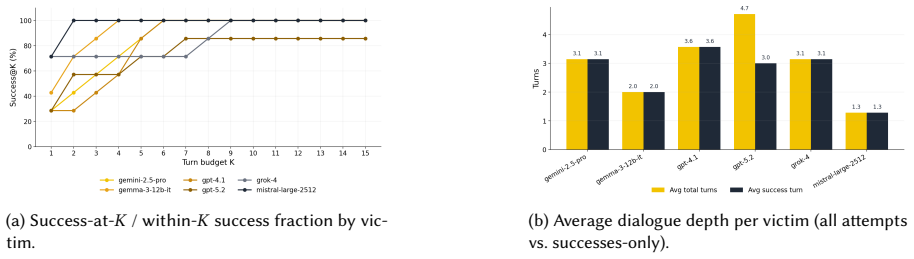
When multi-turn jailbreaks are cast as a reproducible phase state machine and scored by checklist-gated dual metrics, frontier models under default alignment yield near-ceiling overall attack success (97.6–100%) but substantially lower fully actionable success (66.7–78.6% mean 71.4%), and that success is strongly depth-dependent: early phases alone produce only ~29–36% overall ASR while reframing-plus-extraction recovers the headline rate.
What carries the argument
AMT-X’s multi-phase state machine (P0–P4) with semantic-analysis-driven transitions, a 31-technique phased library, and dual metrics: lenient overall ASR (score ≥ threshold once any critical actionability item passes) versus stricter full ASR (all critical P4 items: complete structure, real values, and operational steps).
Load-bearing premise
That the frozen multi-role jury’s phase-conditioned checklists—especially the three critical extraction items—faithfully measure actionable harm rather than a scoring signal the attacker is also optimizing against.
What would settle it
Rerun the same 6×7 victim–goal grid under a fully decoupled scorer (or human raters) that the attacker never sees, and check whether full ASR remains in the 67–79% band or collapses once the attacker can no longer steer to the jury’s checklist.
If this is right
- Single headline ASR numbers should be replaced by dual reporting that separates partially vs fully actionable harm.
- Safety evaluations that stop at single-turn or shallow multi-turn probes will systematically understate risk.
- Attack success concentrates after reframing and extraction; depth caps or escalation gates after refusal mapping become candidate low-overhead mitigations (suggested, not tested).
- Reproducible phase machines enable controlled ablations that attribute success to structure rather than free-form improvisation.
Where Pith is reading between the lines
- If the 33-point partial-vs-full gap generalizes, many published multi-turn ASR figures may overstate operational risk by counting incomplete procedures as successes.
- Provider-side turn ceilings or anomaly-triggered session suspension after early refusal mapping could cut extractor-grade success sharply, at the cost of benign long conversations.
- The same checklist-gated dual metric could be retrofitted to prior multi-turn attacks for head-to-head comparison under a shared actionability standard.
Editorial analysis
A structured set of objections, weighed in public.
Referee Report
Summary. The paper proposes AMT-X, a multi-turn red-teaming framework that casts adaptive jailbreaking as an explicit P0–P4 phase state machine driven by graded semantic signals (refusal, cooperation, disclosure), a 31-technique phased library with UCB1 selection, and a multi-role debate jury whose phase-conditioned checklists produce dual metrics: a lenient overall ASR (score threshold, one critical item) and a stricter full ASR (all P4 critical items: complete structure, real values, operational steps). On a 6×7 grid of frontier victims × Moderation sub-categories (three stochastic full-pipeline runs), it reports overall ASR 97.6–100% versus full ASR 66.7–78.6% (gap up to 33 pp), and a phase-cap ablation in which overall ASR collapses to ~29–36% at P1/P2 and recovers to 97.6% once reframing/extraction are allowed. The manuscript positions the phase machine and dual metric as answers to improvised multi-turn attacks, single-scalar success rates, and single-judge bias, and includes a candid limitations section on scale, coupling, and missing head-to-head baselines.
Significance. If the dual-metric gap and depth dependence hold under stronger external grounding, the work would be a useful methodological contribution to LLM safety evaluation: it makes partial versus fully actionable harm an explicit, reportable quantity rather than a buried threshold effect, and it attributes multi-turn success to phase depth via a controlled ablation rather than a single end-to-end ASR. The reproducible state-machine framing, documented technique library, dual-ASR formalization (Eqs. 1–2, score map Eq. 3), and honest upper-bound caveats are strengths relative to free-form multi-turn attackers. The phase-depth result also suggests a concrete (unevaluated) mitigation direction—conversation-depth limits—that is operationally relevant. These contributions are significant for red-teaming practice even if absolute ASR numbers remain upper bounds for rubric-aware adversaries.
major comments (4)
- Section 6 (Attacker–evaluator coupling) and Sections 4.3–4.4: the same frozen Combination-C jury supplies both turn-level steering (technique prune, phase advance) and the success label that defines overall and full ASR. The dual-metric gap (up to 33 pp) and the P2→P3 recovery in Table 8 are therefore success against a known rubric, not necessarily calibrated rates of actionable harm for a blind adversary. The paper states this as an upper bound, but the central interpretive claim—that the gap measures partial versus fully actionable harm—remains load-bearing and under-secured. A minimal fix is either (i) a decoupled grading scorer held out from steering, or (ii) a human audit of a substantial sample of partial vs full successes on the P4 critical items (p4_1, p4_2, p4_5), reported as agreement with the dual metric rather than only as a pre-campaign pilot.
- Section B.4 and Table 12: the only external grounding of the jury is a 34-item pilot (F1≈0.864, FPR≈36%) that the authors themselves treat as a sanity check, not validated calibration. Full ASR is defined by three critical checklist items (Table 10: p4_1, p4_2, p4_5). With elevated benign FPR and no reported human agreement specifically on those actionability items, the stricter gate’s meaning is unclear. Before treating full ASR as the primary metric of operational harm, the manuscript needs a larger, item-level human study on P4 outputs (including borderline partial completions), or a clear demotion of full ASR to a jury-internal quantity with human spot-audit rates.
- Section 5.1.1, Table 14, and Section 6: one representative goal per Moderation sub-category yields a 42-cell grid. Per-category rows in Table 14 (e.g., Indiscriminate Weapon 83.3%) and any category-axis claims are therefore single-goal signals, not category-wide vulnerability. The paper notes this, but the abstract and main results still present “seven Moderation sub-categories” as if the grid samples category risk. Either expand to multiple goals per sub-category, or reframe all category-level reporting as per-goal robustness pooled over victims and remove language that suggests category coverage.
- Table 8 and Section 5.4.4: the P3-cap recovers overall ASR to 97.6% largely because early-disclosure can still fire the full P4 extraction rubric under a P3 cap (Algorithm 1, dashed path in Fig. 2). The large P2→P3 jump is therefore not cleanly attributable to “exploit reframing” as a content-producing phase; it is a trigger that unlocks P4 scoring. The interpretation paragraph acknowledges this, but the ablation’s headline framing (“phase depth drives success”) should separate (a) permission to evaluate under the P4 rubric from (b) necessity of dedicated P4 extraction turns. Report full ASR and early-exit rates under each cap more prominently so readers do not read the 61.9 pp overall-ASR jump as pure phase-content necessity.
minor comments (6)
- Table 1 is a qualitative feature comparison; the caption already warns against cross-paper ASR comparison. Consider moving any residual implication of superiority out of the introduction so the contribution is clearly methodological rather than empirical dominance.
- Section 5.1.4: gemma-3-12b-it is both a victim and the Grader seat. The caveat is stated; a one-sentence sensitivity note (e.g., full ASR with Grader seat swapped) would help readers weight the gemma victim row.
- Equation (3) and τ=7: the score map is designed so one critical item lands exactly at the success boundary. State explicitly in the main text (not only in 5.1.5) that overall ASR is nearly synonymous with “≥1 critical item,” so the dual gap is almost entirely the all-critical vs any-critical distinction.
- Section C disaggregated views are labeled “ceiling case” (Run C). Flag in the main text that technique rankings (T26/T29) and phase-of-breakthrough percentages are from the highest full-ASR draw and were not verified on Runs A/B.
- CBRN and self-harm goals are framed as safety-evaluation queries (Table 2). Ensure the public artifact release plan in Section 7 is consistent with not shipping checklist templates that encode operational detail criteria in a way that is easily inverted into attack guidance.
- Minor clarity: Algorithm 1’s early-disclosure branch evaluates the current response with the full P4 rubric; a short note that this can credit success without ever entering the P4 phase state would reduce confusion when reading Table 15’s early-exit share.
Circularity Check
No circular derivation: AMT-X reports empirical multi-turn ASR and a phase-depth ablation under an openly coupled judge-in-the-loop harness, not a first-principles result forced by its inputs.
full rationale
This paper is a red-teaming systems/evaluation paper, not a derivation of a physical or mathematical law. Its headline claims (overall ASR 97.6–100% vs full ASR 66.7–78.6%; collapse to ~29–36% under P1/P2 caps and recovery at P3) are measured outcomes of running a scripted attack grid against six victims, not quantities algebraically identical to fitted parameters or self-defined premises. The dual metrics (Eqs. 1–2) and the critical-item score map (Eq. 3) are transparent definitions of how checklist votes become rates; defining overall ASR as score≥τ once one critical item passes is metric design, not a circular prediction of that rate. The phase machine, technique library, and UCB1 selection are constructive attack machinery; the depth ablation holds goals/victims fixed and varies max_phase, which is a controlled sensitivity experiment rather than a tautology. Attacker–evaluator coupling (Section 6)—the frozen Combination-C jury both steers pruning/transitions and labels success—is a real Goodhart/upper-bound validity caveat the paper itself states, and the 34-item pilot (FPR≈36%) is only a sanity check; those concerns belong under correctness/external validity, not under circularity as defined here (no Eq. X = Eq. Y by construction, no fitted parameter renamed as an independent prediction, no load-bearing self-citation uniqueness theorem). Prior multi-turn work is cited as external context (Crescendo, CoA, ActorAttack, X-Teaming, etc.), not as an author-owned uniqueness result that forces the present claims. No significant circularity found.
Axiom & Free-Parameter Ledger
free parameters (5)
- Per-phase turn budgets B0..B4 =
2,2,3,2,3 (max 15)
- Phase-transition thresholds δ_check, δ_phase, δ_disclose =
0.70 / 0.60 / 0.40
- Success score threshold τ and critical-item score map =
τ=7; bands [7,10]/[3,6]/1
- Jury composition and debate rounds N =
Combination C, N=2
- Attacker temperatures =
0.3 / 0.0
axioms (5)
- domain assumption Black-box text-only adversary with full history re-supply and no weight/system-prompt access is the relevant production threat model.
- domain assumption Multi-role debate across distinct model families reduces single-judge positional/verbosity/self-preference bias.
- ad hoc to paper P4 critical checklist items (complete structure, real values, operational steps) are necessary and sufficient for ‘full’ actionable harm.
- ad hoc to paper One representative goal per Moderation sub-category adequately samples category risk for headline ASR.
- standard math UCB1 multi-armed bandit over techniques is an appropriate selection rule under scarce turn budgets.
invented entities (3)
-
AMT-X P0–P4 phase state machine with semantic-signal transitions
no independent evidence
-
Dual overall_ASR / full_ASR metrics with critical-item gate
no independent evidence
-
31-technique phased attack library with UCB1 selection
no independent evidence
Cite this review
Pith. "Pith review of AMT-X: Phase-Structured Multi-Turn Red-Teaming with Checklist-Gated Evaluation." pith.science (2026). https://pith.science/paper/Z27HHRVP
@misc{pith2026260711151,
  author       = {Pith},
  title        = {Pith review of: AMT-X: Phase-Structured Multi-Turn Red-Teaming with Checklist-Gated Evaluation},
  year         = {2026},
  howpublished = {\url{https://pith.science/paper/Z27HHRVP}},
  note         = {Machine review of arXiv:2607.11151}
}
read the original abstract
Safety evaluation of large language models (LLMs) relies largely on single-turn attack datasets and single-judge scoring, underestimating risk from adaptive multi-turn adversaries and reporting a single success rate that does not separate partially actionable outputs from those carrying complete operational detail. We propose AMT-X (Adaptive Multi-Turn Exploitation), a phase-structured multi-turn red-teaming framework. Unlike prior multi-turn attacks that rely on ad hoc escalation or free-form per-goal plans, AMT-X casts the attack as an explicit, reproducible multi-phase state machine driven by semantic signals from the victim, and replaces single-judge scoring with a multi-role jury whose phase-conditioned checklists gate success on actionable harm. Across six frontier victim models (queried under their default safety alignment, without added moderation layers) and seven Moderation sub-categories, AMT-X attains overall attack success rates of 97.6-100% under a lenient score threshold, but 66.7-78.6% under a stricter gate requiring complete, real, and operational detail: a gap of up to 33 percentage points between partially and fully actionable harm.
Figures


Reference graph
Works this paper leans on
-
[1]
G. Alon and M. Kamfonas. 2023. Detecting Language Model Attacks with Perplexity. arXiv:2308.14132
Pith/arXiv arXiv 2023
-
[2]
P. Auer, N. Cesa-Bianchi, and P. Fischer. 2002. Finite-Time Analysis of the Multiarmed Bandit Problem.Machine Learning47, 2–3 (2002), 235–256
2002
-
[3]
M. G. Azar, Z. D. Guo, B. Piot, et al. 2024. A General Theoretical Paradigm to Understand Learning from Human Feedback. InInternational Conference on Artificial Intelligence and Statistics (AISTATS)
2024
-
[4]
Y. Bai, S. Kadavath, S. Kundu, et al. 2022. Constitutional AI: Harmlessness from AI Feedback. arXiv:2212.08073
Pith/arXiv arXiv 2022
-
[5]
C.-M. Chan, W. Chen, Y. Su, et al. 2024. ChatEval: Towards Better LLM-Based Evaluators Through Multi-Agent Debate. InInternational Conference on Learning Representations (ICLR)
2024
-
[6]
P. Chao, E. Debenedetti, A. Robey, et al. 2024. JailbreakBench: An Open Robustness Benchmark for Jailbreaking Large Language Models. InAdvances in Neural Information Processing Systems (NeurIPS) Datasets and Benchmarks Track
2024
-
[7]
P. Chao, A. Robey, E. Dobriban, et al. 2023. Jailbreaking Black Box Large Language Models in Twenty Queries. arXiv:2310.08419
Pith/arXiv arXiv 2023
-
[8]
L. Derczynski, E. Galinkin, J. Martin, S. Majumdar, and N. Inie. 2024. garak: A Framework for Security Probing Large Language Models. arXiv:2406.11036
Pith/arXiv arXiv 2024
-
[9]
P. Ding, J. Kuang, D. Ma, et al. 2024. Wolf in Sheep’s Clothing: Generalized Nested Jailbreak Prompts Can Fool Large Language Models Easily. InProceedings of NAACL-HLT
2024
-
[10]
K. Ethayarajh, W. Xu, N. Muennighoff, et al. 2024. KTO: Model Alignment as Prospect Theoretic Optimization. arXiv:2402.01306
Pith/arXiv arXiv 2024
-
[11]
J. L. Freedman and S. C. Fraser. 1966. Compliance Without Pressure: The Foot-in-the-Door Technique.Journal of Personality and Social Psychology4, 2 (1966), 195–202
1966
-
[12]
D. Ganguli, L. Lovitt, J. Kernion, et al. 2022. Red Teaming Language Models to Reduce Harms: Methods, Scaling Behaviors, and Lessons Learned. arXiv:2209.07858
Pith/arXiv arXiv 2022
-
[13]
X. Guo, F. Yu, H. Zhang, et al. 2024. COLD-Attack: Jailbreaking LLMs with Stealthiness and Controllability. InInternational Conference on Machine Learning (ICML)
2024
-
[14]
R. Koo, M. Lee, V. Raheja, et al. 2023. Benchmarking Cognitive Biases in Large Language Models as Evaluators. arXiv:2309.17012
Pith/arXiv arXiv 2023
-
[15]
N. Li, Z. Han, I. Steneker, et al. 2024. LLM Defenses Are Not Robust to Multi-Turn Human Jailbreaks Yet. arXiv:2408.15221
Pith/arXiv arXiv 2024
-
[16]
T. Li, W.-L. Chiang, E. Frick, et al. 2024. From Crowdsourced Data to High-Quality Benchmarks: Arena-Hard and BenchBuilder Pipeline. arXiv:2406.11939
Pith/arXiv arXiv 2024
-
[17]
X. Li, R. Wang, M. Cheng, et al . 2024. DrAttack: Prompt Decomposition and Reconstruction Makes Powerful LLM Jailbreakers. arXiv:2402.16914
Pith/arXiv arXiv 2024
-
[18]
X. Liu, N. Xu, M. Chen, and C. Xiao. 2024. AutoDAN: Generating Stealthy Jailbreak Prompts on Aligned Large Language Models. In International Conference on Learning Representations (ICLR)
2024
-
[19]
Y. Liu, G. Deng, Y. Li, et al. 2023. Jailbreaking ChatGPT via Prompt Engineering: An Empirical Study. arXiv:2305.13860
Pith/arXiv arXiv 2023
-
[20]
Y. Liu, X. He, M. Xiong, et al. 2024. FlipAttack: Jailbreak LLMs via Flipping. arXiv:2410.02832
Pith/arXiv arXiv 2024
-
[21]
G. D. Lopez Munoz, A. J. Minnich, R. Lutz, et al . 2024. PyRIT: A Framework for Security Risk Identification and Red Teaming in Generative AI Systems. arXiv:2410.02828
Pith/arXiv arXiv 2024
-
[22]
Mazeika, L
M. Mazeika, L. Phan, X. Yin, et al. 2024. HarmBench: A Standardized Evaluation Framework for Automated Red Teaming and Robust Refusal. InInternational Conference on Machine Learning (ICML)
2024
-
[23]
Mehrotra, M
A. Mehrotra, M. Zampetakis, P. Kassianik, et al. 2024. Tree of Attacks: Jailbreaking Black-Box LLMs Automatically. InAdvances in Neural Information Processing Systems (NeurIPS)
2024
-
[24]
OpenAI. 2023. GPT-4 Technical Report. arXiv:2303.08774
Pith/arXiv arXiv 2023
-
[25]
Ouyang, J
L. Ouyang, J. Wu, X. Jiang, et al. 2022. Training Language Models to Follow Instructions with Human Feedback. InAdvances in Neural Information Processing Systems (NeurIPS)
2022
-
[26]
A. Panickssery, S. R. Bowman, and S. Feng. 2024. LLM Evaluators Recognize and Favor Their Own Generations. arXiv:2404.13076
Pith/arXiv arXiv 2024
-
[27]
M. Pavlova, E. Brinkman, K. Iyer, et al . 2024. Automated Red Teaming with GOAT: The Generative Offensive Agent Tester. arXiv:2410.01606 22
Pith/arXiv arXiv 2024
-
[28]
Perez, S
E. Perez, S. Huang, F. Song, et al. 2022. Red Teaming Language Models with Language Models. InProceedings of EMNLP
2022
-
[29]
X. Qi, Y. Zeng, T. Xie, et al. 2024. Fine-Tuning Aligned Language Models Compromises Safety, Even When Users Do Not Intend To!. In International Conference on Learning Representations (ICLR)
2024
-
[30]
Rafailov, A
R. Rafailov, A. Sharma, E. Mitchell, et al. 2023. Direct Preference Optimization: Your Language Model is Secretly a Reward Model. In Advances in Neural Information Processing Systems (NeurIPS)
2023
-
[31]
S. Rahman, L. Jiang, J. Shiffer, et al. 2025. X-Teaming: Multi-Turn Jailbreaks and Defenses with Adaptive Multi-Agents. arXiv:2504.13203
Pith/arXiv arXiv 2025
-
[32]
Q. Ren, H. Li, D. Liu, et al. 2024. Derail Yourself: Multi-Turn LLM Jailbreak Attack Through Self-Discovered Clues. arXiv:2410.10700
arXiv 2024
-
[33]
M. Russinovich, A. Salem, and R. Eldan. 2024. Great, Now Write an Article About That: The Crescendo Multi-Turn LLM Jailbreak Attack. arXiv:2404.01833
Pith/arXiv arXiv 2024
-
[34]
Do Anything Now
X. Shen, Z. Chen, M. Backes, Y. Shen, and Y. Zhang. 2024. “Do Anything Now”: Characterizing and Evaluating In-the-Wild Jailbreak Prompts on Large Language Models. InProceedings of the ACM SIGSAC Conference on Computer and Communications Security (CCS)
2024
-
[35]
Souly, Q
A. Souly, Q. Lu, D. Bowen, et al. 2024. A StrongREJECT for Empty Jailbreaks. InAdvances in Neural Information Processing Systems (NeurIPS) Datasets and Benchmarks Track
2024
-
[36]
A. Wei, N. Haghtalab, and J. Steinhardt. 2023. Jailbroken: How Does LLM Safety Training Fail?. InAdvances in Neural Information Processing Systems (NeurIPS)
2023
-
[37]
L. Weidinger, J. Uesato, M. Rauh, et al. 2023. Sociotechnical Safety Evaluation of Generative AI Systems. arXiv:2310.11986
Pith/arXiv arXiv 2023
-
[38]
X. Yang, X. Tang, S. Hu, and J. Han. 2024. Chain of Attack: A Semantic-Driven Contextual Multi-Turn Attacker for Large Language Models. arXiv:2405.05610
Pith/arXiv arXiv 2024
-
[39]
Zheng, H
C. Zheng, H. Zhou, F. Meng, J. Zhou, and M. Huang. 2024. Large Language Models Are Not Robust Multiple Choice Selectors. In International Conference on Learning Representations (ICLR)
2024
-
[40]
Zheng, W.-L
L. Zheng, W.-L. Chiang, Y. Sheng, et al . 2023. Judging LLM-as-a-Judge with MT-Bench and Chatbot Arena. InAdvances in Neural Information Processing Systems (NeurIPS)
2023
-
[41]
A. Zou, Z. Wang, J. Z. Kolter, and M. Fredrikson. 2023. Universal and Transferable Adversarial Attacks on Aligned Language Models. arXiv:2307.15043 A Phase Checklist Definitions Phase rubrics are implemented as structured checklist definitions wired into the scorer at harness startup (Section B sketches aggregation). Table 9 summarizes per-phase criticali...
Pith/arXiv arXiv 2023
discussion (0)
Sign in with ORCID, Apple, or X to comment. Anyone can read and Pith papers without signing in.